Category Archives: Paul Buhle

THE EPHEMERATA by Carol Tyler book review

Carol Tyler, The Ephemerata: Shaping the Exquisite Nature of Grief. Seattle: Fantagraphics, 2025. 232pp, $39.95.

Review by Paul Buhle

The joys of childhood, according to folklore, scholarship and wide personal experience, lead to sadness in old age. How could it be otherwise in a secular age? Carol Tyler is an artist of sadness, artistically calculated remorse, and a distinct curiosity about the whole train of human experience too often neglected in comic arts (because they are supposed to “entertain”).

Her early, spectacular work encompassed her pressing her father about the grumpiness and evasion that she figured out, probably by her teenhood, to be undiagnosed PTSD. Dad was one of the hundreds of thousands, at a modest estimate, who did not, could not speak about his experiences in the Second World War. To acknowledge let alone describe them, even to the most intimate of family members, would be to show weakness of character, or perhaps they would bring to the surface things that could easily become unbearable. You’ll Never Know, a trilogy of these stories, won her a much-deserved fame. She has added to it in various ways: teacher, stand-up comic, and scholar.

To this saga, we cannot fail to add another. A second volume of Tyler’s “grief series” will relate her life to that of her late husband, Justin Green, who as much as reinvented a key trope of modern literature for comics, and not just Underground Comix of lore. His one-shot Binky Brown Meets the Virgin Mary delved his own earlier life, the confused kid who became obsessed with religious imagery as he tried to navigate his own OCD.

Green’s totemic achievement encouraged other artists, most famously Art Spiegelman, toward a similar path about self and family. Robert Crumb was already there, but only in metaphors of various kinds (a little later, an identified Troubled Crumb becomes a live character as well). These were the Walking Wounded of comic art, and their success emboldened thousands of others, including Alison Bechdel (with Fun Home) to take a similar path. When Underground Comix could be seen properly as having added something decisive to comic art, Justin Green stood high, even if he could not continue comics, finding his modest role in sign-painting.

A lot closer to home, Carol Tyler dealt with Justin and their daughter, Justin’s abandonment of both of them for another woman (he came back after a few months, guilt-ridden the rest of his life), as she followed Justin in seeking self-discovery in comic art. She had the skill and personal intensity to develop, especially in themes particular to women artists and other women.

The Ephemerata is fascinating for so many reasons. What her earlier trilogy seemed to feature, dense black and white drawing, is not so much in these pages. It would take a finer eye than mine to suggest just what she has done with sometimes thin drawings, near full pages of hard-written prose, carefully chosen shading and sometimes spare but seemingly accurate portrayals of herself and family, including Justin.

Let me stick to the story, the best that I can. For her, life’s dearest discoveries seem first of all to be in the garden. Never formally trained as a gardener,  using whatever land happens to be available, she discovers her sometimes-fulfilled self but also Melancholy with a capital “M.” She eventually labels the branches of trees (p.18) with deaths of those she has known and loved, such as “Worn Out” or “Too Soon”  or “One I had to Put Down” (her dog).

In a secular age, the older, religious-based consolations or rationalization of our Dear Dead have slipped away. No doubt, the collapse of American society, the glum prospects for global nature and so on, also pay their part. She does not seem to think that her remarkable work, bound to have lasting value, is any condolence, at least for herself. Ahead is Darkness,  labelled “Griefville.” For pages and pages she wanders in what she imagines to be Victoria Park in London, with the statue of the queen on hand, dominating the landscape as well as the age.

She comes curiously to that forgotten headpiece, the Bonnett, typically used (I did not know this) by women treating the Civil War wounded and when aiding the victims of the Flu in the late 1910s. She imagines herself entering a bonnet large enough to shelter her, today the size of a Manhattan (or Tokyo) apartment. Is it perhaps a womb regained?

Never mind. As she leaves to further explore the landscape, we realize that she is reenacting Dante’s famous traversing of the Underworld. These are not damned for their sins,  tormented by little devils, but the sufferers are also not to be consoled. By now, by p.63, we come to the main point of the book: the suffering of those who, so far, survive.

Tyler has an abundance of visual metaphors, invented expressions both verbal and visual, terrible moments (like “The Realm of Cessation,” reached at the point of death) and what, in her imagination, happens afterward.

I am going to come back, for a moment, to a 1950s, Middle American family discussion about Heaven. My father loved to sing in the choir, and my mother considered weekly church attendance to be mandatory. But they weren also modern Congregationalists, and she once quipped to me “You make your heaven or hell on earth.”  Forget about the Afterlife: it was all about kind metaphors that the minister offered, and the sense of community.

Carol Tyler is there and not there. She boldly rips off her clothes (pp.89-90) to help her cancer-ridden sister in the shower. A couple pages later, she is a college art teacher, a little later she is maneuvering her OCD husband to help a little with household chores, or she is treating a mother getting worse, or she is remembering when a stray dog suddenly appeared and became a beloved pet.

A mean-spirited family member, or a hard-nosed psychologist, might say that artist Tyler lets herself in for abuse, faithfully helping a father who is losing it but evidently saving his strength to lash out at her. Then again, she really does help her failing mother, eventually taking mostly upon herself the task of scattering the ashes. She recalls her mother’s hard-wrought accomplishments, managing the family plumbing business while raising the kids, including an autistic daughter.

This is not an unusual story for middle Americans in the middle twentieth century, but she tells it with great sympathy and real insight. And tells it over again, from different angles,about different moments in her mother’s life and especially the final phase.

The final chapter is really about herself and husband Justin (their daughter, leaving a troubled family, is long gone). His OCD seems to get worse and is mixed with paranoid delusions—I can remember his writing to me about the “conspiracy” around the 9/11 bombings—and then she leaves Justin for the next book.

She is herself alone, with worsening Tinnitus (join the club!), difficulty in sleeping,rare moments of joy or pleasant self-discovery. Trees give her solace. Her friends, also provide joy. Or her sisters, while they are still around. The conclusion is no conclusion. She needs another volume of ruminations.

Like any other reviewer who is also an admirer, I am happy that Tyler finds consolation in her art. I’d like to say that this Ohio story is about Midwestern suffering, Protestant or Catholic, large city, small town or suburb. We repress so much, it is  obviously in our nature to do so. We rarely grasp the politics and economics of our suffering as firmly rooted in class society and the particular deep illnesses in US society, rootless by nature and a lack of deep history. She has taken on, as an artist, a different set of particulars.

Paul Buhle

1 Comment

Filed under Comics, Graphic Novel Reviews, Paul Buhle

Democratic Socialists of America: A Graphic History

The fight continues. For those interested in learning some history of the progressive movement in the United States, a new comic book is out. A press release follows by the National Political Education Committee (NPEC):

NPEC is excited to announce that Democratic Socialists of America: A Graphic History is here and ready for chapters to be used in their political education. This comic, completed with financial support from the DSA Fund plus research and input from many generations of DSA members, was written and penned by Paul Buhle and Raymond Tyler with illustrations by Noah Van Sciver.

This is a 24-page online graphic history of DSA that can be used to give members a quick overview of our origins and campaigns. This is a fantastic and fun tool for new and experienced people to learn about DSA’s history and development and the dynamic force it is today.

View the Democratic Socialists of America: A Graphic History here

1 Comment

Filed under Comics, Noah Van Sciver, Paul Buhle

World War 3 Illustrated #54 comics review

World War 3 Now?, #54, 2024.  World War 3 Illustrated. 250pp, $25.00. Distributed by AK Press.

Guest review by Paul Buhle

The very launch of World War 3 Illustrated in 1979 offered a grim view of the future. Sadly, not much has altered for the better since then. We are now in a most perilous situation, and the annual comics anthology offers a way to look at things and, just possibly, also offers some potential ways out.

Many of the contributors to WW3 remain from its long-ago origins, most evidently Seth Tobocman and Sabrina Jones. One might risk calling them the darker and lighter spirits of the team, respectively. How WW3 has evolved through the decades is mostly through globalizing. Once mostly if never entirely North American in its artists and subjects, it has become a truly global anthology. Lots from the Middle East, not surprisingly. More from Latin America.

One of the most striking pieces, by Nico Donatti, treats the Bolsonaro years in Brazil. The Trump-inspired rightwing politician and his movement looked to wipe out as much of the Amazon rainforest as profitable, deal the last final blow to the surviving tribes, and blame the social unrest on “Communists.”  Happily, Bolsanaro went down in defeat. Yet the regional peril remains, as we see in the pages of Carlo Quispe and Nadia Rondon, two Peruvian artist/activists. They depict the continuing role of colonization launched by Spain centuries ago and very much alive in the violent repression of protesters. As of the present, new changes in the laws give the judicial branch the ability to blunt environmental laws in the name of profit and international investments.

It gets worse, if possible. Certainly around color pages on the climate protests in New York City and the violent assaults upon Palestinian civilians. Like the treatment of the war in the Ukraine, these are studies of people under attack. With good reason, many depictions of fear appear in these pages, but none worse than the fear and terror experienced by an Israeli woman who sees nothing good in the narrative of revenge and hope. Only a change of mood that will bring the hostages home can offer hope.  Maisara Baroud and Mohammed Sabannet offer visual treatments of Gaza, and readers may shudder as they turn the pages.

I am drawn (as always) to Sabrina Jones’s work, because of her unique comic art style but also because her intense humanism finds a basis for redemption. Here, a deteriorating old building in the Lower East Side is repeatedly revived by artists and musicians until…it was snatched up by a random billionaire. And yet the struggle of 9th Street continues, as it has since the labor uprising of Tompkins Square Park in 1873.

There’s more here, almost incomprehensibly more. Another familiar contributor, Susan Simensky Bietela, offers a hard look at her adopted Milwaukee, how the Republican convention brought out the worst in a city proudly governed by socialists, only a century ago. Near the end of the book, Kevin Pyle shows us a “wasteland” in New Jersey, close to Manhattan, somehow remarkably become a haven for birds and other species who can live in the marshes untouched by suburban life.  “Nobonzo,” a non-gendered artist, closes the book  by renewing the “beautiful idea”of anarchism reborn for the near End Times. Two children learn about the ideas of Kropotkin among others, with this pregnant thought:

“Rather than looking at history backwards, starting with the conclusion, when everything we love will have ceased to exist, let’s begin from the present moment; Let’s become capable of action in the context we’re in….The real content of utopia is the concrete actions it enables you to take.” Along with the very final one: “There will always be something beautiful.” We need to hold that thought.

Paul Buhle

2 Comments

Filed under Comics, Comics Reviews, Paul Buhle

Mark Twain’s War Prayer, Illustrated by Seymour Chwast book review

Mark Twain’s War Prayer, Illustrated by Seymour Chwast. Seattle: Fantagraphics Books, 2024. 96pp, $22.99.

Guest review by Paul Buhle

The literary-political Establishment fairly well managed, for three or four generations, to hide or to minimize Mark Twain’s later-life antiwar devotions. The beloved writer, considered by readers and critics alike as the creator of the singular US classic, Huckleberry Finn, devoted much of his prose energy in later years to denouncing wars in general and the vastly murderous American assault on the Philippines in particular.

It was no doubt the Vietnam War, with the vast military assault and chemical warfare sidebars against large parts of Southeast Asia, that brought to light Twain’s writings previously considered marginal, old age ramblings. Twain knew what he was writing about, and he knew how to say it in painfully funny ways.

“The War Prayer,” actually written in 1905 but unpublished, remained in family archives after his death in 1910 as dangerous for his literary reputation. It reached readers rather obscurely in 1916, tacked onto another Twain essay, and took on a new relevance when narrated for PBS viewers in 1981. It has emerged repeatedly in short films since then, but most notably as an animated short in 2007, narrated by actor-activist Peter Coyote and starring no one less than the Beat poet and bohemian antiwar champion Lawrence Ferlinghetti, as the war-mongering parson.

Chwast is a fascinating and formidable artist to take on the task of illustration, in what must be regarded as an act of devotion to Twain. A mainstream illustrator publishing in the “slicks” while still in his teens, Chwast did work for the New York Times and Esquire among other places, also creating a plethora of commercial designs from packaging to magazine covers to Broadway show posters. He and a sometime workmate at Esquire, Edward Sorel (himself later a Nation magazine regular) started their own operation, Push Pin Studios, in 1957 along with rising stars Milton Glaser and Robert Ruffins. It would be too much to say that Push Pin transformed exhibit advertising, but not too much to say that together with other artists, this team moved commercial art into new zones, more playful, more interesting than before.

Ever on the progressive side, Chwast took on the present task without adding a single comment of his own. All Twain Text and not so much of that. After an excerpt from the famous caustic essay “The Lowest Animal” (a date of the essay might have been helpful but might artistically intrusive,  and anyway remains uncertain even to scholars), we have a hundred pages of quotes running from a few words to a short paragraph.

Chwast has evidently thrown himself into the work with abandon. Early pages look like circus posters, announcing wars proudly like the American war posters of old, with wordless, cartoony facing pages. Later, he passes heavily into pastels, the voice of the prophet (seen bearded) in suggesting what the “voice of the prophet” means for those who pray for military victory.

What follows, for almost the rest of the book, is Chwast’s drawings of war and destruction, predominantly in stark blacks and whites. Then more color pages of war’s victims looking to the heavens, “imploring thee for the refuge of the grave and denied it—for our sakes who adore Thee, Lord. Blast their hopes, blight their lives…” (pp.72-77) and so onward.

This is Twain’s explanation or exploration of religion as basically a cheat, especially Judeo-Christian religion for the reason that he knew it best. A cheat in many things, but above all in the praises of war, the warriors, humanity in war, and so on. We could add, into the endlessly terrifying night of our present world, as a particular kind of Jewish artist might see the misuses of religion now.

This is something new for Twain-illustrated books, despite the many earlier illustrations of his works. We see again, in Twain’s spare prose that no better American writer has ever emerged. A novelist who still makes  vaunted modernists like Saul Bellow read like amateurs, and whose caustic attack on falsities finds an equal only in the best moments of Kurt Vonnegut.

Chwast has a past dossier of recaptured and reworked images from a thousand sources that have crossed his eyes. Never has his political energy been on display so clearly and with so much concentrated energy. Mark Twain’s War Prayer is a book horribly relevant, horribly significant in its art and for today’s world.

Leave a comment

Filed under Book Reviews, Illustration, Mark Twain, Paul Buhle

Comics and Modernism book review

Comics and Modernism: History, Form and Culture. Edited by Jonathon Najarian. Oxford: University of Mississippi, 2024. 326pp, $30.

Guest Review by Paul Buhle

Continue reading

Leave a comment

Filed under Comics, Paul Buhle

BEN KATCHOR by Benjamin Fraser book review

Ben Katchor. By Benjamin Fraser. Jackson: University of Mississippi Press, 2023. 130pp, $20.00

Guest Review by Paul Buhle

Continue reading

Leave a comment

Filed under Ben Katchor, Comics, Paul Buhle

SOPHIE’S WORLD: Volume II comics review

Sophie’s World: a Graphic Novel about the History of Philosophy, Volume II: From Descartes to the Present Day. SelfMadeHero, London, 2023. 260pp. $29.95. Scripted by Vincent Zabus, based on the novel by Jostein Gaarder, drawing by Nicoby, color by Philippe Ory, translation by Edward Gauvin.

Guest Review by Paul Buhle

The publishing of novels is, of course, centuries old, in thousands of languages, and even after the competition of radio, television and the Internet, a hugely successful commercial business. By notable contrast, the Graphic Novel owes its prominence to the 1990s, in the US at least, and despite the awards handed out by various institutions, perhaps it came too late to find a secure footing.

Hardly had the virtual ink dried on a distribution deal for Fantagraphics in the late 1990s, when video games had begun to eat at the lower-age edge. According to some close observers, the age average of the adult reader has meanwhile continued to rise, as gainfully employed adults, 30 or over, take to GNs as a newer version of the “art book” seen for generations on the coffee tables of sophisticates. Perhaps these two trends might balance out, or perhaps not. Parents and grandparents may need, in the years ahead, to force educational comics on their pre-adolescents, an experiment rarely altogether successful. Art Spiegelman insisted, long ago, that with the demise of the daily funny pages, comics as a form of expressive entertainment had lost its practical basis, and would be forced into the world of art and even the museum.

Still, the market for self-improvement or “encouraged self-improvement” is likely to be large for some time to come.  A French original translated into English for SelfMadeHero in the UK, Sophie’s World: A Graphic Novel about the History of Philosophy, saw its first volume covering the Ancient World to Descartes.  According to this volume’s final page,  the literary original was a world-wide best seller, prompting the Norwegian author, Josein Gaarder, to donate a large chunk of the royalties to sustainable environmental development. His heart is in the right place.

Scriptwriter Vincent Zabus, adapting a novel by Jostein Gaarder, is obviously adept and Nicoby, as the artist calls herself,  more than talented. And yet, color (in the volume, “Colours”) by Philppe Ory, may be the best feature or at least the most striking one, a splash of primaries with plenty of black. Harvey Kurtzman used to say that only the old German-American craftsmen could get color signature right, the coloring work itself done by top craftsmen (sometimes craftswomen) in the artists’ section of the comics trade.  Presumably, technology has made all this easier.

Our protagonist is an adolescent of perhaps fifteen, interacting with someone who could be her granddad. She is constantly in motion, climbing, jumping or running rings around him, while the two come across philosophers who say their own piece. After a while, actually on p.123, she realizes that she is herself a created character and her creator happens to be the father of her bestie or presumed bestie, the adolescent who happens to be  very “real.”

This volume takes up the story from the famous (was he typically French?) chap looking inward to his mental cogitations, up to the present. Decartes thus yields to Locke, Hume,  Spinoza and Hobbes, who should scare our teenager rather more than he does, and then onward to Rousseau, obviously a favorite of the author in his quest for freedom. Going onward to Voltaire, we even see the French Revolution (not its counterpart in Haiti: Black history is absent), then on to Romanticism and Appolinaire,  seemingly another French choice.

It’s a convention familiar to better comics going all the way back to Little Nemo that allows our fictive adolescent to jump through panels as she moves across history. Perhaps the test of this comic’s intellectual acuity happens when we meet Hegel,  who explains the dialectic without calling it dialectical. Instead, he points to a stream as the steam of historical change, with history itself “the slow awakening of thought.” (p.143).  Let us say that this touches the main point of dialectics but leaves a lot to be desired. Hegel himself described his predecessor, the mystic  Silesian cobbler Jakob Böhme, as the “complete German philosopher,” and others would say that Böhme, a child of the Radical Reformation (which also escapes mention), was also the godfather of German Romanticism. Perhaps too complicated a story to be told here. Never mind.

The stormier landscape of Kierkegaard offers a more dramatic informant (for all of three pages) and a real sense of the “subjective truth.” But with Marx comes the artist’s boldest and, if not perhaps the best, at least the most heartfelt effort. She goes “through the looking glass” like Alice, but actually plunges through a poster of Marx dawn roughly on a wall, following him as he describes structure and superstructure, the division of labor, class struggle and the estrangement of the proletariat from its own creation. Her mentor explains that the Russian version went “dreadfully astray” but that the prospects for a good use of Marxism remain—if they also remain vague. We grasp at some point the ecological catastrophe facing her own generation, but not the source in the crimes of capital, in all its varied forms.

This is, nevertheless, bold for a kid’s book or as bold as we can reasonably expect. Darwin, Freud and Sartre eventually yield to Simone De Beauvoir (the first woman in the list of giants), who has a lot to say. Compared to her, Camus is a cigarette-puffing introvert who thankfully does not offer his dim view of Algerians and their right for independence from the French empire.

Given the inevitable limits, Sophie’s World is engaging and useful, certainly a model of sorts for handling many large ideas in a fairly brief space.

Paul Buhle is an editor of more than twenty non-fiction, historical comics.

Continue reading

Leave a comment

Filed under Comics, Comics Reviews, Paul Buhle

Toussaint Louverture: The Story of the Only Successful Slave Revolt in History book review

C.L.R. James’s Touissaint Louverture: The Story of the Only Successful Slave Revolt in History. Adapted by Nic Watts and Sakina Karimjee. New York: Verso Books, 2023. 272pp, $24.95.

Guest review by Paul Buhle

This is quite a comic! A very intense treatment of the uprising in Haiti that paralleled and deeply involved the French Revolution and yet was treated for centuries as a mere sidebar to world events. Readers will need to think hard, even now, about the reasons why.

But your reviewer gets ahead of the story. This is the graphic adaptation of a play performed on the British stage with Paul Robeson, the phenomenal actor (also and otherwise mainly singer), during the mid-1930s. The author of the play, C.L.R. James, had emigrated from his native Trinidad to Britain in 1931, earned a living as a top-notch cricket reporter, but found himself immersed simultaneously in anti-colonial movements and in the Trotskyist corner of the political Left.

According to contemporary stage critics, the play came across too talky for the drama that it represented, perhaps inevitably: it could have required a cast of thousands. Then again, the subject had hardly surfaced by that time.  James’s The Black Jacobins (1938), a parallel to W.E.B.  Du Bois’s Black Reconstruction (1935), arose out of his research on the French Revoluition, then grew and grew. It was a story that had hardly been told at all. And if the book received respectable reviews, it fairly disappeared until reappearing as a textbook on campus campuses in the early 1960s. This was “Black History” written like a novel, one of the great successes of the time, definitely parallel to the reprinted editions of Black Reconstruction, one of the later editions introduced by none other than C.L.R. James.

Nic Watts and Sakina  Karimjee fill the pages with dramatic dialogues (as well as monologues) that draw directly upon the play, and on many pages do not require a dense background. Here and there, we see a remarkable landscape or a vivid crowd scene, but speaking largely moves the story along. Neither the colonizers nor the colonized can be described as unified in their ideas and their actions. On the contrary, events play out with internal agreements astonishingly almost as volatile as between whites, blacks and mulattoes.

James, who also happened to be one of the very first non-white novelists of the English-speaking West Indies, never again had the time, energy or will to write a drama, nor did Robeson (who later captured the stage with his Othello) have the opportunity to play the great black revolutionary hero again. It was a one-time collaboration of giants, after all, but the artists have, in their way, captured both the sense of the play and its deepest meaning. Here, all the contempt of whites for their suppose “inferiors,” against the background of a French Revolution that supposedly broke down all the barriers of inequality. There, the rage of slaves who, contrary to stereotype, did not “go wild” but found their own way, choosing Toussaint as he chose them and following him to the death with a tolerance for suffering that seemed to whites unbelieveable.

Independent Haiti will, of course, be betrayed, by the U.S. among other world powers, isolated and punished for having the nerve to demonstrate the right and capacity for freedom from slavery. The persecution has not ended even now.

But at least the story has been told.

Enough said! Get the book!

Paul Buhle is the authorized biographer of C.L.R. James and editor of more than twenty non-fiction, historical comics.

2 Comments

Filed under Comics, Graphic Novel Reviews, Paul Buhle

THE BUND graphic novel review

The Bund: A Graphic History of Jewish Labour Resistance. Sharon Rudahl (Author); Paul Buhle (Editor); Michael Kluckner (Artist). Between the Lines. 144 pp. $25.99.

The Bund was a phenomenal uprising of people doing the right thing at a critical time when it was needed most. This graphic novel, or history, (call it whatever you like! It’s comics!) runs with its theme right out of the gate with a sense of urgency that embraces the reader all the way through to the very last page. Think of The Bund as a coalition, a movement, people power at its best. It was there to help people in need, people who happened to be Jewish and living by a thread. Let’s focus on the region, as it could not be more relevant. This is what was known as “The Pale,” what is now Poland and Ukraine. Let’s focus on the era. This is circa 1900 to 1940, covering Tsarist Russia into World War II. The Bund was a Jewish labor resistance movement that pushed back on its oppressors, namely Russia and Nazi Germany; and that cultivated and celebrated a Jewish identity, specifically in nurturing the Yiddish language and tradition. This book provides a history and insights into The Bund. And, if it makes you think of Bundt cake, you are on the right track: a metaphor for a strong and sturdy collective.

What is very exciting to me about this graphic novel is how it is put together as a vehicle to educate while also mindful of keeping the reader engaged. The artwork is pared down to the essentials, for the most part, with the added artistic flourish where needed. I can’t stress enough how important it is to include some personality even in the most straightforward graphic storytelling. If an artist is capable of it, well, go to it. Clearly, Michael Kluckner is in command of a compelling and expressive line.

The individuals behind this book are a creative dream team. The goal here is to provide an entry point, a doorway, into further study or a highly accessible overview. That is what this book does with Sharon Rudahl leading the way as the author. Rudahl is a veteran cartoonist, to say the least, who intimately understands what the comics medium can do. Rudahl is many things, including a passionate activist, along with the book’s esteemed editor, Paul Buhle. In fact, Rudahl and Buhle have a long and productive professional history, highlighted by working together on the Yiddish anthology, Yiddishkeit: Jewish Vernacular and the New Land, published by Abrams in 2011. So, one can see this new book as a continuation of what was achieved with that landmark anthology.

The overriding theme to this book is how The Bund reached out and put itself in the places it needed to be, achieving time and time again the “hereness” that was so desperately called upon. The Bund was HERE! It met the moment, did what it could, and now lives on in spirit. Here we have a book introducing readers to the leaders of The Bund, such as Pati Kremer and Bernard Goldstein. For the first time, we have a concise visual narrative of this highly significant Jewish history. All in all, this visual narrative encapsulates essential history that will inspire new generations.  This graphic history meets the moment in its own way, and helps return The Bund to the here and now.


1 Comment

Filed under Comics, Graphic Novel Reviews, Paul Buhle, Sharon Rudahl

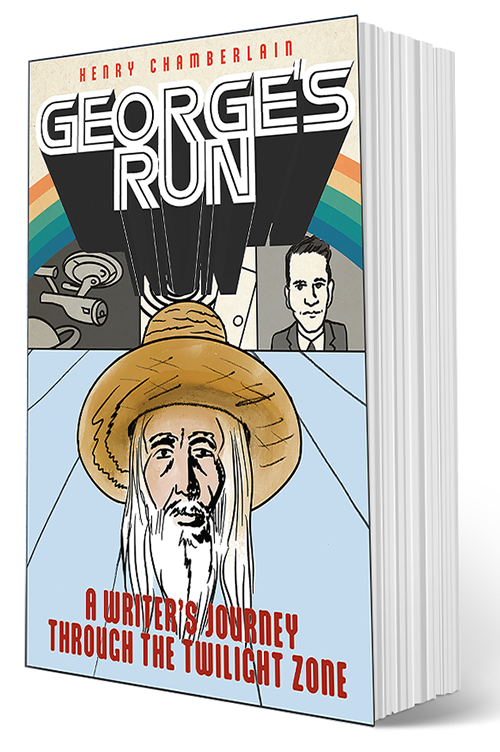
GEORGE’S RUN, a graphic novel review by Paul Buhle

This is the book for any fan of comics, pop culture, and great stories!

George’s Run. by Henry Chamberlain. Rutgers University Press. 2023. 226 pp. $27.95.

Guest review by Paul Buhle

I leapt at the chance to write my foreword, what came to be called “A Historical Portal,” in Henry Chamberlain’s graphic novel, George’s Run. Now, with some time to reflect upon it, deeper and more personal observations come to me.

The Twilight Zone offered me proof positive—to this future editor/publisher of a little magazine dedicated to demonstrating the significance of popular culture—that a generation had been more than enriched by it. George Clayton Johnson, a writer for the show, as well as Star Trek, had a lot of insight to deliver, and Henry Chamberlain was the one to winnow it out and to illustrate it.

Astute critics of American cinema have often remarked that the Star Wars series of blockbuster movies, beginning in 1977, marked the return of films but also chunks of television shifting from serious social themes of the later 1950s to later 1970s, back to the Outer Space version of cowboys-and-Indians, with the “Indians” now aliens, some of them friendly (aka “on our side”) and others dangerously hostile. Many critics observed, after the 1999 Star Wars feature, The Phantom Menace, that “African Americanism,” aka Minstrelsy, had been transformed into amusing-looking aliens with humorous talk or behavior. The source of this gloomy transformation might be attributed to the world cinema market for action films or some other external cause, but it is hard to avoid the consequences for Hollywood-produced films as art or cultural/political statements. The social movements of the 1960s shook up Hollywood and created a socially critical audience whose favorite films came and went, in the following decade or so. M*A*S*H, their TV equivalent, was by the end of the century the most “re-run” of all shows and also held the most “peacenik” sentiments. It counted.

In this light, The Twilight Zone looms as a late, major statement of a different era. Rod Serling was a serious and important figure in US culture, a critic and artist who after trying various professions and skills, radio broadcaster to television writer, created the most important television drama in the era when television had a monopoly on media attention.

It was a moment when live television drama, vibrant and often socially critical despite the Blacklist and cultural cold war,  hard shortly before reached its peak with a half-dozen theatrical-style shows, just as it poised to rushed production from New York to Hollywood. The Twilight Zone could not have worked as live drama, but it had the dramatic quality of what had gone before. Even in melodrama and seemingly far-fetched plots, the acting was serious. The show was showing something and saying something, working urgently to open up minds. At the right place and time, George Clayton Johnson found himself and helped make television and pop culture history.

George’s collaboration with Rod Serling occupies a central place in George’s Run. But the meeting of George Clayton Johnson with Ray Bradbury offers us something from the comic that retains all its meaning, six decades later.  Bradbury (a museum bearing his name and artifacts, in my wife’s hometown of blue collar Waukegan, Illinois, opened last year) stands for a starkly different view of science fiction and its role in opening minds. His stories, adapted to EC Comics shortly before the massive wave of repression, offered readers a glimpse of the horrors ahead if the atomic/nuclear arms race were not halted but also a glimpse of aliens and civilizations that had something to teach the self-proud human race. Farenheit 451 along with a large handful of short stories  best realized the social criticism made by a raft of science fiction writers, including some others who knew George well.

Onward and upward.

That George went onto Star Trek is logical, as part of the trajectory of a fantasy writer’s life. But there is much more. The world of fan publications and fan events can be traced back to networks of amateur (unpaid, mostly unpublished) writers who traded their own mimeographed newsletters as early as the 1920s. Sci-Fi fans gathered here, virtually, and then in person by the  middle 1960s, trading publications directly, meeting and partying with authors as well as each other. “Trekkies,” a much-discussed phenomenon, led in time to comics events, later to Comic-Cons and all the regional events of today, sometimes grand but most often with self-publishers in the booths, chatting and selling copies to whoever the passers-by they could convince.

The subject of Star Trek itself remains, for many fans and scholars, important and bears symptoms of the richer mix of American popular culture emerging at the moment of its production. This brings us to the topic of the Other, a theme that endlessly drives discussion. Yes, Leonard Nimoy started in Yiddish theater; Spock is culturally Jewish without a doubt. And Uhuru is a staggeringly beautiful African American woman with all the sexualized implications, even if hardly acted out. And so on. But these, considered seriously, are minor notes. George Clayton Johnson’s scripts quietly urged viewers to ponder the fate of humanity within the cosmos, to get off the pedestal of human-centeredness and come to grips with terrestrial reality.

George’s Run bears all this meaning and so much more.  But there is one more, albeit indirect, connection too delicious for me to leave out. Rod Serling called upon the blacklisted screenwriter Michael Wilson—before being purged from Hollywood, he had scripted the 1951 Oscar-winning A Place in the Sun—to help develop a crucial subplot that most viewers have taken in subconsciously.  The humans are now allowed to speak. But when the human played by Rod Taylor asks to speak, the Chairman of the Tribunal interjects, “the exhibit is indeed a man, therefore it has no rights under ape law.” Those outside the definition of having the right to speak, cannot be allowed to speak, for fear that they will bring down the system.  It was a plot that could easily have been taken out of Berthold Brecht’s Life of Gallileo, including the responsibility of the scientist to speak up against the threats facing society.

Such weighty considerations would have been thought, only a few decades ago, as being properly far beyond the scope of anything resembling comic art. Now, at last, we know better. Henry Chamberlain has given us a gift in George’s Run. Let us use it well.

Paul Buhle

Leave a comment

Filed under Comics, George Clayton Johnson, Henry Chamberlain, Paul Buhle, The Twilight Zone