Tag Archives: Publishing

Fantagraphics and the History of Comic Art (Part Two)

Love and Rockets propelled both the creators, Los Bros Hernandez, and the publisher, Fantagraphics.

Editor’s Note: This is a two-part look back at 50 years of the comics publisher, Fantagraphics. Part Two is by Henry Chamberlain.

Essay by Henry Chamberlain

No one cartoonist can fully represent the phenomenon that is the comics publisher Fantagraphics but each can speak to distinguishing traits, especially by drawing their own comics tribute or appearing on a panel at a comics convention. Even writers (myself included) for the comics publisher’s own separate magazine of comics criticism, The Comics Journal, will need to exercise special care in how they depict their boss. However, in the case of this publisher, being outspoken is part of the brand so there’s considerable leeway. Anyone at all familiar with this niche publisher will have their own ideas too. At the end of the day, there is much to be thankful and be grateful for regarding Fantagraphics as it marks its 50th anniversay. Huge inroads have been made in a greater appreciation of the comics medium and Fantagraphics remains a significant part of that process in the titles it publishes and in its own dissection and analysis of the art form.

16-year-old Gary Groth, circa 1970. Already contemplating a comics empire.

The story of the house that Gary Groth built is the stuff of legend. As a teenager, Groth was already leading the way at putting together comics conventions with the same zest and gusto as fellow kid entrepreneur Richard Alf on his path to leading the way to creating Comic-Con in San Diego. Gary Groth could have continued on a similar path but he was always more interested in publishing. Now, before we dig deeper, I must say that what Fantagraphics has gone on to accomplish, and continues to do so, is both breathtaking and staggering. It wasn’t just a one-off dumb luck success of snagging a comics talent at the right time. It was one success after another, year after year, bringing to the world precisely what Fantagraphics boasts as its tagline: “publisher of the world’s greatest cartoonists.”

I lived a great part of my life in Seattle, the headquarters for Fantagraphics, and I still live there in spirit. Anyway, I got to see firsthand what it was like for local cartoonists living in such close proximity to a legendary powerhouse in the world of independent comics publishing. I suppose that experience is what drives this essay. I think the feeling among cartoonists always runs the gamut from being some vague goal to get to network within the publisher inner circles to all-out battle plans to claw one’s way in and get work published. At Bumbershoot, for instance, the annual music (and arts) festival held at Seattle Center, cartoonists usually have more than one way to be part of some event that might allow them to draw attention to themselves and their work. Maybe, if they’re lucky, they will at least draw attention to themselves for some fleeting moments, such as dancing on stage as part of some comedy skit. So, that kind of nervous energy is always brewing somewhere in the background, at all sorts of events in Seattle throughout the year, including Short Run, an annual comics festival with related activities.

And the beat goes on with HATE by Peter Bagge.

Who might be fortunate enough to be chosen to join the ranks of the greatest cartoonists in the world? Well, the answer is complicated and no one can be sure how things will pan out, including Gary Groth. But, allowing for the process to work itself out, the right cartoonist at the right time may emerge. Dash Shaw walked right up to Gary Groth at a comics convention with a work-in-progress, Bottomless Belly Button. It worked for him. But it might not for you.

What has been impressed upon me over and over again is that sometimes a cartoonist may seem to be the last person you’d want to explain what comics are all about. Just like anyone else, they can overthink it and not even be sure how to be describe what a graphic novel is supposed to be. They’ll even think they haven’t read enough comics. But, once I’ve engaged with someone in an interview I’m hosting and we’ve managed to get past any misgivings, the guest does just fine. I’ve interviewed countless comic talent and that’s what I’ve discovered: some cartoonists are born conversationalists; while others prefer to let their comics speak for themselves. Is it any wonder then that when Fantagraphics set out to create a book to honor its 40th Anniversary, We Told You So: Comics As Art, it not only sought out comments from its roster of cartoonists but it also sought out comics from them. There was no need for cartoonists to worry if they’d read enough comics. They could just let their comics do a lot of the talking for them. Believe me, if you’ve ever created comics, which I have and still do, more than half the battle is won. Yes, you can consider yourself something of an expert on comics!

Noah Van Sciver pays tribute to Fantagraphics.

In fact, any comics reviewer who has never created comics will always be at a disadvantage. They will always come at the work as a consumer, not a participant. It makes it doubly hard to appreciate certain things, everything from why a comics creator might struggle with how to depict a scene to the motivations that compel the cartoonist to persevere. Not really knowing what it’s like to be a cartoonist does make one thing a lot easier: to dish out an over-the-top harsh review. It’s the ye ole savage critic school of comics criticism and that kind of criticism has been a hallmark at The Comics Journal. I think it’s great that we can all give ourselves some distance from that particular style of writing. I think the usual review from the new crop of writers at The Comics Journal is invested more in insight than controversy only for the sake of controversy. That’s not to say a reviewer needs to hold back but there’s something to be said for retracting one’s claws. All that said, if you’re writing about comics, you’re ahead of the game of those who only talk about comics. We’ve reached a glut in comics talking heads now that everyone has a podcast. Some are better than others, and the vast majority fade away. As for thinking and writing about comics, if you wisely use your skills, favor language and logic, anything is possible.

One thing you need to keep in mind is that there’s always been something gritty about Fantagraphics–or, more to the point, something grunge. We’re talking about Seattle, after all. When you get right down to it, the energy emitting from Fantagraphics was as much tied to the insanity that was grunge as anything else. Back in the early ’90s, it was a perfect storm of disaffected youth on a steady migration to the promised hipster land of Seattle. Some had a plan (musicians, writers, painters and cartoonists) and others did not, being young was enough. All the creative people were interested in finding their tribe. It was at this critical time that The Center on Contemporary Art (a rather snobbish group that sometimes hit the mark), in collaboration with Fantagraphics, put on a show, “Misfit Lit,” a look at contemporary comic art (March 15 to May 4, 1991). The poster for the show echoed a self-conscious and overly self-deprecating vibe, a stance that dared the viewer to come closer and attracted more people than repelled. Not a perfect campaign to engage the general public but it got some notice. The rather staid Seattle Post-Intelligencer, in a Sunday supplement (June 1, 1992), summed up the mood with the headline: “In your face, Seattle; you’re becoming a capital of alternative comics.” And, even more than comics, it was the zeitgeist that supercharged everything.

Dan Clowes leading that pop culture wave.

When Geffen released Nirvana’s album Nevermind on September 24, 1991, it was a game changer. It would be on heavy rotation on the radio, in homes, cars, and Walkmans for months, even years, on KNDD, 107.7 FM, “The End.” On another musical note: The romantic comedy film Singles, featuring young people in love in Seattle, came out in theaters on September 18, 1992. The youthquake was happening in Seattle and everyone who loved Nirvana, and music from Sub Pop (which featured Dan Clowes art on album covers and in its ads), was into the new cool and edgy comics coming out of Fantagraphics (Hate, Eightball, Love and Rockets, Acme Novelty Library, Naughty Bits, Palestine, The Biological Show). Many people have fond memories of buying their music and comics from Tower Records in Seattle.

When it doubt, just return to what matters. For Fantagraphics, it’s been this stubborn persistence of vision. They simply did not want to succumb to the harsh realities that have wiped out other publishers in similar circumstances. These days are far more solid. Fantagraphics has fended off the threat of bankruptcy many times. And when its own distributor went belly up, they found a much better arrangement.

Cartoon in The Stranger on Fantagraphics financial woes, 2003, by Pat Moriarity.

Fantagraphics is now distributed to the book trade by W.W. Norton and to comics retailers by Lunar. It has been a uphill battle but the dark times have ushered in exciting new phases like the pioneering deluxe archival editions of George Herriman’s Krazy Kat, E.C. Segar’s Popeye, Charles Schulz’s Peanuts, and neglected classics from the Marvel Comics archives.  Fantagraphics is running more smoothly than ever and, with any luck, will be ready for the next challenge when it inevitably comes.

Part of the new wave of Fantagraphics titles: Cutting Season by Bhanu Pratap.

The biggest contribution that Fantagraphics has made, and continues to make, is leading the way in the distinction between mainstream superhero comics publishers and those publishers, creators and fans who prefer “alternative comics.” This is a term that I always stand by. I recall one academically-inclined friend not sure if the term had any gas in the tank. This was many years ago and I assured him it was the proper term and it was here to stay–and so it has. Some folks, looking here again at our more academically-inclined types, proclaim that comics are comics and that’s that. I don’t know what the motivation is in saying that unless one feels a great need not to offend this or that big publisher. But this is well beyond that. Alt-comics means something, if nothing more than an alternative to the Big Two superhero publishing empires we’ve all grown up with, Marvel and D.C. Comics. The superhero model is branded early on with some fans becoming instantly enthralled. The idea of having an alternative is more in step with seeing comics as an art form. Of course, anything is possible and the Big Two, from time to time, create masterful work that rises to the level of art. Overall, the superhero model is what it is, mostly a genre, which you can make of what you will. Alt-comics, as a rule, are striving to be offbeat, unconventional, experimental and appealing to more discerning adults. Fantagraphics has set out to publish the best alt-comics, year after year. For it to maintain that sense of purpose is its greatest accomplishment.

Eightball #23: The Death Ray by Daniel Clowes

So, I keep thinking about those aspiring cartoonists dancing on a stage hoping to get noticed and yet unclear as to what purpose. Well, to each and every one of these dreamers, I say enjoy the comics art form and let Fantagraphics lead the way. It is Fantagraphics that introduced Los Bro Hernandez to a wider audience. Along with so many other amazing talents like Dan Clowes, Chris Ware and Charles Burns. It is Fantagraphics that has set loose upon a reading public all manner of comics mayhem and majesty. It is all rooted in a genuine love for the comics medium. While it may seem to some readers that comics has had a rough time of it in gaining any sort of  legitimacy, I think it comes down to individual points of view.

Jim Woodring, one of the greatest cartoonists in world, demonstrates his giant pen.

For those in the know, the comics medium continues to evolve and prove itself time and time again, even if most people do not take great notice. The vast majority of readers are not going to appreciate comics in the same way as someone who regularly reads comics, let alone anyone who actually studies comics. And that brings us back to what is so special and remarkable about an independent publisher of the statue of Fantagraphics. Gary Groth and Michael Carton, a couple of comics experts to be sure, founded Fantagraphics in 1976. At that point, the term “graphic novel” did not even exist. Other comics connoisseurs would soon join the team: Eric Reynolds and Kim Thompson. And it was this expertise that would guide this upstart endeavor of a publishing house focused on comics with an independent voice. It was fine to review and comment about mainstream superhero comics but to go toe to toe with the Big Two comics giants by creating its own similar superheroes was never part of the vision. The vision was a work-in-progress and it had everything to do, and still does, with comics that are more offbeat, experimental and artful. So keep dancing, my wonderful dreamers, as there is plenty to dance about!

Henry Chamberlain

Leave a comment

Filed under Comics, Essays, Henry Chamberlain

Fantagraphics and the History of Comic Art (Part One)

An early sign of the future: Gary Groth’s Fantastic Adzine, 1971.

Editor’s Note: This is a two-part look back at 50 years of the comics publisher, Fantagraphics. Part One is by Paul Buhle. Next week, we’ll have Part Two by Henry Chamberlain.

Essay by Paul Buhle

2026 marks the fiftieth anniversary of the comics publisher, Fantagraphics, and that deserves more public attention, within the comics world and beyond. I would argue a larger point: when it comes to the scholarship of art, from art history to contemporary criticism, comics remain both recent and suspect.

The history of comics is, of course, full of interesting and sometimes depressing contradictions. Newspaper pages aside (not a topic here), comics as in comic books always seemed very much part of the larger pulp magazine world, at the low end where publications actually bought by kids would be found.  As such, they were suspect from almost the first moment of publication, during the later 1930s. Trouble was always on the way, and dire warnings began to emerge in popular magazines already in the early 1940s, warning against the corruption of young minds.

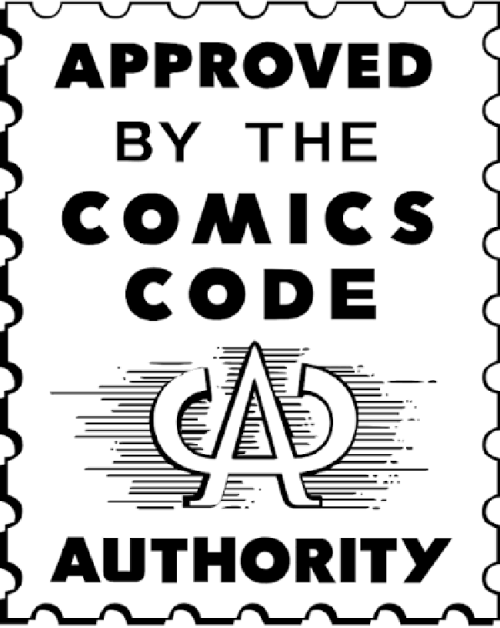
The Comics Code (1954-2011)

The anti-comics crusade, or rather anti-comic book crusade of the early 1950s surely did not rise to the level of Hitler’s burning of modern art in 1930s Germany.  For that matter, the spread of television broadcasting across the country by the middle 1950s would have marked the eclipse of comics’ Golden Age in sales and volume, in any event. That said,  the enactment and industry-wide acceptance of the Comics Code brought the end of the most creative and artistic comic projects. Soon enough, the attacks on  comics’ purported threats to culture and the young mind in particular would pass on to television (“chewing gum for the mind”) as a danger.

We can now look back on all this from some distance, and look back with scholarship on hand. Never considered an art, perhaps even by editors and artists themselves—even screenwriting was seen by the writers as a craft—it would not be treated as such almost until the close of the twentieth century and a bit beyond. We seem to be a lot further now, or are we?

The subsequent development of comic art has inspired a new and sometimes impressive scholarship. Two recent issues of scholarly journals, The American Book Review (Winter 2025, #46:4) and the Radical History Review (May, 2026, #155 ) offer serious, ongoing studies, mirroring the spread of scholarly efforts in several specialty journals in the US and abroad. Graduate students in a handful of fields, mainly English and Communications (under a variety of names like “Media and Communication”) work on college degrees, even advanced degrees, some doubtless hoping for jobs, teaching the subject.

Let us leave aside the glum prospect that the jobs may not ever come into existence in any real numbers. Undergraduates by the thousands nevertheless continue to take comics-study courses even as the liberal arts suffer assaults from within the academy and outside. Do conservative Christian academies teach conservative Christian comics? We do not know.

Comics history viewed clearly, a groundwork set for understanding what it means, might well start with Fantagraphics and its anniversary.

EC Fan-Addict Club

When I interviewed Harvey Kurtzman for the Oral History of the American Left archive (at New York University) in 1981, he kidded me about the use of the word “fan.” The word could only, he insisted, be a contraction of “fanatic.” True baseball fans, the category that I knew best and shared most in childhood, were clearly fanatics. And when EC comics launched its “Fan-Addict Club” in 1950, it pinpointed the most fanatical section of comics readers anywhere. Perhaps because Mad artists and editors met in person with fans, mostly in Greater New York, it was also a Jewish, cerebral thing, no matter how many members were geographically distant. The Letters Page in EC comics seemed to feature devotees from afar, including soldiers and sailors stationed anywhere in the Cold War world, doubtless probably seeking fellowship with fellow fanatics.

The Comics Journal, #58, 1980.

Here, then, we can jump ahead to the far-sighted founding of Fantagraphics in 1976. It could be seen as the successor to the  EC Fan-Addict Club, for the good reason that the founders greatly admired a handful of the artists of the old EC days. But it was, in this light, also a successor of a different kind. It would itself publish comics. And it would encourage the study of comic art through the pages of The Comics Journal (TCJ), launched the same year.

The Nostalgia Journal, Number 22, 1974.

Founded by Gary Groth and Michael Catron in College Park, MD,  TCJ moved several times before settling in Seattle in 1989. Groth himself had been a publisher, beginning as a teenager with a superhero fan magazine. There may be a deeply curious significance to the  actual launching of The Comics Journal by way of taking over an “adzine,” The Nostalgia Journal. But Groth had already been organizing comics festivals in the early 1970s.

The Comics Journal, Number 35, 1977.

There, in the festivals, is surely the hidden source of much else. We might trace the festival mode to the amateur writers (including sci-fi writers) creating and sending out their own fanzines—not yet called that—as far back as the 1920s. Were they lonely adolescent boys or older insular types nervous with people close up and eager to befriend at a safe distance? At any rate, fandom received a huge boost during the 1960s with new, mostly xeroxed sci-fi zines—replacing used Gestettners and ink— and, above all, fan gatherings.

The presence of fan sci-fi events in areas small or larger, in big cities or smallish towns, setting up their tables (and paying some fee to the venue) for other fan-publishers and just plain fans to look at, flip through, perhaps purchase or exchange for their own creations established a pattern. And the value of celebrity, alongside costumes among other curious behavior.

Groth was building upon this past, applied from sci-fi to comics, the two genres that shared a pulpy reputation with some “big names” that ordinary Americans would not likely recognize. The two genres also shared an avant-garde element previously unknown or at least little understood. Underground comix and their anti-establishment or avant-garde qualities could be viewed as counterparts to daring or rakish sci-fi novelists, Philip K. Dick and Ursula LeGuin among others. The 1960s, the popular anti-Establishment sentiment and the apparent collapse of censorship had opened the doors and young people in particular were eager to rush in, find new friends (or lovers) and dig into a kind of cultural examination.

Cultural Correspondence, Number 5, 1978.

My own small magazine, Cultural Correspondence (“the first cultural publication whose readers watched television without guilt”), 1975-82, largely the work of a group of history graduate students, set out the proposition that popular culture contained the possibilities of liberation, if we looked closely enough. To be theoretical: we were seeking to turn upside down Theodore Adorno’s insistence on the corrupting nature of popular culture, and if anyone remembered, Irving Howe’s curse at comics (in a 1949 issue of Politics magazine) as inherently degraded and degrading. It was a natural thing to interview Crumb, Bill Griiffith, Justin Green and assorted others, including women artists, of the underground.

We scholarly-minded comics devotees at large were all, in a way, following film studies’ rise during the 1950s-70s, from the mostly campus Film Clubs to scholarly endeavors. But with some of the same limitations: those who wanted to study the work and its creators constituted only a small portion of those who enjoyed films and comics.  And also: film studies had rapidly developed a down side of aestheticism, scholars who competed with each other and argued about details but especially pointed the finger at fan-amateurs. What else would university-level specializations mean?

Fantagraphics, for its part, managed somehow to avoid the obstacles and unleash the popular imagination about comics. The Hernandez Brothers, Daniel Clowes, Chris Ware and Charles Burns would pretty soon reach best-seller status, along with reprints from Peanuts, Donald Duck and many others.

Meanwhile, in the pages TCJ, later to be called, grandiosely, the “New York Times/Wall Street Journal of comics”— as a measure of value and sales—Harvey Pekar still had the space to curse Art Spiegelman and Maus. Even if any reader knew that Harvey, still making a living by working at the VA in Cleveland, was actually envious of Spiegelman’s critical and financial success. Even getting on Letterman repeatedly did not make Harvey any happier: he still had a 9 to 5 job and a mortgage.

By the mid-1980s, Fantagraphics had already launched the Jack Kirby Award for artistic achievement,  a crucial step toward the award system and the giant Comic-Cons of later decades. The role of fairly early staffer Eric Reynolds became notable, first as news editor for TCJ and then as the small and financially uncertain company’s needed marketing expert. Reynolds helped the company past the cyclical downturn of comics (among others, Denis Kitchen’s firm did not survive) with a brighter future in promise.

The Comics Journal, #177, 1995.

The distribution deal with WW Norton in 2001 fairly reflected the rise of “comic art” prompted, arguably, by Maus, a global market hit, and by Raw Magazine, an aesthetic bombshell. Comics had come of age, and global comic art took off spectacularly as well, even more on the web than the printed page.

Not to make too much of a name, the “Graphic Novel” had been born. Marjane Sartrapi, among those who did not enjoy this term, considered it to be an attempt to win the respect of the gentility in every sense, by promoting comics as “novels.” A fair charge. Seen more narrowly, the “GN” soon came to function as the coffee table book of the new century, or at least a large handful of the more vaunted comics did.

Some of those active in comics with serious artistic and/or educational aims would say that after comics became the Next New Thing (the business section of the New York Times eager to report on adapted comics superheroes hitting big numbers in Hollywood), the interest in comics faded somewhat. The intermittent interest nevertheless has seem to have remained, up to the present day, in the Obituaries. That is,  for fallen heroes and heroines of the field. Feature obits have always been a serious matter for the Times, artists as well as film-makers, advertising executives and scientists.

Today, over at Fantagraphics, Donald Duck’s further family adventures coexist with lesbian adventurers of another dimension or another century. More non-sequential comic art books seem to be emerging, further advancing the idea that comics and art, or for that matter comics and contemporary social drama (Joe Sacco’s real life depictions of troubled and doomed populations), have won a lasting place. Congratulations, Fantagraphics.

Paul Buhle is an American historian, who is (retired) Senior Lecturer at Brown University, author or editor of 35 volumes, including histories of radicalism in the United States and the Caribbean, studies of popular culture, and a series of nonfiction comic art volumes. He is the authorized biographer of C. L. R. James.

Leave a comment

Filed under Comics, Essays

Like Swimmers by Dash Shaw graphic novel review

Like Swimmers. Dash Shaw. New York Review Comics. 2026. 120pp. $32.95.

Dash Shaw is creating his best work. His latest has him, once again, playing with mystery, in storytelling and in the comics medium itself. It begins with that first page with an exchange between two characters. For the first bit of dialogue, Shaw adds one of his distinctive footnotes just below the speech balloon. It’s an unconventional yet natural fit. The two characters are in awkward poses: so close to each other that the reader can only see one eye from a frontal view and one eye from a profile view. So close and yet so distant.

Dash Shaw’s people are exceptionally unexceptional, just average folks, the perfect foils for any worthwhile quirky, weird, noir comic. And that is exactly what this is. Shaw has created his own subgenre of subdued characters at odds with everything, including themselves. The icing on the cake this time around is that the whole thing is set during Covid. Back in 2020, I was in Seattle, one of the epicenters for highly dysfunctional behavior towards the pandemic. It wasn’t enough to wear a mask, maintain six feet away distance and get vaccinated. A lot of people really took on their roles as guardians of the galaxy to the limit. All you could do was accept it: the severely strained staring back, cloaked under a mask, the incredible added tension waiting in lines. Well, that was the case in so many places–and it remains so at various venues that perpetuate mask wearing as a performative act. For this story, the locale is Richmond, Virginia, a ground zero of its own with heightened levels of rage. If Orson Welles were still around, he would most definitely cook up a film set during Covid. For comics, Dash Shaw is our Orson Welles.

Does Shaw weigh in on the more zany aspects of the Covid era? Yes. Well, there’s so many to choose from and Shaw does a great job of gingerly picking and choosing his way through. Just admitting to the fact that Richmond is not a safe place to live, is haunted in more ways than one and has its share of more sketchy areas seems brave to address. Shaw points out that on any random night in Richmond, you could have a couch set on fire. It’s a matter-of-fact observation which is remarkable given how matter-of-fact observations are not in vogue. We like to think that our everyday lives were at a brink during Covid, upturned in such an unprecedented way, but we’re just living another version of its disruption today. Well, this is a Covid story but it doesn’t feel dated at all. We’re all still processing Covid. And, in its own way, this book helps.

Whatever troubled times we live in, a good mystery can help as we sort out things going on in our own lives. And we have a dandy of a mystery here. Mackenzie is a young woman who works from home as a web designer. Her little brother, Howie, lives with her and is drifting through life as a delivery person. He rides his bike. He makes deliveries. Then one day he meets Isa, an older married woman of means who is decidedly out of his league. Ultimately, Howie and Isa have an affair. Mackenzie is none too impressed nor pleased with this. Finally, almost a foreseen conclusion, Howie is found dead in his bedroom, apparently murdered but the police call it a suicide. And it is at this point that our story really kicks off.

For the love of Howie.

Another essential trait of a Dash Shaw comic is how every character matters, no matter what station in life. Howie, who plays a significant role in the plot is all but a minor player on the stage of life. He is the result of countless decisions that he made, and other factors, that leave him on the margins. And yet, like all of us, he matters to someone. He drives his sister, Mackenzie, into a tailspin as she embarks on a mission to solve the mystery of his death. As far as she was concerned, Howie was a simpleton but she dearly loves him.

Once Mackenzie takes it upon herself to do some detective work, she discovers that Howie was likely a little more complex than she imagined. Howie, deliciously naive and yet an enigma, the sort of character after Agatha Christie’s heart. Mackenzie digs deeper and, well, things get deeper. Shaw has a great time with giving Howie his due. This is a far stranger case than anyone suspected. After all, Howie was killed by a silver bullet. Howie is an absurd and tragic figure with a touch of the whimsical, a classic Shaw character if ever there was one.

For fans of Dash Shaw, this new book, so soon after the success of Blurry, is a great treat not to be missed.

3 Comments

Filed under Comics, Graphic Novel Reviews

The Nightingales by Emil Wilson graphic novel review

The Nightingales. Emil Wilson. Simon & Schuster. 2026. 416pp. $38.

Review by Henry Chamberlain

Emil Wilson has a very compelling story to tell and he dives deep into his storytelling skills to tell it. I can honestly say this is the most original work in comics that I’ve read this year. For those aspiring cartoonists out there who desire to create a spark with their work, here is a prime example. Tell a story from the heart. Wilson’s story takes the reader back to 1985, an era of great shifts, forward and backward, fraught with turmoil. Into a modest little town in Oregon, a sign of the times arrives and makes himself at home. This is Jim, who has taken ill and, with no family or friends to speak of, has been invited into the home of Donald, his co-worker at the local courthouse. Donald has his own family and issues to focus on but he decides to take in a stranger. Donald withholds from his wife, Annemarie, and his daughter, Lou, that Jim has AIDS.

This is a story that we see from various viewpoints, none the least of which is Lou, who is completing her senior year in high school and virtually only a few steps out the door into a life of her own. At this pivotal time in her life, Lou’s father decides, out of the blue, to bring home a stranger who is dying from AIDS. How does this factor into her own life? Lou is hesitant to the idea at first but steadily warms up to Jim, who is a deep well of insight and genuine goodwill. For such an unfolding narrative, Emil Wilson delivers a groundbreaking comics path. That sort of thing doesn’t happen all that often and, when it does, it needs to be honored. Wilson has added a new wrinkle into the mix, truly making the pages come to life. His framework is a sketchbook, filled page after page with various drawings, markings, notes and ephemera. Some of the dialogue is kept within traditional word balloons and a good bit of it is kept within the bounds of script notes, on Post-Its, like a play or screenplay. And it is all held together by a steady and flowing narrative. At no time did I feel like I was taken out of the story.

As a comic artist myself, I can tell you that it is always an interesting crossroads to take when you’re looking over a series of sketches that may or may not make their way into the finished work. Sometimes, you just want to take this or that sketch, lift it out and pin it down into the final work, because it’s so loose and powerful just as it is. That sort of vibe is at play in this book. I’m sure that Wilson had a wonderful, and challenging time, working his way through all the artwork that was generated during the making of this story. For him to, in essence, find a third way with his work is remarkable. Of course, we can thank Emil Ferris for clearing the way with her own monumental work, My Favorite Thing Is Monsters, often evoking art and notes from a sketchbook. That said, Wilson brings home something different and new he can call his own. You can’t rush these kind of developments and it is clear to me that Wilson took his time and thoughtfully crafted this book with integrity.

I encourage you to seek out this heart-felt coming-of-age graphic novel that is going to stay with me for a very long time. Emil Wilson makes it look easy but there’s really nothing easy about making comics, at least not genuinely worthwhile comics that will stand the test of time. And, if you happen to be in the area, by all means, meet Emil Wilson at one of these upcoming book events:

Book Passage (Ferry Building) – August 4 at 5:30 pm

1 Ferry Building Plaza, San Francisco

Powell’s Books – August 5 at 7:00 pm

1005 W Burnside Street, Portland, OR

Elliott Bay Book Company – August 6 at 7:00 pm

1521 10th Ave, Seattle

1 Comment

Filed under Comics, Graphic Novel Reviews

Dynamite Diva Comics by Jasper Jubenvill comics review

Horrific Romance Comics. Jasper Jubenvill. Self-published. 2025. 28pp. $8.

Review by Henry Chamberlain

Filled with provocative imagery, loaded with symbolism, eroticism, and angst, this is a comic book (part of a bigger body of work) that your mother might have warned you about–or supported, if you were raised in a more artistic/bohemian household like our comics creator here, Jasper Jubenvill. As with everything in life, your mileage will vary. Our first panel has our femme fatale, Dynamite Diva, clad in leather with a green trim, raising up her bare foot for all to see. She declares: “Little Piggies were roastin’ in those leather boots!” And, sure enough, those lil’ piggies must be set free. What’s intriguing is the jump cut this comic makes to the very next panel, pivoting away to a real pig. This is Diva’s lil’ piggy pet, Russel, who loves beef jerky. Then we cut to an old church in the desert. Finally, the nuns beckon Diva to join them in a game of Kick the Can. Of course, they would. All this on the first page!

If you’re looking for a work of comics with a more artful cosmopolitan sophistication, then Jasper Jubenvill’s Dynamite Diva comics is it. There’s plenty more to say so let’s keep going. This comic is a mash-up of various comics and genres, a cornucopia of pop culture. Not only does the Diva universe have a vintage setting, circa the 1970s, it channels all sorts of comics going back to the ’30s and ’40s (Milton Caniff’s Terry and the Pirates, Chester Gould’s Dick Tracy). You could say it’s a bit of a Frankenstein monster, just like our heroine, Diva, and a few other characters we’ll get to in a moment.

Jasper Jubenvill has his pulse on something wonderfully creepy, fun and unsettling. It’s Underground Comix with a heaping dose of added self-awareness. God only knows the great lords of comix of yesteryear unloaded a ton of over-the-top and outright wrong gunk, rightfully called out for its inherent racism, misogyny, etc. You know it when you see it. Anyway. Quite a lot to unpack there beyond the scope of just this one review. Needless to say, there’s so much to pick and choose and recontextualize. Jubenvill has a steady hand with all this and so the reader can appreciate his take on sex, violence, body horror and the like now, well into a new century. Jubenvill is picking apart this facial expression, this gesture, this setting and repurposing it all as you would a customized hot rod. Jubenvill is internalizing various processes and making them his own.

You can say that the sex and violence in a Jasper Jubenvill comic is deliberate and well-paced, thoughtful and impactful. There’s a lot coming at the reader, like a runaway locomotive but, unlike a lesser comic, it never feels empty. When Diva finally gets to grasp her lover’s manhood, it is perfectly timed, culminating in a series of repercussions, and consequential panels.

The conceit here is that an understanding has been established between the comics creator and the reader that this is all highly conceptualized artifice. It is then up to the creator to deliver on this ambitious goal. Jubenvill delivers. His Diva is quite a strange creature herself, giving off a Bride of Frankenstein vibe right from the moment she exposes her piggies. The rest of the narrative to this comic will have Diva confronting her brothers from another mother. Plenty of Frankenstein subtext to go around. The art and color choices, the whole darn thing screams out strange, weird and wonderful.

Jasper Jubenvill has set himself on a delightful path with his lovely Diva creature leading the way. Diva is undoubtedly a force of nature, and a product of unnatural forces. She has a mind and body of her own, made up of a compilation of parts. She is both a grotesque creature and a soul searching for meaning. She is not without her charms and yet someone to avoid.

Jubenvill has tapped into something vital: our collective need to be scared, grossed out and given a good cathartic kick in the pants. There’s not one false note in this carefully crafted comic. Let it work its magic on you. We are living in extremely whacked out times. We need more of these kind of comics.

Henry Chamberlain


Leave a comment

Filed under Comics, Comics Reviews

Jacques Tardi, the Extraordinary Adventures of Adèle Blanc-Sec, Volume 1 book review

The Extraordinary Adventures of Adèle Blanc-Sec, Volume 1. Jacques Tardi. Cynthia Rose (introduction). Seattle: Fantagraphics. 2026. 199pp. $29.99.

Review by Paul Buhle

It would be difficult to grasp the full influence of the artist who goes under the cognomen of his last name, thus “Tardi,” within France and beyond. Not because he lacks readers world-wide or influence on graphic novels at large. Rather, his work embraces French society and culture of two centuries’ running, providing a cultural view as penetrating as Walter Benjamin’s famed but uncompleted work on the Arcades.

Viewing Tardi’s work from outside of France and French culture, we wonder if we can possibly grasp his impact on the national scene. And then again, he will not let himself be confined: given every imaginable comics award, including several Eisners, he actually turned down the (French) Legion of Honor, insisting he would not be “held hostage” by nationality.

His realism, delivered in highly personal tones—above all the stories of his father and grandfather amidst the grimness of two world wars, in five volumes—has proven itself both gritty and funny, with brilliant art and a driving narrative. This, I think, must be his most identifiable style. Possibly, it is merely the artist’s style that the socialist critic likes best.

Tardi first successfully reached a genuine mass audience in a very different form and space. He began in the pulps. The periodicals that published him back in the 1970s could be called French comic books or even “Underground Comix,” if that term were sweeping enough. An obsessive teenage reader of comics and of fiction, he came up with a way of entering on his own terms.

Born in 1946, Tardi was thirty when Adèle Blanc-Sec (her last name happens to be the term for a dry French wine, i.e., lacking sugar) first appeared.  As Cynthia Rose suggests in the introduction, the periodicals of the day brought the new kind of comic—more realistically sexualized and more directly political than the underground comix of the US—into the center of young people’s culture. Definitely influenced by American Underground Comix, the French counterpart took on new life just as the US version faded. Adèle first appeared in a daily paper, in black and white, then color on Sundays, with a distinctive green dress set off from her red hair. So, too, her era, the real subject of the strip.

Adèle, the forerunner to cool women characters in comics.

There had always been both housemaid types and “sex bombs” in French comics, without much in between. Adèle has a mind and character entirely of her own, and accounting for other differences, could have appeared in Ms Magazine (where Wonder Woman took on a new life) or even perhaps the sexist-but-sensational National Lampoon. Not apparently sex-driven at all, she is She independent-minded, sarcastic and contemptuous of male prerogatives.

Adèle, Tardi’s answer to the new woman of Paris.

She lives out her adventures in Paris of the Belle Epoch, the early 20th century.

This Paris has been and remains a source of world wide fascination. In Adèle, Tardi recaptured not only the moment in chronology and place, but Paris as it has been seen in contemporary periodicals and revisited in film. The styles of the time, from architecture to clothes, have repeatedly been interpreted artistically alongside the terrors and anxieties that anticipated the First World War.

Tardi and his female lead eventually hit the mark in one distinctive, presumably unexpected way. The Adventures of Adèle Blanc-Sec reached the French movie screens in 2010, as a stylish adventure that did not take itself too seriously. Heroine-actress Louise Bourgeoin made her name here with audiences that enjoyed the humor of the improbable. Perhaps we could regard it as the successful version of Joseph Losey’s Modesty Blaize, (1966) somewhat of a satire on the first James Bond series.

An earlier step in Tardi’s career had found him in the steam-punk world with strong female characters. Here, in The Adventures, she is an erstwhile popular novelist who takes up the life of an investigative journalist, stumbling into unimagined and indeed incredible adventures. Along the way, she tests the depths of official corruption and incompetence, anticipating the real-life bungling France into the catastrophe of world war.

French critics noted that Tardi hardly misses a note of the Belle Epoque, from clothes to manners.  Indeed, the fantastic stories, with abounding monsters from  Pterodactyls to talking gorillas and walking mummies, seem to have been created to keep the plot moving, as the funny paper artists of yore invented the improbable out of necessity.

“And that is how a cat, a simple passing cat, can alter the story line  of a comic book. Just because we are dealing with a neurotic killer….” (p.182). The artist and his audience are always on the set, the third or fourth screen of post-modern if not post-narrative art that is the modern comic style.

This is not true of all artists, by any means, nor even of Tardi at his more didactic moments. It is difficult but not quite impossible to find the message beneath the style. Cynthia Rose articulates what can only be found between the lines or buried in the characterizations. The wealthy and powerful share with crooked politicians what they deprive the rest of the population from enjoying.

Paris of Belle Epoque, with so much promise in its Modernism—before the catastrophic war punctured the balloon—saw the emergence of electricity all around, apartment building and restaurant city lights to automobile headlights to the glittering Eiffel Tower. Optimists and other wild dreamers imagined that all existence was being modernized in the best and most vivid ways. Not everyone thought so.  Desperate anarchists plotted revenge against the monstrously rich and irresponsible bourgeoisie. In failing, they nevertheless threw a scare and raised hopes that the newest forms of capitalism could not possibly last long.

One more factor weighs upon this review: nearly half of French citizenry continues to read printed comic art in one form or another, making Tardi the rare artist of any kind, but especially the radical comic artist, an extraordinary public figure. Or at least his art. He speaks to them, for them and about them as no other comic artist in the world. At least, that is my view.

Paul Buhle is an American historian, who is (retired) Senior Lecturer at Brown University, author or editor of 35 volumes, including histories of radicalism in the United States and the Caribbean, studies of popular culture, and a series of nonfiction comic art volumes. He is the authorized biographer of C. L. R. James.

1 Comment

Filed under Comics

Daniel McCloskey interview: On Comics and CLOUD TOWN

Friends in Stormy Weather Part 2!

Daniel McCloskey is a happy warrior in comics, making things happen on his terms, for many years. Readers gravitate to the off-the-wall antics his young characters get into, a mix of gritty realism and supernatural mayhem. In a nutshell, the Cloud Town universe revolves around two best friends whose relationship is tested when one of them gains the ability to pilot giant robots defending their town from interdimensional monsters. Who knew? Easy peasy, right? This kind of outrageous and uninhibited storytelling is what keeps winning over new fans to Daniel McCloskey and the Cloud Town universe. And now for the cool part, there’s a new Cloud Town: Friends in Stormy Weather book on its way.

Excerpt from Cloud Town.

In this interview, comics veteran Daniel McCloskey shares his insights on the world of publishing from the vantage point of being part of a big publisher as well as in charge of his own independent work. It’s a balancing act, but it’s also the best of both worlds as it all takes on a life of its own and leads to his work finding readers from a wide array of venues. One thing is for sure, it all adds up to a lot of activity along the whole process, from creating the work to marketing the work. It leads to such a wide and varied readership. As McCloskey points on: “I’ve been told I’m about half indie and about half manga, so it’s hard to pin down my readership.”

Daniel provides a lot of encouragement to everyone who creates work or aspires to do something creative. And, as he emphasizes: don’t get in your way, and don’t get caught up in thinking you need to do everything perfectly! Often, a well-drawn hand is a well-drawn hand and you don’t need to go back and try to keep making it better.

Hop on board the Kickstarter campaign, running through July, to help boost it into the world here. And check out our conversation below at the Comics Grinder YouTube channel. Your views, Likes and Comments are always welcome and really helps keep the lights on:

Friends in Stormy Weather Part 2!

Perfect is the Enemy of the Strange!

Go to the Kickstarter campaign, now thru all of July, right here.

A few words from Daniel McCloskey:

I believe life’s about discovery, and that discoveries are best made by exploring the strange. That’s why in life and comics, I gravitate toward the edges–the edges of my abilities, my understanding, and my imagination. It’s why Kirkus Reviews called my graphic novel, Cloud Town, “weirdly and unexpectedly wonderful,” and Comics Grinder recently called my work, “controlled chaos that wins me over.” If you’re looking for a story that can still surprise you, I’ve been working on one.

1 Comment

Filed under Comics, Interviews

Who Can Deny Trump His Arch? comics by Henry Chamberlain

You don’t want to be the person who denies Trump his Arch, do you?

Oh, hang on there, this is supposed to be the 4th of July, and a rather special edition of it as I’m given to understand.

Or it is just another very sad Trump rally? Oh, right, that’s it, a nightmare.

And so the nightmare rages on.

The firm hired to stage the Great American State Fair is Event Strategies Inc., the same event planning company that managed the January 6, 2021 rally on the Ellipse. The events were funded, in part, through a $68 million federal funding package—much of which is being directed through a nonprofit group called Freedom 250.
Event Strategies Inc. has deep ties to President Trump and is organizing some of the biggest events in Washington this weekend, including the Great American State Fair and the record-breaking fireworks display planned for Saturday. Those events will be funded, in part, by $68 million in taxpayer money.

Leave a comment

Filed under Henry Chamberlain

Joe Sikoryak Interview: On Comics and Star Trek

Joe Sikoryak is a cartoonist who focuses on observational comics. Joe’s debut graphic novel is about the early years of Star Trek fandom, When We Were Trekkies. You can get the collected work here. His recent short-form comics are 3×3: Nine Panels on Life, the Universe and Other Things, The Awful Tooth: A True Tale of Dental Denial, and 1968: A Boy’s Odyssey. Each work, from long-form to short-form, is a work of dedication to detail, created with heart, insight and good humor. In this interview, we cover each of these titles. This is an easygoing look at how one cartoonist gets the job done. And it’s cool that we have these short works to consider too as it’s always nice when a cartoonist can provide such a variety for readers at comics conventions and beyond. You can always find Joe at his website and Bird Cage Bottom Books.

Joe has a wonderful sense of what will work in a comic, always thinking in terms of what will catch the eye, what will entice the reader, imagining any given scene on the stage, screen or comics page. For 3×3, he tackles a variety of subjects in a 9-panel grid format, a whole world per page. It’s a fun exercise in distilling down to the essentials and Joe makes the most of it. You may to find yourself in one of Joe’s recollections, perhaps his melancholic look at a failed relationship or his exuberant look at the joy of cooking.

1968: A Boy’s Odyssey gives the reader a guided tour through a historic year, filled with tragedy and triumph. It is a year that left a great impression on a 10-year-old Joe. Two landmark films came out that year, Planet of the Apes and 2001: A Space Odyssey plus the year ended with the crew of Apollo 8 circling the moon for the first time. Pretty heady stuff!

The Awful Tooth is a gem of a comic, both playful and informative. Heck, it’s actually quite the cautionary tale that will be enjoyed  by all ages.

When We Were Trekkies is Joe’s baby, where a lot of things came together. There’s nothing quite like your own coming-of-age experiences to inspire and guide you through life. Some of these experiences are on such a scale that they are shared by countless other people, even spanning generations, such as the love for icons in pop culture, like Star Trek. Joe Sikoryak took his passion for all things Star Trek and turned it into his first graphic novel. In a series of ten comic book issues, Sikoryak shares what it was like to be part of something bigger than yourself, back in a time when it wasn’t exactly cool to do so, long before cosplay and comics conventions had hit the mainstream.

In Sikoryak’s story, loosely based on his own experiences, a group of young people, most still in high school, are part of a new fandom in the early ’70s for Star Trek, a Sci-Fi television series that only lasted for three seasons (1966-1969). True fans were stirred by the program’s themes of equality, diversity and world peace.

Our conversation is free-wheeling and covers a lot of ground. Joe shares all sorts of thoughts on creativity and process. “The fun thing about being an artist is experimenting and trying out new things. I feel limited if I just nail down one style and one approach to telling a story.” Joe wants to push himself some more with his next work. He believes that, to a certain extent, he treated his last graphic novel more like a movie, as a series of storyboards. While that worked out really well, now he’s thinking he’d like to try a looser, more visual approach, less dependent upon dialogue.

We cartoonists are never fully satisfied, even when it looks to a lot of folks like we nailed it. We can be contrarian, very self-critical along with being very observant. Is it any wonder that we gravitate to memoir? Whether young or old, cartoonists love to include themselves in their comics. Young cartoonists readily admit they’re still figuring it out. Older cartoonists readily offer that they’ve learned a thing or two. “You can create a memoir that results in a funny story. Or you can dig deeper, tell other stories and connect them,” suggests Joe. “You can contextualize your life, find patterns, get a deeper perspective.”

Alright, I hope this all adds up to your visiting the Comics Grinder YouTube channel. All Views, Likes and Comments are greatly appreciated. We strongly encourage you to engage directly with the Comics Grinder YouTube channel and leave a Like and Comment. Every bit helps make the channel stronger, directing algorithms to do the right thing and help spread the word.

Cartoonists, just like any other creative folk, deeply want to spread the word. With that in mind, Joe encourages you to check out When We Were Trekkies for free. You can read posts over at Joe’s Substack here.

So, enjoy the video and look for the audio podcasts at various platforms. The video goes up first and the audio will go up later. And Live Long and Prosper.

Leave a comment

Filed under Comics, Interviews

Love and Desire in the Promised Land comics review

Love and Desire in the Promised Land: The Private Lives of Israelis and Palestinians. writer: Salome Parent-Rachi. artist: Zac Deloupy. translation: Jenna Allen. Seattle: Fantagraphics. 2026. 160pp. $24.95.

Review by Paul Buhle

Comics reader,  please suspend your immediate thoughts, even or especially the most horrible and apocalyptic ones, about the current wars in the Middle East. Imagine yourself, for a moment, to be a young person in Israel or the West Bank,  striving to live out a life  that despite everything remains in some ways near-universal for a young person almost anywhere. That is: sexual desires and active encounters, often subrosa and undisclosed to surrounding older generations.

Parent-Rachi is a young French journalist, a sometime correspondent-journalist writing from Israel but also a creator of podcasts and collaborator on documentaries related to sexual practices. Deloupy, born in 1968 and twenty years younger, is a free-lance illustrator who earned some much-deserved fame by working under Marjane Satrapi on the 2023 anthology Femme, Vie, Liberté.

To say that the art here is wonderfully expressive would be a gross underestimate.  The street scenes, the bedroom scenes, the close-ups of bars and even prison cells are captured in subdued tones, perhaps to bring a quiet clarity to the conflicts on hand or only implied.

Love and Desire appeals to this reviewer not only as a brilliantly-drawn comic but as an exercise in interviews, not example life-stories but not far away, the stories of sexual encounters that reveal much more. I feel the need to add that I have guided oral history projects and conducted hundreds of interviews, if  mostly with old people and generally not concerning their sex lives. Still, the personal narrative is the key to the interview. They are wonderful here, in their candor and their careful descriptions.

In their Introduction to the book, Parent-Rachdi and Deloupy stress that the book was finished in late 2023, and if so much has happened—much of it dreadful, almost beyond words—so much still remains. An important preface by Vincent Lemire, renowned scholar of the region and co-author with Chistophe Gaultier of The History  of Jerusalem, offers “Transgressing the Conflict,” the same message. Everything is messy, perhaps nothing more than breaking old bonds, yet some things remain hopeful, obviously  including the wish and the willingness to transgress in order to find love.

So we have the writer herself on the streets in Israel, a normal workday, young people crossing  busy streets and talking to the illustrator as they embark on the saga of Lana, 34, in Tel Aviv. She’s a Palestinian whose best friend, Jewish, signed her up for “a dating life,” (p.6). She met a young man on the beach and confessed her identity on their third date. Not a peacenik, her new lover was both too distant to understand her complicated self-identity, and too distant from her community. But they struggle with the complications and things work out somehow. There’s a happy Jewish/Palestinian ending here that I leave for the reader to discover.

In the meantime,the book transitions to a Famous Couple story, with a handsome male star of several Israeli film and television series, a renowned singer to boot, with his partner, the very first  Arab presenter in Hebrew, on Israeli television. Critical of Hamas but also of the Israeli PM, she has enemies galore, and also admirers everywhere. Their families, after serious doubts, accept the celebrity pair, and so apparently does eighty percent of the public expressing opinions. The twenty percent remain bitterly opposed for their various tribal reasons, but life goes on.

Not everything is nearly that pleasant. The number of Israeli/Palestinian marriages  remains astonishingly few; and sexual encounters must surely add up to thousands unrecorded. Often, one partner is a French national, confirming perhaps our old stereotype of the Romantic French!

Collective, willful ignorance about sex along with their various issues and problems of conception cloud the lives of many young people, especially those in deeply religious communities. Gay sex among the Haredim, the strictly Orthodox Jewish community, seems at first glance almost unthinkable but, of course, it happens anyway.

Our artist and writer follow documentary photo-journalist Tanya Habjouqa through Ramallah, and by asking questions she finds a lot of intense personal conflict. More than a few women have two lives, one on the street and another at night, including the bedroom. The “good behavior” of women, Palestinian or Israeli, is often “policed” whenever they appear in public.

Relative open-mindedness is not likely enough for a gay man in Gaza, where such real relationships prove daunting. The easiest thing to do is to leave, as another of her interview subjects, a man married to a Palestinian widow of the war, manages to do but only, by leaving for Jordan. He laments, not without reason, “there will always be new wars,” (p.97) and hopes that his adopted children can, at least, avoid the worst of them. Likewise, an intermarried couple seen here gives up, solving their problems by moving to France while another couple, experiencing their child born in a Tel Aviv hospital with a staff both Jewish and Palestinian, retains hopes. We can hope that they are still there, making a life under difficult circumstances.

The book nearly closes on a special part of the Israeli Jewish population, Russian immigrants, now more than a million, adding up to an amazing fifteen percent. A third live outside the religious definitions of Jewishness, according to the standards of the Rabbinate. They remain largely secular, as they were in the old Soviet Union, hoping for a better life by emigrating. A Russian woman has married a Nigerian, and like many other mixed couples, escape difficulties by making the marriage official in Cyprus. As a painter, she struggles with both the pervasive Israeli stereotype that women from Russia are probably prostitutes and racial stereotypes about people of color as common in Israel as anywhere in Europe or the US.

The last stories in Love and Desire in the Promised Land come back to the difficulties of crossing lines. That is, the odds against mutual understanding between populations that have been kept apart or kept themselves apart, for any reason, whether history, religion or exercise of military power. The intensity of the Middle Eastern conflicts creates yet more barriers.

Can engagement of one another among young people, obviously including sex of any type, smooth out the roughest parts and point toward something better? Perhaps we do not know yet. Let us hope that time is not running out.

It is no exaggeration to say that with Love and Desire in the Promised Land, the splendid work of Salomé Parent-Rachdi and Zae Deloupy have made a contribution to every reader. Fantagraphics, with its volumes by Joe Sacco and others, continues to open new worlds for comic art and ways for the mostly young readership to grapple with the troubled societies where they find themselves.

Paul Buhle is an American historian, who is (retired) Senior Lecturer at Brown University, author or editor of 35 volumes, including histories of radicalism in the United States and the Caribbean, studies of popular culture, and a series of nonfiction comic art volumes. He is the authorized biographer of C. L. R. James.

Leave a comment

Filed under Comics, Comics Reviews, Paul Buhle