
Dick Sprang is your friend if you prefer your Batman to be more surreal and offbeat. If you want your Batman deep in his cartoon roots, and not so allied with CSI, then Zap, Pow, Boom, Bang, it’s Dick Sprang!
The above image is from a lithograph that Sprang created for DC Comics in 1995. Comics Alliance does a wonderful job of going over the details. What it comes down to is, Sprang, along with a special select group of artists from the Golden Age, essentially did what they had to do. Sprang outshone many of them but he, like the rest, just did his work and let Bob Kane, “the creator of Batman,” take the credit for it. Flash forward a few decades, and people come to appreciate an artist like Sprang. You have DC Comics doing the honorable thing by showcasing his work in reprint volumes and even bringing the old man out of retirement to do a double-page spread. Sprang has left us but he is hardly lost to obscurity.

It was a notion that the Batman I was looking for lived in old issues of “World’s Finest” that led me to Dick Sprang and his magical world.

The Jokermobile, for instance, is a perfectly Sprangian concoction and is included in an insightful essay at Matt Seneca’s blog. Sprang was completely steeped in cartoonland wizardy. And that is what I’d like to see in Batman today!

The above work graces the cover of the current issue of “Alter Ego,” #107. What exactly this illustration was created for has been completely forgotten! But here it is back from the dead and quite a lively spectacle. You’ve got Robin tied up to a speeding truck while Batman is jumping off another speeding truck going in the opposite direction. Batman secures himself to the truck that Robin is tied to, manages to break the windshield and even control the steering wheel!
Inside the magazine, you will find a nice little interview with Dick Sprang, from 1993, conducted by Shel Dorf, one of the founders of the San Diego Comic-Con. The interview gets lost in the details as these fanzine type of things tend to do but that’s okay. Mostly, you get a sense of what it is was like back in the ’40s in New York hustling for illustration work and finally landing a big time gig. A man in a suit approaches, Sprang, a young eager artist. He asks him to draw three Batman pages of script in four days. Sprang delivers. Then he asks him to do a whole Batman comic book, fifteen pages in fifteen days, maybe sixteen if he needs it. But, there’s a war on, so there are no guarantees. Sprang’s work will be stockpiled in anticipation of laying off artists, including possibly Sprang himself. Sprang agrees and the rest is history. The interview does well with history but the forest gets lost for the trees. It’s only at the very end that any mention is made of Sprang’s use of composition. Sprang, being at heart a company man, plays down his accomplishments. But we do get a glimmer as when he says, “You can draw lines that illustrate the artist’s thoughts.” That Sprang did most eloquently.
Here are the particulars on “Alter Ego,” #107:
ALTER EGO #107 (84 pages with color section, $8.95) is a big BATMAN issue, featuring an unused Golden Age cover by definitive Dark Knight artist DICK SPRANG! Headlining this bat-centric issue is a SHEL DORF interview with SPRANG (Batman, the Superman/Batman team, etc.) and JIM MOONEY (Batman, Superman, Robin, Supergirl, Tommy Tomorrow, Spider-Man, Marvel Team-Up, Son of Satan, etc.)! Plus there’s rare and unseen Batman art by BOB KANE, JERRY ROBINSON, WIN MORTIMER, SHELLY MOLDOFF, CHARLES PARIS, and others! Part II of the TONY TALLARICO interview, conducted by JIM AMASH! Plus FCA (Fawcett Collectors of America), MICHAEL T. GILBERT in Mr. Monster’s Comic Crypt, BILL SCHELLY, and more! Now in FULL COLOR! Edited by ROY THOMAS.
Like this:
Like Loading...









Cleveland Amory and the Dawn of Pop Culture
There was Andy Warhol. And there was Marshall McLuhan. But, also leading the way at the dawn of contemporary pop culture, there was Cleveland Amory. This post is going to be personal. It’s going to be one that I highlight and refer back to and I hope might inspire you. Amory’s was a remarkable life. He was gifted with something any blogger would appreciate: a way with words. He was such a keen observer of his times and what lay ahead. When I was describing my blog to a friend awhile ago, I mentioned Amory. It made sense in that instance although I’m not sure my friend caught the significance. It felt like an epiphany to me: I hadn’t thought of Amory in years, and now, it was clear that I should look back to what I knew about him and learn more. I think, as I recall, my friend nodded, as we continued our conversation. For all I know, he had just nodded, did not actually know who Cleveland Amory was! And there lies the purpose of this post. I want you to know, or rediscover, Cleveland Amory and see why he’s such a big deal.
In the beginning, and that would be at the end of World War II and with the rise of American prosperity, there was pop culture and it was good–but it had a ways to go in defining itself. Cleveland Amory arrived at the party just as it started. Fresh out of college, Harvard no less, Amory wrote his first bestseller, “The Proper Bostonians,” in 1947, which chronicled the world of old families and their old money. Amory was describing a world that held to the highest esteem those that fit into what was then known to be “high society.” Amory, an honest social observer, was not hesitant about questioning the importance or relevance of the “blue bloods.” He was one of them. He was also quick to note their decline and the emergence of a new order, celebrity culture. And with each new bit of insight, Amory took it all with a grain of salt. He was not enamoured by any of it. He was amused by it which makes him such a healthy role model for those who keep up with and write about pop culture. The man had his priorities straight. In the end, what he really found compelling was the rights of animals. He founded The Fund For Animals, which would go on to merge with The Humane Society. Instead of only focusing on social commentary, he was able to parlay his formidable connections and skills to help animals in a variety of ways from harm by hunters, questionable practices in laboratories, exploitation and slaughter.
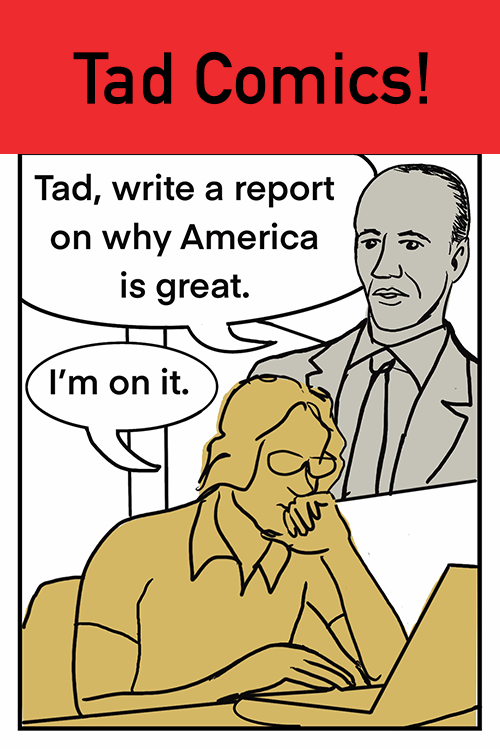
A book that opened my eyes to the multi-faceted Mr. Amory is the impressive biography written by Marilyn Greenwald, Cleveland Amory: Media Curmudgeon and Animal Rights Crusader. That book has gotten me to thinking about spreading the word about Cleveland Amory. The comic strip below is a taste of what I’m working on. Here is a moment of truth for Amory. He is enjoying one of his peaks of popularity as a regular commentator on “The Today Show.” He is already on the board of directors of The Humane Society and his animal activism is growing. With his platform to say whatever he wished, with no prior approval needed on his commentary, it was just a matter of time before Mr. Amory rocked the medium he was so much a part of on behalf of animals…
Suffice it to say, there are no more annual “Bunny Bops.” It was also the end of Amory’s free rein at “The Today Show.” His scripts would be tightly supervised from then on. His days at NBC were no longer so golden. But that’s when a new door opened at “TV Guide.” My interest in Cleveland Amory goes back to childhood when I read his reviews in “TV Guide” towards the end of his time there as chief critic. I’m just old enough to remember finding him to be a really cool dude in an upper crust sort of way. He was clearly someone of refined sensibilities who had taken upon himself the burden of making sense of the new untested mass medium. He wrote his “TV Guide” columns from the 1960s to 1970s, just as TV was coming into its own. It’s no mistake that “YouTube” takes its logo directly from “TV Guide.” Television and “TV Guide” used to go hand in hand, both leading each other into uncharted waters. Even “Entertainment Weekly,” today’s influential media weekly, can not truly compare with the impact of “TV Guide” in its heyday, with its analysis and support of television. I was just a little kid back then but I was already hip to what “TV Guide” was doing and the one person who most personified the effort to make sense of television was Cleveland Amory. Thankfully, Amory did far more than make sense out of television. He helped us all make more sense of how to live a worthwhile life.
Share this:
Like this:
9 Comments
Filed under Cleveland Amory, Commentary, Culture, pop culture
Tagged as Entertainment, Pop Culture