

Cartoonist Henry Chamberlain
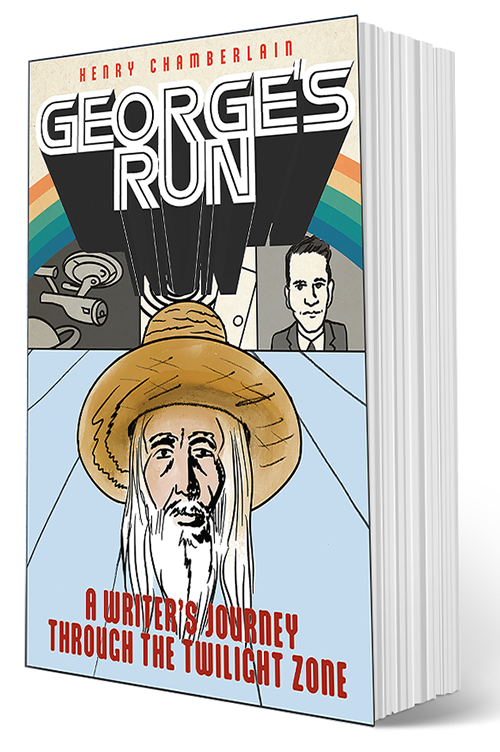
Those of us who create books of one kind or another must be mindful of the next step in our work’s journey, once it’s complete, published, and out in the world: the never-ending job of making more people aware of the book! My graphic novel, George’s Run: A Writer’s Journey Through The Twilight Zone, was published by Rutgers University Press in 2023. It was a pleasure to get a chance to give a talk and lead a workshop in support of my book at the Cartoon Art Museum in San Francisco.

Photos by Robbie Gomez.
The Cartoon Art Museum is a landmark in the local arts community and has the distinction of being one of the few museums dedicated to the comics medium. I have followed the museum’s progress since its time in San Francisco’s Yerba Buena Gardens neighborhood when Andrew Farago became its curator in 2005. Fast forward to 2017, the museum moved to its current location on 781 Beach Street on Fisherman’s Wharf. I’ve always found it to be a reliable source of inspiration with its impressive works on display, from new shows and its permanent collection. If you’re someone who has established a credible footing in this business of comics, you might find yourself invited to show your work here. I want to thank both Andrew and museum director Summerlea Kashar for helping make my presentation possible.

I have experience with leading presentations of one kind or another, notably a slide show lecture format which I first did when I led a panel discussion at San Diego Comic-Con. That said, I’ve been adding and refining notes attached to it ever since. I have found it easy to refer to notes and then break off into other directions. Lately, I’ve focused on an unusual zine that Marc Zicree (The Twilight Zone Companion) gave me a while ago. It’s a term paper he wrote in 1976, when he was 21 years-old. Marc’s paper features interviews with three significant figures from the Sixties zeitgeist: political cartoonist Ron Cobb; novelist Theodore Sturgeon; and television writer George Clayton Johnson. In his introduction, Marc makes clear how moved he is by Sturgeon’s uncanny ability to evoke the concept of love in his work. As for George Clayton Johnson, the subject of my book, Marc is mesmerized by George’s uncanny ability to speak virtually indefinitely on a wide variety of subjects. I carefully combed through Marc’s interview with George, and, just as important, Marc’s interview with George’s mentor, Mr. Sturgeon. What is clear is how much both men revered storytelling, which is at the heart of what my book is about–and, ultimately, my talk.

Once I start talking, I sense a detour up ahead. I had just mentioned the challenge of conveying the significance of a television show of the caliber of The Twilight Zone to a young audience unfamiliar with it when I found myself confronting a fresh new example in my audience for that day. Literally, only a few minutes prior, I had said that a young man had seemed to dare me at a comics convention when he told me outright that he’d never seen even one episode of The Twilight Zone. Right after that, a young man that day in my audience seemed to take it up a notch by telling me that he didn’t watch television at all. I was now juggling at least a couple of ideas going well beyond just being unfamiliar with a certain television show. Part of what I think was going on here is that the young man was, perhaps unintentionally, mirroring what I had just said. I gave it some thought and emphasized the fact that we all need to get as clear an idea of the big picture: seeking out great storytelling.

I went on to say that, when I’m given a dare to explain myself and make my case, I’m more than happy to break it down. In fact, the determination to break down ideas into concise and accessible elements took a life of its own in my book. That’s a vital part of the book: guiding the reader through the creative process that led to The Twilight Zone, one of the greatest works of television on many levels, not the least of which is the writing. My book is about the writers who made this possible. Overall, I think folks enjoyed what I had to say. Getting back to Marc Zicree’s 1976 term paper, one concept that keeps popping up is the steady encroachment of mass media and related distractions. This is well before even the internet and it already seemed like people were drowning in a flood of data. No wonder some young people today might think they don’t have time for “television.” I know it was very helpful for me to give this talk and the feedback will help fuel the next one.

It was my intention to offer more than enough stuff to cover within my two-hour window. During the talk, I encouraged the audience to begin drawing their own tribute to their favorite TV show. By the end, we had a few interesting submissions. I want to thank Chartpak for partnering with me and providing the art supplies for this portion of the event. I will provide a separate post that features the Chartpak marker that I used for my art demonstration. I want to invite everyone to check out the Chartpak factory store for an incredible selection of art supplies.


Thanks again to the Cartoon Art Museum for an amazing event and I look forward to many more visits in the future. And special thanks to photographer Robbie Gomez for these amazing photos.





That’s so cool 😊
Thank you!
Who would have known? Thanks for your share.
Yes, absolutely! Your comments are always welcome. The Cartoon Art Museum has something for everyone, whether you are new to comics or already a big fan.
Henry, this is marvelous. I have read your book, George’s Run! I can see you are a genuine storyteller! I have followed your writing, and other activity, for a while now. You have so much energy and integrity! You have a bright future, my friend!
Thanks so much!