The Horrors of Being a Human: A Cola Pop Creemees Comic. Desmond Reed. Microcosm Publishing. 2025. 270pp. $19.99.
Desmond Reed is a rising talent in the world of comics. His latest book makes that clear. Years of dedication to the making of comics has resulted in his design being sharper, his insight being keener and, heck, the guy knows how to put on a good show. It is that focus on storytelling, as well as development of character, that leads us to such a smooth and pleasing comics experience. As Reed explains, he has five characters, the Cola Pop Creemees, who, among other things, represent different emotions and different aspects of himself, or yourself. I can see that this comic is very relatable, in the spirit of such groundbreaking work as BoJack Horseman. Let me just say from the get-go, the Cola Pop Creemees are very different and original, and if you see them turned into an animated series someday, well, you heard about it here first.
Cartoonist and Publishers.
The world of cartoons and comics has always dealt with far more than might meet the eye, depending upon where you venture off to. In the world of Desmond Reed, you enter a kaleidoscopic world of the real and surreal. For instance, our heroes live in a house in the shape of a hand. There is plenty to be anxious about in the real world, and this comic manages to tackle many of these issues within its quirky borders.
Cartoonist and Comics Festivals.
Desmond Reed has set the stage and, from there, he can modulate the tone. Stories vary in length with some far-out zany and others more contemplative. Reed’s most serious and ambitious work to date is one of his longer stories, “Memories,” winner of a 2022 MICE Mini-Grant. Here, he focuses on his most madcap character, Wallace T.J. by allowing for a careful look back at his development and the darker side to his life.
“Memories”
Life is quite a journey with plenty of bumps in the road and that’s where a daring artist like Desmond Reed steps in to create art to defy even the most challenging of times. Believe me, there’s always room for another valiant artist to lead the way, especially one as gifted as Reed. It all comes down to the reader getting a chance to know the work–and so I encourage you to seek out this highly inventive work and let it speak for itself. I can tell you that Reed has a magic touch, with his pared-down whimsical style, when it comes to addressing some very serious issues like addiction and depression.
The Cola Pop Creemees live inside a hand.
Desmond Reed is not afraid to go down to depths of despair and come back up with a tear and a smile. It is a combination of a pared-down style and a direct straightforward narrative. Think of it as a friend who sets you down and needs to tell you something. Maybe there will be some humor thrown in that both of you share. But then you get to the story, without pretense, and you just get it. That is what is happening here. Reed has constructed characters that you can tap into in the very best spirit of comics. You can say that the lodestar guiding us cartoonists in such matters is Peanuts, and, I dare say, there’s some of that Peanuts DNA in the Cola Pop Creemees gang.
Some much said within a special world.
What irony there is to be found here is subverted by a persistent vision of perseverance. That is not an easy thing to achieve and it has everything to do with Reed following his own instincts and staying true to his authentic self. That’s where you get original work and not some trendy “next big thing” that is aping some previous “next big thing.” Yes, it is possible for comics to be funny, sincere and have some redeeming quality that will speak directly to you.
It was a lot of fun to get to chat with Desmond about his new book and sharing thoughts about the cartoonist life. I hope you feel the same. So, please do check out the above conversation on the Comics Grinder YouTube channel and please view, LIKE and COMMENT directly on the channel. Every bit of input and engagement helps us continue.
Keep up Desmond Reed here. And be sure to visit Microcosom Publishing here.
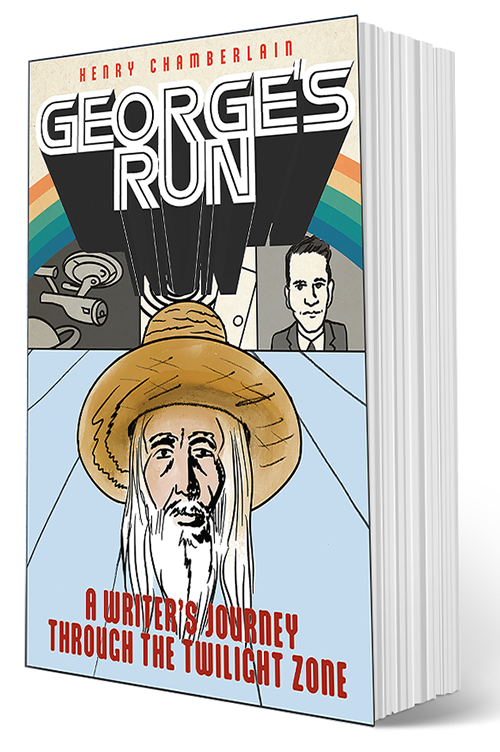
I have an event coming up at San Francisco’s Cartoon Art Museum, 781 Beach Street, on Sunday, August 24th, 2-4pm to talk about my graphic narrative, George’s Run: A Writer’s Journey Through The Twilight Zone, published by Rutgers University Press. It would be so great to have you there if possible.
If you are a science fiction fan, or love various forms of related genres, this is for you. Science fiction acts as a convenient umbrella but, if I was asked to dig deeper in my description, it would be Dark Fantasy. My book is about a group of writers who, individually and in their combined efforts, basically invented a lot of the pop culture we take for granted today. Specifically, I’m talking about the writers behind the original Twilight Zone and Star Trek.
We’ll have a slide show lecture format where I’ll share as much as I can about how I went about creating my book. George Clayton Johnson is our guide, one of the last writers from that 1950s-70s era of golden age television writing. I got to know George pretty well and our friendship led to my book. We’ll have plenty of time for a Q&A as well as overall discussion. I’ll take my cue from the audience. I’m happy to do demonstrations of my art style and chat about making comics too. Feel free to draw or write along the way, and we can share results after we’ve had time to discuss. Hey, this is as open-ended as you like. We might even have some snacks. Seriously, comment here or get a hold of me via email and I’ll consider any ideas.
One step at a time. First, let’s plan on meeting up at the Cartoon Art Museum on August 24th.
ONTEMPORARY CRITICS’ RECOGNITON of “Outsider Art” can be said to have come early to its precursor, Underground Comix of the late 1960s and 1970s. “Recognition,” that is, in the best way: publication—albeit with a real if fleeting audience—far from any recognized, official art scene. Thus artist/nonartist Michael McMillan. A leftover from those days and now past 90, he fairly inhabits this book of his past drawings and sculptures, with a standout introduction by Crumb biographer Dan Nadel and supportive blurbs from the likes of Gary Panter and Bill Griffith.
Nadel takes less than four pages to give us the heart of the McMillan saga, among the more unusual in the always-unusual “comix” world. Son of a railroad office worker and an art teacher, the young artist grew up mostly in Fresno, home of an agricultural empire with the Sierra Nevada nearby. An insular kid drawn to fantasy popular culture, building model airplanes and railroads, also a high school newspaper cartoonist interested in abstract art, he attended the USC School of Architecture just before he found himself drafted into the peacetime Army.
Trying to avoid “predictable boredom.”
Moving to San Francisco after his two-year hitch, McMillan landed, in the late 1950s, in US version of Bohemia. Over the next decade, he worked at various jobs, took art and sculpture classes at San Francisco State and felt himself inspired or confirmed in his inclinations by a 1969 exhibit of the Hairy Who. Would-be successors to Surrealism but conspicuously without the label, the group of Chicago artists lasted only 1966-69, with a couple of group showings in Chicago and one (the one that McMillan saw) in San Francisco. Drawing heavily upon vernacular street visuals, sharing the psychedelic colors, anti-racism and anti-war politics of the contemporary scene, they offered ambiguous but transgressive symbols of a radically shifting public culture. Most of all, arguably, they challenged the contemporary New York art scene. Thereby, they moved close to the sensibilities of the emerging Underground Comics, but from another direction.
McMillan actively sought out comix publisher Don Donahue, living nearby in the city’s Mission District, and arranged publication of a one-shot comic of his own, the instantly obscure Terminal Comix. Recognized and greatly admired among these artists a half generation younger than himself, he remained nevertheless an outsider.
Oddly, the public history of the artist almost ends here, in the 1970s. A handful of comix (after 1980, restyled “alternative comics”) anthologies, including Robert Crumb’s Weirdo magazine, took him up, usually for one-shot contributions. He earned a quiet reputation among the artist-editors as someone drawing upon multiple vernacular visual sources, breaking down the barriers between experimental art and comic styles. He made no effort at further outreach, giving himself over to the quiet life of his own sculptures, paintings and prints on his home press. He did it all because he enjoyed the work for its own sake, living cheap and taking little commercial jobs along the way. According to the more notable artists, this self-chosen insularity demonstrated his artistic purity: he had nothing to gain and no interest in gaining it.
The easiest part of Terminal Exposure to describe is naturally the autobiographical five comic pages. Boyhood fascinations with machines, boyish fantasies of heros and adventures followed by fantasies about girls at his school, and above all, riffs on hiking seem to flow forward, however weirdly drawn and narrated. One might say that all of this constituted, already, a way of being alone, learning to be alone, and satisfying himself with that choice.
More pure fantasy dominates the book otherwise. The strips that appeared in the comics anthologies and others very much like them would be the most narrative, a few pages at a time. His characters change, sometimes satirical superheroes or random oddballs. The setting is forever abstract, more than unreal and often humorous but never in the predictable fashion of funnypaper gag strips.
Reflecting his own life or rather his view of his life, these dream-like sagas often take place amid wide horizons, even amid some mild eroticism and occasional nudity. Returning to the fantasy films and pulp literature of his young years, his characters appear in jungles or the high seas. More than occasionally—this is often theorized as the real source of Wonder Woman’s popularity—a miraculous female overwhelms the ostensibly innocent but definitely gratified male, ignorant in the mysteries of biological appeal and incapable of seduction.
Most remarkably, McMillan is also capable of straight-forward memory art, like his experience in climbing mountains of the West, in the half century from 1951 onward. Of his four drawn and otherwise unpublished volumes of illustrated stories, we get two pages of exertion and also escape—from an entangling relationship. This is an artist who, we learn repeatedly and in different circumstances, made the choice to escape relationships in order to be on his own.
The assorted sculptures in the book mean less to this reviewer. They certainly resemble the products of surrealist experimentation with mixed materials and playful human/non-human depictions. McMillan, even more than the collective Hairy Who, makes no editorial, political or any other statement about his his art. It Is.
Trying to reach those “primeval forces.”
The best or easiest to see McMillan’s work is as an extension of comic art forms appropriate to the age of comic/art experimentation, an age that began in the 1960s and has, in multiple ways, continued as fixed forms break down at all levels. By contrast to, say, Pop Art’s stylizing familiar and notably banal comic strip protagonists and remaking them into studio art, McMillan goes the other direction. They escape Pop Art by posing the issues differently.
Or is this somehow familiar, after all? The last several years have seen a burst of renewed Surrealist activity in its own name, exhibits in dozens of locations celebrating the centenary of Surrealism’s 1924 birth but also a global art-show interest and an accompanying scholarly surge. Who would have guessed that the younger generation of radicalized graduate students and an evidently wider milieu would re-establish actual surrealist groups in familiar (Prague) and unfamiliar (Helsinki or Sao Paulo) locations, create the Journal of Surrealist Studies or its sponsoring International Society of Surrealist Studies? Why, in a world damaged almost beyond repair, would the long-gone dreams of the 1920s Parisians now find watchers, listeners and zealous disciples?
Your reviewer, publisher of two journals (1967-91) with several special issues organized by the Chicago Surrealists (and mainly Franklin Rosemont) has a special stake in these questions, without any firm conclusions. McMillan, unpublished and unknown, might easily have been a “discovery” of surrealist researchers rather than the underground comix circles. Instead, he may offer a kind of bridge between several worlds, not by dint of any political commitment or any commitment, except to his own imagination and skills.
Whatever the analysis, Terminal Exposure’s content, that is to say also the artist’s work as a whole, can now be said to have been exposed to public examination. Also the artist himself? Probably not, because without intending to do, Michael McMillan remains a mystery within his work. Or he has done so by intent, the very reason he stopped drawing for publication just as soon as editors stopped asking?
The Young Person’s Illustrated Guide to American Fascism, by Sue Coe and Stephen F. Eisenman. New York: OR Books, 2025. 190pp, $22.95
When I eyeball the work of Sue Coe, the highly awarded radical illustrator, painter and lithographer, what comes to my mind is a forgotten 1935 book, Karl Marx in Lithographs, by Hugo Gellert.
There’s a good reason, if also personal. I went to interview Gellert in New Jersey, in 1984, and found the 91-year-old artist voluble in memories of The Masses magazine—he had long since been the only surviving staffer of any kind. The radical modernist experiment in words and pictures reached wide audiences before it was suppressed, for opposing the US entry into the First World War.
To extend this story a little before turning to the book at hand, the Hungarian-American Gellert traveled back through a Hungary amidst revolution and counter-revolution. He subsequently became a leading artistic antifascist, a collaborator with Communists in art and politics. Karl Marx in Lithographs is easily his most didactic work.* Here, Capital rules ruthlessly, murderously, in iconography that reminds us, in turn, of some of Sue Coe’s favorites, notably Francisco Goya, not to mention a favorite contemporary of Gellert, Kathe Kollwitz.
The Young Person’s Illustrated Guide to American Fascism
Cue, Sue Coe. Growing up in the English countryside, so close to a hog butchery that she could hear the screams of the animals being slaughtered and smell the process, Coe took an art degree and emigrated to New York City at the dawn of the 1970s. It would be a mistake, as more than one friendly critic has noted, to see any of Coe’s work as far from the experience of animals at large, animals mostly endangered by ruthless, mechanized human activity. Sometimes—rarely—animals of all kinds are seen in a utopian future, reconciled with a better humanity and highlighted by children. This is clearly her idea of the classless socialistic society.
The Young Person’s Illustrated Guide to American Fascism
Hugely successful and widely admired in a variety of art forms, she has very often published in World War 3 Illustrated, the annual lefty anthology best known for bringing forth young radical artists. Coe even provided the vivid image of an African-American worker as the frontispiece of Wobblies! A Centennial History of the Industrial Workers of the World, the 2005 anthology that started my own later-life project of radical comics
Coe calls herself a activist artist, and for good reason. Meat-packing has been high on her list, but factory farming, the hyper-exploitation of immigrants and victims of the prison-industrial complex, the curse of AIDS and, very often, war in its various grisly forms can be seen. She does not want us to turn away from the horrible.
The Birth of Fascism (2017) by Sue Coe.
The Birth of Fascism (2017) might be viewed as the precursor to The Young Person’s Guide, and a handful of her art on Trump specifically from that period, is on view again here. The interpretive essays by Stephen F. Eisenman, retired professor and art historian, also columnist for Counterpunch, offers a fresh element of collaboration. Eisenman is nothing if not didactic: he explains that US democracy has never been all that democratic, despite endless narcissistic claims, but that fascism is much, much worse. The undercurrent of “racial fascism” never really disappeared from the mainstream, and the pseudo-scientific American theories of race superiority found a welcome home in Hitler’s Germany.
The Young Person’s Illustrated Guide to American Fascism
A reviewer earlier this year, in the London Morning Star (formerly the Daily Worker), praised The Young Person’s Guide but posed the problem of the “melodrama” in the artist’s work, what he called “the exaggerated emotional effect …..[of] focusing on grief pain and suffering.” In the critic’s view, this tendency somewhat diminished Coe’s impact, as has the common place alternative in Left art, an exaggerated sentimentality. Each extreme, according to the critic, tends to emphasize “feeling” over understanding and serve the reader poorly.
The Young Person’s Illustrated Guide to American Fascism
This is criticism-among-comrades that continues a discussion going back well over a century. Socialistic best-sellers on the page, in theater and in film achieve an emotional pitch that is not likely to be cerebral, nuanced or even necessarily in line with modernism. Popular audiences are unapologetically sentimental, even if they enjoy pratfalls, especially in ridicule of the wealthy classes.
The Young Person’s Illustrated Guide to American Fascism
Without saying so, Coe meets this criticism head on, in the traditions of angry audiences turning their rage upon the villains in the pay of the ruling class. Weapons makers dance over the pyramids of corpses, a chorus line of skull-headed dancers carries on beneath boots squashing a hapless victim. Trump appears again and again, a monster, trophy hunter of infants, assaulting the embodiment of the Statue of Liberty, and so on. The images of death and destruction, lined up one after another in the book, are demanding: LOOK!
And that, surely, is Coe’s point. Eisenman insists properly that she mixes mythic and contemporary images, adopting the role of a reporter of current events, while also the fine artist widely seen in museum and other public exhibits.
We’ve had quite a number of comics chats here at Comics Grinder and we will press forward with more! In that spirit, I present to you Todd Webb, a perfect ambassador to the world of comics and a great person to chat with. This time around, we focus on Todd’s new collection, The Poet, Volume 2. You can find it via Todd’s website and various platforms, including Barnes & Noble. Todd is on a roll with one of the most consistently funny and engaging comic strips. Keep in mind, as we discussed in our previous chat, Todd is an old-fashioned cartoonist creating a daily comic strip. You must hop aboard and see what he’s up to. Join him on his Substack right here. Consider the following example:
In the above example, the bird gets the better of the poet yet again. But, I’m sure, the bird is only trying to help the poet reach his “A” game.
The Charlie in the Rye, the Schulz-Salinger mashup mini comic.
Todd is always coming up with new ideas. Recently, he wondered about how much Charles Schulz (1922-2000) and J.D. Salinger (1919-2010) might have in common considering they were contemporaries: both going off to war; both sharing in the same culture; both creatives working at the top of their profession. Well, you get the drift. The upshot to this is . . . very funny. What if you took lines from The Catcher in the Rye and inserted them into Peanuts comic strips? Todd was pleasantly surprised with the results and you will be too. Here is one example:
Well, pretty uncanny, don’t you think? This Schulz-Salinger mashup is priceless.
I try something a little different for our deep dive into Volume 2. It occurs to me that the back-of-the-book Notes are all too often overlooked or taken for granted. But people appreciate them when they read what’s there. With that mind, I begin with the notes and work by way back to the contents. Makes for some interesting discoveries.
Patrick McDonnell’s favorite comic strip from The Poet.
I encourage you to pick up a copy of The Poet, Volume 2. This 410-page book makes a perfect gift for a friend, a loved one, or yourself! I leave you with one more sample. This is the one that cartoonist Patrick McDonnell (Mutts) cited as one of his favorite The Poet comics strips in the foreword to this collection. If you’re a Mutts fan, then you appreciate the interest. Both McDonnell and Webb have a way with paring down to the essentials.
Be sure to check out our conversation and, if you have the time, please LIKE and COMMENT over at the YouTube Comics Grinder channel. Your support keeps us going.
And be sure to check out Todd’s Etsy store where he’s a Star Seller!
A-T WALKER (Issues 1 and 2). by Micah Liesenfeld. Micah Nova. 48 pages total. $8 each or $12 for both.
Summoning the strength to move forward.
When a comics artist enters into a life crisis and decides to document it as a graphic narrative, that person has made the transition from just being a cartoonist to being a comics journalist. That’s how I see what Micah Liesenfeld is doing. His daughter, Eva, has a rare disease, Ataxia Telangiectasi, also known simply as “A-T.” This condition goes all the way back to five years ago, at the time of Eva’s birth. Little by little, after some false starts, the A-T diagnosis emerged: a degenerative condition that eats away at the patient, with the risk of cancer and a short lifespan. There is an ongoing search for a cure and the focus now is on management and quality of life.
Navigating the medical world.
This comic provides something of a medical record and an essential window on how one family and the medical community are responding to one child’s condition. This work is being made available as single issue comic books with the goal of it being collected into a graphic narrative book. Liesenfeld would like to see the book become a success and have proceeds go to the A-T Children’s Project, an organization currently funding research like gene therapy that could cure the disease in the near future.
“She has an ear infection.”
Graphic medicine comics provide a unique opportunity for the reader to gain some essential grounding. Many of life’s challenges do not come with a manual or some tutorial. Even YouTube videos don’t always fill in the gaps. With an excellent comic like what Micah Liesenfeld provides, it is as if you’re there. A-T Walker is a personal essay, field notes and an immersive medical record experience wrapped into one. For instance, you need to be ready when this or that doctor is not exactly responsive or providing ideal service. Doctors are not gods. Liesendfeld keeps track. One doctor lectured Micah and his wife, Aicha, on not relying on antibiotics but then neglected to catch the fact that Eva’s white blood cell count was zero, even though this was already an unusual situation that required carefully looking over every detail. Patients, and their loved ones, have rights and essential insight and information that must be paid attention to by the medical team. All things made clear in this comic.
Micah Liesenfeld has been making comics since 1989 when he was in the fifth grade. His efforts over the years have honed his skills to a direct and impactful style. He can truly communicate with words and pictures in a way that is both memorable and to the point.
If you are compelled to do so, you create a work of graphic medicine.
This is a storytelling style that grabs the reader from the very start. The way that Micah draws his people and situations is very palpable. The way he tells his story is putting it on the line and telling it like it is. Like I’ve said before regarding graphic medicine work, it’s not for everyone. Many people will feel too overwhelmed but, given time, will want to sort through a crisis and express what happened in one form or another. If it comes naturally to you, and you are compelled to do so, then you create a work of graphic medicine.
The most important factor needed in pursuing a successful work is a purpose. Clearly, Liesenfeld is compelled to see this series, and ultimately a book, to completion. I can just feel it on every page: the steady pace; the desire to be clear and convey the facts to the reader; the need to reach out to the reader. Every figure gets to be heard, especially Eva and her parents, Aicha and Micah. I know that Liesenfeld is creating the best work of his life right now and all of us in the comics community wish him and his family the very best.
A-T Children’s Project (atcp.org) is an organization currently funding research like gene therapy that could cure the disease in the near future. The bold audacious goal of the project is to raise enough awareness in the world to prompt attention to help fund the research and speed up the hope for therapies that make their lives more manageable and even a cure … even for Eva and the kids currently living with this disease in her lifetime.
Hanging On by a Thread. Noémie Naoumi. Black Panel Press. 2025. 240pp. $14.99 PDF, $34.99 hardcover.
Noémie Naoumi is a Lebanese artist, now based in Paris, who has created quite a remarkable graphic memoir. It is about being young, full of life and determined and falls within the category of graphic medicine. Our story begins with Noémie, an 18-year-old art student in Beirut, with a sense of adventure and humor. And then she is diagnosed with a form of cancer. All she knows is that her life has taken an abrupt change. It’s not the same life anymore. She thinks of herself as a whole other person and doesn’t blame her boyfriend if he wants to break up but he’s steadfast in being committed to her. What follows is Noémie’s journey, as she learns about what is happening to her, the treatment process and life beyond it.
As I’ve been reading more and more graphic medicine works, I’m always humbled and intrigued by what I read. These are often auto-bio with the main character confronting a life crisis and following a certain path: depicting one’s self; learning about the challenge ahead; and some kind of conclusion.
“The best oncologist. The best PET scan. The best cancer.”
What happens is that the comics creator becomes a comics journalist, out in trenches, providing dispatches for the reader and perhaps for themselves to help make sense of it all. This is not a task for everyone. I can only imagine that most readers have at least one life crisis that they would just prefer to leave private. However, it is these very kind of life events that cry out for discussion and analysis. Going back to Noémie‘s first impulse, you have been forever changed and you will never quite go back to what it was like before. Well, you can fight like hell to regain your life, that is for sure.
Noémie Naoumi is, no doubt, a powerful artist. Her attitude is to tell it like it is in her paintings and illustration and, most certainly, in her comics. Her art has the energy of a live wire with a worldly-wise sensibility. It is clear to me, and it will be to the reader, that cancer is not going to stop her.
Hanging On by a Thread, in the end, is a story of hope and courage. Going back to Noémie‘s initial thoughts that, indeed, she was now a different person since her cancer diagnosis, this graphic memoir attests to a strong spirit that retains strength, good humor and self-autonomy.
Introverts Illustrated. Issue 1. Scott Finch. 2025. Available at various venues, like Partners and Son. Can be purchased in bundles of five for $25.
Scott Finch, an artist based out of Baton Rouge, has a new comics creation out in the world and I thought I’d tackle it from one of its multitudinous aspects. Given that, as a whole sum, this is a 21-issue bundle package (which you can purchase in smaller bundles!), I wanted to walk through the very first issue with you. Pretend that you and I are wandering about inside a dream. We are free to fly in the air, if we please. We can be naked too. It simply doesn’t matter. It’s a dream, you dig?
Each issue to this series runs for as long as it needs to run, varying from, say, 14 pages to 50 pages. As an artist, I find this zany unbridled presentation utterly fascinating. But you don’t have to be an artist to enjoy it, relate to it. This is all about free-form uninhibited freedom. You’re in a dream, right? If you can’t do as you please inside your own mind, where else can you go to seek refuge from the madding crowd? And the crowds these days are quite madding, aren’t they?
I’ve had a chance to get to know the artist and his work. You could call me something of a Scott Finch scholar, or a budding scholar. Not that anyone would notice or care. As much in life, all that really matters is if I care. And, if I care enough, then perhaps that will move you to care as well.
It is in this who-gives-a-hoot spirit that Scott Finch revels–and, believe me, you will find something here that sets you free. Part of the magic and charm about Finch’s work is that it is both highly enigmatic and highly accessible. It is what it is but so much more. You simply don’t need to overthink it and give yourself over to it, just as you would any painting, or music, what have you.
Anyway, this first issue sets the tone for much that follows, although it hardly gives away the whole game. You are just getting your feet wet here, touching the tip of the iceberg. Plenty more to immerse yourself in, believe me. With Scott Finch, I have found a kindred spirit and perhaps, on some level all your own, you will too.
Peter Kuper is a regular contributor to The New Yorker, The New York Times, The Nation and MAD magazine where he has written and illustrated SPY vs. SPY every issue since 1997. Kuper is also the co-founder and editor of World War 3 Illustrated, a political graphics magazine that has given a forum to political artists for over 40 years. Well, that gives you some sense of his impressive career, one that finds his latest graphic narrative a most notable addition. Insectopolis, published by W.W. Norton, is about the insect world and how it interacts with us humans and is truly one of those great all-ages works that will equally appeal to kids and adults. Insectopolis makes you all the more aware of your existence and how it is shared with a multitude of other beings, some with wings, antennae or multiple eyes and legs.
Insectopolis is published by W.W. Norton. The publication date is May 13, 2025 and is available for pre-order. Visit W.W. Norton here.
All great works of graphic narrative always involve a process with numerous factors in play: the research, the timing, the pacing, the work environment, and so on. It was an amazing and fascinating conversation I had with Peter Kuper. In terms of getting a window into the creative process, Kuper shares a multitude of observations on how his new book was created, and under some very unusual circumstances. As he explained, it all began when he was awarded a fellowship with The New York Public Library. Oh, it did just so happen to coincide with the Covid pandemic. This perfect storm or, let’s say, most unusual set of circumstances provided Kuper with quite a unique vantage point. Suddenly, here he was working on his new book with a world-class library practically all to himself.
“Roses?”
The Rose Room!
Suddenly, the famous Rose Room, a favorite of library visitors and usually filled with hushed activity, was empty and there for Kuper, and Kuper alone, to draw inspiration from. Well, he must have been in heaven, a heaven filled with butterflies, beetles, and even cockroaches! All insects are welcome here!
Under the library!
So, Kuper set about making the most of this situation he was in, where time had seemed to stand still. He was able to linger longer than ever before and explore places that normally would have gone unnoticed, like the library’s vast underground corridor. And, bit by bit, a book being created during a pandemic led to a book set in a post-apocalyptic future, post-human, where insects must assess the relationship between humans and insects. Fortunately for us, we can read the results. Without a doubt, this is a book that is a must-read for any human seeking a better connection with the vast array of potential insect friends.
A paperback talisman.
A little over ten years ago, Kuper published a wonderful graphic novel, Ruins, which follows two parallel stories: one of a troubled relationship between a husband and wife; and the other, the struggles of migration for a Monarch butterfly. Well, there are plenty of Monarch butterflies in Kuper’s latest book. Is there a connection? Oh, sure, but the deepest one goes back to a four-year-old Peter Kuper. As he states, it was picking up a paperback on insects at such an early stage that sparked a lifelong interest in insects. Peter even held up a copy of that very same beloved paperback. He keeps it handy, as a friendly reminder.
And then a gnat flew by.
I must say, there was something in the air on the day of our interview. This has never ever happened before to me but, just as I was reciting my introductory remarks, a gnat emerged out of nowhere and darted across the screen. You can see it for yourself. Was that a sign? Yes, of it was! That little gnat needed to be known!
Ants as Horror Movie Monsters.
As you will see in the video, our conversation is easygoing as well as at a steady pace. There are a lot of dots to connect. I did my best to imagine, beforehand, what it must have been like for Peter to find himself gathering one compelling set of facts after another and seeing how this element might fit in with another. For example, there is a good bit of unpacking on how insects have been demonized by humans. Dragonflies were once deemed spawned from hell itself. And ants get grilled over the coals and become monsters for Hollywood’s answer to the atomic bomb and the threat of nuclear war. But it’s humans who ultimately cause the most destruction to insects, the planet and to themselves.
One favorite moment for me is when Peter and I discuss what a cicada and a tree might chat about over the course of many years. That happened after we had discussed the various shifts in tone and style found in the book. The cicada sequence proves to be a refreshing shift from the previous sequence of pages–and a great example of how Kuper deftly balances the pace of things.
I greatly encourage you to view the video and, while you’re at it, give it a Comment and Like. I’m often good at getting people to stop by for a brief view and now I’m doing what I can to have more and more folks take it a step further and engage with my YouTube channel. Your engagement helps to secure more videos in the future and we all want to see me continue to do that, don’t we? Ah, well, that’s my pitch.
That said, by all means, seek this book out and, if you’re in New York City, be sure to catch a show of original art from the book at the Society of Illustrators. Details on the show follow:
Society of Illustrators Presents Insectopolis: A Natural History
Insectopolis: A Natural History will be on view at the Society of Illustrators from May 14 – September 20, 2025 in the second floor gallery. It will feature original artworks by Peter Kuper.
Exhibit Details:
On display in the 2nd Floor Gallery.
Join us on Thursday, May 22, from 5–9pm for a Museum Mixer celebrating the opening of Insectopolis: A Natural History.
The evening will kick off with a special pre-tour at 4pm & 4:30pm, led by artist Peter Kuper, with guest entomologist Louis Sorkin — who will be bringing live insects for visitors to observe and interact with up close! Space for the pre-tour is limited, so be sure to RSVP.
Craig Thompson is a cartoonist and the author of the award-winning books Blankets; Good-bye, Chunky Rice; and Habibi. He was born in Michigan in 1975, and grew up in a rural farming community in central Wisconsin. His graphic novel Blankets won numerous industry awards and has been published in nearly twenty languages. Thompson lives in Portland, Oregon. In this interview, Craig Thomspon discusses his new book, Ginseng Roots, published by Pantheon. Publication release date is April 29, 2025 and it is available for pre-order.
You could count on buying it cheap from China.
Ginseng Roots explores class divide, agriculture, holistic healing, the 300-year-long trade relationship between China and North America, childhood labor, and the bond between two brothers.
From ages 10 to 20, Craig Thompson (the author of Blankets) and his little brother Phil, toiled in Wisconsin farms. Weeding and harvesting ginseng—an exotic medicinal herb that fetched huge profits in China—and funded Craig’s youthful obsession with comic books. Comics in turn, allowed him to escape his rural, working class trappings.
Working in the fields and loyal to the family.
This new book is the result of Thompson having worked in serial form, creating a bimonthly comic book series, the first time he’s done this in his career. Ginseng Roots is part memoir, part travelogue, part essay and all comic book. In this conversation, we chat about the book, and life as a cartoonist, from as many angles as possible.
Panax Ginseng dating back 3,000 years.
Henry Chamberlain:Craig, would you kick things off with an elevator pitch for folks who are new to Ginseng Roots?
Craig Thompson: Sure. This is my new book. It is half memoir and it is half documentary. When I was a little kid, starting when I was 10 years-old, during my summer vacations, I would get up at the crack of dawn, and load up in the car with my little brother and mother. We’re driving on gravel roads and muddy fields, in the middle of nowhere, in rural Wisconsin, to giant ginseng gardens. Ginseng is a medicinal herb prized in Chinese medicine. We worked eight hour days and forty hour weeks, throughout the summer, weeding this delicate medicinal plant.
It was the first job of my life. It spanned from age 10 to 20. When I started, I was being paid one dollar an hour, which translated to one comic book an hour. So, it was ginseng that first fueled my obsession with comic books and kind of led me to where I am today.
This book is about myself and my childhood but also about that herb and all those labyrinthian tangles that it weaves around the world.
Considering your other long-form work, what can you tell us about how you built up your new book?
So, this is the first project that I serialized in comic book form. A 32-page, twelve issue series through Uncivilized Books, based out of Minneapolis, the amazing cartoonist Tom Kacyniski’s publishing house. At this point in my career, this was the first time that I’d worked in the comic book format unless you count mini-comics and zines. That was my introduction to everything: going to Kinko’s and photocopying and hand-stapling my own zines. So, I sort of had missed out on the whole ’90s indie comics thing. I serialized the book first as twelve issues. But the book and the series are different beasts because, once I finished the series, it was missing some key components, some glue to hold it together, to help me transform it into a book. It went through an overhaul: I added some 70 new pages. I moved the order of things around a bit.
The final Pantheon edition, this new book, is twelve chapters. As you say, there are things you have refined or expanded on.
Yes, for example, the series has twelve issues and the book has twelve chapters but the ninth chapter in the new book does not exist in the series. That one focuses a lot of my personal health crisis–it was part of the glue that was needed to hold the whole book together: to be vulnerable about my own health and how ginseng related to that too.
How did it feel returning to the subject of childhood and growing up, which you covered so beautifully in Blankets–what did it feel like to go back to that in Ginseng Roots?
Quite different. Because of my age. When I started Blankets, I was 23 years-old. I worked on that book from ages 23 to 27. I was only about five years away from the events that took place in the book. So, it was pretty raw and I was still a kid. I was still living those experiences and trauma.
Now, I’m turning 50 and I’m the age my parents were when Blankets was published. So, it’s definitely a mid-life sort of perspective that I have now. The dynamic with my parents has shifted. They are in a much more vulnerable position than they were back then. It’s now a more nuanced and empathetic view that I have of my parents. It’s a whole different view of my childhood. I grew up in rural Wisconsin and I hated growing up there and always wanted to get as far away from there as possible from this suffocating small town, this rural farming community. That led me to the West Coast and Portland, one of the most liberal cities in America, with its artistic circles.
Ginseng Roots was an opportunity to go back to where I grew up and to reconcile a lot of things. And to feel differently about that place that I grew up in discomfort as a child.
Ginseng Baptism.
I picked up on that. You are more tolerant about certain things. There are layers of wisdom as we get older. As we go through the book, I’m on a page where you daydream about what it might be like to live the life of a cartoonist. Maybe, someday, you too can be Bob Hope or Jack Lemmon, in silk pajamas at the cartoonist drafting table.
Yeah, growing up working class, you know. My dad was a plumber. And everyone around me were either farmers, truck drivers, carpenters or electricians. I didn’t know adults who had university educations. It wasn’t my class. My first job was outdoors, working an agriculture job, dealing with all the elements of the outdoors and all the discomforts. Besides the fact that I loved comics, working as a cartoonist sure did seem like a very cushy lifestyle, hiding from all the physical elements of weather and get to make-believe and draw.
Younger people can totally relate to wishing for their lives to just get on with it. Older people can relate to looking back at the good things. Maybe someone learned how to fish or paddle a canoe because of a parent.
Yeah, now I miss being outside. Maybe it seemed like a bad thing as a kid but, after twenty-five years creating graphic novels, it sounds nice to get out of the house a bit more often. And this book brought me out of the house. It wasn’t something just created from my imagination. It was documentary work so I had to get out in the field. And interview people. I interviewed nearly 80 people for the project. Generally, any dialogue in a word balloon is from some recorded conversation I had with someone I interviewed.
You do this so smoothly. You just do it. In the spirit of the best comics journalism, like Joe Sacco.
My biggest inspiration of all is Joe Sacco. Certainly for this project since I wanted to deliberately work in comics journalism. Also, thinking more broadly. Joe is a friend of mine, full disclosure. You know, he’s a mentor, a great role model or artists. I always wanted to do comics journalism like he does but I don’t have his background, or his intellect. I don’t know if I quite have that sense of adventure that Joe has, going to war zones and whatnot and being embedded in places of conflict.
But then with my book, I had this very organic subject matter that was kind of unique to me and so I had my entry point. I had wanted to write a book about plants. That’s sort of my tagline. I was really influenced by Michael Pollan, the food and plant writer. He’s known for The Omnivore’s Dilemma and How to Change Your Mind. The book that really influenced me is The Botany of Desire, and it’s about four plants that shaped human civilization as much as we manipulated them as a species. After that, I really wanted to do a book about plants. Again, I’m not a botanist, I don’t have that background like Michael Pollan. And so I just meditated on what I knew and ginseng surfaced right away. I started researching and I knew there was a lot to work with.
One thing I wanted to emphasize to readers of my review of your book is what prose novels and graphic novels have in common. Each begins as something small and then mushrooms into something much bigger as you add to it. I’ve done my fair share of graphic narratives and I know that once you have a compelling subject, you find yourself having to read this or that book. It just keeps growing.
Sometimes I’d read an entire book just to inform one panel. There are certain chapters that are a little more dense; and some areas that I didn’t know at all. I’d have to get through a pile of books just to write that one 32-page chapter.
This is a monumental book, on the same scale with Blankets and Habibi. Can you share with something about the freedom that you have when you have such a big canvas to work on?
I guess I’ve always tended towards this longer format. Blankets was 580 pages, at a time when that was pretty novel, so to speak. I like books that are fully immersive, you just kind of get lost in them, get disoriented, have this opportunity to sort of wander labrynthian routes and work you way back to the main narrative. In the case of this book, I serialized it first. The twelve issues was arbitrary, it just seemed like the right amount for the series. I liked the numerology. I work from an outline and then I focused on one issue at a time. I’d write, pencil, ink it and color it–and publish it–before really digging into the next section. Each issue was self-contained when I was putting it out as a series. The goal was to have each issue stand alone along with having the momentum to have the reader want to seek out the next issue but not like cliffhangers.
I was thinking about how to get a handle on the book and I thought we could focus on one of the chapters, “Make America Ginseng Great Again.” It’s a very timely chapter. I enjoyed viewing a talk given by Will Hsu, of Hsu’s Ginseng Enterprises, one of the leading growers of ginseng in Wisconsin who you profile in your book. This gives us an opportunity to cover ginseng from many angles.
Yeah, this is Chapter 5 in the book and Issue 9 in the series and it focused on the Hsu family. Paul is the father and Will is the son who took over the family business. Paul Hsu emigrated from Taiwan with a degree in Social Work but ended up becoming a ginseng farmer, and growing the business into a mega-growing operation, partly because they diversified, developing all these other products. They also have strong family connections in Taiwan that provided advantages in trade routes and all kinds of leverage and knowledge that the typical white ginseng business would not have.
Make America Ginseng Great Again!
“Make America Ginseng Great Again” was a tagline that Will Hsu used in 2018. The Hsu family has a lot of political ties. They’ve had ties to the Bush administration, and tangential ties to the Trump administration and local government. They’re a big business and big business ends up tangled with politics. When I traveled in Asia, I was in China, South Korea and Taiwan. In Taiwan, I met with my publisher’s foreign rights agent, Joann Yang, and she talked about what she’d heard about Wisconsin ginseng, and that was connected to the Taiwanese version of Trump, Terry Gou, who has ties with President Trump and they’re both getting involved with Wisconsin ginseng.
Trump and the Rust Belt strategy.
It’s a bit of a convoluted story. So, people are now hearing more about Pres. Trump trying to get more industry and factories in the U.S. Well, he made a deal with Terry Gou, who is the CEO of Foxconn, the world’s largest electronics manufacturer. They employ more people than anyone in China. That’s where iPhones come from, and Xboxes and most of the electronics and they wanted to start a company in Wisconsin and they were able to score the biggest state subsidies in U.S. history, something like 4 billion dollars. They were going to bring all these jobs to the area and none of that quite materialized. They have only about a tenth of the staff they have promised. Back to the ginseng, Gou teamed up with the Hsu family to develop a high-end version of ginseng products. So, a lot of the business and science behind all of this is covered in this chapter. A lot of the future of ginseng focuses on breaking down the compounds of ginseng, and synthesizing it for pharmaceuticals.
What can you tell us about misconceptions that the general public has about ginseng?
There’s a lot. Either people have never heard of it or don’t know what it is. Often, people will call it, “ginger roots,” since they’re familiar with ginger, which is also a medicinal root. People will also associate it with these power energy drinks that you might get at a gas station. Those are derived from Asian ginseng which is a stimulant, like caffeine. American ginseng has the opposite properties. It is more of a cooling adaptogenic herb which is better for long-term use for overall health. It’s the American ginseng that is more prized in Asia.
Working on your comics and loyal to your dreams.
You begin your book talking about your love for comics. Could you share with us a bit more about what it is that attracts you to the comics medium?
I’m like a lot of people, more of a visual learner, visually oriented. Unlike other content, like film, video games, other digital content, it just washes over you, bombards you, is moving over you. Comics is much more intimate, something a reader can take in at their own pace. I love prose but it has a sort of arms-length technology of being typeset. So, you’re looking at a font that has been typed. Whereas with comics, you’re actually seeing the handwriting of the author. There’s a great intimacy in that. You’re seeing the handwriting in the lettering and in the drawing itself. I’ve always been into the calligraphy of cartooning. And the sort of strange time travel of comics: you can exist in different times on the same page. I don’t know of any other medium that can do that so effortlessly. It takes skills for us as readers of comics. It’s also something we’re sort of indoctrinated with and so we know how to read them. Once you do, there’s a lot of potential.
It becomes intoxicating!
Yes! I love that!
It’s happening instantaneously and simultaneously. You look in every direction and something is happening.
I just got back from several months of touring in Europe. The A.I. question always comes up. If I feel threatened by A.I., my general response to that is: while I think all jobs are threatened and even human life could be threatened, I don’t think that comics is specifically threatened. I think because A.I. can do a lot of things “better” than humans, the things that people will value more in the arts is the humanity, the fragility, the flaws, the vulnerability. That’s why I like paper and ink. Because it can transmit those things. I don’t want to draw digitally because of the perfection and the cleanness of the line. I want to see the humanity in the line. I think that’s going to become more common. As A.I. takes over all of illustration and the images we see, we’re going to be seeking out images feel more human in their flaws.
I don’t see A.I. replacing you or Kate Beaton or any other cartoonist. For one thing, comics is too idiosyncratic. Where I see A.I. having clearly taken over is hyper-realistic illustration. Basically, A.I. is regurgitating human content–spewing out generic results.
A.I. will just make it easier to get generic but the more personal content will require humans.
Let’s talk about hand-lettering. You still do all your own hand-drawn lettering, right?
Yes. It’s all hand-drawn.
I hesitated to ask since I felt I knew that. It’s something that always comes up, the pros and cons of hand-drawn and using a font. If you’re an auteur cartoonist, you do everything, including the lettering–and it’s hand-drawn. There’s no getting around the fact that hand-drawn lettering is part of the art.
Yeah, I like it being embedded in the art. It might make it more difficult to work on the foreign editions. But, for those, we have a font. There’s a digital font created from my hand-lettering for the foreign editions. I want the lettering to be on the page. I start with the word balloons first to see how many words I can fit. I want the balloons to be kind of minimal, not too dense and wordy. I use a sort of felt tip pen that’s archival, a Micron, which is loose enough to keep the character of my handwriting. It’s not as stiff as using a more traditional tool to slowly letter. I want to retain the looseness of my hand-lettering.
As I get older, I keep looking at other options. I prefer using a Speedball. It does have that resistance but, if you like it, then you can’t help but want to use it. And, if you prefer a Micron, then you use that. One person once told me that it’s no use overthinking it. And I’ve concluded that you’re best served by using what keeps you wanting to draw, what keeps you productive.
That’s great advice. I agree with that for sure. Although, I do admire you for using the more traditional Speedball style. I was never patient enough. And, I guess if it takes a bit longer, it’s giving you more time to think about how the words fit in the balloon and other decisions on the page so there’s a benefit to slowing things down.
It’s going to be a tough nut to crack. I tell folks that it’s going to be time-consuming not matter what you do. It’s going to take time whether it’s all analog or digital so pick whatever method works best for you.
Yeah. Agreed. That’s solid advice.
I have a high concept question for you. Looking at the issues that you cover in your new book, what do you think it will take for better economic outcomes for folks in rural areas?
Wow, that’s a great and broad question. In my hometown, population 1,200 people, this town that I’d found suffocating as a child, now I have a nostalgia for it because it was all these home-grown businesses. The grocery store, the diners, the general store and the pharmacy that had the spinner rack where we bought our comics–all of those were local businesses owned by families in town. And now all of those have been gutted. There’s no real businesses there except for just on the outskirts of town and that’s only corporate things like MacDonald’s. It makes me very sad to see the loss of all those local businesses.
And the ginseng industry has dried up, even in the course of working on this project. Part of that is due to climate change. The growing region has started nudging north–and I saw that happen in the span of the six years I was working on this project. The gardens migrated north because it was too warm to grow south of my parent’s house.
As a kid, I felt my hometown was sheltered from everything else going on culturally. I have some fondness for that reality now. Because, now, everybody is online–so culture has become pretty homogeneous and global. Instagram has made interior design generic for wherever you go in the world.
I was just in a cafe the other day in Portland and we were commenting on how all cafes look exactly the same now. We’ve been spoon-fed this specific aesthetic via Instagram algorithms. Whether you’re in Portland, Iowa City, Barcelona or Beijing, all the cafes look exactly the same. I miss the strange cultural isolation of where I grew up now.
One of my favorite things in life, for many years, has been spending time in coffee shops in Seattle. I’ll just mildly correct you in saying that Seattle still has its fare share of independent coffee shops, in all its neighborhoods, and they can all be a bit different, have some well-worn homey/comfy vibe to them.
Maybe Seattle has managed to keep the integrity of that. Portland use to be like that too but I wouldn’t say that about Portland now. They all look the same: that minimalist inoffensive hipster style.
The minimalist style you see world-wide, for sure. All tones of gray and beige.
Yes! Beige! The neutral, muted and inoffensive tones of gray and beige. Of course, as we scroll through the book, we’re seeing gray and beige tones too! Everything in the book is made up of just two inks, a black and a red ink–and then gradations of those colors to get a whole palette of sepia tones. I really nerded out of the process, you know, trying to add just the right amount of red to this gray to get this earth tone.
Did you end up tweaking things in Photoshop to any great extent?
Yes. So, everything is drawn on paper with ink, the line art. A lot of the second color I would use bond paper that I would lay over the line art. So, tracing paper for that second color. Then it’s all scanned and composited in Photoshop. To get separate tones, that’s all Photoshop manipulation of many layers of reds and grays.
Speaking of digital vs. analog, Photoshop has been around forever so it has a cred all its own.
I last real job, before becoming a cartoonist, was being a graphic designer back in the ’90s. My first graphic design job was at a newspaper, around 1995. And in 1996, I was at a small town advertising agency. In 1998, I joined Dark Horse Comics as a graphic designer. So, I came from that background of production. Before I was doing comics or illustration, I was helping out Top Shelf with book design, production work. My ’90s training in Photoshop has been what’s carried me through my whole career.
A lot of people would envy your skill set. I mean, with such an intimate knowledge of Photoshop. The new generation seems to be relying more on Procreate and perhaps not being quite as familiar with Photoshop.
What I’m grateful for is having been around, in the ’90s, when there was still so much paste-up and analog work being done. I still think of making a color page as more like making a screenprint: thinking about trapping, how the colors print out on the plates. There was a printing press in the building so you need see each plate. You would see the cyan, magenta, yellow and black plates printed. How things would come alive.
When I try to tinker with something like Procreate on the iPad, I think it defaults to RGB since most people are using it for online stuff. Right away, that’s jarring to me. I’m so trained in CMYK, the way things are printed. Old school print technology is an obsession of mine. Maybe not on the level of someone like Jordan Crane. He’s the excerpt of those things but we’re of that generation.
Ginseng Baptism.
What we’re looking at now, a page about the ginseng baptism, speaks to the attention to detail, the beauty on the page, you’re talking about. Any final thoughts on what people can expect from this Pantheon edition of your book?
The book comes out at the end of the month, on April 29th. There’s around 70 additional pages since the series. I changed things around. I changed the beginning. I changed the end. And I added a lot in the middle. The series has its own unique features, art created by my brother and an old-fashioned letters page in each issue. The book is a hardcover edition, 448 pages. When I sat down and read all twelve of the original comic book issues, I felt it wasn’t cohesive enough. So, it went through quite an overhaul.
Let me ask you one last question as we close out. How do you tackle a visual metaphor? Maybe how you used the ginseng root?
Every new project starts with a visual metaphor, or symbol or scene. It’s hard to know how I break it down. That’s one of the unique strengths of comics, that you can illustrate ideas visually with metaphors. It just sort of happens organically. I think my religious instruction also informs that. Because Jesus’ teachings were all in parables and they’re all a little bit abstract and so you have to decipher the meaning from them. Some cartoonist are far better than I at working the magic of having the words say one thing and the images they another and from that dissonance a whole other meaning emerges.
As for the ginseng root, I was drawn to the physicality of a plant root. But it was also the perfect metaphor for this process that I needed to engage in of going back to where I came from: tilling through that soil, the aeration of that soil. One thing that is confounding and disturbing about ginseng is that it can never be grown on the same plot of land more than once. You can imagine how frustrating that is for farmers. And we are running out of land for growing in places like Wisconsin. A hundred years can go by and you still wouldn’t be able to grow ginseng in the same soil and that has to do with ginseng depositing a form of toxin in the soil particular to the plant. So, on a personal level, as an author, best known for a memoir, Blankets, I was very wary of that fact. If you have a plant that won’t grow again in the same soil, is it dangerous for me to go back to Wisconsin, revisiting memoir, and try to plant there again which is what I did with this project.
Wow. Well, that’s a perfect place to end it. Thank you so much, Craig.