Tag Archives: Art

TALES OF PARANOIA by R. Crumb comics review

Tales of Paranoia. R. Crumb. Fantagraphics. 2025. 36pp. $5.99.

A lot of the public has caught up with cartoonist-provocateur R. Crumb. More people than ever are ready to do some of their own provoking. But don’t count the master out. Fantagraphics is releasing, Tales of Paranoia, Crumb’s first new comic book in 23 years. A show featuring original pages from the book is on view (and for sale) at David Zwirner gallery in Los Angeles thru December 20, 2025. The leading cartoonist of the Sixties underground, one of the greatest ever, Crumb’s influence cannot be overstated. Whenever you see the work of a comics artist that features an alter ego stand-in for the creator, commenting and complaining about life’s foibles, you can thank R. Crumb. He single-handedly invented the one-person comics anthology with the launch of Zap Comix in 1967, a progenitor to the whole “autobio comics” genre that was to evolve into the “alternative comics” scene into the 21st century. Following the Crumb tradition of a Larry David-like anti-hero are countless cartoonists, including such notables as Julie Doucet, Gabrielle Bell, Julia Wertz and Noah Van Sciver. With this in mind, it is no small feat to have R. Crumb yet again hold his own—and at the age of 81!

Page from R. Crumb, I’m Afraid, 2025
© Robert Crumb, 2025
Courtesy the artist, Paul Morris, and David Zwirner

Everything you could expect in a R. Crumb comic book can be found in this new book. I have read Tales of Paranoia a number of times and I am thoroughly impressed with how well it all holds together, one story blending into the next, not an easy thing to do well with a collection of short works. I’m delighted right away to see that distinctive, and consistent, lively drawing line. Crumb is a sui generis cartoonist: a one-of-a-kind artist who is highly accessible; sort of inviting other cartoonists to join in but most likely leaving them creating lesser replicas of his work. For the reader, Crumb is casually inviting you into his world: creating an illusion that you have entered an inner sanctum, whether it is the human condition, the national psyche or what may or may not be his own mind.

Reading every crumb of Crumb.

It is important to process every crumb of Crumb. He has written and rewritten, formatted and reformatted, to the point that he’s amassed layers of meaning, leaving room for argument and counterargument and further interpretation. Like any artist, he has absorbed the current zeitgeist and reflects it back to the reader. This leaves me wondering about his current batch of rants and riffs, as much expressions of his beliefs as a satire of how we collectively express ourselves: begin with the outrage and go from there, just like one podcaster emulates another podcaster, ad infinitum. Or, if you wish to take a longer view, it’s all about finding a way to tell the most compelling story, going back to the first stories ever told.

Crumb’s hobby horse of choice in this book is the potentially nefarious background attached to the Covid-19 vaccine and the cottage industry that has grown around it. This is not the only subject that Crumb sinks his teeth into but it is definitely at the top and provides a structure for further “ranting.” As any good storyteller knows, it’s all in the pacing. Like a good conversationalist, Crumb eases into this or that fact, gently but firmly citing his sources. Crumb makes his case for Big Pharma’s track record of corruption and encourages the reader to do their own research. Crumb finds nuggets of wisdom from a wide range of books and publications that he dutifully cites. He also includes such controversial figures as Joe Rogan and RFK Jr. which gives me pause. That said, Crumb insists you don’t have to like or agree with them but be open to what is coming from their corners. I conclude, if it is information resonating with the public, then it takes on a value, at the very least, for doing that.

We have gone from a tradition of “serious people” in high office and places of authority (John Kerry, Robert Reich, Hillary Clinton) to this current Trumpian transgressive period of unqualified “unserious people” in places of power (Kash Patel, Kristi Noem, RFK Jr.). Midway through the book, the comic “Deep State Woman,” points out that even a “highly qualified” person isn’t always your best bet. Here, Crumb can ease up on his “paranoid” character and simply focus on presenting a compelling portrait of a dangerous career bureaucrat.

With a nod to the mind-boggling complexity of all the world’s machinations, Crumb, more than once, looks upward and pleads for some words of encouragement from a higher power. Crumb depicts himself asking for some clarification from God and receiving the bare minimum for his efforts. All we can do is try. It’s nice to see that Crumb hasn’t given up.

2 Comments

Filed under Comics, Comics Reviews, R. Crumb

R. Crumb: Tales of Paranoia at David Zwirner, L.A.

Page from R. Crumb, I’m Afraid, 2025
© Robert Crumb, 2025
Courtesy the artist, Paul Morris, and David Zwirner

A new collection of work by the legendary underground cartoonist R. Crumb will be on display at the David Zwirner gallery in Los Angeles. Entitled, Tales of Paranoia, the original works on paper and prints highlight one man’s obsessions. Moreover, this is another fascinating output by Crumb. This new show is Crumb’s first extensive solo show in two decades. Many of the works in this show were made for the artist’s forthcoming book, Tales of Paranoia. This will be Crumb’s first new comic book in twenty-three years and will be published in November, 2025 by Fantagraphics. The work was made in the wake of the 2022 passing of Crumb’s wife and longtime artistic partner, Aline Kominsky-Crumb.

The show is on view from October 10—December 20, 2025. David Zwirner gallery in Los Angeles is located at 616 N Western Avenue.

Leave a comment

Filed under Comics, R. Crumb

Joe Sacco Interview: As Goes India, So Goes the World

I want to make clear that Joe Sacco did not say, “As Goes India, so goes the world.” That’s just my summation, my interpretation, as trite as it may sound. But I’m sure Joe would acknowledge my attempt at finding the universal truths in his latest work of comics journalism: The Once and Future Riot, published by Henry & Holt, releasing on October 14, 2025 and available for pre-order. Well, we had a most agreeable conversation. No doubt, Joe Sacco is a towering figure in comics, known for such landmark work as Palestine and Footnotes in Gaza. My main concern was simply to focus on the new book at hand and resist getting caught up in so many other things we could have talked about. But that was easy since the point I kept coming back to is that this new book has so much to say and proves timeless and highly relevant.

“They are rich people. We are poor people.”

This was an easygoing conversation, just like you’d expect in a coffee shop. I wasn’t there to argue this or that fiery point. I was there to, I suppose, coax along insights. A revelation for me, when I think about it, is that Joe Sacco is quite a regular guy in the sense that he’s not there to persuade you with any sort of slanted rhetoric. No “slanters,” just a progression of logical observations. All of this in the service of talking about this book, an exploration of political violence and focusing on a prime example in India: the communal hatred between Hindus and Muslims that led to the 2013 riots in Uttar Pradesh. How, and why, did this happen? All of this emerges in layers within layers.

“No one is left in the middle.”

Here’s the thing to keep in mind about any book by Joe Sacco: the background is essential because that’s where the meat of the story resides, made up of numerous personal stories. Joe’s tried and true method has been to go about capturing these moments with all their subtle nuances in words and pictures which provides an uncanny result by a reporter who literally has gone beyond the initial hard news to uncover the sort of details that can so easily get lost in the shuffle. During our conversation, I was struck by Joe’s patient and calm delivery, his response to my sometimes excitable questions. He was so engaged in the moment, which is undoubtedly the ideal state you want your guest to be in, that we were able to truly enjoy a conversation and let ideas flow.

The Lie becomes Truth.

One of the most interesting things about this new book is that it poses a lot of questions, more than we can hope to fully answer although we will keep on seeking solutions. As I suggest, this is a book not only about India but about the state of the whole world. Everywhere, we must confront demagoguery; we must confront those with power who prey on those without power; and we must confront our lesser selves who contribute to a polarized society. I shared with Joe what I believed to be the book’s conclusion: a primary way to end the vicious cycle of political violence among a nation’s people is to have a government that the people can rely upon and trust. He asked me if I thought that was his conclusion and I readily said, yes. And he agreed. We played with the thread of that idea. Joe shared that he thought of himself as a Democrat, but with a small “d,” as far from the established Democratic Party as possible. What other options did one have within the current reality? A very good question.

War on Gaza

I brought up something during our conversation that I didn’t think I would, and then I did. At the time that Joe Sacco did his War on Gaza limited series, published by The Comics Journal, I was on the fence about it because I feared it would help, in its own modest way, to contribute to a Democrat loss in the presidential election. It feels like a lifetime ago but, back then, Americans were facing a very close election, which it was, if you admit Trump’s 77 million to Harris’s 75 million votes was close, which it was, the closest one this century. With hindsight, I conclude that Sacco’s comics revisit of Gaza, his calling out genocide, was an honest response that made sense and still does. Democrats are far from perfect but, compared to the current administration, well, you tell me.

Ultimately, Joe and I both let out a collective sigh at confronting the hard truth that the big, truly substantial, leaps of progress still lay way ahead in the distant future. And yet the effort must continue towards that future, no matter how elusive, no matter how far out of reach, it may be.

Enjoy the video interview. As always, your views, LIKES and COMMENTS are very welcome and help us continue to do what we do here at Comics Grinder.

3 Comments

Filed under Comics, Interviews

THE KING’S WARRIOR by Huahua Zhu comics review

The King’s Warrior. Huahua Zhu. Bulgilhan Press. 2024. 65pp. $15.00.

From the cover, all the way through, I am completely swept into the exquisite world that Huahua Zhu has created in her new comic. I love fantasy when it works for me and this does. Recently, I was browsing through a bunch of zines at a certain shop and I was struck by the art on the cover, the delicate and ethereal lines holding up a bold eccentricity.
When a comic sparks my curiosity, that’s a very good sign. The best fantasy will do that: somehow turn the genre on its head, give you something refreshingly new and will its own reality. By simply jumping into the story, in just the right understated manner, Zhu has achieved this. One wonders what led up to this moment while, at the same time, ready to follow along.
The two leading characters are rather enigmatic: a brother and sister with elfin ears. All we know, at first, is that this is a world of monsters, especially dragons.  Zhu’s approach is to not give too much away. The first page is a trio of close-up panels depicting a slaughter of dragons. This is followed by a couple of pages of combat. And then a page featuring a castle and an inset close-up panel that only shows part of a craggy face. A textbox below dares someone to come and kill him. Finally, the next page has our leads, Mara and Echo: an animated page of various panels that gently introduces the siblings with light hints of yellow and blue watercolor.
An ambiguous and fanciful tempo is kept up all the way to the end of this book. The connections between characters are not altogether clear hinting at a larger backstory. There is no apparent reason why the actions of one character should determine the fate of another but that seems to be the point. Mara and Echo have both ended up being kidnapped by a mysterious queen who won’t set them free until a warrior has completed his task of assassinating a wizard. Once this chain of events has been set into motion, more things are triggered and there’s no turning back.

Zhu has a wonderful way with drawing horses, dragons, gnomes, elves, wizards, all the stuff of fantasy, including a magical golden coin. The trick is to not bring out the big swords too often or all at once. Good fantasy, or any good story, is made up of a number of well-timed moments, constantly moving forward, toward something greater than its parts. This Zhu does well. I buy it in every quiet scene she’s conjured up with the mighty warrior and Growl, his chimera sidekick. Yes, Zhu manages a bit of humor. This is an ideal work of comics fantasy, both spooky and enchanting.

2 Comments

Filed under Comics, Comics Reviews

Comics Pro Tip: Higgins India Ink Pump Marker

Lately, I’ve been grooving on a very special marker from Chartpak, the Higgins India Ink Pump Marker. A lot of you out there are familiar with paint pens. You know, the kind that you gently push down on the nib to start it up and get the paint ready to flow. Well, in this case, we’re pushing down on the nib to get the ink ready to flow. The results are simply stunning.

I recommend that you go easy into your drawing and you’ll discover that, depending upon the pressure you apply, you actually can control the thickness of the line. This will take a bit of practice but it’s worth it.

Enjoy the moment and let the magic happen–the human magic. Unlike AI, you can make all kinds of human connections based on whatever you please. Feel free to really make this your own work in a way that only you can make. I had a lot of fun leading a workshop at the Cartoon Art Museum and got to enjoy working with the Higgins Ink Pump Marker. I look forward to doing more of these workshops and posting more videos using them on social media.

Creating Art Demo at Cartoon Art Museum

WHAT YOU NEED TO KNOW

Give your pen a few pumps: apply the pen point to a piece of paper and push down until you see that the white nib is now black with ink. You’re now ready to go.

CHOOSE A PLACE TO START

Maybe you will want to draw a face, a symbol or shape to get this party started. Don’t overthink it but also consider what your next few steps might look like. Do you want to place something in the middle? Or maybe off to a side.

GETTING INTO A ZONE

You’re getting into a zone. Let one drawing, or part of a drawing, help you get to the next step. Meditate while you draw. Relax. This is your Me Time. Let your dreams guide you. Let your surrounding guide you.

GOING GRAY

After a while, you’ll notice your lines are starting to go gray. This is when you push down again to get some more ink. While you have gray lines, you can experiment and use that tone in your artwork.

YOU’VE GOT SOMETHING!

Before you know it, you’ve got something! Let it rest and come back to it if you think it still needs more. Who knows, you might be done and it’s ready to tape or magnet to your refrigerator door, pin to your cubicle at work or even frame on a wall. Your mileage will vary. It’s all up to you! I hope this little tutorial helps and will inspire you to go out there and create something fun and engaging for yourself. And be sure to visit the Chartpak store for a truly impressive line of art supplies.

Leave a comment

Filed under Comics, Tutorial

Cartoon Art Museum: On Putting on a Show and Making a Case for Storytelling

Cartoonist Henry Chamberlain

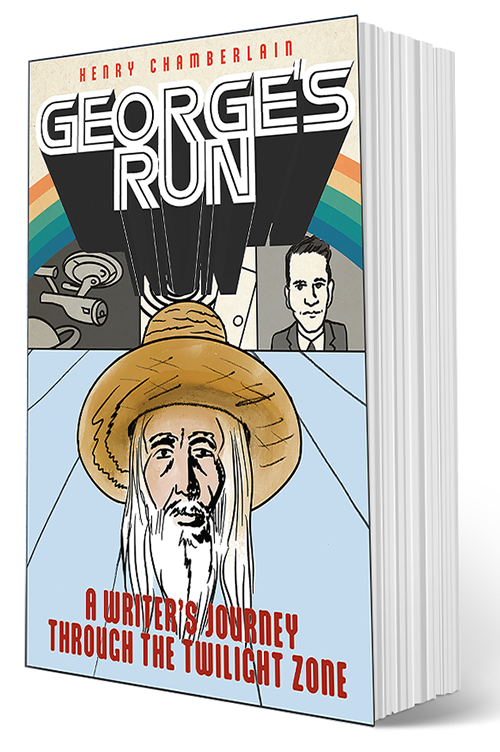
Those of us who create books of one kind or another must be mindful of the next step in our work’s journey, once it’s complete, published, and out in the world: the never-ending job of making more people aware of the book! My graphic novel, George’s Run: A Writer’s Journey Through The Twilight Zone, was published by Rutgers University Press in 2023. It was a pleasure to get a chance to give a talk and lead a workshop in support of my book at the Cartoon Art Museum in San Francisco.

Photos by Robbie Gomez.

The Cartoon Art Museum is a landmark in the local arts community and has the distinction of being one of the few museums dedicated to the comics medium. I have followed the museum’s progress since its time in San Francisco’s Yerba Buena Gardens neighborhood when Andrew Farago became its curator in 2005. Fast forward to 2017, the museum moved to its current location on 781 Beach Street on Fisherman’s Wharf. I’ve always found it to be a reliable source of inspiration with its impressive works on display, from new shows and its permanent collection. If you’re someone who has established a credible footing in this business of comics, you might find yourself invited to show your work here. I want to thank both Andrew and museum director Summerlea Kashar for helping make my presentation possible.

I have experience with leading presentations of one kind or another, notably a slide show lecture format which I first did when I led a panel discussion at San Diego Comic-Con. That said, I’ve been adding and refining notes attached to it ever since. I have found it easy to refer to notes and then break off into other directions. Lately, I’ve focused on an unusual zine that Marc Zicree (The Twilight Zone Companion) gave me a while ago. It’s a term paper he wrote in 1976, when he was 21 years-old. Marc’s paper features interviews with three significant figures from the Sixties zeitgeist: political cartoonist Ron Cobb; novelist Theodore Sturgeon; and television writer George Clayton Johnson. In his introduction, Marc makes clear how moved he is by Sturgeon’s uncanny ability to evoke the concept of love in his work. As for George Clayton Johnson, the subject of my book, Marc is mesmerized by George’s uncanny ability to speak virtually indefinitely on a wide variety of subjects. I carefully combed through Marc’s interview with George, and, just as important, Marc’s interview with George’s mentor, Mr. Sturgeon. What is clear is how much both men revered storytelling, which is at the heart of what my book is about–and, ultimately, my talk.

Once I start talking, I sense a detour up ahead. I had just mentioned the challenge of conveying the significance of a television show of the caliber of The Twilight Zone to a young audience unfamiliar with it when I found myself confronting a fresh new example in my audience for that day. Literally, only a few minutes prior, I had said that a young man had seemed to dare me at a comics convention when he told me outright that he’d never seen even one episode of The Twilight Zone. Right after that, a young man that day in my audience seemed to take it up a notch by telling me that he didn’t watch television at all. I was now juggling at least a couple of ideas going well beyond just being unfamiliar with a certain television show. Part of what I think was going on here is that the young man was, perhaps unintentionally, mirroring what I had just said. I gave it some thought and emphasized the fact that we all need to get as clear an idea of the big picture: seeking out great storytelling.

I went on to say that, when I’m given a dare to explain myself and make my case, I’m more than happy to break it down. In fact, the determination to break down ideas into concise and accessible elements took a life of its own in my book. That’s a vital part of the book: guiding the reader through the creative process that led to The Twilight Zone, one of the greatest works of television on many levels, not the least of which is the writing. My book is about the writers who made this possible. Overall, I think folks enjoyed what I had to say. Getting back to Marc Zicree’s 1976 term paper, one concept that keeps popping up is the steady encroachment of mass media and related distractions. This is well before even the internet and it already seemed like people were drowning in a flood of data. No wonder some young people today might think they don’t have time for “television.”  I know it was very helpful for me to give this talk and the feedback will help fuel the next one.

It was my intention to offer more than enough stuff to cover within my two-hour window. During the talk, I encouraged the audience to begin drawing their own tribute to their favorite TV show. By the end, we had a few interesting submissions. I want to thank Chartpak for partnering with me and providing the art supplies for this portion of the event. I will provide a separate post that features the Chartpak marker that I used for my art demonstration. I want to invite everyone to check out the Chartpak factory store for an incredible selection of art supplies.

Thanks again to the Cartoon Art Museum for an amazing event and I look forward to many more visits in the future. And special thanks to photographer Robbie Gomez for these amazing photos.

6 Comments

Filed under Comics

Nancy Burton, aka Hurricane Nancy, A Tribute

‘Good Eggs’ by Hurricane Nancy. Color by Henry Chamberlain.

Nancy Burton (1941-2025) was a great joy to work with here at Comics Grinder and, with great humility, I share some thoughts on her passing. Alex Dueben, who collaborated with Nancy on a collection of her work in book form, has just posted a wonderful tribute to her at The Comics Journal and I encourage you to read it. For some years, she would submit her artwork and I would post it with some accompanying text. Later on, I would add color to some of her pieces, just for fun. I asked permission and she was delighted. So, this went on for years, my accepting work from a legendary underground comics artist to appear here on my blog. It never occurred to me to ask Nancy if she ever wanted any further help in mounting art shows or creating a book. She submitted work. I posted. It was a fun and organic fit. She’s one of those special people who has entered my life who did not think twice about giving out a compliment, providing recognition. It is because of people like Nancy, one artist genuinely supporting another artist, that I have the inner strength to clearly see my worth as well as sincerely and constructively evaluate the work of my fellow artists.

So, what was it like to have a big name artist sending her work to appear on my blog? I grooved to her style right away. This was a very spirited and uninhibited style, which I love. It’s simply a person being honest and free but that can often be a very difficult, or complicated, thing for people. Nancy’s work invites you to enter her world as well as encourages you to create your own.

Nancy Burton began her career in art in New York City on the Lower East Side, in the 1960s. Talk about being in the right place and at the right time. As she related to me, it was a one-step-at-a-time process. You really had nothing to lose and you were encouraged to be as uninhibited as you wanted to be. Nancy’s work began to regularly appear in the underground magazines of the era: The East Village Other, Gothic Blimp Works, and It Ain’t Me, Babe. Over time, as she continued to explore and experiment, with gaps in between, she developed her distinctive work which included various anthropomorphic characters in a surreal landscape.

Give Peace a Chance!

Nancy’s work is very pure coming from a very primal place: a desire to express one’s self without getting caught up in editing the work before it has even had a chance to land on the page. That’s essential. There’s a magic and power to following one’s instincts, to letting your senses take over, to giving yourself over, mind, body and soul, to automatic drawing and then moving in step with the creative process wherever it may take you.

Art by Hurricane Nancy. Color by Henry Chamberlain.

Nancy’s art has a special language all its own. Within these images, there are pleas for common understanding as well as a rallying cry in support of individual freedom. Characters are lost in all manner of activity. You are left to do as you please with what is on view: speculate and/or embrace what you see.

Occasionally, Nancy would add a note or two, some comment to the art she submitted to me, and I’d reply personally to her and then perhaps some bit of it would appear within my description of the art I was posting. Maybe, at some point, I sensed she really needed to collect her art into a book. Then, it turned out, there was a book in the works. The first monograph of her work would be coming out, to be published by Fantagraphics. Well, we both shared in the anticipation.

When the time finally arrived, I wrote a review of it here and we accompanied that with an interview.

Some more time passed. And then I realized it had been a while since I’d heard from her. And then I received news of her passing away from her book’s collaborator, Alex Dueben. The news was provided to me. I processed it. I waited. At some point, I would share my thoughts and so I am doing that now.

To have a celebrated artist of the caliber of Nancy Burton be part of what I do here on this blog is a gift I will cherish for the rest of my life. If I thought I knew my way around, had already seen it all, her art, and most importantly, her friendship, are among those special things in my life that gently remind me there is always something new to discover for those who find a way to balance being humble with being bold. Nancy always believed in me.

2 Comments

Filed under Comics, Hurricane Nancy

Molly and the Bear by Bob & Vicki Scott book series review

Molly and the Bear: An Unlikely Pair and Molly and the Bear: Campers Beware. By Bob Scott and Vicki Scott. Simon & Schuster. (ages 8-12) 240pp each. $14.99 each.

Molly and the Bear is a syndicated comic strip by Bob Scott with a wide fan base going back to 2010. Bob Scott is a highly regarded cartoonist and animator who has worked with many of the greats in the comics industry including Jim Davis as well as with such high profile animation studios as Warner Brothers, DreamWorks and Pixar. Molly and the Bear is about an 11-year-old girl and her best friend, a very sensitive 800-pound bear. In partnership with his wife, Vicki, Bob turned this webcomic into a middle-grade graphic novel series. It is a wonderful collaborative project by two respected creatives in the world of comics and animation. The first two books in the series have just come out and I’m thrilled to share with you such a wildly inventive work.

“An Unlikely Pair”

Both of these books are coming out together and so make a perfect pair. That leads me to the title of the first book, “An Unlikely Pair,” which acts as an entry point, especially if you enjoy seeing two characters meet for the very first time. A big point I need to stress is that I’m always intrigued and overjoyed to see just how much quirky, artful and original storytelling is found within the pages of a book that has a younger demographic of readers. In this particular case, I firmly believe that Bob and Vicki Scott have achieved that classic “all-ages” appeal, and that has a lot to do with Bob’s refined sense of meeting the demands of a comic strip, traditionally meant to be enjoyed by any reader, whatever the age. This first book opens with Molly’s parents off to enjoy a drive and trusting their daughter to mind the home alone. This leads to Molly exchanging text messages with her pal, Harper, followed by her just dancing and enjoying a little freedom. But then, suddenly, a huge bear crawls in from an open window. In short order, Molly discovers this bear has some serious issues with living outside–and inside: he’s a complete mess who needs help. Molly decides to let him stay and just hope for the best. Of course, she will have to deal with Bear’s intricate system of worries. For instance, he’s afraid of heights, especially “mid-level heights.” Enough to boggle the mind of any therapist. And there’s your very unusual and funny premise.

Even if you are a highbrow comics connoisseur, I ask that you put on your white gloves, monocle and top hat and examine this work for yourself, just as you would any number of other works with a mass media following created by industry professionals (Carl Barks, Ernie Bushmiller, etc.). I think you’ll find the waters you swim here to be rather pleasant. Not only are the gags set up with precise timing but the compositions are consistently compelling. There is a level of skill here that can go underappreciated because it doesn’t call attention to itself but it’s there in every well-rendered figure and face, every well-established interior and exterior. I’m really charmed by the example above. Molly is luring her new best friend Bear to the safety of her bedroom with some ice cream, having him climb up a few stairs that he’s been terrified over. She manages to navigate a close call with her parents. By the next page, she races up the same stairs to check in on his progress and finds he’s overcome with a really bad case of stress-shedding. You see on these two pages Bear go through a roller coaster of emotions: from an all-time high to a lowest low.

“Campers Beware”

I actually read the second book first and only later went back and read the first book second. And I’m glad that I just leapfrogged into the material. Again, it’s all very polished and professional work with a certain subversive edge to it, just the sort of thing you find in all the old favorite animated TV shows like The Jetsons and The Flintstones. In the case of “Campers Beware,” Bob and Vicki deliver a hilarious story involving Bear beside himself attempting to befriend Dad while battling his fears of the great outdoors–and other bears. Really priceless stuff. Seek it out!

2 Comments

Filed under Comics, Comics Reviews

Introverts Illustrated by Scott Finch book review and creator interview

Introverts Illustrated. Scott Finch. Sold in Bundles of 5 ($25) at Partners & Son.

I turn to ambient music when I need an added kick of focus. Usually, it’s when I’m writing. I would never have a show or a podcast on in the background. No, I need something stripped down that will allow me to actually think when I’m writing or reading. Complete silence is quite nice too. Ambient music can be ideal at times. That’s what I did for this most unusual work by the artist Scott Finch. It helped in just the way it was intended to do: a means to push back all the added noise and clutter in life. Finch’s new work, Introverts Illustrated, is a collection of 21 mini-comics, meant to be accepted as a whole and, most likely, read in one sitting . . . or as many as you feel like, no pressure.

INTROVERTS ILLUSTRATED!

That’s the way it worked for me: to have the whole collection by my side and just dive in. I wouldn’t say it’s like reading through 21 issues of King Cat or even Superman. The experience is something different and, in its own way, a bit groundbreaking. I mean, you don’t usually see a creator presenting a whole series of individual works all at once. The tried and true method is to parcel them out one by one, just like the big mainstream comic book companies. Reading this work, in sections, I believe adds to its mystique, a work already in a full embrace with the sort of ambiguity you traditionally find in poetry and painting. In other words, take this more as a high art piece and less as anything resembling a traditional comic, indie or otherwise.

Diving into the work.

Scott Finch is a pure artist: someone who loves to experiment; who will create work just to see what happens; who will treat a project as something sacred that may end up never to be viewed by anyone else. That kind of commitment is what gives you something like Introverts Illustrated. Now, there’s a lot of things that can be said about this work and one of the most important is to just enjoy it and reach your own conclusions. There are a number of so-called gatekeepers and experts with their own theories as to what this project is about or isn’t about. I sincerely hope that I don’t fall into that group–or maybe I do–but I do my best to be self-aware. Anyway, I sense that what excites those of us deep in the comics cognoscenti is the sense that this is indeed one of those unicorns we keep hoping for: a work that you can really claim to be something different. Once a work of that sort is spotted, it’s like throwing chum into the waters where sharks await. Within seconds, the water spreads out a bloody spew of pontificating. Lucky for me, and you, I have taken the time to get to know the work and the artist. After this review, we proceed with an interview with Scott Finch.

Dig in!

One key concept, in all honesty, is ambiguity. Scott freely admits that he followed his muse and did it his way. His first priority wasn’t clarity. In fact, during our chat, I point out one fragment of text that is every bit as enigmatic as the art it accompanies. Now, that can be beautiful–and it is. But, like I’ve already stated, don’t expect this to be a typical work–but, oddly enough, don’t expect it to be cryptic either! It’s more like a series of dreams and, I believe you’ll agree, dreams do follow their own logic and often can be very lucid and highly accessible.

Issues of Introverts Illustrated.

Another key concept, to be sure, is the creative process. At its core, the backbone to this project, is automatic drawing. That’s where Finch started: one drawing after another, without thinking too much, just drawing. That’s the beginning of the process. Where you go from there is the next level of engagement. It can involve making numerous copies of various elements and arranging them, see what you get. Cut here. Paste there. Trace this. Redraw that. Things emerge, unexpected things.

Finally, I would add one more important concept: structure. You begin with the raw and make your way to the cooked. At some point, you add text, all the while staying true to what you’ve done before and letting it guide you. Getting back to dreams, there are a lot of paths following various dreams to be found here, all engaging, and delightful. If I had to be pinned down as to what is going on in this free-spirited tableaux, I would say this is a series of meditations on the human condition, especially the human who aspires to something different, to something artful, to something like this most unusual work.

When we talk about such matters as comics being an art form, something that’s been well established over the years, it can still be elusive to pin down. Sometimes, it’s found within more commercial work. And, sometimes, it is not found within indie comics. Within the rough and tumble world of any given comic arts festival, the reality is that it is as much a marketplace as a more obviously corporate-heavy major comics convention and it can be a challenging arena, even for unicorns. I sense that Finch is modest about the whole thing and will find his way. As an artist, first, he is more interested in some good old-fashioned artistic problem-solving and that will serve him well. Perhaps he’ll find the most success within a gallery space or whatever other venues and platforms may arise in the future. Finch will most likely follow the words in his own work regarding his career: “I make space for it. I do not seize it.”

“I make space for it. I do not seize it.”

Alright, we’ll end the review there. I encourage you to check out my conversation with the artist. During our talk, Scott not only explains what’s going on in this project but really opens up about his process which will undoubtedly resonate if you folks, whatever kind of creative work you happen to do.

1 Comment

Filed under Art, Comics

The Spawn of Venus and Other Stories Illustrated by Wallace Wood book review

The Spawn of Venus and Other Stories Illustrated by Wallace Wood. Seattle: Fantagraphics, 2025, 216pp. $39.99.

Review by Paul Buhle

The Great Bohemian of comic books’ grandest moments, Wallace (aka “Wally”) Wood drew like a genius for a number of publishers before falling to overwork, too many cigarettes and too much liquor. EC loved him the best, and it was a mutual feeling, notwithstanding the inevitable tensions of artist, collective/collaborative work process, and the reality of a boss.

Wally Wood in his prime, excerpt from “My World,” Weird Science #22, 1953.

This splendid volume collects some of his finest Sci-Fi—he was also among the greatest satirical artists for Mad Comics—from forgotten series titles like Weird Science, Weird Fantasy and Incredible Science Fiction of the early 1950s. It also offers much woderful contextual material, commentary by serious scholars—university professors but mostly otherwise—to individual stories and collaborations, from editors to scriptwriters to presumably lowly inkers.

Most “classics” comic art volumes these days contain a hat-tipping of industry insiders. Same here. Howard Chaykin, vaunted comic artist (and a short time assistant to  Wood)  does not have a lot to say beyond describing Wood’s talent, nor does the appropriately admiring Larry Hama, of today’s GI Joe, itself a remnant of another and in this case, less pleasant, aka Cold War, comics era. S.S. Ringenberg, a comic scriptwriter, and fan-interviewer works harder with a biographical introductory sketch that goes little beyond ground familiar to Woods devotees, but reminds us sharply of the nature of the self-destructive genius. Wood put a gun to his head in 1981, leaving no note. The career disappointments were real, especially for an artist who worked hard at improving his style. But by that time, two divorces and a separation, he became too exhausted to keep himself in check. Besides, the glory years of the older comic art had been long past, and he was not suited to the new comix generation. His barely controlled artistic id did not find a home in the ill-paying Undergrounds.

Meanwhile, in the substantial Introduction,Tommy Burns and Jon Gothold go through the stories one by one, in such detail that no biographer of a novelist may ever have done better. Do we need such detail? Perhaps not every reader will think so, but among the plot summaries, these scholarly-minded critics offer so many small insights that the net result is remarkable, and demands several readings for details.

Wood reached his apex, arguably, in adapting the stories of Ray Bradbury, and this tells us much of what need to know about the vital and lasting importance of Wood’s work. This reviewer came upon Bradbury’s writings around age 10 or 11, in the Republican political/cultural climate of Central Illinois where the perceptions of sophisticated New Yorkers, for instance, would have been unusual and likely mistrusted. Mad Comics explained McCarthyism in the most penetrating and hilarious fashion. Bradbury, who was personally close to the Hollywood Blacklisted, found ways in his stories and novels to explore the takeover of public space, the waning of the New Deal stress for reform in favor of forced patriotism, but also unapologetic commercialization of daily life. He saw the future and it looked bad.

Thus, famously,  Fahrenfeit 451 and The Martian Chronicles, made into feature films but only after the worst of McCarthyism had faded. Bradbury had been trying for years to send out warnings, even while he was making a living and a reputation (including a personal move to Hollywood)  in a Sci-Fi field with leftist underpinnings going back to the 1930s. He also badly wanted to escape being pegged as a “genre writer,” but never made it and did not need to: we loved him anyway.

Photo funnies tribute in The Spawn of Venus and Other Stories.

Wally Wood so internalized the logic of Bradbury that stories composed by others at EC somehow have the “Bradbury Touch” in addition to the EC Touch, which consists—leaving aside the art— in terse scripting and a surprise ending. Like the alien civilization in “He Walked Among Us,” where the Savior was actually an Earthman who preaches love and forgiveness is executed. Two thousand years (!) later, another Earth visitor learns that the aliens’ holy symbol is the rack, aka cross, where the presumed savior was tortured to death.*

You get the idea. Human folly in the Atomic Age has become toxic. Wood could have predicted what a willful destroyer like Musk would write about opening up the need for “planetary” civilizations when Earth has been plundered beyond repair.

Not that all the stories are like this. And Bradbury could not have featured the scantily-clad beauties, alongside the virile young males, that seemed to be a specialty for Wood. Earthmen fall in love with alien females who assume a delicious human form only… to revert back, inspiring horror. Humans landing on a distant planet learn that the babies born to them, urgently wanting love and care, may have a dozen arms and look like octopi or something else weird (in this case, mommy does not care, which sounds right).

How were Wood’s females all so young and buxom, you might ask? The mostly male and young readers of these comics didn’t likely ask at all. The happy dreamers of another story are space explorers kidnapped to service the all-female population of a planet whose males have died out after a war. The “scientifically selected” dames look awfully familiar.

Wood could also favor social criticism–with a dark turn. In one story here, tens of thousands of Earth people who disappear in bunches, every few hundred years, turn out to be farm edibles, as a scientist explains over…a turkey dinner. Actually, this was an EC Sci-Fi trope several times over, like the aliens in another EC comic who capture interplanetary humans to use their skins for…fashionable minkish coats, and so on. Why do we egotistical Homo sapiens think we can abuse the animal kingdom?

From “Spawn of Venus”

Wood also loved the occasional in-joke, with a drawing of himself in the final panel. Here, EC Comics miraculously predict unexpected events, like the appearance of flying saucers, or the rise of surgical sex change (think “Christine” Jorgenson in tabloid headlines of the time). A jowly comics publisher (could it be plump William Gaines, who inherited EC when his father died in a boating accident?) wants them to take “a loyalty oath” (cue to Joe McCarthy). After some alien hi-jinks, the real Wally confesses that he and his fellow artists are actually disguised Venusians saving the world from horrible-looking Martians!!! What those helpful Venusians might look like beneath their disguise…we will never know.

In the real world, EC’s marvelous Sci-Fi, “Real War” and humor series (MAD and PANIC) never reached the sales level of its various, blood-dripping but also deeply satirical horror comics, also full of plot reversals and revenge-justice. Gaines was called upon, in the famous Congressional hearings (held in the same Manhattan courtroom as “Red” hearings a few years earlier), to explain the horror as something less than dangerous to young minds. The inquisitors weren’t listening to his answers, and the guillotine blade fell on a glorious moment in popular art.

Wally Wood outlived his time, this is the tragedy of his life and not only his. Harvey Kurtzman and his trusted artists hit their peak as satirists, also arguably as editors and artists, in their twenties and early thirties. Some became highly successful illustrators. None could recapture the magic.

Paul Buhle

*Let it be known that the Ray Bradbury Museum rests in the blue collar city of Waukegan, Ilinois, which only happens to be my wife’s hometown.

Leave a comment

Filed under Book Reviews, Comics