Tag Archives: comics

HURRICANE NANCY book review

Hurricane Nancy. Nancy Burton. Fantagraphics. 2024. 112pp. $30.

If you are looking for something that is truly authentic and distinctive, then turn your attention to the underground comix superstar Hurricane Nancy. She is the real deal and her new book showcasing her career in comics art has been recently published by Fantagraphics.

I have gotten to know the art of Hurricane Nancy bit by bit, as it has appeared here on Comics Grinder. From time to time, I have added color to her iconic black & white artwork. Ultimately, the work must be respected in its original form. I think my impulse to add color comes from the fact the art emits so much energy, a colorful force all its own. This is wild and wooly and defiant work. At its heart, this is work coming straight out of the Sixties counterculture at its very nexus on the Lower East Side of New York City. These are highly uninhibited flowing lines, oozing and spilling across the page about protest, outrage, sex and simply being alive.

True to form, Hurricane Nancy does whatever she likes, going back to the first comic strip, Gentles Tripout, in 1966, in The East Village Other. This first foray into “art comics” lets loose a young artist’s instincts, part rebellious, part Alice in Wonderland trippy. These early comic strips lead to full page explorations with Busy Boxes. Things rapidly progress into full-on drawings, moving well beyond sequential art considerations while still embracing comics as part of the tool chest.

Once we reach the more recent section of art in this book, “Artwork 2010 – Present,” I’m on more familiar ground. More mature and evenly paced? Perhaps what this book helps me appreciate is that a lot of what Hurricane Nancy is about was always there from the start.

One thing I always come back to is the idea that we can never have enough comics art in galleries and museums. I think this first time collection of the work of artist-cartoonist Hurricane Nancy is a brilliant step forward for artists, women artists, comics artists, you name it. You can consider it the art catalog ahead of the museum art show. Seriously, this book presents the work in a very appealing way, on a black backdrop, complete with a highly insightful interview between writer Alex Dueben and the artist.

This is how it’s done. If you are an artist in search of a bigger audience, you create the party and you bring the people to it. This book is such a party and you are invited.

7 Comments

Filed under Book Reviews, Comics

Over For Rockwell by Uzodinma Okehi book review

Over For Rockwell. Uzodinma Okehi. Hobart. 2015. 344 pp. $12.

It’s always been for me a search for the authentic, the different and the real. That is what leads me to this gem, a real dreamer’s notebook: Over For Rockwell, by Uzodinma Okehi. This deliberately pint-sized book, a collection of prose short stories, packs plenty of punch with Blue Okoye leading the way, a protagonist feverishly seeking the euphoric stuff of life.

Art by Uzodinma Okehi.

Perhaps Blue Okoye is an alter ego for the author. Very good chance of that–or at least a jumping off point in the tradition of, well, just about every audacious and ambitious young writer out to suck the very marrow of existence. Our story has much to do with a young man pitted against, and madly in love with, the big city. Which big city? Well, New York City, of course, is front and center but also the BIG CITY in general and that leads to adventures overseas, particularly Hong Kong. Our hero is up to his eyeballs in frenzied lust for life: out to create great art and bed every beautiful woman he can charm. Yes, all the hot and classic stuff, before some people lost their nerve to go all-out Hemingway. This is a collection of loosely connected observations, some twenty years ago, and then going even further back, but it all rings true and has a timeless quality to it. In fact, the narrative is structured in such a way that has Blue Okoye on his excellent adventures spiraling through time. We begin circa 1995, jump around to 2003 and beyond, and land back in 1995. All to show that the shaggy dog stories from our salad days share much in common, transcend the boundaries of time.

The novel is very clever and fun to read, even if it doesn’t have much in the way of a plot, at least not in the traditional sense. Okehi defies convention at every turn, delivering a series of observations that resemble a story but doesn’t adhere to any rules. This main character appears to be perpetually on the make, dreaming big dreams, and colliding with the reality that he will likely never be a so-called “success.” At times, a lot actually, Okehi questions the goals we’ve been told we must achieve: the soul-crushing game of gaining notoriety. Was it ever in the cards for our hero, Blue Okoye? Success is a very hard thing to pin down, especially if you keep feeling the need to roam the streets at night in search of some elusive epiphany, notebook in hand, ready to jot down inspiration as it beams down upon you. So, yeah, Okehi has fun with the starving artist tropes for all they’re worth. No matter how hard you try to pry it from him, your dim-witted co-worker at the warehouse is probably not going to blurt out some piece of inadvertent wisdom that you, as the artist, can mine for gold.

One of the really interesting things going on in this very quirky novel is the send-up of the indie comics community. Blue Okoye is supposed to be an aspiring comics artist although there is very little to indicate why he is pursuing this line of creative work and what he hopes to achieve. And perhaps that is the whole point. Blue Okoye is simply performing a role. He plucked out a purpose in life from all the cool and hip options before him and he’s sticking to it. Okehi doesn’t only depict Okoye as shallow but all the other comics artists he knows seem to be treading water as well. Ah, the folly of youth. Will Blue Okoye mature in time and find some real meaning to life? Well, that’s for another novel. This novel is all about floundering and, on that subject, it succeeds with flying colors.

Also available from the same author is House of Hunger, a continuation of the Blue Okoye adventures. I think, if you’re new to this, it will be a lot of fun to dive into either work and let it take over. After taking a look at both, I appreciate the indie connection more as Okehi is basically treating all these prose short stories as content to publish in the small press community and/or as short works in a zine format to be sold at small venues, especially various zine and indie comics festivals, to perhaps be later collected into a book. And, of course, the overriding theme of these stories invariably is about this indie/small press community. Works for me.

Leave a comment

Filed under Book Reviews, Books, Comics, Reviews

Emil Ferris My Favorite Thing Is Monsters Review via Notes

“My Favorite Thing Is Monsters” Vol 2 (of 2) by Emil Ferris

Notes on Emil Ferris’s My Favorite Thing Is Monsters, Books One and Two by Nick Throkelson

Editor’s Note: In keeping with the unconventional spirit of the work being reviewed, cartoonist Nick Thorkelson presents a review within a collection of notes on the two-part epic work by Emil Ferris.

Emil Ferris draws over rules. Ha!

The following notes assume some familiarity with Emil Ferris’s comics masterpiece, My Favorite Thing Is Monsters, published by Fantagraphics, now available in two volumes. For those who haven’t had the pleasure, suffice it to say that it’s a story set in the 1960s, as told and drawn by young Karen Reyes, about her coming of age in the Uptown neighborhood of Chicago. Karen identifies and depicts herself as a monster, not (except in one instance) as the innocent and plucky girl that others see. And she tells her story in a notebook, whose binder coil and holes and rules are visible on every page.

“My Favorite Thing Is Monsters” Vol 1 (of 2) by Emil Ferris

Karen’s self-portrait. Karen draws herself not just as a monster but as a stereotype of a monster. Her jaw is spherical and her teeth are perfect cones, while the heads of other major characters like Deeze, Franklin, and especially Anka are malleable and protean — they react and adapt to circumstances. In that one instance where Karen appears as she is seen by others, her face becomes protean too, even as its irregular shape clearly justifies the geometric shape we usually see. The set of her mouth and jaw express hard-won courage in both versions. see.

The mob. At the end of the opening sequence in Book 1, the ugly citizens with pitchforks hunting monsters are called “M.O.B.,” which stands for “Mean, Ordinary, Boring.” What a perfect description of unfree America! Karen says, “What freaks me out is that one day they could turn me into one of them.”

Karen does not fear the mob the way the mob fears her. She writes, “Humans are afraid of death and it makes them frantic. The undead don’t have a ‘self-esteem problem.’” Does the fear of death negatively correlate with self-esteem? Actually, all the major characters in Monsters have a self-esteem problem, but what unites the (sympathetic) ones is that they acknowledge their inner monstrousness instead of pretending it’s not there.

The neighbors. Karen and her mother and older brother Deeze (Diego Zapata Reyes) live in an apartment building with a number of offbeat people. Mrs. Gronan, the gangster’s wife who lives upstairs and has the hots for Deeze, is introduced in Book 1 as an unattractive woman so fabulously decked out that she looks sexy. In Book 2 Karen observes that Mrs. Gronan is pretty as long as she doesn’t try to smile.

Anka’s eyes. Anka, a beautiful holocaust survivor married to a jazz musician, also lives upstairs until, early in Book 1, she is murdered. Eyes—intense, beautiful, and threatening—appear throughout both books, but the eyes of Anka are the saddest.

Hatch lines. The blue and red pen lines used to draw Anka’s skin could almost be her arteries and veins. These complementary colors blend and cancel each other out, so that her face looks like porcelain. In a flashback, she arrives at a Nazi concentration camp, perhaps Theresienstadt, set up to look like a humane facility in order to fool visitors. But the bakery worker is a mannequin with cracks in his “skin,” which remind us of the knife wounds on the face of Karen’s Black classmate Franklin, inflicted by a homophobic gang when he was young.

Franklin’s face. Karen says, “If all the pieces fell away, I got the idea that what was inside him was a big ball of white light.” His scarred face is reminiscent of Frankenstein’s Monster, or the Willem DaFoe character in Poor Things. Franklin illustrates Karen’s idea that Frankenstein was a “skin-tight Prometheus variously coded as Black and queer” (odd language for a 1960s kid, but no matter). Franklin’s scars were inflicted to destroy, unlike the ones on Mary Shelley’s monster that are the marks of an attempt to create life.

Franklin as Françoise in Book 2 hides her scars with makeup, and turns out to be the most soulful Patsy Cline imitator anybody has ever heard.

Commercial art. At one point in Book 2 we see part of an illustration Deeze did for a science fiction novel by his friend Jeffrey Alvarez, a.k.a. The Brain. This sets up several pages concerning Deeze’s second career as a commercial artist (in his day job he’s an enforcer for a loan shark). Deeze may well have created many of the monster comics covers that Karen uses to set off sections of her story. A treat. For comics nerds like me it is enjoyable to learn that Deeze plagiarizes himself. He creates a frightening monster called The Lurch for one of his comics covers and then repurposes it as the repulsive mouth of a different monster, Mothman. This is reminiscent of real life comics legends like Wallace Wood who plagiarized themselves when pressed for time.

Another treat. We see many covers of a horror comic called Ghastly, and they feature a cartoony master of ceremonies in the upper-left-hand corner. This character could have been drawn by Harvey Kurtzman. Similarly, in real life, the emcee character that appeared on covers of the great 1970s-80s Eerie comics series was drawn by Jack Davis, Kurtzman’s frequent collaborator. Image quotation. The re-drawing and re-purposing of art occurs constantly in Monsters, sometimes based on comics imagery but just as often based on the “high art” that Karen encounters at the Art Institute of Chicago, and in Deeze’s art books.

Not every quotation from a famous artwork is acknowledged as such. A parochial school art teacher, remembered fondly by Karen in Book 2, is first seen as a witch on the cover of Dread (another magazine with a comical M.C. in the corner). In Karen’s memory she is a sweet-looking lady, but on the Dread cover she looks just like the grotesque profiles of Jesus’s tormenters in Hieronymus Bosch’s Carrying of the Cross. Grotesques. Ferris’s (i.e., Karen’s) Chicago is full of racists, homophobes, sadists, the ravaged and empty. One group portrait of the surly M.O.B. looks like an homage to George Grosz’s 1920s Berlin etchings. A contradictory image, of everyday Uptown people on the street, has a caption telling us that most of them are migrants and all of them are riders on the “Royal Shaft Express,” as Deeze calls it. These faces are ravaged but not empty.


Slouching towards androgyny. After recreating a painting of Oedipus and the Sphinx in which the Sphinx is a pretty woman, Karen imagines Oedipus saying, “I’m scared of the part of me that is you.” The Sphinx replies, “That part is bigger than you think.” It turns out that women know, and men need to know, that we are all part male and part female. Karen and Deeze illustrate this by mirroring each other.

Hey hey we’re the. Karen says of one of the first girls she crushes on: “Missy’s bedroom used to be monster-themed but now it’s covered in Monkees posters and these big horrible flowers” — Monkees and stylized 1960s flowers being emblems of sexual and sentimental self-presentation, as opposed to monsters that function as emblems of unrestrained nature and difference. As Peter Tork’s brother I defensively object to the idea that the Monkees were fakes, but that’s another story.


Fire. Karen, usually stoical and observant, becomes an aggressive monster flame-thrower when  she learns that Deeze has been hiding their mother’s terminal illness from her. Karen expects to be betrayed by the M.O.B., but not by those she loves.


Paintings. Karen and Deeze bond over their shared (or negotiated) responses to the treasures of the Art Institute of Chicago. The magical romantic projection of themselves into the academic story-paintings is consistent with the theme of adolescent rites of passage.
Ambroise Fredeau’s painting The Blessed Gillaume DeToulouse Tormented by Demons (1657) certainly fits. In Karen’s reading, the painting says that good monsters frighten us because they can’t control how they look, and bad monsters frighten us because they demand control.


The minor character Salvatore is a bad monster observing us from the top floor of a skyscraper, and he is simultaneously German, Italian, and Japanese, i.e., the Axis powers.

The Greens. Anka has a “Viewmistress” covering the bullet hole in her chest. Karen steps through the hole and finds more paintings. As a near-contemporary of Karen, I identify them as the academic paintings we were taught to disparage in the days of triumphant modernism. (The paintings’ dates are 1790, 1865, 1875, 1886, and 1906, bringing us right up to the surrealist revolt.)

This sequence culminates in a two-page spread, “Green Island,” a fever dream of solace where a branch overhanging a rapids turns into a skeleton’s hand groping a breast or buttock. For me, Green Island evokes the “Green Door” of H.G. Wells and Jim Lowe (Wells wrote a story in 1906 of an elusive green door leading to happiness, and Lowe had a hit record in 1956 where he couldn’t get through the Green Door leading to a rocking party.)


A Cool Breeze. The sky in Alpine Scene by Gustave Doré, as depicted by Karen, is full of fuzzy stars “like the tangled strands of pearls in Mama’s jumbled jewelry box.” The actual painting is set in daytime and is only dark because of the towering evergreens in what looks like the Black Forest. The original, like Karen’s version, has a tiny male figure as its focal point, but it also has a second figure, perhaps a sweetheart, that Karen leaves out. The famously gloomy artist Doré sees companionship and a cool breeze in the shade, where Karen sees solitude and mortal dread.


Victor. At the end of Book 1, Karen turns and sees Deeze but it’s not Deeze, it’s Victor, the twin brother that Deeze killed (by accident?) when they were children. Victor, who will become an important character in Book 2, seems to float among the fuzzy stars and the eyes of Anka, not to
mention the holes in the notebook pages. Sexuality of the monster trope. In the Dracula story, woman’s irrationality/hysteria is the flaw that lets evil insinuate itself into polite society. In Monsters, society is never polite and Karen’s awakening gayness is the armor that makes society bearable, at the same time that it is her authentic self.


Chicago. I love all the drawings of Chicago and wish there were more. In one full-page drawing of Karen and Deeze on the bridge over the Chicago River, near the end of Book 2, the golden evening light from the West butts up against the pale blue light coming off of Lake Michigan to the East. Not naturalistic but it certainly puts you there. But no act of virtuosity exists for its own sake in Monsters, except in the sense that Karen might like to show off her drawing chops sometimes. That poignant picture of the Chicago River at twilight feels like it’s there to foreshadow the imminent ending of Deeze and Karen’s rich Chicago life.


The invisible man. In Book 2 the lost or missing father of Karen and Deeze materializes as a vicious tramp and a surrogate for the biblical Holofernes, the supposedly invincible warrior beheaded by Judith so that her community could survive. Many different paintings of Judith killing Holofernes are reproduced, mirroring Karen’s obsession with, and ambivalence about, violence and female power.


Later. The notebook/journal format of Monsters allows major story points to be implied or passed over, not stated or concluded plainly. It’s as if Karen says to herself, “I will never know what happened when I took Deeze’s gun and went looking for my father, but never mind, let me move on to the stuff I’m actually trying to understand.”


In Book 2 we frequently hear some form of “I’ll tell you more about this later,” which doesn’t happen.

Another example. The episode in Book 2 featuring “the preacher guy” and his female followers seems too brief after such a tantalizing setup, but I appreciate the idea that these sinister characters are going to do what they do, for better or for worse, and we don’t need to know what that is. Unanswered questions feel more true to life than the typical wrapping-it-up ending to a murder mystery.


Except for this. In Book 2 we learn that Deeze is a killer, and we already know Anka is a murder victim. Also in Book 2, Deeze denies that he killed Anka. Well, actually, he denies that he meant to kill her. But even after two fat comic books, we don’t know how or why she was shot, do we?
We do hear, or seem to hear, a jealous Deeze say to Anka, “I’ve always been a big distraction for you, haven’t I? And then you throw me a look and I come running. I should put a goddam bullet through your heart!”


On the other hand. We learn late in Book 2 that the police wanted to frame Chubb, the ventriloquist in the building, for Anka’s murder. This doesn’t make sense if Deeze was the killer, does it? The cops all have it in for Deeze because Deeze’s father, Frank, was once a cop and he wants his former fellow police to make Deeze suffer for the death of Victor.

And on the other other hand, just because somebody wants to frame you doesn’t mean you’re innocent. Could it have been the lovesick ventriloquist, impersonating Deeze, that threatened to shoot Anka, and did so? I suppose we’ll never know.

The sixties. The main thing we know from Book 2 is that Karen and Deeze leave Chicago, which seems all but impossible except they’re being hunted by the police and, anyway, leaving home is what young people did in the 1960s.


From one angle, Monsters is a perfect sixties story, “the sixties without apology.” We monsters of that era needn’t apologize for being freaks, for rebelling, for facing sexuality head-on. Ferris doesn’t say this but it occurs to me that we have spent all the decades since then wondering whether we may have been turned “into one of them.”
3 Comments

Filed under Comics, Graphic Novel Reviews

FUNNY STUFF: Great Cartoons Dissected

Funny Stuff: How Great Cartoonists Make Great Cartoons. Phil Witte and Rex Hesner. Forward by Bob Mankoff. Prometheus Books. 2024. 150pp. $28.95.

If becoming a New Yorker cartoonist had an employee manual, FUNNY STUFF would be it. Here you’ll find the secrets to making great cartoons from some of the greatest cartoonists in the business. Your guides are two of the best authorities on such things, Phil Witte (a great cartoonist in his own right) and Rex Hesner, co-writers of the blog, Anatomy of a Cartoon, which you can regularly read at CartoonStock.com.

New Yorker cartoon by Michael Maslin.

As a cartoonist myself, I am very sensitive and self-aware about the whole subject of cartooning. And, just like anyone else, I can get cocky and think I already know enough about how to make a great cartoon. But, hang on, this book is truly useful, something different, and I’m thrilled to share it with you. As someone who completely loves cartoons, particularly New Yorker cartoons, I can honestly say this is a book you must get. So, enjoy the rest of this review and then come back this upcoming Tuesday for an interview with the authors to this wonderful guidebook on cartoons.

New Yorker cartoon by Joe Dator.

For something this worthwhile, I’m happy to spring into action. What excites me about this book is that I actually found the text compelling and highly relevant. You know, let’s be honest, sometimes you just want to view the cartoons in some of these collections but, in this case, I found an orderly approach, filled with insights, that really motivated me. People will read this book for a variety reasons but, I suspect, a main driver will be to get some tips on how to make better cartoons. Or, more broadly, how to better understand the unique humor behind New Yorker cartoons. This book has its own unique way of addressing the artwork and the caption, and how these two components work. On top of that, the authors have interviewed many of the great cartoonists so, one way or another, you are getting this from the horse’s mouth.

New Yorker cartoon by Phil Witte.

Is this book for you if you are not a serious student of the art of cartoons? Yes! In fact, put any concerns about being serious aside. This book can be enjoyed on different levels. If you want a fun look at some first-rate cartoons with the option of scanning a few bits of insights, so be it. And, if you’re enticed to read at a deeper level, so be it. The point is that the book has been created in such a way, I think, that it appears as if it takes some of the mechanisms involved in luring the reader into reading a great New Yorker cartoon: simple and intriguing, at first, with a thought-provoking sensation taking hold. Well, something like that.

Leave a comment

Filed under Book Reviews, Comics

Paul Peart-Smith Interview: Adapting ‘Souls of Black Folk’

Paul Peart-Smith is an accomplished artist, illustrator and cartoonist. In this interview, we focus on his recent graphic adaptation of the landmark work by W.E.B. Du Bois, The Souls of Black Folk. Back in 1903, when the original was published, it was as if Du Bois was anticipating the internet with his multi-faceted presentation, a taking stock of the status of Blacks in America after Reconstruction. I think this graphic adaptation is, in its own way, also in answer to the many distractions (along with a very real internet) that can get in the way. The original is essentially a collection of thoughts, some subtle, some direct, in the service of appreciating where Blacks stood in these United States of America after the Civil War and is a timeless classic that remains relevant today. This unique graphic adaptation compliments the original and adds to our understanding.

As I try to impress upon anyone, I have a long history with comics. When I tell you that Paul Peart-Smith’s book is something special, you can believe me. I think a lot can get lost in the whirlwind of media. I know that certain factions in this or that sector of the publishing world stake their claim and it’s hard to get noticed. That said, what I love about this book is that it feels like, and truly is, a patiently assembled thing that will always be there when you’re ready for it.

The art of any successful graphic adaptation is in how the artist evokes the written work in a very palpable way, going into the mind’s eye of the reader. During our conversation, Paul shared with me how he constructed the above page. Playing off the fact that Du Bois was keenly aware of his white readership, wanting them to be part of the conversation, Peart-Smith creates a scene depicting a lynching that mixes the Black existential crisis with the epitome of Western cultural angst, the existentially rattled Hamlet.

This book is published by a university press and, with that, comes some sense of permanence. As long as Rutgers University Press keeps it in print, it has a healthy life ahead of it. Perhaps that is the answer for some honest hardworking cartoonists with a project they aspire for the ages and not just to make a quick splash at a comics festival or one promotional cycle. For those select few cartoonists out there, the right fit at a small press could be rewarding. And yet reaching a wider audience beyond your niche readership is a good thing too. How could it not be? So, one does what one can.

One succeeds in the comics market, like any other market, by taking most things with a grain of salt. What may seem like an all-important moment will likely be but a mere blip. Real staying power requires taking the long view and just being patient. What becomes clear is that Paul’s love of art and storytelling has guided him along.

Paul relates to me during our conversation a lifetime of being ready for when opportunities arise. If he hadn’t submitted some of his work to the Sci-Fi anothology, 2000 A.D., when he did, he may have continued on a different path, perhaps going deeper into animation.

Worse Than Slavery by Thomas Nast, 1874.

Fast forward to more recent times, if Paul Peart-Smith had not made contact with the great comics authority Paul Gravett, he just might have missed out on Souls of Black Folk. One thing led to another, Paul Gravett put Paul Peart-Smith in touch with the man directly connected to this new exciting Souls of Black Folk project, Paul Buhle. So many factors need to be in place and that includes a good dose of serendipity. Three Pauls in a row!

Excerpt pages from One Plus One.

Of course, there’s always more to the story and, as Paul related to me, it was a small work entitled, One Plus One, a mix of slice-of-life and social commentary, that led, down the road, to Souls of Black Folk. That piece appeared in the popular webcomics collective ACT-I-VATE and people in the industry, Paul Gravett included, took notice.

A career in comics has to do with making yourself known and available. The comics market is, in part, a game with a number of players jockeying to be known and remembered. In the case of Paul Peart-Smith, he can confidently let his work do a lot of the talking for him.

It was during our discussing the last chapter in the book that we came back to the power of mass communication, and how it is harnessed. The last chapter to the book is entitled, “Of the Sorrow Songs,” a look back at Black spirituals, with their origins in slave songs, and their power to inspire and inform. The fact that W.E.B. Du Bois was focusing in on the power of the songs, says it all. As Paul related to me, it brought back to him Chuck D, of Public Enemy, and his famous quote: “Rap is Black America’s CNN.”

Paul Peart-Smith has a couple of new titles out on the horizon as well as an amazing newsletter you should join. With Inkskull, you’ll get all sorts of tips and insights into comics, life hacks and much more.

Paul provides a graphic interpretation of Roxanne Dunbar-Ortiz’s Indigenous Peoples’ History of the United States, published by Beacon Press, and out October 2024.

Romanis Magicae is a Roman Empire supernatural adventure. Paul illustrates the script by creator Matthew Blair of this ongoing comic book series.

And so I hope you enjoy the video conversation. As always, your VIEWS, LIKES and COMMENTS are welcome directly on the Comics Grinder YouTube channel.

Souls of Black Folk: A Graphic Interpretation is published by Rutgers University Press.

Leave a comment

Filed under Comics, Interviews

Zack Quaintance Comics Chat: About a Bookcase

When was the last time you encountered a werewolf priest? Well, comics writer Zack Quaintance has got you covered! We discuss Death of Comics Bookcase, Vol 1., a highly engaging, whimsical and magical comics anthology that pays homage to a number of inter-related subjects, including Zack’s dead (or is it?) blog, Comics Bookcase. For more details, check out the Comics Grinder review.

If you follow this blog closely, then you know that I’ve been quite intrigued with this comic book based upon the creator’s comics blog. How often does something like this happen? Maybe never? Well, I created my own comic book based upon my own comics blog, the one you’re reading right now. I figured I was all alone in this unique endeavor but, heck, the more the merrier. In fact, it was great to chat with Zack. My ongoing comic book series, Pop Culture Super-Sleuth, is a somewhat different animal in that it focuses on one main evolving story at a time, with various side trips along the way, while Zack’s is a full-on anthology.

The thing that keeps writers going is knowing their work is appreciated. They will write what they write no matter what too, don’t get me wrong. But it’s nice to share thoughts with another reader from time to time and even a fellow writer when possible. And, in this case, I think it’s safe to say that Zack and I are on the same page, don’t you think? I mean, really, it’s not every day that I chat with a fellow comics writer and reviewer who also happens to be working on such a similar project: a comic book about a comic book blog. I don’t know. If I think about it for too long, it makes me a little dizzy. No, I’m kidding. I am kidding, aren’t I? I’ll be fine. I think you’ll enjoy the interview, that’s all that matters. Check it out right below and then proceed to YouTube and Like it and Comment. That’s always appreciated.

Be sure to stay tuned on further developments and how to purchase your own copy of Death of Comics Bookcase by following Zack on social media and by going to the Comics Bookcase blog.

2 Comments

Filed under Comics, Interviews

SELF HELP #1 comics review

Self Help #1 w. Owen King & Jesse Kellerman. a. Marianna Ignazzi. Image Comics – Syzygy Publishing. Pub date: June 19, 2024. $3.99.

During a recent conversation, the topic of what comics are most interesting came up. I usually begin by saying I love offbeat material and I go from there, often looking for a current example. Well, this is it. This comic has that X-factor I find most satisfying, something I find in the best stuff that Image Comics has to offer. So, in this case, we have a classic doppelganger story, straight out of a classic Twilight Zone episode and yet with a distinctive vibe all its own carried forward by a perfect mix (in script and art) of the new and the retro. And that’s significant since it’s not just a pale imitation but firmly part of a dark fantasy tradition.

If a first issue has only one purpose, it is to hook the reader in a big way. That happens here, with that special brand of uncanny contemporary flavor in Image Comics. This comic feels like it’s now and the characters are simple and accessible examples of our current situation: a nice big and scary California noir tale. You have Jerry Hauser, a driver for a ride-share company. You have Darren Hart, an A-list life coach, the kind who can fill up arenas with fawning followers. One guy a loser. One guy a winner. And they both look exactly alike, and then they have a fateful meeting. With this crisp premise, the rest of the story takes on a life of its own and it looks like this one will keep that promise.

The look and feel of this comic, thanks to artist Marianna Ignazzi, coupled with the intelligent script by Owen King and Jesse Kellerman, all adds up best-of-year material. Take note that this comic is part of the new Image Comics imprint, Syzygy Publishing, with an impressive lineup all its own. That may help provide that last nudge to seek this title out. Also, by all means, keep in mind the all-star talent behind this work: two heavyweight writers and one killer artist. Yes, this one is a winner with a full tank.

Rating: 10 out of 10

Leave a comment

Filed under Comics, Comics Reviews

The Death of Comics Bookcase, Vol. 1 review

The Death of Comics Bookcase, Vol 1. w. Zack Quaintance. Art by Nick Cagnetti, PJ Holden, Luke Horsman, Ryan Lee, Anna Readman, & Pat Skott. 48 pp. Funded via Kickstarter. Original Comics Bookcase.

A comics bookcase host.

A werewolf. A teen-aged superhero. Dueling wizards. An old man. Super-powered gorillas and sharks. These are characters with nothing in common in the real world. However, in Zack Quaintance’s imagination, they come to life and share their fears and misgivings about their own realities. There’s even a talking bookcase going through its own existential crisis, something of an alter ego for the author. This comics bookcase acts as a Rod Serling-like host both introducing each story in this comics anthology while also confronting its own peculiar mortality. You see, the possessed bookcase plays many roles, including that of a former comics blog. In fact, the author was once the host of his own comics blog, Comics Bookcase. If that sounds weird and intriguing, then you’re in luck, since there’s more I can tell with you.

Life is made up of much that is ineffable: the stuff that is beyond our meager grasp and simple discernment, be it grand or mundane, to fully understand and articulate our own existence. We miss a lot. We take in what we can. One thing we humans do well, it seems, is to come up with ways to pass the time, like the creation of comic books. It is with this lofty preamble, that I offer to you the comics world of Zack Quaintance. This writer has been up to quite a bit in the last few years, all in the service of storytelling, leading up to his comics anthology, The Death of Comics Bookcase. This 48-page comic (with a deluxe version well worth seeking out too) is the first volume in a proposed series. This comic book is loosely based upon Zack’s Comics Bookcase blog (2018-2022), its demise and the stories it has inspired.

That’s one freaky werewolf!

What happens within the pages of this comic book is something of a love letter to comic books as well as an impressive showcase of comics talent. Yes, we have stories, much in the spirit of some of the most celebrated anthology formats, from The Twilight Zone to Tales from the Crypt. The idea here is what it’s always been: to provide some thrills and chills along with offbeat humor. What really stands out for me is the variety of stories, mixing different genres and viewpoints, all held together by a certain dark fantasy sensibility. Some might call it, “a touch of strange,” because that’s really what’s going on here. It’s a particular strain of spinning yarns that has been brewing for at least a couple of hundred years, reaching new heights with the advent of pulp fiction and fully blossoming into what we have come to know and love as modern horror or dark fantasy.

Art by Nick Cagnetti.

Let’s dive deep into this comic book and consider one of its stories, “Responsibili-Teen.” This is a homage to Steve Ditko and proposes not only an off-kilter Ditkoesque comic book superhero for the age of social media but a clever analysis of where we seem to be heading with ever-expanding Big Tech, particularly, AI. Because, well, AI seems to be both the great boon and the great threat to humanity that we can’t seem to get enough of talking about on . . . er, social media.

The new-and-improved does battle with the ineffable.

In this story we meet a character as familiar as our own childhood and as up-to-date as our latest post. Meet Maxwell, a dorky high schooler, with no parents, being raised by his Aunt Jen and Aunt June. This would-be Spider-Man is even more repressed than the original. No radioactive spiders for this guy. Instead, Maxwell stumbles into the high school computer lab and confronts Tacky, an experimental AI word processor who promptly bites him and sets him on his pre-programmed new life. This is all, of course, hilarious. Nick Cagnetti’s artwork not only leans into the humor but taps into the spooky quality as well since nothing is quite right in this story. That touch of strange is milked for all it’s worth.

Art by Nick Cagnetti.

Nothing is as it should be, as if reality as been processed and regurgitated. Nothing makes sense, as if all real meaning has been drained out and simply repackaged as new. The big clue is at the start when Maxwell must contend with his new marching orders in life: “With great responsibility comes great power.” This inversion of an all-time classic superhero call to action is what Maxwell must work with, turn into something new, until he begins to question everything: himself, his purpose, his whole reality. And it all began with Tacky taking a bite out of him. Wow. This is a great mix of offbeat humor and social commentary that ultimately just goes to show that we humans, believe it or not, can do reality better than any machine. As Quaintance so eloquently states, there is no “new” AI content that can match the authentic and ineffable human hand.

Art by Nick Cagnetti.

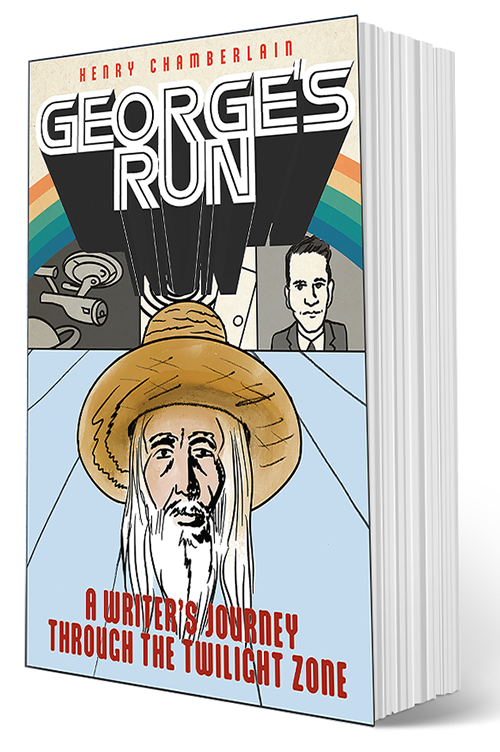
Zack Quaintance aspires to join the ranks of the great writers of the spooky and the macabre and he has plenty to show for his ambition in the pages of this comic book. We both have a keen interest in writing which has carried over to writing about comics and actual comics writing. We’ve gotten a chance to chat and to exchange each other’s work and, in a natural fashion, we’ve connected some dots. I believe in serendipity. Zack has followed his intuition and ended up writing a terrific review of my graphic novel, George’s Run, which is greatly invested in exploring the elusive and mysterious storytelling process. And I, in turn, after reading his Death of Comics Bookcase, can’t help but be equally inspired. Whether Zach is pursuing a crime procedural involving werewolves or a mystical and whimsical homage to the great comics of yesteryear, he is consistently expressing spirited creative energy.

As I go back and re-read passages from the advance review PDF, I find myself briskly scrolling back and forth and marveling over the art, color and overall design. If you enjoy behind-the-scenes stuff, I highly recommend the deluxe version which provides a generous sampling of pages from the script along with a break down on the comics process. The first set focuses on a page from “The Werewolf Priest.” The clear and thoughtful notes evoke a cluttered, stifling and antiquated newsroom, a most unlikely place to prepare to do battle with a supernatural beast. The script notes are written out in such a way that it makes clear why the resulting work came out as well, and as spooky, as it ultimately did.

This is an impressive anthology with a team of first-rate creatives. No doubt, this was a colossal undertaking: a full-on mainstream comic book production with separate artists, colorists, and letterers. Just a quick shout out to the key artists: Ryan Lee. Anna Readman. Nick Cagnetti. Luke Horsman. Pat Skott. PJ Holden. In fact, each story here is like a whole universe to itself while adding up to a tidy and seamless whole. All in all, I think that this anthology has set the bar high with a confident promise of more fun and weird comics to come. And, with all this said, it’s important to emphasize that this is basically an advance review and the comic book is still in the process of becoming available to the public. Stay tuned via the Kickstarter campaign and the original Comics Bookcase blog which this comic pays tribute to. This comic book is what the ideal comics experience is all about: weird and intriguing and always, always, about that ineffable human spirit! Thank goodness we have comics and this particular comic book is a prime example of comics at its best.

Death of Comics Bookcase, Vol. 1 Deluxe Edition.

4 Comments

Filed under Comics, Comics Reviews

Stan Mack’s Real Life Funnies book review

Stan Mack—wotta guy!

Stan Mack’s Real Life Funnies. The Collected Conceits, Delusions, and Hijinks of New Yorkers from 1974 to 1995.  Foreword by Jake Tapper. Afterword by Jeannette Walls. Seattle: Fantagraphics, 330pp, $50. (On sale date: June 11, 2024).

Guest review by Paul Buhle

Sometime in the last decades of the late nineteenth century, urban journalists sitting or strolling among the middle class masses coined the term “flaneur.” The relaxed, curious style of looking, almost randomly, at such things as which department store windows would be designed in ever more intense sales efforts or which open-air cafes flourished, would be taken up by American writers, painters and even monument-makers, by the 1910s.

Lots of interesting art epitomized by Ashcan styles (but not exhausted by them) found its origins here. Perhaps because the art schools began to flourish and young radicals (in every sense) began to see a life for themselves within the emerging culture.

How this art became more public than museums or art shows poses difficult and interesting questions. The illustrated Left-leaning or outright left-wing magazine or newspaper had appeared, a genre originally carrying only cartoons but gradually enabled by changing technology to offer decent half-toned prints. The Masses magazine (1911-17) hugely popularized the work of the Ashcan artists and of cartoonists as well—until it was suppressed for opposing US entry into the First World War. The Liberator and New Masses carried on with interesting art, intermittently, as did Der Hommer, in Yiddish, into the 1930s. Even when the art quality of the Left papers trailed off due to limited page space and to a vernacular Socialist Realism strangely similar to WPA post office fare, much of value remained.

Stan Mack. “Call it human ashcan art.”

The return of the sketch, an art form inherently given to popular use, offered artists yet another and very popular mode. Not that sketches in magazines had ever vanished, but they seemed to grow closer to life in the better and more interesting publications, including those leaning toward left-wing causes.

Jules Feiffer, drawing for the Village Voice starting in the middle 1950s, offered something as new as the Voice itself, at once bohemian, literate and truly popular. Feiffer looked at New Yorkers, especially but not only self-styled bohemians, with a jaundiced eye. He saw through their pretenses. But not without fondness. They were, in a sense, the Voice itself, the idealized reader. They wanted to live in a different way if not in a different society (it was as easy then as now to give up on reform causes). And they were silly.

Panel excerpt.

Stan Mack might object to being described as a successor to Feiffer, but a family resemblance cannot quite be missed. Mack took on the task of cinema verite plus more than a little sly humor, within the Voice of the middle 1970s and continued until the editor dropped the strip in 1995. It happens that this reviewer appeared in the same pages, or rather my book reviews did, during the 1980s mostly, and this personal detail kept me looking with special, probably egotisical, interest at the paper and at Mack’s entertaining strips. Like many future readers of this book, I have unknowingly kept memories of particular strips in my head. I liked them a lot.

Real Life Funnies deserves a full biographical essay and I wish I had written it (but the artist might possibly object). Here is a shorter version, which is not easy. Raised in Providence, RI, son of shoe store owners whose nearby Jewish relatives included a bookie or two, Stan attended the Rhode Island School of Design. He spent time in the Army, was mustered out, and became an art director at the New York Herald Tribune in the early 1960s. When the paper closed, he moved over to the New York Times. Perhaps most notably, at least for him, the task was to discover illustrators for the “new journalism” of the 1960s.  Here may well have been born the kernel of an idea.

He knew that he wanted to do something different. He went to well known designer/illustrator/editor Milton Glaser, then working for the Voice, and pitched an idea based on his newspaper background. Glaser liked that, and encouraged him. Here Mack found his voice, so to speak. He became an oral historian without degree or evident training. He roamed the city, listening to New Yorkers, adventuring to places outside his comfort zone. He would take notes, go back to his studio, and draw furiously, seeking to capture their sensibility.

Panel excerpt.

The result is like nothing else in popular or for that matter, scholarly (as in oral history-scholarly) literature. It is miles away from what Feiffer had done, although old-time Voice readers will surely see a kind of relation. Mack is more than adequate as an artist, but he does not rely upon the motions of the protagonists to tell the story. Far from it. This is, properly understood, illustrated oral history.

What he has in mind (this reviewer admits to having been a much-traveled oral history fieldworker, archivist and prof-coach) is the intimacy of the personal revelation. Not the kind of revelation that could be considered scandalous (these happen, if rarely) but the more-or-less unconscious bursting out of personality.

That is, the inescapably unique personalities, however anonymous, of New Yorkers during the 1970s-1980s and early 1990s. He offers them up for the reader, showing himself to be variously ironic, open-minded, detached and empathetic or perhaps not so empathetic.The psychic crises of the materially comfortable middle classes wishing for more satisfying or less stressful experiences prompt mostly now-forgotten cures, like “Rolfing,” or some sexual version of psychic restoration. By the 1980s, as the gaps between social classes grew wider, the squatters are more often seen more in evidence along with druggies, new immigrants, nonwhites and….yuppies.

Many of Mack’s subjects happen to think of themselves somehow as artists, would-be movie makers with hand-held camera, seeking street personalities or a convenient woodsy park where a porn scene can be managed. This is not unnatural: New York is a creative center in every sense, with more successful (and mostly unsuccessful) artists, actors, directors and every other category imaginable, per square mile, than anywhere else including Los Angeles. For a lot of these working people, at any level of fame, obscurity, high life or low life, “entertainment” is a job. Mack offers us more varied glimpses than any novelist has provided. Call it human ashcan art.

I am inordinately fond of seeing the craven businessmen, who Mack delightfully skewers for their arrogance and blatant criminality. But equally hard to miss are  the try-anything avante-gardists, the fashion-craving and silly-looking people of every variety, the sex workers, the gender-benders and the simply confused.

The variety is so great in these pages that further description fails. Sometimes, Stan, who drew himself as diminutive and with a brush-like mustache (most readers thought he actually looked like that), makes an appearance. His chapter introductions provide some overviews of how things change and yet remain remarkably almost the same, with all the passage of decades and fashions.

Panel excerpt.

It is definitely not a love letter to New York. And yet, somehow, it is. Stan Mack’s Real Life Funnies calls to memory those 1920s-40s hits, from Broadway or not, that made Manhattan a unique place, a centralizing place for shared experiences. A thousand films and some memorable television dramas of the 1950s, before TV moved to Los Angeles, carried the same sense.

No, no, I am making things sound “nice,” when Stan Mack does not mean that at all. There’s so much human potential on hand, but people who should know better go around ruining it with their insecurities, their egos and their cravings.

And I realize that I want to say something more about Stan’s art work. It pushes out of the page toward the reader. His characters are in the reader’s collective face, and the reader has chosen Stan’s strip by choice. Accept it! His friend Harvey Kurtzman, founder of Mad, described himself not as a humorist but a truth-teller.  That’s Stan, too.

Paul Buhle

Leave a comment

Filed under Comics, New York City, The Village Voice

Comics by Henry Chamberlain: The Flaneur Seeks a Hamburger

Clem, our trusty man-about-town, seeks a tasty treat. Let’s follow along as our favored flaneur negotiates his way to America’s favorite, the humble yet mighty & hearty beef patty. Where’s the beef? Well, it’s been here all along! Ah, always remember my dear sweet friend, that what matters most is the journey and not the destination. Until again, maintain your courage (thinking about Dan Rather right now), you never know when you’ll need it next. Back to the subject at hand, nowadays, a simple fast food transaction can escalate into an existential crisis.


Fin

Leave a comment

Filed under Comics, Flaneur, Henry Chamberlain