Tag Archives: graphic novels

Derek Kirk Kim interview: In Search of The Last Mermaid

Derek Kirk Kim

Derek Kirk Kim is a heavy hitter in the comics and animation world. He’s managed to accomplish quite a lot with award-winning comics and a successful career in animation as a director, storyboard artist and character designer for numerous companies like Disney, Cartoon Network and Netflix. In this interview, I put my pop culture sleuthing skills to good use as we cover Kim’s creative process which has brought him back to his first love, comics, and his new comic book series, The Last Mermaid, published by Image Comics. Here is my review.

Volume 1 collects Issues 1-6.

The Last Mermaid #6!

Variant Cover for #6 by Joy Ang.

Variant Cover for #6 by Gene Luen Yang.

Variant Cover for #6 by Jacob Perez.

What is essential for any work of comics, or any form of art, to stand the test of time is structural integrity. If a work is built upon a firm and solid foundation of diligent care, then it surely stands a chance. We chat about the connections shared by Kim’s earlier work (notably, Same Difference and The Eternal Smile, with Gene Luen Yang) and Kim’s latest work. There’s a certain sensibility at play: a devotion to characters, a heart-felt narrative and a sly drive to push boundaries. The magic to all of this is carefully crafted writing. And then you add the wow factor of equally well-crafted artwork. So, at the end of the day, you have a work where everything is there for a reason. It’s sturdy. It will stand the test of time.

How about that silver trident?

This is an important time in the routines of comics fans as tomorrow is Wednesday, the day of the week that comics shops get in their latest titles. Each week has its own favorites. This Wednesday, the number one comic book title has got to be The Last Mermaid #6. This issue will round out what will be the first trade paperback collection of this title. And it is in this issue that our main character finally reveals her name. We chat about this at length along with the usual comics shop talk. I invite you to join us. Just click the video below.

And remember that it’s The Last Mermaid #6 that wraps up the first story arc. The first collected trade paperback comes out in October. Visit Image Comics.

Also, be on the lookout in April of next year for Royals, the new graphic novel written by Derek Kirk Kim and art by Jacob Perez, a crime caper involving telepathic twins, published by Image Comics.

Leave a comment

Filed under Comics

Einstein in Kafkaland by Ken Krimstein book review

Einstein in Kafkaland: How Albert Fell Down the Rabbit Hole and Came Up with the Universe. By Ken Krimstein. New York: Bloomsbury, 2024. 214pp, $32.00

Guest review by Paul Buhle

What a great subject for a comic! Back in 2016—it seems a long and grim century ago—the artist team Corinne Maier and Anne Simon offered a  biographical GN treatment of the same totemic figure, titled simply Einstein, after similarly lively treatments of  Freud and Marx. In their version, Einstein’s early life as a secularized Jew in Germany,  a rebellious kid, then reluctant member of the family electronics firm, makes for a lively beginning. Soon, in this pretty carefully factual version, comes his amorous adventures and then emigration…and scientific triumph, to say the least.

Ken Krimstein’s Einstein is a very different creature, perhaps first understood by a quick look at the artist himself.  Known better as a prolific cartoonist than graphic novelist, Krimstein has reached readers from the lofty New Yorker to the oddball midwestern Puzzler. His premier GN on Hannah Arendt gained him a handful of prizes. When I Grow Up, based on the hitherto lost essays of six Yiddish-writing teenagers from the prewar years, is perhaps closest to the work under review. This is the lost world of Judeo-Europa.

The comic art of Einstein in Kafkaland is as far from the comic art of Carl Barks’ Donald Duck or, say, the newer world of  Alison Bechdel’s Fun Home,  as one could imagine. His characters, language and bodies, do not stay in one place. Instead, they spill across the page, with a pallette of colors ever changing if mostly muted. Krimstein wants to let us know on every page that he is also a painter of software sorts, doing comic art in the very particular way that he chooses. He has no obligtion to offer a straight biographical account, and the larger facts of Einstein’s life, ongoing, do not seem to interest him very much.

One might say that this effort is closer to Logicomix (2008) a best-selling, fictionalized account of Betrand Russell, but less about scientific  theory and more about Krimstein’s own artistic expression. Science and math continue to get comic treatments of various kinds in other books, but rarely if ever by the methods adopted here.

If we wish to establish further that Einstein in Kafkaland is not an Einstein biography, we notice that it ends long before his global renown. The reviewer regrets that we will never get to Einstein the saddened A-Bomb scientist, the major peacenik or the ardent socialist whose famous essay “Why Socialism?” appears,  early 1949, in the very first issue of Monthly Review, where I happen to have been writing since 1970 (we didn’t overlap!). Or the Einstein who is offered the presidency of the young state of Israel, and turns down the offer, having already made clear that he opposed an ethnic state and its military apparatus.

No matter. What Krimstein does offer us, in narrative as well as visual text, is sufficently intriguing.

A struggling member of the lower-middle class in Zurich, desperate to prove his own scientific theories against arguments that they have already been disproved, Einstein, the impoverished family, man struggles. He wants to explain gravity to his son as they take a train ride to Prague. In this  highly imaginative version of theoretical discovery, he falls down a sort of metaphorical rabbit hole before the train arrives at its destination.

There, in Prague, he engages with a series of typically Eastern European Jewish intellectuals, above all his nemesis, a physicist  named Max Abraham who is urgent to disprove Einstein and thereby discredit his accomplishments. As he teaches for a living, Einstein also experiences the life of the avant-garde.

Prague is, to our modern view, inevitably the land of Franz Kafka. I did not mention the book’s fictive narrator, a skeleton in the famous clock in the city square of Prague, or that Kafka is introduced, in the first pages, with Einstein. The then erstwhile patent clerk, Einstein, meets or does not actually meet the minor insurance executive, Kafka. Something is about to happen to both of them, although in real life, we do not know anything about what may have passed between them.

Fictively, perhaps it already did. In the train ride, with the train entering a tunnel, Einstein has an experience that replicates Alice falling down the famed rabbit hole and brings him—this is both highly imaginative and not too convincing—a basis for his evolving theories. A bit Kafkaesque.

His engagements with the (mostly male) intellectuals of Prague leads him inevitably to the famed salons, where he even plays his violin, and more important, is said to have met Kafka himself. Krimstein admits he is making up everything about the two famed characters’ rendezvous. Their dialogue, stretching over ten pages, may be the high point of the book’s narrative. Or not.

Still, the Kafka interlude does definitely resonate, in other ways. with what other comic artists have sought to do. Peter Kuper’s Metamorphosis (2004) is gripping in its own way, carefully piling detail upon detail. Robert Crumb’s Kafka for Beginners (1993) marked the famed underground artist’s shift toward adaptation, a shift completed with his later-life masterpiece Genesis, early in the new century.

Krimstein’s Kafka, meanwhile, has taken Einstein on a walking tour in Prague, mainly talking insurance, also grappling with gravity. Einstein needs to prove how gravity relates to acceleration, among other mysteries. Dealing with his growing family, including his wife properly demanding him taking a bath to rid himself of bedbugs, he approaches the “bending of light.” He is reaching for a thesis: “If mass bends light, gravity is the same thing as  acceleration.” (p.99) With this brilliant theoretical stroke, the family can, maybe, gets out of Prague, where the historical presence of anti-Semitism coexists with something more personally ominous: a mild but not entirely harmless sort of military induction, complete with soldiers’ uniform. Does Einstein guess at his future role in a war even more horriffic than the one rapidly approaching?

Whatever his personal troubles, Einstein is going to get to his not-quite-stated goal: relativity. Which is to say, also: “the shape of the cosmos, the architecture of time, the unified theory of totality…” (p.146) An accidental meeting with Austrian physicist Paul Ehrenfest, seems to be crucial to Einstein, but several years after the theorem takes shape.

The artist concludes that Einstein leads us, guides us, to a modern world “where science is art, art is science, and everything is way, way different as it ever has been—a new universe we’re all struggling to catch up to.” (p.196)

One might as well say, of course, that the calamitous war just ahead for Einstein has been decisive in raising doubts about Europe, also about the future of European Jewry, and for that matter the future of human civilization at large. The mechanized mega-death around Franz Kafka will bring Hitler and the Holocaust. Judeo-Europe, in the old and collectively self-confident sense—for middle class German Jews, at least—will cease to exist.  Science will advance, but for what end? In a society of global warming with a constantly accelerating arms’ race to boot, we are hard-pressed to offer any positive conclusion.

The art of Einstein in Kafkaland is not literally describable, the fast-shifting dynamism of Krimstein’s accomplishment beyond the realm of what this reviewer has previously considered to be comic art. But so what?

Paul Buhle

Leave a comment

Filed under Comics, Comics Reviews

THE LAST MERMAID by Derek Kirk Kim comics review (#1-5)

Volume 1 collects Issues 1-6.

Here is a comic book that is a treat to introduce to new readers, share with fans, and genuinely marvel over its beauty. There is nothing calculated about it. What I get from this comic is a feeling that Derek Kirk Kim is simply compelled to share his vision and it’s that feeling that drives this quirky cosmic sci-fi adventure. We’ll take a look here at the first five issues of this series which is slated to run for about 30 issues total. Take note that the first collected trade (#1-6) will be out this October.

I recall Derek from back in the day, ten or more years ago, when he did autobio comics, notably Same Difference, published by First Second. And so it was great to see this amazing new project. I appreciate that Derek became successful in animation and that this process has influenced his new comics: lush approach; 16:9 storyboard panels. Having read the first five issues, I totally get the general response from readers about it being very immersive. And then there’s the whimsical touches, especially Lottie, a cute little salamander sidekick. On top of that, many more layers. This is a post-apocalyptic story. There’s a number of influences in anime and manga. And it’s a story that begins with touches of levity but promises to get more gritty, maybe a little grim. So much to unpack and yet the end result is a very smooth entertaining ride.

How about that silver trident?

The big takeaway is that this comic is really for everyone, although it will get darker as it progresses so that will lean it more firmly into teen and up. It’s a comic for new readers, non-readers and all of us who sometimes think we’ve seen it all. The mysterious mermaid is definitely a big draw. It’s five issues in and we still don’t know her name. We do know that she wears this enormous body of armor to get around, more like a rover with arms and legs. It’s called a hybrid aquatic vehicular chamber. She’s always on the run, looking for fresh water in a world with very little of it, and she’s on a quest. For someone who is short on words, she delivers what has got to be the best line in comics this year: “Have you ever come across a giant silver trident impaling the sun?” Now, that’s a question to keep you up at night.

Issue 6 wraps up the first story arc and comes out August 28th. Visit Image Comics.

1 Comment

Filed under Comics, Comics Reviews

PeePee PooPoo #1 comics review

PeePee PooPoo #1. Caroline Cash. Silver Sprocket. 36 pp. $9.99.

Caroline Cash is back! Her fourth comic book has just released and it looks terrific. The PeePee PooPoo series recently won the Eisner Award for Best Limited Series, has won the Ignatz Award for Outstanding Minicomic in 2023, and the Broken Frontier Award for Best Periodical. Of great interest to comic strip fans, Cash took over the Nancy comic strip during Olivia Jaimes’s hiatus. Cash started PeePee PooPoo with issue #69, then #420, and followed by #80085. And now we have #1, a “first issue,” an opportunity to re-introduce herself to new readers.

I am ramping up my own new comic book series, Pop Culture Super-Sleuth, and I can tell you from that experience that it’s a ton of work, a labor of love but work all the same. A key thing I want to make note of is that Cash is a very well organized phenomena: just like a political campaign, Cash has a well-oiled machine, thanks to Silver Sprocket, keeping things flowing with production as well as promotion. Pee Pee Poo Poo is a comic book series with the ambition of placing itself among the best ground-breaking indie comics. Well, the stars have indeed aligned as each new issue has been celebrated within social media and grass roots word-of-mouth. Momentum has built over a period of time. The style, content and approach all add up. Unabashed autobio comics are a staple of indie comics and go through up and down cycles, but, when done with gusto, like Cash’s work, they can be a hit. If done right, they can even be considered a voice of a generation. Once the momentum is in place, the machine is running at full steam.

What do I like about this new issue? Well, what I’ve loved all along. Cash is showing us once again that she is in it for the long haul. She’s a born storyteller spinning yarns with a seemingly effortless abandon about travel, relationships, sexuality and just being a human being. It doesn’t matter, in the big picture, really, if you’re gay, bi, or whatever. What really matters is that you have something to say and you express it, which is what Cash does so well. This issue is playfully numbered as #1 but that’s significant. I think it’s safe to say that this is a nice pause, a chance to say hello again, while at the same time continuing to celebrate her wonderfully uninhibited comics. There will be nods to the giants from time to time. Yes, Cash is walking down the same path of such greats as R. Crumb, Julie Doucet and Daniel Clowes and she can rest assured that she is leaving behind her own distinctive footprints. I love the scene, by the way, in one of her comics where she’s walking barefoot through TSA. I’ve done that and, well, it’s definitely a unique experience.

Leave a comment

Filed under Comics, Comics Reviews

Hurricane Nancy Interview

Well, we finally got around to having an interview. It seems as if we’d already done that but now it’s official. I am beyond words in my deep respect for the artist Nancy Burton, aka Hurricane Nancy. It is a delight and an honor to know her and call her a friend. Fantagraphics has recently published HURRICANE NANCY, a monograph on the art career of one of the legendary underground cartoonists and you will want to seek it out.

Give Peace a Chance!

Over the years, it has been a point of distinction for this site, Comics Grinder, to showcase art by Hurricane Nancy. When Nancy told me about her upcoming book, I was as thrilled about it as if it were my own book coming out. We discussed my doing some coverage and it was great getting to review the book and now to attach this interview during the book’s promotional run. I can’t say enough good things about the book, about Nancy and about Fantagraphics. I know that Fantagraphics loves me too, as I’ve gotten to know various folks there over the years. Well, one thing is for sure, the years keep rolling along. So, you better make the most of it while you can. I firmly believe that is exactly what Nancy has done. If I had to sum up her art career, I’d say it’s been a wild, and steady, ride made up of an artist trusting herself and going for it with her art.

What Fantagraphics has done with the Hurricane Nancy monograph is create something special in the spirit of this most audacious publisher: a taking the bull by the horns, and let the chips fall where they may, attitude that, at the end of the day, is what life is all about. I encourage you to get a copy of the book and stick around and go to the interview at the Comics Grinder YouTube channel.

1 Comment

Filed under Comics, Comix, Interviews

Amber Atoms by Kelly Yates comics review

Amber Atoms. (c,w,a) Kelly Yates. Vol. 1. 2023.

Amber Atoms is a refreshing take on an ole Sci-Fi tradition. I love the character’s overall style, in the same way that I love, say, Liberty Meadows or Power Girl or any number of “Girl Power” characters. Kelly Yates, the creator, writer and artist of this comic book, is best known for illustrating multiple comics and covers for Doctor Who (IDW/Titan). I really like the look and feel of what Yates is doing with his foray into what can be very familiar territory (from Buck Rogers to Star Wars). Another way of looking at it, no kid ever lost sleep considering the finer details of an Indiana Jones adventure. It’s Jones who is the big draw.

Okay, so you had me at Amber Atoms. She has moxie. Like a young Luke Skywalker, Amber Atoms is stuck in a rut, arguing with her parents, restless to cut loose, in a world she never asked for. It’s a multi-world, in fact, a sort of unstable coalition, a federation on the brink. Anything could set it off and Amber knows it.

Shades of Luke Skywalker. Girls just wanna have fun!

After a human-sized ant baddie is thwarted from attacking Amber, it looks like her protector, Ace Armstrong, might just stick around. A lot is happening very fast. But we get a pause to consider if they’re a match. The alliteration alone is priceless. Amber Atoms, all-around cute daredevil, and Ace Armstrong, super detective for the mighty Galactic Guard. And then they run off and hop aboard this dazzling retro-futuristic ship. Blast off! So, yeah, it’s a bit tongue-in-cheek stuff without ever outright admitting to it, sort of like what Star Wars is all about, right?

You had me at Amber Atoms.

Everything turns on the theft of a museum artifact with a secret message. Now, it’s up to Ace and Amber to navigate all the machinations of a fractured empire. As for me, I just go right back to Amber Atoms. You had me at Amber Atoms. I think Kelly Yates is on the right track. This is a collection of an earlier run and it really seems to me that the timing is just right to take stock and see where Amber goes next. She really could go anywhere she pleases.

Leave a comment

Filed under Comics, Comics Reviews

Delights: A Story of Hieronymous Bosch by Guy Colwell review

Guy Colwell, Delights: A Story of Hieronymous Bosch. Seattle: Fantagraphcs. 162pp, hardcover, $29.95. (release date: 13 August 2024).

Guest Review by Paul Buhle

Not all readers of comic art will recall the occasional evocation of a young Robert Crumb, in the later 1960s and shortly after, to the fifteenth century Dutch artist Hieronymous Bosch. That Bosch saw and drew the dark prospects of the human fall from innocent beginnings, as depicted in his singularly famous altar triptych, “The Garden of Earthly Delights,” prompted religious-minded viewers and several centuries of art critics to treat the painter as warning against sins and sinners.

Excerpt from Guy Colwell’s Delights.

Quite the opposite or nearly the opposite, as now understood. One of a family of artists, his work made possible by the support of a wealthy wife older than himself, Bosch sought to depict human innocence within nature turned by society—arguably class society with its exploitation and corruption—into an unholy, totally destructive mess. In the left-most panel of the famous triptych, the beautiful, young humans are conversing with animals, equally unashamed of their own nakedness. Increasingly, as our eyes move rightward, horrors appear. The last panel has a character shitting out gold coins. Socialists would call this final depiction Class Society, and they would not be wrong.

Excerpt from The Garden of Earthly Delights, Hieronymus Bosch (1490-1510). Depiction of shitting gold coins.

Not all comic fans will remember artist Guy Colwell vividly or perhaps at all. But he is sui generis, mistaken often to be a Black artist, and for good reasons. Busted on drug charges in the Bay Area of the 1960s, he spent years with black prisoners affably, listening and learning. His Inner City Romance (initial book publication, 1978) explored the lives of erstwhile prisoners and their girlfriends, graphically and sympathetically, with all the tragedy and occasional exuberantly happy moments intact. Nothing else like it could be seen for decades during which Colwell, who never made a living from comics, looked in other directions.

Millions of art lovers have traveled to European museums to see Bosch paintings (and not only the famed triptych),  and many have been lucky enough to capture traveling shows. None could have come into visual contact with anything like Colwell’s Bosch.

Why would that be? The painter’s life remains largely obscure. His membership in the small but intense, devotional Brotherhood of Our Lady must help to explain something. His relationship with other artists or trends of the time, even within the village where he lived and worked, will likely never be known. We do know that the Radical Reformation, its origins in the Wat Tyler Revolt of the English 1280s, continued taking shape across the following centuries, shaking large parts of society. Peasants’ and craftsmen’s uprisings in Central Europe, influenced by millenarian visions of a perfected social order, pointed to the future. These uprisings, crushed with great violence by the authorities, anticipated modern class struggle—as Bosch’s work anticipated Surrealist art. Did such social and class struggles play a role in his visions?

Late in the book, the artist briefly suggests another possible explanation. “New ideas” are coming from Italy, that is to say the Renaissance, starting to reveal different ways of seeing art and the uses of the body in art. Indeed,  another long-held rumor has Bosch influenced by an Italian mystic who traveled to Holland from Italy.

In either case, the power of the Church is weakening, as Bosch’s defenders reference in the comic. They no longer hold absolute power over art. This explanation is as good, and as limited in explaining what is really going on in Bosch’s fantastic visions.

To Bosch or Not To Bosch?

Colwell has taken yet a third and more direct path, a narrative that drives the comic forward. He suggests the obvious, that an artist who needs funds to survive can sometimes find a patron—in that long-gone era most likely a royal patron. How would that painter work, and struggle within himself, to satisfy the client? In this version, Bosch’s wealthy wife evidently cannot support the household herself.

Colwell, himself the craftsman, makes the painter a deeply religious figure, fretful about the art of nudes ordered— along with generous payment for following directions. The narrative plays to Colwell’s strengths, as readers of his 1970s comic art will remember. The nudes, male and female, are wonderfully drawn, unashamed and a thousand miles from anything like pornography. They radiate the innocence of an art work that is not quite innocent. They obviously enjoy looking and touching, something that comes through so clearly and scandalously in the triptych.

The protest of the presumably respectable townspeople whom he characterizes is one more bit of Colwell’s history-imagined world. He is correct, as scholars of medieval Germany have explored and explained at length, that ordinary and most highly-placed people of the time and place thought in such religious terms, could not actually think outside of them. Radicals likewise saw their lives and their work in equally religious and often millenarian terms.  Driven to their death by the rising classes of merchants, assaulted in sermons and pamphlets, they were depicted as immoralists seeking to overthrow all religion and virtue—agents of Satan himself.

In Colwell’s imaginative re-creation, the monsters come to Bosch as he doubts himself, especially when he is beyond his studio and his comforting wife. They lunge at him and leer at him, but we discover in the final pages that they may be showing him the limits of his time and place, hinting at the strange things somewhere beyond.

I do not think it is likely that, as the book suggests, the artist is even thinking about a possible secular age ahead. This seems too much. But he has, like the most sensitive of art historians, accurately pointed to the appreciation of Bosch’s work after centuries of Christian-based misrepresentation.

No one else in comic art, perhaps, would undertake such a project. Colwell is to be congratulated for his beautiful, meaningful work.

Paul Buhle

Leave a comment

Filed under Comics

See You At San Diego and George’s Run: Two Views

Two books you should check out: See You at San Diego and George’s Run.

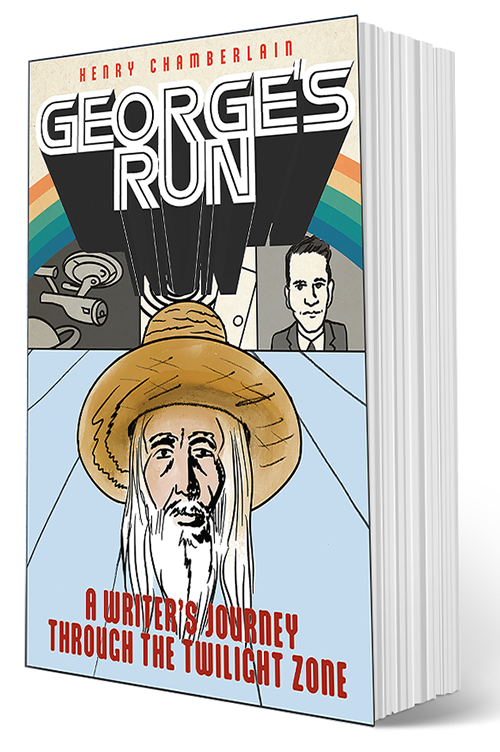
See you at San Diego! I’m saying this now, since I am actually heading out to San Diego for Comic-Con, as a lot of you are also doing. I will have a table under Comics Grinder Productions in the Small Press Pavilion, Table L-05, and I welcome anyone to chat with me on what I’m about to lay out for you here. Okay, so I go with my own set of particulars regarding Comic-Con, this landmark pop culture institution. In fact, my going to Comic-Con, over the years, led to my creating a graphic biography, George’s Run, published by Rutgers University Press, a book about one of the most notable figures so inextricably linked to Comic-Con: George Clayton Johnson. I’ve written various pieces about this but I never tire about talking about it. That’s exactly what George would have advised me: Keep being a storyteller, you never give up! And so I don’t, won’t and will never give up.

Here’s the thing, there’s always someone else ready to tell another story and so, yeah, I feel obligated all the more to keep setting the record straight. Now, don’t get me wrong, I am not leading up to something unsavory. On the contrary, I just need to point out a few things. Okay, a couple of years ago, back in 2022, Fantagraphics published Mathew Klickstein’s See You at San Diego, a veritable phone book of data (480 pages) on San Diego Comic-Con. It is fueled by about a dozen or so extended interviews with some of the people, going back to the origins of Comic-Con (founded in 1970) who were, or even still are, intimately involved with Comic-Con. The interviews were then sliced and diced into various categories so that you have a collection of snippets hanging together under certain themes that the book pursues. All well and good. However, it will be a challenge for some readers to know just where to begin but I definitely welcome this amazing undertaking. It’s a lot of what amounts to a mountain of data to sift through. My point is that I did something similar by focusing on one person who, in some very significant ways, acts as a portal in my book to a vast array of things somewhat similar to what Klickstein’s book engages with. Similar, in spirit to some extent, but also very different. It’s very, very different, in fact, in the way that I seek to create clarity as well as maintain a playful and artful tone, turning it all into one free-wheeling but driven and focused narrative.

Wonderful part of book referring to George Clayton Johnson.

Is one way of tackling a subject better than another? Well, no, I would argue you want as many ways of looking at things as possible. I am simply asking for my due. See You at San Diego has gotten plenty of attention and has been celebrated rightly so. What I propose is, if you are at all interested in a dive into the origins of pop culture, then, by all means, seek out both books. Perhaps that’s the best way to put it. Heck, folks, my book is focused in such a way that compliments the more massive everything-but-the-kitchen-sink approach that Klickstein is going after by default. I would venture to say that, if you didn’t know where to look, you would miss some genuine nuggets in Klickstein’s book simply by the fact that you can’t see the forest for the trees. It’s just that kind of a book, the sort that you cozy up with and take in a bit here and there.

The reference to George Clayton Johnson is the highlight to Klickstein’s book.

But let’s follow that trail of thought. If you were not sensitive to, or any bit aware of, the whirlwind of creative talent involved in some of the most iconic pop culture, then it is inevitable that you will miss the more subtle and finer points being advanced by some of the quotes to the interviews. That said, I certainly picked up on the ferocious loyalty to Ray Bradbury and the arguments being made by some that somehow Ray Bradbury should have received more credit for helping influence the original Twilight Zone, created by Rod Serling, who, in point of fact, was already an accomplished writer going back to the early years of television’s golden age and had his own vision of what he wanted for the show. Klickstein’s book provides some casual, unsubstantiated and simply inaccurate observations regarding this subject, which, for me, are priceless and worthy of further discussion. I’m so glad to have read them but I can sift through what is correct and what is not. Basically this collection of interviews amounts to people’s opinions and recollections without any filter or fact-checking. You need to know what you’re looking for with this book.

And it’s not like Mathew Klickstein could not have interviewed George Clayton Johnson, a key figure while he was very much alive. I did a number of times. I got to know George. I think the portion of Klickstein’s book that refers to George is one of the better parts to his whole book. In fact, it is quite clear that Klickstein finds great value in including George in his book. Klickstein most certainly could have gone on to interview George but, unfortunately, he did not. He should have. It would have been easy. It would have been totally possible given that Klickstein interviews Comic-Con co-founder Richard Alf which dates this work to at least before Alf’s death in 2012. George passed away in 2015. My final interview with George was in 2014. Reaching out to George would have been completely in the spirit of what Comic-Con is all about. George was of that generation of creatives who opened their homes to people seeking answers. I was, and I still am, one of those persons seeking deeper answers.

In my book, I steadily pursue the creative process and give the reader a variety of scenes, observations and research distilled within the narrative. You get to know the charismatic, yet enigmatic, storytelling wizard who was George Clayton Johnson and, through his life’s journey, you get to know many of the other key figures: Rod Serling, Ray Bradbury, Theodore Sturgeon, Richard Matheson, William F. Nolan, Charles Beaumont, and so on. You need context, and solid storytelling, for this to make sense and I do exactly that. This is very important stuff. It’s a big deal. It’s not something to simply drop in someone’s lap. That said, raw information has its place and has an essential role to play. Just don’t ever expect that to be the only version. The more said, the better. I have plenty to say. Believe me, I will keep talking about this and that is a good thing.

Leave a comment

Filed under Comics

Emil Ferris My Favorite Thing Is Monsters Review via Notes

“My Favorite Thing Is Monsters” Vol 2 (of 2) by Emil Ferris

Notes on Emil Ferris’s My Favorite Thing Is Monsters, Books One and Two by Nick Throkelson

Editor’s Note: In keeping with the unconventional spirit of the work being reviewed, cartoonist Nick Thorkelson presents a review within a collection of notes on the two-part epic work by Emil Ferris.

Emil Ferris draws over rules. Ha!

The following notes assume some familiarity with Emil Ferris’s comics masterpiece, My Favorite Thing Is Monsters, published by Fantagraphics, now available in two volumes. For those who haven’t had the pleasure, suffice it to say that it’s a story set in the 1960s, as told and drawn by young Karen Reyes, about her coming of age in the Uptown neighborhood of Chicago. Karen identifies and depicts herself as a monster, not (except in one instance) as the innocent and plucky girl that others see. And she tells her story in a notebook, whose binder coil and holes and rules are visible on every page.

“My Favorite Thing Is Monsters” Vol 1 (of 2) by Emil Ferris

Karen’s self-portrait. Karen draws herself not just as a monster but as a stereotype of a monster. Her jaw is spherical and her teeth are perfect cones, while the heads of other major characters like Deeze, Franklin, and especially Anka are malleable and protean — they react and adapt to circumstances. In that one instance where Karen appears as she is seen by others, her face becomes protean too, even as its irregular shape clearly justifies the geometric shape we usually see. The set of her mouth and jaw express hard-won courage in both versions. see.

The mob. At the end of the opening sequence in Book 1, the ugly citizens with pitchforks hunting monsters are called “M.O.B.,” which stands for “Mean, Ordinary, Boring.” What a perfect description of unfree America! Karen says, “What freaks me out is that one day they could turn me into one of them.”

Karen does not fear the mob the way the mob fears her. She writes, “Humans are afraid of death and it makes them frantic. The undead don’t have a ‘self-esteem problem.’” Does the fear of death negatively correlate with self-esteem? Actually, all the major characters in Monsters have a self-esteem problem, but what unites the (sympathetic) ones is that they acknowledge their inner monstrousness instead of pretending it’s not there.

The neighbors. Karen and her mother and older brother Deeze (Diego Zapata Reyes) live in an apartment building with a number of offbeat people. Mrs. Gronan, the gangster’s wife who lives upstairs and has the hots for Deeze, is introduced in Book 1 as an unattractive woman so fabulously decked out that she looks sexy. In Book 2 Karen observes that Mrs. Gronan is pretty as long as she doesn’t try to smile.

Anka’s eyes. Anka, a beautiful holocaust survivor married to a jazz musician, also lives upstairs until, early in Book 1, she is murdered. Eyes—intense, beautiful, and threatening—appear throughout both books, but the eyes of Anka are the saddest.

Hatch lines. The blue and red pen lines used to draw Anka’s skin could almost be her arteries and veins. These complementary colors blend and cancel each other out, so that her face looks like porcelain. In a flashback, she arrives at a Nazi concentration camp, perhaps Theresienstadt, set up to look like a humane facility in order to fool visitors. But the bakery worker is a mannequin with cracks in his “skin,” which remind us of the knife wounds on the face of Karen’s Black classmate Franklin, inflicted by a homophobic gang when he was young.

Franklin’s face. Karen says, “If all the pieces fell away, I got the idea that what was inside him was a big ball of white light.” His scarred face is reminiscent of Frankenstein’s Monster, or the Willem DaFoe character in Poor Things. Franklin illustrates Karen’s idea that Frankenstein was a “skin-tight Prometheus variously coded as Black and queer” (odd language for a 1960s kid, but no matter). Franklin’s scars were inflicted to destroy, unlike the ones on Mary Shelley’s monster that are the marks of an attempt to create life.

Franklin as Françoise in Book 2 hides her scars with makeup, and turns out to be the most soulful Patsy Cline imitator anybody has ever heard.

Commercial art. At one point in Book 2 we see part of an illustration Deeze did for a science fiction novel by his friend Jeffrey Alvarez, a.k.a. The Brain. This sets up several pages concerning Deeze’s second career as a commercial artist (in his day job he’s an enforcer for a loan shark). Deeze may well have created many of the monster comics covers that Karen uses to set off sections of her story. A treat. For comics nerds like me it is enjoyable to learn that Deeze plagiarizes himself. He creates a frightening monster called The Lurch for one of his comics covers and then repurposes it as the repulsive mouth of a different monster, Mothman. This is reminiscent of real life comics legends like Wallace Wood who plagiarized themselves when pressed for time.

Another treat. We see many covers of a horror comic called Ghastly, and they feature a cartoony master of ceremonies in the upper-left-hand corner. This character could have been drawn by Harvey Kurtzman. Similarly, in real life, the emcee character that appeared on covers of the great 1970s-80s Eerie comics series was drawn by Jack Davis, Kurtzman’s frequent collaborator. Image quotation. The re-drawing and re-purposing of art occurs constantly in Monsters, sometimes based on comics imagery but just as often based on the “high art” that Karen encounters at the Art Institute of Chicago, and in Deeze’s art books.

Not every quotation from a famous artwork is acknowledged as such. A parochial school art teacher, remembered fondly by Karen in Book 2, is first seen as a witch on the cover of Dread (another magazine with a comical M.C. in the corner). In Karen’s memory she is a sweet-looking lady, but on the Dread cover she looks just like the grotesque profiles of Jesus’s tormenters in Hieronymus Bosch’s Carrying of the Cross. Grotesques. Ferris’s (i.e., Karen’s) Chicago is full of racists, homophobes, sadists, the ravaged and empty. One group portrait of the surly M.O.B. looks like an homage to George Grosz’s 1920s Berlin etchings. A contradictory image, of everyday Uptown people on the street, has a caption telling us that most of them are migrants and all of them are riders on the “Royal Shaft Express,” as Deeze calls it. These faces are ravaged but not empty.


Slouching towards androgyny. After recreating a painting of Oedipus and the Sphinx in which the Sphinx is a pretty woman, Karen imagines Oedipus saying, “I’m scared of the part of me that is you.” The Sphinx replies, “That part is bigger than you think.” It turns out that women know, and men need to know, that we are all part male and part female. Karen and Deeze illustrate this by mirroring each other.

Hey hey we’re the. Karen says of one of the first girls she crushes on: “Missy’s bedroom used to be monster-themed but now it’s covered in Monkees posters and these big horrible flowers” — Monkees and stylized 1960s flowers being emblems of sexual and sentimental self-presentation, as opposed to monsters that function as emblems of unrestrained nature and difference. As Peter Tork’s brother I defensively object to the idea that the Monkees were fakes, but that’s another story.


Fire. Karen, usually stoical and observant, becomes an aggressive monster flame-thrower when  she learns that Deeze has been hiding their mother’s terminal illness from her. Karen expects to be betrayed by the M.O.B., but not by those she loves.


Paintings. Karen and Deeze bond over their shared (or negotiated) responses to the treasures of the Art Institute of Chicago. The magical romantic projection of themselves into the academic story-paintings is consistent with the theme of adolescent rites of passage.
Ambroise Fredeau’s painting The Blessed Gillaume DeToulouse Tormented by Demons (1657) certainly fits. In Karen’s reading, the painting says that good monsters frighten us because they can’t control how they look, and bad monsters frighten us because they demand control.


The minor character Salvatore is a bad monster observing us from the top floor of a skyscraper, and he is simultaneously German, Italian, and Japanese, i.e., the Axis powers.

The Greens. Anka has a “Viewmistress” covering the bullet hole in her chest. Karen steps through the hole and finds more paintings. As a near-contemporary of Karen, I identify them as the academic paintings we were taught to disparage in the days of triumphant modernism. (The paintings’ dates are 1790, 1865, 1875, 1886, and 1906, bringing us right up to the surrealist revolt.)

This sequence culminates in a two-page spread, “Green Island,” a fever dream of solace where a branch overhanging a rapids turns into a skeleton’s hand groping a breast or buttock. For me, Green Island evokes the “Green Door” of H.G. Wells and Jim Lowe (Wells wrote a story in 1906 of an elusive green door leading to happiness, and Lowe had a hit record in 1956 where he couldn’t get through the Green Door leading to a rocking party.)


A Cool Breeze. The sky in Alpine Scene by Gustave Doré, as depicted by Karen, is full of fuzzy stars “like the tangled strands of pearls in Mama’s jumbled jewelry box.” The actual painting is set in daytime and is only dark because of the towering evergreens in what looks like the Black Forest. The original, like Karen’s version, has a tiny male figure as its focal point, but it also has a second figure, perhaps a sweetheart, that Karen leaves out. The famously gloomy artist Doré sees companionship and a cool breeze in the shade, where Karen sees solitude and mortal dread.


Victor. At the end of Book 1, Karen turns and sees Deeze but it’s not Deeze, it’s Victor, the twin brother that Deeze killed (by accident?) when they were children. Victor, who will become an important character in Book 2, seems to float among the fuzzy stars and the eyes of Anka, not to
mention the holes in the notebook pages. Sexuality of the monster trope. In the Dracula story, woman’s irrationality/hysteria is the flaw that lets evil insinuate itself into polite society. In Monsters, society is never polite and Karen’s awakening gayness is the armor that makes society bearable, at the same time that it is her authentic self.


Chicago. I love all the drawings of Chicago and wish there were more. In one full-page drawing of Karen and Deeze on the bridge over the Chicago River, near the end of Book 2, the golden evening light from the West butts up against the pale blue light coming off of Lake Michigan to the East. Not naturalistic but it certainly puts you there. But no act of virtuosity exists for its own sake in Monsters, except in the sense that Karen might like to show off her drawing chops sometimes. That poignant picture of the Chicago River at twilight feels like it’s there to foreshadow the imminent ending of Deeze and Karen’s rich Chicago life.


The invisible man. In Book 2 the lost or missing father of Karen and Deeze materializes as a vicious tramp and a surrogate for the biblical Holofernes, the supposedly invincible warrior beheaded by Judith so that her community could survive. Many different paintings of Judith killing Holofernes are reproduced, mirroring Karen’s obsession with, and ambivalence about, violence and female power.


Later. The notebook/journal format of Monsters allows major story points to be implied or passed over, not stated or concluded plainly. It’s as if Karen says to herself, “I will never know what happened when I took Deeze’s gun and went looking for my father, but never mind, let me move on to the stuff I’m actually trying to understand.”


In Book 2 we frequently hear some form of “I’ll tell you more about this later,” which doesn’t happen.

Another example. The episode in Book 2 featuring “the preacher guy” and his female followers seems too brief after such a tantalizing setup, but I appreciate the idea that these sinister characters are going to do what they do, for better or for worse, and we don’t need to know what that is. Unanswered questions feel more true to life than the typical wrapping-it-up ending to a murder mystery.


Except for this. In Book 2 we learn that Deeze is a killer, and we already know Anka is a murder victim. Also in Book 2, Deeze denies that he killed Anka. Well, actually, he denies that he meant to kill her. But even after two fat comic books, we don’t know how or why she was shot, do we?
We do hear, or seem to hear, a jealous Deeze say to Anka, “I’ve always been a big distraction for you, haven’t I? And then you throw me a look and I come running. I should put a goddam bullet through your heart!”


On the other hand. We learn late in Book 2 that the police wanted to frame Chubb, the ventriloquist in the building, for Anka’s murder. This doesn’t make sense if Deeze was the killer, does it? The cops all have it in for Deeze because Deeze’s father, Frank, was once a cop and he wants his former fellow police to make Deeze suffer for the death of Victor.

And on the other other hand, just because somebody wants to frame you doesn’t mean you’re innocent. Could it have been the lovesick ventriloquist, impersonating Deeze, that threatened to shoot Anka, and did so? I suppose we’ll never know.
The sixties. The main thing we know from Book 2 is that Karen and Deeze leave Chicago, which seems all but impossible except they’re being hunted by the police and, anyway, leaving home is what young people did in the 1960s.


From one angle, Monsters is a perfect sixties story, “the sixties without apology.” We monsters of that era needn’t apologize for being freaks, for rebelling, for facing sexuality head-on. Ferris doesn’t say this but it occurs to me that we have spent all the decades since then wondering whether we may have been turned “into one of them.”

3 Comments

Filed under Comics, Graphic Novel Reviews

Paul Peart-Smith Interview: Adapting ‘Souls of Black Folk’

Paul Peart-Smith is an accomplished artist, illustrator and cartoonist. In this interview, we focus on his recent graphic adaptation of the landmark work by W.E.B. Du Bois, The Souls of Black Folk. Back in 1903, when the original was published, it was as if Du Bois was anticipating the internet with his multi-faceted presentation, a taking stock of the status of Blacks in America after Reconstruction. I think this graphic adaptation is, in its own way, also in answer to the many distractions (along with a very real internet) that can get in the way. The original is essentially a collection of thoughts, some subtle, some direct, in the service of appreciating where Blacks stood in these United States of America after the Civil War and is a timeless classic that remains relevant today. This unique graphic adaptation compliments the original and adds to our understanding.

As I try to impress upon anyone, I have a long history with comics. When I tell you that Paul Peart-Smith’s book is something special, you can believe me. I think a lot can get lost in the whirlwind of media. I know that certain factions in this or that sector of the publishing world stake their claim and it’s hard to get noticed. That said, what I love about this book is that it feels like, and truly is, a patiently assembled thing that will always be there when you’re ready for it.

The art of any successful graphic adaptation is in how the artist evokes the written work in a very palpable way, going into the mind’s eye of the reader. During our conversation, Paul shared with me how he constructed the above page. Playing off the fact that Du Bois was keenly aware of his white readership, wanting them to be part of the conversation, Peart-Smith creates a scene depicting a lynching that mixes the Black existential crisis with the epitome of Western cultural angst, the existentially rattled Hamlet.

This book is published by a university press and, with that, comes some sense of permanence. As long as Rutgers University Press keeps it in print, it has a healthy life ahead of it. Perhaps that is the answer for some honest hardworking cartoonists with a project they aspire for the ages and not just to make a quick splash at a comics festival or one promotional cycle. For those select few cartoonists out there, the right fit at a small press could be rewarding. And yet reaching a wider audience beyond your niche readership is a good thing too. How could it not be? So, one does what one can.

One succeeds in the comics market, like any other market, by taking most things with a grain of salt. What may seem like an all-important moment will likely be but a mere blip. Real staying power requires taking the long view and just being patient. What becomes clear is that Paul’s love of art and storytelling has guided him along.

Paul relates to me during our conversation a lifetime of being ready for when opportunities arise. If he hadn’t submitted some of his work to the Sci-Fi anothology, 2000 A.D., when he did, he may have continued on a different path, perhaps going deeper into animation.

Worse Than Slavery by Thomas Nast, 1874.

Fast forward to more recent times, if Paul Peart-Smith had not made contact with the great comics authority Paul Gravett, he just might have missed out on Souls of Black Folk. One thing led to another, Paul Gravett put Paul Peart-Smith in touch with the man directly connected to this new exciting Souls of Black Folk project, Paul Buhle. So many factors need to be in place and that includes a good dose of serendipity. Three Pauls in a row!

Excerpt pages from One Plus One.

Of course, there’s always more to the story and, as Paul related to me, it was a small work entitled, One Plus One, a mix of slice-of-life and social commentary, that led, down the road, to Souls of Black Folk. That piece appeared in the popular webcomics collective ACT-I-VATE and people in the industry, Paul Gravett included, took notice.

A career in comics has to do with making yourself known and available. The comics market is, in part, a game with a number of players jockeying to be known and remembered. In the case of Paul Peart-Smith, he can confidently let his work do a lot of the talking for him.

It was during our discussing the last chapter in the book that we came back to the power of mass communication, and how it is harnessed. The last chapter to the book is entitled, “Of the Sorrow Songs,” a look back at Black spirituals, with their origins in slave songs, and their power to inspire and inform. The fact that W.E.B. Du Bois was focusing in on the power of the songs, says it all. As Paul related to me, it brought back to him Chuck D, of Public Enemy, and his famous quote: “Rap is Black America’s CNN.”

Paul Peart-Smith has a couple of new titles out on the horizon as well as an amazing newsletter you should join. With Inkskull, you’ll get all sorts of tips and insights into comics, life hacks and much more.

Paul provides a graphic interpretation of Roxanne Dunbar-Ortiz’s Indigenous Peoples’ History of the United States, published by Beacon Press, and out October 2024.

Romanis Magicae is a Roman Empire supernatural adventure. Paul illustrates the script by creator Matthew Blair of this ongoing comic book series.

And so I hope you enjoy the video conversation. As always, your VIEWS, LIKES and COMMENTS are welcome directly on the Comics Grinder YouTube channel.

Souls of Black Folk: A Graphic Interpretation is published by Rutgers University Press.

Leave a comment

Filed under Comics, Interviews