Tag Archives: Humor

America First? Time to Protest! Time to March!

“We were always suckers for ridiculous hats.”

America First or

America Last?

A criminal, when possible,

gets an added delight

when he can pull off his crime

right in plain sight.

Sounds like something out of Green Eggs and Ham, doesn’t it? I just thought up those lines as I’ve been looking over Theodor “Dr. Suess” Geisel’s career as a political cartoonist (1941 to 1943).

We have come to accept that the Orange One revels in this hiding in plain sight, with his MAGA hats and his embracing fascism (look up America First) and it seems like we’ve normalized it. Well, no, I don’t really think so. You see, we can walk and chew gum at the same time. We will not get overwhelmed. We can process what is going on and we can protest–and vote. U.S. House and Senate midterm elections are November 3, 2026.

It’s happened before and history has a way of repeating itself. How to confront our current state of affairs? When just using words fail, there are alternatives, like political cartoons. What’s so powerful about political cartoons is that the very best of them continue to speak truth to power, well into the future and hold their relevance.

The “America First” isolationist slogan of yesteryear (U.S. reluctance to enter WW I) devolved into a loaded and not so subtle dog whistle for nationalists and fascists in the United States (U.S. insistence in not entering WW II). Donald Trump embraces it and uses it to represent U.S. foreign policy (U.S. avoidance of becoming involved with Ukraine, disparaging NATO and readily appeasing Russia).

Any American, no matter who you voted for in the last election, who appreciates we’ve entered into a crisis, can stay tuned, stay informed and voice your concern. You can protest, of course. You can contact your representative. You can vote. Here are some resources: You can streamline contacting your representatives with @5calls and Common Cause. You can also join the upcoming national protest at the Washington Mall on March 14, 2025. Go to nowmarch.org. At the end of the day, I believe that Americans just want an honest and straightforward government.

America First? No, it’s just that those of us that believe we’ve already entered into a Constitutional Crisis, to say the least, want America to return to the good work of aspiring to be at its genuine best (no doubt, it’s a journey): to lead, to care and work for the American people. No more secret hand gestures and signals. No more kleptocracy. Did any honest American voters vote for a kleptocracy? Didn’t think so.

Leave a comment

Filed under Comics, Political Cartoons

Milky Zest by Steve Hogan comics review

Milky Zest. Steve Hogan. Acid Keg Comics. One-Shot. 2024. 28pp. $5.99

I would never tell Steve Hogan to stop making comics even though this comic book is begging me to do so. Ah, I only kid. I kid in the stubbornly ironic way that Hogan loves. If you followed alt-comics in the ’90s, you know precisely what brand of humor I’m talking about. It permeated the very air. All of hipsterdom worshiped the crass sarcasm tempered by a devastating self-deprecation. That was Gen X sensibility for you. In our youth, we valued spot-on humor and were not overly timid and cautious in its pursuit. It was a certain vibe we were playing with in music, fashion and comics: Peter Bagge’s Hate; Daniel Clowes’s Eightball; Rick Altergott’s Doofus, and so on.

Steve Hogan provides a sharp wit that harkens back to the snarky humor of ’90s alt-comics and makes it his own. At a deeper level, Hogan also honors the respect for craft with spot-on design sense. The antecedents date back even further to mid-century modern, dealing in crisp clean lines and a wry and dry sense of humor, often dealing with wacky and larger-than-life subjects. To engage in this kind of comics as a cartoonist today is certainly tricky. You don’t want to just repeat something that essentially already was a sly post-modern look back. That said, this retro style of comics is totally valid and various contemporary cartoonists work in it to one degree or another: Sammy Harkham and Rich Tomasso are a couple of excellent examples. As you can see from the page excerpt above, and the panel excerpt below, Hogan revels in visual treats and packs in as many added gags as possible.

The story for this comic is a fun MacGuffin-packed roller coaster of a tale. If you like a good comedy thriller with the very fabric of reality at stake, then this is for you. And, along with all the irony, there’s even a sweet romantic subplot. It turns out that our hero, Milky Zest, is a good guy with Tuesday, a good woman, by his side. It’s up to Milky to prove his worth as the newbie at a private detective agency. Little did he know that he would end up in the thick of a case with earth-shattering repercussions. Yeah, that sounds about right. All in all, I enjoyed this comic and, without a hint of irony, I look forward to what Steve Hogan does next.

Leave a comment

Filed under Comics, Comics Reviews

Tad in D.C.: A Bit of Humor in a Dire Time

“USAID is a criminal organization and needs to die.” — Elon Musk

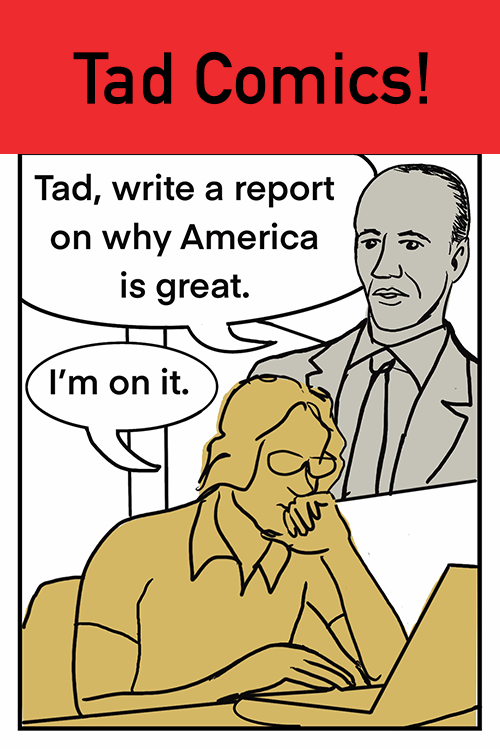
An update from today’s across-the-board firings in the U.S. govt.–so far.

Leave a comment

Filed under Comics

The Poet by Todd Webb comics review

The Poet collection, Volume One

The Poet is a comic strip by Todd Webb. If you are not familiar with it, I encourage you to check it out. There are a number of ways to dive in, including purchasing a full collection or sampler book. First off, you can check it out online. The following are some of my own thoughts on the comic strip format in general and how Todd Webb’s remarkable comic strip fits into this tradition.

The art of the comic strip is a very specific format. What do I mean? Well, there are the differences in dynamics between superhero vs. indie; or the traditional art world vs. the comics medium. And then there’s the comic strip which most definitely has its own very specific turf. Honestly, sometimes I wonder if the diehard fan base for comic strips and graphic novels overlap very much. So, when you hear someone say, “Oh, it’s all just comics!” that is pure nonsense. Comics is not one big pot of stew. However, at the end of the day, I’d still like to think that there’s enough common ground. Anyway, this is all to say that I realize I spend a lot of time with issues dealing with the graphic novel, or what aficionados like to call, “long-form comics.” However, I also love comic strips, or “short-form comics,” and I like to create them as much as I do graphic novels. Basically, there’s a big shift in how you approach either one and only a few comics artist would dare to seriously pursue both. The best example I can give you is Bill Griffith, known for his ongoing comic strip, Zippy the Pinhead, who in more recent years has also maintained a regular output of some very significant graphic novels. With all that in mind, I shift gears to a comics artist who has focused his efforts on the comic strip with some fabulous results, Todd Webb, the creator of the ongoing comic strip, The Poet.

From a recent The Poet post.

There are a number of elements and traits unique to comic strips, a creature of the newspaper, with a whole set of traditions. What Todd Webb does best is respect those traditions and contribute something uniquely his own. That happens in many ways, both instantly and over a period of time. It begins with a notion that the cartoonist plays with; and that leads to a thought-out scene; and, ultimately, to a resolution which, in the case of The Poet, tends to be a gag or punchline of some kind involving a gentle poet and a skeptical pigeon.

The Poet and sampler books.

One of the most fascinating qualities of a comic strip is its potential for delivering something pleasant, even compelling, over and over again, in a very familiar setting, a pattern led by its anchoring main character. You have these things in graphic novels, of course, but not to such a formalized level–and perhaps that is one of the things that diehard fans find so attractive, a love affair with the familiar. Well, I see that Todd Webb understands this very well. The fact is that the loyal fan of the comic strip enjoys a good laugh delivered in a certain way and comic strips have this built-in delivery mechanism. If you honor that, you’re on the right track.

Comic strips, by their very nature, are compact and tend to not mince words. In fact, a verbose comic strip seems to go against the whole spirit of the format. The best example of a wordy, perhaps sometimes too wordy, comic strip has got to be Doonesbury. The gold standard is to make every single word count, very concise, near to a haiku. And the prize for the best example, arguably, is Peanuts. Here is where the diehard fans get their kicks in comparing who is best. And, I gotta say, it can be some pretty wacky fun. Apparently, the biggest rivalry is between fans of Peanuts and fans of the original Nancy. And, here again, I believe that Todd Webb fully appreciates the tropes, the canon, the whole tradition–and he delivers.

Comic strips are, as I say, a whole world onto themselves, just like New Yorker cartoons. You can push boundaries and limits but there’s much to say for keeping true to what works. One of the most distinguishable traits of any comic strip that wants to keep to the old school standards is regularity. If the cartoonist can set up a routine and platform that keeps this engine going, then the path is clear. Once you have created this well-oiled machine, you just keep delivering. You refine here and there. You make adjustments. But you ultimately stay on brand, whatever it is that you have cultivated. This is exactly what Webb has managed to construct over a series of various experiments. Finally, he hit upon something he was compelled to dedicate a substantial amount of time and effort: an elder gentleman poet and his wisecracking pigeon cohort. It’s a simple and clear concept and it delivers. You can find Webb’s latest comic strips on his Instagram and then you can take a deeper dive on his Substack. Plus, of course, you can buy his books and whatever else he might have for sale on his site.

2 Comments

Filed under Comic Strips, Comics

Waymo is My Friend: comics by Henry Chamberlain

I have grown quite curious, and sympathetic, to the comings and goings of Waymo cars. This is a discussion we are all gradually, yet steadily, beginning to share as Waymo becomes better known. If you’ve never heard of Waymo, I can appreciate that. And, if you’re hip to it, please stick around as well. I’ll share with you what I’ve experienced firsthand. In fact, you can view a YouTube video I did all about it here:

So, how many Waymos does it take to start a movement? I asked Google and, since it should know, especially since it runs Waymo, it states: “As of October 2024, Waymo operates around 300 driverless cars in San Francisco. This is part of a national fleet of about 700 driverless cars.” That seems like a fair amount! The rest of “the fleet” of robotaxis is in Austin, Phoenix and Los Angeles (with more cities emerging, like Atlanta). Nice start, don’t you think? Waymo was so special, only a few months ago, that you needed to be on a waiting list to get access to the app. On a visit to San Fran in November, it was no big deal for me to get the app and hop into a Waymo. As of this writing, the big thing right now is people posting their first Waymo rider experience. That is not going to end anytime soon. People’s reaction to Waymo appears to run the gamut from all-in early adopter to cautious newcomer.

I have to admit that Waymo, or any extended thoughts on self-driving cars, was not on my radar before my visit to San Francisco last November (just prior to the election of you-know-who). Waymo was way in the back of my mind, along with a million other bits of news items and random factoids. And, then, suddenly, I find myself loading up a new app and hopping into the future. I had recently read Mr. Penumbra’s 24-Hour Bookstore by Robin Sloan, the now-classic 2012 novel that plays with the tension and intermingling of bookish old hippie culture and nervy high tech in San Francisco. The night before, I had gone to a reading at the epicenter of the old guard counterculture, City Lights Bookstore. The moment I was finally inside, I felt a sense of relief and resolution: I had waited a certain amount of time; I had figured out a new app; I was already in the throes of being driven without anyone behind the wheel when it steadily became a new normal. Here I was, this bookish neo-hippie inside this futuristic vehicle (a taxi with a robot for a driver!) but I wasn’t quaking in my sandals!

In fact, there is more of a process in breaking in a new human driver interaction than there is in letting a machine do the work. And that, in a nutshell, is the essential difference; the crossing of a threshold done with each new innovation: letting go and letting the machine do the work!

Did the machine do as good as job as I would like? Well, a driverless car will inevitably be a better driver, overall, than I could ever hope to be what with the help of sensors, radar and cameras. A machine never gets tired or distracted. That said, a machine does not have the human touch, that common sense that tells a human driver what to do in a human moment. Anyway, while I was on this recent trip, I used a Waymo on three separate rides. I noticed that the Waymo does not truly know how to improvise. It will not do well with more obscure pickup spots, but neither will a human driver. A Waymo may opt to pick you up at an alternate location for no good reason, at least not for your benefit, and the same can be said for a human driver. A Waymo may pull over to the curb, again for no clear reason, at least not for your benefit, and so too a human. All that said, I never felt unsafe in a Waymo. We still have a long road ahead for Waymo but, overall, I remain optimistic. And, heck, I don’t always like to make small talk and the Waymo is more than cool with that.

For more comics, art and related items, visit henry-chamberlain.com.

2 Comments

Filed under Comics, Henry Chamberlain, Technology

Uncle Sam: Special Election Edition comics review

Uncle Sam: Special Election Edition. Steve Darnell and Alex Ross. New York: Abrams, 2024. 121pp, $25.99.

Guest review by Paul Buhle

The Special Election Edition came out just in time, more or less, for the most disappointing election in recent US history. Or just in time to drive the main point of this extraordinary comic home: the utter confusion in what the US has been, stands for, might be, remains very much the national saga. No matter what any politician (maybe not Bernie Sanders or AOC) says. The bilge of the politicians’ messaging still makes for indigestion and the worst may be ahead.

Never mind, let’s focus on the comic. Darnell (the scriptwriter), Ross (co-plotter, so called, and illustrator, joined by Todd Klein on Lettering) caught me flat footed in the original 1997 printing. Like any other radical historian of the 1960s-80s generation, I was not likely to expect anything so riveting, no immanent critique of “Americanism,” from the mainstream comics industry. Sure, gay and lesbian superheroes had been added, not to mention the popularity of noir comics with heavy social implications. Uncle Sam was another geography.

So much so that its real value, and I hope real impact, is difficult to characterize. The tall fellow in the funny suit with suspenders emerged in the nineteenth century, definitely boosted by the tall (and homely) Abe Lincoln but goes back to earlier self-celebration. You might say that it borrowed a little or a lot from the “Columbiad” celebration of the marvelous creature (actually a semi-clothed female) entering the New World with perfectly innocent intent, an image displaced by icons from the neoclassicism of the Roman Empire: the heraldic eagle, counterpart to the “Senate” on “Capitol Hill.” Uncle Sam was more the fighting type, of course, but he had God on his or our Side.

Thus the First World War posters set the pace, with actor James Montgomery Flagg as model for Red Cross fundraising and recruitment messages, not to mention contemporary sheet music illustrations and magazine covers. We have been stuck with the guy ever since, actually recreated as a comic book action hero by none less than Will Eisner in the 1940s.

This book’s Uncle Sam is anything but clear-minded or resolute. He’s homeless and hapless, a broken old man wandering through a deeply sick society. The cruelty of the present for this pathetic dumpster-diver drives him back to a real and imagined past, or many pasts. He finds himself, for instance, in a modest domestic scene with a kindly wife during the Revolutionary War. She explains that George Washington is a slaveowner protecting his own fortune. Sam, a healthy looking Sam in his 30s, can only say what he will say again and again, “I pray this war will make us better. All I know is that I can’t let it make things worse.” Off to battle, presumably. Too soon, he finds himself in a modern USA where “I walk past a nation that’s covered in equal parts of dirt and despair.”

The voices inside his head won’t go away, like Andrew Jackson’s Secretary of State on Native Americans, “We must frequently promote their interest against their inclination” as they are sent on the notorious death-march Trail of Tears. Sometimes, it’s John Brown who is quoted, sometimes journalists describing the inhuman behavior of white mobs assaulting a black prisoner later on in the nineteenth century.

Uncle Sam, at the scene of Civil War battles, is particularly beset. Here, if anywhere, is the Good War. My own Great Great Grandfather, an Abolitionist who marched with Sherman through Georgia, making the continuation of slavery impossible, would surely have said so. And yet it did not seem to bring the purge of racist sins that idealistic Americans hoped for, quite the contrary: the excuse in advance for other wars with idealistic claims entirely false.

A survivor of the Dust Bowl, looking remarkably like the wife of the first Uncle Sam, can only say, “We had it coming.” Rip away the top soil for short term gain and what else should be expected; the craving for constant expansion provided its own rationale and rationalizations.

And so Sam grinds onward into the 1980s and his apparent appropriation by the New Right where public manipulation becomes almost open: “If there’s one thing I learned about you, the American people…it’s that you…fear change.” Sell them emotional security, sell them the image of liberalism as the enemy, and any protester can be bashed on the head, jailed, even slaughtered.

In Sam’s head, he is still marching to the tune of Yankee Doodle, while in reality he sits in jail, referencing MLK, Joe Hill, Sacco and Vanzetti.  Sooner or later, he gets to the slave pens and is released as harmless, only to meet Miss Britannica, Sam’s original.

The horrors relived from here to the end of the book are less words than pictures, and less horrific in images (with some exceptions) than in the messages being driven home, page after page. An Empire acts like this or it wouldn’t be an empire.

Paul Buhle

Leave a comment

Filed under Comics, Comics Reviews

Hurricane Nancy Art: Making Sense of the News

Here is a new work of art by Hurricane Nancy. We all have our thoughts on current events these days. It can be a lot to process and sometimes art can help lead the way. In this latest piece, it looks like someone is being torn in two directions without any clear path ahead. Well, time will tell.

Be sure to visit Hurricane Nancy and check out her art for sale.

2 Comments

Filed under Comics

SPX 2024: M. Jacob Alvarez comics

The Atheist’s Guide to the Old Testament

M. Jacob Alvarez is a longtime cartoonist who always has something new and interesting up his sleeve. For this year’s Small Press Expo, he has two new minicomics to debut: The Atheist’s Guide to the Old Testament and Mae the Master. Find Alvarez at Table W37B. As a fellow cartoonist with a similar penchant for exploring and dissecting, it’s great to follow Alvarez’s various pursuits. These two books could not be more different from each other and yet they share certain qualities. So, if you haven’t already made plans, and happen to be in the DC metro area, consider Small Press Expo, Sept 14-15, and seek out the work of M. Jacob Alvarez.
The Atheist’s Guide to the Old Testament. M. Jacob Alvarez. Hypnospiral Comics. 36pp. $6.
I have read more of The Bible than I might give myself credit for. I have certainly not read it from cover to cover nor do I have plans to do so anytime soon. Thanks to M. Jacob Alvarez, I need not worry if I’m missing out, at least not as far as the Old Testament is concerned. In his handy dandy minicomic, Alvarez covers all the highlights and then some. And, as is his way, he can’t help but dive into related matters. There’s a bonus section on the I Ching and a brief history of magic.
Mae the Master. M. Jacob Alvarez. Hypnospiral Comics. 28pp. Free.
If you treated your passion in life like a religion, then it might involve this next work by M. Jacob Alvarez. As he told me himself, this comic is more than just a love letter to manga and anime: “Mae the Master is about devoting yourself to an art you love, having your whole social life be that art, but never ‘making it.’ Dragon Ball Z is full of interesting characters who have obtained near God-like power through training and self-discipline. Without fail, after their initial appearance and threat, they fall behind the main character (Goku) and are treated as a joke.”  Alvarez relates this dynamic back to the rough and tumble of stand-up comedy where he endured the harsh competition between comedians. Well, every industry has its rough and tumble dynamic with competitors and gatekeepers. Alvarez’s comics demonstrate a happy warrior, confident in his worth, and in it for the love of the game.

1 Comment

Filed under Comics, Comics Reviews, Small Press Expo

PeePee PooPoo #1 comics review

PeePee PooPoo #1. Caroline Cash. Silver Sprocket. 36 pp. $9.99.

Caroline Cash is back! Her fourth comic book has just released and it looks terrific. The PeePee PooPoo series recently won the Eisner Award for Best Limited Series, has won the Ignatz Award for Outstanding Minicomic in 2023, and the Broken Frontier Award for Best Periodical. Of great interest to comic strip fans, Cash took over the Nancy comic strip during Olivia Jaimes’s hiatus. Cash started PeePee PooPoo with issue #69, then #420, and followed by #80085. And now we have #1, a “first issue,” an opportunity to re-introduce herself to new readers.

I am ramping up my own new comic book series, Pop Culture Super-Sleuth, and I can tell you from that experience that it’s a ton of work, a labor of love but work all the same. A key thing I want to make note of is that Cash is a very well organized phenomena: just like a political campaign, Cash has a well-oiled machine, thanks to Silver Sprocket, keeping things flowing with production as well as promotion. Pee Pee Poo Poo is a comic book series with the ambition of placing itself among the best ground-breaking indie comics. Well, the stars have indeed aligned as each new issue has been celebrated within social media and grass roots word-of-mouth. Momentum has built over a period of time. The style, content and approach all add up. Unabashed autobio comics are a staple of indie comics and go through up and down cycles, but, when done with gusto, like Cash’s work, they can be a hit. If done right, they can even be considered a voice of a generation. Once the momentum is in place, the machine is running at full steam.

What do I like about this new issue? Well, what I’ve loved all along. Cash is showing us once again that she is in it for the long haul. She’s a born storyteller spinning yarns with a seemingly effortless abandon about travel, relationships, sexuality and just being a human being. It doesn’t matter, in the big picture, really, if you’re gay, bi, or whatever. What really matters is that you have something to say and you express it, which is what Cash does so well. This issue is playfully numbered as #1 but that’s significant. I think it’s safe to say that this is a nice pause, a chance to say hello again, while at the same time continuing to celebrate her wonderfully uninhibited comics. There will be nods to the giants from time to time. Yes, Cash is walking down the same path of such greats as R. Crumb, Julie Doucet and Daniel Clowes and she can rest assured that she is leaving behind her own distinctive footprints. I love the scene, by the way, in one of her comics where she’s walking barefoot through TSA. I’ve done that and, well, it’s definitely a unique experience.

Leave a comment

Filed under Comics, Comics Reviews

FUNNY STUFF Interview: Secrets of New Yorker Cartoons

New Yorker cartoon by John O’Brien.

In this interview, I chat with Phil Witte and Rex Hesner, the authors of, Funny Stuff, a new book that explores the creative process behind great cartoons, specifically the tradition of the one-panel gag cartoon in The New Yorker. What exactly is it that makes for a perfect New Yorker cartoon? Well, you get a lot of answers in this book, starting with the Foreword by one of the legendary New Yorker cartoonists and editors, Bob Mankoff. As a cartoonist, myself, I’m on cloud nine with this read and you will be too.

New Yorker cartoon by Leo Cullum.

What, when you get right down to it, is a New Yorker cartoon, down to its essence? This is a very important question given that we live in disruptive times eager for change. With that in mind, here’s a book that simply lays it all out: what it takes to make an engaging, funny, and successful New Yorker cartoon, including the more subtle aspects. As for what the cartoonist is aiming for, Hesner boils it down to a cartoon where “the humor is not on the nose. It’s not going to be obvious.” And Witte points to “the cartoon’s subtext. What is it that the cartoonist is really saying.”

New Yorker cartoon by Bob Mankoff.

The main point, I believe, is to take a pause and appreciate what is involved, and what is at stake, in the creation of such a cartoon. You know it when you see it, right? It’s not protest art. It’s not cathartic art. It’s not even outright funny art. Heck, it’s not even “art,” per se, although we can argue the finer points in another post. One thing it is, for sure, is funny. It is a one-panel cartoon that not only will stand the test of time but will also instantly engage the reader with a laugh in a very distinctive and offbeat way. It’s not easy to do right and there’s no need to re-invent the wheel. There are tried and true methods that go into such a work. So, it’s worth it to take the time to understand the nuts and bolts behind this very special thing we’ve come to know as The New Yorker cartoon.

Phil Witte and Rex Hesner are two of the most well-versed authorities on all things having to do with New Yorker cartoons. You can find their observations on the state of New Yorker cartoons over at their blog, The Anatomy of a Cartoon at CartoonStock.com. Phil Witte, is an outstanding cartoonist in his own right, published in such notable places as The Wall Street Journal, Barron’s, New Statesman and, of course, The New Yorker.

Leave a comment

Filed under Comics, Interviews, The New Yorker