Sometimes, a comic, by its energy, spirit and style, just grabs you and you know you’ve found a winner. Such is the case with Artichoke Knight by Alex Newton. Let me tell you, this comics artist loves what he does. It is so apparent from every page. I believe this holds true for all of his work since I clearly see an overriding style here. Newton just keeps going; he has a relentless drive to share his vision. With that in mind, I say that Mr. Newton must continue and you must buy his work.
Page after page of fun, inventive and original work.
The book we are looking at collects all the single issues thus far, which appears to be a dozen. Newton manages to completely avoid any continuity of style issues; the whole thing runs quite smoothly, easily passing the flip-through pages test. What instantly catches my eye is Newton’s confident use of wordless passages. If you don’t speak English or, if for some unfortunate reason, reading is just not your thing, there are quite a number of amazing text-free pages. Newton has a career in illustration just waiting for him. Anyway, he’s doing just fine. Clearly, creating comics is his passion. His lettering is outstanding. His color choices are spot on. His light-line style is right on the money.
What a scene!
The story is delightfully straightforward. A couple of friends, Charlie and Cherry, engage in an annual competition. Cherry always wins and has gotten a bit complacent. This could be Charlie’s big year to win big. The plot gets a little more involved as the competition is some sort of “cookery-combat.” Okay, sounds very intriguing–and original. All sorts of opportunities for fun visuals. There’s a road trip to get to this event. The couple are cute and energetic. A hint of romance is in the air. A competitive spirit is also in the bargain. This is a great set-up and Newton makes it pure comics nirvana. Yes, I say this: Artichoke Night is pure comics nirvana!
When pigs fly.
As you can see, Newton delivers page after page with work that is a lot of fun to view. I can see him going into animation if he chose to. Again, it’s all about the comics, that we’ve established. But branching out into related things is definitely an option. At least offering prints, which Newton does. Just go visit his website. However you look at it, Newton is a born storyteller. He writes. He draws. He lays it all out. Talk about auteur creators! This guy is doing it.
And away we go!
Hats off to this book being self-published too. While there are some perks to getting picked up by a publisher (and there are wonderful things to that) there is no getting around the fact that holding onto your intellectual property and getting to call all the shots is very appealing. You’re going to do most, if not all, of the marketing whether or not you have a publisher. If you can stay determined, self-publishing done right is truly the gold standard. Just ask Jeff Smith.
There’s a moment in the story when Charlie is slouched over on his couch trying to take stock of his life. We’ve all been there many times over. And it hits him. He’s been attempting to hang in there all this time. Why not level up? Too often, in various circles, we’re encouraged to just get along and embrace just being a participant. Phone in your effort. Mediocrity is more than okay; it’s the standard; and it’s celebrated. Excellence is not supposed to exist. I say to this killjoy of a concept, that there is such a thing as reaching for the stars! Some people, if they so choose, do get there–and we all benefit when that happens. Ah, you only live once. So, why not do better? You’ll regret the drip, drip, drip of conformity.
A hint of romance.
Getting back to Newton and Artichoke Knight, it’s just a matter now of staying the course, going to comics conventions, engaging in various grassroots marketing and always believing in yourself. I’m sure that Newton is a true believer. We are so lucky to have him around.
The College Try, Vol. 1. w. Olivia Cuartero-Briggs. a. Roberta Ingranata. c. Warnia Sahadewa. l. Jodie Troutman. Mad Cave Studios – Maverick. 120pp. 2026. $9.99 digital. $14.99 print.
I love the time travel theme, and I’m certainly not alone. I’ll admit that it’s not always done right but I tend to give a creator credit for simply stepping up to bat. Sure, some folks will take a stab at it just because it’s a popular genre but I like to believe that a sizable number are attracted to it by a true sense of wonder. That’s what happens with The College Try. I was charmed by it right away.
Meet Rachel. At 42, she’s at the top of her game as a professional comedian but she can’t catch a break when it comes to dating men. After yet another disastrous online date, Rachel retreats to the apartment of, Scout, her former roommate, to dish on her latest flame-out. Scout is not too thrilled about Rachel barging in but reverts back to her younger days for the sake of her pal. And this scene sets us up for what is to follow in more ways than one. Not only is Rachel forcing Scout to revert back to their college days. Through the magic of time travel, Rachel is about to embark upon a journey that Rod Serling would approve of. Rachel will be literally returning to her college days with all the benefits of doing over her life if she so chooses.
Yep, once zapped back to 2003, Rachel is totally okay with making some changes to her life. At the start, the story doesn’t waste any time with the mechanics of time travel, why Rachel is not her 42-year-old self in 2003 but has been transformed into her 20-year-old self or even with details on convincing her 20-year-old pal, Scout, that she’s materialized from twenty-two years in the future. Now, these points would usually be hard to get past but I appreciate that Olivia Cuartero-Briggs’s script is more rom-com than sci-fi. The banter between characters in fun and breezy, akin to what you would expect from Buffy the Vampire Slayer, both the TV show and the subsequent comic book. Fun and breezy says it all. This is the sort of escapist entertainment that is hard to put down once you’ve started.
So, yeah, you had me at time travel—and that’s a double-edged sword because you want to embrace the genre no matter what and yet you won’t be satisfied if it falls short. And sometimes you get something in between (not ideal but not failure either) that ultimately wins out because of its own unique set of features, what it brings to the table. This comic is within that less than perfect fit. That said, what gives it a special oomph is its quick wit and pace. So, Rachel, our main character, has been transported back in time and is inhabiting her twenty-year-old self. She’s after an old flame who was never truly interested in her and, throughout the story, there are massive hints that she was never meant to be with her loverboy, Jason, but was most likely going to find happiness with that girl, her best pal, Scout. This is no spoiler but sets up the premise for what follows. It’s a little more than irritating that Rachel, supposedly such a street smart person, would hold a torch for Jason in any way but maybe that’s part of the fun. In fact, it is! My quibble is that these personal dynamics could be tweaked a bit more early on.
All the great time travel stories are character-driven even if the plot is to kill Hitler or prevent the JFK assassination. It always comes back to a story at a relatable human scale. Perhaps the greatest of them all is a story you don’t think of as a time travel story, the Dickens classic, “A Christmas Story.” Talk about character-driven! Ebenezer Scrooge goes through one of the all-time best known character transformations in the written word. The subplot of the fate of Tiny Tim is right up there. With greater insight after traveling through time, will Ebenezer help save Tiny Tim? Ah, this is one of the greatest short stories ever. This comic shares a more fanciful approach to time travel as the Dickens classic and even has its own Tiny Tim type of subplot. Not too bad for a rom-com. And, let me be clear, a rom-com is fine in my book. This comic turns out to be that and a lot more.
A close look at Snafu suggests what is behind the behindess of popular culture in its pulp-industry glory days, just before professors discovered the paperback market for their prospective (or imagined) best-sellers. A dozen versions of Seventeen or other magazines for adolescent girl-readers; more dozens for the home-bound household drudge, mostly short fiction; Hollywood glamour mags by the dozens; Men’s Magazines with adventures and salacious fiction of semi-nude women, alongside lion-hunting and such-like manly fantasies. Not to mention Hot Rod specials, Wrestling specials, big-selling Sci-Fi magazines with wonderfully crazy covers. All this miles below the respectable (and then still numerous) slicks like the Saturday Evening Post.
MAD #6, 1953.
Mad Comics (1952-55), notoriously the brain child of Harvey Kurtzman, drawn by a handful of the greatest satirical artists of the age and best known for skewering the morals and manners of modern culture was also….a huge hit. So huge that it evoked, as its more hugely popular successor Mad Magazine would evoke, a not-so-small army of imitators. The best of them by a long stretch was Panic (1953-55), using many of the same artists but without the avant-garde “feel” expressed, for instance, in the April, 1955 Mad Comics satire of art history including abstract expressionism, seen through the imagined artistic life of Willie Elder, Kurtzman’s most intimate collaborator. Nobody else would even think to go that deep, although when I asked Kurtzman about this most striking and unusual feature, he responded “it is amazing what you can do if you have pages to fill.” He was joking, I think. Maybe.
PANIC #1, 1954.
Kurtzman, resigning from Mad when his insistence that he own 51% ownership was turned down, famously tried to duplicate his success in Trump, Humbug and the final shot, Help! Simply to name all the other Mad knockoffs during the 1950s-70s would be impossible, but they definitely include Eh!, Snafu, Frenzy, Cracked, Thimk, Loco,Frantic, Grump, Drool and Crazy. Cracked outlasted the rest by winning reader loyalty as a serviceable if second-rate Mad. Sick!, more literary pulp than comic, stands out as a kind of avant-garde response, an imitation Lenny Bruce on the page, easily adopted from the lesser stand-up comics of the day.
Kurtzman, when I pressed him for precursors of Mad Comics, suggested that the college humor magazines, especially in their post-war phase where censorship and political restraint wavered, had offered a model of sorts for what he wanted to do with something new. He and his artists would take on the world. The GI Bill generation that launched campus cinema clubs to see European art films and sometimes protested racial discrimination wanted something more than a handshake from the society that sent them to war. Through the 1950s and a bit further, college magazines continued to appear with issues banned for their sarcastic political commentary as well as overly sexualized prose and cartoons.
SNAFU #3, 1956.
Snafu, like nearly all of the other Mad imitators, had no such ambition, although repeated, not-very-humorous references to violence may indirectly reflect wartime memories and unintentionally express PTSD. “The Funniest Magazine in the World” (an overly ambitious claim, to say the least) lasted two years in the middle 1950s, the normal run for a Mad Comics imitator. And it had several veterans of Kurtzman’s project, mainly artist John Severin and his sister Marie, a letterer who could obviously go beyond her domain to produce parody photo manipulations.
HELP! #12, 1960.
The expansive introduction by Michael J. Vassallo may itself be worth the price of the book to scholars. Both meticulous and incisive, at least when the fannish generosity of appreciation does not get in the way, it tells us what we need to know. We learn that businessman-publisher Martin Goodman, known earlier for the formative Timely Comics, is in charge here, if doubtless preoccupied by the wider scope of his empire. For a while, Stan Lee clocked in as an executive employee and continued in the boom years to reign over dozens of titles with a small army of underpaid contributors. Jim Warren would publish Kurtzman’s Help!. Andkill it for the crime of low revenue.
Goodman, familiar with many of the comic artists and writers who had seen military service—most of them in non-combat roles as educator/editors, identified with the sentiments of the Warner Brothers famed 1946 animated feature, “Private Snafu.” Famously, the phrase “situation normal, all fucked up” was a familiar expression of ordinary soldiers none too fond of the Brass that lorded over them, especially because the overlording so often got in the way of whatever really needed to be done. This movie cartoon had been created by some of the animation greats, including Chuck Jones, Fritz Freeling, Bob Clampett and Frank Tashlin, “voiced” by Mel Blanc, and for millions of GIs, offered a much-needed laugh and some mental solace.
SNAFU #2, 1956.
Then, seven years later, came Mad. As popular among young adults as kids, its readership included plenty of GIs, many of them already familiar with Kurtzman’s bravely realistic, arguably antiwar war comics. It was apparently Stan Lee, still hardly a name outside of the comics industry, who came up with a knockoff of Mad for the growing Goodman empire.
RIOT #1, 1954.
Snafu closely followed teen and funny-animal humor of the same company, published under titles like Millie the Model, Patsy and Her Pals, The Monkey and the Bear, Girls Life, Homer and the Happy Ghost and My Girl Pearl. Among them, Wild, Crazy Comics and Riot all imitated Mad, but none with the energy or success of Snafu. A comics art veteran, Joe Maneely, was chosen along with John Severin to carry the serious artistic weight, issue after issue, with Mad veteran Russ Heath among others on the side.
SNAFU #1, 1955.
Vassallo comments that the humor writing in the comic aspires to be at Mad level, but “unfortuntely, Lee is no Kurtzman,” and “sometimes very funny, but frequently juvenile” (p.xx). This is an understatement of considerable weight. The cover of the volume—a young woman in panty girdle and bra, seen from the back but clearly holding onto a subway loop, with an all male cast in the foreground reading Snafu rather than looking at her— already suggests juvenile humor of boys turning toward sexual interests a little nervously, as funny or strange. Very very Snafu.
THIMK #3, 1958.
The art, numerous steps downward from the EC standard, looks rushed, the gags pretty obvious. Albeit sometimes contemporary: “Good News for Men Over 40…Who are Frequently Tired and Worn Out. You’re Draft Exempt!” A Korean War joke or a memory of WWII? Sometimes the jokes are a bit worse, as in “TV Programs This Week”: “Evelyn runs away from reform school because [her] boy friend is always smacking her with the palm of his hand. She finally finds true love with Jack Gonng, prize-fighter, who hits her only with a closed fist.” (p.15, November 1954.)
WILD #1, 1954.
On the last page of the introduction, Vassallo asks why these highly ephemeral efforts failed and were, so to speak, never heard from again. He reiterates that Mad really was the original, attracting the best artists with the best editors and production, while Snafu and others in the Goodman barn could never, by their nature, be more than imitations.
SNAFU Issues 1-3.
There is much to be said for this interpretation. Yet, as Vassallo insists, the seriously talented Severin obviously labored under rushed conditions and tight deadlines, turning out visual gags. We wince at the Burlesque Show jokes, the “Squaw” gags with pretend-Indians and the assorted gender jokes that would not survive “Me Too” complaints of a later day. Snafu does a lot better, arguably hits a high point, with one repeat feature, well-drawn imitations of famous cartoon artists’ work, from the Saturday Evening Post to the New Yorker, not to mention 1000 Jokes and other low-class pulps that would disappear from the news stands before 1970 or so. The various artists who created these pages obviously did their homework.
Captain Billy’s Whiz Bang, #188, 1934.
Seen from another standpoint, the repetitive sex-joke format of Snafu issues may seem further from Little Annie Fanny (Kurtzman and Elder, later on in Playboy) and closer to the tradition of Captain Billy’s Whizbang of the 1920s-30s. Updated to suburban life and its consumer pleasures with built-in frustrations, it loses the old sex-crazed undergraduates—often male and female alike—of the campus and the sailors, not to mention the naughty talking parrot of the college landlady. Snafu offers, one might say, a last look backward on another time and another world of comic art.
BUNK #1, 1956.
With two issues of Snafu under his belt, Goodman launched Bunk!, made up almost entirely of retouched photos and gag commentaries, as if the butt of the joke is actually Confidential, just then a new hit in the exploitation trade. Then comes Riot, soon dumped and then revisited in short order, itself spun off to monster-satire features like Melvin the Monster. Still other, seemingly endless spinoffs follow until Atlas itself implodes. The lead artists of these efforts evidently go on, but not, I think, to greener pastures. Some made it to advertising, a long-wished goal of comic book artists, at first barred or limited by their Jewishness, and then less so. By then, the golden age of printed satire is over. At least, according to this critic.
Tales of Paranoia. R. Crumb. Fantagraphics. 2025. 36pp. $5.99.
A lot of the public has caught up with cartoonist-provocateur R. Crumb. More people than ever are ready to do some of their own provoking. But don’t count the master out. Fantagraphics is releasing, Tales of Paranoia, Crumb’s first new comic book in 23 years. A show featuring original pages from the book is on view (and for sale) at David Zwirner gallery in Los Angeles thru December 20, 2025. The leading cartoonist of the Sixties underground, one of the greatest ever, Crumb’s influence cannot be overstated. Whenever you see the work of a comics artist that features an alter ego stand-in for the creator, commenting and complaining about life’s foibles, you can thank R. Crumb. He single-handedly invented the one-person comics anthology with the launch of Zap Comix in 1967, a progenitor to the whole “autobio comics” genre that was to evolve into the “alternative comics” scene into the 21st century. Following the Crumb tradition of a Larry David-like anti-hero are countless cartoonists, including such notables as Julie Doucet, Gabrielle Bell, Julia Wertz and Noah Van Sciver. With this in mind, it is no small feat to have R. Crumb yet again hold his own—and at the age of 81!
Everything you could expect in a R. Crumb comic book can be found in this new book. I have read Tales of Paranoia a number of times and I am thoroughly impressed with how well it all holds together, one story blending into the next, not an easy thing to do well with a collection of short works. I’m delighted right away to see that distinctive, and consistent, lively drawing line. Crumb is a sui generis cartoonist: a one-of-a-kind artist who is highly accessible; sort of inviting other cartoonists to join in but most likely leaving them creating lesser replicas of his work. For the reader, Crumb is casually inviting you into his world: creating an illusion that you have entered an inner sanctum, whether it is the human condition, the national psyche or what may or may not be his own mind.
Reading every crumb of Crumb.
It is important to process every crumb of Crumb. He has written and rewritten, formatted and reformatted, to the point that he’s amassed layers of meaning, leaving room for argument and counterargument and further interpretation. Like any artist, he has absorbed the current zeitgeist and reflects it back to the reader. This leaves me wondering about his current batch of rants and riffs, as much expressions of his beliefs as a satire of how we collectively express ourselves: begin with the outrage and go from there, just like one podcaster emulates another podcaster, ad infinitum. Or, if you wish to take a longer view, it’s all about finding a way to tell the most compelling story, going back to the first stories ever told.
Crumb’s hobby horse of choice in this book is the potentially nefarious background attached to the Covid-19 vaccine and the cottage industry that has grown around it. This is not the only subject that Crumb sinks his teeth into but it is definitely at the top and provides a structure for further “ranting.” As any good storyteller knows, it’s all in the pacing. Like a good conversationalist, Crumb eases into this or that fact, gently but firmly citing his sources. Crumb makes his case for Big Pharma’s track record of corruption and encourages the reader to do their own research. Crumb finds nuggets of wisdom from a wide range of books and publications that he dutifully cites. He also includes such controversial figures as Joe Rogan and RFK Jr. which gives me pause. That said, Crumb insists you don’t have to like or agree with them but be open to what is coming from their corners. I conclude, if it is information resonating with the public, then it takes on a value, at the very least, for doing that.
We have gone from a tradition of “serious people” in high office and places of authority (John Kerry, Robert Reich, Hillary Clinton) to this current Trumpian transgressive period of unqualified “unserious people” in places of power (Kash Patel, Kristi Noem, RFK Jr.). Midway through the book, the comic “Deep State Woman,” points out that even a “highly qualified” person isn’t always your best bet. Here, Crumb can ease up on his “paranoid” character and simply focus on presenting a compelling portrait of a dangerous career bureaucrat.
With a nod to the mind-boggling complexity of all the world’s machinations, Crumb, more than once, looks upward and pleads for some words of encouragement from a higher power. Crumb depicts himself asking for some clarification from God and receiving the bare minimum for his efforts. All we can do is try. It’s nice to see that Crumb hasn’t given up.
Macabre Valley #1. w. Zack Quaintance. a. Anna Readman. 30pp. Comics Bookcase.
Macabre Valley #1 is a 30-page horror comic by writer Zack Quaintance (Death of Comics Bookcase), artist Anna Readman(2000AD, Peachfuzz), colorist Brad Simpson (Local Man, Coffin Bound), Eisner-nominated letterer Becca Carey (Absolute Wonder Woman, Exquisite Corpses), and designer Jared K. Fletcher (Paper Girls).
This is one of those comic books that will speak to anyone looking for a blast of good authentic fun. You know, the good stuff. Comics and horror go hand in hand and Macabre Valley does not miss a beat. There’s a cool story behind this comic which I’ll get to in a moment. For now, just think werewolves done right. I see that the Kickstarter campaign (thru 10/15) attached to this comic has done very well. Let’s take a closer look.
Welcome to McCobb, Texas, “home of the Macabre Valley.” If that sounds ominous, that’s because it is. Okay, so the cool thing to know about this comic is that its writer, Zack Quaintance, has tapped into his own experience as a young intrepid reporter and built upon that to structure his own horror story. This is a shaggy dog story, complete with gumshoe tropes and offbeat humor, reminiscent of classic EC Comics.
This is the story of the gruesome murder of a border patrol agent out in the middle of the desolate badlands of South Texas. A young reporter happens upon the scene and is abruptly brushed away by local police who plead with him to just let this one go. Of course, that’s the last thing that our hero is going to do. So, now the chase is on to solve the mystery of a savagely murdered border patrol agent. The trail leads the reporter to a maverick pastor with a soft spot for rehabilitating stray dogs. That’s all well and good until that night he confronts something less dog-like and more monster-like.
This quirky story, its whole premise, reminds me of the cult classic TV show from the 1970s, Kolchak: The Night Stalker. In that series, Kolchak is a gumshoe reporter, played by character actor Darren McGavin. Each week, by incredible luck (good or bad?) Kolchak confronts a supernatural creature: of course, he “stalks” the creature; goes all-out Columbo (another ’70s TV classic) on the monster until he cracks the case. So it goes with this highly entertaining comic book.
I got to read a shorter version of this story which was part of Zack’s comic book anthology, Death of Comics Bookcase. You can read my review of it here. This 30-page full-bodied version allows for a richer experience and far more breathing room for the talents of the whole creative team, named at the start of this review. You get all sorts of opportunities for expansion like the beautiful greeting card two-page spread. Zack gets to play with various narrative nuances, including some strategic humor inserted at just the right time to pause before consuming more grindhouse gore. One thing to remember about Zack Quaintance is that he’s someone who really cares about the details. He demonstrates that with all of his work, notably his own review of comics which, these days, you can find over at Comics Beat. So, you can rely upon his being a perfectionist when it comes to delivering the goods here with this exceptional horror comic book.
Lastly, keep in mind that this comic book is the result of a Kickstarter campaign so refer to the campaign for details. That said, this comic book will be embarking upon a journey akin to a salmon run where it will endure a challenging journey on its way to spawn for future glory. So, keeps an eye out. Follow this comic book’s journey in all the usual places, including Zack’s hub, Comics Bookcase.
The King’s Warrior. Huahua Zhu. Bulgilhan Press. 2024. 65pp. $15.00.
From the cover, all the way through, I am completely swept into the exquisite world that Huahua Zhu has created in her new comic. I love fantasy when it works for me and this does. Recently, I was browsing through a bunch of zines at a certain shop and I was struck by the art on the cover, the delicate and ethereal lines holding up a bold eccentricity.
When a comic sparks my curiosity, that’s a very good sign. The best fantasy will do that: somehow turn the genre on its head, give you something refreshingly new and will its own reality. By simply jumping into the story, in just the right understated manner, Zhu has achieved this. One wonders what led up to this moment while, at the same time, ready to follow along.
The two leading characters are rather enigmatic: a brother and sister with elfin ears. All we know, at first, is that this is a world of monsters, especially dragons. Zhu’s approach is to not give too much away. The first page is a trio of close-up panels depicting a slaughter of dragons. This is followed by a couple of pages of combat. And then a page featuring a castle and an inset close-up panel that only shows part of a craggy face. A textbox below dares someone to come and kill him. Finally, the next page has our leads, Mara and Echo: an animated page of various panels that gently introduces the siblings with light hints of yellow and blue watercolor.
An ambiguous and fanciful tempo is kept up all the way to the end of this book. The connections between characters are not altogether clear hinting at a larger backstory. There is no apparent reason why the actions of one character should determine the fate of another but that seems to be the point. Mara and Echo have both ended up being kidnapped by a mysterious queen who won’t set them free until a warrior has completed his task of assassinating a wizard. Once this chain of events has been set into motion, more things are triggered and there’s no turning back.
Zhu has a wonderful way with drawing horses, dragons, gnomes, elves, wizards, all the stuff of fantasy, including a magical golden coin. The trick is to not bring out the big swords too often or all at once. Good fantasy, or any good story, is made up of a number of well-timed moments, constantly moving forward, toward something greater than its parts. This Zhu does well. I buy it in every quiet scene she’s conjured up with the mighty warrior and Growl, his chimera sidekick. Yes, Zhu manages a bit of humor. This is an ideal work of comics fantasy, both spooky and enchanting.
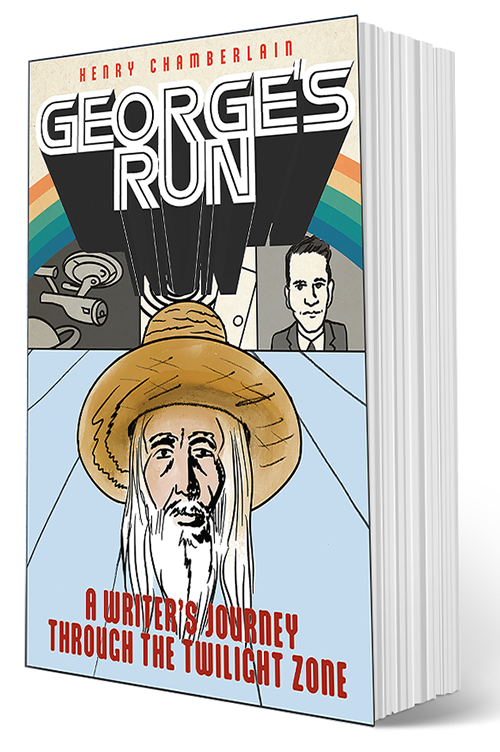
Those of us who create books of one kind or another must be mindful of the next step in our work’s journey, once it’s complete, published, and out in the world: the never-ending job of making more people aware of the book! My graphic novel, George’s Run: A Writer’s Journey Through The Twilight Zone, was published by Rutgers University Press in 2023. It was a pleasure to get a chance to give a talk and lead a workshop in support of my book at the Cartoon Art Museum in San Francisco.
Photos by Robbie Gomez.
The Cartoon Art Museum is a landmark in the local arts community and has the distinction of being one of the few museums dedicated to the comics medium. I have followed the museum’s progress since its time in San Francisco’s Yerba Buena Gardens neighborhood when Andrew Farago became its curator in 2005. Fast forward to 2017, the museum moved to its current location on 781 Beach Street on Fisherman’s Wharf. I’ve always found it to be a reliable source of inspiration with its impressive works on display, from new shows and its permanent collection. If you’re someone who has established a credible footing in this business of comics, you might find yourself invited to show your work here. I want to thank both Andrew and museum director Summerlea Kashar for helping make my presentation possible.
I have experience with leading presentations of one kind or another, notably a slide show lecture format which I first did when I led a panel discussion at San Diego Comic-Con. That said, I’ve been adding and refining notes attached to it ever since. I have found it easy to refer to notes and then break off into other directions. Lately, I’ve focused on an unusual zine that Marc Zicree (The Twilight Zone Companion) gave me a while ago. It’s a term paper he wrote in 1976, when he was 21 years-old. Marc’s paper features interviews with three significant figures from the Sixties zeitgeist: political cartoonist Ron Cobb; novelist Theodore Sturgeon; and television writer George Clayton Johnson. In his introduction, Marc makes clear how moved he is by Sturgeon’s uncanny ability to evoke the concept of love in his work. As for George Clayton Johnson, the subject of my book, Marc is mesmerized by George’s uncanny ability to speak virtually indefinitely on a wide variety of subjects. I carefully combed through Marc’s interview with George, and, just as important, Marc’s interview with George’s mentor, Mr. Sturgeon. What is clear is how much both men revered storytelling, which is at the heart of what my book is about–and, ultimately, my talk.
Once I start talking, I sense a detour up ahead. I had just mentioned the challenge of conveying the significance of a television show of the caliber of The Twilight Zone to a young audience unfamiliar with it when I found myself confronting a fresh new example in my audience for that day. Literally, only a few minutes prior, I had said that a young man had seemed to dare me at a comics convention when he told me outright that he’d never seen even one episode of The Twilight Zone. Right after that, a young man that day in my audience seemed to take it up a notch by telling me that he didn’t watch television at all. I was now juggling at least a couple of ideas going well beyond just being unfamiliar with a certain television show. Part of what I think was going on here is that the young man was, perhaps unintentionally, mirroring what I had just said. I gave it some thought and emphasized the fact that we all need to get as clear an idea of the big picture: seeking out great storytelling.
I went on to say that, when I’m given a dare to explain myself and make my case, I’m more than happy to break it down. In fact, the determination to break down ideas into concise and accessible elements took a life of its own in my book. That’s a vital part of the book: guiding the reader through the creative process that led to The Twilight Zone, one of the greatest works of television on many levels, not the least of which is the writing. My book is about the writers who made this possible. Overall, I think folks enjoyed what I had to say. Getting back to Marc Zicree’s 1976 term paper, one concept that keeps popping up is the steady encroachment of mass media and related distractions. This is well before even the internet and it already seemed like people were drowning in a flood of data. No wonder some young people today might think they don’t have time for “television.” I know it was very helpful for me to give this talk and the feedback will help fuel the next one.
It was my intention to offer more than enough stuff to cover within my two-hour window. During the talk, I encouraged the audience to begin drawing their own tribute to their favorite TV show. By the end, we had a few interesting submissions. I want to thank Chartpak for partnering with me and providing the art supplies for this portion of the event. I will provide a separate post that features the Chartpak marker that I used for my art demonstration. I want to invite everyone to check out the Chartpak factory store for an incredible selection of art supplies.
Thanks again to the Cartoon Art Museum for an amazing event and I look forward to many more visits in the future. And special thanks to photographer Robbie Gomez for these amazing photos.
McFarlane’s cover for Marvel’s Spider-Man No. 1 (August 1990)
Are you a superhero comics fan–especially an old school Spider-Man fan? I’d say that I’m a sensible fan with my own set of reasons. I appreciate that Spider-Man, along with all the great characters in comics, will forever be a wonderful opportunity to tell a story. Also, from a design sense, gotta love Spidey. From a pop culture sense, ditto. And, sometimes, like many fans, I’m susceptible to buying into Spidey, or any other comic book, as a keepsake. People have become conditioned to believe that an old stash of comic books might hold some highly valuable, “collector’s item.” This is based on such rags-to-riches stories as the astronomical rise in value of such Golden Age gems as Action Comics #1. By the 1990s, that mindset was completely ingrained among comic book consumers. The comic book market in the 1990s took a sharp turn down a speculative path with numerous titles touted as collector items and it ultimately went bust for a while. One of the most celebrated titles of that era, deemed a “collector’s item” on its front cover, was the first issue of the Todd McFarlane Spider-Man run, both written and drawn by McFarlane. Part of the battle is won when you have Spider-Man in the title and promise it’s a collector’s item. Spider-Man #1 went on to sell a whopping 2.5 million copies, partly due to the collector craze (take your pick in gold and/or silver variant covers) but just as much having to do with a new direction led my Todd McFarlane.
The speculative markets will tumble!
The new horror movie, Cloud, by Kiyoshi Kurosawa, features a flipper who buys up all the fan favorite items in order to resell them at jacked-up prices. It’s a cautionary tale about how we, as consumers, must be wary of traps. That’s what happened with comics. Hard-core collectors would buy multiple issues of the latest hot comic book title in order to manipulate the price. And then comic book publishers got into the act by feeding that demand for collector material: titles promising to be the next big thing with huge print runs, which, of all ironies, guaranteed they would not be scarce. Here’s a Comics 101 FYI: If you want a comic book to become valuable, one of the key factors is that it is rare to find a copy. These comics were NOT rare but were flooding the market and nearly destroyed the comic book industry. The solution? Well, it’s a hard pill to swallow but quality will always win out over quantity. So, in general, comic book publishers, despite all the variant covers and big events they create to lure in readers, are supposedly more interested in creating artful stories instead of marketing gimmicks. And that can often be true. That’s where comics reviewers lend a hand in seeking those titles out. Ultimately, let the buyer beware–and make your voice heard. Continued pushes for quality will keep the speculative beast at bay.
Howard the Duck #1 (1976), considered a collector’s item due to low distribution.
Speculation in the comics market will never die. But there are enough safeguards in place today that make it less likely we’ll have another 1990s-style market crash again. There is a greater sophistication and transparency at play and a lot more common sense. There will still be a lot of comic book collectors who don’t even read the comic books they collect. But that’s their problem. The best defense is to do more of what has helped the comic book industry survive and that is to strive for higher standards. In fact, the passion to hold comics to the highest standards is what drives what is going on here at Comics Grinder. And it only makes sense because the backbone of the market, in order for this to really work, is made up of readers, not speculators. The more readers you have, instead of vulture-speculators, the better chance of comic book shops, and publishers, weathering the market storms. Graphic novels, in all their various shapes and sizes, capable of focusing on any and all subjects, have risen to the challenge and help considerably to keep the lights on. Our best bet is that readers win out in the end.
The McFarlane Effect at its inception.
In the spirit of celebrating the art of comic books, let’s take a closer look at that iconic first issue of the McFarlane Spider-Man. What stands out? Well, one key element that McFarlane enjoyed was creating a page with a series of thin long panels, like stripes, than ran across and created a bunch of jump cuts, slivers of moments. I don’t think McFarlane has gotten any real credit for this narrative device so allow me to do the honors and introduce you to what I’m calling The McFarlane Effect. A certain number of us who keep up with comics are aware of the De Luca Effect which I have written about here and, in a nutshell, is a page that features one character (perhaps two) repeated in a succession of moments. I think it’s only now, with decades to separate us from the media phenomena that was McFarlane’s Spider-Man, that we can better appreciate the art behind the work. I honestly think that McFarlane is such a towering figure in comics that such little nuances can sort of be overlooked. How many other artists have used this narrative device? Well, overall, I think that anytime that you see a work with long panels slicing through it, there’s a good chance it is by an artist influenced by McFarlane.
A rhythm struck up by quirky panels.
McFarlane’s use of long slim panels allowed for an infinite set of variations and set an ambitious tone for his helm at the landmark character. Keep in mind that here was a young man, working his way up the ranks at Marvel Comics, given his chance to create his version of, arguably, the most renown character in comics history. He would have been well aware of the trends and cross-currents at the time. He was an artist is search of the most compelling narrative devices he could think of so, you better believe that he was up late at night at that drawing board, night after night. He did not use this long slim panel device on every page but used it where it was needed, and developed a rhythm struck up by quirky panels.
The maestro makes music with his magical panels.
The maestro was making music with his magical panels. Sure, this was a darker and more realistic Spider-Man than the higher-ups were used to, or comfortable with, at Marvel, but there he was, Todd McFarlane, the aspiring baseball player, knocking them out of the park. McFarlane would have been thinking of Frank Miller and his audacious TheDark Knight Returns. Well, he had an answer for it bringing home his own take on horror tropes and delivering with a distinctive style that has been borrowed by many great artists, including Jim Lee.
Spawn #1 is a collector’s item!
And to continue giving credit where credit is due, of course, Todd McFarlane went on to found Image Comics, where creativity and creator rights are honored. Image Comics stands as a testament to what is possible for a great comic book publisher and everyone associated with it. You may know one of the big titles lined up to launch Image Comics. That was Spawn #1 in May of 1992. Created by Todd McFarlane, the first issue was written and penciled by him and it did pretty well: It sold 1.7 million copies. Not bad, right? And the rest is history.
Molly and the Bear: An Unlikely Pair and Molly and the Bear: Campers Beware. By Bob Scott and Vicki Scott. Simon & Schuster. (ages 8-12) 240pp each. $14.99 each.
Molly and the Bear is a syndicated comic strip by Bob Scott with a wide fan base going back to 2010. Bob Scott is a highly regarded cartoonist and animator who has worked with many of the greats in the comics industry including Jim Davis as well as with such high profile animation studios as Warner Brothers, DreamWorks and Pixar. Molly and the Bear is about an 11-year-old girl and her best friend, a very sensitive 800-pound bear. In partnership with his wife, Vicki, Bob turned this webcomic into a middle-grade graphic novel series. It is a wonderful collaborative project by two respected creatives in the world of comics and animation. The first two books in the series have just come out and I’m thrilled to share with you such a wildly inventive work.
“An Unlikely Pair”
Both of these books are coming out together and so make a perfect pair. That leads me to the title of the first book, “An Unlikely Pair,” which acts as an entry point, especially if you enjoy seeing two characters meet for the very first time. A big point I need to stress is that I’m always intrigued and overjoyed to see just how much quirky, artful and original storytelling is found within the pages of a book that has a younger demographic of readers. In this particular case, I firmly believe that Bob and Vicki Scott have achieved that classic “all-ages” appeal, and that has a lot to do with Bob’s refined sense of meeting the demands of a comic strip, traditionally meant to be enjoyed by any reader, whatever the age. This first book opens with Molly’s parents off to enjoy a drive and trusting their daughter to mind the home alone. This leads to Molly exchanging text messages with her pal, Harper, followed by her just dancing and enjoying a little freedom. But then, suddenly, a huge bear crawls in from an open window. In short order, Molly discovers this bear has some serious issues with living outside–and inside: he’s a complete mess who needs help. Molly decides to let him stay and just hope for the best. Of course, she will have to deal with Bear’s intricate system of worries. For instance, he’s afraid of heights, especially “mid-level heights.” Enough to boggle the mind of any therapist. And there’s your very unusual and funny premise.
Even if you are a highbrow comics connoisseur, I ask that you put on your white gloves, monocle and top hat and examine this work for yourself, just as you would any number of other works with a mass media following created by industry professionals (Carl Barks, Ernie Bushmiller, etc.). I think you’ll find the waters you swim here to be rather pleasant. Not only are the gags set up with precise timing but the compositions are consistently compelling. There is a level of skill here that can go underappreciated because it doesn’t call attention to itself but it’s there in every well-rendered figure and face, every well-established interior and exterior. I’m really charmed by the example above. Molly is luring her new best friend Bear to the safety of her bedroom with some ice cream, having him climb up a few stairs that he’s been terrified over. She manages to navigate a close call with her parents. By the next page, she races up the same stairs to check in on his progress and finds he’s overcome with a really bad case of stress-shedding. You see on these two pages Bear go through a roller coaster of emotions: from an all-time high to a lowest low.
“Campers Beware”
I actually read the second book first and only later went back and read the first book second. And I’m glad that I just leapfrogged into the material. Again, it’s all very polished and professional work with a certain subversive edge to it, just the sort of thing you find in all the old favorite animated TV shows like The Jetsons and The Flintstones. In the case of “Campers Beware,” Bob and Vicki deliver a hilarious story involving Bear beside himself attempting to befriend Dad while battling his fears of the great outdoors–and other bears. Really priceless stuff. Seek it out!
It’s been a minute since we had a full-on Superman major motion picture with all the trimmings. And this new installment shows with each charming but self-conscious step. It’s like a very expensive and fragile antique has been brought down from wherever it usually hides and one hopes it survives the special occasion that summoned it from its crypt. Superman is like that. Also like the James Bond franchise. Just as you’re getting used to one Bond, they bring in a new model. What was wrong with Henry Cavill? He seems to have a lot of mileage ahead of him. Well, he’s 42. The new guy, David Corenswet, is ten years younger. But there’s no getting around the fact that the actual character goes back to 1938. And, some will argue, Christopher Reeve, in the role of Superman, along with Margot Kidder as Lois Lane, in 1978, will always be the gold standard. In fact, Corenswet seems to be channeling Reeve in a pretty big way. The same with the new Lois, played by 34-year-old Rachel Brosnahan. There’s no doubt that the producers were looking for a certain je ne sais quoi and Brosnahan has that world-weary Kidder vibe down. The script doesn’t bother with formalities with these two and has them all over each other back at Lois’s apartment within a few minutes after the first big action scene. They are so used to each other after dating a couple of months that they let loose with a mildly tense quarrel. It was something else. It made a baby cry in the movie theater I was at.
Now, some talking heads have made a big deal about Superman updating for the age of MAGA. And I think the producers tried to split things down the middle. They gave Clark Kent a new set of parents cut from a MAGA trope: more of a laid-back Southern flavor as opposed to a prim and uptight Midwestern reserve that was the original recipe. Clark was raised in Smallville, Kansas after all, not West Virginia. Anyway, that part is done with kindness. The other part could be hard for some hardcore Trump fans to swallow and that’s stuff like Superman duking it out with Lex Luthor with Superman saying things like, “Yeah, I’m an alien and I’m proud of it. I’m a real person.” and Luthor saying, “I don’t care. The government has given me permission to do whatever I want with you!” Your mileage will vary. You can’t avoid a little sprinkle of politics when you’re dealing with such a colossal cultural figure as Superman. Director James Gunn referred to Superman as an embattled immigrant and that alone has created a bit of a firestorm. Every era has its own Superman and so it goes.
But getting back to the whole idea of a major Superman movie. It does feel like the good china and silverware is being brought out. My harshest view would be that the whole thing feels as if its been embalmed in formaldehyde, lost somewhere in the mist of the 1930s up to the 1970s. Maybe that’s a good thing, the fact that this sort of thing is still being done. It’s a very expensive experiment in entertainment but I can only imagine no one is going to lose their shirt over this. It’s going to appeal to a lot of people but that just goes with the brand. It’s too tempting for too many people. And I think it’s mostly going to be older people too even though efforts are made to make these characters seem youthful. One clue to the tilt toward older viewers, I think, is how Lois and Clark are supposed to be such huge fans of punk music. The way they carry on about their devotion to the punk ethos makes them sound more like people twenty or so years older than themselves. And that makes sense given that 58-year-old James Gunn is the movie’s writer and director. But good for him! I think the love for a beloved subject carries over into one’s life in more ways than one. I’m good with that.