Seriously, are we finding a dwindling of support for the Orange regime? Well, the answer is a definite yes, according to polls, very legitimate polling by the way, from various sources, even from Fox News.
From NEWSWEEK:
One hundred days into his second term, Donald Trump is facing a brutal reality: the honeymoon is over.
In January, Trump appeared to be riding high—polls showed him more popular than ever, with his approval ratings in positive territory for the first time in his political career.
But that momentum has vanished. In a stunning reversal, recent surveys now show Trump as the least popular president at the 100-day mark of a second term, eclipsing even the historically low ratings he set during his first time in office.
Polls Show Historic Decline
Such was the case in the latest CNN/SSRS poll, conducted between April 17-24 among 1,678 adults, which found that 41 percent currently approve of the president’s job performance, while 59 percent disapprove. That is down 4 points since March, and is 7 points lower than it was in late February.
From The Washington Post:
It’s the tariffs, stupid
One striking thing about Trump’s early unpopularity is this: Most of the major things he’s doing are more unpopularthan he is.
And at the very top of that list of even-more-unpopular policies is his tariffs. They’re clearly the main driver of Trump’s problems right now.
The most recent Washington Post-ABC News-Ipsos poll showed that Americans disapprove of Trump on the tariffs issue by 30 points, 64 percent to 34 percent. A whopping 72 percent — including 51 percent of Republicans — say it’s at least “somewhat” likely that Trump’s economic policies will lead to a recession.
And just about every recent poll shows Americans more negative on Trump’s broader economic policies than they have ever been, including in his first term. His average approval rating on the economy is in the low 40s.
If there’s a silver lining for Trump, it’s that his base maintains faith that the tariffs will help over the longer term. But only around 4 in 10 Americans think they’ll ultimately be a good thing. And in the meantime, the vast majority of all Americans are expecting economic pain and rising prices that will surely test their patience.
From USA TODAY:
For the first time since 2022, the economy has contracted. That means President Donald Trump inherited an economy on the rise, and instead of helping things along with good conservative policy, he opted to push us toward recession entirely on his impulses and stubbornness with tariffs.
Meanwhile, the administration and its allies are covering their ears and screaming to the contrary. MAGA continues to hide behind Trump’s supposed “massive” mandate that never existed, as much as those believers want to insist otherwise to justify Trump’s radical policies.
Voters aren’t biting. Trump’s job approval rating is plummeting as America feels the effects of one unpopular policy after another. In fact, his 100-day approval rating is the lowest of any president in the last 80 years.
From Fox News:
The latest poll numbers suggest that Americans are not overly thrilled with the job Trump’s doing steering the nation.
The president stands at 44% approval and 55% disapproval in the most recent Fox News national poll, which was conducted April 18-21.
The president’s numbers are also underwater in polls released the past few days by ABC News/Washington Post (42% approval-55% disapproval), New York Times/Siena College (42%-54%), CNN (43%-57%), Reuters/Ipsos (42%-53%), Pew Research (40%-59%), and AP/NORC (39%-59%).
Most, but not all, of the most recent national public opinion surveys indicate Trump’s approval ratings in negative territory, which is a slide from the president’s poll position when he started his second tour of duty in the White House.
If Trump has earned himself the lowest poll ratings for a U.S. president in 80 years, that must say something, don’t you think?
Here’s a great recap on the Trump corruption at 100 days. No more special prosecutors, inspector generals, National Labor Relations Board gutted, no more Consumer Protection Bureau, various favors to loyalists, like New York City mayor Eric Adams, and plenty more . . .
Matt Bors is a Comics Storm in himself, now barely 40 and evidently uncontainable. Raised in Canton, Ohio, he began cartooning for a student newspaper and moved quickly into political cartoons, at 23 the youngest syndicated artist of the day. A finalist for the Pulitzer Prize twice over, winner of the Herblock Prize, he grew restless or perhaps watched the daily press collapse around him. His own first GN appeared in 2020, with his signature boldness of horror and humor in the title itself: War Is Boring.
A restless organizer, he made himself part of the new, globally-based Cartoon Movement, traveled to Afghanistan with the always-controversial Ted Rall, each of them more outrageous than the other. He joined a newly-syndicated project, The Nib, and when it failed, relaunched it a few years later. Three years ago, he announced that he was leaving editorial cartooning for political comics journalism.
The Toxic Avenger emerges from a Syracuse publisher AHOY, the first in a series to be created by a new artist in a new genre. “When I first approached [Ahoy] about reviving the Toxic Avenger in comics, I wasn’t modest,” said Bors. “I pitched a new origin, outrageous new characters…Now, Fred Harper and I have been given the green light to go fucking nuts.” The first is in what might be called a Creature Feature, those following within, also satirizing, the ever-popular genres crime, romance, SciFi and so on. They are planning a video grame and maybe, maybe a theatrical release of The Toxic Avenger itself (or himself).
My own background in Underground Comix (and before them, the EC Comics of “real war” and Mad Comics, 1952-55) leaves me rather stunned at the apparent genre-professionalism of Toxic Avengers. It feels like one of those Richard Corban environmental-horror comics of the 1970s where the grotesque is slick and commonplace, flesh slides easily off bones and may leave the surviving creature more than intact, and humor, at least a kind of humor, is never far away.
Mr.Avenger, huge, green and with one eye both smaller and situated above the other. He is a friend to the kid activists. They are collectively taking on the “Church of Troma” for-profit hospital, whose bigshots are busy rationalizing the latest toxic release into the community, poisoning the water supply. The Green Giant is busy rescuing his pal, a creature even in worse shape, from this supposed health-facility, while the very bohemian and cross-dressing teenagers are organizing around and against “The Quarantine.”
To say it goes on from here, with the forces of State Oppression growing steadily uglier, would be an underestimation. It turns out that extra-planetary, super-intelligent insects have the government fronting for them. To suggest that it would lead to one super-human creature going toe-to-toe with another is…familiar to any seriously addicted comic reader. “
“If you ever want to tell someone you love them…don’t wait until your skin melts off in a large industrial accident.” (p.77) A sweet thought of a cute teenager who, with a few adjustments (no beehive hairdo) might have fitted well, almost, in a True Love comics of the 1940s-50s. True love will win out, even here. To give anything more away would be a sin, although the involvement of those curious cicadas that I saw every seven years in my midwest childhood (they came, they mated, apparently, and they died, leaving a backyard mess), have something to do with all this.
Outside my world but not that of comic readers is the final pages of “Variant Covers,” with some (black and white) alternative character sketches. Donald Duck was never like this. Nor the wild and unpredictable Underground Comix, even.
Matt keeps busy and The Nib also marches on, through the web. It’s a cartoonist/comic artist saga of today that inspires, for this comics editor, astonishment and admiration.
So Buttons #14. w. Jonathan Baylis. various artists. Alchemy Comics. 36pp. $10.
Jonathan Baylis and his anthology So Buttons, comics by a variety of top tier cartoonists based upon Baylis’s life stories and observations (a la Harvey Pekar), has been around for more than a minute, more like over a decade. Folks in the comics industry might even take it a little for granted as they just assume it will always be around. Well, such a comic book is a very special thing. I reviewed the previous issue, Lucky #13, you can read my review here). And I thought I’d say a few words about the most recent, the current #14. Well, it has the Harvey Pekar vibe nailed down just fine, as usual–and that’s a good thing, certainly not something to take for granted at all.
Look at it this say, for those still dipping their toes into indie comics, Baylis provides an essential service. Those still just starting out, figuring it all out, can turn to a comic book like this and it’s like being invited backstage, or to an after party hootenanny. Your ticket, you lucky bastard, to get to hang out with some of the coolest cartoonists just shooting the shit and having fun. That’s the very best way to approach this collection. I’ll go over a couple of examples from a couple of my favorite cartoonists.
Alright, example Numero Uno, is words by Baylis and artwork by none other than Brian “Box” Brown. I never found out why Brian has “Box” for a nickname. I’m sure there’s a story there. He might have even told me once but I don’t think so. By the way, Brown is one of the great explainers via comics. I’m a big fan of his work, like his take on cannabis. I’m a big supporter of cannabis and so it was a total flat out honor to review and interview Brown on his book, CANNABIS: The Illegalization of Weed in America. Anyway, the whole spirit of these comics stories is that they are highly anecdotal: one part ephemeral; one part very personal. Gently mix for best results. I suppose it’s basically one of the stories you might save to share with a group of friends at a bar, that sort of thing. A little gem you keep in your pocket for just the right moment. In this case, Baylis wishes to put into perspective his love for The Howard Stern Show and, in the process, share a bit about his life’s journey. I believe it all adds up with great authenticity: a neat combination of writer and artist. I mean, it really feels very conversational and something you won’t find just anywhere. You had to be there, in that bar, hanging out. In the room when it happened.
Another fine example: and this one is more of a set-up to get something off one’s chest, that’s the motivation here, I think. Words by Baylis and artwork by the lovely Sophia Glock, who happens to be one of the very first cartoonists that I reviewed early on in my career as a comics reviewer. It was, I believe, Sophia’s very first mini-comic, The Deformitory. And, it was a great treat to review Glock’s Passport, an amazing coming-of-age graphic novel. In this vignette, Baylis wants to explain why he was so late to the party in reading the work of The Hernandez Brothers, specifically Love and Rockets. Well, is there an explanation for such an egregious error? Ha! I kid. You know, we are only human and we don’t really need to explain ourselves, now do we? One explanation forces yet another explanation ad infinitum, risking cancellation, tar and feathering and total and utter banishment. Of course, if you really want to explain yourself, then, by all means, do so! Baylis wants to: he begins to imply that he wasn’t all that clear on why Los Bros have been granted such a lofty place within the indie comics ecosystem. This triggers an argument by Glock on behalf of such an esteemed status. In the end, Baylis is, more or less, convinced; leaning more towards unconvinced. Again, another one of those moments that you can be grateful was caught and preserved within these pages.
By all means, seek out this gift to the comics community and anyone hankering for a good yarn. I believe Baylis, and company, are all just getting their second wind and there’s much more ahead. In fact, I look forward to what Baylis continues to do with this unique platform. The price of admission is reasonable and you never know who might show up to the party.
Craig Thompson is a cartoonist and the author of the award-winning books Blankets; Good-bye, Chunky Rice; and Habibi. He was born in Michigan in 1975, and grew up in a rural farming community in central Wisconsin. His graphic novel Blankets won numerous industry awards and has been published in nearly twenty languages. Thompson lives in Portland, Oregon. In this interview, Craig Thomspon discusses his new book, Ginseng Roots, published by Pantheon. Publication release date is April 29, 2025 and it is available for pre-order.
You could count on buying it cheap from China.
Ginseng Roots explores class divide, agriculture, holistic healing, the 300-year-long trade relationship between China and North America, childhood labor, and the bond between two brothers.
From ages 10 to 20, Craig Thompson (the author of Blankets) and his little brother Phil, toiled in Wisconsin farms. Weeding and harvesting ginseng—an exotic medicinal herb that fetched huge profits in China—and funded Craig’s youthful obsession with comic books. Comics in turn, allowed him to escape his rural, working class trappings.
Working in the fields and loyal to the family.
This new book is the result of Thompson having worked in serial form, creating a bimonthly comic book series, the first time he’s done this in his career. Ginseng Roots is part memoir, part travelogue, part essay and all comic book. In this conversation, we chat about the book, and life as a cartoonist, from as many angles as possible.
Panax Ginseng dating back 3,000 years.
Henry Chamberlain:Craig, would you kick things off with an elevator pitch for folks who are new to Ginseng Roots?
Craig Thompson: Sure. This is my new book. It is half memoir and it is half documentary. When I was a little kid, starting when I was 10 years-old, during my summer vacations, I would get up at the crack of dawn, and load up in the car with my little brother and mother. We’re driving on gravel roads and muddy fields, in the middle of nowhere, in rural Wisconsin, to giant ginseng gardens. Ginseng is a medicinal herb prized in Chinese medicine. We worked eight hour days and forty hour weeks, throughout the summer, weeding this delicate medicinal plant.
It was the first job of my life. It spanned from age 10 to 20. When I started, I was being paid one dollar an hour, which translated to one comic book an hour. So, it was ginseng that first fueled my obsession with comic books and kind of led me to where I am today.
This book is about myself and my childhood but also about that herb and all those labyrinthian tangles that it weaves around the world.
Considering your other long-form work, what can you tell us about how you built up your new book?
So, this is the first project that I serialized in comic book form. A 32-page, twelve issue series through Uncivilized Books, based out of Minneapolis, the amazing cartoonist Tom Kacyniski’s publishing house. At this point in my career, this was the first time that I’d worked in the comic book format unless you count mini-comics and zines. That was my introduction to everything: going to Kinko’s and photocopying and hand-stapling my own zines. So, I sort of had missed out on the whole ’90s indie comics thing. I serialized the book first as twelve issues. But the book and the series are different beasts because, once I finished the series, it was missing some key components, some glue to hold it together, to help me transform it into a book. It went through an overhaul: I added some 70 new pages. I moved the order of things around a bit.
The final Pantheon edition, this new book, is twelve chapters. As you say, there are things you have refined or expanded on.
Yes, for example, the series has twelve issues and the book has twelve chapters but the ninth chapter in the new book does not exist in the series. That one focuses a lot of my personal health crisis–it was part of the glue that was needed to hold the whole book together: to be vulnerable about my own health and how ginseng related to that too.
How did it feel returning to the subject of childhood and growing up, which you covered so beautifully in Blankets–what did it feel like to go back to that in Ginseng Roots?
Quite different. Because of my age. When I started Blankets, I was 23 years-old. I worked on that book from ages 23 to 27. I was only about five years away from the events that took place in the book. So, it was pretty raw and I was still a kid. I was still living those experiences and trauma.
Now, I’m turning 50 and I’m the age my parents were when Blankets was published. So, it’s definitely a mid-life sort of perspective that I have now. The dynamic with my parents has shifted. They are in a much more vulnerable position than they were back then. It’s now a more nuanced and empathetic view that I have of my parents. It’s a whole different view of my childhood. I grew up in rural Wisconsin and I hated growing up there and always wanted to get as far away from there as possible from this suffocating small town, this rural farming community. That led me to the West Coast and Portland, one of the most liberal cities in America, with its artistic circles.
Ginseng Roots was an opportunity to go back to where I grew up and to reconcile a lot of things. And to feel differently about that place that I grew up in discomfort as a child.
Ginseng Baptism.
I picked up on that. You are more tolerant about certain things. There are layers of wisdom as we get older. As we go through the book, I’m on a page where you daydream about what it might be like to live the life of a cartoonist. Maybe, someday, you too can be Bob Hope or Jack Lemmon, in silk pajamas at the cartoonist drafting table.
Yeah, growing up working class, you know. My dad was a plumber. And everyone around me were either farmers, truck drivers, carpenters or electricians. I didn’t know adults who had university educations. It wasn’t my class. My first job was outdoors, working an agriculture job, dealing with all the elements of the outdoors and all the discomforts. Besides the fact that I loved comics, working as a cartoonist sure did seem like a very cushy lifestyle, hiding from all the physical elements of weather and get to make-believe and draw.
Younger people can totally relate to wishing for their lives to just get on with it. Older people can relate to looking back at the good things. Maybe someone learned how to fish or paddle a canoe because of a parent.
Yeah, now I miss being outside. Maybe it seemed like a bad thing as a kid but, after twenty-five years creating graphic novels, it sounds nice to get out of the house a bit more often. And this book brought me out of the house. It wasn’t something just created from my imagination. It was documentary work so I had to get out in the field. And interview people. I interviewed nearly 80 people for the project. Generally, any dialogue in a word balloon is from some recorded conversation I had with someone I interviewed.
You do this so smoothly. You just do it. In the spirit of the best comics journalism, like Joe Sacco.
My biggest inspiration of all is Joe Sacco. Certainly for this project since I wanted to deliberately work in comics journalism. Also, thinking more broadly. Joe is a friend of mine, full disclosure. You know, he’s a mentor, a great role model or artists. I always wanted to do comics journalism like he does but I don’t have his background, or his intellect. I don’t know if I quite have that sense of adventure that Joe has, going to war zones and whatnot and being embedded in places of conflict.
But then with my book, I had this very organic subject matter that was kind of unique to me and so I had my entry point. I had wanted to write a book about plants. That’s sort of my tagline. I was really influenced by Michael Pollan, the food and plant writer. He’s known for The Omnivore’s Dilemma and How to Change Your Mind. The book that really influenced me is The Botany of Desire, and it’s about four plants that shaped human civilization as much as we manipulated them as a species. After that, I really wanted to do a book about plants. Again, I’m not a botanist, I don’t have that background like Michael Pollan. And so I just meditated on what I knew and ginseng surfaced right away. I started researching and I knew there was a lot to work with.
One thing I wanted to emphasize to readers of my review of your book is what prose novels and graphic novels have in common. Each begins as something small and then mushrooms into something much bigger as you add to it. I’ve done my fair share of graphic narratives and I know that once you have a compelling subject, you find yourself having to read this or that book. It just keeps growing.
Sometimes I’d read an entire book just to inform one panel. There are certain chapters that are a little more dense; and some areas that I didn’t know at all. I’d have to get through a pile of books just to write that one 32-page chapter.
This is a monumental book, on the same scale with Blankets and Habibi. Can you share with something about the freedom that you have when you have such a big canvas to work on?
I guess I’ve always tended towards this longer format. Blankets was 580 pages, at a time when that was pretty novel, so to speak. I like books that are fully immersive, you just kind of get lost in them, get disoriented, have this opportunity to sort of wander labrynthian routes and work you way back to the main narrative. In the case of this book, I serialized it first. The twelve issues was arbitrary, it just seemed like the right amount for the series. I liked the numerology. I work from an outline and then I focused on one issue at a time. I’d write, pencil, ink it and color it–and publish it–before really digging into the next section. Each issue was self-contained when I was putting it out as a series. The goal was to have each issue stand alone along with having the momentum to have the reader want to seek out the next issue but not like cliffhangers.
I was thinking about how to get a handle on the book and I thought we could focus on one of the chapters, “Make America Ginseng Great Again.” It’s a very timely chapter. I enjoyed viewing a talk given by Will Hsu, of Hsu’s Ginseng Enterprises, one of the leading growers of ginseng in Wisconsin who you profile in your book. This gives us an opportunity to cover ginseng from many angles.
Yeah, this is Chapter 5 in the book and Issue 9 in the series and it focused on the Hsu family. Paul is the father and Will is the son who took over the family business. Paul Hsu emigrated from Taiwan with a degree in Social Work but ended up becoming a ginseng farmer, and growing the business into a mega-growing operation, partly because they diversified, developing all these other products. They also have strong family connections in Taiwan that provided advantages in trade routes and all kinds of leverage and knowledge that the typical white ginseng business would not have.
Make America Ginseng Great Again!
“Make America Ginseng Great Again” was a tagline that Will Hsu used in 2018. The Hsu family has a lot of political ties. They’ve had ties to the Bush administration, and tangential ties to the Trump administration and local government. They’re a big business and big business ends up tangled with politics. When I traveled in Asia, I was in China, South Korea and Taiwan. In Taiwan, I met with my publisher’s foreign rights agent, Joann Yang, and she talked about what she’d heard about Wisconsin ginseng, and that was connected to the Taiwanese version of Trump, Terry Gou, who has ties with President Trump and they’re both getting involved with Wisconsin ginseng.
Trump and the Rust Belt strategy.
It’s a bit of a convoluted story. So, people are now hearing more about Pres. Trump trying to get more industry and factories in the U.S. Well, he made a deal with Terry Gou, who is the CEO of Foxconn, the world’s largest electronics manufacturer. They employ more people than anyone in China. That’s where iPhones come from, and Xboxes and most of the electronics and they wanted to start a company in Wisconsin and they were able to score the biggest state subsidies in U.S. history, something like 4 billion dollars. They were going to bring all these jobs to the area and none of that quite materialized. They have only about a tenth of the staff they have promised. Back to the ginseng, Gou teamed up with the Hsu family to develop a high-end version of ginseng products. So, a lot of the business and science behind all of this is covered in this chapter. A lot of the future of ginseng focuses on breaking down the compounds of ginseng, and synthesizing it for pharmaceuticals.
What can you tell us about misconceptions that the general public has about ginseng?
There’s a lot. Either people have never heard of it or don’t know what it is. Often, people will call it, “ginger roots,” since they’re familiar with ginger, which is also a medicinal root. People will also associate it with these power energy drinks that you might get at a gas station. Those are derived from Asian ginseng which is a stimulant, like caffeine. American ginseng has the opposite properties. It is more of a cooling adaptogenic herb which is better for long-term use for overall health. It’s the American ginseng that is more prized in Asia.
Working on your comics and loyal to your dreams.
You begin your book talking about your love for comics. Could you share with us a bit more about what it is that attracts you to the comics medium?
I’m like a lot of people, more of a visual learner, visually oriented. Unlike other content, like film, video games, other digital content, it just washes over you, bombards you, is moving over you. Comics is much more intimate, something a reader can take in at their own pace. I love prose but it has a sort of arms-length technology of being typeset. So, you’re looking at a font that has been typed. Whereas with comics, you’re actually seeing the handwriting of the author. There’s a great intimacy in that. You’re seeing the handwriting in the lettering and in the drawing itself. I’ve always been into the calligraphy of cartooning. And the sort of strange time travel of comics: you can exist in different times on the same page. I don’t know of any other medium that can do that so effortlessly. It takes skills for us as readers of comics. It’s also something we’re sort of indoctrinated with and so we know how to read them. Once you do, there’s a lot of potential.
It becomes intoxicating!
Yes! I love that!
It’s happening instantaneously and simultaneously. You look in every direction and something is happening.
I just got back from several months of touring in Europe. The A.I. question always comes up. If I feel threatened by A.I., my general response to that is: while I think all jobs are threatened and even human life could be threatened, I don’t think that comics is specifically threatened. I think because A.I. can do a lot of things “better” than humans, the things that people will value more in the arts is the humanity, the fragility, the flaws, the vulnerability. That’s why I like paper and ink. Because it can transmit those things. I don’t want to draw digitally because of the perfection and the cleanness of the line. I want to see the humanity in the line. I think that’s going to become more common. As A.I. takes over all of illustration and the images we see, we’re going to be seeking out images feel more human in their flaws.
I don’t see A.I. replacing you or Kate Beaton or any other cartoonist. For one thing, comics is too idiosyncratic. Where I see A.I. having clearly taken over is hyper-realistic illustration. Basically, A.I. is regurgitating human content–spewing out generic results.
A.I. will just make it easier to get generic but the more personal content will require humans.
Let’s talk about hand-lettering. You still do all your own hand-drawn lettering, right?
Yes. It’s all hand-drawn.
I hesitated to ask since I felt I knew that. It’s something that always comes up, the pros and cons of hand-drawn and using a font. If you’re an auteur cartoonist, you do everything, including the lettering–and it’s hand-drawn. There’s no getting around the fact that hand-drawn lettering is part of the art.
Yeah, I like it being embedded in the art. It might make it more difficult to work on the foreign editions. But, for those, we have a font. There’s a digital font created from my hand-lettering for the foreign editions. I want the lettering to be on the page. I start with the word balloons first to see how many words I can fit. I want the balloons to be kind of minimal, not too dense and wordy. I use a sort of felt tip pen that’s archival, a Micron, which is loose enough to keep the character of my handwriting. It’s not as stiff as using a more traditional tool to slowly letter. I want to retain the looseness of my hand-lettering.
As I get older, I keep looking at other options. I prefer using a Speedball. It does have that resistance but, if you like it, then you can’t help but want to use it. And, if you prefer a Micron, then you use that. One person once told me that it’s no use overthinking it. And I’ve concluded that you’re best served by using what keeps you wanting to draw, what keeps you productive.
That’s great advice. I agree with that for sure. Although, I do admire you for using the more traditional Speedball style. I was never patient enough. And, I guess if it takes a bit longer, it’s giving you more time to think about how the words fit in the balloon and other decisions on the page so there’s a benefit to slowing things down.
It’s going to be a tough nut to crack. I tell folks that it’s going to be time-consuming not matter what you do. It’s going to take time whether it’s all analog or digital so pick whatever method works best for you.
Yeah. Agreed. That’s solid advice.
I have a high concept question for you. Looking at the issues that you cover in your new book, what do you think it will take for better economic outcomes for folks in rural areas?
Wow, that’s a great and broad question. In my hometown, population 1,200 people, this town that I’d found suffocating as a child, now I have a nostalgia for it because it was all these home-grown businesses. The grocery store, the diners, the general store and the pharmacy that had the spinner rack where we bought our comics–all of those were local businesses owned by families in town. And now all of those have been gutted. There’s no real businesses there except for just on the outskirts of town and that’s only corporate things like MacDonald’s. It makes me very sad to see the loss of all those local businesses.
And the ginseng industry has dried up, even in the course of working on this project. Part of that is due to climate change. The growing region has started nudging north–and I saw that happen in the span of the six years I was working on this project. The gardens migrated north because it was too warm to grow south of my parent’s house.
As a kid, I felt my hometown was sheltered from everything else going on culturally. I have some fondness for that reality now. Because, now, everybody is online–so culture has become pretty homogeneous and global. Instagram has made interior design generic for wherever you go in the world.
I was just in a cafe the other day in Portland and we were commenting on how all cafes look exactly the same now. We’ve been spoon-fed this specific aesthetic via Instagram algorithms. Whether you’re in Portland, Iowa City, Barcelona or Beijing, all the cafes look exactly the same. I miss the strange cultural isolation of where I grew up now.
One of my favorite things in life, for many years, has been spending time in coffee shops in Seattle. I’ll just mildly correct you in saying that Seattle still has its fare share of independent coffee shops, in all its neighborhoods, and they can all be a bit different, have some well-worn homey/comfy vibe to them.
Maybe Seattle has managed to keep the integrity of that. Portland use to be like that too but I wouldn’t say that about Portland now. They all look the same: that minimalist inoffensive hipster style.
The minimalist style you see world-wide, for sure. All tones of gray and beige.
Yes! Beige! The neutral, muted and inoffensive tones of gray and beige. Of course, as we scroll through the book, we’re seeing gray and beige tones too! Everything in the book is made up of just two inks, a black and a red ink–and then gradations of those colors to get a whole palette of sepia tones. I really nerded out of the process, you know, trying to add just the right amount of red to this gray to get this earth tone.
Did you end up tweaking things in Photoshop to any great extent?
Yes. So, everything is drawn on paper with ink, the line art. A lot of the second color I would use bond paper that I would lay over the line art. So, tracing paper for that second color. Then it’s all scanned and composited in Photoshop. To get separate tones, that’s all Photoshop manipulation of many layers of reds and grays.
Speaking of digital vs. analog, Photoshop has been around forever so it has a cred all its own.
I last real job, before becoming a cartoonist, was being a graphic designer back in the ’90s. My first graphic design job was at a newspaper, around 1995. And in 1996, I was at a small town advertising agency. In 1998, I joined Dark Horse Comics as a graphic designer. So, I came from that background of production. Before I was doing comics or illustration, I was helping out Top Shelf with book design, production work. My ’90s training in Photoshop has been what’s carried me through my whole career.
A lot of people would envy your skill set. I mean, with such an intimate knowledge of Photoshop. The new generation seems to be relying more on Procreate and perhaps not being quite as familiar with Photoshop.
What I’m grateful for is having been around, in the ’90s, when there was still so much paste-up and analog work being done. I still think of making a color page as more like making a screenprint: thinking about trapping, how the colors print out on the plates. There was a printing press in the building so you need see each plate. You would see the cyan, magenta, yellow and black plates printed. How things would come alive.
When I try to tinker with something like Procreate on the iPad, I think it defaults to RGB since most people are using it for online stuff. Right away, that’s jarring to me. I’m so trained in CMYK, the way things are printed. Old school print technology is an obsession of mine. Maybe not on the level of someone like Jordan Crane. He’s the excerpt of those things but we’re of that generation.
Ginseng Baptism.
What we’re looking at now, a page about the ginseng baptism, speaks to the attention to detail, the beauty on the page, you’re talking about. Any final thoughts on what people can expect from this Pantheon edition of your book?
The book comes out at the end of the month, on April 29th. There’s around 70 additional pages since the series. I changed things around. I changed the beginning. I changed the end. And I added a lot in the middle. The series has its own unique features, art created by my brother and an old-fashioned letters page in each issue. The book is a hardcover edition, 448 pages. When I sat down and read all twelve of the original comic book issues, I felt it wasn’t cohesive enough. So, it went through quite an overhaul.
Let me ask you one last question as we close out. How do you tackle a visual metaphor? Maybe how you used the ginseng root?
Every new project starts with a visual metaphor, or symbol or scene. It’s hard to know how I break it down. That’s one of the unique strengths of comics, that you can illustrate ideas visually with metaphors. It just sort of happens organically. I think my religious instruction also informs that. Because Jesus’ teachings were all in parables and they’re all a little bit abstract and so you have to decipher the meaning from them. Some cartoonist are far better than I at working the magic of having the words say one thing and the images they another and from that dissonance a whole other meaning emerges.
As for the ginseng root, I was drawn to the physicality of a plant root. But it was also the perfect metaphor for this process that I needed to engage in of going back to where I came from: tilling through that soil, the aeration of that soil. One thing that is confounding and disturbing about ginseng is that it can never be grown on the same plot of land more than once. You can imagine how frustrating that is for farmers. And we are running out of land for growing in places like Wisconsin. A hundred years can go by and you still wouldn’t be able to grow ginseng in the same soil and that has to do with ginseng depositing a form of toxin in the soil particular to the plant. So, on a personal level, as an author, best known for a memoir, Blankets, I was very wary of that fact. If you have a plant that won’t grow again in the same soil, is it dangerous for me to go back to Wisconsin, revisiting memoir, and try to plant there again which is what I did with this project.
Wow. Well, that’s a perfect place to end it. Thank you so much, Craig.
A few weeks ago, I was speaking with Comics Grinder’s Henry Chamberlain about comic anthologies. I told him about Ivan Brunetti’s An Anthology of Graphic Fiction, Cartoons, and True Stories (Volumes 1 & 2), published in 2006 and 2008 by Yale University Press. When I described the books to him, he remarked that they sounded like an encyclopedia—an apt description, though they are perhaps a hybrid of anthology and reference guide. Given the intrigue, he asked me to write a review piece for his blog.
Over the weekend, I picked up both volumes and began rereading them. These books now have a permanent place in my lounge, perfect for dipping in and out whenever time allows, especially between other books. I’m grateful to Chamberlain for prompting me to revisit them.
One of the highlights of both volumes is the collection of essays. Volume 1 includes a written reflection by Charles Schulz on the art of the comic strip, along with graphic essays and tributes scattered throughout. Volume 2 features an essay on Harvey Kurtzman by Adam Gopnik, as well as tribute comic essays by Robert Crumb and Art Spiegelman. My only criticism is that I would have loved more essays—Daniel Raeburn’s piece on Daniel Clowes’s short story Gynecology is another standout, but more analytical content would have been welcome.
Prior to the first volume, Brunetti curated The Cartoonist’s Eye, an exhibit of 75 artists’ work, for the A+D Gallery of Columbia College Chicago. Given his expertise in comics, the task must have been immense. His prologue, though brief, offers valuable insights. He describes comics as a “peculiar art form” and cites Chris Ware’s description of cartooning as “the convergence of seeing and reading” and Spiegelman’s characterization of comics as “writing with pictures.” Brunetti firmly believes that doodling is the fundamental essence of cartooning.
Notably, the anthology is deliberately unstructured—Brunetti eschewed chronology and explanations, preferring the cartoons to speak for themselves. He even apologizes for the title Graphic Fiction, acknowledging that it serves as an umbrella term for memoir, essay, fiction, nonfiction, autobiography, and journalism.
The selections span a wide range, from excerpts of 10–12 pages to single-page works. Many are drawn from serialized pieces, and I realized I already owned several of the featured classics: Maus, Black Hole, Clyde Fans, Berlin, and Building Stories. Seeing Richard McGuire’s Here in its original form was particularly exciting.
Some notable works include:
Riot of the Insane by George Grosz (1915)
Nancy by Ernie Bushmiller
Personal favorites from the collection:
Jack London by Jessica Abel
An untitled work by Ivan Brunetti (page 87 of Volume 1)
Cheap Novelties by Ben Katchor
Griffith’s Observatory by Bill Griffith
Hawaiian Getaway by Adrian Tomine
Patton and A History of America by Crumb
How I Quit Collecting Records by Robert Crumb & Harvey Pekar
Is There Life After Levittown? (from Lemme Outta Here!, 1978)
The Ethel Catherwood Story by David Collier
While writing this article, I watched Married to Comics, the documentary about Justin Green and Carol Tyler. It featured Green’s groundbreaking work Binky Brown Meets the Holy Virgin Mary—a piece I had never read but immediately wanted to. I thought to myself, I’m sure this is in Brunetti’s anthology—and of course, it was, which only underscores the lasting value of these volumes. Phoebe Gloeckner was also interviewed in the documentary, which piqued my interest in her work. I was then able to dip into an excerpt from Diary of a Teenage Girl included in the anthology. There’s always something more to discover, even years later. That’s the magic of a truly great collection.
Other contributors include David Mazzucchelli, Lynda Barry, Gary Panter, Gilbert & Jaime Hernandez, and more. In fact, there are too many to mention. Of course, not every piece resonated with me, but that’s the point. Some styles didn’t connect, and certain artworks—like King-Cat by John Porcellino and Joe Matt’s work—can be challenging to read due to how much they try to fit onto each page. This reminded me of something Scott McCloud once said: how comics were once constrained by limited space—artists would cram as much as possible onto a page—but now, they have the freedom to stretch out. The key takeaway is that there are so many different ways to draw comics, and this anthology showcases the eclecticism and variety of this wonderful art form.
It’s also worth noting that these volumes are nearly 20 years old. In a 2013 interview with Gil Roth, Brunetti mentioned the proliferation of graphic novelists, noting that he couldn’t keep up. Now 20 years on—as readers, we are spoiled for choice. That said, the works and the artists in these two volumes still stand the test of time.
Other details worth noting: The books were co-edited by Chris Ware and Laura Mizicko. Volume 1’s dust jacket was designed by Seth, while Daniel Clowes provided the cover for Volume 2. The anthologies draw from essential art-house comics publishers, including Fantagraphics, Drawn & Quarterly, Pantheon, Top Shelf, and Smithsonian Collections. Both volumes also feature illustrations by Saul Steinberg.
A few years ago, if someone had asked me about comics, I might have (ignorantly) thought only of superheroes, horror comics, or children’s books. But over time, I’ve immersed myself in the world of art-house comics, particularly those by North American cartoonists. Brunetti’s two volumes of Graphic Fiction are magisterial. Every art-house comics fan should have them on their bookshelf. These aren’t books you read from start to finish—they are books to explore, revisit, and savor over time.
About Ivan Brunetti: Ivan Brunetti was born in Italy and moved to the South Side of Chicago when he was eight. He is an Associate Professor of Illustration in the Design Department at Columbia College Chicago, where he teaches courses on illustration, cartooning, graphic novels, and visual narrative. He has also taught at the University of Chicago. He is the author of Cartooning: Philosophy and Practice and Aesthetics: A Memoir, as well as the editor of both volumes of An Anthology of Graphic Fiction, Cartoons, and True Stories.
News on Hegseth began the day with: The White House has begun the process of looking for a new leader at the Pentagon to replace Pete Hegseth, according to a U.S. official who was not authorized to speak publicly. This comes as Hegseth is again mired in controversy over sharing military operational details in a group chat.
The defense secretary is under fire after revelations that he shared classified information in a group chat with his wife, brother and lawyer, according to the official.
And from Politico:
Rep. Don Bacon, a prominent Republican on the House Armed Services Committee, became the first sitting GOP lawmaker Monday to suggest President Donald Trump should fire Pete Hegseth — calling the chaos at the Pentagon one reason why many Hill Republicans were privately uneasy with the Defense secretary’s nomination in the first place.
“I had concerns from the get-go because Pete Hegseth didn’t have a lot of experience,” Bacon, a former Air Force general who now chairs the subcommittee on cyber issues, said in an interview. “I like him on Fox. But does he have the experience to lead one of the largest organizations in the world? That’s a concern.”
In this evolving story, the White House denies plans to replace Hegseth.
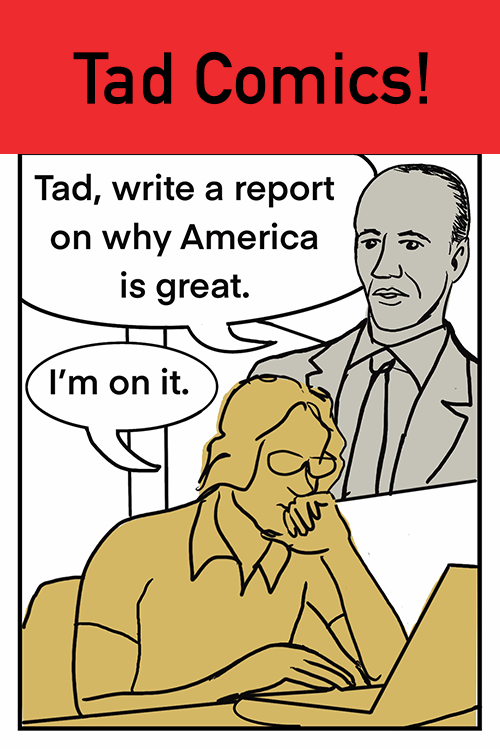
Pete Hegseth continues to be the poster boy for all that is disturbing and frightening about the Trump administration. Mind you, if Pete was fired, it would not change anything but it would be a step in the right direction. Imagine that cobra-like strike of the pointed finger that Trump made famous as he uttered, “You’re Fired!” to some contestant that didn’t measure up on everyone’s favorite unreal reality-TV sitcom, The Apprentice. You remember that show, don’t you? Well, this would be one of those for-real moments when Trump, now the Commander-In-Chief, would let out a cobra-like pointed finger gesture, right from the Oval Office. No cameras this time around, or maybe just a few. In this edition of Tad comics, Pete makes a call in hopes of getting into more trouble only to easily slip right out of it.
Will this story have legs and continue to distract the Trump administration? Yes, of course it will. Yes. Yes. Yes. Without a doubt. It’s on a whole other level to some of the past mishaps from the previous Trump years. While it is understandable that Trump would prefer to appear to have things more under control than last time around, it would come as no surprise that he’s got an itchy trigger finger and would just love to go back to the ole cobra days and give it a good yell, “You’re fired!”
Nick Diak is a whirlwind of cartoonist energy! It’s page after page of fun stuff, coming at you in all directions, a kaleidoscopic journey paying tribute to MAD Magazine, various kid magazines like Nickelodeon and Highlights, Cartoon Network fare and a tip of the hat to such greats as Daniel Clowes and even Moebius.
If you are looking for a grab bag of loopy and goopy comics, this is an impressive effort from a rising talent. I can see the passion and determination on display here and it gets my attention. I think that’s the number one thing about new comics on the scene: they need to make you take notice. That’s because so much has already been done by so many other creators at such a higher level than a newcomer could ever hope to overtake. It depends upon what the cartoonist is trying to achieve. Is it just a hobby, something to do with a bunch of pals or is it a calling? Because, if you’re taking this seriously, the comics need to have some X factor, something truly genuine at its core, whether it’s weird, personal, hilarious, whatever the case may be.
It’s total mayhem!
For example, Nick does a great job with, “KXW,” a 5-page comic about a clown and other colorful characters in a wrestling match scene. The clown eggs on these two ogres and then suddenly a human-velociraptor hybrid is unleashed. It is full-on goofy, so be sure to tap into your inner 12-year-old. And that’s the beauty of it. I’m not sure exactly what is going on but, then again, whoever is when it comes to pro-wrestling. Nick states in the back page notes that this story honors hours of playing the Nintendo 64 game, WWF War Zone, and hours of viewing the now legendary YouTube podcast, Cartoonist Kayfabe.
The point I’m making is that new comics need to have something to offer, an X factor, and this comic book delivers with its uninhibited exuberance. Even the little extra surreal bits give added impact, like a pterodactyl off to a corner on the comic book cover demanding, “Eat more comics!” Funny. Goofy. Done with passion and determination, Sliced Timber by Nick Diak, is a comic book just waiting to be eaten!
Where would comics be without Superman? It is Supes who has led the way in more ways than you might imagine. It’s important to look back and honor where we’ve come from. So, with Superman Day offering us a chance to pay tribute to one of the greatest characters in comics, let me offer you one of my own Superman memories. I was a little kid back in the 1970s in a small Southern town. We moved around a bit, due to my dad’s work, but I believe we were living in Morgan City, Louisiana. I had just been chased by a dog and ended up crashing my bicycle into a neighbor’s truck. I recall this big guy staring at me and I was just about to lose it completely. I was around 10 years-old. This guy, big as a bear, looks down to see me on the ground. It was his German Shepherd, off his leash, who had chased me down. Apparently, no damage done to his truck to speak of. His wife came out and then his two kids, around my age. They all took me inside their home and I ended up reading comic books with his two kids. I recall this was a DC Comics home. It was mostly Superman and that’s what I focused on. That was my introduction to Superman!
We follow my recollections with a lineup to all the wonderful Superman events that DC Comics has scheduled for April 18, 2025, known world-wide as Superman Day, and beyond. As you scroll further down, you’ll see a great checklist of events for fans to follow throughout 2025. For instance, we do have a new Superman movie to look forward to now, don’t we?
I have included a gallery of some amazing Superman art, just in time for the movie!
Action Comics #1087’s Superman Movie Variant Cover by Dan Jurgens, publishing on June 11
Krypto: The Last Dog of Krypton #1’s Superman Movie Variant Cover by Dan Mora, publishing on June 18
Justice League Unlimited #9’s Superman Movie Variant Cover by Frank Quitely, publishing on July 23
Superman #27’s Superman Movie Variant Cover by Jerry Ordway, publishing on June 25
Superman Unlimited #1’s Superman Movie Variant Cover by Jim Lee, publishing on May 21
Batman #161’s Superman Movie Variant Cover by Jorge Jiménez, publishing on June 25
Supergirl #1’s Superman Movie Variant Cover by Nicola Scott & Annette Kwok, publishing on May 14
When is a comic better described as an illustrated text? This question goes back to the distant pre-origins of comics in the hand-drawn, pre-printed “illuminated texts” that kept workers in primitive factories on certain streets of fourteenth century Paris. Perhaps the distinction is not even important, except as evidence that “comics” today are undergoing constant evolution not excluding the very subject. Call Anarchy in the Big Easy an art book of a certain kind, and call it an experiment in anarchist reinterpretation of history.
There is a grand story to tell, and writers of every kind, especially novelists but doubtless also generations of talented journalists, have poked away at the anarchistic spirit of the city. How could it be otherwise? More Caribbean than any other US city of size, more interracial or transracial, with the distinctions of color (and the privilege conveyed) astonishing, almost as astonishing as the birth of jazz, with comics the most important contribution of the US to global culture (films would be third, but mainly for the scale of Hollywood).
What is it about New Orleans? An eco-history is, here, vastly helpful. The natural sustenance offered in edible (also buildable) plant life, along with the vast range of seafood, made for one of the most productive Native life in what would become the USA. Also, and this is a large point, the need for others thousands of years ago to cultivate varieties of what would become corn, demanding enormous care, could be here evaded, allowing looser organizations of communities, and arguably less class structure.
All this is thrown into chaos by the Old World invasion, reducing the estimated population by at least two-thirds, as of 1750. From here on, escape into the backwoods and attempts to built insular communities became mandatory, and with a difference: escaped black slaves escaping with, merging with, others who survived.
Liberated socieities of Maroons, escapees, certainly opened the way for these groups and others, even the enslaved Filipinos who escaped Spanish ships. Not surprisingly, theorists of what would be called anarchism found inspiration here. The text references Elisee Reclus, a true giant of nineteenth century anarchism, who spent some years here, learning and writing. Then we turn to Joseph Dejacque, rediscovered in recent decades as a visionary with his vision of utopia that he called “Harmonic Anarchy.” From the Left, Dejacque assaulted Prudhon himself as the enemy of women’s freedom.
The 1853 novel Mysteries of New Orleans, by a German immigrant intellectual, gives Anarchy in the Big Easy an opening for a more sweeping literary-anarchist overview, but by this time, the book is already moving from literature to social and labor history. Many are the stories of solidarity from the era of Populism to the high days of the IWW to the streetcar strike of 1929, with massive popular support, to the emergence of Black Nationalism and the larger meanings of the annual, Mardi Gras Carnival of the People.
That Carnival, its triumphs and struggles amidst the vast and mostly white tourist outpouring, makes up the rest of the book’s final section. The latest culture or cultures of resistance, over perhaps forty years, seem more obviously anarchic in mobilization, involving more volunteerism of the humanitarian kind, than what we have understood as Left organization or mobilization.
Is it New Orleans or is this the shape of radical activity in our era, when even the most modest political reform seems to fall to defeat or become corrupted by the nearness of power? The virtue of Anarchy in the Big Easy is that the present seems very much in tune with the radical, humanitarian past before the Spanish arrived.
With one big caveat: we are still on the run.
The art of Anarchy could be described as “thin,” or perhaps minimalist, really sketches that seem to want the reader to fill in the gaps. It suits the purpose of the volume.
Ginseng Roots. By Craig Thompson. 448 pp. New York: Pantheon. 2025. $35.
It seems like only a blink of an eye for some comics fans since Blankets first made it upon the scene. The 600-page coming-of-age graphic novel was published in 2003. At the time, it led the way during a great wave of interest in a new generation of indie comics, or “alternative comics,” alternatives to mainstream superhero fare and a wholly new voice to the old underground comics guard dating back to the 1960s. By 2003, a ten-some-year wave of interest had reached its crescendo with Craig Thompson‘s monumental book. Were all new graphic novels to be this big? Well, some would be but only a few. Thompson’s book was different is so many ways, from its virtuoso drawing to its uncanny and disarmingly earnest honesty. What would Craig Thompson do for an encore? Plenty, including Habibi and Space Dumplins. Fast forward to now, Thompson has come full circle with another look at his childhood, this time with the focus out on the ginseng farms.
Working in the fields and loyal to the family.
We learn a lot about life as the years roll along and, a good bit of those life lessons are learned early on. It’s only years later, in retrospect, that some of this wisdom has time to blossom. Craig Thompson seems to have taken everything he’s learned in childhood, and in a long career in cartooning, and put it into this latest monumental work. Going back to the 1980s, in order to make ends meet, Craig and his brother Phil, along with his mom, all made extra cash for the family by tending the burgeoning ginseng farms of their hometown, Marathon, Wisconsin, which became the capital of the American ginseng market. Starting from around age 10 to age 20, Craig dutifully went out to pick the crop. Thompson takes the little ginseng herb and masterfully dissects the hell out of it, giving the reader a long and detailed history and analysis and, in the bargain, turning the plant into a mighty metaphor for hard work and a way of life.
Working on your own comics and loyal to your own dreams.
So, what is ginseng, in the big, and little scheme of things? Some people might ask, what is ginseng, in the first place? It is a slow-growing perennial plant, with various health benefits, often distilled into tea, best known to originate in East Asia but, as this book makes clear, also has its counterpart in the United States. In regards to Thompson’s story, and his family and the community, ginseng proved to be a vital source for making a living. It became the town’s life blood and it didn’t matter one way or another if any of the town folk actually used ginseng themselves.
Lessons from the past.
The most important thing I can say about Thompson’s book is that it is a phenomenal work of testimony and storytelling. It brings to mind my recent conversation with Paul Karasik, in terms of creating any graphic narrative. At the end of the day, whether it is a prose novel or a graphic novel, it is essentially still a novel. That means it shares a lot of the methodology and framework. It takes time to build it up. It takes time to refine it. I recall, many years back, chatting with Brett Warnock, the co-publisher of Top Shelf Productions, which first published Blankets. When I asked Brett if he’d ever come across a cartoonist like Craig Thompson, someone who produced such a massive output of pages of work. Brett shook his head and said, “Never. Craig is one of a kind.” So, that’s what is going on with this book. It’s one of those head-spinning massive works that is so indicative of what Thompson is capable of doing. The sheer scale of it is what is most striking.
Herb, Music, Medicine and Comics!
Any writer begins with a small book that may become a much bigger book. As a cartoonist, the sensibility is to go towards the concise. I see that in Thompson’s book with it reaching for the big picture and making his points. But a different sort of mindset takes over if you have a much bigger canvas to play with. With a big book, a cartoonist, just like any other writer, has room to expand and to go back to finer points. So, in this case, a reader will know everything they ever wanted to know about ginseng and then work their way into deeper issues of family, work, and ethics. Beginning with ginseng, this book is, in the very best sense, a book about everything. For instance, how did the United States treat Chinese workers after they arrived during the American gold rush? It triggered America’s first anti-immigration legislation. Well, that’s a whole topic in itself. Fast forward to more recent times and it’s American farmers dependent upon Chinese investors. Nothing wrong with that if you’re a fair-minded sort.
Ginseng puts Marathon, Wisconsin on the map!
So, a huge graphic narrative is its own animal gathering together concise points, taking a deep breath, and then exhaling much more expansive content. With Blankets, Thompson set the tone for what is possible with long-form American contemporary graphic novels and, from time to time, other cartoonists rise to the challenge. I suppose you can say that massive graphic works have been around for a good long time within mainstream superhero comics. Fans of the genre are more than happy to pore over huge volumes and beg for more. It’s a whole other thing to will into existence a quirky autobiographical graphic memoir with a ginseng theme.