Category Archives: Comics

This Slavery by Scarlett and Sophie Rickard graphic novel review

This Slavery. By Scarlett and Sophie Rickard.  London: SelfMadeHero, 2025. 368pp, $23.99

Review by Paul Buhle

Rising stars in the comics world, with nominations for Eisner and Broken Frontier awards,  the Rickard sisters may register as the leading artists of historical, proletarian dramas with socialist morale. Or rather: Scarlett is the artist, Sophie the story-teller, a creative pair from the same Lancashire country as their subject.

They have already done thousands of avid readers a favor by adapting the enormous, historic novel by Richard Tressel about impoverished paperhangers, The Ragged Trousered Philanthropists, and brought a widely misunderstood woman suffage movement back to life in an adaptation of Constance Maud’s mostly forgotten work published more than a century ago.

And now, we see Lancashire, famous for its nineteenth century textile mills with thousands of underpaid workers, for the working class participation in the Chartist movement and for their self-sacrificing support of the antislavery cause in the US.  The novelist, Ethie Carnie Holdsworth (1886-1962), has not exactly been forgotten, but her status as the first blue collar English woman to write a novel, and her remarkable output of at least ten novels, had long been neglected until British feminist-socialists helped bring it back to light.

Textile owners naturally wanted continuation of sales to the Confederacy. A decade before the Civil War, masses of workers in Lancashire had nevertheless greeted Abolitionist speakers with enthusiasm, embracing an antislavery cause that many American workers shunned. The protagonists of the novel take another path through history: two sisters unemployed when “their” mill burned. Rachel sets herself to a course of reform while her sister fatalistically accepts the inequality of contemporary marriage to a capitalist swine.

We see mass street events, meetings around radical causes, and a bang-up conclusion that no conscientious reviewer would reveal. If This Slavery sometimes leans into melodrama, it faithfully follows its source. But plot summaries and narrative high points offer scarce appreciation of the graphic novel’s accomplishments and sheer beauty.

Perhaps the exactness of the industrial, blue collar setting and the precision of the detail of clothes, but also of contemporary working class language, will strike the historically-minded reader the most forcefully. The sheer length is staggering. This reviewer is a poor judge of the use of color, which is now obviously accomplished (like nearly all the rest of comic art) by way of computer graphics rather than laboriously by handwork, likewise dialogue, no longer written out, a point of pride for comic artists only a decade or so ago. To have accomplished this vast visual text any other way would likely have been a life-long task for these sisters obviously with their eye on future radical projects.

Something more needs to be said about working class portrayal in comic art, or rather, its near-total absence until the recent past. “Out Our Way,” one of the long-lasting and popular early newspaper strips, holds the dubious honor of being the first strip with a recurring factory scene (usually, the supervisor is frustrated at the kinks in the production process) and the first to feature a corpse. Lower class types go back to Mutt ’n Jeff, racetrack touts, or even to the Yellow Kid, the 1890s slum-dweller whose ethnic identity remains uncertain but whose coloring gave the comics a daily identity.

Actual working class people, their families and neighborhoods, receded further with the triumph of the family-oriented strips in the 1920s. Famously, Blondie needed to leave her secretary-and-flapper life for home and Dagwood. Comic books rose to their apex with working class guys at war, never at work; and in the grim strips of blue collar violence, in which escape from wage slavery meant guns and molls (themselves apparently escaping dull working lives).

The rise of Underground Comix brought intense, radical themes to the surface as never before. Despite the political leanings/commitments of the artists themselves (in the Bay Area, they even launched a union drive that promptly failed), the sharpening contradictions of blue collar life were rarely seen, except through glimpses of satire.

Graphic novels, now in the global thousands or tens of thousands, not even to mention digital comic creations, treat the widest possible settings and characters. With some notable exceptions—among them Wobblies!, the 2005 history of the Industrial Workers of the World, with a handful of artists, edited by  Nicole Shulman and myself, on the centenary of the famed organization—we have not seen much else.

All the more important, then, is This Slavery, for what it seeks to do.  Anyone who puts on a pair of shoes knows, or should know, that factory work continues, blue collar life continues across the world. Let us hope to see more in comic art.

Paul Buhle

1 Comment

Filed under Comics, Graphic Novel Reviews

You and Me on Repeat by Mary Shyne comics review

You and Me on Repeat. Mary Shyne. Henry Holt. 2025. 224pp. $17.99.

A good time travel story these days walks a fine line as a genre all to itself: self-aware, serious and ironic all at once. I can see that Mary Shyne has given this a lot of consideration which has resulted in a graphic novel with a fresh take. Clearly, Shyne knows her way around all the time travel tropes, and so do her characters.

Chris and Alicia, two teenagers who have just graduated high school, are quick to accept the reality of time travel but not so quick to accept themselves. This is the premise that Shyne plays with as she has these two endure an endless loop of re-living their high school graduation day. Chris is a science geek and he’s a bit uptight. Alicia is an aspiring writer and she’s a free spirit. These two seem unlikely as a romantic couple but only time will tell, right? Shyne is way ahead of it and manages to keep thickening the plot, even for the most jaded young adult, this book’s prime audience.

As with any good time-looping story, the journey is what it’s all about. Shyne paves the way with a light manga art style that is pleasing to the eye and compliments the breezy nature of the narrative. It’s a very impressive work that checks all the boxes in what makes for a highly marketable work in comics. In its layout, its humor and overall vibe, there’s something lean, clean and perfect about Shyne’s work. That said, Shyne elevates her work to something personal and idiosyncratic that defies the most perfectly calculated marketing stratagem.  Could it be a bit of genuine heart-felt magic? I think so.

The best time travel stories have less to do with time travel and more to do with characters and so it is the case here. The two main characters, Chris O’Brien, who is white, and Alicia Ochoa, who is Mexican, are a mixed-race star-crossed couple of kids. The trend in the book and entertainment industry, if you haven’t noticed in the last five years, is diversity. I’ve been very mindful and supportive of diversity for much longer than five years. How about all my life? I’m Mexican American and, as a creator of comics and stories, that unique perspective is always there in my own work, whether it is noticed or not. In the case of this work, it is supposed to be noticed. Alicia Ochoa steals the show as the oldest sibling among many in a large Mexican family. Not all Mexican families are large but it’s a compelling trope and it works well here. Alicia is a restless soul who wishes to explore as many versions of herself as possible, including romance with girls and boys. What could be better than to be stuck in a perpetual loop where you repeat the same day, do whatever you want, wipe the slate clean and dig in for more?

Remember, the reason we can’t seem to get enough of time travel stories, at least good ones, is that they promise to deliver a bit of genuine heart-felt magic. I really enjoyed this book all the way to the last page and that’s because of its heart and honesty. And, hey, Shyne manages to do something that keeps getting more difficult to do in the genre. Shyne taps into that magic we keep craving and hoping for when we seek out a good time travel yarn.

1 Comment

Filed under Comics, Graphic Novel Reviews

THE KING’S WARRIOR by Huahua Zhu comics review

The King’s Warrior. Huahua Zhu. Bulgilhan Press. 2024. 65pp. $15.00.

From the cover, all the way through, I am completely swept into the exquisite world that Huahua Zhu has created in her new comic. I love fantasy when it works for me and this does. Recently, I was browsing through a bunch of zines at a certain shop and I was struck by the art on the cover, the delicate and ethereal lines holding up a bold eccentricity.
When a comic sparks my curiosity, that’s a very good sign. The best fantasy will do that: somehow turn the genre on its head, give you something refreshingly new and will its own reality. By simply jumping into the story, in just the right understated manner, Zhu has achieved this. One wonders what led up to this moment while, at the same time, ready to follow along.
The two leading characters are rather enigmatic: a brother and sister with elfin ears. All we know, at first, is that this is a world of monsters, especially dragons.  Zhu’s approach is to not give too much away. The first page is a trio of close-up panels depicting a slaughter of dragons. This is followed by a couple of pages of combat. And then a page featuring a castle and an inset close-up panel that only shows part of a craggy face. A textbox below dares someone to come and kill him. Finally, the next page has our leads, Mara and Echo: an animated page of various panels that gently introduces the siblings with light hints of yellow and blue watercolor.
An ambiguous and fanciful tempo is kept up all the way to the end of this book. The connections between characters are not altogether clear hinting at a larger backstory. There is no apparent reason why the actions of one character should determine the fate of another but that seems to be the point. Mara and Echo have both ended up being kidnapped by a mysterious queen who won’t set them free until a warrior has completed his task of assassinating a wizard. Once this chain of events has been set into motion, more things are triggered and there’s no turning back.

Zhu has a wonderful way with drawing horses, dragons, gnomes, elves, wizards, all the stuff of fantasy, including a magical golden coin. The trick is to not bring out the big swords too often or all at once. Good fantasy, or any good story, is made up of a number of well-timed moments, constantly moving forward, toward something greater than its parts. This Zhu does well. I buy it in every quiet scene she’s conjured up with the mighty warrior and Growl, his chimera sidekick. Yes, Zhu manages a bit of humor. This is an ideal work of comics fantasy, both spooky and enchanting.

2 Comments

Filed under Comics, Comics Reviews

The Once and Future Riot by Joe Sacco graphic history review

The Once and Future Riot. Joe Sacco. Henry Holt & Co. 2025. 144pp. $27.99

India was once a confident and reliable ally of the United States. Lately, due to the Trump administration’s belligerence and blundering, India has leaned deeper into Russia and China’s orbit. India is simply not enough on the radar of the average American, without some tie to India, to really know or care one way or another but, as Joe Sacco’s book makes clear, there are undeniable universal truths that India has to share with the rest of the world. Once again, Joe Sacco lays out the essential, and ever elusive, truth.

The elusive truth, lost in an instance. At its core, this is what Joe Sacco’s new book is about and what all of his comics journalism books are about. You don’t think you can relate to India, or to Palestinian genocide in Gaza at the hands of the Netanyahu administration? Well, think again. We live in a world where up is down and down is up and, all too often, we fight shadows and ignore the substance. In the case of this new work, Sacco focuses on the conflict between Hindus and Muslims in India. Some would say it is irreparable. Others would say it is a manufactured conflict that favors those in power who gin up the public, stoke the flames of hatred, exploit resentment and distrust.

Sacco interviews a Muslim cleric during his travels in India who plainly lays it out: The media is responsible for the hostility between Hindu and Muslim. “You start telling a lie again and again to make it a truth. TV channels have done it. TV channels are liars. They keep telling lies 24 hours a day.” Where there once was a friend, now there is a demon.

India, it must be stressed is a democracy, with a federalist framework similar to the United States. What happens in India is not from some distant and remote region. The world grows smaller every day, as it is. And India reflects this in a powerful way. Joe Sacco’s book lays out the dynamics that led to the bloody 2013 riots in the streets of Uttar Pradesh, the most populous and diverse state in India. What caused the violence is misinformation that fueled a mob mentality. It can happen again in India. It can, and is, happening in the United States. And it can happen anywhere.

“I was crying. Like anything . . .”

As easily as the United States can experience a collapse of order by the insurrectionists on January 6, 2021, so can a region of India once celebrated for harmony. The lethal power of demagoguery can not be overstated, despite what others who traffic in misinformation may say. We live in dangerous times with no sign of it letting up in our collective lifetimes. As long as there are people in power with the time and money but no wisdom or integrity, we remain in an endless cycle. Well, this should be painfully obvious. Sacco does not beat one over the head with the obvious but steadily covers the specifics of a specific moment in time. The reader gets to know particular people. The reader is guided along as these individuals confront their struggles, some needlessly to die. And it is through this specificity that Sacco reaches the universal.

When will this horror end?

It is within this calm and steady approach that Sacco builds up to the horror and tragedy of the riots in Uttar Pradesh. In one incident that Sacco documents, Muslims ambush droves of Hindus attempting to flee. The Muslim attack is relentless. Hindu farmers attempt to hide behind their trolley trucks only to have their vehicles ransacked. They are attacked with guns, rocks, swords and knives. One man witnesses his son bludgeoned and tossed off a truck. When he attempts to help him, he is overwhelmed by an oncoming mob. He calls out to the police who manage to get his son to a hospital, where he dies. It begs the question, When will this horror end? It is a question that perpetually begs for an answer.

1 Comment

Filed under Comics, Comics Reviews, Joe Sacco

Comics Pro Tip: Higgins India Ink Pump Marker

Lately, I’ve been grooving on a very special marker from Chartpak, the Higgins India Ink Pump Marker. A lot of you out there are familiar with paint pens. You know, the kind that you gently push down on the nib to start it up and get the paint ready to flow. Well, in this case, we’re pushing down on the nib to get the ink ready to flow. The results are simply stunning.

I recommend that you go easy into your drawing and you’ll discover that, depending upon the pressure you apply, you actually can control the thickness of the line. This will take a bit of practice but it’s worth it.

Enjoy the moment and let the magic happen–the human magic. Unlike AI, you can make all kinds of human connections based on whatever you please. Feel free to really make this your own work in a way that only you can make. I had a lot of fun leading a workshop at the Cartoon Art Museum and got to enjoy working with the Higgins Ink Pump Marker. I look forward to doing more of these workshops and posting more videos using them on social media.

Creating Art Demo at Cartoon Art Museum

WHAT YOU NEED TO KNOW

Give your pen a few pumps: apply the pen point to a piece of paper and push down until you see that the white nib is now black with ink. You’re now ready to go.

CHOOSE A PLACE TO START

Maybe you will want to draw a face, a symbol or shape to get this party started. Don’t overthink it but also consider what your next few steps might look like. Do you want to place something in the middle? Or maybe off to a side.

GETTING INTO A ZONE

You’re getting into a zone. Let one drawing, or part of a drawing, help you get to the next step. Meditate while you draw. Relax. This is your Me Time. Let your dreams guide you. Let your surrounding guide you.

GOING GRAY

After a while, you’ll notice your lines are starting to go gray. This is when you push down again to get some more ink. While you have gray lines, you can experiment and use that tone in your artwork.

YOU’VE GOT SOMETHING!

Before you know it, you’ve got something! Let it rest and come back to it if you think it still needs more. Who knows, you might be done and it’s ready to tape or magnet to your refrigerator door, pin to your cubicle at work or even frame on a wall. Your mileage will vary. It’s all up to you! I hope this little tutorial helps and will inspire you to go out there and create something fun and engaging for yourself. And be sure to visit the Chartpak store for a truly impressive line of art supplies.

Leave a comment

Filed under Comics, Tutorial

Cartoon Art Museum: On Putting on a Show and Making a Case for Storytelling

Cartoonist Henry Chamberlain

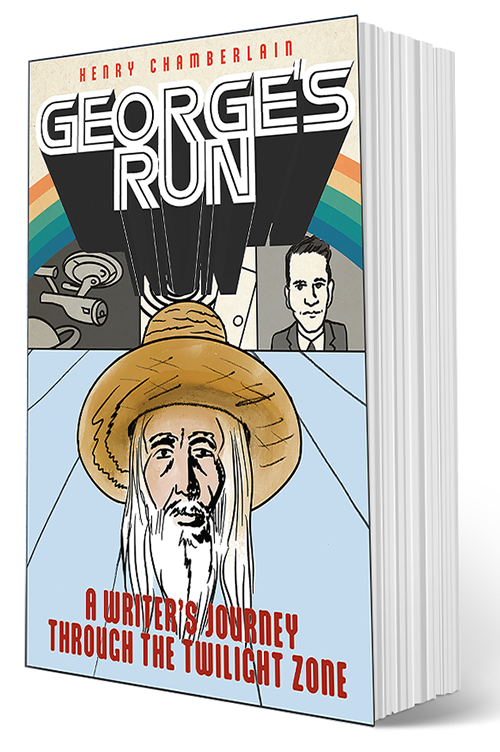
Those of us who create books of one kind or another must be mindful of the next step in our work’s journey, once it’s complete, published, and out in the world: the never-ending job of making more people aware of the book! My graphic novel, George’s Run: A Writer’s Journey Through The Twilight Zone, was published by Rutgers University Press in 2023. It was a pleasure to get a chance to give a talk and lead a workshop in support of my book at the Cartoon Art Museum in San Francisco.

Photos by Robbie Gomez.

The Cartoon Art Museum is a landmark in the local arts community and has the distinction of being one of the few museums dedicated to the comics medium. I have followed the museum’s progress since its time in San Francisco’s Yerba Buena Gardens neighborhood when Andrew Farago became its curator in 2005. Fast forward to 2017, the museum moved to its current location on 781 Beach Street on Fisherman’s Wharf. I’ve always found it to be a reliable source of inspiration with its impressive works on display, from new shows and its permanent collection. If you’re someone who has established a credible footing in this business of comics, you might find yourself invited to show your work here. I want to thank both Andrew and museum director Summerlea Kashar for helping make my presentation possible.

I have experience with leading presentations of one kind or another, notably a slide show lecture format which I first did when I led a panel discussion at San Diego Comic-Con. That said, I’ve been adding and refining notes attached to it ever since. I have found it easy to refer to notes and then break off into other directions. Lately, I’ve focused on an unusual zine that Marc Zicree (The Twilight Zone Companion) gave me a while ago. It’s a term paper he wrote in 1976, when he was 21 years-old. Marc’s paper features interviews with three significant figures from the Sixties zeitgeist: political cartoonist Ron Cobb; novelist Theodore Sturgeon; and television writer George Clayton Johnson. In his introduction, Marc makes clear how moved he is by Sturgeon’s uncanny ability to evoke the concept of love in his work. As for George Clayton Johnson, the subject of my book, Marc is mesmerized by George’s uncanny ability to speak virtually indefinitely on a wide variety of subjects. I carefully combed through Marc’s interview with George, and, just as important, Marc’s interview with George’s mentor, Mr. Sturgeon. What is clear is how much both men revered storytelling, which is at the heart of what my book is about–and, ultimately, my talk.

Once I start talking, I sense a detour up ahead. I had just mentioned the challenge of conveying the significance of a television show of the caliber of The Twilight Zone to a young audience unfamiliar with it when I found myself confronting a fresh new example in my audience for that day. Literally, only a few minutes prior, I had said that a young man had seemed to dare me at a comics convention when he told me outright that he’d never seen even one episode of The Twilight Zone. Right after that, a young man that day in my audience seemed to take it up a notch by telling me that he didn’t watch television at all. I was now juggling at least a couple of ideas going well beyond just being unfamiliar with a certain television show. Part of what I think was going on here is that the young man was, perhaps unintentionally, mirroring what I had just said. I gave it some thought and emphasized the fact that we all need to get as clear an idea of the big picture: seeking out great storytelling.

I went on to say that, when I’m given a dare to explain myself and make my case, I’m more than happy to break it down. In fact, the determination to break down ideas into concise and accessible elements took a life of its own in my book. That’s a vital part of the book: guiding the reader through the creative process that led to The Twilight Zone, one of the greatest works of television on many levels, not the least of which is the writing. My book is about the writers who made this possible. Overall, I think folks enjoyed what I had to say. Getting back to Marc Zicree’s 1976 term paper, one concept that keeps popping up is the steady encroachment of mass media and related distractions. This is well before even the internet and it already seemed like people were drowning in a flood of data. No wonder some young people today might think they don’t have time for “television.”  I know it was very helpful for me to give this talk and the feedback will help fuel the next one.

It was my intention to offer more than enough stuff to cover within my two-hour window. During the talk, I encouraged the audience to begin drawing their own tribute to their favorite TV show. By the end, we had a few interesting submissions. I want to thank Chartpak for partnering with me and providing the art supplies for this portion of the event. I will provide a separate post that features the Chartpak marker that I used for my art demonstration. I want to invite everyone to check out the Chartpak factory store for an incredible selection of art supplies.

Thanks again to the Cartoon Art Museum for an amazing event and I look forward to many more visits in the future. And special thanks to photographer Robbie Gomez for these amazing photos.

6 Comments

Filed under Comics

Nancy Burton, aka Hurricane Nancy, A Tribute

‘Good Eggs’ by Hurricane Nancy. Color by Henry Chamberlain.

Nancy Burton (1941-2025) was a great joy to work with here at Comics Grinder and, with great humility, I share some thoughts on her passing. Alex Dueben, who collaborated with Nancy on a collection of her work in book form, has just posted a wonderful tribute to her at The Comics Journal and I encourage you to read it. For some years, she would submit her artwork and I would post it with some accompanying text. Later on, I would add color to some of her pieces, just for fun. I asked permission and she was delighted. So, this went on for years, my accepting work from a legendary underground comics artist to appear here on my blog. It never occurred to me to ask Nancy if she ever wanted any further help in mounting art shows or creating a book. She submitted work. I posted. It was a fun and organic fit. She’s one of those special people who has entered my life who did not think twice about giving out a compliment, providing recognition. It is because of people like Nancy, one artist genuinely supporting another artist, that I have the inner strength to clearly see my worth as well as sincerely and constructively evaluate the work of my fellow artists.

So, what was it like to have a big name artist sending her work to appear on my blog? I grooved to her style right away. This was a very spirited and uninhibited style, which I love. It’s simply a person being honest and free but that can often be a very difficult, or complicated, thing for people. Nancy’s work invites you to enter her world as well as encourages you to create your own.

Nancy Burton began her career in art in New York City on the Lower East Side, in the 1960s. Talk about being in the right place and at the right time. As she related to me, it was a one-step-at-a-time process. You really had nothing to lose and you were encouraged to be as uninhibited as you wanted to be. Nancy’s work began to regularly appear in the underground magazines of the era: The East Village Other, Gothic Blimp Works, and It Ain’t Me, Babe. Over time, as she continued to explore and experiment, with gaps in between, she developed her distinctive work which included various anthropomorphic characters in a surreal landscape.

Give Peace a Chance!

Nancy’s work is very pure coming from a very primal place: a desire to express one’s self without getting caught up in editing the work before it has even had a chance to land on the page. That’s essential. There’s a magic and power to following one’s instincts, to letting your senses take over, to giving yourself over, mind, body and soul, to automatic drawing and then moving in step with the creative process wherever it may take you.

Art by Hurricane Nancy. Color by Henry Chamberlain.

Nancy’s art has a special language all its own. Within these images, there are pleas for common understanding as well as a rallying cry in support of individual freedom. Characters are lost in all manner of activity. You are left to do as you please with what is on view: speculate and/or embrace what you see.

Occasionally, Nancy would add a note or two, some comment to the art she submitted to me, and I’d reply personally to her and then perhaps some bit of it would appear within my description of the art I was posting. Maybe, at some point, I sensed she really needed to collect her art into a book. Then, it turned out, there was a book in the works. The first monograph of her work would be coming out, to be published by Fantagraphics. Well, we both shared in the anticipation.

When the time finally arrived, I wrote a review of it here and we accompanied that with an interview.

Some more time passed. And then I realized it had been a while since I’d heard from her. And then I received news of her passing away from her book’s collaborator, Alex Dueben. The news was provided to me. I processed it. I waited. At some point, I would share my thoughts and so I am doing that now.

To have a celebrated artist of the caliber of Nancy Burton be part of what I do here on this blog is a gift I will cherish for the rest of my life. If I thought I knew my way around, had already seen it all, her art, and most importantly, her friendship, are among those special things in my life that gently remind me there is always something new to discover for those who find a way to balance being humble with being bold. Nancy always believed in me.

2 Comments

Filed under Comics, Hurricane Nancy

Trump Meets with Allies. Bring Kids Back. @bringkidsback_ua

Ukrainian President Zelensky had to navigate a very disciplined approach with U.S. President Trump, especially on the subject of Russian abductions of Ukrainian children. The topic is so sensitive that even The First Lady’s now famous plea on their behalf does not outright mention Ukraine. Some estimates place the Russian kidnapping of Ukrainian children at over 700,000.

And to quote TIME magazine: The United Nations has condemned Russia for its actions, which U.N. Human Rights Chief Volker Türk said in a March statement have caused “large-scale human rights violations and inflicted unimaginable suffering on millions of children.” Forty countries and the European Union have called on Russia to return the children that have been taken.

To learn more and help, go to Bring Kids Back and also here: @bringkidsback_ua

Leave a comment

Filed under Comics

Partisans: A Graphic History of Anti-Fascist Resistance book review

Partisans: A Graphic History of Anti-Fascist Resistance. Editors: Raymond Tyler & Paul Buhle. Between The Lines. 2025. 148pp. $34.95.

A bold statement is asserted in the introduction to this book: “History does not repeat itself. But the example offered of the Partisans’ courage must not, cannot, be forgotten in our time. We must find our own creative ways, individually and collectively, to rise to the challenge.” This is a collection of short works in comics that chronicle the fight against fascism leading up to and all through the Second World War. I don’t know what to make of the relatively calm assertion that history does not repeat itself when, each day, it looks like history is repeating itself. The best I can come up with to reconcile this statement is to say that we must embrace the calm before the storm, even seek it out during the storm. Each story here offers some moments of contemplation, featuring stories from survivors with their own set of insights.

“Freedom or Death: The French Partisans” by Daniel Selig

For these sort of works in comics, especially a collection such as this, I believe the most compelling work cuts to the chase. This is why I find the straightforward piece by Daniel Selig, known in Europe for this work with Éditions FLBLB, so compelling. He sets out to outline the evolution of French Partisans and does exactly that. There’s even a quick and precise nod to the creative and intellectual contingent on one page featuring Jean Paul-Sartre, Paul Eluard and Elsa Barraine. Food for thought as we engage with our own times.

“The Hungarian Resistance” by Sander Feinberg and Summer McClinton

There are a number of more traditional depictions of testimony coming from the average person. In that vein, some examples: David Lasky‘s rendering of diary entries from Eastern Europe; Trina Robbins and Anne Timmons honoring teenage Paritsans in Holland; and Sander Feinberg and Summer McClinton‘s tribute to the Hungarian resistance. Each work brings the struggle down to the human scale in very distinctive ways in terms of style and approach.

“Andartiko: Fighting Fascism in Greece” by David Lester

Another more straightforward approach focuses on the fight in Greece. David Lester, known for his historical graphic novels with a dramatic flair (Revolution by Fire: New York’s Afro-Irish Uprising of 1741) , offers a study of the Andartiko Partisans, with roots going back to the Ottoman Empire. His approach is gritty, bold and dynamic and really keeps the narrative moving.

“Piccola Staffetta” by Isabella and Franca Bannerman

What each piece in this book has in common is that urgency to connect the dots from the past with the present. The most explicit example comes from long-time World War 3 Illustrated contributor Isabella Bannerman. In her piece, she depicts the words of her mother, Franca Bannerman, who grew up during the rise of Mussolini and can’t help but see a distinct similarity between that fascist dictator and our current U.S. president. Well, someone had to say it and this one hits the nail on the head. So, where do you go from here? Days, let alone months, even years, can go by and the future remains murky and sinister. One thing is for sure, we can all use as much calm contemplation as we can get.

Leave a comment

Filed under Comics, Comics Reviews

Todd McFarlane’s Spider-Man, Speculation and the McFarlane Effect

McFarlane’s cover for Marvel’s Spider-Man No. 1 (August 1990)

Are you a superhero comics fan–especially an old school Spider-Man fan? I’d say that I’m a sensible fan with my own set of reasons. I appreciate that Spider-Man, along with all the great characters in comics, will forever be a wonderful opportunity to tell a story. Also, from a design sense, gotta love Spidey. From a pop culture sense, ditto. And, sometimes, like many fans, I’m susceptible to buying into Spidey, or any other comic book, as a keepsake. People have become conditioned to believe that an old stash of comic books might hold some highly valuable, “collector’s item.” This is based on such rags-to-riches stories as the astronomical rise in value of such Golden Age gems as Action Comics #1. By the 1990s, that mindset was completely ingrained among comic book consumers. The comic book market in the 1990s took a sharp turn down a speculative path with numerous titles touted as collector items and it ultimately went bust for a while. One of the most celebrated titles of that era, deemed a “collector’s item” on its front cover, was the first issue of the Todd McFarlane Spider-Man run, both written and drawn by McFarlane. Part of the battle is won when you have Spider-Man in the title and promise it’s a collector’s item. Spider-Man #1 went on to sell a whopping 2.5 million copies, partly due to the collector craze (take your pick in gold and/or silver variant covers) but just as much having to do with a new direction led my Todd McFarlane.

The speculative markets will tumble!

The new horror movie, Cloud, by Kiyoshi Kurosawa, features a flipper who buys up all the fan favorite items in order to resell them at jacked-up prices. It’s a cautionary tale about how we, as consumers, must be wary of traps. That’s what happened with comics. Hard-core collectors would buy multiple issues of the latest hot comic book title in order to manipulate the price. And then comic book publishers got into the act by feeding that demand for collector material: titles promising to be the next big thing with huge print runs, which, of all ironies, guaranteed they would not be scarce. Here’s a Comics 101 FYI: If you want a comic book to become valuable, one of the key factors is that it is rare to find a copy. These comics were NOT rare but were flooding the market and nearly destroyed the comic book industry. The solution? Well, it’s a hard pill to swallow but quality will always win out over quantity. So, in general, comic book publishers, despite all the variant covers and big events they create to lure in readers, are supposedly more interested in creating artful stories instead of marketing gimmicks. And that can often be true. That’s where comics reviewers lend a hand in seeking those titles out. Ultimately, let the buyer beware–and make your voice heard. Continued pushes for quality will keep the speculative beast at bay.

Howard the Duck #1 (1976), considered a collector’s item due to low distribution.

Speculation in the comics market will never die. But there are enough safeguards in place today that make it less likely we’ll have another 1990s-style market crash again. There is a greater sophistication and transparency at play and a lot more common sense. There will still be a lot of comic book collectors who don’t even read the comic books they collect. But that’s their problem. The best defense is to do more of what has helped the comic book industry survive and that is to strive for higher standards. In fact, the passion to hold comics to the highest standards is what drives what is going on here at Comics Grinder. And it only makes sense because the backbone of the market, in order for this to really work, is made up of readers, not speculators. The more readers you have, instead of vulture-speculators, the better chance of comic book shops, and publishers, weathering the market storms. Graphic novels, in all their various shapes and sizes, capable of focusing on any and all subjects, have risen to the challenge and help considerably to keep the lights on. Our best bet is that readers win out in the end.

The McFarlane Effect at its inception.

In the spirit of celebrating the art of comic books, let’s take a closer look at that iconic first issue of the McFarlane Spider-Man. What stands out? Well, one key element that McFarlane enjoyed was creating a page with a series of thin long panels, like stripes, than ran across and created a bunch of jump cuts, slivers of moments. I don’t think McFarlane has gotten any real credit for this narrative device so allow me to do the honors and introduce you to what I’m calling The McFarlane Effect. A certain number of us who keep up with comics are aware of the De Luca Effect which I have written about here and, in a nutshell, is a page that features one character (perhaps two) repeated in a succession of moments. I think it’s only now, with decades to separate us from the media phenomena that was McFarlane’s Spider-Man, that we can better appreciate the art behind the work. I honestly think that McFarlane is such a towering figure in comics that such little nuances can sort of be overlooked. How many other artists have used this narrative device? Well, overall, I think that anytime that you see a work with long panels slicing through it, there’s a good chance it is by an artist influenced by McFarlane.

A rhythm struck up by quirky panels.

McFarlane’s use of long slim panels allowed for an infinite set of variations and set an ambitious tone for his helm at the landmark character. Keep in mind that here was a young man, working his way up the ranks at Marvel Comics, given his chance to create his version of, arguably, the most renown character in comics history. He would have been well aware of the trends and cross-currents at the time. He was an artist is search of the most compelling narrative devices he could think of so, you better believe that he was up late at night at that drawing board, night after night. He did not use this long slim panel device on every page but used it where it was needed, and developed a rhythm struck up by quirky panels.

The maestro makes music with his magical panels.

The maestro was making music with his magical panels. Sure, this was a darker and more realistic Spider-Man than the higher-ups were used to, or comfortable with, at Marvel, but there he was, Todd McFarlane, the aspiring baseball player, knocking them out of the park. McFarlane would have been thinking of Frank Miller and his audacious The Dark Knight Returns. Well, he had an answer for it bringing home his own take on horror tropes and delivering with a distinctive style that has been borrowed by many great artists, including Jim Lee.

Spawn #1 is a collector’s item!

And to continue giving credit where credit is due, of course, Todd McFarlane went on to found Image Comics, where creativity and creator rights are honored. Image Comics stands as a testament to what is possible for a great comic book publisher and everyone associated with it. You may know one of the big titles lined up to launch Image Comics. That was Spawn #1 in May of 1992. Created by Todd McFarlane, the first issue was written and penciled by him and it did pretty well: It sold 1.7 million copies. Not bad, right? And the rest is history.

Leave a comment

Filed under Comics