Tag Archives: Art

The Girl Who Electrified Tesla by Cynthia Von Buhler comics review

Minky Woodcock: The Girl Who Electrified Tesla, Issue 2. Written and illustrated by Cynthia von Buhler, 2021 (Hard Case Crime/Titan Comics) 110pp. $24.99. (Above cover art by Robert McGinnis)

I spotted this ravishing pulpy cover and I immediately made a mental note, “Tesla girl!” I was just doing my usual navigating and took a second look at Cynthia Von Buhler’s Instagram account. The idea of a really quirky take on Nikola Tesla via comics appealed to me. Over the years, Tesla has become a genre all to itself open to new and fun interpretations. This title does not disappoint and led me down an array of intriguing paths.

Cynthia von Buhler is a genuine art geek, to put it bluntly. This comic truly lives up to its promise by thoughtfully doing all the necessary prep work in order to deliver something authentic. I felt that Tesla was really alive on the page, skulking around Bryant Park and whispering sweet nothings to his pigeon wife. Indeed, the mad scientist never married and did develop a curious attachment to pigeons. That peculiarity and many more are faithfully depicted by von Buhler. This respect for the subject matter compliments the crime thriller that ensues.

Feeding the pigeons in Bryant Park.

What von Buhler manages to do is juggle a number of tantalizing facts. It is New York City, circa 1943: Nazis are creeping in the shadows in pursuit of Tesla’s mysterious Death Ray; Josephine Baker, the beautiful bisexual jazz singer and dancer is performing and spying; John Trump (uncle to Donald) is a doctor with plans of his own to take Tesla’s secret weapon. Add to the mix our protagonist, the diehard detective Minky Woodcock determined to crack the biggest case of her career involving the fate of the planet and, for good measure, a chance to bed none other than Josephine Baker.

Agatha steps in!

The artwork throughout is a delightful homage to gritty pulp fiction, with a steamy semi-realistic quality and a larger-than-life pop culture vibe. There’s both a static and dynamic quality at play, like woodcuts or dolls that have come to life, very eerie and fascinating. Many of the scenes, in fact, would make for beautiful stand-alone paintings. Ultimately, the art naturally fits the book, keeping pace with the narrative. I think of it as moving at a gumshoe detective novel pace: at times melancholy; at other turns, dramatic and intense. Which leads me to mention that, after reading this one, you are going to want more. In fact, there is plenty more to choose from, both in graphic novel format and prose since von Buhler’s book is part of something bigger, the world of Hard Case Crime, featuring work by such modern masters as Stephen King and golden age giants as Ray Bradbury. And, with that in mind, do seek out this gem of a graphic novel by Cynthia von Buhler.

3 Comments

Filed under Comics, Graphic Novel Reviews, Nikola Tesla

MONICA by Daniel Clowes graphic novel review

Monica. By Daniel Clowes. Seattle: Fantagraphics, 2023. 106pp, $30.

Guest review by Paul Buhle

This has been quite a year for determinedly offbeat comic artist Dan Clowes. An interview in the New Yorker followed by a strong review beginning on the front page of the New York Times Book Review, not to mention an NPR interview, nailed down the point: Clowes has hit the big time.

Is this as far as “alt-comics,” somewhere beyond the comic strip and the comic book, can go in becoming “mainstream”? It’s a good question, first raised properly by the reception of the comic art of R. Crumb, then of Art Spiegelman (whose looming presence remains above the scenery somehow), of Alison Bechdel, Joe Sacco and others. The work of Ben Katchor, who is now designing comic-like images for Paris Metro lines stretching into the villages of the countryside, might remind us that in France, comics can be art. Back in the US and despite the rising prestige (and commercial success) of some artists, their work remains….comic art! If, admittedly, viewed very differently from the comic art of old: fewer readers but more prestige, as cynics would say.

Clowes, part of the alternative comics that followed the collapse of the 1960s-70s underground comix, saw Ghost World, his creation, become the basis for a film about teenage angst, with himself as one of the scriptwriters. It was a first for comic scriptwriters, even if comic characters themselves had appeared in dozens of older Hollywood films, with several series of low-production films dedicated to the sagas of Blondie, Joe Palooka and even Captain Marvel (a kids’ serial).

These three series actually happened to have been scripted by Lefties who would go on the blacklist (except for the Captain Marvel series, whose writer became an affable Friendly Witness testifying against his former comrades), and lose their careers. The films themselves, now totally obscure,  even have a curious, populistic social content, leaving one to wonder. What gives? Never mind. These ancient memories of comics adaptations are also buried beneath the tons of animated films from comics, seen especially at holiday times on television or via DVDs.

We are reminded, in an astute Comics Quarterly essay on Monica, that real-life artist Clowes was abandoned by his mother, and that “loneliness” is a continuing theme with a continuing expression in his aesthetics and a basis in personal life. Monica, the fictional subject of the comic is, to put it mildly, a troubled person. But Clowes is not telling anything so straightforward as autobiography. We experience the novel through her wavering consciousness, sometimes beyond her consciousness, which may be the most helpful of all hints.

“Foxhole,” the first of eight semi-discrete and separate chapters or episodes, goes back to the Vietnam War. A disillusioned GI from a poor background reflects on his disillusionment to his battlefield/jungle setting mate, who is from America’s wealthy classes, while they wait to kill or be killed. The trauma in these three pages is not going away. Indeed, the sense of apocalypse described is revisited, precisely, on the final panel of the book.

Other reviewers seem to run away from this particular as anything like central to the plot, and it makes sense. What we see through most of Monica is the results of the 1960s social breakdowns, the impossibility of a thriving counterculture measured in the broken homes and broken lives, crazed cults and children confused or, rather, disoriented for life. Cynical commentators have always viewed this human tragedy as a loss of traditional morals, socially enforced wage slavery, the dangers of drugs, etc. Clowes knows better, although he will not say so.

Our embittered GI returning, he thinks, to a quiet and happy life, is not. He’s the  fiancee  of our protagonist’s mother, but never her husband. His foxhole mate, a serious painter who has returned to the US first, turns out to be the actual biological father, or perhaps not. Monica’s mother Penny,  a counterculture burnout, stumbles along through life, although she actually launches a business that, much later, her daughter can revive and expand successfully, something that brings no pleasure. The book’s sometime narrator, a friend to Penny, relates and reflects on  a not-so-unusual confused single mom experience.  And Monica emerges,  episode after episode, not only damaged but keenly aware of being damaged. She a modern person, a modern woman, who does not accept fatalism, although to do so might have been a better strategy.

In the following vignette, the seemingly more fortunate one of the two GIs returns to his hometown, years later, and quickly realizes that crucial matters including his extended family and their small capitalist empire, have totally fallen apart. In this odd little world, Monica-the-comic becomes a perfectly recreated EC-comic horror story from the early 1950s, updated and upgraded artistically. And then the drugstore supernaturalism ends or perhaps drifts around, looking for a spot to land.

Monica the protagonist reemerges, alone in the world. Reviewers have found something special and intriguing, or at least narratively clear, in her listening to a radio left behind in a family cabin. The radio broadcasts, unbelievably but believably to her, feature the voice of her dead grandfather and allow her to have unsatisfied conversations with him. Although years dead, he is still an anti-Semite.

A few more vignettes and more than twenty years pass. Monica becomes a successful entrepreneur, but success only exposes the emptiness of her life. Her last-gasp effort finds her in a remote cult that manages to somehow be utterly boring, one more sixties offshoot full of conspiracy theories and compulsory collectivity. Successfully tracking down her mother is a total downer, as we might have expected.

That we find ourselves back in EC horror comics at the end is either the fulfillment of the prologue, one Vietnam vet to another predicting utter horror, or it is a general commentary about the average American life in the twenty first century. The consumer society drags on. Dreams of something different are apparently worse than confused. And we face the cosmos, on the cover of the book, searching for a meaning that is not there (on the back cover, more EC, but leaning toward the famed sci-fi series that borrowed heavily from Ray Bradbury.

The Vietnam War explanation to the book’s mysteries, to the mysteries in Daniel Clowes’s mind. Extraordinary crimes were done in our collective name, and someone must be punished. Then again, as mentioned elsewhere, the aesthetics, such as the darker tinting of pages treating trauma,  may work just as well.

Paul Buhle is an editor of more than twenty non-fiction, historical comics.
2 Comments

Filed under Comics, Daniel Clowes, Graphic Novel Reviews

Anatomy of a Painting: Big Girl in Woods by Henry Chamberlain

Gaining a foothold on a new work.

***

Getting Closer to What You Want.

Here are a couple of process samples of a painting I’m working on. The idea is of a lone figure running away. She is a looming figure. The landscape is desolate and foreboding. Will she make it to her destination? Ideas come to us when we least expect it. I love the figure in all its aspects. Whenever possible, I will draw from life. I’ve been a model too and having that experience, I think, helps to elevate the work. After a certain point, you have developed so much muscle memory of drawing that you often will simply draw from memory and that results in some of the most spontaneous and authentic work.

With that in mind, I’m always open to commissions and have work for sale, either originals or prints. Just contact me for details. You can contact me here. And you can see some more of what I do here. I’m still considering what to sell and what not to sell. This project I’m showing you now will eventually be turned into a print. I will be busy next year, and the following years, with more comics and art conventions in the works. I will definitely be selling comics as well as prints at these events, etc. It just seemed a good time to post something about this activity and get the ball rolling some more. I continue to write, draw comics and make paintings!

2 Comments

Filed under Art, Comics, Henry Chamberlain

GIRL JUICE by Benji Nate comics review

Girl Juice. by Benji Nate. Drawn & Quarterly. 2023. 176 pp. $24.

Benji Nate has a wicked sense of humor and is easily one of the best cartoonists today in what is basically a gag comic strip format. Nate has a very loose and lively drawing style which compliments all the fun mayhem. It seems like an easy enough recipe to follow: young housemates figuring out life. And that’s just the beginning. It has to be more than just funny characters in funny situations–but not too much more. Girl Juice works at the highest and wackiest level: the combo of simplicity and silliness is sublime.

Let’s just say that Nate really owns this comic strip, loves and nurtures these characters, and let’s them come to life. It’s a group of four young women and anything can happen. Bunny is, by default and her aggressive personality, sort of the leader even though she appears to offer the least. Bunny doesn’t hold down a job or offer much moral support but she has a certain charm. Nana holds some sway over the group as the thoughtful one although she would prefer to remain in the margins and pursue her cartooning. Sadie and Tallulah are a couple and most likely will someday marry and move to the suburbs. For now, life is a party, if Bunny has anything to do with it.

All in all, I love the uninhibited spontaneity to this comic. Nate makes it feel like it all comes together so effortlessly. And, to some degree, I think it does but you have to have so many factors in place before you get there. So, it’s more of a yes and no when you come down to it. Yes, it can be relatively easy but, no, it actually does take time and care to do this right. From what I understand, Nate enjoys writing, drawing comics and painting in equal measure and I totally relate. Each is inextricably linked to process. So, there are imperfections along the way but, as a whole, the gestural and expressive quality that results is priceless.

Anyway, Nate has a massive fan base who already know how great, and funny, these comics are but, if you are new, then I highly recommend that you check them out. This book collects the latest set of stories. Let’s take a quick look at the camping story. As often happens, Bunny takes the lead, letting her impulsive libido take control. It was supposed to be a girls-night-out glamping but that takes a turn when boys are involved. Bunny’s radar gets the best of her and she’s determined to hook up with one of the guys at the very next campsite. In lesser hands, this scenario would have only gone so far. In this case, Nate has Bunny lost in the woods because of her lust. The other girls, in their attempt to find Bunny, are lost too and furious. Sadie’s comments say it all: “If I die because of Bunny, I swear I’m gonna kill her!” Ah, that’s how it’s done. Comedy gold. Girl Juice is 110% unforgettably hilarious.

Leave a comment

Filed under Comics, Comics Reviews, Drawn & Quarterly

VICTORY PARADE by Leela Corman graphic novel review

Victory Parade. by Leela Corman. Schocken. 2024 (Pre-order) 177 pp. hardcover. $29.

Leela Corman is a force of nature within the comics community and so it is no surprise that her latest book is quite impressive. We go back to Brooklyn, New York, 1943. Corman takes the reader back in time with her comics that are immersed in the ethos of New Objectivity, an art movement begun in the 1920s in response to the more popular German Expressionism (and ending in 1933 with the Nazi party in power) which brought to the fore such artists as Max Beckmann, Otto Dix and George Grosz. This is art stripped of idealism, concerned with gritty reality, and known for an “expressive” and often cartoon-like quality, a sensibility in tune with many contemporary artist-cartoonists. This particular influence is exemplified in the work of Leela Corman. It is from this darker, beyond world-weary, palette that Corman presents a set of misfits trapped within the gears of a giant meat grinder, caught somewhere between a near death in Brooklyn and a sure death in a concentration camp. Even when the Allies win the war, no one feels like celebrating. In a sense, Corman’s work functions more as painting than a narrative as it is essentially a powerful device with which to evoke this overwhelming despair. There are stories to be told here too, for sure, but I’m just saying that much of this graphic novel’s power comes from its unflinching stare into the abyss.

Don’t expect conventional storytelling here, especially any familiar and reassuring resolution. This is a masterwork by Corman and it is confidently laid out as such. Characters come and go, in precise order. They may not acknowledge how purposeful their steps are and yet seem to know what they must ultimately do with the limited time and resources they have. Rose is going to pursue her affair, while her abusive husband is away at war and even after he’s back. Ruth, the Jew who has found a home with Rose, is going to focus her aggression on a new career as a lady wrestler even if it means she has to be branded as a Kraut monster. And Eleanor, Rose’s daughter, must try to cope amid the dysfunction. Darkness upon darkness. Despair upon despair. And yet beautifully rendered as art and nuanced observation.

If you want to pin this down a bit, you can say that this is graphic novel framed within a family: Rose, the matriarch who works as a riveter; Ruth, who explicitly functions as the Other; and Eleanor who provides the trope of the child’s point of view. And then you have to let in the supernatural because much of this book is about the never-ending conflict between the living and the dead. The dead are always present, either attempting to understand events that led them to the other side or welcoming a constant stream of new arrivals. Death is never too far away. Death turns out to be as real and relevant as anything passing for alive. It is an artist-writer-cartoonist of the caliber of Leela Corman who can conjure upon the stage all of these dancing skeletons and turn it into compelling art.

Leave a comment

Filed under Comics, Graphic Novel Reviews, Leela Corman

Hurricane Nancy Art: Buyer Beware!

Art by Hurricane Nancy. Color by Henry Chamberlain.

Welcome to another look into the world of Hurricane Nancy. In this edition, Nancy asks the question: “We the people believe we can buy our way out of anything. Who’s kidding who???”

Be sure to visit Hurricane Nancy here!

4 Comments

Filed under Art, Comics, Hurricane Nancy

Eerie Tales From The School of Screams by Graham Annable book review

Eerie Tales From The School of Screams. Graham Annable. First Second Books. 2023. 368 pp. $22.99

Graham Annable is a magical artist who can conjure up little masterpieces seemingly by just a fast swirl of gestures. I’ve seen him at work and he’s devilishly good. And I’ve kept up with him, going back some twenty years. This is an artist who truly lives and breathes his work. So, when I stumbled upon a brand-new Annable collection, a collection of ghost stories no less, I had to see it and then share it with you!

Graham Annable’s training is in animation. It’s that background that landed him steady storyboard jobs and has kept his drawing chops, and precise timing, in tip top form. You see that professional polish throughout this book. In fact, as I gave myself over to this immersive read, the characters (and creatures) came to life for me over and over again. This book is intended for middle grade kids but the level of sophistication you find here makes it a delight for any age. I’m talking about the level of Tomi Ungerer. It’s definitely not generic stuff. It has a special heart and soul to it.

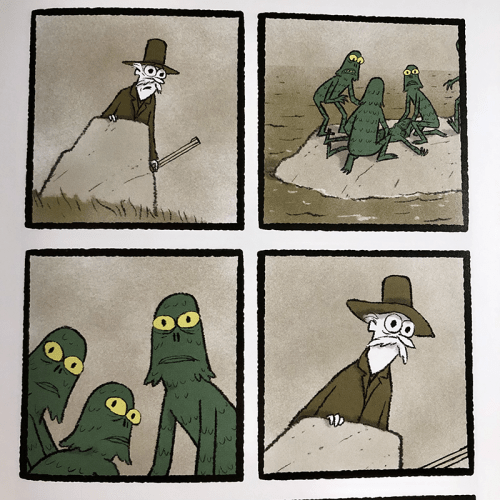
Once I read the first story, “The Village That Vanished,” I was hooked. The collection of stories here is framed around a classroom show-and-tell. Each kid is expected to go up to the front of the class and share their most eerie tale. And so it all begins with two characters overlooking a cliff, attempting to find a village that seems to have literally vanished. Before too long, the two surveyors, or whoever they are, stumble upon an old man in a cottage. And the old man proves to be quite an odd duck with a strange tale about fish people who live nearby. What unfolds is one of the strangest and most engaging bits of comics I’ve read in a long time.

The good stuff of good nightmares.

Annable is a master of capturing just the right movement, gesture, and expression. His characters are lanky, languid long-lost relatives of Buster Keaton. They move in a certain way; stare back at you, and at each other, in a certain way. There are very pregnant pauses in Annable comics. And there are very melancholic and enigmatic moments too. Plus lots of silly surreal fun. You really can’t beat that. It’s perfect for this Halloween season or anytime of the year for that matter.

One last note here from the publisher: “From the director of the Oscar-nominated movie Boxtrolls comes a middle grade horror anthology that will leave you holding onto your blankets for dear life! Perfect for fans of Scary Stories to Tell in the Dark and Goosebumps!” Indeed, I could not have said it better! Ages 8-12 will definitely love this book and, as I say, there’s really something here for all ages, starting around, say, around age 8. Don’t want to get too spooky earlier than that. Anyway, as I suggest, this is more along the lines of thoughtful spooky. This is the good stuff of good nightmares.

1 Comment

Filed under Comics, Comics Reviews

Comics by Henry Chamberlain: Keep the Aspidistra Flying!

Whatever you do, don’t make waves unless you’re okay getting wet. And keep the aspidistra flying! What on earth am I talking about? Well, here’s a comic with some rather puffed up characters, at some afternoon tea party, chattering away about some nonsense. I don’t begrudge them their good fun one bit as they provide some light entertainment. Enough said.

Leave a comment

Filed under Comics, Henry Chamberlain, Webcomics

THE BUND graphic novel review

The Bund: A Graphic History of Jewish Labour Resistance. Sharon Rudahl (Author); Paul Buhle (Editor); Michael Kluckner (Artist). Between the Lines. 144 pp. $25.99.

The Bund was a phenomenal uprising of people doing the right thing at a critical time when it was needed most. This graphic novel, or history, (call it whatever you like! It’s comics!) runs with its theme right out of the gate with a sense of urgency that embraces the reader all the way through to the very last page. Think of The Bund as a coalition, a movement, people power at its best. It was there to help people in need, people who happened to be Jewish and living by a thread. Let’s focus on the region, as it could not be more relevant. This is what was known as “The Pale,” what is now Poland and Ukraine. Let’s focus on the era. This is circa 1900 to 1940, covering Tsarist Russia into World War II. The Bund was a Jewish labor resistance movement that pushed back on its oppressors, namely Russia and Nazi Germany; and that cultivated and celebrated a Jewish identity, specifically in nurturing the Yiddish language and tradition. This book provides a history and insights into The Bund. And, if it makes you think of Bundt cake, you are on the right track: a metaphor for a strong and sturdy collective.

What is very exciting to me about this graphic novel is how it is put together as a vehicle to educate while also mindful of keeping the reader engaged. The artwork is pared down to the essentials, for the most part, with the added artistic flourish where needed. I can’t stress enough how important it is to include some personality even in the most straightforward graphic storytelling. If an artist is capable of it, well, go to it. Clearly, Michael Kluckner is in command of a compelling and expressive line.

The individuals behind this book are a creative dream team. The goal here is to provide an entry point, a doorway, into further study or a highly accessible overview. That is what this book does with Sharon Rudahl leading the way as the author. Rudahl is a veteran cartoonist, to say the least, who intimately understands what the comics medium can do. Rudahl is many things, including a passionate activist, along with the book’s esteemed editor, Paul Buhle. In fact, Rudahl and Buhle have a long and productive professional history, highlighted by working together on the Yiddish anthology, Yiddishkeit: Jewish Vernacular and the New Land, published by Abrams in 2011. So, one can see this new book as a continuation of what was achieved with that landmark anthology.

The overriding theme to this book is how The Bund reached out and put itself in the places it needed to be, achieving time and time again the “hereness” that was so desperately called upon. The Bund was HERE! It met the moment, did what it could, and now lives on in spirit. Here we have a book introducing readers to the leaders of The Bund, such as Pati Kremer and Bernard Goldstein. For the first time, we have a concise visual narrative of this highly significant Jewish history. All in all, this visual narrative encapsulates essential history that will inspire new generations.  This graphic history meets the moment in its own way, and helps return The Bund to the here and now.


1 Comment

Filed under Comics, Graphic Novel Reviews, Paul Buhle, Sharon Rudahl

Small Press Expo 2023: Another Wonderful Show!

A day in the life of Small Press Expo. Sketch by Henry Chamberlain

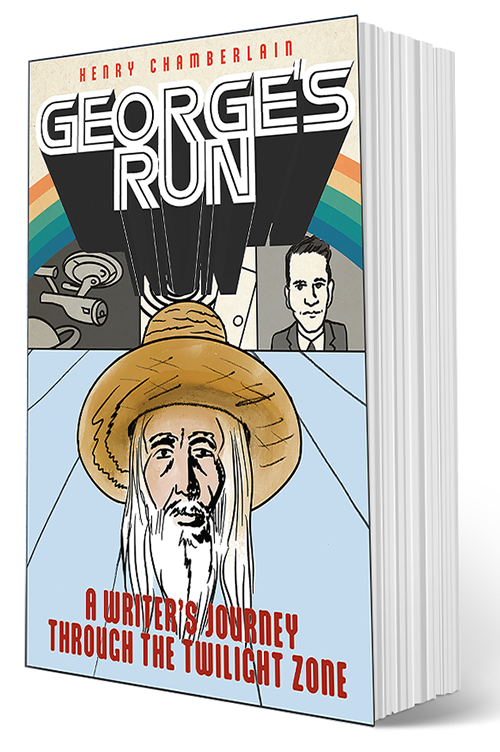
There are a number of ways to experience Small Press Expo and the best is to be on the convention floor as much as possible. And, even better is to be an exhibitor and have your own table space. It can really be a lot fun. Sure, there’s a fair amount of waiting to see what will happen next but you just need to pace yourself. I kept telling myself I was on a mission that no one is going to appreciate better than me: “I am here to represent my new graphic novel, George’s Run, published by Rutgers University Press.” I had to convey that energy and determination. Each time I described my book, and gave my pitch, was a new opportunity. Each work of comics is an island unto itself which you are beckoning passersby to consider hopping upon.

In support of my new graphic novel, GEORGE’S RUN!

Proudly representing Rutgers University Press!

I feel that it’s essential to be in the moment, acknowledge your table-mates, get to know them if possible, acknowledge your environment and everyone passing by, and certainly acknowledge yourself and your own comfort and well-being. I like to sneak in some time to draw in my sketchbook and that’s not only therapeutic but people often are curious and it can help strike up a conversation. Either that or people know right away that you’re not just a rep but the cartoonist! So, without further ado, I want to take a moment to acknowledge a few of my fellow creators. There are plenty more that I can share with you. This is a quick moment in time . . .

In this photo, you will see the following creators and contact info:

Sneaker Ghost by Jackie DeVito. Find it here.

Orts by Barrett Stanley. Find it at Radiator Comics.

Bruce Fort: Professional Bully by Bread Tarleton. Find it at So-So Press.

Bubbles #17. Find it here.

What I’ve Loved: Chapter 11 by Pam Wye. Find it here.

Precinct X99, Episode 2: Soft Toys. by Wren McDonald. Find it here.

I Owe It to My Parents to NOT Come Out by Richard Mercado. Find it here.

Empty by Jared Throne. Find it here.

Nickelodeon Guts by Sean Michael Robinson. Find it here.

Moonray by Brandon Graham and Xurxo G. Penalta. Find it here.

My Body Unspooling by Leo Fox. Find it here.

A big highlight for me, as it was for all of us at Small Press Expo, was Deb JJ Lee winning an Ignatz Award for Promising New Talent. Of course, Lee has many fans and she’s been around for more than a minute but the honor is highly significant. In fact, Lee cried when she went up to accept the award. For those new to Lee, this is the time to check out her new graphic novel, In Limbo, published by First Second.

Also, I would be remiss if I didn’t bring to your attention one of the hottest graphic novel releases for 2023: Naked: The Confessions of a Normal Woman by Éloïse Marseille (out November 7, 2023). This graphic novel presents a raw, tongue-in-cheek and refreshing look at sexuality in an engaging and entertaining manner that mature readers will appreciate. It is published by Pow Pow Press. The French edition is highly popular and we will soon have the English translation.

There is so much more that I need to share with you and I promise to just keep doing what I’m doing. I do my own thing regarding creating comics and I do my own thing writing about comics. See you again with more very soon!!

“Each work of comics is an island unto itself which you are beckoning passersby to consider hopping upon.”

Leave a comment

Filed under Comic Arts Festivals, Comics, Small Press Expo, SPX