Tag Archives: Sci-Fi

Mary Shyne Interview: YOU AND ME ON REPEAT

You and Me on Repeat, published by Henry Holt & Co., is a delightful graphic novel. You can read my review here. This is the first major graphic novel for Mary Shyne, also known for her own self-published graphic novel, Get Over It. So, keep in mind that Mary Shyne is very well-versed in the world of comics with numerous achievements: establishing a solid reputation with a self-published work; working in the book industry (Penguin Random House, no less); earning an MFA from the well respected Center for Cartoon Studies; getting her work published by a major publisher (Henry Holt & Co.); and, to top it off, Mary holds a key position at the Charles Schulz Museum. Alright then, no doubt, Mary Shyne is an exceptional person to talk about comics with. It was a pleasure to chat about Mary’s career path and her new book, a story about two star-crossed time-traveling teenagers.

Given that Mary’s career covers so much ground, this turned out to be a great opportunity to discuss various aspects of comics, specifically, the independent artist who self-publishes and often works alone (the auteur cartoonist) versus a new breed of comics artist that works within a team environment, including an agent, editor and publicist. There are variations to this. For instance, some well-established professional cartoonists retain the “auteur cartoonist” work method, giving up little to no control. While other cartoonists embrace working with others from the very start. Add to that the fact that many independent cartoonists are not thinking in terms of a “comics career” in the first place. But today such a path is potentially more viable if you follow certain steps. Your mileage will vary! There are so many variations on a theme, especially when it comes to a comics artist, etc.

Circa 2003: On a wing and a prayer, emerges The Center for Cartoon Studies.

We also dig deeper into the attitudes and approaches of cartoonists who came up the ranks with little to no formal training compared to cartoonists who have gained this new level of specialized comics training that was not quite possible a generation or so ago. The Center for Cartoon Studies stands out as a place of higher learning that trains those individuals who aspire to some kind of comics career, outside of working in the more mainstream superhero environment. These aspiring cartoonists are setting their sites on all kinds of comics that fit outside of the superhero genre (although there’s always unique exceptions) and these comics tend to be more personal “autobio” slice-of-life type of work, a genre all its own. These stories often find a home at more independent publishers or major book publishers interested in quirky offbeat work that tends to fit primarily into their young adult demographic (age 12 to 18), or the young reader market (age 8 to 14). And there’s more markets and age groups. The point is that there’s a strategy in place long before there’s a story. I suppose the trick, for any enterprising cartoonist, is to transcend any strategy. Those who manage to do that are really the ones who will thrive. After chatting with Mary, I can see she absolutely fits into that group.

All You Need is Kill

It was so much fun to chat with such an enthusiastic and experienced member of the comics community. Mary was very generous in sharing about her work and provided a window into her process. We bounced around a lot of ideas and covered a lot of ground. For instance, we talked about the graphic novel series, All You Need is Kill.

Palm Springs, on Hulu.

We talked about one of the great time loop movies, Palm Springs.

Lowlife (1992) by Ed Brubaker.

We talked about Ed Brubaker’s amazing comic book series, Lowlife.

My Entire High School Sinking Into the Sea by Dash Shaw

We talked about Dash Shaw and his amazing animated feature, My Entire High School Sinking Into the Sea.

Osamu Tezuka

We talked about Osamu Tezuka and his “star system” approach to comics.

Chuck Todd

Given that comics and pop culture are so closely aligned, and the fact that any conversation today can’t help but get a little self-referential, I brought up a giant in media, Chuck Todd, a recent sign of the times. Folks who find themselves pulled out of their high profile positions often turn to doing a podcast. At the time, I could not think of the title of Chuck Todd’s podcast. Well, it’s actually easy: it’s The Chuck Toddcast! I had not planned on mentioning Todd but it made sense. Chuck is someone who did everything right, loved his work, was respected by his peers, and yet it wasn’t enough. He was replaced as moderator of NBC’s Meet the Press, by Kristen Welker, who he graciously mentored. He came to my mind in terms of dealing with the demands of any industry attempting to gain top market share. It’s a war out there and good people can get caught in the crossfire.

Charles Schulz

And we round things out with wondering what Charles Schulz would do in the brave new world that is comics today. Mary thinks that Sparky would have most likely avoided social media, but that’s just a little bit of fun speculation.

I hope you enjoy the video interview. As always, your views, LIKES and COMMENTS directly at the Comics Grinder YouTube channel are crucial to our survival. Any bit of engagement is very welcome and appreciated.

Editor’s Note: If you are in San Francisco, be sure to view original art from Mary Shyne’s new graphic novel, You and Me on Repeat, at the Cartoon Art Museum. The exhibit runs from September 27, 2025 through January 18, 2026.

Leave a comment

Filed under Comics, Interviews

You and Me on Repeat by Mary Shyne comics review

You and Me on Repeat. Mary Shyne. Henry Holt. 2025. 224pp. $17.99.

A good time travel story these days walks a fine line as a genre all to itself: self-aware, serious and ironic all at once. I can see that Mary Shyne has given this a lot of consideration which has resulted in a graphic novel with a fresh take. Clearly, Shyne knows her way around all the time travel tropes, and so do her characters.

Chris and Alicia, two teenagers who have just graduated high school, are quick to accept the reality of time travel but not so quick to accept themselves. This is the premise that Shyne plays with as she has these two endure an endless loop of re-living their high school graduation day. Chris is a science geek and he’s a bit uptight. Alicia is an aspiring writer and she’s a free spirit. These two seem unlikely as a romantic couple but only time will tell, right? Shyne is way ahead of it and manages to keep thickening the plot, even for the most jaded young adult, this book’s prime audience.

As with any good time-looping story, the journey is what it’s all about. Shyne paves the way with a light manga art style that is pleasing to the eye and compliments the breezy nature of the narrative. It’s a very impressive work that checks all the boxes in what makes for a highly marketable work in comics. In its layout, its humor and overall vibe, there’s something lean, clean and perfect about Shyne’s work. That said, Shyne elevates her work to something personal and idiosyncratic that defies the most perfectly calculated marketing stratagem.  Could it be a bit of genuine heart-felt magic? I think so.

The best time travel stories have less to do with time travel and more to do with characters and so it is the case here. The two main characters, Chris O’Brien, who is white, and Alicia Ochoa, who is Mexican, are a mixed-race star-crossed couple of kids. The trend in the book and entertainment industry, if you haven’t noticed in the last five years, is diversity. I’ve been very mindful and supportive of diversity for much longer than five years. How about all my life? I’m Mexican American and, as a creator of comics and stories, that unique perspective is always there in my own work, whether it is noticed or not. In the case of this work, it is supposed to be noticed. Alicia Ochoa steals the show as the oldest sibling among many in a large Mexican family. Not all Mexican families are large but it’s a compelling trope and it works well here. Alicia is a restless soul who wishes to explore as many versions of herself as possible, including romance with girls and boys. What could be better than to be stuck in a perpetual loop where you repeat the same day, do whatever you want, wipe the slate clean and dig in for more?

Remember, the reason we can’t seem to get enough of time travel stories, at least good ones, is that they promise to deliver a bit of genuine heart-felt magic. I really enjoyed this book all the way to the last page and that’s because of its heart and honesty. And, hey, Shyne manages to do something that keeps getting more difficult to do in the genre. Shyne taps into that magic we keep craving and hoping for when we seek out a good time travel yarn.

1 Comment

Filed under Comics, Graphic Novel Reviews

Cartoon Art Museum: On Putting on a Show and Making a Case for Storytelling

Cartoonist Henry Chamberlain

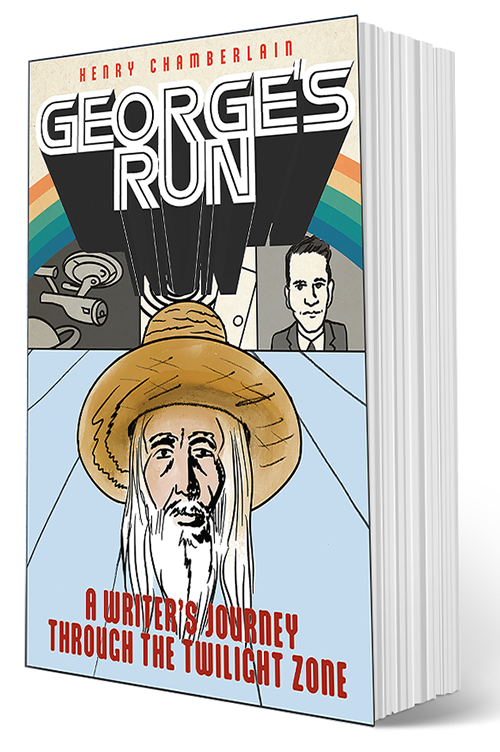
Those of us who create books of one kind or another must be mindful of the next step in our work’s journey, once it’s complete, published, and out in the world: the never-ending job of making more people aware of the book! My graphic novel, George’s Run: A Writer’s Journey Through The Twilight Zone, was published by Rutgers University Press in 2023. It was a pleasure to get a chance to give a talk and lead a workshop in support of my book at the Cartoon Art Museum in San Francisco.

Photos by Robbie Gomez.

The Cartoon Art Museum is a landmark in the local arts community and has the distinction of being one of the few museums dedicated to the comics medium. I have followed the museum’s progress since its time in San Francisco’s Yerba Buena Gardens neighborhood when Andrew Farago became its curator in 2005. Fast forward to 2017, the museum moved to its current location on 781 Beach Street on Fisherman’s Wharf. I’ve always found it to be a reliable source of inspiration with its impressive works on display, from new shows and its permanent collection. If you’re someone who has established a credible footing in this business of comics, you might find yourself invited to show your work here. I want to thank both Andrew and museum director Summerlea Kashar for helping make my presentation possible.

I have experience with leading presentations of one kind or another, notably a slide show lecture format which I first did when I led a panel discussion at San Diego Comic-Con. That said, I’ve been adding and refining notes attached to it ever since. I have found it easy to refer to notes and then break off into other directions. Lately, I’ve focused on an unusual zine that Marc Zicree (The Twilight Zone Companion) gave me a while ago. It’s a term paper he wrote in 1976, when he was 21 years-old. Marc’s paper features interviews with three significant figures from the Sixties zeitgeist: political cartoonist Ron Cobb; novelist Theodore Sturgeon; and television writer George Clayton Johnson. In his introduction, Marc makes clear how moved he is by Sturgeon’s uncanny ability to evoke the concept of love in his work. As for George Clayton Johnson, the subject of my book, Marc is mesmerized by George’s uncanny ability to speak virtually indefinitely on a wide variety of subjects. I carefully combed through Marc’s interview with George, and, just as important, Marc’s interview with George’s mentor, Mr. Sturgeon. What is clear is how much both men revered storytelling, which is at the heart of what my book is about–and, ultimately, my talk.

Once I start talking, I sense a detour up ahead. I had just mentioned the challenge of conveying the significance of a television show of the caliber of The Twilight Zone to a young audience unfamiliar with it when I found myself confronting a fresh new example in my audience for that day. Literally, only a few minutes prior, I had said that a young man had seemed to dare me at a comics convention when he told me outright that he’d never seen even one episode of The Twilight Zone. Right after that, a young man that day in my audience seemed to take it up a notch by telling me that he didn’t watch television at all. I was now juggling at least a couple of ideas going well beyond just being unfamiliar with a certain television show. Part of what I think was going on here is that the young man was, perhaps unintentionally, mirroring what I had just said. I gave it some thought and emphasized the fact that we all need to get as clear an idea of the big picture: seeking out great storytelling.

I went on to say that, when I’m given a dare to explain myself and make my case, I’m more than happy to break it down. In fact, the determination to break down ideas into concise and accessible elements took a life of its own in my book. That’s a vital part of the book: guiding the reader through the creative process that led to The Twilight Zone, one of the greatest works of television on many levels, not the least of which is the writing. My book is about the writers who made this possible. Overall, I think folks enjoyed what I had to say. Getting back to Marc Zicree’s 1976 term paper, one concept that keeps popping up is the steady encroachment of mass media and related distractions. This is well before even the internet and it already seemed like people were drowning in a flood of data. No wonder some young people today might think they don’t have time for “television.”  I know it was very helpful for me to give this talk and the feedback will help fuel the next one.

It was my intention to offer more than enough stuff to cover within my two-hour window. During the talk, I encouraged the audience to begin drawing their own tribute to their favorite TV show. By the end, we had a few interesting submissions. I want to thank Chartpak for partnering with me and providing the art supplies for this portion of the event. I will provide a separate post that features the Chartpak marker that I used for my art demonstration. I want to invite everyone to check out the Chartpak factory store for an incredible selection of art supplies.

Thanks again to the Cartoon Art Museum for an amazing event and I look forward to many more visits in the future. And special thanks to photographer Robbie Gomez for these amazing photos.

6 Comments

Filed under Comics

The Spawn of Venus and Other Stories Illustrated by Wallace Wood book review

The Spawn of Venus and Other Stories Illustrated by Wallace Wood. Seattle: Fantagraphics, 2025, 216pp. $39.99.

Review by Paul Buhle

The Great Bohemian of comic books’ grandest moments, Wallace (aka “Wally”) Wood drew like a genius for a number of publishers before falling to overwork, too many cigarettes and too much liquor. EC loved him the best, and it was a mutual feeling, notwithstanding the inevitable tensions of artist, collective/collaborative work process, and the reality of a boss.

Wally Wood in his prime, excerpt from “My World,” Weird Science #22, 1953.

This splendid volume collects some of his finest Sci-Fi—he was also among the greatest satirical artists for Mad Comics—from forgotten series titles like Weird Science, Weird Fantasy and Incredible Science Fiction of the early 1950s. It also offers much woderful contextual material, commentary by serious scholars—university professors but mostly otherwise—to individual stories and collaborations, from editors to scriptwriters to presumably lowly inkers.

Most “classics” comic art volumes these days contain a hat-tipping of industry insiders. Same here. Howard Chaykin, vaunted comic artist (and a short time assistant to  Wood)  does not have a lot to say beyond describing Wood’s talent, nor does the appropriately admiring Larry Hama, of today’s GI Joe, itself a remnant of another and in this case, less pleasant, aka Cold War, comics era. S.S. Ringenberg, a comic scriptwriter, and fan-interviewer works harder with a biographical introductory sketch that goes little beyond ground familiar to Woods devotees, but reminds us sharply of the nature of the self-destructive genius. Wood put a gun to his head in 1981, leaving no note. The career disappointments were real, especially for an artist who worked hard at improving his style. But by that time, two divorces and a separation, he became too exhausted to keep himself in check. Besides, the glory years of the older comic art had been long past, and he was not suited to the new comix generation. His barely controlled artistic id did not find a home in the ill-paying Undergrounds.

Meanwhile, in the substantial Introduction,Tommy Burns and Jon Gothold go through the stories one by one, in such detail that no biographer of a novelist may ever have done better. Do we need such detail? Perhaps not every reader will think so, but among the plot summaries, these scholarly-minded critics offer so many small insights that the net result is remarkable, and demands several readings for details.

Wood reached his apex, arguably, in adapting the stories of Ray Bradbury, and this tells us much of what need to know about the vital and lasting importance of Wood’s work. This reviewer came upon Bradbury’s writings around age 10 or 11, in the Republican political/cultural climate of Central Illinois where the perceptions of sophisticated New Yorkers, for instance, would have been unusual and likely mistrusted. Mad Comics explained McCarthyism in the most penetrating and hilarious fashion. Bradbury, who was personally close to the Hollywood Blacklisted, found ways in his stories and novels to explore the takeover of public space, the waning of the New Deal stress for reform in favor of forced patriotism, but also unapologetic commercialization of daily life. He saw the future and it looked bad.

Thus, famously,  Fahrenfeit 451 and The Martian Chronicles, made into feature films but only after the worst of McCarthyism had faded. Bradbury had been trying for years to send out warnings, even while he was making a living and a reputation (including a personal move to Hollywood)  in a Sci-Fi field with leftist underpinnings going back to the 1930s. He also badly wanted to escape being pegged as a “genre writer,” but never made it and did not need to: we loved him anyway.

Photo funnies tribute in The Spawn of Venus and Other Stories.

Wally Wood so internalized the logic of Bradbury that stories composed by others at EC somehow have the “Bradbury Touch” in addition to the EC Touch, which consists—leaving aside the art— in terse scripting and a surprise ending. Like the alien civilization in “He Walked Among Us,” where the Savior was actually an Earthman who preaches love and forgiveness is executed. Two thousand years (!) later, another Earth visitor learns that the aliens’ holy symbol is the rack, aka cross, where the presumed savior was tortured to death.*

You get the idea. Human folly in the Atomic Age has become toxic. Wood could have predicted what a willful destroyer like Musk would write about opening up the need for “planetary” civilizations when Earth has been plundered beyond repair.

Not that all the stories are like this. And Bradbury could not have featured the scantily-clad beauties, alongside the virile young males, that seemed to be a specialty for Wood. Earthmen fall in love with alien females who assume a delicious human form only… to revert back, inspiring horror. Humans landing on a distant planet learn that the babies born to them, urgently wanting love and care, may have a dozen arms and look like octopi or something else weird (in this case, mommy does not care, which sounds right).

How were Wood’s females all so young and buxom, you might ask? The mostly male and young readers of these comics didn’t likely ask at all. The happy dreamers of another story are space explorers kidnapped to service the all-female population of a planet whose males have died out after a war. The “scientifically selected” dames look awfully familiar.

Wood could also favor social criticism–with a dark turn. In one story here, tens of thousands of Earth people who disappear in bunches, every few hundred years, turn out to be farm edibles, as a scientist explains over…a turkey dinner. Actually, this was an EC Sci-Fi trope several times over, like the aliens in another EC comic who capture interplanetary humans to use their skins for…fashionable minkish coats, and so on. Why do we egotistical Homo sapiens think we can abuse the animal kingdom?

From “Spawn of Venus”

Wood also loved the occasional in-joke, with a drawing of himself in the final panel. Here, EC Comics miraculously predict unexpected events, like the appearance of flying saucers, or the rise of surgical sex change (think “Christine” Jorgenson in tabloid headlines of the time). A jowly comics publisher (could it be plump William Gaines, who inherited EC when his father died in a boating accident?) wants them to take “a loyalty oath” (cue to Joe McCarthy). After some alien hi-jinks, the real Wally confesses that he and his fellow artists are actually disguised Venusians saving the world from horrible-looking Martians!!! What those helpful Venusians might look like beneath their disguise…we will never know.

In the real world, EC’s marvelous Sci-Fi, “Real War” and humor series (MAD and PANIC) never reached the sales level of its various, blood-dripping but also deeply satirical horror comics, also full of plot reversals and revenge-justice. Gaines was called upon, in the famous Congressional hearings (held in the same Manhattan courtroom as “Red” hearings a few years earlier), to explain the horror as something less than dangerous to young minds. The inquisitors weren’t listening to his answers, and the guillotine blade fell on a glorious moment in popular art.

Wally Wood outlived his time, this is the tragedy of his life and not only his. Harvey Kurtzman and his trusted artists hit their peak as satirists, also arguably as editors and artists, in their twenties and early thirties. Some became highly successful illustrators. None could recapture the magic.

Paul Buhle

*Let it be known that the Ray Bradbury Museum rests in the blue collar city of Waukegan, Ilinois, which only happens to be my wife’s hometown.

Leave a comment

Filed under Book Reviews, Comics

Pop Culture Bits: George Lucas, Star Wars and Summer

I happened to be in San Francisco recently and found myself doing what has become a ritual for many Star Wars fans: the big visit to see the tech campus that houses the Lucasfilm headquarters in San Francisco, located within the Letterman Digital Arts Center nestled within the Presidio. If you go, it might be a bit of a downer, more of a subdued pilgrimage since you’re only going to get to see the campus (which is, no doubt, beautiful) and then loiter around the reception lobby. There’s a fair amount of movie memorabilia to view but, it’s basically a work place so don’t expect to see your favorite characters ready to pose for photos. I’d be curious to know if any of my readers have made this visit and what you thought. I went in with no expectations or maybe I assumed the space was more lived-in, part of an actual communal library for employees. It’s not. It’s mostly a place to pick up your food delivery, and assorted business, just like any other office.

Amid books and Star Wars figures.

Sadly, I discovered that the library was basically fake. Many of the books are only props: real enough books but only a certain amount that you could call relevant. For instance, there’s a copy of the novel, An Affair to Remember, which was adapted into the 1957 film starring Cary Grant and Deborah Kerr. Okay, that’s definitely movie-related but not really something you’d expect Darth Vader to be reading, am I right? How about another title on these shelves: An Only Child, by Frank O’Conor? I guess that sort of echoes the childhood of Luke Skywalker but that’s a bit of a stretch. Then there’s Pop Culture Mania, by Stephen Hughes: a guidebook on how to collect various items of pop culture ephemera. Closer but not exactly satisfying. But, hey, I’m just being silly, I suppose. That said, I can only imagine there might be some kind of corporate library somewhere beyond the reception lobby. If you happen to work at Lucasfilm, please let me know if you have such a library! Just wondering!

Nevil Shute finds a home in the reception lobby library.

Perhaps the best looking match-up of books on display with curio in the lobby is this combination: A “bust” of a Star Wars storm trooper and a collection of the works of Nevil Shute, a notable science fiction writer. His best-selling novel, On the Beach, first published in 1957, is an all-time classic work of post-apocalyptic science fiction.

It’s the beginning of summer. I’m in San Francisco. George Lucas and Star Wars loom over me. I’m ready to see a Sci-Fi blockbuster! Is one fast approaching? I did overhear some heated conversation on the topic but no industry secrets were revealed, just idle conversation. If you want upcoming attraction news, you can go over here and you’ll be hip to Ryan Gosling set to appear in the next major Star Wars movie in 2027! At one time, Gosling was set to appear in the sequel to the 1976 Sci-Fi cult classic, Logan’s Run but that did not take hold. I believe everything did take hold for Star Wars. So, all’s well that ends well and Nevil Shute finds a welcome home in the reception lobby library of Lucasfilm HQ in SF.

Leave a comment

Filed under Comics, Star Wars

When We Were Trekkies by Joe Sikoryak comics review

When We Were Trekkies. by Joe Sikoryak. joesikoryak.com. Bundle of 10 issues. 180pp. $35.

Joe Sikoryak, a filmmaker and cartoonist, provides a very moving, funny and unusual comic. As the title implies, it’s about Star Trek but it’s mostly about being a young person and finding yourself. Now, the purists may have problems with my suggesting that Star Trek take a backseat. But fear not, true believers, it all adds up. This is a wonderful coming-of-age story. And you really feel like you’re there with the kids who were the most loyal fans.

So, how do you navigate through your younger years: a time of raging hormones, developing your own identity and being true to your deepest passions? Well, it doesn’t hurt to be with like-minded souls. You find your tribe. In this case, the tribe is all about Star Trek. But, as I suggest, just like American Graffiti was about cars and music, in the end, you want to know if the boy will get to kiss the girl.

Into the fray. The early days of cosplay.

Our story is set in the 1970s in a small town in New Jersey where five young men (ages 16-21) become immersed in the growing fandom for Star Trek, a science fiction television series which ran for a mere three seasons (1966-69) but continued to intrigue new viewers who discovered it on TV as re-runs. Our protagonist, Jonny ( an alter ego of the author) is the youngest member of what becomes a sort of boy’s club (at least in the beginning) with the guys attending Star Trek conventions, participating in cosplay competitions and basically being part of that first wave of diehard fans which would propel interest in more and more Star Trek entertainment, even major motion pictures.

Those wild and wooly early Star Trek conventions.

As I go back and rifle through all ten issues of this graphic narrative, I gotta say there’s a certain feeling of satisfaction at having all the issues together, as if I had painstakingly collected them, one by one. For folks who maintain a pull list at their local comic book shop, you’ll easily relate. I think our author, Joe Sikoryak, couldn’t help but want to evoke that “collector’s high” for the reader. Collecting is a key element of being a fan, which you can unpack any number of ways. Those early fans were collecting re-run views of Star Trek in order to see the bigger picture. That sense of collecting easily overlapped with the experience of collecting a series of comic books in order to experience that bigger picture, the complete run to a particular story. You can proceed from there to any number of other forms of collecting: going to conventions, amassing a network of friends, entering contests, documenting events. And so on.

Geraldo Rivera and William Shatner.

Jonny and his friends get to know all aspects of fandom and even some they probably could have done without, like all the tedious details involved in organizing a group of cosplay competition contestants. In Issue #6, the gang gets up close and personal with how the world-at-large might view Star Trek via the media. By chance, they get to participate as representatives of the cosplay scene by appearing in the audience for Good Night America (1974-77), a sort of spin-off of Good Morning America which Geraldo Rivera ruled over in his distinctively rakish way. Of course, a lot of things get misrepresented. For some goofy reason, there’s a segment with child pitchman superstar Mason Reese providing “expert” commentary. William Shatner, however, is the main focus and he doesn’t let down the true believers. Speaking from his heart, he honestly concludes that there’s something very special about Star Trek and he’s just there to let it happen, not get in its way. And, in similar fashion, I can say that Joe Sikoryak does his best not to get in the way of his own story showcasing young and vulnerable characters. Sikoryak has got a sixth sense about it and, through his writing and his artwork, he truly captures their spirit.

Mason Reese sees it all.

Moving forward to Issue #7, you’ve got my vote for best convergence of pop culture with auto-bio drama in a comic in quite a while. Jonny is utterly infatuated with Ani, a very sexy cosplay competitor who paints her entire body green. Ani and Jonny have just completed a little performance in a hotel lobby when a “celebrity” catches sight of them. Mason Reese, the 8-year-old tophat-wearing-pitchman for pudding and potato chips makes his presence known and quips to Ani: “That’s a very authentic costume. Are you green all over?” Ani, not missing a beat, lifts up her dress to, presumably, reveal everything. The composition is at a discreet angle so it’s left up to the reader but, yeah. Mason’s jaw drops to the floor.

William Shatner and Geraldo Rivera on Good Night America, January 23, 1975.

Now, if we go back to Issue #6, even better than the whole Mason Reese episode, as far as pop culture colliding with memoir goes, has got to be Jonny and the gang in the audience to see Good Night America. As Sikoryak points out in the footnotes to this issue, this really happened. The episode is from January 23, 1975 and is archived on Geraldo Rivera’s website, as well as available on Sikoryak’s website.

Anyway, who says Star Trek can’t help provide enough wit and wisdom to last you a whole lifetime. Jonny seems all the better for it. He does wonder if perhaps he’ll outgrow his love of comics, music and sci-fi, all the things that have been there for him as he faces his rites of passage into adulthood. But, as this comic book will attest, the good stuff never goes away. It will always be around, either riding shotgun with you for the rest of your life’s journey; or waiting to be rediscovered when you need it most. When We Were Trekkies speaks to that kind of powerful energy, not to be taken lightly but to be honored and celebrated just like it is in this most remarkable comic.

The gang’s all here!

1 Comment

Filed under Comics, Graphic Novel Reviews

Parable of the Talents graphic novel review

Octavio E. Butler’s Parable of the Talents: a Graphic Novel Adaptation. By Damian Duffy, John Jennings & David Brame. New York: Abrams ComicArts, 2025. 300pp, $25.99.

Review by Paul Buhle

Perhaps it is the ominous ecological signs that we have been living through, with  a painful added irony, looking back on the declaration of Earth Day in 1970. No doubt it is the worsening of government in every sense with the first Trump administration and now the second. Whatever the reason, the work of the late and great Science Fiction author Octavia E. Butler is now amidst graphic novel adaptations, adaptations like none others.  After a first streamed series adaptation of her novel Kindred, more are already in development. In other words, we are going to hear a lot more from and about Octavia Butler, the first SciFi writer to win a MacArthur (“genius”) Award and more famous in her death than she could possibly be in her own lifetime.

It is fair to say that Butler never deserted, through all her efforts, the ominous and only occasionally hopeful narrative that she adopted almost from the beginning of her work. If it sounds like Afro-Futurism, that would be accurate because she actually did much to invent the genre, so to speak, without giving it a title. Inasmuch as we live, all of us, in a time of ecological disorder and disaster, with the fragmentation of communities all around, and desperation never far away, she pushed the boundaries even further.

Within this daunting framework of her narrative, the situation of non-whites is precarious, to say the least. Whites are almost certain to get the last lifeboats off the sinking ship, and some of the whites will certainly be eager to kill anyone else seeking escape—another anticipation of Trumpism. Not to mention whites, really anyone in power, seizing every opportunity to exploit and degrade minorities along the way. Here is the Butler Dilemma: her nonwhites do not actually live in some distant continent like Africa, surrounded by other non-whites. Everyone shares a location—it happens to be Future California—also sharing a need for relationships, love, family and a means for collective survival. Non-whites or at least her non-whites, most of all women, have accumulated the historical, collective understanding that they need, if only they can express their full creative energies. Amazingly enough, this narrative also portends the possibilty of interracial relationships and even interracial marriage, something rare for literary science fiction to describe right up to the current century—interspecies sex and romance has, somehow, always been easier.

Butler manages this, not by the geographical escape but by blending a  black culture-based spiritualism within a perpetually uneasy hybridity compulsory in the face of the struggle for survival. Only the gay, black SciFi master Samuel Delaney, who swiftly sought to help the young Butler, had dared to go so far in terms of race and sexuality. Butler takes what may be called the next step.

The Parable of the Talents is, in fact, the second outing for its two creators, Adaptor Damian Duffy and artist/professor John Jennings. Kindred (2017) won an Eisner among other awards and it was their effort that reached streamed film adaptation. They create with a sense of confidence that is observable on the printed page. A reviewer wrote of that work that the graphic expression, “brutally jagged, disorientating, gothic, and impactful art” had added a dimension to Butler’s work, a new angle of vision, something achieved in a small handful of past graphic adaptations going back to prize-winning woodcut adaptations of novels (Including Moby Dick) by Lynd Ward. But more jarring.

If Kindred travels back in time as a black woman in 1976—married to a white man—and finds herself on a plantation before the Civil War, then Parable of the Talents moves forward to 2032, seventeenth year of the Pox. A father-figure physician saves the life of an eighteen year old and they struggle to live, even to build a community, up in the mountains of Humboldt County.

Along with its precursor, Parable is certainly among the most ambitious graphic novels ever published, at least in English. Perhaps the narrators/artists might have chosen to reduce the level of detail, including dialogue? Or allotted more space for the physical settings? I think these questions will be distant, not even secondary, to devotees of Butler who are readers of graphic novels. To have devoted herculean efforts to this production is a sufficient accomplishment.

But consider this, in a book actually written and drawn a bit before the 2024 election. We are about halfway through when we realize that that corralling of homeless children, redirected into Christian indoctrination under the regime of a fascistic and power-mad president, is more of a prediction of Trump II than anyone could have predicted.  “It is hard to imagine that it happened here, in the United States, in the 21st Century, but it did. [President] Andrew Steele Jarret scared, divided and bullied people into letting him ‘fix’ the country….his fanatical followers—filled with righteous superiority and popular among the many frightened ordinary citizens who only wanted order and stability—ran amok.” (p. 180).

Of course there were wars, which are viewed here as “useless, ridiculous, obscene” (p.181) and properly so. War feeds the Maw, and that Maw grows later  on, even after a supposed peace is negotiated.  Christianity is here at its worst, or among the worst in two thousand years of intermittent and self-righteous attacks upon non-believers.

Our protagonist, suffering horribly for herself and others, helps lead an uprising that shakes the scene around them even if a national government cannot be overthrown. A destiny of freedom may be reached across generations and across the cosmos if not on Earth. This offers, for Butler but also for current socialistic SciFi writers like Kim Stanley Robinson and China Mieville, a prospect of hope.

2 Comments

Filed under Comics, Graphic Novel Reviews

The Toxic Avenger, Volume One graphic novel review

The Toxic Avenger, Volume One. By Matt Bors, Fred Harper, et.al. Dewitt, NY: Ahoy Comics. 2025. 130pp. $17.99.

Guest Review by Paul Buhle

Matt Bors is a Comics Storm in himself, now barely 40 and evidently uncontainable. Raised in Canton, Ohio,  he began cartooning for a student newspaper and moved quickly into political cartoons, at 23 the youngest syndicated artist of the day. A finalist for the Pulitzer Prize twice over, winner of the Herblock Prize, he grew restless or perhaps watched the daily press collapse around him. His own first GN appeared in 2020, with his signature boldness of horror and humor in the title itself: War Is Boring.

A restless organizer, he made himself part of the new, globally-based Cartoon Movement, traveled to Afghanistan with the always-controversial Ted Rall, each of them more outrageous than the other. He joined a newly-syndicated project, The Nib, and when it failed, relaunched it a few years later. Three years ago, he announced that he was leaving editorial cartooning for political comics journalism.

The Toxic Avenger emerges from a Syracuse publisher AHOY, the first in a series to be created by a new artist in a new genre. “When I first approached [Ahoy] about reviving the Toxic Avenger in comics, I wasn’t modest,” said Bors. “I pitched a new origin, outrageous new characters…Now, Fred Harper and I have been given the green light to go fucking nuts.” The first is in what might be called a Creature Feature, those following within, also satirizing, the ever-popular genres crime, romance, SciFi and so on. They are planning a video grame and maybe, maybe a theatrical release of The Toxic Avenger itself (or himself).

My own background in Underground Comix (and before them, the EC Comics of “real war” and Mad Comics, 1952-55) leaves me rather stunned at the apparent genre-professionalism of Toxic Avengers. It feels like one of those Richard Corban environmental-horror comics of the 1970s where the grotesque is slick and commonplace, flesh slides easily off bones and may leave the surviving creature more than intact, and humor, at least a kind of humor, is never far away.

Mr.Avenger, huge, green and with one eye both smaller and situated above the other. He is a friend to the kid activists. They are collectively taking on the “Church of Troma” for-profit hospital, whose bigshots are busy rationalizing the latest toxic release into the community, poisoning the water supply. The Green Giant is busy rescuing his pal, a creature even in worse shape, from this supposed health-facility, while the very bohemian and cross-dressing teenagers are organizing around and against “The Quarantine.”

To say it goes on from here, with the forces of State Oppression growing steadily uglier, would be an underestimation. It turns out that extra-planetary, super-intelligent insects have the government fronting for them. To suggest that it would lead to one super-human creature going toe-to-toe with another is…familiar to any seriously addicted comic reader.  “

“If you ever want to tell someone you love them…don’t wait until your skin melts off in a large industrial accident.” (p.77) A sweet thought of a cute teenager who, with a few adjustments  (no beehive hairdo) might have fitted well, almost, in a True Love comics of the 1940s-50s. True love will win out, even here. To give anything more away would be a sin, although the involvement of those curious cicadas that I saw every seven years in my midwest childhood (they came, they mated, apparently, and they died, leaving a backyard mess), have something to do with all this.

Outside my world but not that of comic readers is the final pages of “Variant Covers,” with some (black and white) alternative character sketches. Donald Duck was never like this. Nor the wild and unpredictable Underground Comix, even.

Matt keeps busy and The Nib also marches on, through the web. It’s a cartoonist/comic artist saga of today that inspires, for this comics editor, astonishment and admiration.

Carry On, Matt!

Paul Buhle

Leave a comment

Filed under Comics, Comics Reviews

UFO: Undercover! comics review

UFO: Undercover! Yerstory Transmedia. (w) Eric Warwaruk. (a) Diego Lugli. 2023. 268pp. $24.99

When ordinary lives intersect with the supernatural you can end up with a very satisfying story. A really good space alien story needs a creator who embraces the tropes. Writer/creator Eric Warwaruk knows how to lean into the ordinary and the uncanny to achieve great results.

It’s the journey that is most important in these kinds of stories. The reader invests time in getting to know the characters, usually down on their luck with little prospects. And then, one day, something other-worldly happens. Suddenly, ordinary lives are seen in a new light. Suddenly, 25-year-old Tyler’s UFO podcast becomes very relevant. Not even his best friend Scott can scoff at him now.

If you are looking for a very relatable story with everyday folks confronting a certain X-factor like Stranger Things, then this slow-burn thriller will satisfy you.

The artwork by Diego Lugli is a perfect fit for this story about a daydreamer who dares to keep dreaming. There’s a very fine mix of the whimsical with the surreal. In this comic, in the spirit of such mighty daydreamers as David Lynch, the ordinary is quite extraordinary. There’s a very placid energy running through these characters, spooky in a good way. I love the fact that our hero is so reluctant. The publisher behind this project, Yerstory Transmedia, works with various media and I could see a movie version of this comic book. Sure, why not? That said, I’m charmed by the fun and weird vibes of this authentic work just as it is.

“Why me?”

I encourage you to seek out this very charming and quirky Sci-Fi thriller. And be sure to keep up with Eric Warwaruk and the rest of his comics titles at Yerstory.

Leave a comment

Filed under Comics, Graphic Novel Reviews

Carol Lay and MY TIME MACHINE interview

Carol Lay has set the bar high for time travel novels and, no doubt, time travel graphic novels. I would not be surprised to find out that this book ends up joining the ranks of time travel movies. As we move further along in an ever-expanding tech-laden and crisis-prone world, we seem to have an insatiable desire for time travel stories. Well, then grab this book! And, if you should need a little more convincing, please stop by the Comics Grinder YouTube channel and check out my interview with Carol Lay.

MY TIME MACHINE, published by Fantagraphics Books, is one of the best contemporary time travel stories I’ve ever read, whatever the medium used to tell it.

We keep the chat light and easygoing and, given the subject matter, we find ourselves naturally covering a lot of ground. If you are new to H.G.Wells, or a diehard fan of time travel and science fiction, we’ve got you covered. This is one of my most fun interviews with one of the best cartoonists in the business. As an added bonus for those readers familiar with the original novel, and the 1960 movie for that matter, you can consider Lay’s book, as she states, “a sort of sequel to the original in that my book treats those events as if they had really happened and my story is a continuation.” Lay goes on to say that climate change plays a pivotal role in her story. “H.G. Wells was very interested in science. He carefully studied Darwin. He basically wanted to go into the future to see how humans evolved. In my story, I wanted to go into the future to see how the planet evolved.”

Like I suggest in my review of this book, it’s really nice when you have an auteur cartoonist like Lay (in full command of both writing and artwork) who knows just how to dive into the good stuff. Creating a work of comics at this level is a lot of work but it can also be a lot fun. That’s the whole point to all this: it’s gotta be fun! At some crucial level, the story is moving along at an undeniable and highly compelling pace. You do not have to be a fan of science fiction to get into this book. If you love a good story that is as much character-driven as it is quirky and confronting big issues, then this will appeal to you.

2 Comments

Filed under Comics, Interviews