Tag Archives: Sci-Fi

Carol Lay and MY TIME MACHINE interview

Carol Lay has set the bar high for time travel novels and, no doubt, time travel graphic novels. I would not be surprised to find out that this book ends up joining the ranks of time travel movies. As we move further along in an ever-expanding tech-laden and crisis-prone world, we seem to have an insatiable desire for time travel stories. Well, then grab this book! And, if you should need a little more convincing, please stop by the Comics Grinder YouTube channel and check out my interview with Carol Lay.

MY TIME MACHINE, published by Fantagraphics Books, is one of the best contemporary time travel stories I’ve ever read, whatever the medium used to tell it.

We keep the chat light and easygoing and, given the subject matter, we find ourselves naturally covering a lot of ground. If you are new to H.G.Wells, or a diehard fan of time travel and science fiction, we’ve got you covered. This is one of my most fun interviews with one of the best cartoonists in the business. As an added bonus for those readers familiar with the original novel, and the 1960 movie for that matter, you can consider Lay’s book, as she states, “a sort of sequel to the original in that my book treats those events as if they had really happened and my story is a continuation.” Lay goes on to say that climate change plays a pivotal role in her story. “H.G. Wells was very interested in science. He carefully studied Darwin. He basically wanted to go into the future to see how humans evolved. In my story, I wanted to go into the future to see how the planet evolved.”

Like I suggest in my review of this book, it’s really nice when you have an auteur cartoonist like Lay (in full command of both writing and artwork) who knows just how to dive into the good stuff. Creating a work of comics at this level is a lot of work but it can also be a lot fun. That’s the whole point to all this: it’s gotta be fun! At some crucial level, the story is moving along at an undeniable and highly compelling pace. You do not have to be a fan of science fiction to get into this book. If you love a good story that is as much character-driven as it is quirky and confronting big issues, then this will appeal to you.

2 Comments

Filed under Comics, Interviews

Derek Kirk Kim interview: In Search of The Last Mermaid

Derek Kirk Kim

Derek Kirk Kim is a heavy hitter in the comics and animation world. He’s managed to accomplish quite a lot with award-winning comics and a successful career in animation as a director, storyboard artist and character designer for numerous companies like Disney, Cartoon Network and Netflix. In this interview, I put my pop culture sleuthing skills to good use as we cover Kim’s creative process which has brought him back to his first love, comics, and his new comic book series, The Last Mermaid, published by Image Comics. Here is my review.

Volume 1 collects Issues 1-6.

The Last Mermaid #6!

Variant Cover for #6 by Joy Ang.

Variant Cover for #6 by Gene Luen Yang.

Variant Cover for #6 by Jacob Perez.

What is essential for any work of comics, or any form of art, to stand the test of time is structural integrity. If a work is built upon a firm and solid foundation of diligent care, then it surely stands a chance. We chat about the connections shared by Kim’s earlier work (notably, Same Difference and The Eternal Smile, with Gene Luen Yang) and Kim’s latest work. There’s a certain sensibility at play: a devotion to characters, a heart-felt narrative and a sly drive to push boundaries. The magic to all of this is carefully crafted writing. And then you add the wow factor of equally well-crafted artwork. So, at the end of the day, you have a work where everything is there for a reason. It’s sturdy. It will stand the test of time.

How about that silver trident?

This is an important time in the routines of comics fans as tomorrow is Wednesday, the day of the week that comics shops get in their latest titles. Each week has its own favorites. This Wednesday, the number one comic book title has got to be The Last Mermaid #6. This issue will round out what will be the first trade paperback collection of this title. And it is in this issue that our main character finally reveals her name. We chat about this at length along with the usual comics shop talk. I invite you to join us. Just click the video below.

And remember that it’s The Last Mermaid #6 that wraps up the first story arc. The first collected trade paperback comes out in October. Visit Image Comics.

Also, be on the lookout in April of next year for Royals, the new graphic novel written by Derek Kirk Kim and art by Jacob Perez, a crime caper involving telepathic twins, published by Image Comics.

Leave a comment

Filed under Comics

THE LAST MERMAID by Derek Kirk Kim comics review (#1-5)

Volume 1 collects Issues 1-6.

Here is a comic book that is a treat to introduce to new readers, share with fans, and genuinely marvel over its beauty. There is nothing calculated about it. What I get from this comic is a feeling that Derek Kirk Kim is simply compelled to share his vision and it’s that feeling that drives this quirky cosmic sci-fi adventure. We’ll take a look here at the first five issues of this series which is slated to run for about 30 issues total. Take note that the first collected trade (#1-6) will be out this October.

I recall Derek from back in the day, ten or more years ago, when he did autobio comics, notably Same Difference, published by First Second. And so it was great to see this amazing new project. I appreciate that Derek became successful in animation and that this process has influenced his new comics: lush approach; 16:9 storyboard panels. Having read the first five issues, I totally get the general response from readers about it being very immersive. And then there’s the whimsical touches, especially Lottie, a cute little salamander sidekick. On top of that, many more layers. This is a post-apocalyptic story. There’s a number of influences in anime and manga. And it’s a story that begins with touches of levity but promises to get more gritty, maybe a little grim. So much to unpack and yet the end result is a very smooth entertaining ride.

How about that silver trident?

The big takeaway is that this comic is really for everyone, although it will get darker as it progresses so that will lean it more firmly into teen and up. It’s a comic for new readers, non-readers and all of us who sometimes think we’ve seen it all. The mysterious mermaid is definitely a big draw. It’s five issues in and we still don’t know her name. We do know that she wears this enormous body of armor to get around, more like a rover with arms and legs. It’s called a hybrid aquatic vehicular chamber. She’s always on the run, looking for fresh water in a world with very little of it, and she’s on a quest. For someone who is short on words, she delivers what has got to be the best line in comics this year: “Have you ever come across a giant silver trident impaling the sun?” Now, that’s a question to keep you up at night.

Issue 6 wraps up the first story arc and comes out August 28th. Visit Image Comics.

1 Comment

Filed under Comics, Comics Reviews

Amber Atoms by Kelly Yates comics review

Amber Atoms. (c,w,a) Kelly Yates. Vol. 1. 2023.

Amber Atoms is a refreshing take on an ole Sci-Fi tradition. I love the character’s overall style, in the same way that I love, say, Liberty Meadows or Power Girl or any number of “Girl Power” characters. Kelly Yates, the creator, writer and artist of this comic book, is best known for illustrating multiple comics and covers for Doctor Who (IDW/Titan). I really like the look and feel of what Yates is doing with his foray into what can be very familiar territory (from Buck Rogers to Star Wars). Another way of looking at it, no kid ever lost sleep considering the finer details of an Indiana Jones adventure. It’s Jones who is the big draw.

Okay, so you had me at Amber Atoms. She has moxie. Like a young Luke Skywalker, Amber Atoms is stuck in a rut, arguing with her parents, restless to cut loose, in a world she never asked for. It’s a multi-world, in fact, a sort of unstable coalition, a federation on the brink. Anything could set it off and Amber knows it.

Shades of Luke Skywalker. Girls just wanna have fun!

After a human-sized ant baddie is thwarted from attacking Amber, it looks like her protector, Ace Armstrong, might just stick around. A lot is happening very fast. But we get a pause to consider if they’re a match. The alliteration alone is priceless. Amber Atoms, all-around cute daredevil, and Ace Armstrong, super detective for the mighty Galactic Guard. And then they run off and hop aboard this dazzling retro-futuristic ship. Blast off! So, yeah, it’s a bit tongue-in-cheek stuff without ever outright admitting to it, sort of like what Star Wars is all about, right?

You had me at Amber Atoms.

Everything turns on the theft of a museum artifact with a secret message. Now, it’s up to Ace and Amber to navigate all the machinations of a fractured empire. As for me, I just go right back to Amber Atoms. You had me at Amber Atoms. I think Kelly Yates is on the right track. This is a collection of an earlier run and it really seems to me that the timing is just right to take stock and see where Amber goes next. She really could go anywhere she pleases.

Leave a comment

Filed under Comics, Comics Reviews

William Shatner: You Can Call Me Bill movie review

You Can Call Me Bill. Legion M. written and directed by Alexandre O. Philippe. 2024.

Pop culture documentary filmmaker Alexandre O. Philippe directs but, I suspect, William Shatner leads, even commands the scene, in this new film about his life and times. It could really be no other way. As the saying goes, any actor worth his salt can recite the phone book and turn it into compelling entertainment. That, indeed, is what Shatner is all about. Right from the start, it is Shatner who is the boss as he hits the ground running, speaking in awe about the wonders of the world around him, alternating between hushed tones and a booming voice.

William Shatner in the graphic novel, George’s Run.

I know a thing or two about pop culture myself and I can tell you that, as many times as you’ve seen William Shatner (easily one of the most filmed persons in human history), you haven’t seen him quite like this and I mean the cumulative result you get in this documentary from hearing him out as he masterfully, even miraculously, never loses the thread to some of his more ambitious dramatic leaps of faith. The documentary does a great job of seamlessly alternating between interview segments with Shatner in the present and classic clips from his career. There’s one priceless clip, for example, where Shatner is given the stage at the Golden Globes in order to set up the next segment, some sort of lifetime achievement award to George Lucas. Shatner, at first, appears to be genuinely befuddled as to whether or not he’s at some Star Trek event. There’s a quick cut over to George Lucas who looks perplexed and not at all amused. And then, presto, Shatner reveals a prop at just the right moment: a piece of paper, presumably notes he was supposed to have read telling him he’s there to honor Lucas. At just the right moment, the audience is in on the joke and Shatner receives well-earned laughs and applause. And that, in essence, is what this documentary is all about: one segment after another giving way to one clip after another, all in the service of painting a bigger picture of a savvy and hard-working entertainer/sage storyteller. It’s the stuff of legend and, heck, totally transcends any mere pop culture theme. This is the story of someone who must live life large, who came of age in an era that celebrated such a journey, and who has never stopped.

Excerpt from GEORGE’S RUN.

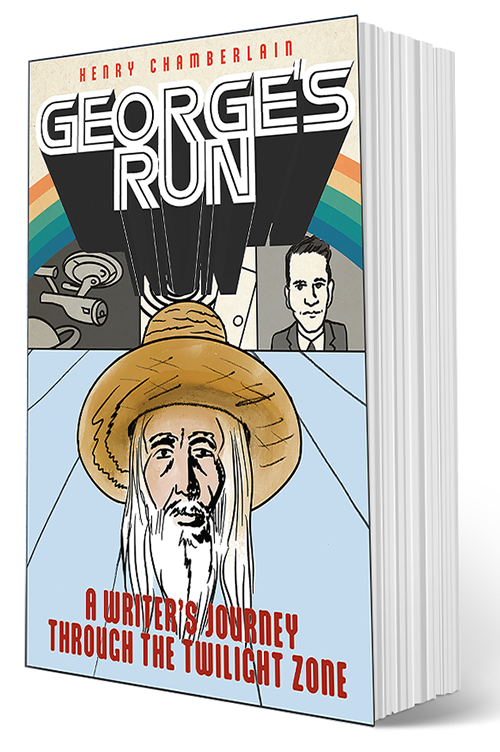
In my graphic novel, George’s Run, published by Rutgers University Press, I recount in various ways the golden age of television that gave us such gems as the original Twilight Zone and Star Trek. I don’t just give you a few examples of some beloved moments from these shows but provide context regarding the key players, primarily the writers but also the actors (particularly William Shatner and Leonard Nimoy) who helped to fuel and build the evolving creative sparks into so much more.

This doc sets Shatner loose to be himself, and, in doing so, provides a great service. In somewhat similar fashion, Leonard Nimoy got his chance to set the record straight in 2016’s For The Love of Spock, directed by his son, Adam Nimoy. If you happen to see both, you’ll get what amounts to one of the best tributes to both of these actors who, by their own grit and high level of integrity did much to secure the course and fate of the USS Enterprise.

5 Comments

Filed under Comics, Movie Reviews, Star Trek

Zack Quaintance’s Death of Comics Bookcase Kickstarter

A page from Death of Comics Bookcase.

Comics Bookcase was a blog, in a similar spirit to Comics Grinder, and then it left the scene. But now it’s back, at least, in the form of a comic book. I find it very inspiring and leads me to think that perhaps Comics Grinder needs its own comic book. Ah, but there is! More on that later. What’s important now is what Zack Quaintance is up to with his 48-page Death of Comics Bookcase comic book. It’s impressive. I can’t wait to check it out. But, first, we all can support the Kickstarter campaign, thru May 1st, and secure that this project becomes a reality. There’s a significant amount of overlap between what Zack does and what I do that I can’t help but sincerely wish Death of Comics Bookcase great success. For more details, an excerpt from the press release follows:

Continue reading

Leave a comment

Filed under Comics, Kickstarter

POWER KNIGHTS: BLADES OF LIBERTY #1 comics review

POWER KNIGHTS: BLADES OF LIBERTY #1. KID Comics. 2022. (Writer/Creator) Keithan Jones, (W) Noble Ward (Color) Salif Thompson. 28pp. $8 USD (Includes 11×17 Poster).

Imagine a precocious 10-year-old who pulls a Jack Kirby move and creates his own world of superheroes. And then life happens, time passes, and that kid is now an adult who has held onto that dream. That’s what this comic book is all about. In fact, Keithan Jones decided to carve out a little space for himself in the comics world and launch KID Comics, a place for comics packed with youthful energy and harkening back to the golden age spirit of comics meant for kids to enjoy.

Continue reading

1 Comment

Filed under Comics, Comics Reviews

CRASHDOWN (#1-2) comics review

Otherworldly indeed!

CRASHDOWN. Massive. 2024. (W) Tom Garcia, Ryan Sargeant (A/CA) Ben Templesmith. $3.99 USD.

This comic book owes much to the great Ben Templesmith, the series artist and cover artist, known for his work with IDW, Image, Oni Press, Dark Horse, and, well, I could go on: Star Wars, Doctor Who, GI Joe, Army of Darkness, Silent Hill, Buffy: The Vampire Slayer and much more (30 Days of Night!), so I’ve made my point. Then you add the writing from a couple of comic book experts, Tom Garcia and Ryan Sargeant, the hosts of the Comic Tom 101 YouTube Channel (over 12 million views) and, having checked out their show from time to time, that got my curiosity. The promotional material promises an apocalyptic tale with a healthy dose of Lovecraft and the right touches of Lost and Alien. I’m going all in here with a look at the first couple of issues to a mini-series that only goes up to four issues.

Continue reading

Leave a comment

Filed under Comics, Comics Reviews

GEORGE’S RUN, a graphic novel review by Paul Buhle

This is the book for any fan of comics, pop culture, and great stories!

George’s Run. by Henry Chamberlain. Rutgers University Press. 2023. 226 pp. $27.95.

Guest review by Paul Buhle

I leapt at the chance to write my foreword, what came to be called “A Historical Portal,” in Henry Chamberlain’s graphic novel, George’s Run. Now, with some time to reflect upon it, deeper and more personal observations come to me.

The Twilight Zone offered me proof positive—to this future editor/publisher of a little magazine dedicated to demonstrating the significance of popular culture—that a generation had been more than enriched by it. George Clayton Johnson, a writer for the show, as well as Star Trek, had a lot of insight to deliver, and Henry Chamberlain was the one to winnow it out and to illustrate it.

Astute critics of American cinema have often remarked that the Star Wars series of blockbuster movies, beginning in 1977, marked the return of films but also chunks of television shifting from serious social themes of the later 1950s to later 1970s, back to the Outer Space version of cowboys-and-Indians, with the “Indians” now aliens, some of them friendly (aka “on our side”) and others dangerously hostile. Many critics observed, after the 1999 Star Wars feature, The Phantom Menace, that “African Americanism,” aka Minstrelsy, had been transformed into amusing-looking aliens with humorous talk or behavior. The source of this gloomy transformation might be attributed to the world cinema market for action films or some other external cause, but it is hard to avoid the consequences for Hollywood-produced films as art or cultural/political statements. The social movements of the 1960s shook up Hollywood and created a socially critical audience whose favorite films came and went, in the following decade or so. M*A*S*H, their TV equivalent, was by the end of the century the most “re-run” of all shows and also held the most “peacenik” sentiments. It counted.

In this light, The Twilight Zone looms as a late, major statement of a different era. Rod Serling was a serious and important figure in US culture, a critic and artist who after trying various professions and skills, radio broadcaster to television writer, created the most important television drama in the era when television had a monopoly on media attention.

It was a moment when live television drama, vibrant and often socially critical despite the Blacklist and cultural cold war,  hard shortly before reached its peak with a half-dozen theatrical-style shows, just as it poised to rushed production from New York to Hollywood. The Twilight Zone could not have worked as live drama, but it had the dramatic quality of what had gone before. Even in melodrama and seemingly far-fetched plots, the acting was serious. The show was showing something and saying something, working urgently to open up minds. At the right place and time, George Clayton Johnson found himself and helped make television and pop culture history.

George’s collaboration with Rod Serling occupies a central place in George’s Run. But the meeting of George Clayton Johnson with Ray Bradbury offers us something from the comic that retains all its meaning, six decades later.  Bradbury (a museum bearing his name and artifacts, in my wife’s hometown of blue collar Waukegan, Illinois, opened last year) stands for a starkly different view of science fiction and its role in opening minds. His stories, adapted to EC Comics shortly before the massive wave of repression, offered readers a glimpse of the horrors ahead if the atomic/nuclear arms race were not halted but also a glimpse of aliens and civilizations that had something to teach the self-proud human race. Farenheit 451 along with a large handful of short stories  best realized the social criticism made by a raft of science fiction writers, including some others who knew George well.

Onward and upward.

That George went onto Star Trek is logical, as part of the trajectory of a fantasy writer’s life. But there is much more. The world of fan publications and fan events can be traced back to networks of amateur (unpaid, mostly unpublished) writers who traded their own mimeographed newsletters as early as the 1920s. Sci-Fi fans gathered here, virtually, and then in person by the  middle 1960s, trading publications directly, meeting and partying with authors as well as each other. “Trekkies,” a much-discussed phenomenon, led in time to comics events, later to Comic-Cons and all the regional events of today, sometimes grand but most often with self-publishers in the booths, chatting and selling copies to whoever the passers-by they could convince.

The subject of Star Trek itself remains, for many fans and scholars, important and bears symptoms of the richer mix of American popular culture emerging at the moment of its production. This brings us to the topic of the Other, a theme that endlessly drives discussion. Yes, Leonard Nimoy started in Yiddish theater; Spock is culturally Jewish without a doubt. And Uhuru is a staggeringly beautiful African American woman with all the sexualized implications, even if hardly acted out. And so on. But these, considered seriously, are minor notes. George Clayton Johnson’s scripts quietly urged viewers to ponder the fate of humanity within the cosmos, to get off the pedestal of human-centeredness and come to grips with terrestrial reality.

George’s Run bears all this meaning and so much more.  But there is one more, albeit indirect, connection too delicious for me to leave out. Rod Serling called upon the blacklisted screenwriter Michael Wilson—before being purged from Hollywood, he had scripted the 1951 Oscar-winning A Place in the Sun—to help develop a crucial subplot that most viewers have taken in subconsciously.  The humans are now allowed to speak. But when the human played by Rod Taylor asks to speak, the Chairman of the Tribunal interjects, “the exhibit is indeed a man, therefore it has no rights under ape law.” Those outside the definition of having the right to speak, cannot be allowed to speak, for fear that they will bring down the system.  It was a plot that could easily have been taken out of Berthold Brecht’s Life of Gallileo, including the responsibility of the scientist to speak up against the threats facing society.

Such weighty considerations would have been thought, only a few decades ago, as being properly far beyond the scope of anything resembling comic art. Now, at last, we know better. Henry Chamberlain has given us a gift in George’s Run. Let us use it well.

Paul Buhle

Leave a comment

Filed under Comics, George Clayton Johnson, Henry Chamberlain, Paul Buhle, The Twilight Zone

WE BELONG Now Crowdfunding on Zoop!

Cover by Jay Hero

In Comics Grinder news, there’s a lot of buzz and excitement over WE BELONG, a new comics anthology focusing on sci-fi and fantasy from a queer Black perspective. Press release follows:

Stacked Deck Press and Prism Comics are pleased to announce that the crowdfunding campaign for WE BELONG is now live on Zoop!

WE BELONG, is an all-Black, all-LGBTQ+ sci-fi and fantasy comics anthology featuring works from over 2 dozen black queer comics creators:

Aimee Campbell * Ajuan Mance * Asia Bey
C.A.P. Ward * E.B. Hutchins * Erika Hardison * Benny Hollman
Gaia WXYZ * Gerald Brandon Bell * Iggy “Eggs” Morris
Jay Hero * Jazmine Joyner and Sam Wade * Jezza Smiles
Joe Philips * Jordan Green * Mihael B. Peralta Myers
Nick Orr * Paul Kellam * Rupert Kinnard * Trevor Adams
Tulani Kiara * Valerie Complex * Victor Hodge
Viktor T. Kerney * William O. Tyler
Edited by Viktor T. Kerney and William O. Tyler

Sample from WE BELONG.

The lack of Black queer characters and stories inspired writer Viktor Kerney (StrangeLore, Prism Comics) to develop a collection of sci-fi and fantasy stories that center the queer Black perspective, all from queer Black creators. Co-editing this project with him is critic and comics creator William O. Tyler (Theater of Terror: Revenge of the Queers). Together they have assembled an array of incredible creators to share their stories, including Jay Hero, C.A.P. Ward, Ajuan Mance, Rupert Kinnard, and many more!

These stories showcase the fact that, despite what the landscape of popular fiction says, Black queer people have existed and do exist everywhere, in every time and space. Whether we’re fighting monsters or becoming superheroes, we belong. From intergalactic adventures to interdimensional exploration, we belong. As wizards, as mermaids, as witches, fully as ourselves, we belong.

BACK THIS AMAZING PROJECT HERE: https://zoop.gg/c/webelong

Sample from WE BELONG.

WE BELONG is a comics anthology composed of 100+ pages of sci-fi and fantasy stories that center the queer Black perspective, all from queer Black creatives. A campaign on Zoop is running through

The lack of Black queer characters and stories inspired writer Viktor Kerney (StrangeLore) to develop a collection of these phenomenal tales. Co-editing alongside critic and comics creator William O. Tyler (Theater of Terror: Revenge of the Queers), they have assembled an array of incredible creators to share their stories, including Jay Hero, C.A.P. Ward, Ajuan Mance and many more!

These stories showcase the fact that, despite what the landscape of popular fiction says, Black queer people have and do exist everywhere, in every time and space. Whether we’re fighting monsters or becoming superheroes, we belong. From intergalactic adventures to interdimensional exploration, we belong. As wizards, as mermaids, as witches, fully as ourselves, we belong.

This joint venture between award-winning comics publisher Stacked Deck Press and Prism Comics, a nonprofit promoting LGBTQIA+ comics, comics creators, and fandom, is a moment not to be missed.

Go to Zoop for more info and support the campaign!

1 Comment

Filed under Comics, Comics News, LGBTQ+