Tag Archives: Rod Serling

George Clayton Johnson, A Remembrance

George Clayton Johnson

George Clayton Johnson

One of George’s favorite themes as a writer was that of cheating death. News outlets have already reported on his death but he is still among us, the living. This is an irony that I must think is appreciated by George. His legion of fans have entered a process of mourning. His spirit, I must think, is pleased, restful, and joyful. Some fans believe he will hang on with us until Christmas.

George Clayton Johnson is in hospice and nearing the end. Of course, he will always live on. His impressive writing career began when he thought up the ultimate heist story. That was to be the Rat Pack classic, Ocean’s Eleven.

George Clayton Johnson has led a full life as a writer, activist, and all-around humanitarian. He will always be an important part of some key pop culture: Ocean’s Eleven, The Twilight Zone, Star Trek, and Logan’s Run. It’s pretty phenomenal when you stop and think about it. And such a decent man. Such a very decent man.

George came from humble origins, poverty-stricken Cheyenne, Wyoming during the Great Depression. He followed his heart, became great friends with legends and, in the process of living, loving, and creating, became a legend himself. This man did not seek out notoriety in some contrived manner. George had the great fortune of possessing just the right combination of talent, determination, and luck. As for luck, he gravitated toward other great talent. As for talent, he’d always had that. He loved to read since he could remember and writing came naturally to him. And, as for determination, that’s just second-nature to a man like George.

This is the man who co-wrote the novel that led to Ocean’s Eleven. He then went on to write iconic episodes of The Twilight Zone. He wrote the first aired episode of Star Trek. And, in a great capping off to a career, co-wrote the novel that led to the cult-classic Logan’s Run. But there’s much more to it than that. On a deeper level, it was always about maintaining one’s integrity and fighting to create something original in a world that demands the tried and true.

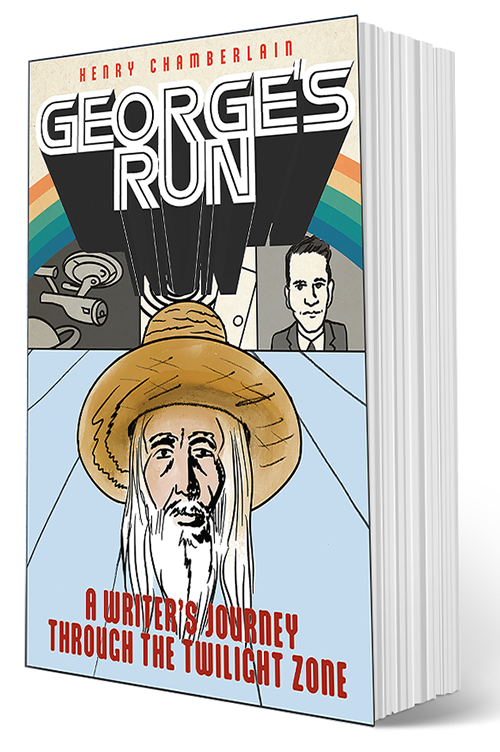
I had the opportunity to interview George for a couple of podcast interviews and got to chat a bit over the phone with him. During the course of one of our conversations, I suggested to him that his life and times would add up to an interesting book. I began work on it. We got to meet in person at his home in Los Angeles in December of 2014. For the next year, I began work on a book in a graphic novel format. It was through knowing George that I opened myself up more to my own love of writing. It was George who helped me rediscover Theodore Sturgeon. And it was George, because of his spirited way, that I opened myself up more to the world in general.

We had planned to meet again this year like before, in December of 2015, but, by then, it was too late. George was already in hospice care and, in the time that followed, it became clear that his time left was short. I had hoped to show him what I’d created thus far. But, I immediately understood, a significant page had turned. The time for asking questions or seeking advice had passed. I understood that I was alone to proceed. George had passed on the baton, just like he did for so many others like me.

The truth is that George will always be around.

8 Comments

Filed under George Clayton Johnson, Logan's Run, Ocean's 11, pop culture, Rod Serling, Star Trek, The Twilight Zone

Review: ‘Reading Richard Matheson: A Critical Survey’

"I Am Legend" by Richard Matheson

“I Am Legend” by Richard Matheson. Illustration by Henry Chamberlain.

The work of Richard Matheson (1926-2013) is certainly suitable for in-depth analysis. It is through an academic lens that you can plumb such insights as the one about the recurring nemesis in Matheson’s groundbreaking novel, “I Am Legend.” As Charles Hoge describes, in this first survey of its kind, the neighbor-turned-vampire who repeatedly taunts the protagonist is part of a literary tradition dating back hundreds of years. Instead of being hidden away in Bavarian castles, vampires were known to call out their victims from their own village. It is a simple distinction like that which Matheson runs with to create one of the most influential books in pop culture.

It was this seismic shift from monsters in castles to monsters in the suburbs that would change everything and influence everyone from George Romero to Stephen King. Yes, you can thank Richard Matheson for the zombie apocalypse. He essentially invented it with his 1954 horror novel, “I Am Legend.” Well, there’s more to it. And you can dig deeper in this first ever substantial study, “Reading Richard Matheson: A Critical Survey,” edited by Cheyenne Mathews and Janet V. Haedicke, published by Rowman & Littlefield.

The original “I Am Legend” novel is an elegant and tightly written work. Our protagonist, Robert Neville, must figure out, with Sherlockian exactitude, what has brought about a world-wide pandemic of vampires. It is a prime example of work from the first phase of Matheson’s career. The theme here is man as victim of his own environment. By the time of Matheson’s work on the landmark television series, The Twilight Zone, his theme has broadened to man as victim of his own making. Within these two themes, a multitude of work can be examined. It is with this survey that we receive an essential collection of serious thought on a writer who Stephen King has ranked with Poe and Lovecraft.

In a piece that focuses on the noir character of The Twilight Zone, Cheyenne Mathews demonstrates both Matheson’s artistry and how well The Twilight Zone holds up to critical scrutiny. Cheyenne writes: “Through science fiction tropes of time travel, alternate realities, and new technologies, Matheson emphasizes the physical and social displacement that afflicted both men and women during the attempted postwar return to normality.” And, in describing what is considered the most noir Twilight Zone episode, “Night Call,” Mathews writes: “The second act of the episode conflates Elva’s personal anxieties with her social alienation, as she becomes increasingly disconnected from the other characters, who attempt to downplay her distress.” Of course, there is Matheson’s most celebrated TZ episode, “Nightmare at 20,000 Feet,” but, as Mathews makes clear, it is part of a bigger picture. Outside of Rod Serling, who wrote the majority of scripts, Matheson wrote the most episodes and they were all gems.

A man of his time, and ahead of his time, Richard Matheson has secured a place for himself within not only great science fiction, horror, and fantasy, but great fiction in general. Ultimately, Matheson’s work strikes a universal chord. We can explore the specific era he worked in and how he spoke to concerns of postwar paranoia and shifting gender roles; and, like Kafka, we can place him within some of the most eloquent writers on the human condition. Matheson was weary of being labeled a genre writer. Perhaps one of his fellow writers and friends, George Clayton Johnson, summed it up best when he said of Matheson that he was one of the “serious storytellers whose works were artful gems of wisdom fiction.”

“Reading Richard Matheson: A Critical Survey” is essential reading for anyone interested in understanding the origins of today’s pop culture at a deeper level and gaining a greater appreciation of the work of Richard Matheson.

Richard-Matheson-Twilight-Zone

“Reading Richard Matheson: A Critical Survey” is a 262-page hardcover published by Rowman & Littlefield.

8 Comments

Filed under fantasy, George Clayton Johnson, Horror, Richard Matheson, Rowman & Littlefield, Sci-Fi, science fiction, The Twilight Zone

Interview: Jason V Brock and the World of Fantasy and Science Fiction

Jason V. Brock

Jason V Brock

Jason V Brock is an author, artist, and filmmaker who finds himself in a very interesting place in pop culture. For starters, he has created two well-regarded documentaries that focus on two very different men, both great contributors to science fiction, horror, movies, television, and the arts in general. One is Charles Beaumont. The other is Forrest J Ackerman. We chat about them and the creative process. How do you create art? One rule of thumb: Do it yourself! We begin with a look back at Brock’s childhood and how he, a child of the ’80s, grew up with the DIY ethos. In Charlotte, North Carolina. That’s where Brock cut his teeth on comics, retro cinema, vintage LPs, pulp fiction, and Playboy. Brock began working at his local comic book shop at the age of 13. His dad was a writer and graphic designer. It sounds like an idyllic way to grow up, right out of a Ray Bradbury story.

Charles Beaumont and Robin Hughes on the set of “The Howling Man”

Charles Beaumont and Robin Hughes on the set of “The Howling Man”

Speaking of stories,there are so many stories to cover just in Brock’s documentary on Beaumont. Take the case of the short story, “The Crooked Man,” by Charles Beaumont. It is a classic today that was highly controversial for the time, circa 1955. It imagined a society where homosexuality was predominant while hetrosexuality was outlawed. The story was bought by Esquire but subsequently was not published. It turned out to also be too hot for the pages of The Magazine of Fantasy & Science Fiction. But when Playboy published it in 1955, then that same story became okay, more than okay. Charles Beaumont sold his first science fiction story, “The Devil You Say,” to Amazing Stories in 1950. By 1954, he had written the first work of fiction, the landmark work, “Dark Country,” to appear in Playboy in 1954. This kicked off over a decade of Beaumont stories in Playboy. Writing for movies and televison soon followed including some of the best episodes of “The Twilight Zone.” All this, and so much more, before his life was cut short at 38 by a mysterious illness.

And, that gives you some sense of what to expect in Brock’s “Charles Beaumont: Short Life of Twilight Zone’s Magic Man.” You can find that documentary as well as Brock’s documentary on Famous Monsters of Filmland’s former editor, Forrest J Ackerman (Uncle Forry), “The AckerMonster Chronicles!” right here.

We also chat about Brock’s work in editing and writing his own stories. This led us to discussing a unique pairing of talents. In the course of working on the Beaumont documentary, Brock got to know one of the members of the Southern California Writer’s Group, William F. Nolan. They struck up a solid friendship. When Nolan was at a turning point on where he wanted to live next, it was a reasonable choice for him to move a bit further north from Bend, Oregon to Brock’s neighborhood in Vancouver, Washington. It turned out to be a natural fit and Brock and his wife, Sunni, could not be happier to share meals but not only that. Bill Nolan became family and you look out for family.

A-Darke-Phantastique

Among Brock’s impressive editorial work, there’s the recent anthology, from 2014, “A Darke Phantastique.” This is a 730-page lushly illustrated collection of some of the best dark horror fiction around with more than fifty stories, poems, and one teleplay. This includes Joe R. Lansdale’s “The Case of the Four-Acre Haunt”; Paul Kane’s “Michael the Monster”; William F. Nolan’s “The Last Witch”; Nathaniel Lee’s “The Wisest Stone and the Zoo”; Derek Künsken’s “The Buddha Circus”; E.E. King’s “Three Fables”; Jason Maurer’s “In Your Dark: Differing Strategies in Subhuman Integration Through Monster Academies” and S.T. Joshi’s “You’ll Reach There in Time.” “A Darke Phantastique” is published by Cicatrix Press and you can find it here.

Disorders-of-Magnitude-Jason-V-Brock

And another recent anthology, out this year, is “Disorders of Magnitude.” This is a 336-page overview of the genres of horror, science fiction, and the supernatural. It will prove useful to anyone who wants a better understanding of the roots of one of today’s dominant forms of entertainment and art. Included in this collection are essays, reviews, and interviews. Brock studies such dynamic figures as H. P. Lovecraft, Forrest J Ackerman, Harlan Ellison, Ray Bradbury, Charles Beaumont, Richard Matheson, Rod Serling, and William F. Nolan. This collection also includes filmmakers Roger Corman, George Romero, and Dan O’Bannon, and such fantasy artists as H. R. Giger. “Disorders of Magnitude” is published by Rowman & Littlefield Publishers. You can find it as Amazon right here.

You can listen to our conversation by clicking the link below. For anyone interested in writing, filmmaking, and creativity in general, there’s something here for you. Enjoy.

And be sure to visit Jason and Sunni Brock at JaSunni Productions to find out more about their products and services right here.

3 Comments

Filed under Charles Beaumont, Documentaries, Forrest J Ackerman, George Clayton Johnson, Interviews, Jason V. Brock, Rod Serling, Sci-Fi, science fiction, The Twilight Zone, William F. Nolan