Monthly Archives: July 2025

Introverts Illustrated by Scott Finch book review and creator interview

Introverts Illustrated. Scott Finch. Sold in Bundles of 5 ($25) at Partners & Son.

I turn to ambient music when I need an added kick of focus. Usually, it’s when I’m writing. I would never have a show or a podcast on in the background. No, I need something stripped down that will allow me to actually think when I’m writing or reading. Complete silence is quite nice too. Ambient music can be ideal at times. That’s what I did for this most unusual work by the artist Scott Finch. It helped in just the way it was intended to do: a means to push back all the added noise and clutter in life. Finch’s new work, Introverts Illustrated, is a collection of 21 mini-comics, meant to be accepted as a whole and, most likely, read in one sitting . . . or as many as you feel like, no pressure.

INTROVERTS ILLUSTRATED!

That’s the way it worked for me: to have the whole collection by my side and just dive in. I wouldn’t say it’s like reading through 21 issues of King Cat or even Superman. The experience is something different and, in its own way, a bit groundbreaking. I mean, you don’t usually see a creator presenting a whole series of individual works all at once. The tried and true method is to parcel them out one by one, just like the big mainstream comic book companies. Reading this work, in sections, I believe adds to its mystique, a work already in a full embrace with the sort of ambiguity you traditionally find in poetry and painting. In other words, take this more as a high art piece and less as anything resembling a traditional comic, indie or otherwise.

Diving into the work.

Scott Finch is a pure artist: someone who loves to experiment; who will create work just to see what happens; who will treat a project as something sacred that may end up never to be viewed by anyone else. That kind of commitment is what gives you something like Introverts Illustrated. Now, there’s a lot of things that can be said about this work and one of the most important is to just enjoy it and reach your own conclusions. There are a number of so-called gatekeepers and experts with their own theories as to what this project is about or isn’t about. I sincerely hope that I don’t fall into that group–or maybe I do–but I do my best to be self-aware. Anyway, I sense that what excites those of us deep in the comics cognoscenti is the sense that this is indeed one of those unicorns we keep hoping for: a work that you can really claim to be something different. Once a work of that sort is spotted, it’s like throwing chum into the waters where sharks await. Within seconds, the water spreads out a bloody spew of pontificating. Lucky for me, and you, I have taken the time to get to know the work and the artist. After this review, we proceed with an interview with Scott Finch.

Dig in!

One key concept, in all honesty, is ambiguity. Scott freely admits that he followed his muse and did it his way. His first priority wasn’t clarity. In fact, during our chat, I point out one fragment of text that is every bit as enigmatic as the art it accompanies. Now, that can be beautiful–and it is. But, like I’ve already stated, don’t expect this to be a typical work–but, oddly enough, don’t expect it to be cryptic either! It’s more like a series of dreams and, I believe you’ll agree, dreams do follow their own logic and often can be very lucid and highly accessible.

Issues of Introverts Illustrated.

Another key concept, to be sure, is the creative process. At its core, the backbone to this project, is automatic drawing. That’s where Finch started: one drawing after another, without thinking too much, just drawing. That’s the beginning of the process. Where you go from there is the next level of engagement. It can involve making numerous copies of various elements and arranging them, see what you get. Cut here. Paste there. Trace this. Redraw that. Things emerge, unexpected things.

Finally, I would add one more important concept: structure. You begin with the raw and make your way to the cooked. At some point, you add text, all the while staying true to what you’ve done before and letting it guide you. Getting back to dreams, there are a lot of paths following various dreams to be found here, all engaging, and delightful. If I had to be pinned down as to what is going on in this free-spirited tableaux, I would say this is a series of meditations on the human condition, especially the human who aspires to something different, to something artful, to something like this most unusual work.

When we talk about such matters as comics being an art form, something that’s been well established over the years, it can still be elusive to pin down. Sometimes, it’s found within more commercial work. And, sometimes, it is not found within indie comics. Within the rough and tumble world of any given comic arts festival, the reality is that it is as much a marketplace as a more obviously corporate-heavy major comics convention and it can be a challenging arena, even for unicorns. I sense that Finch is modest about the whole thing and will find his way. As an artist, first, he is more interested in some good old-fashioned artistic problem-solving and that will serve him well. Perhaps he’ll find the most success within a gallery space or whatever other venues and platforms may arise in the future. Finch will most likely follow the words in his own work regarding his career: “I make space for it. I do not seize it.”

“I make space for it. I do not seize it.”

Alright, we’ll end the review there. I encourage you to check out my conversation with the artist. During our talk, Scott not only explains what’s going on in this project but really opens up about his process which will undoubtedly resonate if you folks, whatever kind of creative work you happen to do.

1 Comment

Filed under Art, Comics

The Spawn of Venus and Other Stories Illustrated by Wallace Wood book review

The Spawn of Venus and Other Stories Illustrated by Wallace Wood. Seattle: Fantagraphics, 2025, 216pp. $39.99.

Review by Paul Buhle

The Great Bohemian of comic books’ grandest moments, Wallace (aka “Wally”) Wood drew like a genius for a number of publishers before falling to overwork, too many cigarettes and too much liquor. EC loved him the best, and it was a mutual feeling, notwithstanding the inevitable tensions of artist, collective/collaborative work process, and the reality of a boss.

Wally Wood in his prime, excerpt from “My World,” Weird Science #22, 1953.

This splendid volume collects some of his finest Sci-Fi—he was also among the greatest satirical artists for Mad Comics—from forgotten series titles like Weird Science, Weird Fantasy and Incredible Science Fiction of the early 1950s. It also offers much woderful contextual material, commentary by serious scholars—university professors but mostly otherwise—to individual stories and collaborations, from editors to scriptwriters to presumably lowly inkers.

Most “classics” comic art volumes these days contain a hat-tipping of industry insiders. Same here. Howard Chaykin, vaunted comic artist (and a short time assistant to  Wood)  does not have a lot to say beyond describing Wood’s talent, nor does the appropriately admiring Larry Hama, of today’s GI Joe, itself a remnant of another and in this case, less pleasant, aka Cold War, comics era. S.S. Ringenberg, a comic scriptwriter, and fan-interviewer works harder with a biographical introductory sketch that goes little beyond ground familiar to Woods devotees, but reminds us sharply of the nature of the self-destructive genius. Wood put a gun to his head in 1981, leaving no note. The career disappointments were real, especially for an artist who worked hard at improving his style. But by that time, two divorces and a separation, he became too exhausted to keep himself in check. Besides, the glory years of the older comic art had been long past, and he was not suited to the new comix generation. His barely controlled artistic id did not find a home in the ill-paying Undergrounds.

Meanwhile, in the substantial Introduction,Tommy Burns and Jon Gothold go through the stories one by one, in such detail that no biographer of a novelist may ever have done better. Do we need such detail? Perhaps not every reader will think so, but among the plot summaries, these scholarly-minded critics offer so many small insights that the net result is remarkable, and demands several readings for details.

Wood reached his apex, arguably, in adapting the stories of Ray Bradbury, and this tells us much of what need to know about the vital and lasting importance of Wood’s work. This reviewer came upon Bradbury’s writings around age 10 or 11, in the Republican political/cultural climate of Central Illinois where the perceptions of sophisticated New Yorkers, for instance, would have been unusual and likely mistrusted. Mad Comics explained McCarthyism in the most penetrating and hilarious fashion. Bradbury, who was personally close to the Hollywood Blacklisted, found ways in his stories and novels to explore the takeover of public space, the waning of the New Deal stress for reform in favor of forced patriotism, but also unapologetic commercialization of daily life. He saw the future and it looked bad.

Thus, famously,  Fahrenfeit 451 and The Martian Chronicles, made into feature films but only after the worst of McCarthyism had faded. Bradbury had been trying for years to send out warnings, even while he was making a living and a reputation (including a personal move to Hollywood)  in a Sci-Fi field with leftist underpinnings going back to the 1930s. He also badly wanted to escape being pegged as a “genre writer,” but never made it and did not need to: we loved him anyway.

Photo funnies tribute in The Spawn of Venus and Other Stories.

Wally Wood so internalized the logic of Bradbury that stories composed by others at EC somehow have the “Bradbury Touch” in addition to the EC Touch, which consists—leaving aside the art— in terse scripting and a surprise ending. Like the alien civilization in “He Walked Among Us,” where the Savior was actually an Earthman who preaches love and forgiveness is executed. Two thousand years (!) later, another Earth visitor learns that the aliens’ holy symbol is the rack, aka cross, where the presumed savior was tortured to death.*

You get the idea. Human folly in the Atomic Age has become toxic. Wood could have predicted what a willful destroyer like Musk would write about opening up the need for “planetary” civilizations when Earth has been plundered beyond repair.

Not that all the stories are like this. And Bradbury could not have featured the scantily-clad beauties, alongside the virile young males, that seemed to be a specialty for Wood. Earthmen fall in love with alien females who assume a delicious human form only… to revert back, inspiring horror. Humans landing on a distant planet learn that the babies born to them, urgently wanting love and care, may have a dozen arms and look like octopi or something else weird (in this case, mommy does not care, which sounds right).

How were Wood’s females all so young and buxom, you might ask? The mostly male and young readers of these comics didn’t likely ask at all. The happy dreamers of another story are space explorers kidnapped to service the all-female population of a planet whose males have died out after a war. The “scientifically selected” dames look awfully familiar.

Wood could also favor social criticism–with a dark turn. In one story here, tens of thousands of Earth people who disappear in bunches, every few hundred years, turn out to be farm edibles, as a scientist explains over…a turkey dinner. Actually, this was an EC Sci-Fi trope several times over, like the aliens in another EC comic who capture interplanetary humans to use their skins for…fashionable minkish coats, and so on. Why do we egotistical Homo sapiens think we can abuse the animal kingdom?

From “Spawn of Venus”

Wood also loved the occasional in-joke, with a drawing of himself in the final panel. Here, EC Comics miraculously predict unexpected events, like the appearance of flying saucers, or the rise of surgical sex change (think “Christine” Jorgenson in tabloid headlines of the time). A jowly comics publisher (could it be plump William Gaines, who inherited EC when his father died in a boating accident?) wants them to take “a loyalty oath” (cue to Joe McCarthy). After some alien hi-jinks, the real Wally confesses that he and his fellow artists are actually disguised Venusians saving the world from horrible-looking Martians!!! What those helpful Venusians might look like beneath their disguise…we will never know.

In the real world, EC’s marvelous Sci-Fi, “Real War” and humor series (MAD and PANIC) never reached the sales level of its various, blood-dripping but also deeply satirical horror comics, also full of plot reversals and revenge-justice. Gaines was called upon, in the famous Congressional hearings (held in the same Manhattan courtroom as “Red” hearings a few years earlier), to explain the horror as something less than dangerous to young minds. The inquisitors weren’t listening to his answers, and the guillotine blade fell on a glorious moment in popular art.

Wally Wood outlived his time, this is the tragedy of his life and not only his. Harvey Kurtzman and his trusted artists hit their peak as satirists, also arguably as editors and artists, in their twenties and early thirties. Some became highly successful illustrators. None could recapture the magic.

Paul Buhle

*Let it be known that the Ray Bradbury Museum rests in the blue collar city of Waukegan, Ilinois, which only happens to be my wife’s hometown.

Leave a comment

Filed under Book Reviews, Comics

Steve Benson (1954 – 2025)

“People are testy and uncomfortable, and they really don’t know where the country’s going. That’s why cartoonists are here.” That quote is by political cartoonist Steve Benson regarding Trump 1.0 back in 2017. Sounds very relevant for today, as does the above editorial cartoon, also circa 2017.

Steve Benson (1954 – 2025) was one of the greats with a career spanning over 40 years. Benson won the Pulitzer Prize for Editorial Cartooning in The Arizona Republic in 1993. Benson grew up in the generation influenced by giants in the industry, Jeff MacNelly and Pat Oliphant, the caliber of cartoonists that even the most casual observer took notice of. As happens with the best, Benson found his own take on things and the rest is history.

Steve Benson is not a name I was particularly acquainted with. Sadly, a good chunk of Benson’s career oversaw the steady decline of newspapers and the overall splintering of media into a thousand pieces. That said, his work was powerful and speaks to the need for more of it, not less. Political cartoons are a perfect vehicle to speak truth to power. We still have any number of cartoonists who aspire to at least try to make as strong a mark as Benson on this or that online platform. We need them to continue their good work since nefarious politicians aren’t slowing down any time soon if ever.

2 Comments

Filed under Comics, Obituaries, Political Cartoons

The Horrors of Being a Human: A Cola Pop Creemees comics review and creator interview

The Horrors of Being a Human: A Cola Pop Creemees Comic. Desmond Reed. Microcosm Publishing. 2025. 270pp. $19.99.

Desmond Reed is a rising talent in the world of comics. His latest book makes that clear. Years of dedication to the making of comics has resulted in his design being sharper, his insight being keener and, heck, the guy knows how to put on a good show. It is that focus on storytelling, as well as development of character, that leads us to such a smooth and pleasing comics experience. As Reed explains, he has five characters, the Cola Pop Creemees, who, among other things, represent different emotions and different aspects of himself, or yourself. I can see that this comic is very relatable, in the spirit of such groundbreaking work as BoJack Horseman. Let me just say from the get-go, the Cola Pop Creemees are very different and original, and if you see them turned into an animated series someday, well, you heard about it here first.

Cartoonist and Publishers.

The world of cartoons and comics has always dealt with far more than might meet the eye, depending upon where you venture off to. In the world of Desmond Reed, you enter a kaleidoscopic world of the real and surreal. For instance, our heroes live in a house in the shape of a hand. There is plenty to be anxious about in the real world, and this comic manages to tackle many of these issues within its quirky borders.

Cartoonist and Comics Festivals.

Desmond Reed has set the stage and, from there, he can modulate the tone. Stories vary in length with some far-out zany and others more contemplative. Reed’s most serious and ambitious work to date is one of his longer stories, “Memories,” winner of a 2022 MICE Mini-Grant. Here, he focuses on his most madcap character, Wallace T.J. by allowing for a careful look back at his development and the darker side to his life.

“Memories”

Life is quite a journey with plenty of bumps in the road and that’s where a daring artist like Desmond Reed steps in to create art to defy even the most challenging of times. Believe me, there’s always room for another valiant artist to lead the way, especially one as gifted as Reed. It all comes down to the reader getting a chance to know the work–and so I encourage you to seek out this highly inventive work and let it speak for itself. I can tell you that Reed has a magic touch, with his pared-down whimsical style, when it comes to addressing some very serious issues like addiction and depression.

The Cola Pop Creemees live inside a hand.

Desmond Reed is not afraid to go down to depths of despair and come back up with a tear and a smile. It is a combination of a pared-down style and a direct straightforward narrative. Think of it as a friend who sets you down and needs to tell you something. Maybe there will be some humor thrown in that both of you share. But then you get to the story, without pretense, and you just get it. That is what is happening here. Reed has constructed characters that you can tap into in the very best spirit of comics. You can say that the lodestar guiding us cartoonists in such matters is Peanuts, and, I dare say, there’s some of that Peanuts DNA in the Cola Pop Creemees gang.

Some much said within a special world.

What irony there is to be found here is subverted by a persistent vision of perseverance. That is not an easy thing to achieve and it has everything to do with Reed following his own instincts and staying true to his authentic self. That’s where you get original work and not some trendy “next big thing” that is aping some previous “next big thing.” Yes, it is possible for comics to be funny, sincere and have some redeeming quality that will speak directly to you.

It was a lot of fun to get to chat with Desmond about his new book and sharing thoughts about the cartoonist life. I hope you feel the same. So, please do check out the above conversation on the Comics Grinder YouTube channel and please view, LIKE and COMMENT directly on the channel. Every bit of input and engagement helps us continue.

Keep up Desmond Reed here. And be sure to visit Microcosom Publishing here.

Leave a comment

Filed under Comics, Comics Reviews, Interviews

Superman, Apple Pie and MAGA

It’s been a minute since we had a full-on Superman major motion picture with all the trimmings. And this new installment shows with each charming but self-conscious step. It’s like a very expensive and fragile antique has been brought down from wherever it usually hides and one hopes it survives the special occasion that summoned it from its crypt. Superman is like that. Also like the James Bond franchise. Just as you’re getting used to one Bond, they bring in a new model. What was wrong with Henry Cavill? He seems to have a lot of mileage ahead of him. Well, he’s 42. The new guy, David Corenswet, is ten years younger. But there’s no getting around the fact that the actual character goes back to 1938. And, some will argue, Christopher Reeve, in the role of Superman, along with Margot Kidder as Lois Lane, in 1978, will always be the gold standard. In fact, Corenswet seems to be channeling Reeve in a pretty big way. The same with the new Lois, played by 34-year-old Rachel Brosnahan. There’s no doubt that the producers were looking for a certain je ne sais quoi and Brosnahan has that world-weary Kidder vibe down. The script doesn’t bother with formalities with these two and has them all over each other back at Lois’s apartment within a few minutes after the first big action scene. They are so used to each other after dating a couple of months that they let loose with a mildly tense quarrel. It was something else. It made a baby cry in the movie theater I was at.

Now, some talking heads have made a big deal about Superman updating for the age of MAGA. And I think the producers tried to split things down the middle. They gave Clark Kent a new set of parents cut from a MAGA trope: more of a laid-back Southern flavor as opposed to a prim and uptight Midwestern reserve that was the original recipe. Clark was raised in Smallville, Kansas after all, not West Virginia. Anyway, that part is done with kindness. The other part could be hard for some hardcore Trump fans to swallow and that’s stuff like Superman duking it out with Lex Luthor with Superman saying things like, “Yeah, I’m an alien and I’m proud of it. I’m a real person.” and Luthor saying, “I don’t care. The government has given me permission to do whatever I want with you!” Your mileage will vary. You can’t avoid a little sprinkle of politics when you’re dealing with such a colossal cultural figure as Superman. Director James Gunn referred to Superman as an embattled immigrant and that alone has created a bit of a firestorm. Every era has its own Superman and so it goes.

But getting back to the whole idea of a major Superman movie. It does feel like the good china and silverware is being brought out. My harshest view would be that the whole thing feels as if its been embalmed in formaldehyde, lost somewhere in the mist of the 1930s up to the 1970s. Maybe that’s a good thing, the fact that this sort of thing is still being done. It’s a very expensive experiment in entertainment but I can only imagine no one is going to lose their shirt over this. It’s going to appeal to a lot of people but that just goes with the brand. It’s too tempting for too many people. And I think it’s mostly going to be older people too even though efforts are made to make these characters seem youthful. One clue to the tilt toward older viewers, I think, is how Lois and Clark are supposed to be such huge fans of punk music. The way they carry on about their devotion to the punk ethos makes them sound more like people twenty or so years older than themselves. And that makes sense given that 58-year-old James Gunn is the movie’s writer and director. But good for him! I think the love for a beloved subject carries over into one’s life in more ways than one. I’m good with that.

Leave a comment

Filed under Comics, Movie Reviews, Superman

Cartoon Art Museum in San Francisco: George’s Run author Henry Chamberlain 08/24/2025

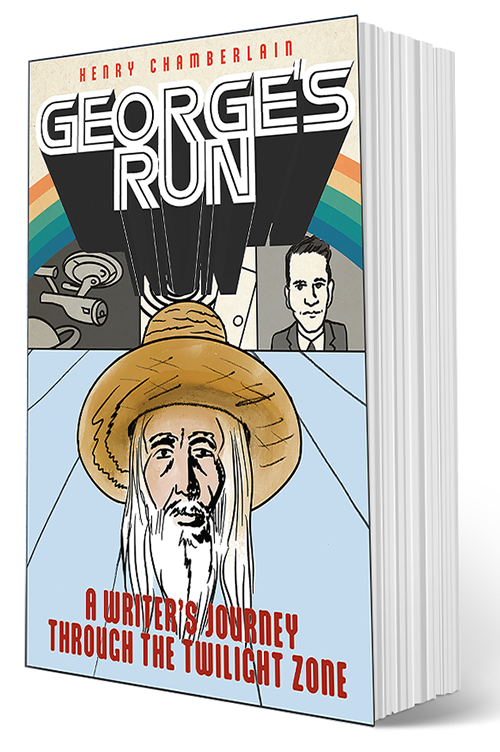
I have an event coming up at San Francisco’s Cartoon Art Museum, 781 Beach Street, on Sunday, August 24th, 2-4pm to talk about my graphic narrative, George’s Run: A Writer’s Journey Through The Twilight Zone, published by Rutgers University Press. It would be so great to have you there if possible.

If you are a science fiction fan, or love various forms of related genres, this is for you. Science fiction acts as a convenient umbrella but, if I was asked to dig deeper in my description, it would be Dark Fantasy. My book is about a group of writers who, individually and in their combined efforts, basically invented a lot of the pop culture we take for granted today. Specifically, I’m talking about the writers behind the original Twilight Zone and Star Trek.

We’ll have a slide show lecture format where I’ll share as much as I can about how I went about creating my book. George Clayton Johnson is our guide, one of the last writers from that 1950s-70s era of golden age television writing. I got to know George pretty well and our friendship led to my book. We’ll have plenty of time for a Q&A as well as overall discussion. I’ll take my cue from the audience. I’m happy to do demonstrations of my art style and chat about making comics too. Feel free to draw or write along the way, and we can share results after we’ve had time to discuss. Hey, this is as open-ended as you like. We might even have some snacks. Seriously, comment here or get a hold of me via email and I’ll consider any ideas.

One step at a time. First, let’s plan on meeting up at the Cartoon Art Museum on August 24th.

Leave a comment

Filed under Comics, George Clayton Johnson, Henry Chamberlain

TERMINAL EXPOSURE book review

Michael McMillan, Terminal Exposure: Comics, Sculpture, and Risky Behavior. New York: New York Review Comics, 2025. 231pp, $39.95.

Review by Paul Buhle

ONTEMPORARY CRITICS’ RECOGNITON of “Outsider Art” can be said to have come early to its precursor, Underground Comix of the late 1960s and 1970s.  “Recognition,” that is, in the best way:  publication—albeit with a real if fleeting audience—far from any recognized, official art scene. Thus artist/nonartist Michael McMillan. A leftover from those days and now past 90, he fairly inhabits this book of his past drawings and sculptures, with a standout introduction by Crumb biographer Dan Nadel and supportive blurbs from the likes of Gary Panter and Bill Griffith.

Nadel takes less than four pages to give us the heart of the McMillan saga, among the more unusual in the always-unusual “comix” world. Son of a railroad office worker and an art teacher, the young artist grew up mostly in Fresno, home of an agricultural empire with the Sierra Nevada nearby. An insular kid drawn to fantasy popular culture, building model airplanes and railroads, also a high school newspaper cartoonist interested in abstract art, he attended the USC School of Architecture just before he found himself drafted into the peacetime Army.

Trying to avoid “predictable boredom.”

Moving to San Francisco after his two-year hitch, McMillan landed, in the late 1950s, in US version of Bohemia. Over the next decade, he worked at various jobs, took art and sculpture classes at San Francisco State and felt himself inspired or confirmed in his inclinations by a 1969 exhibit of the Hairy Who. Would-be successors to Surrealism but conspicuously without the label, the group of Chicago artists lasted only 1966-69, with a couple of group showings in Chicago and one (the one that McMillan saw) in San Francisco. Drawing heavily upon vernacular street visuals, sharing the psychedelic colors, anti-racism and anti-war politics of the contemporary scene, they offered ambiguous but transgressive symbols of a radically shifting public culture. Most of all, arguably, they challenged the contemporary New York art scene. Thereby, they moved close to the sensibilities of the emerging Underground Comics, but from another direction.

McMillan actively sought out comix publisher Don Donahue, living nearby in the city’s Mission District, and arranged publication of a one-shot comic of his own, the instantly obscure Terminal Comix. Recognized and greatly admired among these artists a half generation younger than himself, he remained nevertheless an outsider.

Oddly, the public history of the artist almost ends here, in the 1970s. A handful of comix (after 1980, restyled  “alternative comics”) anthologies, including Robert Crumb’s Weirdo magazine, took him up, usually for one-shot contributions. He earned a  quiet reputation among the artist-editors as someone drawing upon multiple vernacular visual sources, breaking down the barriers between experimental art and comic styles. He made no effort at further outreach, giving himself over to the quiet life of his own sculptures, paintings and prints on his home press. He did it all because he enjoyed the work for its own sake, living cheap and taking little commercial jobs along the way. According to the more notable artists, this self-chosen insularity demonstrated his artistic purity: he had nothing to gain and no interest in gaining it.

The easiest part of Terminal Exposure to describe is naturally the autobiographical five comic pages. Boyhood fascinations with machines, boyish fantasies of heros and adventures followed by fantasies about girls at his school, and above all, riffs on hiking seem to flow forward, however weirdly drawn and narrated. One might say that all of this constituted, already, a way of being alone, learning to be alone, and satisfying himself with that choice.

More pure fantasy dominates the book otherwise. The strips that appeared in the comics anthologies and others very much like them would be the most narrative, a few pages at a time. His characters change, sometimes satirical superheroes or random oddballs. The setting is forever abstract, more than unreal and often humorous but never in the predictable fashion of funnypaper gag strips.

Reflecting his own life or rather his view of his life, these dream-like sagas often take place amid wide horizons, even amid some mild eroticism and occasional nudity. Returning to the fantasy films and pulp literature of his young years, his characters appear in jungles or the high seas. More than occasionally—this is often theorized as the real source of Wonder Woman’s popularity—a miraculous female overwhelms the ostensibly innocent but definitely gratified male, ignorant in the mysteries of biological appeal and incapable of seduction.

Most remarkably, McMillan is also capable of straight-forward memory art, like his experience in climbing mountains of the West, in the half century from 1951 onward. Of his four drawn and otherwise unpublished volumes of illustrated stories, we get two pages of exertion and also escape—from an entangling relationship. This is an artist who, we learn repeatedly and in different circumstances, made the choice to escape relationships in order to be on his own.

The assorted sculptures in the book mean less to this reviewer. They certainly resemble the products of surrealist experimentation with mixed materials and playful human/non-human depictions. McMillan, even more than the collective Hairy Who, makes no editorial, political or any other statement about his his art. It Is.

Trying to reach those “primeval forces.”

The best or easiest to see McMillan’s work is as an extension of comic art forms appropriate to the age of comic/art experimentation, an age that began in the 1960s and has, in multiple ways, continued as fixed forms break down at all levels. By contrast to, say, Pop Art’s stylizing familiar and notably banal comic strip  protagonists and remaking them into studio art, McMillan goes the other direction. They escape Pop Art by posing the issues differently.

Or is this somehow familiar, after all? The last several years have seen a burst of renewed Surrealist activity in its own name,  exhibits in dozens of locations celebrating the centenary of Surrealism’s 1924 birth but also a global art-show interest and an accompanying scholarly surge. Who would have guessed that the younger generation of radicalized graduate students and an evidently wider milieu would re-establish actual surrealist groups in familiar (Prague) and unfamiliar (Helsinki or Sao Paulo) locations, create the Journal of Surrealist Studies or its sponsoring International Society of Surrealist Studies? Why, in a world damaged almost beyond repair, would the long-gone dreams of the 1920s Parisians now find watchers, listeners and zealous disciples?

Your reviewer, publisher of two journals (1967-91) with several special issues organized by the Chicago Surrealists (and mainly Franklin Rosemont) has a special stake in these questions, without any firm conclusions. McMillan, unpublished and unknown, might easily have been a “discovery” of surrealist researchers rather than the underground comix circles. Instead, he may offer a kind of bridge between several worlds, not by dint of any political commitment or any commitment, except to his own imagination and skills.

Whatever the analysis, Terminal Exposure’s content, that is to say also the artist’s work as a whole, can now be said to have been exposed to public examination. Also the artist himself? Probably not,  because without intending to do,  Michael McMillan remains a mystery within his work. Or he has done so by intent, the very reason he stopped drawing for publication just as soon as editors stopped asking?

Paul Buhle

Leave a comment

Filed under Art, Book Reviews, Comics

THE LAST BAND ON EARTH by Elaine M. Will comics review

The Last Band on Earth by Elaine M. Will

The Last Band on Earth. Aritst/Writer: Elaine M. Will. Cuckoo’s Nest Press. 2025. 236pp. $25.

OME YEARS BACK, I REVIEWED A HEARTFELT COMIC. Look Straight Ahead, a graphic novel by Elaine M. Will, struck me as something unusual, in the vein of Nate Powell. Well, here’s the latest by that comics creator, also otherworldly and well worth your time. The connection between music and comics is a strong one. So many comics are inextricably linked to music: both as a source of joy; and as a metaphor for the challenges of pursuing any art form. Elaine M. Will runs with this idea with her story of a band fighting for its chance to make it big and, quite literally, having to fight off demons in the process.

Setting the tone.

Elaine M. Will has been drawing comics since she can remember and has refined her skills through formal comics training and years of creating work. Will is a comics artist who knows how to set the tone, develop characters and pursue her vision. The premise is easy to grasp: Nat and her bandmates in The Dead Layaways want to go on tour, but first they must fight a local gang of demons. The comic offers up a high stakes adventure and delivers with style.

Introducing characters.

We hear so much within the comics industry about the importance of authenticity. Well, Will demonstrates she really believes in it. Every step of the way, successful comics creators are looking for ways to evoke the look and feel of their particular world. If it involves crunchy guitar licks, you better be ready to deliver the goods, which Will does page after page.

Allowing the story to take over.

Once you’ve satisfied the atmosphere and introduced your characters, your story, if it’s worth a hoot, has already made itself known. In this case, we’ve got us an all-out dystopian blow-out: a mix of your favorite horror movie tropes with no guarantee our heroes will survive.

Keep the reader interested and guessing at what happens next.

I have to hand it to Will for managing to sustain that sense of urgency and anticipation which is vital for any successful work of horror. Not only that, Will is also mixing genres. You’ll find plenty of science fiction and coming-of-age tropes here too. Part of this comic’s success has to do with a strong sense of story and, just as important, a love for creating varied images that keep the reader not only interested but curious about what happens next. Remember, monsters can come in all sorts of shapes and sizes. Will certainly understands that.

In the end, here’s a story with plenty of punch and plenty of heart. If only this band of friends could catch a break, maybe they could fulfill their dreams of making beautiful music together. That is unless all sorts of monsters have the last say. With echoes to Will’s Look Straight Ahead, this new graphic novel tackles the age-old challenges of barriers to self-actualization. With any luck, our heroes will win out in the end and defeat any monster. This action-packed, as well as thoughtful and distinctive, comic will win over readers of all ages. I highly recommend this graphic novel to middle school to young adults looking for a fun and inspirational read.

Leave a comment

Filed under Comics, Graphic Novel Reviews