Category Archives: Comix

Jay Kinney on ANARCHY COMICS: THE COMPLETE COLLECTION

AnarchyTests

Mike Dooley of Print Magazine’s Imprint blog has posted an overview of a recent collection of Anarchy Comics, a legendary underground battle cry in comix. We have had (still have?) the Occupy Movement. The call to rebellion has been fueled in various ways over the years. For a punk look at the world, you can turn to Anarchy Comics. Here is Mr. Dooley’s post for your consideration.

Leave a comment

Filed under Art, Art books, Comics, Comix, Design, Michael Dooley, Print Magazine

SHORT RUN: Seattle Indie Comics and the Start of a New Seattle Tradition

Curators Eroyn Franklin and Kelly Froh, pictured above, did it again with the second annual Short Run Small Press Fest. Held at The Vera Project in Seattle Center, Small Run was an awesome gathering of artists and writers: comics, zines art books, animation, independent talent from the Northwest that you just know is good. What follows is a sampling of what Short Run was like this year.

As a cartoonist, I definitely felt at home with this crowd. The Vera Project is a cozy venue for this event providing an intimate yet ample space, the size of a higher end club or restaurant. At times, it got a bit crowded but nothing to worry about, especially if you’ve gone to any convention-type setting. Here, you’re talking a laid back vibe that will see you through very nicely.

For me, Short Run already is quintessential Seattle, bringing together the unique creative spirit of this area. It is on track to becoming a new Seattle tradition.

Randy Wood, pictured above, was one of a number of stellar talent at Short Run this year. Here he is showing off one of his collected books of his “Kitties!” comic strip.

Here is a copy of “The Intruder,” a free newspaper full of local comics talent.

Stefan Gruber was here this year, along with other animators. This is a flipbook of his entitled, “Tiger Wave,” based on a dream. Check out Mr. Gruber and Seattle Experimental Animation Team.

Breanne Boland has a new comic out, “Drawing Bitchface,” a guide on how to make the most of putting on a proper, “bitchface.”

Aron Nels Steinke had his new collection out, “Big Plans,” published by Bridge City Comics. “Mr. Fox” is one of his self-published gems.

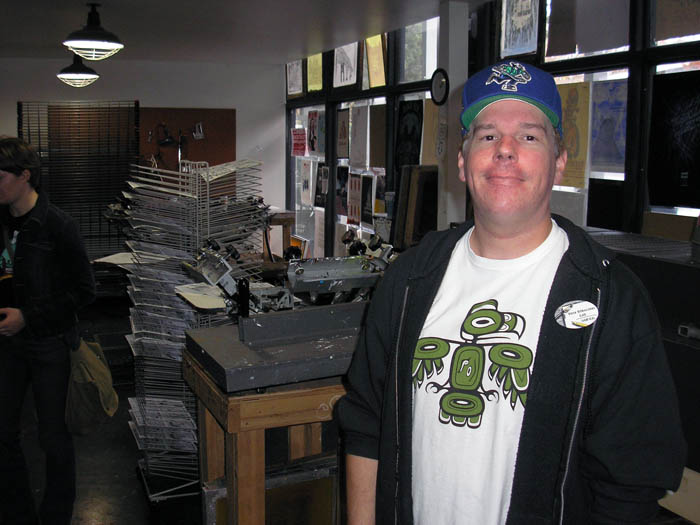
The Vera Project is a fascinating place with much to offer like its silkscreen classes and use of its silkscreen studio! Here is Eric Carnell, who helps to keep things moving along at The Vera Project’s silkscreen studio.

Cartoonist Nicole Georges provides much needed advice.

A great time had by all. See you next year at Short Run.

Leave a comment

Filed under Art books, Comics, Comix, Eroyn Franklin, Indie, Kelly Froh, Seattle, Short Run Small Press Fest, Zines

SHORT RUN SMALL PRESS FEST IN SEATTLE, NOVEMBER 3, 2012

If you’re in Seattle on Saturday, November 3, make sure to stop by the Seattle Center and head down to the Vera Project to experience a special treat: the Short Run Small Press Fest!

This is a showcase of comics, zines, art books, animation and more. It is also a chance to meet some of Seattle’s leading artists in the graphics and comics arts.

Curated by Kelly Froh and Eroyn Franklin, this will be the event’s second year with an extravaganza of nearly 100 small press exhibitors and performers. There will be local animation screening going on all day. Hey, you can even get a free haircut by a writer/professional barber.

Also tied in with Short Run is an art opening at Soil gallery and a not-t0-be-missed book signing at Fantagraphics Bookstore and Gallery: Noah Van Sciver’s graphic novel, “The Hypo” and David Lasky and Frank Young’s “The Carter Family: Don’t Forget This Song.”

So, come on out and get all the details at http://shortrun.org/


Leave a comment

Filed under Art, Comics, Comix, Minicomics, Seattle, Short Run Small Press Fest

Johnny Ryan at Secret Headquarters, June 22, 2012

Are you looking for a “bad boy” artist who pushes the envelope? Well, in the often crazy world of comix, you will find Johnny Ryan proudly flying his freak flag. If you’re in LA, join the fun at an upcoming book launch for “War & Penis” at Secret Headquarters.

Press Release stuff for his new book:

WAR & PENIS BOOK RELEASE @ SHQ
FRIDAY, JUNE 22nd
STARTING AT 7pm
 
Your wait for disgusting and hilarious new Johnny Ryan comics is over! Join Johnny and the SHQ crew on Friday, June 22nd to celebrate the release of his new book, War & Penis
 
The story behind it all: 
“A few months ago, illustrators / comic book makers / funny people Johnny Ryan (creator of Prison Pit, Blecky Yuckerella, Angry Youth Comix) and Frédéric Fleury (founder of Frederic Magazine) started insulting each other by posting obscene, crude, hilarious drawings of the other on their Facebook walls. As they are both proud young men and also profoundly disturbed in their brains, they kept this going for, like, six months or something. Finally, here is the book that collects all those drawings, including an introduction by ZEN MAFIA’s Nate Walton, explaining how the whole sorry mess began.”

Leave a comment

Filed under Art, Art books, Comics, Comix, Johnny Ryan

Review: These Are My Jokes by Nikki Burch

It is not easy to do what Nikki Burch does. It may look easy to some cartoonists but a lot of them simply are not cut out for this particular dance with death, mayhem and destruction. Julie Doucet is one of the best for this kind of underground comix. I think a lot of it has to do with attitude, along with the required skill of course. Even those artists who seem to have what it takes, don’t necessarily need to be out there attempting to be provocative.  Burch rings true with her characters and observations.

Whatever your feelings are for R. Crumb, in the end, I believe most, if not all, people who care about this sort of thing would say the man is authentic. I say the same for Burch. She is no R. Crumb. Not yet, anyway. But she has that kind of uninhibited energy of the young Crumb. She has chosen to lay it all out there, whatever the id might be obsessing over. And what do we, as humans, tend to think a lot about? Well, there’s our own lot in life, our insecurities and prejudices and lots of sex too. In the context of raw comedic social commentary, all of that and more is served up with a healthy dose of nihilism and anarchy. The jokes can be as simple as hell, just as long as they don’t come off as forced.

For example: Burch offers for your pleasure a depiction of a couple who are not exactly stellar, more like dregs scraped off the bottom of a barrel. To add to that picture, the two of them are oddly placed together. They are walking, or bumbling, along and it looks like the guy’s foot is kicking his sweetie in the gut. He says, “Man, I fuckin hate kids!” Her response, “I agree, let’s never have any.” In the background, a cat sits on a trash can and barfs. Ah, a perfect moment.

Or how about this three pager: “The Owl and the Pussycat Run Out of Gas, in a Rusted-out Pea-green Sedan.” In this one, the owl must admit that he hitched his wagon to the wrong mate. The intense use of texture, the dark and wacky characters, the overall dry wit all add up to some fun.

“Sandwich Animal” is an impressive two pager with its brutal cut to the chase and then death. A cat is ostensibly out on a nature walk. “Oh, look at the pretty flowers.” But, all along, he’s there to kill and devour some newborn chicks. Unlike Slyvester, these chicks won’t be outsmarting him at the very last second.

Nikki Burch joins those subversive artists, like Bwana Spoons, who get it right: they don’t try too hard, they have a  lot of heart and talent and know what they’re about. That’s the best way to explain such Burch cartoons as a portrait of the suicide of Boris Nevergoodenov. He never was going to kill that moose or squirrel so he may as well kill himself. You really have to be secure in your own self and work to pull that one off. I believe Burch has succeeded nicely. You can check out other Burch delights at her site and contact her about ordering this 44 page gem.

1 Comment

Filed under Comics, Comix

Lynda Barry Fights the “Green” Power

Nice to see cartoonist Lynda Barry fighting for what she believes in. I wouldn’t have thought there was anything wrong with wind power but, when money is involved, anything can get corrupted.

Director Laura Israel and Lynda Barry talk about the controversy over wind turbines in this photo taken at the first annual DOC NYC, New York’s premiere documentary festival, held Nov. 3 thru Nov. 9. Israel directed “Windfall,” a revealing look at wind energy that tells the story of residents of Meredith, NY, who are divided when companies want to build wind turbines in the traditional dairy farm community.

2 Comments

Filed under Comics, Comix, Lynda Barry

Interview: Jim Woodring

Jim Woodring is a legend in the comics art form with a signature style inspired by MAD magazine, Surrealism, Eastern spiritualism and hallucinations of frogs. His latest book, his first full-length graphic novel, “Weathercraft,” published by Fantagraphics, takes us on a Hero’s Journey with one of the most unlikely of heroes and one of Woodring’s long-running characters, Manhog, an unholy union of man and hog. In this interview, we explore Woodring’s own artist’s journey and some of his own preoccupations, real and otherworldly.

Henry Chamberlain: What would you like most to do if you were teaching a class in comics? In the documentary based on your life, “The Lobster and the Liver,” you demonstrate objects in nature, made up objects and hybrid objects. That looked like the start of an awesome comics course.

Jim Woodring: What I would most like to do if I were teaching would be to have just two or three students at a time. I’ve taught cartooning to large groups and it’s been frustrating. Everyone who wants to cartoon has a different idea of what they want to do and they have lots and lots of questions pertaining to their particular goals. Besides, I just don’t know how to teach manga or superhero cartooning. I can give them information on materials and show them inking techniques, teach storytelling concepts like shot rhythm, camera line and page breaks, and a few other things like that, but when it comes to putting these things into practice everyone has different strengths and weaknesses and it’s difficult to come through for everyone in a large class. Besides, a cartoonist has to find his own unique voice if he is going to do anything good, and that means self-invention.

As for my particular vocabulary, hybrid shapes and all that, I don’t think it would be a good idea to try to teach people to do what I do. Let them discover their own approach, it’s best for them and for the world.

HC: In a Comics Journal interview with Gary Groth, you talk about your desire to create pure comics. You explain that Frank comics are wordless in order to retain a timeless quality. And you go on to express a desire to just focus on the symbols. Isn’t there some intrinsic need to keep a narrative? Or do you foresee moving away from it altogether?

JW: Well, I don’t recall what I said in that interview, but I’m guessing I was referring to the desire to use the symbolic language in pictures rather than comics. Nobody would buy non-narrative comics that were composed entirely of symbols that only meant something to me.

HC: What do you consider to be the natural next step beyond art, beyond being an artist?

JW: What I do believe is that whatever it is that gives art its charge is something that ultimately has to be approached through direct means and not through art. Symbolism alerts you to the existence of something that cannot be reached through symbolism, but needs to be sought directly. Personally I feel the need to go from the symbol to the thing symbolized. That would be true whether I was an artist or not.

HC: There are many references in “Weathercraft” to tears in the fabric of reality. Would you share some of your thoughts on the lofty concept of reality?

JW: The notion that the world is not what it seems to us to be is ancient, and the truth of it can be directly perceived. Everything we experience that has name, form, personality, color, all the attributes of reality, comes from within. A car is not a car until we make it a car with our minds. Until then it is a conglomeration of atoms, a colorless, purposeless, nameless, nearly attributeless drop in the vast ocean of entropic mush.

HC: If you could be a fly on the wall, anywhere and in any time period to witness something, when and where would you be?

JW: I would be in Dakshineswar, India, in 1875, sitting at the feet of Sri Ramakrishna.

HC: I’m attracted to drawing rabbits. For you, frogs come up often in your work. There is the story of you dropping out of college after hallucinating frogs. Is there something you might like to say on the subject of frogs?

JW: Oddly enough, I once heard of a person who had such a phobia of frogs that she would leave a house if she heard one croaking nearby. That’s damn peculiar. I think most people find frogs attractive and some of us find them profoundly attractive. They are small, exquisitely pretty and strangely anthropomorphic. They are biologically interesting, metamorphosing as they do, and they even seem to emulate certain aspects of sadhana, sitting still for an hour at a time and singing at dusk.

HC: You’ve spoken about the Middle Eastern architecture of the Brand Library in Glendale, California. That was your refuge as a teenager and that same architecture can be found in your Frank comics. Can you speak a little more about the importance of having anchors like that library in a young life?

JW: Well, think of that beautiful building, full of books on art, in that park setting, a stone’s throw from the house of a deeply confused but artistically inclined youth. It was an oasis, a refuge, a place where my guardian spirits met. I was a bit anti-social and my life was mostly interior and, in Glendale, I knew not a single adult artist aside from my school’s art teachers, who didn’t like me very much and who weren’t doing work I found at all interesting anyway. Brand Library was like an outpost of heaven. I always walked into that building with the sense of entering a temple where God lived on the shelves.

HC: Cartoonists are something of a unique breed. I mean, a true cartoonist is someone who writes and draws. It takes quite a lot to focus and try to master two such imposing art forms. Could you say a little about that? You’ve talked about how you thought you were going to just do art and then you discovered underground comics.

JW: That’s true of many cartoonists, that they originally wanted to be easel artists and then found that cartooning offered them a better vehicle for their artistic ambitions. Justin Green and Bill Griffith come to mind. As a kid, I loved MAD, the old comic book MAD, and the early magazine format issues. Bill Elder, Wallace Wood, Jack Davis, all those guys were huge heroes of mine. I didn’t even try to copy them, I knew it was impossible. I’d drawn cartoons in my own pitiful way since I was a little shaver but I wasn’t very good and I didn’t make very many strips. I don’t think I actually completed a comic until I was in high school, and the few I did then were dismally bad. I was concentrating more on pictures and paintings, also dismally bad. I drew a few comics for money in my 20’s, still dismally bad, but the opportunities were there so I lunged at them, qualified or not. I didn’t begin to draw comics in earnest until 1986, when Gary Groth saw as copy of my self-published autojournal, JIM, and told me that, if I put comics in it, he’d publish it.

HC: Your comic story, “Too Stupid To Live,” is about an amazing mishap as a youth where you were drunk and fell asleep on some train tracks but were saved just moments before a train would have taken your life. Can you retell it?

JW: It’s a true story. My dear old friend, Ted Miller, now unfortunately gone back into the void, and I would take all-night walks, swilling whiskey, smoking cigarettes and talking trash. Sometimes we’d walk along the train tracks that ran north; sometimes we’d hop off and walk back. Anyhow, one night, we were lying on the tracks, with our heads on one rail and our ankles on the other, talking our big talk and reminding ourselves to keep alert for trains. But we both fell asleep and were awakened by the sound of an approaching whistle. Simple pleasures.

HC: Delicate and enchanting things, like pen nibs, need to be cherished and carried on. Considering your project to create the world’s largest pen nib and holder, what can you tell us about the world of pen nibs and any other time honored gems that come to mind? And how is your pen nib project coming along?

JW: I still have dreams about walking into Broad Stationers, on Brand Boulevard in Glendale, which was an old establishment when I was a youth. The shelves were full of enticing objects: a huge variety of pens, pen holders and different kinds of ink, pencil knives (like wooden pencils with a metal blade running through it instead of lead; you cut away the wood and formed the blade with a file to suit your purpose), huge sticks of red sealing wax that smelled like incense for sealing string-wrapped packages, all kinds of paper in neat packages, such as canary manifold and brass ferrules, pantographs, hektographs, listo pencils, china markers, ink eradicator and a lot more that I can’t even begin to remember. It makes me a little sad to know that the world of the old stationery has vanished.

I’m still waiting for funding for the Giant Pen, but in the meantime, I’m working out various ways to overcome the obvious problems of getting the ink to adhere and flow at that scale. I’m sure I can make it work somehow.

HC: We all wish you well, of course. Anything new on the horizon? Can we expect more gallery shows, toys from Presspop and collaborations with Bill Frisell?

JW: Well, I’m working on a new 100-page book, “The Congress of the Animals.” And, of course, I would love to work with Bill again. Something will happen. I can promise you that.
3 Comments

Filed under comic books, Comics, Comix, Fantagraphics, Fantagraphics Books, Interviews, Jim Woodring

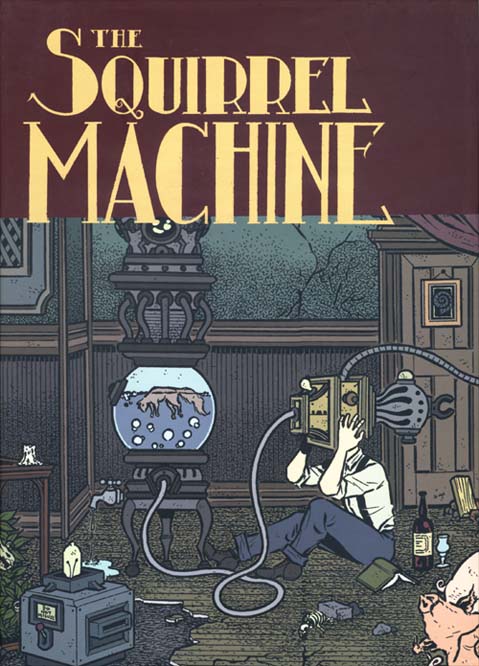
Long Live The Squirrel Machine and Cochlea & Eustachia

Just wrote my review of “The Squirrel Machine” at Newsarama and had some other thoughts to jot down here. I love the work of Hans Rickheit and I am sure a whole lot of other people feel the same way. Take a look at the really cool site dedicated to “The Squirrel Machine.” It’s nice to see all the reviews past and present. Back in the day, I was the critic who called the work of Hans Rickheit, “languidly decadent.” That was for a review I did of one of his amazing “Chrome Fetus Comics.” Hans has always had a way with playing with the underbelly of sexuality and sensuality and, well, all sorts of other underbellies or, rather, underbrains, as he would have it.

On his blog, Hans makes mention of his favorite review by one his comics idols, Mahendra Singh. And it is an admirable piece of work. I quote a little here:

It’s precision of tension between meaning and white noise is so well-calibrated that the observant reader unconsciously ceases to resists Rickheit’s oneiric anti-logic.

I look forward to more of the man’s comics and it’s exciting to know he’s already at work on his next book. Well, Hans, if you’re reading this, I hope to see you sometime soon. Maybe at next year’s MoCCA. And I remain a big fan of Cochlea and Eustachia. Those are characters I hope you don’t retire. I will have to buy some original art of them someday from you.

Leave a comment

Filed under Comics, Comix, Fantagraphics Books, graphic novels, Hans Rickheit, The Squirrel Machine