Tag Archives: Entertainment

The Death of Comics Bookcase, Vol. 1 review

The Death of Comics Bookcase, Vol 1. w. Zack Quaintance. Art by Nick Cagnetti, PJ Holden, Luke Horsman, Ryan Lee, Anna Readman, & Pat Skott. 48 pp. Funded via Kickstarter. Original Comics Bookcase.

A comics bookcase host.

A werewolf. A teen-aged superhero. Dueling wizards. An old man. Super-powered gorillas and sharks. These are characters with nothing in common in the real world. However, in Zack Quaintance’s imagination, they come to life and share their fears and misgivings about their own realities. There’s even a talking bookcase going through its own existential crisis, something of an alter ego for the author. This comics bookcase acts as a Rod Serling-like host both introducing each story in this comics anthology while also confronting its own peculiar mortality. You see, the possessed bookcase plays many roles, including that of a former comics blog. In fact, the author was once the host of his own comics blog, Comics Bookcase. If that sounds weird and intriguing, then you’re in luck, since there’s more I can tell with you.

Life is made up of much that is ineffable: the stuff that is beyond our meager grasp and simple discernment, be it grand or mundane, to fully understand and articulate our own existence. We miss a lot. We take in what we can. One thing we humans do well, it seems, is to come up with ways to pass the time, like the creation of comic books. It is with this lofty preamble, that I offer to you the comics world of Zack Quaintance. This writer has been up to quite a bit in the last few years, all in the service of storytelling, leading up to his comics anthology, The Death of Comics Bookcase. This 48-page comic (with a deluxe version well worth seeking out too) is the first volume in a proposed series. This comic book is loosely based upon Zack’s Comics Bookcase blog (2018-2022), its demise and the stories it has inspired.

That’s one freaky werewolf!

What happens within the pages of this comic book is something of a love letter to comic books as well as an impressive showcase of comics talent. Yes, we have stories, much in the spirit of some of the most celebrated anthology formats, from The Twilight Zone to Tales from the Crypt. The idea here is what it’s always been: to provide some thrills and chills along with offbeat humor. What really stands out for me is the variety of stories, mixing different genres and viewpoints, all held together by a certain dark fantasy sensibility. Some might call it, “a touch of strange,” because that’s really what’s going on here. It’s a particular strain of spinning yarns that has been brewing for at least a couple of hundred years, reaching new heights with the advent of pulp fiction and fully blossoming into what we have come to know and love as modern horror or dark fantasy.

Art by Nick Cagnetti.

Let’s dive deep into this comic book and consider one of its stories, “Responsibili-Teen.” This is a homage to Steve Ditko and proposes not only an off-kilter Ditkoesque comic book superhero for the age of social media but a clever analysis of where we seem to be heading with ever-expanding Big Tech, particularly, AI. Because, well, AI seems to be both the great boon and the great threat to humanity that we can’t seem to get enough of talking about on . . . er, social media.

The new-and-improved does battle with the ineffable.

In this story we meet a character as familiar as our own childhood and as up-to-date as our latest post. Meet Maxwell, a dorky high schooler, with no parents, being raised by his Aunt Jen and Aunt June. This would-be Spider-Man is even more repressed than the original. No radioactive spiders for this guy. Instead, Maxwell stumbles into the high school computer lab and confronts Tacky, an experimental AI word processor who promptly bites him and sets him on his pre-programmed new life. This is all, of course, hilarious. Nick Cagnetti’s artwork not only leans into the humor but taps into the spooky quality as well since nothing is quite right in this story. That touch of strange is milked for all it’s worth.

Art by Nick Cagnetti.

Nothing is as it should be, as if reality as been processed and regurgitated. Nothing makes sense, as if all real meaning has been drained out and simply repackaged as new. The big clue is at the start when Maxwell must contend with his new marching orders in life: “With great responsibility comes great power.” This inversion of an all-time classic superhero call to action is what Maxwell must work with, turn into something new, until he begins to question everything: himself, his purpose, his whole reality. And it all began with Tacky taking a bite out of him. Wow. This is a great mix of offbeat humor and social commentary that ultimately just goes to show that we humans, believe it or not, can do reality better than any machine. As Quaintance so eloquently states, there is no “new” AI content that can match the authentic and ineffable human hand.

Art by Nick Cagnetti.

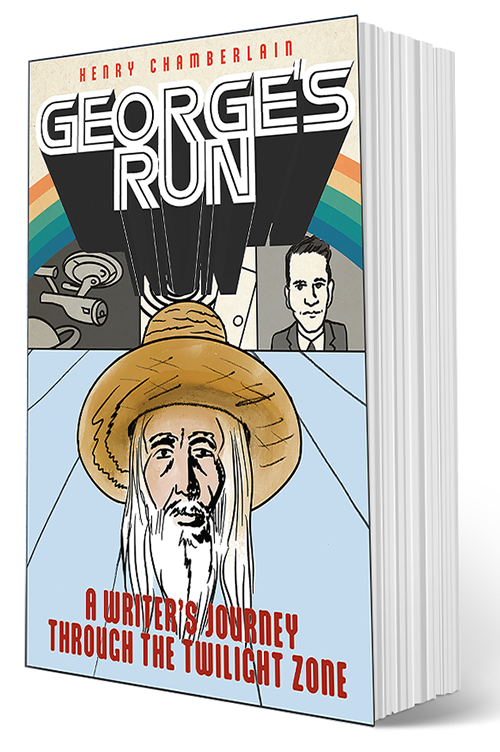
Zack Quaintance aspires to join the ranks of the great writers of the spooky and the macabre and he has plenty to show for his ambition in the pages of this comic book. We both have a keen interest in writing which has carried over to writing about comics and actual comics writing. We’ve gotten a chance to chat and to exchange each other’s work and, in a natural fashion, we’ve connected some dots. I believe in serendipity. Zack has followed his intuition and ended up writing a terrific review of my graphic novel, George’s Run, which is greatly invested in exploring the elusive and mysterious storytelling process. And I, in turn, after reading his Death of Comics Bookcase, can’t help but be equally inspired. Whether Zach is pursuing a crime procedural involving werewolves or a mystical and whimsical homage to the great comics of yesteryear, he is consistently expressing spirited creative energy.

As I go back and re-read passages from the advance review PDF, I find myself briskly scrolling back and forth and marveling over the art, color and overall design. If you enjoy behind-the-scenes stuff, I highly recommend the deluxe version which provides a generous sampling of pages from the script along with a break down on the comics process. The first set focuses on a page from “The Werewolf Priest.” The clear and thoughtful notes evoke a cluttered, stifling and antiquated newsroom, a most unlikely place to prepare to do battle with a supernatural beast. The script notes are written out in such a way that it makes clear why the resulting work came out as well, and as spooky, as it ultimately did.

This is an impressive anthology with a team of first-rate creatives. No doubt, this was a colossal undertaking: a full-on mainstream comic book production with separate artists, colorists, and letterers. Just a quick shout out to the key artists: Ryan Lee. Anna Readman. Nick Cagnetti. Luke Horsman. Pat Skott. PJ Holden. In fact, each story here is like a whole universe to itself while adding up to a tidy and seamless whole. All in all, I think that this anthology has set the bar high with a confident promise of more fun and weird comics to come. And, with all this said, it’s important to emphasize that this is basically an advance review and the comic book is still in the process of becoming available to the public. Stay tuned via the Kickstarter campaign and the original Comics Bookcase blog which this comic pays tribute to. This comic book is what the ideal comics experience is all about: weird and intriguing and always, always, about that ineffable human spirit! Thank goodness we have comics and this particular comic book is a prime example of comics at its best.

Death of Comics Bookcase, Vol. 1 Deluxe Edition.

4 Comments

Filed under Comics, Comics Reviews

Stan Mack’s Real Life Funnies book review

Stan Mack—wotta guy!

Stan Mack’s Real Life Funnies. The Collected Conceits, Delusions, and Hijinks of New Yorkers from 1974 to 1995.  Foreword by Jake Tapper. Afterword by Jeannette Walls. Seattle: Fantagraphics, 330pp, $50. (On sale date: June 11, 2024).

Guest review by Paul Buhle

Sometime in the last decades of the late nineteenth century, urban journalists sitting or strolling among the middle class masses coined the term “flaneur.” The relaxed, curious style of looking, almost randomly, at such things as which department store windows would be designed in ever more intense sales efforts or which open-air cafes flourished, would be taken up by American writers, painters and even monument-makers, by the 1910s.

Lots of interesting art epitomized by Ashcan styles (but not exhausted by them) found its origins here. Perhaps because the art schools began to flourish and young radicals (in every sense) began to see a life for themselves within the emerging culture.

How this art became more public than museums or art shows poses difficult and interesting questions. The illustrated Left-leaning or outright left-wing magazine or newspaper had appeared, a genre originally carrying only cartoons but gradually enabled by changing technology to offer decent half-toned prints. The Masses magazine (1911-17) hugely popularized the work of the Ashcan artists and of cartoonists as well—until it was suppressed for opposing US entry into the First World War. The Liberator and New Masses carried on with interesting art, intermittently, as did Der Hommer, in Yiddish, into the 1930s. Even when the art quality of the Left papers trailed off due to limited page space and to a vernacular Socialist Realism strangely similar to WPA post office fare, much of value remained.

Stan Mack. “Call it human ashcan art.”

The return of the sketch, an art form inherently given to popular use, offered artists yet another and very popular mode. Not that sketches in magazines had ever vanished, but they seemed to grow closer to life in the better and more interesting publications, including those leaning toward left-wing causes.

Jules Feiffer, drawing for the Village Voice starting in the middle 1950s, offered something as new as the Voice itself, at once bohemian, literate and truly popular. Feiffer looked at New Yorkers, especially but not only self-styled bohemians, with a jaundiced eye. He saw through their pretenses. But not without fondness. They were, in a sense, the Voice itself, the idealized reader. They wanted to live in a different way if not in a different society (it was as easy then as now to give up on reform causes). And they were silly.

Panel excerpt.

Stan Mack might object to being described as a successor to Feiffer, but a family resemblance cannot quite be missed. Mack took on the task of cinema verite plus more than a little sly humor, within the Voice of the middle 1970s and continued until the editor dropped the strip in 1995. It happens that this reviewer appeared in the same pages, or rather my book reviews did, during the 1980s mostly, and this personal detail kept me looking with special, probably egotisical, interest at the paper and at Mack’s entertaining strips. Like many future readers of this book, I have unknowingly kept memories of particular strips in my head. I liked them a lot.

Real Life Funnies deserves a full biographical essay and I wish I had written it (but the artist might possibly object). Here is a shorter version, which is not easy. Raised in Providence, RI, son of shoe store owners whose nearby Jewish relatives included a bookie or two, Stan attended the Rhode Island School of Design. He spent time in the Army, was mustered out, and became an art director at the New York Herald Tribune in the early 1960s. When the paper closed, he moved over to the New York Times. Perhaps most notably, at least for him, the task was to discover illustrators for the “new journalism” of the 1960s.  Here may well have been born the kernel of an idea.

He knew that he wanted to do something different. He went to well known designer/illustrator/editor Milton Glaser, then working for the Voice, and pitched an idea based on his newspaper background. Glaser liked that, and encouraged him. Here Mack found his voice, so to speak. He became an oral historian without degree or evident training. He roamed the city, listening to New Yorkers, adventuring to places outside his comfort zone. He would take notes, go back to his studio, and draw furiously, seeking to capture their sensibility.

Panel excerpt.

The result is like nothing else in popular or for that matter, scholarly (as in oral history-scholarly) literature. It is miles away from what Feiffer had done, although old-time Voice readers will surely see a kind of relation. Mack is more than adequate as an artist, but he does not rely upon the motions of the protagonists to tell the story. Far from it. This is, properly understood, illustrated oral history.

What he has in mind (this reviewer admits to having been a much-traveled oral history fieldworker, archivist and prof-coach) is the intimacy of the personal revelation. Not the kind of revelation that could be considered scandalous (these happen, if rarely) but the more-or-less unconscious bursting out of personality.

That is, the inescapably unique personalities, however anonymous, of New Yorkers during the 1970s-1980s and early 1990s. He offers them up for the reader, showing himself to be variously ironic, open-minded, detached and empathetic or perhaps not so empathetic.The psychic crises of the materially comfortable middle classes wishing for more satisfying or less stressful experiences prompt mostly now-forgotten cures, like “Rolfing,” or some sexual version of psychic restoration. By the 1980s, as the gaps between social classes grew wider, the squatters are more often seen more in evidence along with druggies, new immigrants, nonwhites and….yuppies.

Many of Mack’s subjects happen to think of themselves somehow as artists, would-be movie makers with hand-held camera, seeking street personalities or a convenient woodsy park where a porn scene can be managed. This is not unnatural: New York is a creative center in every sense, with more successful (and mostly unsuccessful) artists, actors, directors and every other category imaginable, per square mile, than anywhere else including Los Angeles. For a lot of these working people, at any level of fame, obscurity, high life or low life, “entertainment” is a job. Mack offers us more varied glimpses than any novelist has provided. Call it human ashcan art.

I am inordinately fond of seeing the craven businessmen, who Mack delightfully skewers for their arrogance and blatant criminality. But equally hard to miss are  the try-anything avante-gardists, the fashion-craving and silly-looking people of every variety, the sex workers, the gender-benders and the simply confused.

The variety is so great in these pages that further description fails. Sometimes, Stan, who drew himself as diminutive and with a brush-like mustache (most readers thought he actually looked like that), makes an appearance. His chapter introductions provide some overviews of how things change and yet remain remarkably almost the same, with all the passage of decades and fashions.

Panel excerpt.

It is definitely not a love letter to New York. And yet, somehow, it is. Stan Mack’s Real Life Funnies calls to memory those 1920s-40s hits, from Broadway or not, that made Manhattan a unique place, a centralizing place for shared experiences. A thousand films and some memorable television dramas of the 1950s, before TV moved to Los Angeles, carried the same sense.

No, no, I am making things sound “nice,” when Stan Mack does not mean that at all. There’s so much human potential on hand, but people who should know better go around ruining it with their insecurities, their egos and their cravings.

And I realize that I want to say something more about Stan’s art work. It pushes out of the page toward the reader. His characters are in the reader’s collective face, and the reader has chosen Stan’s strip by choice. Accept it! His friend Harvey Kurtzman, founder of Mad, described himself not as a humorist but a truth-teller.  That’s Stan, too.

Paul Buhle

Leave a comment

Filed under Comics, New York City, The Village Voice

Comics by Henry Chamberlain: The Flaneur Seeks a Hamburger

Clem, our trusty man-about-town, seeks a tasty treat. Let’s follow along as our favored flaneur negotiates his way to America’s favorite, the humble yet mighty & hearty beef patty. Where’s the beef? Well, it’s been here all along! Ah, always remember my dear sweet friend, that what matters most is the journey and not the destination. Until again, maintain your courage (thinking about Dan Rather right now), you never know when you’ll need it next. Back to the subject at hand, nowadays, a simple fast food transaction can escalate into an existential crisis.



Fin

Leave a comment

Filed under Comics, Flaneur, Henry Chamberlain

Mark Twain’s War Prayer, Illustrated by Seymour Chwast book review

Mark Twain’s War Prayer, Illustrated by Seymour Chwast. Seattle: Fantagraphics Books, 2024. 96pp, $22.99.

Guest review by Paul Buhle

The literary-political Establishment fairly well managed, for three or four generations, to hide or to minimize Mark Twain’s later-life antiwar devotions. The beloved writer, considered by readers and critics alike as the creator of the singular US classic, Huckleberry Finn, devoted much of his prose energy in later years to denouncing wars in general and the vastly murderous American assault on the Philippines in particular.

It was no doubt the Vietnam War, with the vast military assault and chemical warfare sidebars against large parts of Southeast Asia, that brought to light Twain’s writings previously considered marginal, old age ramblings. Twain knew what he was writing about, and he knew how to say it in painfully funny ways.

“The War Prayer,” actually written in 1905 but unpublished, remained in family archives after his death in 1910 as dangerous for his literary reputation. It reached readers rather obscurely in 1916, tacked onto another Twain essay, and took on a new relevance when narrated for PBS viewers in 1981. It has emerged repeatedly in short films since then, but most notably as an animated short in 2007, narrated by actor-activist Peter Coyote and starring no one less than the Beat poet and bohemian antiwar champion Lawrence Ferlinghetti, as the war-mongering parson.
Chwast is a fascinating and formidable artist to take on the task of illustration, in what must be regarded as an act of devotion to Twain. A mainstream illustrator publishing in the “slicks” while still in his teens, Chwast did work for the New York Times and Esquire among other places, also creating a plethora of commercial designs from packaging to magazine covers to Broadway show posters. He and a sometime workmate at Esquire, Edward Sorel (himself later a Nation magazine regular) started their own operation, Push Pin Studios, in 1957 along with rising stars Milton Glaser and Robert Ruffins. It would be too much to say that Push Pin transformed exhibit advertising, but not too much to say that together with other artists, this team moved commercial art into new zones, more playful, more interesting than before.

Ever on the progressive side, Chwast took on the present task without adding a single comment of his own. All Twain Text and not so much of that. After an excerpt from the famous caustic essay “The Lowest Animal” (a date of the essay might have been helpful but might artistically intrusive,  and anyway remains uncertain even to scholars), we have a hundred pages of quotes running from a few words to a short paragraph.

Chwast has evidently thrown himself into the work with abandon. Early pages look like circus posters, announcing wars proudly like the American war posters of old, with wordless, cartoony facing pages. Later, he passes heavily into pastels, the voice of the prophet (seen bearded) in suggesting what the “voice of the prophet” means for those who pray for military victory.

What follows, for almost the rest of the book, is Chwast’s drawings of war and destruction, predominantly in stark blacks and whites. Then more color pages of war’s victims looking to the heavens, “imploring thee for the refuge of the grave and denied it—for our sakes who adore Thee, Lord. Blast their hopes, blight their lives…” (pp.72-77) and so onward.

This is Twain’s explanation or exploration of religion as basically a cheat, especially Judeo-Christian religion for the reason that he knew it best. A cheat in many things, but above all in the praises of war, the warriors, humanity in war, and so on. We could add, into the endlessly terrifying night of our present world, as a particular kind of Jewish artist might see the misuses of religion now.

This is something new for Twain-illustrated books, despite the many earlier illustrations of his works. We see again, in Twain’s spare prose that no better American writer has ever emerged. A novelist who still makes  vaunted modernists like Saul Bellow read like amateurs, and whose caustic attack on falsities finds an equal only in the best moments of Kurt Vonnegut.

Chwast has a past dossier of recaptured and reworked images from a thousand sources that have crossed his eyes. Never has his political energy been on display so clearly and with so much concentrated energy. Mark Twain’s War Prayer is a book horribly relevant, horribly significant in its art and for today’s world.

Leave a comment

Filed under Book Reviews, Illustration, Mark Twain, Paul Buhle

William Shatner: You Can Call Me Bill movie review

You Can Call Me Bill. Legion M. written and directed by Alexandre O. Philippe. 2024.

Pop culture documentary filmmaker Alexandre O. Philippe directs but, I suspect, William Shatner leads, even commands the scene, in this new film about his life and times. It could really be no other way. As the saying goes, any actor worth his salt can recite the phone book and turn it into compelling entertainment. That, indeed, is what Shatner is all about. Right from the start, it is Shatner who is the boss as he hits the ground running, speaking in awe about the wonders of the world around him, alternating between hushed tones and a booming voice.

William Shatner in the graphic novel, George’s Run.

I know a thing or two about pop culture myself and I can tell you that, as many times as you’ve seen William Shatner (easily one of the most filmed persons in human history), you haven’t seen him quite like this and I mean the cumulative result you get in this documentary from hearing him out as he masterfully, even miraculously, never loses the thread to some of his more ambitious dramatic leaps of faith. The documentary does a great job of seamlessly alternating between interview segments with Shatner in the present and classic clips from his career. There’s one priceless clip, for example, where Shatner is given the stage at the Golden Globes in order to set up the next segment, some sort of lifetime achievement award to George Lucas. Shatner, at first, appears to be genuinely befuddled as to whether or not he’s at some Star Trek event. There’s a quick cut over to George Lucas who looks perplexed and not at all amused. And then, presto, Shatner reveals a prop at just the right moment: a piece of paper, presumably notes he was supposed to have read telling him he’s there to honor Lucas. At just the right moment, the audience is in on the joke and Shatner receives well-earned laughs and applause. And that, in essence, is what this documentary is all about: one segment after another giving way to one clip after another, all in the service of painting a bigger picture of a savvy and hard-working entertainer/sage storyteller. It’s the stuff of legend and, heck, totally transcends any mere pop culture theme. This is the story of someone who must live life large, who came of age in an era that celebrated such a journey, and who has never stopped.

Excerpt from GEORGE’S RUN.

In my graphic novel, George’s Run, published by Rutgers University Press, I recount in various ways the golden age of television that gave us such gems as the original Twilight Zone and Star Trek. I don’t just give you a few examples of some beloved moments from these shows but provide context regarding the key players, primarily the writers but also the actors (particularly William Shatner and Leonard Nimoy) who helped to fuel and build the evolving creative sparks into so much more.

This doc sets Shatner loose to be himself, and, in doing so, provides a great service. In somewhat similar fashion, Leonard Nimoy got his chance to set the record straight in 2016’s For The Love of Spock, directed by his son, Adam Nimoy. If you happen to see both, you’ll get what amounts to one of the best tributes to both of these actors who, by their own grit and high level of integrity did much to secure the course and fate of the USS Enterprise.

5 Comments

Filed under Comics, Movie Reviews, Star Trek

Roger Corman (1926-2024), An Indie Film Maverick

Roger Corman’s “The Intruder,” featured in the graphic novel, “George’s Run.”

Roger Corman (1926-2024) was a dedicated filmmaker who, by just doing what he loved, managed to carve out a place in cinema history. At the end of the day, he’s one of the great indie film mavericks, whether you happen to be a fan of the B-movie horror genre or not. Heck, the guy practically invented it! Corman addressed what he was doing as a business as much, or more so, than an art pursuit. For the most part, his movies were meant to entertain with chills and thrills for a teen audience at a drive-in.

Charles Beaumont’s controversial novel was a risky choice to adapt into film.

That said, from time to time, his films would demonstrate more than a strict profit motive. In fact, in 1962, you would have been hard pressed to find any movie director who would have considered adapting Charles Beaumont‘s 1959 incendiary novel, The Intruder, an indictment on racism in America. It was not the sort of novel that promised any profit but certainly promised a lot of trouble.

From George’s Run: George and Bill find themselves cast in “The Intruder.”

Despite all the risks (the film was shot in the rural south), Corman went full steam ahead and made a movie that didn’t return anything close to a profit until decades later when it was rediscovered by film enthusiasts.

Before Star Trek, William Shatner starred as the racist villain in “The Intruder.”

Now, here is where some folks might conflate Roger Corman with being attached to science ficiton. No, he was a horror guy but he did cast William Shatner in the lead role in The Intruder as the villain, the outside agitator who stirs up racial unrest in a sleepy little town. Before Star Trek, our very own Captain Kirk was a ruthless and spineless villain!

This is the book for any fan of comics, pop culture, and great stories!

It is my honor to include the story of the making of The Intruder in my graphic novel, George’s Run, published by Rutgers University Press. I can appreciate how it’s easy to conflate the various players during the ’60s, a highly creative time in both television and film. In this case, the players, genres and mediums all seem to blend in together as you have two pivotal talents, television writers George Clayton Johnson and William F. Nolan, participating as actors in a film that is based on a novel by another key writer, Charles Beaumont, who was a central cohort of the group of writers who worked separately and together on various projects, including the original Twilight Zone and Star Trek. And then, just to add to the multi-layered and high octane theme, you have William Shatner leading the way. I’m sure all of this creative energy and artistic passion was not lost on Roger Corman. It was quite a fortuitous combination of talents and viewpoints and Corman must have given it all a confident nod. Full steam ahead.

2 Comments

Filed under Comics, Horror, Obituaries, Roger Corman

UNFROSTED Directed by Jerry Seinfeld movie review

Unfrosted. Directed by Jerry Seinfeld. Netflix.

Jerry Seinfeld’s new movie, Unfrosted, as Tony the Tiger would say, is great! It’s great for more reasons than you might think. First and foremost, it’s funny as it keeps to its theme, basically that of our love/hate relationship with American consumer culture (at its zenith in the early ’60s), and just runs with it with sincere passion and goofy humor. The whole thing rings true in a way that you can’t fake, managing to unlock that secret code that usually eludes Hollywood of creating a homage piece in the style of the thing being honored, in this case, the broad and frenetic ’60s comedy. It doesn’t feel at all like a contrived attempt but, in fact, the culmination of a lifelong love for a certain moment in time. Any fan of Jerry Seinfeld’s standup comedy knows that he loves, and loves to poke fun at, the simple pleasures in life, like the Pop-Tart.

This movie is all about Pop-Tarts and then some. It’s everything that you would expect from a comedy that is like a classic ’60s comedy: somewhat higher production value, family friendly, usually with a cavalcade of comic actors and unapologetically nonsensical. I don’t think I’m giving anything away (but spoiler alert nonetheless) when I say that this is the kind of movie that invests a lot of time and energy in establishing that the milk industry is having a very hard time with the emergence of a product that will replace cereal. Did Pop-Tarts ever really threaten to replace cereal? Don’t Pop-Tarts go great with milk? Toss any serious arguments aside and just bask in the playful satire, including spot on jabs at John F. Kennedy (Bill Burr) and remarkable send-ups of Walter Cronkite and Johnny Carson (both by Kyle Dunnigan).

Kyle Dunnigan, as Johnny Carson.

This whole movie is a hilarious send-up of ’60s culture from the race to the moon to the race to the consumer. Just add milk, and I’m sure this movie will deliver some good laughs. It’s certainly not meant to be taken too seriously, at least not in any obvious way. That said, it has its own special social commentary particularly focused upon American exceptionalism. A highly polished report could do no better. This gentle well thought-out and heart-felt comedy has plenty to say and with a stellar cast, including everyone from Hugh Grant to Amy Schumer to Jim Gaffigan to Melissa McCarthy. In fact, this movie has some great child actors, including Eleanor Sweeney who helps in the mad pursuit to invent the ultimate breakfast treat. If these young stars of tomorrow can not only appreciate the humor in this movie but help to make it shine, then there’s still hope for the rest of us.

Leave a comment

Filed under Movie Reviews, pop culture

Advocate by Eddie Ahn comics review

Advocate. Eddie Ahn. Ten Speed Graphic. 2024. 208pp. $24.99

Eddie Ahn learned early on that the only way to really make a difference demands hard work and dedication fueled by passion. You see that zeal on every page of his debut graphic memoir. Taken as a whole, the book runs at a steady clip which evokes the life of a bright and sensitive young man determined to help his family and community. What’s remarkable is that Eddie Ahn managed to put in the time and energy to become both a successful environmental lawyer in San Francisco and a brilliant cartoonist. This is the story of the titular advocate and storyteller.

With great humor and insight, Ahn seamlessly takes the reader along for a ride that covers his journey of self-discovery. Comics, especially nonfiction comics, tends to be a balancing act of editing and boiling down to the prime facts while not losing any of the flavor. So, you have here a wonderful back and forth narrative wave dipping down to a granular level then back up to a big picture view and so on. Ahn is not afraid to shift the timeline as needed and do some nonlinear fancy footwork. There’s one segment where the story is comparing events a decade apart: a medical trauma that Ahn experienced in 2008 compared to a medical trauma experience by his mother in 2017 and it works beautifully. A lot of this story deals with family and how one person’s journey is influenced by decisions made going back generations. In that sense, seeing one’s destiny as the culmination of countless decisions, illuminates Ahn’s circuitous path that led him to his relatively unlikely but quite successful career in fighting for environmental social justice.

Coming from a mixed race background as I do, my father Anglo and my mother Mexican, I can certainly relate to Ahn’s point of view as he sees life through the prism of a Korean American. That strangers-in-a-strange-land saga, that is the legacy of the immigrant experience, is evoked so well by Ahn as he shares his parents’ vision, ambition and struggles, always striving for and measuring success. When have you reached your goal? Once you have achieved the American dream of buying a house? Once you have amassed enough wealth that you can easily purchase a new luxury car as a thank you gift to your parents? Ahn dissects all these efforts, misgivings, and calculations along that ladder climb to success. This book, both inspiring and highly entertaining, is his final report card to his beloved parents. Advocate is not what I expected at first. It’s a refreshing and riveting read, just the sort of unexpected read that will make you want to make your own difference in the world.

Advocate is available as of April 16, 2024, published by Ten Speed Graphic, an imprint of Penguin Random House.

Leave a comment

Filed under Comics, Graphic Novel Reviews

2120 by George Wylesol comics review

2120. George Wylesol. Avery Hill. 2022. 500pp. $25

A meandering story is often an asset in the world of comics. Sometimes, it’s the whole point, especially if your story is also a game. Think of the Choose Your Own Adventure series and then times that by a hundred and gear it up to a relatively older demographic. This book sets you upon a journey, having you choose your own narrative by leap frogging your way through the book’s infinite number of alternate paths. It’s a book that will entertain any age but there is a fine dollop of droll sophistication given the premise is a middle-aged tech guy who finds himself trapped in a building with no clear way out.

Continue reading

Leave a comment

Filed under Comics, Games

Trina Robbins, A Remembrance

THE SILVER METAL LOVER by Trina Robbins (Wimmen’s Comix)

Trina Robbins (1938-2024) was a firebrand. Trina Robbins will be fondly remembered as the raucous female alternative voice to the acknowledged underground superstar cartoonists of the 1960s (think R. Crumb), a group that just happened to be predominantly male. There doesn’t appear to be any documented proof that the ’60s comix scene was somehow formed by some conspiracy to create a “no girls allowed” cabal. That said, it was a “man’s world” back then and that attitude and power structure did manage to permeate, ya dig? So, it made perfect sense for Robbins to launch into her own female-focused Wimmen’s Comix comic book series, which became a lightning rod in the culture wars. The men got to create experimental comics. And so did the women.

Continue reading

Leave a comment

Filed under Comics, Obituaries, trina robbins