Tag Archives: graphic novels

The Horrors of Being a Human: A Cola Pop Creemees comics review and creator interview

The Horrors of Being a Human: A Cola Pop Creemees Comic. Desmond Reed. Microcosm Publishing. 2025. 270pp. $19.99.

Desmond Reed is a rising talent in the world of comics. His latest book makes that clear. Years of dedication to the making of comics has resulted in his design being sharper, his insight being keener and, heck, the guy knows how to put on a good show. It is that focus on storytelling, as well as development of character, that leads us to such a smooth and pleasing comics experience. As Reed explains, he has five characters, the Cola Pop Creemees, who, among other things, represent different emotions and different aspects of himself, or yourself. I can see that this comic is very relatable, in the spirit of such groundbreaking work as BoJack Horseman. Let me just say from the get-go, the Cola Pop Creemees are very different and original, and if you see them turned into an animated series someday, well, you heard about it here first.

Cartoonist and Publishers.

The world of cartoons and comics has always dealt with far more than might meet the eye, depending upon where you venture off to. In the world of Desmond Reed, you enter a kaleidoscopic world of the real and surreal. For instance, our heroes live in a house in the shape of a hand. There is plenty to be anxious about in the real world, and this comic manages to tackle many of these issues within its quirky borders.

Cartoonist and Comics Festivals.

Desmond Reed has set the stage and, from there, he can modulate the tone. Stories vary in length with some far-out zany and others more contemplative. Reed’s most serious and ambitious work to date is one of his longer stories, “Memories,” winner of a 2022 MICE Mini-Grant. Here, he focuses on his most madcap character, Wallace T.J. by allowing for a careful look back at his development and the darker side to his life.

“Memories”

Life is quite a journey with plenty of bumps in the road and that’s where a daring artist like Desmond Reed steps in to create art to defy even the most challenging of times. Believe me, there’s always room for another valiant artist to lead the way, especially one as gifted as Reed. It all comes down to the reader getting a chance to know the work–and so I encourage you to seek out this highly inventive work and let it speak for itself. I can tell you that Reed has a magic touch, with his pared-down whimsical style, when it comes to addressing some very serious issues like addiction and depression.

The Cola Pop Creemees live inside a hand.

Desmond Reed is not afraid to go down to depths of despair and come back up with a tear and a smile. It is a combination of a pared-down style and a direct straightforward narrative. Think of it as a friend who sets you down and needs to tell you something. Maybe there will be some humor thrown in that both of you share. But then you get to the story, without pretense, and you just get it. That is what is happening here. Reed has constructed characters that you can tap into in the very best spirit of comics. You can say that the lodestar guiding us cartoonists in such matters is Peanuts, and, I dare say, there’s some of that Peanuts DNA in the Cola Pop Creemees gang.

Some much said within a special world.

What irony there is to be found here is subverted by a persistent vision of perseverance. That is not an easy thing to achieve and it has everything to do with Reed following his own instincts and staying true to his authentic self. That’s where you get original work and not some trendy “next big thing” that is aping some previous “next big thing.” Yes, it is possible for comics to be funny, sincere and have some redeeming quality that will speak directly to you.

It was a lot of fun to get to chat with Desmond about his new book and sharing thoughts about the cartoonist life. I hope you feel the same. So, please do check out the above conversation on the Comics Grinder YouTube channel and please view, LIKE and COMMENT directly on the channel. Every bit of input and engagement helps us continue.

Keep up Desmond Reed here. And be sure to visit Microcosom Publishing here.

Leave a comment

Filed under Comics, Comics Reviews, Interviews

Superman, Apple Pie and MAGA

It’s been a minute since we had a full-on Superman major motion picture with all the trimmings. And this new installment shows with each charming but self-conscious step. It’s like a very expensive and fragile antique has been brought down from wherever it usually hides and one hopes it survives the special occasion that summoned it from its crypt. Superman is like that. Also like the James Bond franchise. Just as you’re getting used to one Bond, they bring in a new model. What was wrong with Henry Cavill? He seems to have a lot of mileage ahead of him. Well, he’s 42. The new guy, David Corenswet, is ten years younger. But there’s no getting around the fact that the actual character goes back to 1938. And, some will argue, Christopher Reeve, in the role of Superman, along with Margot Kidder as Lois Lane, in 1978, will always be the gold standard. In fact, Corenswet seems to be channeling Reeve in a pretty big way. The same with the new Lois, played by 34-year-old Rachel Brosnahan. There’s no doubt that the producers were looking for a certain je ne sais quoi and Brosnahan has that world-weary Kidder vibe down. The script doesn’t bother with formalities with these two and has them all over each other back at Lois’s apartment within a few minutes after the first big action scene. They are so used to each other after dating a couple of months that they let loose with a mildly tense quarrel. It was something else. It made a baby cry in the movie theater I was at.

Now, some talking heads have made a big deal about Superman updating for the age of MAGA. And I think the producers tried to split things down the middle. They gave Clark Kent a new set of parents cut from a MAGA trope: more of a laid-back Southern flavor as opposed to a prim and uptight Midwestern reserve that was the original recipe. Clark was raised in Smallville, Kansas after all, not West Virginia. Anyway, that part is done with kindness. The other part could be hard for some hardcore Trump fans to swallow and that’s stuff like Superman duking it out with Lex Luthor with Superman saying things like, “Yeah, I’m an alien and I’m proud of it. I’m a real person.” and Luthor saying, “I don’t care. The government has given me permission to do whatever I want with you!” Your mileage will vary. You can’t avoid a little sprinkle of politics when you’re dealing with such a colossal cultural figure as Superman. Director James Gunn referred to Superman as an embattled immigrant and that alone has created a bit of a firestorm. Every era has its own Superman and so it goes.

But getting back to the whole idea of a major Superman movie. It does feel like the good china and silverware is being brought out. My harshest view would be that the whole thing feels as if its been embalmed in formaldehyde, lost somewhere in the mist of the 1930s up to the 1970s. Maybe that’s a good thing, the fact that this sort of thing is still being done. It’s a very expensive experiment in entertainment but I can only imagine no one is going to lose their shirt over this. It’s going to appeal to a lot of people but that just goes with the brand. It’s too tempting for too many people. And I think it’s mostly going to be older people too even though efforts are made to make these characters seem youthful. One clue to the tilt toward older viewers, I think, is how Lois and Clark are supposed to be such huge fans of punk music. The way they carry on about their devotion to the punk ethos makes them sound more like people twenty or so years older than themselves. And that makes sense given that 58-year-old James Gunn is the movie’s writer and director. But good for him! I think the love for a beloved subject carries over into one’s life in more ways than one. I’m good with that.

Leave a comment

Filed under Comics, Movie Reviews, Superman

Cartoon Art Museum in San Francisco: George’s Run author Henry Chamberlain 08/24/2025

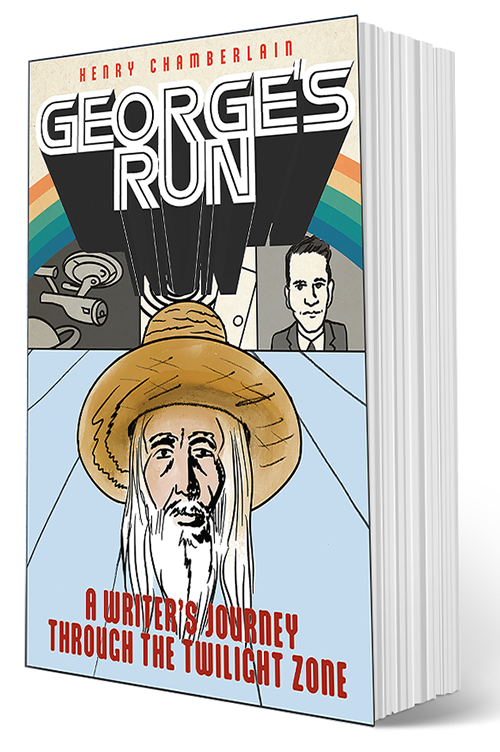
I have an event coming up at San Francisco’s Cartoon Art Museum, 781 Beach Street, on Sunday, August 24th, 2-4pm to talk about my graphic narrative, George’s Run: A Writer’s Journey Through The Twilight Zone, published by Rutgers University Press. It would be so great to have you there if possible.

If you are a science fiction fan, or love various forms of related genres, this is for you. Science fiction acts as a convenient umbrella but, if I was asked to dig deeper in my description, it would be Dark Fantasy. My book is about a group of writers who, individually and in their combined efforts, basically invented a lot of the pop culture we take for granted today. Specifically, I’m talking about the writers behind the original Twilight Zone and Star Trek.

We’ll have a slide show lecture format where I’ll share as much as I can about how I went about creating my book. George Clayton Johnson is our guide, one of the last writers from that 1950s-70s era of golden age television writing. I got to know George pretty well and our friendship led to my book. We’ll have plenty of time for a Q&A as well as overall discussion. I’ll take my cue from the audience. I’m happy to do demonstrations of my art style and chat about making comics too. Feel free to draw or write along the way, and we can share results after we’ve had time to discuss. Hey, this is as open-ended as you like. We might even have some snacks. Seriously, comment here or get a hold of me via email and I’ll consider any ideas.

One step at a time. First, let’s plan on meeting up at the Cartoon Art Museum on August 24th.

Leave a comment

Filed under Comics, George Clayton Johnson, Henry Chamberlain

TERMINAL EXPOSURE book review

Michael McMillan, Terminal Exposure: Comics, Sculpture, and Risky Behavior. New York: New York Review Comics, 2025. 231pp, $39.95.

Review by Paul Buhle

ONTEMPORARY CRITICS’ RECOGNITON of “Outsider Art” can be said to have come early to its precursor, Underground Comix of the late 1960s and 1970s.  “Recognition,” that is, in the best way:  publication—albeit with a real if fleeting audience—far from any recognized, official art scene. Thus artist/nonartist Michael McMillan. A leftover from those days and now past 90, he fairly inhabits this book of his past drawings and sculptures, with a standout introduction by Crumb biographer Dan Nadel and supportive blurbs from the likes of Gary Panter and Bill Griffith.

Nadel takes less than four pages to give us the heart of the McMillan saga, among the more unusual in the always-unusual “comix” world. Son of a railroad office worker and an art teacher, the young artist grew up mostly in Fresno, home of an agricultural empire with the Sierra Nevada nearby. An insular kid drawn to fantasy popular culture, building model airplanes and railroads, also a high school newspaper cartoonist interested in abstract art, he attended the USC School of Architecture just before he found himself drafted into the peacetime Army.

Trying to avoid “predictable boredom.”

Moving to San Francisco after his two-year hitch, McMillan landed, in the late 1950s, in US version of Bohemia. Over the next decade, he worked at various jobs, took art and sculpture classes at San Francisco State and felt himself inspired or confirmed in his inclinations by a 1969 exhibit of the Hairy Who. Would-be successors to Surrealism but conspicuously without the label, the group of Chicago artists lasted only 1966-69, with a couple of group showings in Chicago and one (the one that McMillan saw) in San Francisco. Drawing heavily upon vernacular street visuals, sharing the psychedelic colors, anti-racism and anti-war politics of the contemporary scene, they offered ambiguous but transgressive symbols of a radically shifting public culture. Most of all, arguably, they challenged the contemporary New York art scene. Thereby, they moved close to the sensibilities of the emerging Underground Comics, but from another direction.

McMillan actively sought out comix publisher Don Donahue, living nearby in the city’s Mission District, and arranged publication of a one-shot comic of his own, the instantly obscure Terminal Comix. Recognized and greatly admired among these artists a half generation younger than himself, he remained nevertheless an outsider.

Oddly, the public history of the artist almost ends here, in the 1970s. A handful of comix (after 1980, restyled  “alternative comics”) anthologies, including Robert Crumb’s Weirdo magazine, took him up, usually for one-shot contributions. He earned a  quiet reputation among the artist-editors as someone drawing upon multiple vernacular visual sources, breaking down the barriers between experimental art and comic styles. He made no effort at further outreach, giving himself over to the quiet life of his own sculptures, paintings and prints on his home press. He did it all because he enjoyed the work for its own sake, living cheap and taking little commercial jobs along the way. According to the more notable artists, this self-chosen insularity demonstrated his artistic purity: he had nothing to gain and no interest in gaining it.

The easiest part of Terminal Exposure to describe is naturally the autobiographical five comic pages. Boyhood fascinations with machines, boyish fantasies of heros and adventures followed by fantasies about girls at his school, and above all, riffs on hiking seem to flow forward, however weirdly drawn and narrated. One might say that all of this constituted, already, a way of being alone, learning to be alone, and satisfying himself with that choice.

More pure fantasy dominates the book otherwise. The strips that appeared in the comics anthologies and others very much like them would be the most narrative, a few pages at a time. His characters change, sometimes satirical superheroes or random oddballs. The setting is forever abstract, more than unreal and often humorous but never in the predictable fashion of funnypaper gag strips.

Reflecting his own life or rather his view of his life, these dream-like sagas often take place amid wide horizons, even amid some mild eroticism and occasional nudity. Returning to the fantasy films and pulp literature of his young years, his characters appear in jungles or the high seas. More than occasionally—this is often theorized as the real source of Wonder Woman’s popularity—a miraculous female overwhelms the ostensibly innocent but definitely gratified male, ignorant in the mysteries of biological appeal and incapable of seduction.

Most remarkably, McMillan is also capable of straight-forward memory art, like his experience in climbing mountains of the West, in the half century from 1951 onward. Of his four drawn and otherwise unpublished volumes of illustrated stories, we get two pages of exertion and also escape—from an entangling relationship. This is an artist who, we learn repeatedly and in different circumstances, made the choice to escape relationships in order to be on his own.

The assorted sculptures in the book mean less to this reviewer. They certainly resemble the products of surrealist experimentation with mixed materials and playful human/non-human depictions. McMillan, even more than the collective Hairy Who, makes no editorial, political or any other statement about his his art. It Is.

Trying to reach those “primeval forces.”

The best or easiest to see McMillan’s work is as an extension of comic art forms appropriate to the age of comic/art experimentation, an age that began in the 1960s and has, in multiple ways, continued as fixed forms break down at all levels. By contrast to, say, Pop Art’s stylizing familiar and notably banal comic strip  protagonists and remaking them into studio art, McMillan goes the other direction. They escape Pop Art by posing the issues differently.

Or is this somehow familiar, after all? The last several years have seen a burst of renewed Surrealist activity in its own name,  exhibits in dozens of locations celebrating the centenary of Surrealism’s 1924 birth but also a global art-show interest and an accompanying scholarly surge. Who would have guessed that the younger generation of radicalized graduate students and an evidently wider milieu would re-establish actual surrealist groups in familiar (Prague) and unfamiliar (Helsinki or Sao Paulo) locations, create the Journal of Surrealist Studies or its sponsoring International Society of Surrealist Studies? Why, in a world damaged almost beyond repair, would the long-gone dreams of the 1920s Parisians now find watchers, listeners and zealous disciples?

Your reviewer, publisher of two journals (1967-91) with several special issues organized by the Chicago Surrealists (and mainly Franklin Rosemont) has a special stake in these questions, without any firm conclusions. McMillan, unpublished and unknown, might easily have been a “discovery” of surrealist researchers rather than the underground comix circles. Instead, he may offer a kind of bridge between several worlds, not by dint of any political commitment or any commitment, except to his own imagination and skills.

Whatever the analysis, Terminal Exposure’s content, that is to say also the artist’s work as a whole, can now be said to have been exposed to public examination. Also the artist himself? Probably not,  because without intending to do,  Michael McMillan remains a mystery within his work. Or he has done so by intent, the very reason he stopped drawing for publication just as soon as editors stopped asking?

Paul Buhle

Leave a comment

Filed under Art, Book Reviews, Comics

THE LAST BAND ON EARTH by Elaine M. Will comics review

The Last Band on Earth by Elaine M. Will

The Last Band on Earth. Aritst/Writer: Elaine M. Will. Cuckoo’s Nest Press. 2025. 236pp. $25.

OME YEARS BACK, I REVIEWED A HEARTFELT COMIC. Look Straight Ahead, a graphic novel by Elaine M. Will, struck me as something unusual, in the vein of Nate Powell. Well, here’s the latest by that comics creator, also otherworldly and well worth your time. The connection between music and comics is a strong one. So many comics are inextricably linked to music: both as a source of joy; and as a metaphor for the challenges of pursuing any art form. Elaine M. Will runs with this idea with her story of a band fighting for its chance to make it big and, quite literally, having to fight off demons in the process.

Setting the tone.

Elaine M. Will has been drawing comics since she can remember and has refined her skills through formal comics training and years of creating work. Will is a comics artist who knows how to set the tone, develop characters and pursue her vision. The premise is easy to grasp: Nat and her bandmates in The Dead Layaways want to go on tour, but first they must fight a local gang of demons. The comic offers up a high stakes adventure and delivers with style.

Introducing characters.

We hear so much within the comics industry about the importance of authenticity. Well, Will demonstrates she really believes in it. Every step of the way, successful comics creators are looking for ways to evoke the look and feel of their particular world. If it involves crunchy guitar licks, you better be ready to deliver the goods, which Will does page after page.

Allowing the story to take over.

Once you’ve satisfied the atmosphere and introduced your characters, your story, if it’s worth a hoot, has already made itself known. In this case, we’ve got us an all-out dystopian blow-out: a mix of your favorite horror movie tropes with no guarantee our heroes will survive.

Keep the reader interested and guessing at what happens next.

I have to hand it to Will for managing to sustain that sense of urgency and anticipation which is vital for any successful work of horror. Not only that, Will is also mixing genres. You’ll find plenty of science fiction and coming-of-age tropes here too. Part of this comic’s success has to do with a strong sense of story and, just as important, a love for creating varied images that keep the reader not only interested but curious about what happens next. Remember, monsters can come in all sorts of shapes and sizes. Will certainly understands that.

In the end, here’s a story with plenty of punch and plenty of heart. If only this band of friends could catch a break, maybe they could fulfill their dreams of making beautiful music together. That is unless all sorts of monsters have the last say. With echoes to Will’s Look Straight Ahead, this new graphic novel tackles the age-old challenges of barriers to self-actualization. With any luck, our heroes will win out in the end and defeat any monster. This action-packed, as well as thoughtful and distinctive, comic will win over readers of all ages. I highly recommend this graphic novel to middle school to young adults looking for a fun and inspirational read.

Leave a comment

Filed under Comics, Graphic Novel Reviews

Raymond Chandler’s Trouble Is My Business comics review and author interview

Raymond Chandler’s Trouble Is My Business. w. Arvind Ethan David. a. Ilias Kyriazis. Pantheon Books. 2025. 128pp. $29.

You may think you know Raymond Chandler. Thoughts of the quintessential detective Philip Marlowe and The Big Sleep may come to mind. In order to get to the bottom of it all, I highly recommend that you go back to the original 1939 short story by Raymond Chandler, featuring his most famous hard-boiled detective, Philip Marlowe–and the basis for this new graphic novel adaptation. Let me emphasize that this comics version is a gem. It does, without a doubt, bring up an issue in the zeitgeist that I’ve followed with great interest: re-working this or that classic work to contemporary scrutiny. It brings to mind a question I recently saw posted on Quora: Was John F. Kennedy a woke president? One person began their answer with: “It is not an easy fit, to take ‘woke’ values and apply them retroactively to 1960.” Not only is it not easy, the effort to examine history through a “do-over” lens is problematic. And, in creative works, the results can range from mixed to intriguing. That said, the trend to do do-overs is strong and prevalent ever since Hamilton opened on Broadway in 2015, ten years ago. So, the impulse is there and the question is what do you do with that impulse.

Trouble Is My Business by Raymond Chandler

Trouble Is My Business is a fast-moving Philip Marlowe short story authored by Raymond Chandler (1888-1959), that much we can’t deny. It is a classic noir detective story written by one of the masters. In all the rapid-fire storytelling, surely it would be asking a lot for Chandler to also recast himself as an activist or futurist–but, it turns out, he was far more aware than some may credit him to have been. The do-over strategy is playing with time travel or something beyond the reality of space and time. And perhaps that’s where a writer like Arvind Ethan David steps in to write this comics adaptation. He is no stranger to science fiction. He worked with Douglas Adams as executive producer to the TV adaptation of Dirk Gently’s Holistic Detective Agency. Now, maybe I’m being a bit tongue-in-cheek but I say all this just because I know other purists out there might be having some difficulty with a rethinking of a classic. But let’s take a pause. The way I see it, “a comics adaptation,” or any other adaptation, can utilize whatever options needed to fulfill a certain vision. Arvind Ethan David is no stranger to writing comics adaptations. He has written seven. And that’s only part of quite a remarkable career.

Arvind Ethan David’s approach, as he states in an interview with me, is to open up the story to other voices. He made a point of giving each major character a spotlight, complete with each having their own color palette and lettering font. That’s a tricky strategy, which David readily admits. You’re playing with the delicate balance to a tightly-woven mystery. When you add to a story, the trick is to not upturn the original’s purpose and charm: one gumshoe’s pursuit of solving a mystery. Not only that, we as readers owe it to ourselves to not overlook the original in other ways. For example, if you don’t bother to read the original, you might simply dismiss it as somehow inferior and unenlightened to today’s standards. Chandler’s version has George, a Black chauffeur, with an education from Dartmouth, who holds his own with the main character of Philip Marlowe. That’s certainly forward-thinking without it being forced upon the narrative.

“You’re a better man than I am, Gunga Din.”

Without resorting to spoilers, let’s just say that the impulse to balance the order of things is very strong today and so there’s some tilting of the power dynamics in favor of George in this graphic novel. Again, a tricky matter to pull off but an interesting one. George is elevated a bit in status in this comics version–complete with Philip Marlowe thanking him for his heroics. Marlowe says to George: “You’re a better man than I am, Gunga Din.” But, hey, after Raymond Chandler was given time to recover from a time travel adventure to 2025, he probably would applaud this tinkering with his work! Give the guy some credit. My guess is that Chandler would politely quibble with his relatively plot-driven story being transformed into an even more nuanced character-driven story. Given ample time to soak up the zeitgeist, maybe he would just smile and say that it’s awesome. The guy knew how to read a room.

Harriet Huntress

Chandler’s short story also features a strong woman character, Harriet Huntress. She is a femme fatale and that may distress some readers but this is, after all, noir crime fiction so the character is true to form. It would be ridiculous to apologize for her being a villain. Anyway, she puts Philip Marlowe in his place in both the original story and in the comics adaptation with, as I say, the added benefit of getting her extended point of view in the graphic novel.

George Hasterman

It’s fascinating to read Chandler’s own introduction to his short story. He fears that there’s no way out of following a proven formula to writing a successful mystery. Well, you could argue that some writers today may fear there’s no way out of following a proven formula to writing a successful work that follows the latest trend. As I say during our conversation, I found David’s graphic novel to smoothly thread that needle. Part of what David is after is finding a way to tilt the focus, with a nod to the contemporary, and I believe he has achieved that. In David’s version, you see each major player take the stage in a fuller way, from their own point of view, and you can argue that Raymond Chandler himself would have had no problem with it. And he would have championed the artwork in this book by Ilias Kyriazis too.

So, I welcome re-imagining a classic. That’s not the issue. Just think of Orson Welles’s triumphant 1936 production of Macbeth, which featured an all-Black cast, 80 years before Hamilton. The problem is when people conflate history: mixing different events, time periods or contexts leads to inaccurate understanding of the past. Raymond Chandler’s original storytelling, his language, his artistry, doesn’t automatically require a retelling. Here’s a fine example from the original Raymond Chandler story: a quick snapshot of another strong woman character, Anna Halsey. A line, among so many other quintessential Chandler lines, that Arvind Ethan David uses in his graphic novel version too:

“I need a man good-looking enough to pick up a dame who has a sense of class, but he’s got to be tough enough to swap punches with a power shovel.”

Nice knowin’ ya.

Ultimately, the do-over strategy, or we can call it the Hamilton Effect, still has a lot of gas in the tank and can lead to some interesting results. But, at the end of the day, we will do ourselves a great injustice if we dismiss this or that classic, solely based upon some notion, ill-conceived or otherwise. I’m not saying that is happening in this graphic novel. More discerning readers will appreciate what is going on in this comics adaptation. Chandler’s work does not demand to have new life breathed into it, per se, and withstands being “reworked” in the same creative spirit as other great fiction has been re-imagined, from Shakespeare to Jane Austen. I think, in that sense, we can say that Arvind Ethan David has created a most notable reworking.

I hope you enjoy the above conversation with Arvind Ethan David, the author of this graphic adaptation. Raymond Chandler’s Trouble Is My Business is published by Pantheon Books. Do seek it out. It is brainy, quirky and something Raymond Chandler would give a gracious salute.

2 Comments

Filed under Comics, Interviews

Paul Buhle on Comics Scholarship

The Rise of the Graphic Novel by Alexander Durst

Comics Scholarship

Under Review: Mike Borkent, Comics and Cognition, Toward a Multimodal Cognitive Poetics (Oxford University Press, 2024); Benôt Crucifix, Drawing from the Archives, Comics Memory in the Contemporary Graphic Novel (Cambridge University Press, 2024); Alexander Durst, The Rise of the Graphic Novel, Computational Criticism and the Evolution of Literary Value (Cambridge University Press, 2024); Fabrice Leroy, Back to Black, Jules Feiffer’s Noir Trilogy (Rutgers University Press, 2025);  Jonathan Najarian, ed., Comics and Modernism, Memory, Form and Culture (University Press of Mississippi, 2024); Diana Whitted, ed, Desegregating Comics: Debating Blackness in the Golden Age of American Comics (Rutgers University Press, 2023); Frances Gateward & John Jennings, The Blacker the ink: Constructions of Black identity in Comics & Sequential Art (Rutgers University Press, 2015); Jeet Heer and Kent Worcester, ed., Arguing Comics: literary Masters of a Popular Medium (Mississippi, 2004); Paul Buhle and Abigail Susik, ed., Surrealism, Bugs Bunny, and the Blues: Selected Writings on Popular Culture (PM, 2025).

Essay by Paul Buhle

We comics readers and fans, engaged in the nearly-vanished Funny Pages since we learned how to read old-fashioned ten cent comic books, are likely to be overwhelmed by the reality, let alone the volume, of comics scholarship. One of the scholars under review here quips that comics scholarship is among the most “productive” cultural efforts by sheer volume, in the continuing rise of deconstructive university life. Jobs and salaries depend on something here, and if most undergraduates these days are said to shy away from actual books, the graduate student world offers new horizons. And not only in the US, and not only in English, of course.

It all makes sense, at least some sense, first of all because the number of undergraduates taking courses on comics, or with comics as part of the curriculum, seems to continue to rise. For prospective comics artists or writers, the world of digital comics, at least, can only grow larger and more global.

Krazy Kat mashup. R. Sikoryak, after George Herriman.

Comics history can only be an uncertain part of this large narrative. Ben Katchor, magnum figure in his own artwork but also with his use of comics classes at Parsons, quipped that the word “new” in comics signifies only what is happening today. Very respectfully, your reviewer considers the emergence of Underground Comix as the end of censorship in the creative regions of comic art, and the proper beginning of something new that remains something new. But Katchor certainly has a point.

Desegregating Comics, Diana Whitted, ed.

Historians  of comics will likely feel  that “new” does not reach what they find most interesting. Several of the essays in Desegregating Comics point to the story line and art work of artists in the local (sometimes not so local) Black press, at its comics peak from the 1910s to the 1970s.

Patty-Jo ’n Ginger comic strip (1945 to 1959), by Jackie Ormes: “It would be interestin’ to discover WHICH committee decided it was un-American to be COLORED!”

To take a case in point, Jackie Ormes, creator of the Patty-Jo ’n Ginger strip that ran for a decade in the Pittsburgh Courier (the largest-circulation Black paper for many years), combined fashion, cheesecake and politics in ways impossible for white artists. She was watched closely by the  FBI in the 1940s-50s, and she wrote popular novels that pushed at the edges of racial controversies.

Negro Romance, Fawcett Comics (June-October, 1950)

There are plenty of other cases in point in this remarkable volume, including the rise and fall of Negro Romance during the 1950s, and the post-censorship Black comics full of bemuscled men and full-figured women in states of undress and violent behavior.  Plenty more in these pages offer the reader/scholar a lot to take in and mull.

The Blacker the Ink, Frances Gateward and John Jennings, ed.

An earlier anthology along the same lines by the same publisher, The Blacker the Ink, explores Black comics productive from somewhat different angles. Here we find some analyses of African novels unknown to me, and some superheroes, male and female, like none seen before. Consider pregnant teen Raquel/Rocket who strains to click on her utility belt over a very pregnant belly, in a comic referencing Batman and Robin but with a  Black  superhero Batman and a very un-Robin. Most of all, however, consider artist Aaron McGruder’s Boondocks, hugely syndicated around the turn of the twenty-first century. The Black Power era was long gone by this time but the strip’s star, Huey, won’t let it go forgotten. In referencing a past radical challenge, Huey seriously criticizes the invasion of Iraq and its Black apologist, Condoleezza Rice. Huey, named for Huey Newton, uses the hip hop culture icons to attack the unending white domination of society and the eagerness of some Black elites to become partners of it.

Comics and Modernism by Jonathan Najarian

Historical study can be extended in other ways, as we learn in the essays of Comics and Modernism. Consider this, for example: the promoters of the famed Armory Show of modern art in Manhattan, 1913, challenging and in some ways transforming the US art scene, happened to be….comic artists in local newspapers. Katherine Roeder’s “Modernism for the Masses” has a lot more to say about how the graphic ridicule of cubism in particular inevitably made the ideas about modern art available to a wide audience. And how the Greats, at least some of them (like Winsor McCay) toyed with modernist themes in their drawings, and George Herriman’s Krazy Kat based a certain amount of its strangeness in the internalization of modernist gestures. “While plot and dialogue loop in upon themselves, Herriman’s  customarily changing landscape ramifies with kaleidoscopic consequence for the reader’s eye and comprehension.” (p.77). ( Yes, reader, “ramifies” is a word.)

Surrealism, Bugs Bunny, and the Blues, Paul Buhle and Abigail Susik, ed.

This notion sounds right, and is in line with the general line of commentary on Krazy Kat, one of the most discussed of all comic strips, ever. I ask the reader’s indulgence to add that Franklin Rosemont, Chicago surrealist, was far ahead of this crowd of critic-scholars in his essays on Krazy Kat (also the forgotten Smokey Stover), and that a collection of Rosemont’s writings on popular culture, co-edited by myself and Abigail Susik, has shortly been published: Surrealism, Bugs Bunny, and the Blues: Selected Writings on Popular Culture (PM, 2025). But I digress.

Arguing Comics, Jeet Heer and Kent Worcester, ed.

Meanwhile, the scholarly investigation of women-oriented comics is here to stay, and then some. This is new, so new that the classic collective of the field, Arguing Comics: literary Masters of a Popular Medium (Mississippi, 2004), edited by Jeet Heer and Kent Worcester, has only a couple of women commentators (one of them is Dorothy Parker, on the Red artist Crocket Johnson) and no female artists studied. Since this book’s publication, the exploration has begun in earnest.

Taking a case in point. A rather famous essay, Scott Bukatman’s “Telling Details: Feminine Flourish in Midcentury Illustration and Comics,” argues that by “reading the face” of women in comic strips and comic books, looking hard at the fashions of women in the stories, reveals something beyond the nominal plot narrative. Buried deep in the history of the magazine advertisement and the illustrations of short stories, emerging vividly in “romance comics,” these images offer the real intent. If (as the essayist recalls of his earlier writings), superheroes actually fight crime to wear costumes, romantic comic characters have plots in order to display their stylishness. Makes sense to me.

Drawing From the Archives by Benoit Crucifix

Benoit Crucifix, burdened or graced with probably the most unusual name of any comics scholar ever, argues vividly that comics have always been “about memory,” and the main change is that today’s artists more and more wish to explore the collective memory of comic art itself. Art Spiegelman, who taught comics at the School for Visual Arts (taking over the slot from his mentor, none other than Harvey Kurtzman), is naturally the key case in point. From the 1970s onward, Spiegelman reconstructed comic art tropes of the famous, like McCay, and continued to do so in a famous cardboard-framed special created as a response to living in Manhattan in 9/11.

Not that Spiegelman was alone, in his (and my) generation. Robert Crumb’s uniqueness, stunning in 1970 and hardly less so today, lay in his semi-conscious recovery of tropes from past generations, not only comics but street signage of past big cities, sheet music illustrations, and so on (including the famous Big Feet). Artist Chris Ware and book designer Chip Kidd have lifted this borrowing up to new levels, thanks to the use/manipulation of software and comics archives.

Thanks likewise to ruminations from the likes of Jeet Heer,  the totemic artist Frank King and his genre-inventing Gasoline Alley with its continuity day-by-day treatment of ordinary (white, urban, middle class) life comes back into focus.  That King was the master of the Sunday comic page recuperating museum Modernism could not be an accident. He was a walking encyclopedia.

Back to Black by Fabrice Leroy

Many are the specific studies in this new genre of comics studies. Fabrice Leroy’s study of Jules Feiffer disappoints this reader by treating only his last cycle of works—leaving aside the works that reached us way back in the early 1960s and remain in memory as “underground” before the “underground” had a name in the Counter Culture.  Never mind. The very, very, very close reading of what the critic rightly called the “noir trilogy” would be more satisfying if it had explored further Feiffer’s own family connections with the Old Left (aka Communist Party/Popular Front) and FBI pursuits. That it takes the visual text at literal face value, with plenty of excerpts, is enough. It’s a good book.

We would be a the end of this roaming except for the most difficult of texts. The notion that comics would be suscepitable to “computational criticism” is presumably as new to the readers of Comics Grinder as it is to me. But, still, the idea that a computational study of “brightness” in comics, from Donald Duck (very bright colors) to Frank Miller (very dark indeed) is intriguing.  Can the “digital humanities” gathering together comics sales figures, scholarly and popular reception, escape the overwhelming accumulation of data? I am hoping not to be kept awake at night worrying this point.

But author Alexander Dunst has something else to say, of more identifiable value to this commentator. He describes “the rise of the graphic novel as an instance of aesthetic gentrification.” (179)

This is very real, if not startlingly original. The reader of the graphic novel, at least those intended for adult audiences, is more and more likely to be buying an “art book.” The leading art book publisher in the US and Europe for a half-century, Abrams, dubs its series “ComicArts” (all one word) for good reason. The most “arty” book ever to be edited by the reviewer (along with Harvey Pekar) is Yiddishkeit (2011), published by Abrams. This is proof positive for me, but the most prestigious graphic novels these days are likely in the same category. Chris Ware produces art books that cannot be anything but art books, even with meaningful social content.

Comics and Cognition by Mike Borkent

I would like to offer something lucid on the book Comics and Cognition, but I find the language-framework too hard for me to follow. Comics, with their spatio-topical apparatus, are said to be “tabular” rather than narrative, producing a “sense of sequentiality and rhythm, but refuse a sense of narrative without. Direct connection to referentiality,” amounts to a “panelogic.” (p.201)

Admittedly, this analysis refers to “abstract’ comics so far out of my world that I have no need as well as no capacity to see what is going on. Do we need to Go Gestalt or did those little lines coming out of the feet in comic characters back to the 1910s to indicate motion, seem to come from some place in popular culture that may not be susceptible to Gestalt?

We wonder.

Paul Buhle

1 Comment

Filed under Comics, Comics Scholarship, Comics Studies

Joan Jett and the Blackhearts 40×40 comics review

The deluxe hardcover edition.

Joan Jett and the Blackhearts, 40×40. Ed. Rantz Hoseley, Cat Mihos et al. Z2 Comics. 160pp. 2022. $40 for hardcover.

“Doing Alright with the Boys” by Wiktoria Radkiewicz

Comics anthologies come and go all too quickly. But, given a little time and patience, some will return, emerge, finally arrive. Here is a great case in point, a wonderfully zany comics anthology from a few years ago that is devoted to Joan Jett and the Blackhearts. My guess is that at least half, maybe more, of the talented crew of writer and artists were either too young, or not even born, to enjoy Joan in her heyday. I was. And I can tell you that she hit the pop culture scene (“I Love Rock n Roll” released in 1981) like a bat out of hell, although perhaps a rather polished up bat. Not that I ever had any problem at all with Joan Jett. There was a time when I would have obeyed any order she gave me. Perhaps I still would!

“Bits and Pieces,” written by Barbara Kesel, Line Art by Aneke Murillenem, Color by Kelly Fitzpatrick

Here’s the thing, Joan Jett was (still is) an original and she made it despite the media machine that I think could have easily derailed her career before it even started. Her brand began as a loud and brash singer who loved the old rock ‘n’ roll: a fuzzy nostalgic nod back to some simpler time when you “put a dime in the jukebox, baby.” Huh? This would have been way before Joan Jett’s time. The lyrics made no sense, really. And, at this point, Joan Jett had fallen into the trap of massive marketing packaging. Well it happens to the best of ’em. I’m taking the long view, looking back historically to the earliest days of pop culture.

“Nag,” written by Annie Zaleski, art by Andrea Bell

Put it simply, Joan Jett had the street cred as part of  The Runaways and had to navigate the world of super pop stardom by the time she was part of Joan Jett and the Blackhearts. Another fine example is the marketing make-over that John “Cougar” Mellencamp had to endure and the process he had to go through to prove his own artistic integrity. Like I say about comics anthologies, if you give something enough time, the good stuff will reveal itself.

“You’re Too Possessive” by Hannah Templer

After all, there was always something about Joan Jett. If Elivs Presley could be forced to literally sing to a hound dog, then I think Joan Jett’s real talent and star power could survive having her image oversaturated. I’m sure that too much exposure made it seem like it all came too easy for Joan Jett. On April 18, 2015, over 30 years after her first hit song that launched her career, Joan Jett and the Blackhearts were inducted into the Rock and Roll Hall of Fame. You can’t tell me there wasn’t a lot of resentment and prejudice over Joan becoming a rocker It Girl. But the passage of time wins out. It’s great now to see Joan Jett celebrated in this comics anthology, with fresh eyes, focusing on the music, lyrics and overall vibe. I think what this collection does best is a combination of celebrating the content along with the band’s spirit, and that’s important in this ongoing process that public figures go through, well beyond their own lifetimes. The process to return, emerge, and finally arrive once again, over and over, forever.

Here’s the thing about anthologies. You must have a clear plan of action, a clear theme, and a unified effort. I should be able to call up any two random examples and they should be able to speak to the book as a whole. What I get from this book is an amazing showcase of talent with creators tackling the Joan Jett theme from a wide variety of viewpoints. Yes, it’s very important to know what your anthology is about and this book is very clear and follows through. I would have this book easily nominated for this or that award. I swear, the mighty comics industry, to a very discernible degree, will listen is you’re simply loud enough and this book packs a lot of volume. I am curious to learn more about each and everyone involved with this book. And I’ll do my utmost best to update you on my findings.

Leave a comment

Filed under Comics, Comics Anthologies, Comics Reviews

When We Were Trekkies by Joe Sikoryak comics review

When We Were Trekkies. by Joe Sikoryak. joesikoryak.com. Bundle of 10 issues. 180pp. $35.

Joe Sikoryak, a filmmaker and cartoonist, provides a very moving, funny and unusual comic. As the title implies, it’s about Star Trek but it’s mostly about being a young person and finding yourself. Now, the purists may have problems with my suggesting that Star Trek take a backseat. But fear not, true believers, it all adds up. This is a wonderful coming-of-age story. And you really feel like you’re there with the kids who were the most loyal fans.

So, how do you navigate through your younger years: a time of raging hormones, developing your own identity and being true to your deepest passions? Well, it doesn’t hurt to be with like-minded souls. You find your tribe. In this case, the tribe is all about Star Trek. But, as I suggest, just like American Graffiti was about cars and music, in the end, you want to know if the boy will get to kiss the girl.

Into the fray. The early days of cosplay.

Our story is set in the 1970s in a small town in New Jersey where five young men (ages 16-21) become immersed in the growing fandom for Star Trek, a science fiction television series which ran for a mere three seasons (1966-69) but continued to intrigue new viewers who discovered it on TV as re-runs. Our protagonist, Jonny ( an alter ego of the author) is the youngest member of what becomes a sort of boy’s club (at least in the beginning) with the guys attending Star Trek conventions, participating in cosplay competitions and basically being part of that first wave of diehard fans which would propel interest in more and more Star Trek entertainment, even major motion pictures.

Those wild and wooly early Star Trek conventions.

As I go back and rifle through all ten issues of this graphic narrative, I gotta say there’s a certain feeling of satisfaction at having all the issues together, as if I had painstakingly collected them, one by one. For folks who maintain a pull list at their local comic book shop, you’ll easily relate. I think our author, Joe Sikoryak, couldn’t help but want to evoke that “collector’s high” for the reader. Collecting is a key element of being a fan, which you can unpack any number of ways. Those early fans were collecting re-run views of Star Trek in order to see the bigger picture. That sense of collecting easily overlapped with the experience of collecting a series of comic books in order to experience that bigger picture, the complete run to a particular story. You can proceed from there to any number of other forms of collecting: going to conventions, amassing a network of friends, entering contests, documenting events. And so on.

Geraldo Rivera and William Shatner.

Jonny and his friends get to know all aspects of fandom and even some they probably could have done without, like all the tedious details involved in organizing a group of cosplay competition contestants. In Issue #6, the gang gets up close and personal with how the world-at-large might view Star Trek via the media. By chance, they get to participate as representatives of the cosplay scene by appearing in the audience for Good Night America (1974-77), a sort of spin-off of Good Morning America which Geraldo Rivera ruled over in his distinctively rakish way. Of course, a lot of things get misrepresented. For some goofy reason, there’s a segment with child pitchman superstar Mason Reese providing “expert” commentary. William Shatner, however, is the main focus and he doesn’t let down the true believers. Speaking from his heart, he honestly concludes that there’s something very special about Star Trek and he’s just there to let it happen, not get in its way. And, in similar fashion, I can say that Joe Sikoryak does his best not to get in the way of his own story showcasing young and vulnerable characters. Sikoryak has got a sixth sense about it and, through his writing and his artwork, he truly captures their spirit.

Mason Reese sees it all.

Moving forward to Issue #7, you’ve got my vote for best convergence of pop culture with auto-bio drama in a comic in quite a while. Jonny is utterly infatuated with Ani, a very sexy cosplay competitor who paints her entire body green. Ani and Jonny have just completed a little performance in a hotel lobby when a “celebrity” catches sight of them. Mason Reese, the 8-year-old tophat-wearing-pitchman for pudding and potato chips makes his presence known and quips to Ani: “That’s a very authentic costume. Are you green all over?” Ani, not missing a beat, lifts up her dress to, presumably, reveal everything. The composition is at a discreet angle so it’s left up to the reader but, yeah. Mason’s jaw drops to the floor.

William Shatner and Geraldo Rivera on Good Night America, January 23, 1975.

Now, if we go back to Issue #6, even better than the whole Mason Reese episode, as far as pop culture colliding with memoir goes, has got to be Jonny and the gang in the audience to see Good Night America. As Sikoryak points out in the footnotes to this issue, this really happened. The episode is from January 23, 1975 and is archived on Geraldo Rivera’s website, as well as available on Sikoryak’s website.

Anyway, who says Star Trek can’t help provide enough wit and wisdom to last you a whole lifetime. Jonny seems all the better for it. He does wonder if perhaps he’ll outgrow his love of comics, music and sci-fi, all the things that have been there for him as he faces his rites of passage into adulthood. But, as this comic book will attest, the good stuff never goes away. It will always be around, either riding shotgun with you for the rest of your life’s journey; or waiting to be rediscovered when you need it most. When We Were Trekkies speaks to that kind of powerful energy, not to be taken lightly but to be honored and celebrated just like it is in this most remarkable comic.

The gang’s all here!

1 Comment

Filed under Comics, Graphic Novel Reviews

Parable of the Talents graphic novel review

Octavio E. Butler’s Parable of the Talents: a Graphic Novel Adaptation. By Damian Duffy, John Jennings & David Brame. New York: Abrams ComicArts, 2025. 300pp, $25.99.

Review by Paul Buhle

Perhaps it is the ominous ecological signs that we have been living through, with  a painful added irony, looking back on the declaration of Earth Day in 1970. No doubt it is the worsening of government in every sense with the first Trump administration and now the second. Whatever the reason, the work of the late and great Science Fiction author Octavia E. Butler is now amidst graphic novel adaptations, adaptations like none others.  After a first streamed series adaptation of her novel Kindred, more are already in development. In other words, we are going to hear a lot more from and about Octavia Butler, the first SciFi writer to win a MacArthur (“genius”) Award and more famous in her death than she could possibly be in her own lifetime.

It is fair to say that Butler never deserted, through all her efforts, the ominous and only occasionally hopeful narrative that she adopted almost from the beginning of her work. If it sounds like Afro-Futurism, that would be accurate because she actually did much to invent the genre, so to speak, without giving it a title. Inasmuch as we live, all of us, in a time of ecological disorder and disaster, with the fragmentation of communities all around, and desperation never far away, she pushed the boundaries even further.

Within this daunting framework of her narrative, the situation of non-whites is precarious, to say the least. Whites are almost certain to get the last lifeboats off the sinking ship, and some of the whites will certainly be eager to kill anyone else seeking escape—another anticipation of Trumpism. Not to mention whites, really anyone in power, seizing every opportunity to exploit and degrade minorities along the way. Here is the Butler Dilemma: her nonwhites do not actually live in some distant continent like Africa, surrounded by other non-whites. Everyone shares a location—it happens to be Future California—also sharing a need for relationships, love, family and a means for collective survival. Non-whites or at least her non-whites, most of all women, have accumulated the historical, collective understanding that they need, if only they can express their full creative energies. Amazingly enough, this narrative also portends the possibilty of interracial relationships and even interracial marriage, something rare for literary science fiction to describe right up to the current century—interspecies sex and romance has, somehow, always been easier.

Butler manages this, not by the geographical escape but by blending a  black culture-based spiritualism within a perpetually uneasy hybridity compulsory in the face of the struggle for survival. Only the gay, black SciFi master Samuel Delaney, who swiftly sought to help the young Butler, had dared to go so far in terms of race and sexuality. Butler takes what may be called the next step.

The Parable of the Talents is, in fact, the second outing for its two creators, Adaptor Damian Duffy and artist/professor John Jennings. Kindred (2017) won an Eisner among other awards and it was their effort that reached streamed film adaptation. They create with a sense of confidence that is observable on the printed page. A reviewer wrote of that work that the graphic expression, “brutally jagged, disorientating, gothic, and impactful art” had added a dimension to Butler’s work, a new angle of vision, something achieved in a small handful of past graphic adaptations going back to prize-winning woodcut adaptations of novels (Including Moby Dick) by Lynd Ward. But more jarring.

If Kindred travels back in time as a black woman in 1976—married to a white man—and finds herself on a plantation before the Civil War, then Parable of the Talents moves forward to 2032, seventeenth year of the Pox. A father-figure physician saves the life of an eighteen year old and they struggle to live, even to build a community, up in the mountains of Humboldt County.

Along with its precursor, Parable is certainly among the most ambitious graphic novels ever published, at least in English. Perhaps the narrators/artists might have chosen to reduce the level of detail, including dialogue? Or allotted more space for the physical settings? I think these questions will be distant, not even secondary, to devotees of Butler who are readers of graphic novels. To have devoted herculean efforts to this production is a sufficient accomplishment.

But consider this, in a book actually written and drawn a bit before the 2024 election. We are about halfway through when we realize that that corralling of homeless children, redirected into Christian indoctrination under the regime of a fascistic and power-mad president, is more of a prediction of Trump II than anyone could have predicted.  “It is hard to imagine that it happened here, in the United States, in the 21st Century, but it did. [President] Andrew Steele Jarret scared, divided and bullied people into letting him ‘fix’ the country….his fanatical followers—filled with righteous superiority and popular among the many frightened ordinary citizens who only wanted order and stability—ran amok.” (p. 180).

Of course there were wars, which are viewed here as “useless, ridiculous, obscene” (p.181) and properly so. War feeds the Maw, and that Maw grows later  on, even after a supposed peace is negotiated.  Christianity is here at its worst, or among the worst in two thousand years of intermittent and self-righteous attacks upon non-believers.

Our protagonist, suffering horribly for herself and others, helps lead an uprising that shakes the scene around them even if a national government cannot be overthrown. A destiny of freedom may be reached across generations and across the cosmos if not on Earth. This offers, for Butler but also for current socialistic SciFi writers like Kim Stanley Robinson and China Mieville, a prospect of hope.

2 Comments

Filed under Comics, Graphic Novel Reviews