Tag Archives: Movies

Superman, Apple Pie and MAGA

It’s been a minute since we had a full-on Superman major motion picture with all the trimmings. And this new installment shows with each charming but self-conscious step. It’s like a very expensive and fragile antique has been brought down from wherever it usually hides and one hopes it survives the special occasion that summoned it from its crypt. Superman is like that. Also like the James Bond franchise. Just as you’re getting used to one Bond, they bring in a new model. What was wrong with Henry Cavill? He seems to have a lot of mileage ahead of him. Well, he’s 42. The new guy, David Corenswet, is ten years younger. But there’s no getting around the fact that the actual character goes back to 1938. And, some will argue, Christopher Reeve, in the role of Superman, along with Margot Kidder as Lois Lane, in 1978, will always be the gold standard. In fact, Corenswet seems to be channeling Reeve in a pretty big way. The same with the new Lois, played by 34-year-old Rachel Brosnahan. There’s no doubt that the producers were looking for a certain je ne sais quoi and Brosnahan has that world-weary Kidder vibe down. The script doesn’t bother with formalities with these two and has them all over each other back at Lois’s apartment within a few minutes after the first big action scene. They are so used to each other after dating a couple of months that they let loose with a mildly tense quarrel. It was something else. It made a baby cry in the movie theater I was at.

Now, some talking heads have made a big deal about Superman updating for the age of MAGA. And I think the producers tried to split things down the middle. They gave Clark Kent a new set of parents cut from a MAGA trope: more of a laid-back Southern flavor as opposed to a prim and uptight Midwestern reserve that was the original recipe. Clark was raised in Smallville, Kansas after all, not West Virginia. Anyway, that part is done with kindness. The other part could be hard for some hardcore Trump fans to swallow and that’s stuff like Superman duking it out with Lex Luthor with Superman saying things like, “Yeah, I’m an alien and I’m proud of it. I’m a real person.” and Luthor saying, “I don’t care. The government has given me permission to do whatever I want with you!” Your mileage will vary. You can’t avoid a little sprinkle of politics when you’re dealing with such a colossal cultural figure as Superman. Director James Gunn referred to Superman as an embattled immigrant and that alone has created a bit of a firestorm. Every era has its own Superman and so it goes.

But getting back to the whole idea of a major Superman movie. It does feel like the good china and silverware is being brought out. My harshest view would be that the whole thing feels as if its been embalmed in formaldehyde, lost somewhere in the mist of the 1930s up to the 1970s. Maybe that’s a good thing, the fact that this sort of thing is still being done. It’s a very expensive experiment in entertainment but I can only imagine no one is going to lose their shirt over this. It’s going to appeal to a lot of people but that just goes with the brand. It’s too tempting for too many people. And I think it’s mostly going to be older people too even though efforts are made to make these characters seem youthful. One clue to the tilt toward older viewers, I think, is how Lois and Clark are supposed to be such huge fans of punk music. The way they carry on about their devotion to the punk ethos makes them sound more like people twenty or so years older than themselves. And that makes sense given that 58-year-old James Gunn is the movie’s writer and director. But good for him! I think the love for a beloved subject carries over into one’s life in more ways than one. I’m good with that.

Leave a comment

Filed under Comics, Movie Reviews, Superman

Cartoon Art Museum in San Francisco: George’s Run author Henry Chamberlain 08/24/2025

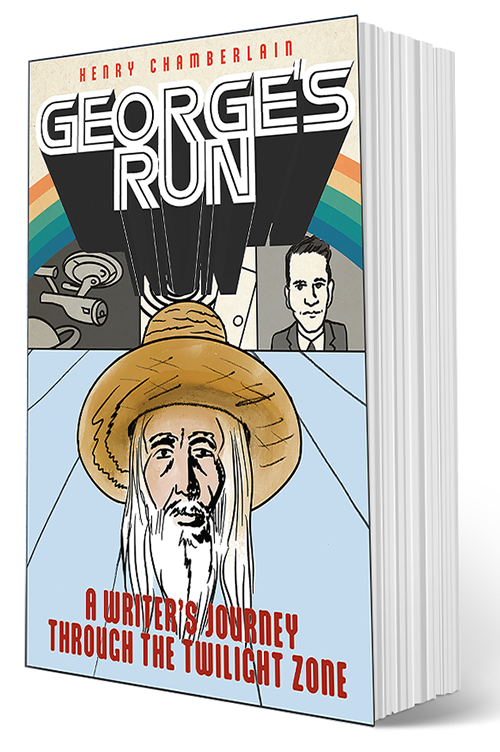
I have an event coming up at San Francisco’s Cartoon Art Museum, 781 Beach Street, on Sunday, August 24th, 2-4pm to talk about my graphic narrative, George’s Run: A Writer’s Journey Through The Twilight Zone, published by Rutgers University Press. It would be so great to have you there if possible.

If you are a science fiction fan, or love various forms of related genres, this is for you. Science fiction acts as a convenient umbrella but, if I was asked to dig deeper in my description, it would be Dark Fantasy. My book is about a group of writers who, individually and in their combined efforts, basically invented a lot of the pop culture we take for granted today. Specifically, I’m talking about the writers behind the original Twilight Zone and Star Trek.

We’ll have a slide show lecture format where I’ll share as much as I can about how I went about creating my book. George Clayton Johnson is our guide, one of the last writers from that 1950s-70s era of golden age television writing. I got to know George pretty well and our friendship led to my book. We’ll have plenty of time for a Q&A as well as overall discussion. I’ll take my cue from the audience. I’m happy to do demonstrations of my art style and chat about making comics too. Feel free to draw or write along the way, and we can share results after we’ve had time to discuss. Hey, this is as open-ended as you like. We might even have some snacks. Seriously, comment here or get a hold of me via email and I’ll consider any ideas.

One step at a time. First, let’s plan on meeting up at the Cartoon Art Museum on August 24th.

Leave a comment

Filed under Comics, George Clayton Johnson, Henry Chamberlain

Pop Culture Bits: George Lucas, Star Wars and Summer

I happened to be in San Francisco recently and found myself doing what has become a ritual for many Star Wars fans: the big visit to see the tech campus that houses the Lucasfilm headquarters in San Francisco, located within the Letterman Digital Arts Center nestled within the Presidio. If you go, it might be a bit of a downer, more of a subdued pilgrimage since you’re only going to get to see the campus (which is, no doubt, beautiful) and then loiter around the reception lobby. There’s a fair amount of movie memorabilia to view but, it’s basically a work place so don’t expect to see your favorite characters ready to pose for photos. I’d be curious to know if any of my readers have made this visit and what you thought. I went in with no expectations or maybe I assumed the space was more lived-in, part of an actual communal library for employees. It’s not. It’s mostly a place to pick up your food delivery, and assorted business, just like any other office.

Amid books and Star Wars figures.

Sadly, I discovered that the library was basically fake. Many of the books are only props: real enough books but only a certain amount that you could call relevant. For instance, there’s a copy of the novel, An Affair to Remember, which was adapted into the 1957 film starring Cary Grant and Deborah Kerr. Okay, that’s definitely movie-related but not really something you’d expect Darth Vader to be reading, am I right? How about another title on these shelves: An Only Child, by Frank O’Conor? I guess that sort of echoes the childhood of Luke Skywalker but that’s a bit of a stretch. Then there’s Pop Culture Mania, by Stephen Hughes: a guidebook on how to collect various items of pop culture ephemera. Closer but not exactly satisfying. But, hey, I’m just being silly, I suppose. That said, I can only imagine there might be some kind of corporate library somewhere beyond the reception lobby. If you happen to work at Lucasfilm, please let me know if you have such a library! Just wondering!

Nevil Shute finds a home in the reception lobby library.

Perhaps the best looking match-up of books on display with curio in the lobby is this combination: A “bust” of a Star Wars storm trooper and a collection of the works of Nevil Shute, a notable science fiction writer. His best-selling novel, On the Beach, first published in 1957, is an all-time classic work of post-apocalyptic science fiction.

It’s the beginning of summer. I’m in San Francisco. George Lucas and Star Wars loom over me. I’m ready to see a Sci-Fi blockbuster! Is one fast approaching? I did overhear some heated conversation on the topic but no industry secrets were revealed, just idle conversation. If you want upcoming attraction news, you can go over here and you’ll be hip to Ryan Gosling set to appear in the next major Star Wars movie in 2027! At one time, Gosling was set to appear in the sequel to the 1976 Sci-Fi cult classic, Logan’s Run but that did not take hold. I believe everything did take hold for Star Wars. So, all’s well that ends well and Nevil Shute finds a welcome home in the reception lobby library of Lucasfilm HQ in SF.

Leave a comment

Filed under Comics, Star Wars

DEAD AIR: The Night That Orson Welles Terrified America book review

Dead Air: The Night That Orson Welles Terrified America. William Elliott Hazelgrove. Rowman & Littlefield. 2024. 280pp. $32.

For six seconds, Orson Welles held his audience in suspense with utter silence during the infamous 1938 Halloween broadcast of The War of the Worlds. This is the linchpin moment vital to this book’s argument that Orson Welles had a malevolent intention behind this most talked about radio scare. Was it a playful prank, an attempt at art, that got out of control? Most will argue that to be the case. William Elliott Hazelgrove, the author of this book, prefers to paint a much darker picture. Whatever the case, you can add this to the mountain of books on Welles and make a note of its intriguing details.

Orson Welles rehearsing War of the Worlds broadcast, 1938.

Orson Welles, given such a vast and complex career, continues to inspire great love and hate. Hazelgrove comes out of the gate exhibiting his scorn like a badge of honor with a bombastic description of what it must have been like for Orson Welles, someone wielding so much power as a star of the dazzling new medium of radio. No doubt, numerous casual listeners to a radio play of H.G. Wells’s The War of the Worlds, adapted to sound like a realistic news broadcast, were innocently caught unawares in 1938 and this resulted in a panic. Hazelgrove turns the screws with his suggestion that Welles should have known better and that a touch of evil must have been at play that night. Now, whether there is more or less truth to this analysis, Hazelgrove sounds very certain. However, keep in mind, that is just Hazelgrove’s suggestion. Smithsonian Magazine presents a case of Welles and his Mercury Players team scrambling to turn their adaptation into something palatable: “The elements of the show that a fraction of its audience found so convincing crept in almost accidentally, as the Mercury desperately tried to avoid being laughed off the air.”

Orson on Mars, sketch by Orson Welles, 1938.

Given that Hazelgrove clearly falls within the anti-Welles contingent, it becomes all the more interesting to continue to read onward as he paints as unfavorable a picture of Welles as he can muster. His next target is the Welles masterpiece, Citizen Kane, which Hazelgrove quickly dismisses as a “famous flop.” In Hazelgrove’s opinion, and this is only his opinion being quoted here: “Undoubtedly, people in 1941 left the theater scratching their heads. Some caught it. Most didn’t.” The popular belief is that Citizen Kane was misunderstood in its own time but that is, in fact, not the case. There are so many facts to work with that can be spun in so many directions. William Randolph Hearst got in the way of Citizen Kane succeeding at the box office but, without a doubt, Citizen Kane, in its own time, was a critical success. So, herein lies the frustration, and fun, in discussing Welles and his work. There is more than enough room to spin the facts and tilt your argument in one direction or another. All in all, Hazelgrove offers up an engaging and highly readable addition to Welles scholarship. I don’t have to completely believe him or agree with him and you don’t have to either but, like Orson Welles himself, Hazelgrove offers something lively and highly relevant for further discussion.

2 Comments

Filed under Book Reviews, Orson Welles

The Apprentice: An American Horror Story movie review

The Apprentice: An American Horror Story. Director: Ali Abbasi. Writer: Gabriel Sherman. Starring Sebastian Stan. Jeremy Strong. Maria Bakalova. 2024.

Even the most loyal fan of Donald Trump will likely find something to appreciate from the Trump biopic, The Apprentice: An American Horror Story, which, by no small measure, is like what Citizen Kane was for William Randolph Hearst. The Trump film is not attempting anything as grandiose as redefining filmmaking but, while Trump’s lawyers would argue otherwise, it can hardly be dismissed as a “hit job.” No, this film is significant. As a story of one person’s descent into the abyss, it is impossible to resist the pull of this film. While it may seem, at first, to be merely framed within the confines of a biopic, it has a certain grace and gravitas all its own, with a distinctive degree of horror. I’ll demonstrate with a series of storyboards I created on the fly while viewing and later refined a bit.

And, one day, this will be Trump Tower!

The opening shots set the tone for an ambitious film with a young Donald Trump, circa 1974, the big player center stage. He is gallivanting through the decay and despair of economically throttled New York City. His eye is on the eyesore of the once opulent Commodore Hotel, the long dead crown jewel of a bygone Grand Central Terminal super-block. The young Don sees a way back to the glory days but that story is yet to unfold, a quintessential example of graft in the extreme.

Hi, I’m Donald Trump.

Steadily, we reach the core theme with the first meeting of young Don and the infamous take-no-prisoners super lawyer Roy Cohn. Early on, Cohn is impressed that Donald has managed to schmooze his way into membership to the same elite club he belongs to. He sees potential in the handsome bumbler.

Rules of the Game.

As his mentor, Cohn teaches the Donald the rules of the game, if you want to win at any cost: Rule 1: Attack, Attack Attack; Rule 2: Admit Nothing, Deny Everything; and Rule 3: Claim Victory, Never Admit Defeat.

Dinner with the Trumps.

So much of the raw content that makes up this film is bits of facts we’ve heard before but the film manages to look at them from a different angle as during a family dinner scene. There’s the patriarch, Fred Trump, openly belittling the eldest son, Fred Jr., for never having amounted to anything important. Fred Trump does not come across as an over-the-top villain, just a miserable person. There’s a deadening acceptance by everyone at the table that Freddy is a failure, not up to Trump standards. It is one of the most sorrowful Trump family facts that is a recurring motif.

It was love that didn’t stand a chance.

Why can’t Fred Jr. find his place in the world or why is it that the Trump family can’t seem to find a way to make him feel welcome? The answer is that Freddy doesn’t have the killer instinct. But Donald does–and that makes all the difference in the world.

No love to spare.

Again, at its core, this is a film about Donald and Roy Cohn. It turns out that the sorcerer’s apprentice has learned his lessons all too well. The tone of the characters drops from dark to darker and even pitch black at times. We see Don out to win at all costs. There’s a good amount of time spent depicting Donald stalking Ivana before he made her his bride, only to later assault her and discard her. Given enough time, Don will even discard his beloved mentor, Roy Cohn.

Young Donald Trump.


Of course, the film is self-conscious of its subject, its relevance and its undeniable connection to Citizen Kane. There’s a blink-and-you’ll-miss-it moment with the young Don in his bachelor pad viewing Nixon on TV while in the background there’s a big movie poster of Citizen Kane.

Trump’s Rosebud.


The final frames of the film zoom in on Trump, now a full-fledged killer in the game of life. And, just like a fanciful scene from Citizen Kane, the camera closes in on his eyeball, an American flag waving from within. While not a perfect match, the Citizen Kane/The Apprentice comparison is definitely worth discussion. It’s interesting for me to discover, having lately been reading up on Orson Welles, that there was a growing consensus by critics, when Citizen Kane was released in 1941, that somehow that film failed to capture something. When you tallied it all up, Charles Foster Kane remained an enigma and perhaps not someone even worthy of so much attention. Well, from today’s point of view, that uncanny hollowness makes the film all the more alluring. Also, from today’s point of view, it should give us all quite a shudder.

Leave a comment

Filed under Comics

William Shatner: You Can Call Me Bill movie review

You Can Call Me Bill. Legion M. written and directed by Alexandre O. Philippe. 2024.

Pop culture documentary filmmaker Alexandre O. Philippe directs but, I suspect, William Shatner leads, even commands the scene, in this new film about his life and times. It could really be no other way. As the saying goes, any actor worth his salt can recite the phone book and turn it into compelling entertainment. That, indeed, is what Shatner is all about. Right from the start, it is Shatner who is the boss as he hits the ground running, speaking in awe about the wonders of the world around him, alternating between hushed tones and a booming voice.

William Shatner in the graphic novel, George’s Run.

I know a thing or two about pop culture myself and I can tell you that, as many times as you’ve seen William Shatner (easily one of the most filmed persons in human history), you haven’t seen him quite like this and I mean the cumulative result you get in this documentary from hearing him out as he masterfully, even miraculously, never loses the thread to some of his more ambitious dramatic leaps of faith. The documentary does a great job of seamlessly alternating between interview segments with Shatner in the present and classic clips from his career. There’s one priceless clip, for example, where Shatner is given the stage at the Golden Globes in order to set up the next segment, some sort of lifetime achievement award to George Lucas. Shatner, at first, appears to be genuinely befuddled as to whether or not he’s at some Star Trek event. There’s a quick cut over to George Lucas who looks perplexed and not at all amused. And then, presto, Shatner reveals a prop at just the right moment: a piece of paper, presumably notes he was supposed to have read telling him he’s there to honor Lucas. At just the right moment, the audience is in on the joke and Shatner receives well-earned laughs and applause. And that, in essence, is what this documentary is all about: one segment after another giving way to one clip after another, all in the service of painting a bigger picture of a savvy and hard-working entertainer/sage storyteller. It’s the stuff of legend and, heck, totally transcends any mere pop culture theme. This is the story of someone who must live life large, who came of age in an era that celebrated such a journey, and who has never stopped.

Excerpt from GEORGE’S RUN.

In my graphic novel, George’s Run, published by Rutgers University Press, I recount in various ways the golden age of television that gave us such gems as the original Twilight Zone and Star Trek. I don’t just give you a few examples of some beloved moments from these shows but provide context regarding the key players, primarily the writers but also the actors (particularly William Shatner and Leonard Nimoy) who helped to fuel and build the evolving creative sparks into so much more.

This doc sets Shatner loose to be himself, and, in doing so, provides a great service. In somewhat similar fashion, Leonard Nimoy got his chance to set the record straight in 2016’s For The Love of Spock, directed by his son, Adam Nimoy. If you happen to see both, you’ll get what amounts to one of the best tributes to both of these actors who, by their own grit and high level of integrity did much to secure the course and fate of the USS Enterprise.

5 Comments

Filed under Comics, Movie Reviews, Star Trek

Roger Corman (1926-2024), An Indie Film Maverick

Roger Corman’s “The Intruder,” featured in the graphic novel, “George’s Run.”

Roger Corman (1926-2024) was a dedicated filmmaker who, by just doing what he loved, managed to carve out a place in cinema history. At the end of the day, he’s one of the great indie film mavericks, whether you happen to be a fan of the B-movie horror genre or not. Heck, the guy practically invented it! Corman addressed what he was doing as a business as much, or more so, than an art pursuit. For the most part, his movies were meant to entertain with chills and thrills for a teen audience at a drive-in.

Charles Beaumont’s controversial novel was a risky choice to adapt into film.

That said, from time to time, his films would demonstrate more than a strict profit motive. In fact, in 1962, you would have been hard pressed to find any movie director who would have considered adapting Charles Beaumont‘s 1959 incendiary novel, The Intruder, an indictment on racism in America. It was not the sort of novel that promised any profit but certainly promised a lot of trouble.

From George’s Run: George and Bill find themselves cast in “The Intruder.”

Despite all the risks (the film was shot in the rural south), Corman went full steam ahead and made a movie that didn’t return anything close to a profit until decades later when it was rediscovered by film enthusiasts.

Before Star Trek, William Shatner starred as the racist villain in “The Intruder.”

Now, here is where some folks might conflate Roger Corman with being attached to science ficiton. No, he was a horror guy but he did cast William Shatner in the lead role in The Intruder as the villain, the outside agitator who stirs up racial unrest in a sleepy little town. Before Star Trek, our very own Captain Kirk was a ruthless and spineless villain!

This is the book for any fan of comics, pop culture, and great stories!

It is my honor to include the story of the making of The Intruder in my graphic novel, George’s Run, published by Rutgers University Press. I can appreciate how it’s easy to conflate the various players during the ’60s, a highly creative time in both television and film. In this case, the players, genres and mediums all seem to blend in together as you have two pivotal talents, television writers George Clayton Johnson and William F. Nolan, participating as actors in a film that is based on a novel by another key writer, Charles Beaumont, who was a central cohort of the group of writers who worked separately and together on various projects, including the original Twilight Zone and Star Trek. And then, just to add to the multi-layered and high octane theme, you have William Shatner leading the way. I’m sure all of this creative energy and artistic passion was not lost on Roger Corman. It was quite a fortuitous combination of talents and viewpoints and Corman must have given it all a confident nod. Full steam ahead.

2 Comments

Filed under Comics, Horror, Obituaries, Roger Corman

UNFROSTED Directed by Jerry Seinfeld movie review

Unfrosted. Directed by Jerry Seinfeld. Netflix.

Jerry Seinfeld’s new movie, Unfrosted, as Tony the Tiger would say, is great! It’s great for more reasons than you might think. First and foremost, it’s funny as it keeps to its theme, basically that of our love/hate relationship with American consumer culture (at its zenith in the early ’60s), and just runs with it with sincere passion and goofy humor. The whole thing rings true in a way that you can’t fake, managing to unlock that secret code that usually eludes Hollywood of creating a homage piece in the style of the thing being honored, in this case, the broad and frenetic ’60s comedy. It doesn’t feel at all like a contrived attempt but, in fact, the culmination of a lifelong love for a certain moment in time. Any fan of Jerry Seinfeld’s standup comedy knows that he loves, and loves to poke fun at, the simple pleasures in life, like the Pop-Tart.

This movie is all about Pop-Tarts and then some. It’s everything that you would expect from a comedy that is like a classic ’60s comedy: somewhat higher production value, family friendly, usually with a cavalcade of comic actors and unapologetically nonsensical. I don’t think I’m giving anything away (but spoiler alert nonetheless) when I say that this is the kind of movie that invests a lot of time and energy in establishing that the milk industry is having a very hard time with the emergence of a product that will replace cereal. Did Pop-Tarts ever really threaten to replace cereal? Don’t Pop-Tarts go great with milk? Toss any serious arguments aside and just bask in the playful satire, including spot on jabs at John F. Kennedy (Bill Burr) and remarkable send-ups of Walter Cronkite and Johnny Carson (both by Kyle Dunnigan).

Kyle Dunnigan, as Johnny Carson.

This whole movie is a hilarious send-up of ’60s culture from the race to the moon to the race to the consumer. Just add milk, and I’m sure this movie will deliver some good laughs. It’s certainly not meant to be taken too seriously, at least not in any obvious way. That said, it has its own special social commentary particularly focused upon American exceptionalism. A highly polished report could do no better. This gentle well thought-out and heart-felt comedy has plenty to say and with a stellar cast, including everyone from Hugh Grant to Amy Schumer to Jim Gaffigan to Melissa McCarthy. In fact, this movie has some great child actors, including Eleanor Sweeney who helps in the mad pursuit to invent the ultimate breakfast treat. If these young stars of tomorrow can not only appreciate the humor in this movie but help to make it shine, then there’s still hope for the rest of us.

Leave a comment

Filed under Movie Reviews, pop culture

Urban Nerd Con in Atlanta, April 26-28, 2024

The Urban Nerd Con is something new and exciting for pop culture fans, with a focus on diversity. If you are in the Atlanta area later this month, check out this event: April 26-28 at the Courtland Grand Hotel, located at 165 Courtland St. NE, Atlanta, GA 30303. More details and press release follows:

Continue reading

Leave a comment

Filed under Comics, Comics News

The Girl Who Handcuffed Houdini by Cynthia von Buhler comics review

Minky Woodcock: The Girl Who Handcuffed Houdini. by Cynthia von Buhler. Titan Comics. 2018. 112pp. $24.99

Having reviewed the Tesla book, it only makes sense for me to go back and review the Houdini book, the first in Cynthia von Buhler’s Minky Woodcock crime noir series. I like how von Buhler gives both men the treatment by exposing their peculiarities and destructive tendencies.  In the case of Houdini, he was hell bent on demolishing the industry of seances, spiritualism and fortune telling. That kind of intense zeal triggers deadly enemies. Our story begins when, Sir Arthur Conan Doyle, one of spiritualism’s biggest defenders, wishes to enlist the detective agency of Woodcock & Son to get to the bottom of Houdini’s own supposed magical powers.

From Murray Hill to Park Avenue to Montreal.

The only problem is that Minky Woodcock is the only one available and not exactly Sir Arthur’s first choice. Be that as it may, Minky manages to not only ingratiate herself with Doyle but with Houdini and his wife, Bess. Minky gets in so deep that she’s even trading places with the most notorious of seance mavens, Margery of Boston, who is famous for presiding nude over her events and emitting mysterious protoplasmic fumes from her body. Margery has a way of intruding into personal spaces that her collaborators find intoxicating. All except for Minky, who easily sees through Margery’s scam.

It’s a delight to have gone back and read this first book in the series as I appreciate all the more von Buhler’s storytelling and artwork. If it’s not clear by now, this book is for mature readers, starting with older and wiser teens. This is in the best tradition of pulp fiction with its own sense of discretion, most interested in achieving a light entertainment. That brings to mind master illustrator Robert McGinnis, known for his iconic movie posters (Breakfast at Tiffany’s, The Odd Couple and James Bond), who provides the cover art for the first single issue to the Houdini story. And, with that image, in all its wildly vintage sensibility, you get a quick idea of the marvelously retro content you will find inside. So, if that’s your cup of tea, then you’ve found a very special blend.

3 Comments

Filed under Comics, Comics Reviews