Tag Archives: Science Fiction

Cartoon Art Museum: On Putting on a Show and Making a Case for Storytelling

Cartoonist Henry Chamberlain

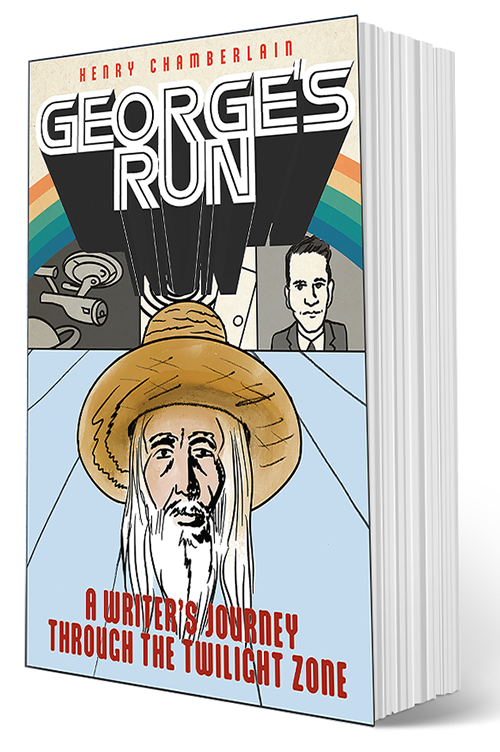
Those of us who create books of one kind or another must be mindful of the next step in our work’s journey, once it’s complete, published, and out in the world: the never-ending job of making more people aware of the book! My graphic novel, George’s Run: A Writer’s Journey Through The Twilight Zone, was published by Rutgers University Press in 2023. It was a pleasure to get a chance to give a talk and lead a workshop in support of my book at the Cartoon Art Museum in San Francisco.

Photos by Robbie Gomez.

The Cartoon Art Museum is a landmark in the local arts community and has the distinction of being one of the few museums dedicated to the comics medium. I have followed the museum’s progress since its time in San Francisco’s Yerba Buena Gardens neighborhood when Andrew Farago became its curator in 2005. Fast forward to 2017, the museum moved to its current location on 781 Beach Street on Fisherman’s Wharf. I’ve always found it to be a reliable source of inspiration with its impressive works on display, from new shows and its permanent collection. If you’re someone who has established a credible footing in this business of comics, you might find yourself invited to show your work here. I want to thank both Andrew and museum director Summerlea Kashar for helping make my presentation possible.

I have experience with leading presentations of one kind or another, notably a slide show lecture format which I first did when I led a panel discussion at San Diego Comic-Con. That said, I’ve been adding and refining notes attached to it ever since. I have found it easy to refer to notes and then break off into other directions. Lately, I’ve focused on an unusual zine that Marc Zicree (The Twilight Zone Companion) gave me a while ago. It’s a term paper he wrote in 1976, when he was 21 years-old. Marc’s paper features interviews with three significant figures from the Sixties zeitgeist: political cartoonist Ron Cobb; novelist Theodore Sturgeon; and television writer George Clayton Johnson. In his introduction, Marc makes clear how moved he is by Sturgeon’s uncanny ability to evoke the concept of love in his work. As for George Clayton Johnson, the subject of my book, Marc is mesmerized by George’s uncanny ability to speak virtually indefinitely on a wide variety of subjects. I carefully combed through Marc’s interview with George, and, just as important, Marc’s interview with George’s mentor, Mr. Sturgeon. What is clear is how much both men revered storytelling, which is at the heart of what my book is about–and, ultimately, my talk.

Once I start talking, I sense a detour up ahead. I had just mentioned the challenge of conveying the significance of a television show of the caliber of The Twilight Zone to a young audience unfamiliar with it when I found myself confronting a fresh new example in my audience for that day. Literally, only a few minutes prior, I had said that a young man had seemed to dare me at a comics convention when he told me outright that he’d never seen even one episode of The Twilight Zone. Right after that, a young man that day in my audience seemed to take it up a notch by telling me that he didn’t watch television at all. I was now juggling at least a couple of ideas going well beyond just being unfamiliar with a certain television show. Part of what I think was going on here is that the young man was, perhaps unintentionally, mirroring what I had just said. I gave it some thought and emphasized the fact that we all need to get as clear an idea of the big picture: seeking out great storytelling.

I went on to say that, when I’m given a dare to explain myself and make my case, I’m more than happy to break it down. In fact, the determination to break down ideas into concise and accessible elements took a life of its own in my book. That’s a vital part of the book: guiding the reader through the creative process that led to The Twilight Zone, one of the greatest works of television on many levels, not the least of which is the writing. My book is about the writers who made this possible. Overall, I think folks enjoyed what I had to say. Getting back to Marc Zicree’s 1976 term paper, one concept that keeps popping up is the steady encroachment of mass media and related distractions. This is well before even the internet and it already seemed like people were drowning in a flood of data. No wonder some young people today might think they don’t have time for “television.”  I know it was very helpful for me to give this talk and the feedback will help fuel the next one.

It was my intention to offer more than enough stuff to cover within my two-hour window. During the talk, I encouraged the audience to begin drawing their own tribute to their favorite TV show. By the end, we had a few interesting submissions. I want to thank Chartpak for partnering with me and providing the art supplies for this portion of the event. I will provide a separate post that features the Chartpak marker that I used for my art demonstration. I want to invite everyone to check out the Chartpak factory store for an incredible selection of art supplies.

Thanks again to the Cartoon Art Museum for an amazing event and I look forward to many more visits in the future. And special thanks to photographer Robbie Gomez for these amazing photos.

6 Comments

Filed under Comics

The Spawn of Venus and Other Stories Illustrated by Wallace Wood book review

The Spawn of Venus and Other Stories Illustrated by Wallace Wood. Seattle: Fantagraphics, 2025, 216pp. $39.99.

Review by Paul Buhle

The Great Bohemian of comic books’ grandest moments, Wallace (aka “Wally”) Wood drew like a genius for a number of publishers before falling to overwork, too many cigarettes and too much liquor. EC loved him the best, and it was a mutual feeling, notwithstanding the inevitable tensions of artist, collective/collaborative work process, and the reality of a boss.

Wally Wood in his prime, excerpt from “My World,” Weird Science #22, 1953.

This splendid volume collects some of his finest Sci-Fi—he was also among the greatest satirical artists for Mad Comics—from forgotten series titles like Weird Science, Weird Fantasy and Incredible Science Fiction of the early 1950s. It also offers much woderful contextual material, commentary by serious scholars—university professors but mostly otherwise—to individual stories and collaborations, from editors to scriptwriters to presumably lowly inkers.

Most “classics” comic art volumes these days contain a hat-tipping of industry insiders. Same here. Howard Chaykin, vaunted comic artist (and a short time assistant to  Wood)  does not have a lot to say beyond describing Wood’s talent, nor does the appropriately admiring Larry Hama, of today’s GI Joe, itself a remnant of another and in this case, less pleasant, aka Cold War, comics era. S.S. Ringenberg, a comic scriptwriter, and fan-interviewer works harder with a biographical introductory sketch that goes little beyond ground familiar to Woods devotees, but reminds us sharply of the nature of the self-destructive genius. Wood put a gun to his head in 1981, leaving no note. The career disappointments were real, especially for an artist who worked hard at improving his style. But by that time, two divorces and a separation, he became too exhausted to keep himself in check. Besides, the glory years of the older comic art had been long past, and he was not suited to the new comix generation. His barely controlled artistic id did not find a home in the ill-paying Undergrounds.

Meanwhile, in the substantial Introduction,Tommy Burns and Jon Gothold go through the stories one by one, in such detail that no biographer of a novelist may ever have done better. Do we need such detail? Perhaps not every reader will think so, but among the plot summaries, these scholarly-minded critics offer so many small insights that the net result is remarkable, and demands several readings for details.

Wood reached his apex, arguably, in adapting the stories of Ray Bradbury, and this tells us much of what need to know about the vital and lasting importance of Wood’s work. This reviewer came upon Bradbury’s writings around age 10 or 11, in the Republican political/cultural climate of Central Illinois where the perceptions of sophisticated New Yorkers, for instance, would have been unusual and likely mistrusted. Mad Comics explained McCarthyism in the most penetrating and hilarious fashion. Bradbury, who was personally close to the Hollywood Blacklisted, found ways in his stories and novels to explore the takeover of public space, the waning of the New Deal stress for reform in favor of forced patriotism, but also unapologetic commercialization of daily life. He saw the future and it looked bad.

Thus, famously,  Fahrenfeit 451 and The Martian Chronicles, made into feature films but only after the worst of McCarthyism had faded. Bradbury had been trying for years to send out warnings, even while he was making a living and a reputation (including a personal move to Hollywood)  in a Sci-Fi field with leftist underpinnings going back to the 1930s. He also badly wanted to escape being pegged as a “genre writer,” but never made it and did not need to: we loved him anyway.

Photo funnies tribute in The Spawn of Venus and Other Stories.

Wally Wood so internalized the logic of Bradbury that stories composed by others at EC somehow have the “Bradbury Touch” in addition to the EC Touch, which consists—leaving aside the art— in terse scripting and a surprise ending. Like the alien civilization in “He Walked Among Us,” where the Savior was actually an Earthman who preaches love and forgiveness is executed. Two thousand years (!) later, another Earth visitor learns that the aliens’ holy symbol is the rack, aka cross, where the presumed savior was tortured to death.*

You get the idea. Human folly in the Atomic Age has become toxic. Wood could have predicted what a willful destroyer like Musk would write about opening up the need for “planetary” civilizations when Earth has been plundered beyond repair.

Not that all the stories are like this. And Bradbury could not have featured the scantily-clad beauties, alongside the virile young males, that seemed to be a specialty for Wood. Earthmen fall in love with alien females who assume a delicious human form only… to revert back, inspiring horror. Humans landing on a distant planet learn that the babies born to them, urgently wanting love and care, may have a dozen arms and look like octopi or something else weird (in this case, mommy does not care, which sounds right).

How were Wood’s females all so young and buxom, you might ask? The mostly male and young readers of these comics didn’t likely ask at all. The happy dreamers of another story are space explorers kidnapped to service the all-female population of a planet whose males have died out after a war. The “scientifically selected” dames look awfully familiar.

Wood could also favor social criticism–with a dark turn. In one story here, tens of thousands of Earth people who disappear in bunches, every few hundred years, turn out to be farm edibles, as a scientist explains over…a turkey dinner. Actually, this was an EC Sci-Fi trope several times over, like the aliens in another EC comic who capture interplanetary humans to use their skins for…fashionable minkish coats, and so on. Why do we egotistical Homo sapiens think we can abuse the animal kingdom?

From “Spawn of Venus”

Wood also loved the occasional in-joke, with a drawing of himself in the final panel. Here, EC Comics miraculously predict unexpected events, like the appearance of flying saucers, or the rise of surgical sex change (think “Christine” Jorgenson in tabloid headlines of the time). A jowly comics publisher (could it be plump William Gaines, who inherited EC when his father died in a boating accident?) wants them to take “a loyalty oath” (cue to Joe McCarthy). After some alien hi-jinks, the real Wally confesses that he and his fellow artists are actually disguised Venusians saving the world from horrible-looking Martians!!! What those helpful Venusians might look like beneath their disguise…we will never know.

In the real world, EC’s marvelous Sci-Fi, “Real War” and humor series (MAD and PANIC) never reached the sales level of its various, blood-dripping but also deeply satirical horror comics, also full of plot reversals and revenge-justice. Gaines was called upon, in the famous Congressional hearings (held in the same Manhattan courtroom as “Red” hearings a few years earlier), to explain the horror as something less than dangerous to young minds. The inquisitors weren’t listening to his answers, and the guillotine blade fell on a glorious moment in popular art.

Wally Wood outlived his time, this is the tragedy of his life and not only his. Harvey Kurtzman and his trusted artists hit their peak as satirists, also arguably as editors and artists, in their twenties and early thirties. Some became highly successful illustrators. None could recapture the magic.

Paul Buhle

*Let it be known that the Ray Bradbury Museum rests in the blue collar city of Waukegan, Ilinois, which only happens to be my wife’s hometown.

Leave a comment

Filed under Book Reviews, Comics

THE LAST BAND ON EARTH by Elaine M. Will comics review

The Last Band on Earth by Elaine M. Will

The Last Band on Earth. Aritst/Writer: Elaine M. Will. Cuckoo’s Nest Press. 2025. 236pp. $25.

OME YEARS BACK, I REVIEWED A HEARTFELT COMIC. Look Straight Ahead, a graphic novel by Elaine M. Will, struck me as something unusual, in the vein of Nate Powell. Well, here’s the latest by that comics creator, also otherworldly and well worth your time. The connection between music and comics is a strong one. So many comics are inextricably linked to music: both as a source of joy; and as a metaphor for the challenges of pursuing any art form. Elaine M. Will runs with this idea with her story of a band fighting for its chance to make it big and, quite literally, having to fight off demons in the process.

Setting the tone.

Elaine M. Will has been drawing comics since she can remember and has refined her skills through formal comics training and years of creating work. Will is a comics artist who knows how to set the tone, develop characters and pursue her vision. The premise is easy to grasp: Nat and her bandmates in The Dead Layaways want to go on tour, but first they must fight a local gang of demons. The comic offers up a high stakes adventure and delivers with style.

Introducing characters.

We hear so much within the comics industry about the importance of authenticity. Well, Will demonstrates she really believes in it. Every step of the way, successful comics creators are looking for ways to evoke the look and feel of their particular world. If it involves crunchy guitar licks, you better be ready to deliver the goods, which Will does page after page.

Allowing the story to take over.

Once you’ve satisfied the atmosphere and introduced your characters, your story, if it’s worth a hoot, has already made itself known. In this case, we’ve got us an all-out dystopian blow-out: a mix of your favorite horror movie tropes with no guarantee our heroes will survive.

Keep the reader interested and guessing at what happens next.

I have to hand it to Will for managing to sustain that sense of urgency and anticipation which is vital for any successful work of horror. Not only that, Will is also mixing genres. You’ll find plenty of science fiction and coming-of-age tropes here too. Part of this comic’s success has to do with a strong sense of story and, just as important, a love for creating varied images that keep the reader not only interested but curious about what happens next. Remember, monsters can come in all sorts of shapes and sizes. Will certainly understands that.

In the end, here’s a story with plenty of punch and plenty of heart. If only this band of friends could catch a break, maybe they could fulfill their dreams of making beautiful music together. That is unless all sorts of monsters have the last say. With echoes to Will’s Look Straight Ahead, this new graphic novel tackles the age-old challenges of barriers to self-actualization. With any luck, our heroes will win out in the end and defeat any monster. This action-packed, as well as thoughtful and distinctive, comic will win over readers of all ages. I highly recommend this graphic novel to middle school to young adults looking for a fun and inspirational read.

Leave a comment

Filed under Comics, Graphic Novel Reviews

Pop Culture Bits: George Lucas, Star Wars and Summer

I happened to be in San Francisco recently and found myself doing what has become a ritual for many Star Wars fans: the big visit to see the tech campus that houses the Lucasfilm headquarters in San Francisco, located within the Letterman Digital Arts Center nestled within the Presidio. If you go, it might be a bit of a downer, more of a subdued pilgrimage since you’re only going to get to see the campus (which is, no doubt, beautiful) and then loiter around the reception lobby. There’s a fair amount of movie memorabilia to view but, it’s basically a work place so don’t expect to see your favorite characters ready to pose for photos. I’d be curious to know if any of my readers have made this visit and what you thought. I went in with no expectations or maybe I assumed the space was more lived-in, part of an actual communal library for employees. It’s not. It’s mostly a place to pick up your food delivery, and assorted business, just like any other office.

Amid books and Star Wars figures.

Sadly, I discovered that the library was basically fake. Many of the books are only props: real enough books but only a certain amount that you could call relevant. For instance, there’s a copy of the novel, An Affair to Remember, which was adapted into the 1957 film starring Cary Grant and Deborah Kerr. Okay, that’s definitely movie-related but not really something you’d expect Darth Vader to be reading, am I right? How about another title on these shelves: An Only Child, by Frank O’Conor? I guess that sort of echoes the childhood of Luke Skywalker but that’s a bit of a stretch. Then there’s Pop Culture Mania, by Stephen Hughes: a guidebook on how to collect various items of pop culture ephemera. Closer but not exactly satisfying. But, hey, I’m just being silly, I suppose. That said, I can only imagine there might be some kind of corporate library somewhere beyond the reception lobby. If you happen to work at Lucasfilm, please let me know if you have such a library! Just wondering!

Nevil Shute finds a home in the reception lobby library.

Perhaps the best looking match-up of books on display with curio in the lobby is this combination: A “bust” of a Star Wars storm trooper and a collection of the works of Nevil Shute, a notable science fiction writer. His best-selling novel, On the Beach, first published in 1957, is an all-time classic work of post-apocalyptic science fiction.

It’s the beginning of summer. I’m in San Francisco. George Lucas and Star Wars loom over me. I’m ready to see a Sci-Fi blockbuster! Is one fast approaching? I did overhear some heated conversation on the topic but no industry secrets were revealed, just idle conversation. If you want upcoming attraction news, you can go over here and you’ll be hip to Ryan Gosling set to appear in the next major Star Wars movie in 2027! At one time, Gosling was set to appear in the sequel to the 1976 Sci-Fi cult classic, Logan’s Run but that did not take hold. I believe everything did take hold for Star Wars. So, all’s well that ends well and Nevil Shute finds a welcome home in the reception lobby library of Lucasfilm HQ in SF.

Leave a comment

Filed under Comics, Star Wars

Carol Lay and MY TIME MACHINE interview

Carol Lay has set the bar high for time travel novels and, no doubt, time travel graphic novels. I would not be surprised to find out that this book ends up joining the ranks of time travel movies. As we move further along in an ever-expanding tech-laden and crisis-prone world, we seem to have an insatiable desire for time travel stories. Well, then grab this book! And, if you should need a little more convincing, please stop by the Comics Grinder YouTube channel and check out my interview with Carol Lay.

MY TIME MACHINE, published by Fantagraphics Books, is one of the best contemporary time travel stories I’ve ever read, whatever the medium used to tell it.

We keep the chat light and easygoing and, given the subject matter, we find ourselves naturally covering a lot of ground. If you are new to H.G.Wells, or a diehard fan of time travel and science fiction, we’ve got you covered. This is one of my most fun interviews with one of the best cartoonists in the business. As an added bonus for those readers familiar with the original novel, and the 1960 movie for that matter, you can consider Lay’s book, as she states, “a sort of sequel to the original in that my book treats those events as if they had really happened and my story is a continuation.” Lay goes on to say that climate change plays a pivotal role in her story. “H.G. Wells was very interested in science. He carefully studied Darwin. He basically wanted to go into the future to see how humans evolved. In my story, I wanted to go into the future to see how the planet evolved.”

Like I suggest in my review of this book, it’s really nice when you have an auteur cartoonist like Lay (in full command of both writing and artwork) who knows just how to dive into the good stuff. Creating a work of comics at this level is a lot of work but it can also be a lot fun. That’s the whole point to all this: it’s gotta be fun! At some crucial level, the story is moving along at an undeniable and highly compelling pace. You do not have to be a fan of science fiction to get into this book. If you love a good story that is as much character-driven as it is quirky and confronting big issues, then this will appeal to you.

2 Comments

Filed under Comics, Interviews

MY TIME MACHINE by Carol Lay graphic novel review

My Time Machine. Carol Lay. Fantagraphics. 168pp. $24.99.

I be time travelin’. Carol Lay‘s debut graphic novel makes the case for jumpin’ on board that time travel machine if you should get the chance. While seemingly downright casual about the whole thing, Lay’s adventure comes fully loaded with serious considerations on theory, sober insights and plenty of What If? scenarios. This is time travelin’ after all! And who better to suit up with than such a stellar cartoonist as Carol Lay? Best known for her comic strips (find current work at GoComics), this book lets Lay shine in the full-fledged graphic novel format.

Yep, you need someone who is really into the whole concept of time travel in order to have a truly awesome time travel story. Lay delivers right from the opening pages that depict her in the far, far distant future, just her inside her time machine on some desolate landscape. What now? When now? Instantly, we get a sly nod to the familiar: whatever she’s doing, it’s running on an app from her phone. Moving right along, she runs commands from her iPad. Lay has her alter ego kept at bay with enough comforting high tech to keep her in a chill and relatively matter-of-fact mindset. Time traveling can be seen as just one big, albeit massive, status check.

It turns out sly humor can do wonders and it definitely fuels much of what goes on here as you might expect. But it’s not jokey humor. It’s more of a point of view, like the world-weary wisecracks from a co-worker you’ve grown to love. When you think about the best time travel stories, they’re often far more understated than the genre would seem to suggest. As much as Lay’s alter ego is excited about the possibility of killing Hitler, once the time travel option is in play, she’s really more preoccupied with her own lot in life. It seems rather short-sighted, right? But it proves rather impossible to avoid, all the same. Rob, her ex-husband and closest friend, would agree.

The story’s time machine is a result of Rob’s handiwork. He, fairly nonchalantly, rigs it up in his spare time. Not a big deal, really, when you know what you’re doing. And that very wry and dry humor, I must say, is the most fantastical aspect to this graphic novel and gives it a special charm. You could say this is science fiction with the mature adult in mind who has seen it all, needs to skip over all the dancing around, and is ready to get right to it. This is truly sci-fi for grown-ups! The two main characters are of a certain age, spry enough to still think of themselves as middle-aged yet humbled to know better. For them, time has become more precious. Sure, time can’t help but get wasted but, at least, they’re wise enough to know better, which is a big part of this time travel tale. I welcome more of these kind of stories from writers and cartoonists, especially those of a certain vintage and viewpoint.

1 Comment

Filed under Comics, Graphic Novel Reviews, Sci-Fi

William Shatner: You Can Call Me Bill movie review

You Can Call Me Bill. Legion M. written and directed by Alexandre O. Philippe. 2024.

Pop culture documentary filmmaker Alexandre O. Philippe directs but, I suspect, William Shatner leads, even commands the scene, in this new film about his life and times. It could really be no other way. As the saying goes, any actor worth his salt can recite the phone book and turn it into compelling entertainment. That, indeed, is what Shatner is all about. Right from the start, it is Shatner who is the boss as he hits the ground running, speaking in awe about the wonders of the world around him, alternating between hushed tones and a booming voice.

William Shatner in the graphic novel, George’s Run.

I know a thing or two about pop culture myself and I can tell you that, as many times as you’ve seen William Shatner (easily one of the most filmed persons in human history), you haven’t seen him quite like this and I mean the cumulative result you get in this documentary from hearing him out as he masterfully, even miraculously, never loses the thread to some of his more ambitious dramatic leaps of faith. The documentary does a great job of seamlessly alternating between interview segments with Shatner in the present and classic clips from his career. There’s one priceless clip, for example, where Shatner is given the stage at the Golden Globes in order to set up the next segment, some sort of lifetime achievement award to George Lucas. Shatner, at first, appears to be genuinely befuddled as to whether or not he’s at some Star Trek event. There’s a quick cut over to George Lucas who looks perplexed and not at all amused. And then, presto, Shatner reveals a prop at just the right moment: a piece of paper, presumably notes he was supposed to have read telling him he’s there to honor Lucas. At just the right moment, the audience is in on the joke and Shatner receives well-earned laughs and applause. And that, in essence, is what this documentary is all about: one segment after another giving way to one clip after another, all in the service of painting a bigger picture of a savvy and hard-working entertainer/sage storyteller. It’s the stuff of legend and, heck, totally transcends any mere pop culture theme. This is the story of someone who must live life large, who came of age in an era that celebrated such a journey, and who has never stopped.

Excerpt from GEORGE’S RUN.

In my graphic novel, George’s Run, published by Rutgers University Press, I recount in various ways the golden age of television that gave us such gems as the original Twilight Zone and Star Trek. I don’t just give you a few examples of some beloved moments from these shows but provide context regarding the key players, primarily the writers but also the actors (particularly William Shatner and Leonard Nimoy) who helped to fuel and build the evolving creative sparks into so much more.

This doc sets Shatner loose to be himself, and, in doing so, provides a great service. In somewhat similar fashion, Leonard Nimoy got his chance to set the record straight in 2016’s For The Love of Spock, directed by his son, Adam Nimoy. If you happen to see both, you’ll get what amounts to one of the best tributes to both of these actors who, by their own grit and high level of integrity did much to secure the course and fate of the USS Enterprise.

5 Comments

Filed under Comics, Movie Reviews, Star Trek

Zack Quaintance’s Death of Comics Bookcase Kickstarter

A page from Death of Comics Bookcase.

Comics Bookcase was a blog, in a similar spirit to Comics Grinder, and then it left the scene. But now it’s back, at least, in the form of a comic book. I find it very inspiring and leads me to think that perhaps Comics Grinder needs its own comic book. Ah, but there is! More on that later. What’s important now is what Zack Quaintance is up to with his 48-page Death of Comics Bookcase comic book. It’s impressive. I can’t wait to check it out. But, first, we all can support the Kickstarter campaign, thru May 1st, and secure that this project becomes a reality. There’s a significant amount of overlap between what Zack does and what I do that I can’t help but sincerely wish Death of Comics Bookcase great success. For more details, an excerpt from the press release follows:

Continue reading

Leave a comment

Filed under Comics, Kickstarter

CRASHDOWN (#1-2) comics review

Otherworldly indeed!

CRASHDOWN. Massive. 2024. (W) Tom Garcia, Ryan Sargeant (A/CA) Ben Templesmith. $3.99 USD.

This comic book owes much to the great Ben Templesmith, the series artist and cover artist, known for his work with IDW, Image, Oni Press, Dark Horse, and, well, I could go on: Star Wars, Doctor Who, GI Joe, Army of Darkness, Silent Hill, Buffy: The Vampire Slayer and much more (30 Days of Night!), so I’ve made my point. Then you add the writing from a couple of comic book experts, Tom Garcia and Ryan Sargeant, the hosts of the Comic Tom 101 YouTube Channel (over 12 million views) and, having checked out their show from time to time, that got my curiosity. The promotional material promises an apocalyptic tale with a healthy dose of Lovecraft and the right touches of Lost and Alien. I’m going all in here with a look at the first couple of issues to a mini-series that only goes up to four issues.

Continue reading

Leave a comment

Filed under Comics, Comics Reviews

GEORGE’S RUN, a graphic novel review by Paul Buhle

This is the book for any fan of comics, pop culture, and great stories!

George’s Run. by Henry Chamberlain. Rutgers University Press. 2023. 226 pp. $27.95.

Guest review by Paul Buhle

I leapt at the chance to write my foreword, what came to be called “A Historical Portal,” in Henry Chamberlain’s graphic novel, George’s Run. Now, with some time to reflect upon it, deeper and more personal observations come to me.

The Twilight Zone offered me proof positive—to this future editor/publisher of a little magazine dedicated to demonstrating the significance of popular culture—that a generation had been more than enriched by it. George Clayton Johnson, a writer for the show, as well as Star Trek, had a lot of insight to deliver, and Henry Chamberlain was the one to winnow it out and to illustrate it.

Astute critics of American cinema have often remarked that the Star Wars series of blockbuster movies, beginning in 1977, marked the return of films but also chunks of television shifting from serious social themes of the later 1950s to later 1970s, back to the Outer Space version of cowboys-and-Indians, with the “Indians” now aliens, some of them friendly (aka “on our side”) and others dangerously hostile. Many critics observed, after the 1999 Star Wars feature, The Phantom Menace, that “African Americanism,” aka Minstrelsy, had been transformed into amusing-looking aliens with humorous talk or behavior. The source of this gloomy transformation might be attributed to the world cinema market for action films or some other external cause, but it is hard to avoid the consequences for Hollywood-produced films as art or cultural/political statements. The social movements of the 1960s shook up Hollywood and created a socially critical audience whose favorite films came and went, in the following decade or so. M*A*S*H, their TV equivalent, was by the end of the century the most “re-run” of all shows and also held the most “peacenik” sentiments. It counted.

In this light, The Twilight Zone looms as a late, major statement of a different era. Rod Serling was a serious and important figure in US culture, a critic and artist who after trying various professions and skills, radio broadcaster to television writer, created the most important television drama in the era when television had a monopoly on media attention.

It was a moment when live television drama, vibrant and often socially critical despite the Blacklist and cultural cold war,  hard shortly before reached its peak with a half-dozen theatrical-style shows, just as it poised to rushed production from New York to Hollywood. The Twilight Zone could not have worked as live drama, but it had the dramatic quality of what had gone before. Even in melodrama and seemingly far-fetched plots, the acting was serious. The show was showing something and saying something, working urgently to open up minds. At the right place and time, George Clayton Johnson found himself and helped make television and pop culture history.

George’s collaboration with Rod Serling occupies a central place in George’s Run. But the meeting of George Clayton Johnson with Ray Bradbury offers us something from the comic that retains all its meaning, six decades later.  Bradbury (a museum bearing his name and artifacts, in my wife’s hometown of blue collar Waukegan, Illinois, opened last year) stands for a starkly different view of science fiction and its role in opening minds. His stories, adapted to EC Comics shortly before the massive wave of repression, offered readers a glimpse of the horrors ahead if the atomic/nuclear arms race were not halted but also a glimpse of aliens and civilizations that had something to teach the self-proud human race. Farenheit 451 along with a large handful of short stories  best realized the social criticism made by a raft of science fiction writers, including some others who knew George well.

Onward and upward.

That George went onto Star Trek is logical, as part of the trajectory of a fantasy writer’s life. But there is much more. The world of fan publications and fan events can be traced back to networks of amateur (unpaid, mostly unpublished) writers who traded their own mimeographed newsletters as early as the 1920s. Sci-Fi fans gathered here, virtually, and then in person by the  middle 1960s, trading publications directly, meeting and partying with authors as well as each other. “Trekkies,” a much-discussed phenomenon, led in time to comics events, later to Comic-Cons and all the regional events of today, sometimes grand but most often with self-publishers in the booths, chatting and selling copies to whoever the passers-by they could convince.

The subject of Star Trek itself remains, for many fans and scholars, important and bears symptoms of the richer mix of American popular culture emerging at the moment of its production. This brings us to the topic of the Other, a theme that endlessly drives discussion. Yes, Leonard Nimoy started in Yiddish theater; Spock is culturally Jewish without a doubt. And Uhuru is a staggeringly beautiful African American woman with all the sexualized implications, even if hardly acted out. And so on. But these, considered seriously, are minor notes. George Clayton Johnson’s scripts quietly urged viewers to ponder the fate of humanity within the cosmos, to get off the pedestal of human-centeredness and come to grips with terrestrial reality.

George’s Run bears all this meaning and so much more.  But there is one more, albeit indirect, connection too delicious for me to leave out. Rod Serling called upon the blacklisted screenwriter Michael Wilson—before being purged from Hollywood, he had scripted the 1951 Oscar-winning A Place in the Sun—to help develop a crucial subplot that most viewers have taken in subconsciously.  The humans are now allowed to speak. But when the human played by Rod Taylor asks to speak, the Chairman of the Tribunal interjects, “the exhibit is indeed a man, therefore it has no rights under ape law.” Those outside the definition of having the right to speak, cannot be allowed to speak, for fear that they will bring down the system.  It was a plot that could easily have been taken out of Berthold Brecht’s Life of Gallileo, including the responsibility of the scientist to speak up against the threats facing society.

Such weighty considerations would have been thought, only a few decades ago, as being properly far beyond the scope of anything resembling comic art. Now, at last, we know better. Henry Chamberlain has given us a gift in George’s Run. Let us use it well.

Paul Buhle

Leave a comment

Filed under Comics, George Clayton Johnson, Henry Chamberlain, Paul Buhle, The Twilight Zone