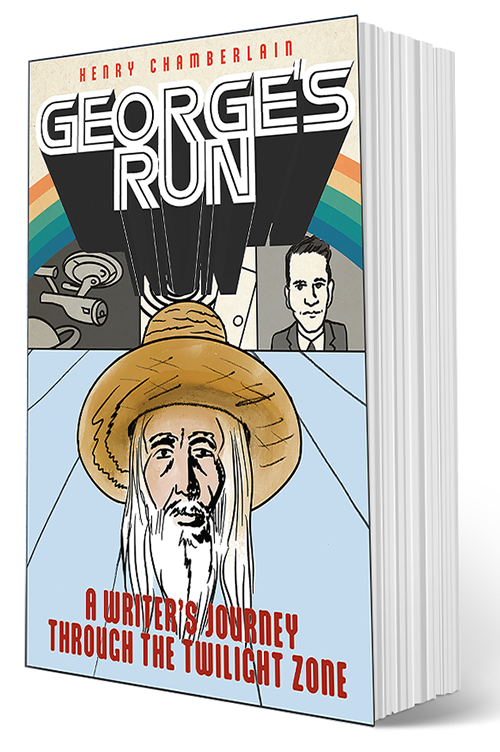
I have an event coming up at San Francisco’s Cartoon Art Museum, 781 Beach Street, on Sunday, August 24th, 2-4pm to talk about my graphic narrative, George’s Run: A Writer’s Journey Through The Twilight Zone, published by Rutgers University Press. It would be so great to have you there if possible.
If you are a science fiction fan, or love various forms of related genres, this is for you. Science fiction acts as a convenient umbrella but, if I was asked to dig deeper in my description, it would be Dark Fantasy. My book is about a group of writers who, individually and in their combined efforts, basically invented a lot of the pop culture we take for granted today. Specifically, I’m talking about the writers behind the original Twilight Zone and Star Trek.
We’ll have a slide show lecture format where I’ll share as much as I can about how I went about creating my book. George Clayton Johnson is our guide, one of the last writers from that 1950s-70s era of golden age television writing. I got to know George pretty well and our friendship led to my book. We’ll have plenty of time for a Q&A as well as overall discussion. I’ll take my cue from the audience. I’m happy to do demonstrations of my art style and chat about making comics too. Feel free to draw or write along the way, and we can share results after we’ve had time to discuss. Hey, this is as open-ended as you like. We might even have some snacks. Seriously, comment here or get a hold of me via email and I’ll consider any ideas.
One step at a time. First, let’s plan on meeting up at the Cartoon Art Museum on August 24th.
Two books you should check out: See You at San Diego and George’s Run.
See you at San Diego! I’m saying this now, since I am actually heading out to San Diego for Comic-Con, as a lot of you are also doing. I will have a table under Comics Grinder Productions in the Small Press Pavilion, Table L-05, and I welcome anyone to chat with me on what I’m about to lay out for you here. Okay, so I go with my own set of particulars regarding Comic-Con, this landmark pop culture institution. In fact, my going to Comic-Con, over the years, led to my creating a graphic biography, George’s Run, published by Rutgers University Press, a book about one of the most notable figures so inextricably linked to Comic-Con: George Clayton Johnson. I’ve written various pieces about this but I never tire about talking about it. That’s exactly what George would have advised me: Keep being a storyteller, you never give up! And so I don’t, won’t and will never give up.
Here’s the thing, there’s always someone else ready to tell another story and so, yeah, I feel obligated all the more to keep setting the record straight. Now, don’t get me wrong, I am not leading up to something unsavory. On the contrary, I just need to point out a few things. Okay, a couple of years ago, back in 2022, Fantagraphics published Mathew Klickstein’s See You at San Diego, a veritable phone book of data (480 pages) on San Diego Comic-Con. It is fueled by about a dozen or so extended interviews with some of the people, going back to the origins of Comic-Con (founded in 1970) who were, or even still are, intimately involved with Comic-Con. The interviews were then sliced and diced into various categories so that you have a collection of snippets hanging together under certain themes that the book pursues. All well and good. However, it will be a challenge for some readers to know just where to begin but I definitely welcome this amazing undertaking. It’s a lot of what amounts to a mountain of data to sift through. My point is that I did something similar by focusing on one person who, in some very significant ways, acts as a portal in my book to a vast array of things somewhat similar to what Klickstein’s book engages with. Similar, in spirit to some extent, but also very different. It’s very, very different, in fact, in the way that I seek to create clarity as well as maintain a playful and artful tone, turning it all into one free-wheeling but driven and focused narrative.
Wonderful part of book referring to George Clayton Johnson.
Is one way of tackling a subject better than another? Well, no, I would argue you want as many ways of looking at things as possible. I am simply asking for my due. See You at San Diego has gotten plenty of attention and has been celebrated rightly so. What I propose is, if you are at all interested in a dive into the origins of pop culture, then, by all means, seek out both books. Perhaps that’s the best way to put it. Heck, folks, my book is focused in such a way that compliments the more massive everything-but-the-kitchen-sink approach that Klickstein is going after by default. I would venture to say that, if you didn’t know where to look, you would miss some genuine nuggets in Klickstein’s book simply by the fact that you can’t see the forest for the trees. It’s just that kind of a book, the sort that you cozy up with and take in a bit here and there.
The reference to George Clayton Johnson is the highlight to Klickstein’s book.
But let’s follow that trail of thought. If you were not sensitive to, or any bit aware of, the whirlwind of creative talent involved in some of the most iconic pop culture, then it is inevitable that you will miss the more subtle and finer points being advanced by some of the quotes to the interviews. That said, I certainly picked up on the ferocious loyalty to Ray Bradbury and the arguments being made by some that somehow Ray Bradbury should have received more credit for helping influence the original Twilight Zone, created by Rod Serling, who, in point of fact, was already an accomplished writer going back to the early years of television’s golden age and had his own vision of what he wanted for the show. Klickstein’s book provides some casual, unsubstantiated and simply inaccurate observations regarding this subject, which, for me, are priceless and worthy of further discussion. I’m so glad to have read them but I can sift through what is correct and what is not. Basically this collection of interviews amounts to people’s opinions and recollections without any filter or fact-checking. You need to know what you’re looking for with this book.
And it’s not like Mathew Klickstein could not have interviewed George Clayton Johnson, a key figure while he was very much alive. I did a number of times. I got to know George. I think the portion of Klickstein’s book that refers to George is one of the better parts to his whole book. In fact, it is quite clear that Klickstein finds great value in including George in his book. Klickstein most certainly could have gone on to interview George but, unfortunately, he did not. He should have. It would have been easy. It would have been totally possible given that Klickstein interviews Comic-Con co-founder Richard Alf which dates this work to at least before Alf’s death in 2012. George passed away in 2015. My final interview with George was in 2014. Reaching out to George would have been completely in the spirit of what Comic-Con is all about. George was of that generation of creatives who opened their homes to people seeking answers. I was, and I still am, one of those persons seeking deeper answers.
In my book, I steadily pursue the creative process and give the reader a variety of scenes, observations and research distilled within the narrative. You get to know the charismatic, yet enigmatic, storytelling wizard who was George Clayton Johnson and, through his life’s journey, you get to know many of the other key figures: Rod Serling, Ray Bradbury, Theodore Sturgeon, Richard Matheson, William F. Nolan, Charles Beaumont, and so on. You need context, and solid storytelling, for this to make sense and I do exactly that. This is very important stuff. It’s a big deal. It’s not something to simply drop in someone’s lap. That said, raw information has its place and has an essential role to play. Just don’t ever expect that to be the only version. The more said, the better. I have plenty to say. Believe me, I will keep talking about this and that is a good thing.
You Can Call Me Bill. Legion M. written and directed by Alexandre O. Philippe. 2024.
Pop culture documentary filmmaker Alexandre O. Philippe directs but, I suspect, William Shatner leads, even commands the scene, in this new film about his life and times. It could really be no other way. As the saying goes, any actor worth his salt can recite the phone book and turn it into compelling entertainment. That, indeed, is what Shatner is all about. Right from the start, it is Shatner who is the boss as he hits the ground running, speaking in awe about the wonders of the world around him, alternating between hushed tones and a booming voice.
William Shatner in the graphic novel, George’s Run.
I know a thing or two about pop culture myself and I can tell you that, as many times as you’ve seen William Shatner (easily one of the most filmed persons in human history), you haven’t seen him quite like this and I mean the cumulative result you get in this documentary from hearing him out as he masterfully, even miraculously, never loses the thread to some of his more ambitious dramatic leaps of faith. The documentary does a great job of seamlessly alternating between interview segments with Shatner in the present and classic clips from his career. There’s one priceless clip, for example, where Shatner is given the stage at the Golden Globes in order to set up the next segment, some sort of lifetime achievement award to George Lucas. Shatner, at first, appears to be genuinely befuddled as to whether or not he’s at some Star Trek event. There’s a quick cut over to George Lucas who looks perplexed and not at all amused. And then, presto, Shatner reveals a prop at just the right moment: a piece of paper, presumably notes he was supposed to have read telling him he’s there to honor Lucas. At just the right moment, the audience is in on the joke and Shatner receives well-earned laughs and applause. And that, in essence, is what this documentary is all about: one segment after another giving way to one clip after another, all in the service of painting a bigger picture of a savvy and hard-working entertainer/sage storyteller. It’s the stuff of legend and, heck, totally transcends any mere pop culture theme. This is the story of someone who must live life large, who came of age in an era that celebrated such a journey, and who has never stopped.
Excerpt from GEORGE’S RUN.
In my graphic novel, George’s Run, published by Rutgers University Press, I recount in various ways the golden age of television that gave us such gems as the original Twilight Zone and Star Trek. I don’t just give you a few examples of some beloved moments from these shows but provide context regarding the key players, primarily the writers but also the actors (particularly William Shatner and Leonard Nimoy) who helped to fuel and build the evolving creative sparks into so much more.
This doc sets Shatner loose to be himself, and, in doing so, provides a great service. In somewhat similar fashion, Leonard Nimoy got his chance to set the record straight in 2016’s For The Love of Spock, directed by his son, Adam Nimoy. If you happen to see both, you’ll get what amounts to one of the best tributes to both of these actors who, by their own grit and high level of integrity did much to secure the course and fate of the USS Enterprise.
The Urban Nerd Con is something new and exciting for pop culture fans, with a focus on diversity. If you are in the Atlanta area later this month, check out this event: April 26-28 at the Courtland Grand Hotel, located at 165 Courtland St. NE, Atlanta, GA 30303. More details and press release follows:
Our hero, the “contrarian librarian,” Clemens Samuel, is prone to take an offbeat position. In this case, he has a soft spot for the critically-savaged The Chevy Chase Show, which lasted on Fox for the shortest duration of a major talk show, a mere 29 episodes (September 7 – October 15, 1993). One could argue that this was just a blink of an eye and that Chase needed to have had robust network support and far more time. It’s not like Chase hadn’t proven himself on numerous fronts, including many guest host appearances on The Tonight Show. Looking back on it (and you can literally look back on every episode on YouTube!) the show was definitely guided by some highly irreverent vision. And that, my friends, is the Chevy Chase style of comedy: cavalier and devil-may-care. With enough time, who knows if the general thinking, both in creating and experiencing the show, would have evolved. That said, apparently there are a good number of outright haters of the show, if you believe every kooky peanut gallery comment you read. Rabid hatred is not exactly reliable. The appreciation of humor, like art, is very subjective. Ultimately, the professional media consensus is that this show gave every indication that it was going to continue to be something of a loose cannon and would likely never lift off in any conventional sense, establish a stable brand and make a lot of money. So many factors go into a winning show. Who would have thought Dean Martin would have gotten away with his shtick and yet he did. He probably negotiated a much better contract too. Of course, Chevy Chase is not losing any sleep over this and rightfully so! Chase took a big risk doing his show the way he did and that’s about it.
I leapt at the chance to write my foreword, what came to be called “A Historical Portal,” in Henry Chamberlain’s graphic novel, George’s Run. Now, with some time to reflect upon it, deeper and more personal observations come to me.
The Twilight Zone offered me proof positive—to this future editor/publisher of a little magazine dedicated to demonstrating the significance of popular culture—that a generation had been more than enriched by it. George Clayton Johnson, a writer for the show, as well as Star Trek, had a lot of insight to deliver, and Henry Chamberlain was the one to winnow it out and to illustrate it.
Astute critics of American cinema have often remarked that the Star Wars series of blockbuster movies, beginning in 1977, marked the return of films but also chunks of television shifting from serious social themes of the later 1950s to later 1970s, back to the Outer Space version of cowboys-and-Indians, with the “Indians” now aliens, some of them friendly (aka “on our side”) and others dangerously hostile. Many critics observed, after the 1999 Star Wars feature, The Phantom Menace, that “African Americanism,” aka Minstrelsy, had been transformed into amusing-looking aliens with humorous talk or behavior. The source of this gloomy transformation might be attributed to the world cinema market for action films or some other external cause, but it is hard to avoid the consequences for Hollywood-produced films as art or cultural/political statements. The social movements of the 1960s shook up Hollywood and created a socially critical audience whose favorite films came and went, in the following decade or so. M*A*S*H, their TV equivalent, was by the end of the century the most “re-run” of all shows and also held the most “peacenik” sentiments. It counted.
In this light, The Twilight Zone looms as a late, major statement of a different era. Rod Serling was a serious and important figure in US culture, a critic and artist who after trying various professions and skills, radio broadcaster to television writer, created the most important television drama in the era when television had a monopoly on media attention.
It was a moment when live television drama, vibrant and often socially critical despite the Blacklist and cultural cold war, hard shortly before reached its peak with a half-dozen theatrical-style shows, just as it poised to rushed production from New York to Hollywood. The Twilight Zone could not have worked as live drama, but it had the dramatic quality of what had gone before. Even in melodrama and seemingly far-fetched plots, the acting was serious. The show was showing something and saying something, working urgently to open up minds. At the right place and time, George Clayton Johnson found himself and helped make television and pop culture history.
George’s collaboration with Rod Serling occupies a central place in George’s Run. But the meeting of George Clayton Johnson with Ray Bradbury offers us something from the comic that retains all its meaning, six decades later. Bradbury (a museum bearing his name and artifacts, in my wife’s hometown of blue collar Waukegan, Illinois, opened last year) stands for a starkly different view of science fiction and its role in opening minds. His stories, adapted to EC Comics shortly before the massive wave of repression, offered readers a glimpse of the horrors ahead if the atomic/nuclear arms race were not halted but also a glimpse of aliens and civilizations that had something to teach the self-proud human race. Farenheit 451 along with a large handful of short stories best realized the social criticism made by a raft of science fiction writers, including some others who knew George well.
Onward and upward.
That George went onto Star Trek is logical, as part of the trajectory of a fantasy writer’s life. But there is much more. The world of fan publications and fan events can be traced back to networks of amateur (unpaid, mostly unpublished) writers who traded their own mimeographed newsletters as early as the 1920s. Sci-Fi fans gathered here, virtually, and then in person by the middle 1960s, trading publications directly, meeting and partying with authors as well as each other. “Trekkies,” a much-discussed phenomenon, led in time to comics events, later to Comic-Cons and all the regional events of today, sometimes grand but most often with self-publishers in the booths, chatting and selling copies to whoever the passers-by they could convince.
The subject of Star Trek itself remains, for many fans and scholars, important and bears symptoms of the richer mix of American popular culture emerging at the moment of its production. This brings us to the topic of the Other, a theme that endlessly drives discussion. Yes, Leonard Nimoy started in Yiddish theater; Spock is culturally Jewish without a doubt. And Uhuru is a staggeringly beautiful African American woman with all the sexualized implications, even if hardly acted out. And so on. But these, considered seriously, are minor notes. George Clayton Johnson’s scripts quietly urged viewers to ponder the fate of humanity within the cosmos, to get off the pedestal of human-centeredness and come to grips with terrestrial reality.
George’s Run bears all this meaning and so much more. But there is one more, albeit indirect, connection too delicious for me to leave out. Rod Serling called upon the blacklisted screenwriter Michael Wilson—before being purged from Hollywood, he had scripted the 1951 Oscar-winning A Place in the Sun—to help develop a crucial subplot that most viewers have taken in subconsciously. The humans are now allowed to speak. But when the human played by Rod Taylor asks to speak, the Chairman of the Tribunal interjects, “the exhibit is indeed a man, therefore it has no rights under ape law.” Those outside the definition of having the right to speak, cannot be allowed to speak, for fear that they will bring down the system. It was a plot that could easily have been taken out of Berthold Brecht’s Life of Gallileo, including the responsibility of the scientist to speak up against the threats facing society.
Such weighty considerations would have been thought, only a few decades ago, as being properly far beyond the scope of anything resembling comic art. Now, at last, we know better. Henry Chamberlain has given us a gift in George’s Run. Let us use it well.
George Clayton Johnson: Master Storyteller SDCC panel, 23 July 2023.
In 2012, I had the honor of being in the audience for a memorial tribute to one of Comic-Con’s founders, Richard Alf. And when I heard the introduction for one of the speakers, it immediately got my attention. The next person up to the lectern was this older elfin man with long gray hair and a full length beard. He had on a vest and Panama hat and, when he spoke, he seemed more wizard than elf. He had just been introduced with the longest list of credits I’d ever heard at Comic-Con. George Clayton Johnson had written for many of the leading television shows of the 1950s into the 1970s, including the biggest of pop culture icons, The Twilight Zone and Star Trek. George began his career by co-writing the story that was the basis of the Rat Pack classic, Ocean’s Eleven. And here he was, essentially the last man standing of a certain group of writers who would launch into the world the modern horror and dark fantasy genres we take for granted today. Fast forward a few more years, and here I am at Comic-Con leading a panel discussion of my graphic novel, George’s Run and honoring the man I was so fortunate to get to know and build a book around.
The gang’s all here: David Weiner, Wendy All, Mark Habegger, Henry Chamberlain, Phil Yeh, Martin Olson, and Marc Zicree.
The panelists all came through with flying colors. It felt like the gang was all here. That’s because they were, coming from various locales, all assembled to speak about George and basically help me launch my book.
This is the book for any fan of comics, pop culture, and great stories!
Heck, it’s a little awkward, I suppose, being my own marketing person but I sincerely believe there is nothing quite like this book outside of, say, Tim Scioli’s own unique graphic novel tribute to another legend, Jack Kirby: King of Comics. I’m very pleased with the journey I’m on as I go about promoting the book. It is a labor of love I would have created one way or another, which I did. It was first self-published and then it got published by Rutgers University Press. It’s a process that requires grit and dedication. That’s exactly the fighting spirit that kept George going.
Me and Marc Zicree, the man who gave us The Twilight Zone Companion.
Persistence, my friends, pays off. So, when your time comes, and you’ve put in the work, you’ll be ready. For anyone out there who enjoys a good story, would like to learn from George Clayton Johnson, a true master storyteller, then read on. This is Comic-Con history! This is storytelling history! Here is the transcript to the panel as well as the video at the end.
This panel took place at San Diego Comic-Con, in Room 29CD, 12:30-1:30 pm, on Sunday, 23 July 2023. It was a pleasure to organize and I look forward to the chance to organize more panels in the future. George’s Run: A Writer’s Journey Through The Twilight Zone is published by Rutgers University Press. I am very grateful to Rutgers and to Comic-Con for supporting my vision and helping me spread the word about my book. The panel begins with an introduction where I present some context and images from the book. I then pass it on to our moderator, David Weiner.
Henry Chamberlain: This is a story about ideas and about storytelling. George and I went on an adventure together where he shared with me his secrets to great writing and the meaning of life. I got to know George pretty well and finally worked up the courage to ask for his blessing on a graphic novel about him and the unique group of writers he worked with. George approved and wished me well, encouraged my creative license. Who was George? Well, many of you pop culture fans will instantly recognize some of his best known work, like the iconic episode, “Kick the Can,” from the original Twilight Zone. George was blessed to work with some of the greatest writers of the era who essentially invented the modern horror and dark fantasy genres we take for granted today. Richard Matheson single-handedly invented the zombie genre with his novel, I Am Legend. Robert Bloch set the tone for many a personal horror novel with Psycho. George was drawn to this dark fantasy world and gave it his own more whimsical twist. In public, he always talked about his love for Ray Bradbury–which is true. I private, he also talked about something with a darker tinge. At the end of the day, George held Theodore Sturgeon in the highest esteem. I will stop there and hand over the ceremonies to our moderator, David Weiner.
At the end of the day, George held Theodore Sturgeon in the highest esteem.
“A Penny For Your Thoughts,” one of George’s landmark works, is explored in GEORGE’S RUN.
David Weiner: That was Henry Chamberlain, the author and artist of George’s Run, this delightful book we’re going to discuss along with speaking about George. I’m David Weiner, former executive editor of Famous Monsters and director of the In Search of Darkness documentaries. Let’s go down the row here and have everyone introduce themselves and how you are connected to George Clayton Johnson.
Wendy All: Hi, I’m Wendy All. I’m an artist. I first met George around 1975. It was for a meeting, at the home of magician Patrick Culliton, to discuss the direction that Comic-Con was heading in. This was still in the very early days of Comic-Con. I didn’t know George. I saw a man with long hair wearing a bright orange vest. George was sitting playing the second movement of Rachmaninoff’s piano concerto on his harmonica. That fascinated me.
Later, at the El Cortez, a bunch of us were going to lunch, and I remember that George stopped to pick up a penny he spotted on the sidewalk. He was jingling it in his pocket. This is something he would do, all the way to the very end. I recall meeting him one last time, before his death, and he was still jingling those pennies in his pocket. It was his way of recalling that very famous episode he wrote for The Twilight Zone, “A Penny For Your Thoughts.”
Marc Zicree: Hi, I’m Marc Zicree, the author of The Twilight Zone Companion, among other things. I met George when I was 16-years-0ld, around 1971-72 at a convention. This was before he had a beard, but he already had long hair. There was a wall-sized poster for the novel for Logan’s Run with his name in big letters. I had written my first book, while in college, Three Interviews on Media and Society, which featured Ron Cobb, Ted Sturgeon, and George Clayton Johnson. George was the impetus for The Twilight Zone Companion. I think back to how we have a changing of the guard. But it seems to me that the older generation is more interesting. I think of Ray Bradbury, and George, and we won’t see their like again.
Original page from George’s Run.
Martin Olson: Hi, I’m Martin Olson. I’m a comedy writer and author. I met Henry going back to an interview he did with me. Later on, we met in person and he had just come from talking with George. When Henry told me that, I nearly fell over. George was an idol of mine. Going back to as a child, I’ve always diligently looked at the credits after a show. George Clayton Johnson had written some of my favorites ever. I was so intrigued by him and read up on him. After Henry told me about George, we never got around to talking about my shows as I was so thrilled to just chat about George, as we’re doing today.
Phil Yeh: Hi, I’m Phil Yeh. I created a magazine, with Mark Eliot, called Uncle Jam, and we have the issue available today which features an interview with did George for anyone who is interested. I was at the first Comic-Con and somewhere along the way, maybe at the El Cortez hotel, I became friends with George. He would speak to anyone. And, when you’re young, it’s nice to have someone older who will listen to you. George told me about a convention he wanted to do featuring him, called Clayton-Con, and I did the graphics for it. Over the years, George would come to our booth. And I always loved his enthusiasm.
Mark Habegger: Hi, I’m Mark Habegger, a writer and filmmaker. I probably have the shortest association with George. I became involved with Comics Fest, beginning with the first one in 2012, which was Mike Towry’s brainchild, a way to bring back the original Comic-Con vibe. George was part of that. Wendy did a recreation of George’s Cafe Frankenstein. The following year, I interviewed George for about an hour in order to help archive memories of the history of Comic-Con. It was just me and George in a white room. Once we started, he completely lit up. He was a storyteller who needed an audience. It didn’t matter if it was an audience of one or a thousand, he was going to tell his stories. You can find my interview at Comic-Con Kids.
David Weiner: Henry, you wrote George’s Run because George had a profound impact upon you. Please speak to the origins of your project and why it is so personal for you.
Henry Chamberlain: I’m a cartoonist and I’m always looking for a project to sink my teeth into, preferably a full-length graphic novel. I used to do comic strips, going back to working on my college paper, but I always wanted to take things further. I had done some graphic novel work in the past. When I went to a memorial tribute to one of Comic-Con’s founders, Richard Alf, in 2012, I was so impressed with the introduction given to this one speaker, George Clayton Johnson. He’d written for all the leading television shows of the era: Alfred Hitchcock Presents, Route 66, Honey West, and then the biggest ones, The Twilight Zone, and Star Trek. He began by writing the story that was the basis for the Rat Pack classic, Ocean’s Eleven; and he capped his career as the co-author of the cult classic novel, Logan’s Run. I instantly imagined this being a graphic novel if handled in just the right way, paying attention to various connections.
I approached George that night and we instantly got to talking. We ended up doing some podcast interviews, chatted on the phone, and got to spend some time at his home. I imagine you could say that I had around 20 interactions with him, some long, some short. Spending time with George in his own home was very much a Forry Ackerman (founder of Famous Monsters) thing to do, inviting people into your home.
I think about George all the time, during the week, perhaps not every day, but he’s a guiding light. I want to honor him. I feel his presence here.
David Weiner: How is a graphic novel the ultimate platform for all the stories you’re telling here?
Henry Chamberlain: I hope that folks will pick up on what I’m doing. It’s like the world you create in a prose novel or a painting. I got into a zone and dug deep and, I believe the reader will sense the dedication. Even my harshest critic can’t say that my work seems to have been rushed. I put a lot of work into it, connecting the dots. The whole experience is at a reader’s pace, the sort of cerebral vibe you can get in a daydream. Which seems fitting considering that George loved calling himself a “professional daydreamer.”
David Weiner: The initial motivation for George’s work as a writer, and he struggled a bit, was to talk a big name. George was with a group of writers who ultimately dubbed themselves, “The Group,” who were spectacular names, on the page and screen. Henry, and we can open this up to the rest of the panel, talk a bit about The Group and their influence on writer’s today.
Henry Chamberlain: George held his own with the other writers because he was a voracious reader. It may be lost to history but I don’t believe that George ever wrote for the pulps while all the other writers in The Group had cut their teeth on pulp fiction. George had to prove himself and he relished that. He’d talk about how everyone in The Group would regularly lay it all out, size each other up, and spill their guts out to each other. I’m not sure about every detail but I do know that, from the start, George was fortunate to become friends with Charles Beaumont since Beaumont was the key to gain entry into the rest of The Group, as well as the smaller core group.
The Core of The Group!
Wendy All: I can share about George and The Group. George hitchhiked across the country and he knew he wanted to end up in L.A. and he knew he wanted to end up with Ray Bradbury. So, he got into that group of writers, centered around Ray Bradbury, which included Charles Beaumont, who happened to live upstairs from the apartment my husband was renting in North Hollywood. Playboy magazine was paying $200 per story and, in those days, that was a lot of money. Bradbury had figured out a formula to sell stories. So, yeah, the writers would gather and critique each others’ work.
Marc Zicree: I just want to jump in and say that science fiction is unique, in a certain way. The fans who go on to become professionals don’t shut the door on the fans attempting to move up. If you want to meet someone in the science fiction and fantasy genres, whether an actor or a writer, they are there for the fans.
Ray Bradbury grew up as a fan of Ray Harryhausen and Forry Ackerman. Later, Bradbury became a mentor to Richard Matheson, Charles Beaumont, and George Clayton Johnson, core writers, under Rod Serling, on The Twilight Zone. So, to have George in that circle, he was in the perfect fertile field for a writing career.
What I learned from George is that you can write one story on one show that is so well-written that it can have an impact on someone’s life that can last forever.
David Weiner: There’s that elusive ingredient you talk about in your book, Henry, that this group of writers strove for, that “touch of strange.” Can you tell us about it?
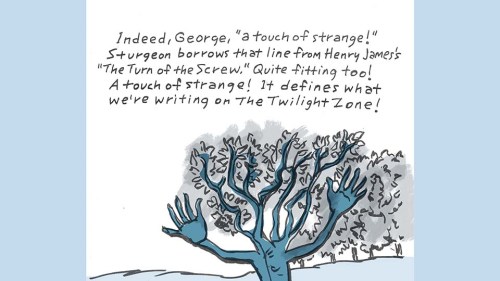
Henry Chamberlain: Rod Serling, under contract, wrote the majority of the episodes of The Twilight Zone, 80 percent for the first season alone; and around 70 percent of the episodes for the whole run of the series, which made sense considering his caliber of writing. And then there was that 30 percent to which Serling granted access to this select group of writers. Here’s the rub, it wasn’t easy to describe what exactly these writers were pursuing. It wasn’t just science fiction, or horror, or social commentary. When asked, George would describe it as writing with “a touch of strange.”
Now, I like to read and I discovered the origin of this term. This is, if I do say so myself, my original discovery. The term goes back to 1898 and the short story, The Turn of the Screw, by Henry James. You’ll find it there and it basically refers to something not quite right, unnerving and unsettling. And then I come to find that Theodore Sturgeon made note of this term and named one of his own short stories after it. So, this is a very literary thing going on and it takes time to process such things. It seems as if we’ve lost the art of doing this. Of course, we haven’t exactly. It goes on–and it must. We need to celebrate this kind of thinking, and writing, every time we come across it.
David Weiner: We’re going through something that is very profound, the advent of A.I. and how that could affect writers. The nightmare scenario is that clients, who might prefer to not pay writers, could turn to A.I. Let’s talk about the writing process and the human touch. What was it about The Group, working as a group of writers versus writing alone?
Mark Habegger: I think that George was the kind of writer who saw something magical in the audience interaction with the storyteller. He saw himself as a shaman-storyteller. I think that The Group that we’re talking about, and other writing groups, like the writers he went down to Mexico with, even Cafe Frankenstein, were all opportunities to “gather around a campfire” and have an immediate interaction. I think he was a futurist-humanist. He wanted to take his forward-thinking sci-fi ideas and see how we would be affected by them, see how people would rise above it. It’s all a very human story. And I think he would have seen A.I. as a threat to all that. Not that he wouldn’t have embraced new ideas but he would have found very human ways to respond to them. None of us want to see the end of human creativity. It’s those human imperfections that inform the best art.
Wendy All: I have an example of how George would have agreed with the human factor. I asked him once how he came up with the idea for Ocean’s Eleven. He said that they (George and Jack Golden Russell) were sitting watching a grocery store being closed up. And it occurred to them how easy it would be to rob the grocery store safe. And then, George thought, may as well go where the big money is . . . go to Las Vegas. The details that George came up with were enough for the Nevada Gaming Commission to change some of its procedures. So, if you fed an A.I. computer footage of a grocery store, I don’t think it would come up with a heist movie.
Marc Zicree: Getting back to the idea of a circle of writers. I think of the energy that comes from being around other writers, great writers. I would seek out such writers, like J Michael Straczynski, James Michael Reaves, and many others–and I would then pace myself to them. It made me have to strive to do my best and really get proficient. That’s the same thing that happened with George. He came from a very impoverished background, his mother was an alcoholic. He had a very hard scrabble childhood. And he was now with all these big writers for television. A TV show on one of the Big Three networks, per episode on average, would have from 30 to 40 million viewers. Not like today at all. Charles Beaumont was at the core of all that with all of his astonishing energy. Ray Bradbury was on high as the patron saint.
When Beaumont died, at only 38, that whole circle of writers went spinning off into space. George and Bill Nolan were very good friends and went on to write together the novel, Logan’s Run. But when they go together to write a sequel, what had happened in the interim was . . . well, George was a chain smoker, of tobacco; but when the Surgeon General’s report came out, George made the switch from tobacco to weed. So, that brought on a change. George grew his hair long and became a hippie and all that. When they tried getting back to work, George had a fistful of joints that he placed in an ash tray. Bill Nolan took one look, and being so strait-laced, he shook his head and said he couldn’t work with George. That was the breakup of their collaboration with both agreeing to write their own sequels as they shared the property.
This is a case of who you are as a writer, the identity of being George Clayton Johnson, or Ray Bradbury, versus the reality of sitting down and doing the hard work of writing, having that discipline, that clarity of mind. Sometimes, when you lose that circle of colleagues, you lose something. George was extremely good at being George Clayton Johnson but, in terms of the ongoing discipline of writing, well, years ago, I read the outline to his sequel for Logan’s Run but, as far as I know, that never reached fruition. So, I think, there’s always that challenge.
David Weiner: Let’s go down the line and have panelists share with us their favorite moment or story by George Clayton Johnson, one of the great writers of that era.
Martin Olson: Well, everything that Marc, and Henry, have said about The Twilight Zone, and what I’ve come across myself is so interesting and then you add this: George wrote the very first episode of Star Trek! Are you kidding me? Then, when Steven Spielberg, of all people, decided to do a movie of The Twilight Zone, he arranged for different directors to do various classic episodes and, for his episode, Spielberg chose none other than George Clayton Johnson’s “Kick the Can.” That story was about a group of old people who, through fearing death, they discovered the secret to eternal youth. “Immortality is accessible to all of us,” that was what he was saying. “It exists forever in our memories, in our hearts, and in our minds.” That’s the strength of George’s writing.
Marc Zicree: I want to say something about “Kick the Can” in connection to The Twilight Zone movie. I was a consultant on the film. I believe it was Kathleen Kennedy I was talking with and I asked about what episode Spielberg was going to do and she said he was leaning towards doing “The Trade-ins,” about old people trading in their bodies for new ones. He wanted to do something with old people. So, I asked if he’d seen “Kick the Can.” She said she thought he had. And then I asked if he’d seen in recently. When I got a no, I immediately went to get my own copy of the episode to show it to him. It was a VHS that I taped off my TV. And he then chose to direct “Kick the Can.” What’s cool is that the payment George got for using the episode allowed him to make the last payment on his home.
A celebration of individualism!
Mark Habegger: My personal connection with George was through Comic Fest. My favorite part of my interview with George was at the very end. He was telling his stories and his son, Paul, was in the room. There’s a point when Paul ends up sitting in George’s chair, a sort of passing of the baton. Paul was chomping at the bit to get the details right on something. George gives Paul the mic and Paul goes on to talk about the artist group that George traveled with to Mexico. It was a very fortuitous way to end the interview. I think this idea of gathering around like a tribe, being around the kids at Comic-Con, was something that George loved.
George Clayton Johnson
Phil Yeh: When George would come by our booth at Comic-Con, most of time people had no idea who George was. But he would talk, and all these ideas would come out of him. He was very animated. One time, I recall, one of my son’s friends was listening to George, then he went over to buy a book by George, this was like an hour later, and when he came back, George was still talking, still very lively. George was, more than anything, great about encouraging younger generations about the world of ideas.
Henry Chamberlain: I wanted to point out a few things before we wrap up. There’s a collection of the work by George Clayton Johnson, All of Us Are Dying, and it’s the size of an old classic thick phone book so he did do quite a lot of things beyond the well-known work. He was always looking for original ideas. He liked to say that, as human beings, we’re free agents, we could rob a bank if we chose to. He was constantly thinking up plots and scenarios. He was an idea machine. He wrote a story that was the basis for Charlie’s Angels. There’s a musical he wrote about Emile Zola. There’s a satirical play he wrote about Christopher Columbus.
Henry’s book, George’s Run, is a must-read for fans of Alfred Hitchcock Presents, The Twilight Zone, and Star Trek. George was in the thick of all of that. George was such an unusual character. This book is about storytelling and humanism. So, for those of you who appreciate these things, get this book, George’s Run, because it goes to the core of what happened within The Group, this celebrated writing group. It’s just a beautiful surreal brilliant graphic novel.
— Martin Olson
Marc Zicree: Well, George talked to me about his famous episode, “A Penny For Your Thoughts,” starring Dick York, about a bank teller who flips a coin and it lands on its edge. As long as that coin stays on its edge, the character has telepathic powers. He comes to listen in on the thoughts of people and finds they don’t always do what they think or vice versa. So, George actually wanted to turn that episode into a full-fledged series. Each week would follow a new person on a coin adventure. Finally, there’s one episode that features a high stakes poker game and the main character with telepatyhic powers thinks he’s going to win big. Except, in turns out, the greatest poker player in the world is Chinese, thinks in Chinese, and our hero can’t understand a word!
George was great about paying it forward. As Bradbury did. Beaumont did. And as Matheson did. As I do. The Twilight Zone Companion was my first book out of college. It was what led to my writing for television. I was 21 when I first got the idea to write the book and George encouraged me to pursue it. He introduced me to everyone he could involved with the show. Finally, I approached Rod’s widow, Carol Serling, who had turned down many professional journalists. This was only two years after Rod’s death. The book went on to great success. Years later, we were at a American Cinematheque tribute for The Twilight Zone, and I asked George why he was willing to take a chance on me, some 22-year-old kid. And he said that I seemed very intelligent and that I looked like I could pull it. If it hadn’t been for George, I wouldn’t have had a career.
George Clayton Johnson’s Cafe Frankenstein
Wendy All: I was so grateful to get a chance to honor George in 2012 at Comic Fest with my recreating George’s Cafe Frankenstein. Among George’s work, I loved “All of Us Are Dying” or “The Four of Us Are Dying.” I loved the idea of transformation. All the character had to do was concentrate and he’d change into someone else. It was interesting to read it and then seeing it on the screen.
Marc Zicree: The idea that someone could change their face, to be a shapeshifter, you see that go from “The Four of Us Are Dying” in The Twilight Zone to George’s “The Man Trap” in Star Trek. Interesting to see the shapeshifter motif cross over like that.
Martin Olson: In fact, the Star Trek story, “The Man,” was the first transgender alien story. And the whole idea of that salt vampire is a great example of George’s wild imagination.
George keeps on running!
Martin Olson: Marc, I want to say something to you. I didn’t know about the origin of your book, The Twilight Zone Companion, with George standing up for you. As a comedy writer, going back to 1980, I can tell you that every writer in a writer’s room had your book. We would read your book because it was a catalyst for great stories.
Marc Zicree: My big interest in writing The Twilight Zone Companion was the writers: how they did what they did. At the time, Bantam, my publisher wanted me to take out all the information on the writers. I told them that they could do whatever they wanted with the photographs, and I had all of them, but they’d have to leave the content on the writers alone.
Henry Chamberlain: Speaking about paying it forward, I want to thank Rutgers University Press for believing in me and my vision and publishing George’s Run. I am forever grateful to them.
Martin Olson: Henry, I want to say something about your book. I imagine that the first comic strip cartoonists were influenced by maybe three or four things, like motion pictures. Then you think about, Alfred Hitchcock Presents, The Twilight Zone, and Star Trek make up the major influences on cartoonists of more recent generations. You know, without George Clayton Johnson, and people like him, there would be no Comic-Con.
Henry’s book, George’s Run, is a must-read for fans of Alfred Hitchcock Presents, The Twilight Zone, and Star Trek. George was in the thick of all of that. George was such an unusual character. This book is about storytelling and humanism. So, for those of you who appreciate these things, get this book, George’s Run, because it goes to the core of what happened within The Group, this celebrated writing group. It’s just a beautiful surreal brilliant graphic novel.
Ray Bradbury lit the fuse and a smaller core group, led by Charles Beaumont, took hold.
David Weiner: As we close out, Henry, give us some final thoughts on what George Clayton Johnson’s impact on pop culture is today. George was part of the foundation of so much of the pop culture that we love today.
Henry Chamberlain: I was asked on a radio show what I thought were the hot new science fiction writers today and I sort of drew a blank for a moment since it was such a big question. I keep coming back to the concept of “a touch of strange” and some writers have picked up on that. I think of Charles Yu, as just one example. It’s not hard science fiction we’re talking about. It’s more literary. That’s a big influence. And then there’s the love of storytelling in general. And love for the written word. The Twilight Zone was syndicated beyond belief. The local affiliate in L.A. broadcast it twice a day, at noon and at midnight. So, yeah, it ran, and still runs, very deep for people on many levels.
David Weiner: Thank you, Henry.
Henry Chamberlain: Thank you, David.
The Core of The Group!
And here is the video . . .
George’s Run: A Writer’s Journey Through The Twilight Zone is published by Rutgers University Press.
So, what happens when Comic-Con is not Comic-Con, at least not what many people might expect? The famous Hollywood celeb-fest at Hall H is not happening this year due to participants pulling out of all the big ticket panels amid the writer and actor strikes. It’s not a pretty picture and some cry foul but the show must go on and, in many ways, there is a light at the end of this tunnel in terms of a refocus to the roots of Comic-Con: comic books! With the spotlight off of Hollywood blockbusters and related projects, Comic-Con will, in fact, be returning in a big way to how it all began, as a gathering place for comic book enthusiasts. And that’s got to be a good thing.
It’s all about writers working with, and supporting, writers.
My panel at this year’s Comic-Con, along with the smaller scale, down-to-earth panels, is still on. And it happens to be all about writers and the creative process. George Clayton Johnson: Master Storyteller is about my new book, George’s Run. It features George Clayton Johnson and his meteoric rise as a writer. And it is through his journey that you learn about the group of writers responsible for what we take for granted today as dark fantasy, as well as a more nuanced and personal science fiction and horror. The point is that the creative process is at the core of what we’re talking about. I invite you to go to my panel which celebrates the very essence of Comic-Con. In fact, George was a great supporter of Comic-Con right from the start. He loved the sense of community of people joined together by the magic of comic books.
Here is a report from CBS 8 San Diego (archived on YouTube):
3,267 viewsJul 13, 2023
As Hollywood continues to grapple with the impact of the writer’s strike and the all-but-certain actor’s strike, the standoff is creating new problems for San Diego Comic-Con. Several of Hollywood’s biggest companies have now decided to skip panels in Hall H, which is typically the biggest attraction and the longest wait time of the convention. In years past, Hall H panelists would discuss current and upcoming projects as well as promote future ones. This year is a little different. Disney, Marvel, Lucas Films, HBO, Sony, Netflix, DC Studios, and Universal have announced they will be pulling out from Hall H presentations, the Hollywood Reporter said on July 8. In a statement to CBS 8, a spokesperson for Comic-Con says in part, “With regard to the strike and its possible effects on Comic-Con, we tend to refrain from speculation or forecasting. Our hope is for a speedy resolution.” While the status of some things at Comic-Con are still up in the air, there is still plenty to be excited about at the Comic-Con and the Comic-Con museum.
Are you going to San Diego Comic-Con this year? I am! This is not a regular thing for me and it’s always a big deal when I do get to go. I am going in support of my new graphic novel, George’s Run: A Writer’s Journey Through The Twilight Zone, published by Rutgers University Press. The official program schedule has been announced and it includes a panel discussion focusing on my new book and celebrating the great man himself: George Clayton Johnson: Master Storyteller is scheduled for Sunday, July 23, from 12:30 – 1:30 pm, in room 29CD.
George Clayton Johnson contributed brilliant writing for some of the most iconic and beloved shows in television history, including the original Twilight Zone and Star Trek. The 2023 schedule for panels is the place to go for any and all info on panels. My panel, again, is Sunday, July 23, 12:30 – 1:30 pm in Room 29CD. I’m just thrilled to be able to pay tribute to George in this way. We have a wonderful group of folks for the panel and it will surely be a fun, informative and inspiring discussion.
It’s moments like this that can really make your day. I was just noodling around catching up on stuff and I stumbled upon this wonderful review on Amazon of my new graphic novel, George’s Run. It is published by Rutgers University Press and available at various platforms including Amazon.
Of course, the customer review photo of a Vulcan salute is utterly priceless! Maybe it will inspire you to do the same. So, yes, please do consider getting a copy and maybe even writing your very own Amazon review.
The review speaks for itself so I’ll just run it here:
I was gifted the unique graphic novel GEORGE’S RUN for my birthday, and am so happy I got to read it!
I wasn’t really ready for what I was in store for, but, being very into all things retro and 60’s and 70’s and cool, this graphic novel was a delightful surprise from start to finish.First of all, let’s address the fact that, although usually you should not judge a book by its cover~ it’s actually totally okay to do so in this circumstance; because the contents are just as intriguing as the beguiling face of the book!I was stunned and impressed by the overall presentation ~in the same way I was drawn to the deeply felt drawings and stories within.Although I am close enough to Henry’s generation to appreciate and remember the country’s love of all things Twilight Zone and Star Trek, I must admit~ I was unaware of George Clayton Johnson and his important role as a writer during this time. I certainly was completely unaware of his eclectic group of writing friends that influenced many aspects of pop culture~especially science fiction culture~at the time…
and I LOVE Ray Bradbury and Rod Serling!!There’s just so much coming at you these days, sometimes it’s difficult to follow even the threads of your heroes and potential creative literary longings.It was really interesting to learn (especially from such an unusual and non-linear format) about this particular outlier writer’s journey through Hollywood and the sort of rebel gang of writers he became a part of~in a way it was akin to the clan in the Ocean’s Eleven story he conjured up…except instead of a rat pack of swanky burglars, he was part of a bunch of literary iconoclasts who didn’t fit into any one particular category!
I loved the colors and the whimsical illustrations and the unexpected dream-like quality with which the book told its tales.
And most of the information included within was completely unbeknownst to me~ and that was surprising; because I love all things Sci-Fi!! What a lovely hardbound book surprise.
This book has a really good energy to it. You can feel the author’s love for his subject matter and for the stories he tells just jumping off every page.
And even though you never know where the tales are going to go, you can be sure that you too have gotten a taste of the Touch of Strange these writers were after on their mission to spread their weird around the world….
…..just by picking up a copy and taking a look for yourself!