Category Archives: Graphic Novel Reviews

Review: THE GRAPHIC CANON, VOLUME 3, Edited by Russ Kick

Graphic-Canon-Russ-Kick-2013

Not all the work here is by cartoonists, per se, but most of it is and everyone here is part of the larger world of the graphic arts. We still live, may always live, in a world that, for the most part, thinks of cartoonists as only one thing. However, “The Graphic Canon,” edited by Russ Kick, and published by Seven Stories Press, gives you a taste of what is possible. You are certainly in capable hands with Russ Kick, bestselling author of “You a Are Being Lied To” and “Everything You Know Is Wrong.”

This is a remarkable project that takes on the world of literature on a grand scale with Volume 3 dedicated to the 20th Century. Ah, the 20th Century, it was a time dominated by the most heroic and romantic of rebels. You are sure to find your favorite rabble rouser in this colossal book, heroic in its own right. It weighs in at 564 pages, literally a phone book worth of literary artistic expression, so the odds are in your favor.

Like a classroom full of gifted children, each artist here has taken their chosen work of literature, immersed themselves in it, and turned in their best effort. Not all the contributions here are exclusive to this book but most are. And, like thoughtful and caring students, these artists don’t let ego get in the way or stray too far from the goal. They fall into two lines of attack: illustration and adaptation. Within these two camps, we get just about everything under the sun, an exciting array of talent, over 80 artists, that will please hardcore lit fans and newbies alike. Among previously published work, there is Robert Crumb’s rarely-seen adaptation of Sartre’s “Nausea.” Another gem is David Lasky‘s unique take on “Ulysses.” Reproduced here, you get the original 1993 mini-comic version.

"Ulysses," adapted by David Lasky

“Ulysses,” adapted by David Lasky

Check out the first pages of this book to find a homage to “Heart of Darkness.” Matt Kish is known for creating illustrations for each page of “Moby Dick.” Here you see him bring that same level of obsession to Joseph Conrad’s masterpiece. Reproduced are some selected illustrations with the promise from Kish will go on to fully illustrate “Darkness” page per page.

"Heart of Darkness" illustration by Matt Kish

“Heart of Darkness” illustration by Matt Kish

Ellen Lindner‘s illustration for “The Bell Jar” sums up in great measure the internal struggle that Sylvia Path attempted to endure.

"The Bell Jar" illustration by Ellen Linder

“The Bell Jar” illustration by Ellen Lindner

Tara Seibel provides some fanciful illustrations for “The Great Gatsby” that evoke the jazz age.

"The Great Gatsby" illustration by Tara Seibel

“The Great Gatsby” illustration by Tara Seibel

Among the adaptations, Julia Gfrörer gives us some very intriguing images inspired by Umberto Eco’s “Foucault’s Pendulum.” In the introduction, Russ Kick helps the casual reader to relate by jokingly suggesting that Umberto Eco’s masterwork is a much more complex version of Dan Brown’s “The Da Vinci Code.” Full of metaphysical and philosophical observation, it centers on three characters who work at a vanity press who concoct elaborate conspiracy theories and then discover that maybe they’re true. Julia Gfrörer is clearly up to the task.
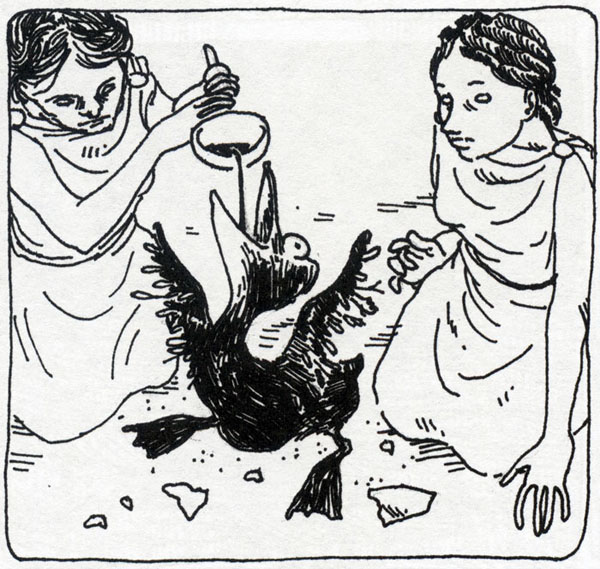
"Foucault's Pendulum" adaptation by Julia Gfrörer

“Foucault’s Pendulum” adaptation by Julia Gfrörer

I think this unusual adaptation by Julia Gfrörer is a good place to linger since it goes a long way in representing the best you will find in this book. Gfrörer has taken on a wildly complex novel, found an opening, what she entitles, “The Chymical Wedding,” that explores the alchemical wedding in “Foucault’s Pendulum” and runs with it. This certainly doesn’t come across as Lit 101 filtered through comics. No, it does what you’d hope for: Gfrörer wears Umberto Eco like a well-worn pair of pajamas. Is that appropriate? If you don’t feel comfortable with what you’re doing, how will your reader? Gfrörer lets herself go and, without trying too hard, turns in her assignment. It’s just what editor Russ Kick would have expected.

This is the thing, there are any number of ways to go about your adaptation. “The Mowers,” by D.H. Lawrence, for example, is pretty straightforward and has a deft and gentle touch by Bishakh Som.

"The Mowers," adapted by Bishakh Som

“The Mowers,” adapted by Bishakh Som

Another ethereal and arresting approach comes from Caroline Picard with her adaptation of Virginia Woolf’s “The Voyage Out.”

"The Voyage Out," adapted by Caroline Picard

“The Voyage Out,” adapted by Caroline Picard

Emelie Östergren provides her heart-felt interpretation of “Naked Lunch” by William S. Burroughs.

"Naked Lunch," adapted by Emelie Östergren

“Naked Lunch,” adapted by Emelie Östergren

“The Graphic Canon, Volume 3” is such a mighty undertaking that you just can’t go wrong. I come back to the idea of a powerful vehicle that demonstrates what’s possible. We’d be fools to think we’ve got literature and fiction all figured out. And we’d be fools to think we have the comics medium all figured out. It’s a post-postmodern world, but that’s no excuse. There is something very traditional about writing stories and creating comics and that’s quite alright.

Issues of storytelling will not be resolved in the 21st Century and never will be. If Russ Kick is around (gee, anything is possible), or maybe a descendent or disciple, we will find that Volume 4’s tribute to the 21st Century (available only digitally?) will continue the good fight for a good story. And we will find that all three volumes of “The Graphic Canon” have held up considerably well.

Visit Seven Stories Press here. You can also find “The Graphic Canon” by visiting Amazon here.

2 Comments

Filed under Comics, Fiction, Graphic Novel Reviews, Illustration, Literature, Novels, Russ Kick, The Graphic Canon

4th of July Review: THE GETTYSBURG ADDRESS: A GRAPHIC ADAPTATION By Jonathan Hennessey and Aaron McConnell

The-Gettysburg-Address-A-Graphic-Adaptation-McConnell-Hennessey

“The Gettysburg Address: A Graphic Adaptation” makes for compelling reading, whatever your prior knowledge of American history. It is a a wildly inspiring presentation in all its power to convey detailed facts, insights, and nuanced concepts. Is the 4th of July a good day to read this book? Of course! You could, for instance, read it on your Kindle with plenty of time to spare before the fireworks display. Are you one of those persons who just enjoys the fireworks and doesn’t know, or believe they care, about why today is a good day for fireworks? Well, even you would likely enjoy this book. Rachel Maddow calls it, “the coolest thing since Schoolhouse Rock.” And who doesn’t love Schoolhouse Rock? We love to learn and sometimes we want it to come at us from a more accessible venue. This would be the book to do just that.

Sure, the 4th of July and the Battle of Gettysburg appear to be strange bedfellows. However, in a ghoulish twist of fate,it was on a 4th of July, 150 years ago today, that the carnage from the bloodiest battle of the American Civil War rested on the battlefield at Gettysburg, Pennsylvania. It had been a three-day fight and the results so ghastly that it sent shockwaves through both camps and led the President of the United States to create and deliver a masterwork of argument in defense of a unified nation. It was a way of communicating to his fellow Americans, then and in the future, on what was at stake. What this book does is run with that desire to communicate. It does a most remarkable thing. It breaks down Lincoln’s famous speech, a relatively brief and easy to follow piece of work, and examines in depth what was really being said. In doing so, we explore the inner workings of that great ongoing experiment in democracy known as the United States of America.

Gettysburg-Address-Hennessey

And there’s more to that 4th of July connection. In this book we explore the origins of the Civl War in a variety of ways not the least of which is the tension between the two founding documents, The Declaration of Independence and The Constitution of the United States. In law, if there’s any chance to take an inch, a mile will be taken every time. That’s what happened with what we commonly celebrate as the founding document on the 4th of July. The Declaration of Independence, of 1776, is a rallying cry for freedom and, left open enough to interpretation, a murky blueprint for states to do as they please, even secede from the nation. Once such a notion takes root, well, not even ratification of The Constitution, in 1788, can put a stop to it.

The-Gettysburg-Address-A-Gaphic-Adaptation-2013

If you want answers to all your questions about how America found itself at war with itself and where we’ve come since then, you’ll want to get this book. It is by writer Jonathan Hennessey and artist Aaron McConnell, the team that created 2008’s “The United States Constitution: A Graphic Adaptation.” Apparently, these guys really love explaining American history and they’re very good at it too. Both of them relish completing a thought in an intelligent extended manner while also keeping pace with a dramatic narrative. In a steady conversational tone, we come to appreciate the deep-seated conflict between a desire for limited government, as supported by Thomas Jefferson, and a robust government, as supported by Alexander Hamilton. We see how Americans allowed slavery to take hold in the first place and then, once it did, found it nearly impossible to abandon it.

Gettysburg-Address-Graphic-Adaptation-2013

We come to better appreciate the task at hand for the founding fathers and the inevitability of passing on one generation’s burden onto the next. Would the founding fathers have put an end to slavery if they had all the time in the world, if they could have seen into the future? Would Lincoln have acted any faster in his own actions? In his case, he certainly appears to have acted as quickly as anyone for his time could have. What is clear is that, once he was gone, America took a number of steps back for each step forward. That would not have been lost on Lincoln one bit. If anyone came close to having a crystal ball to foresee the future, it was Lincoln. All you have to do is read The Gettysburg Address.

“The Gettysburg Address: A Graphic Adaptation” is published by Harper Collins. It is a 222-page trade paperback, priced at $15.99 U.S. and you can find it in print or digital here.

2 Comments

Filed under American History, Comics, Graphic Novel Reviews, graphic novels

Review: ‘Legends of the Blues’ by William Stout

Legends-of-the-Blues-William-Stout-2013

You may know more names in blues than you think. There’s Billie Holiday, B.B. King, Chuck Berry, Bo Diddley, John Lee Hooker, and Muddy Waters, to name a few. And, if those names don’t ring a bell, well, that’s alright. This collection featuring 100 profiles of all-time great blues musicians, big names or not, will give you a look at the big picture.

Abrams-Comic-Arts-Billie-Holiday

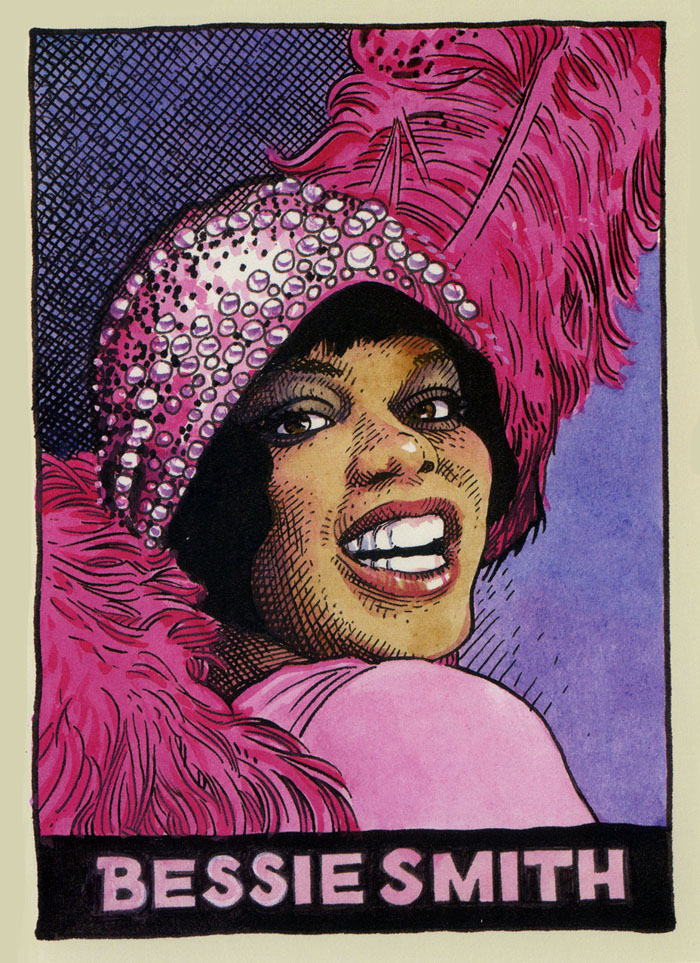
William Stout has picked up where R. Crumb left off some years back in creating “trading card” portraits of blues legends. This has led to this beautiful and intriguing book published by Abrams ComicArts, “Legends of the Blues,” complete with Bonus CD! Here you have a very accessible guide to American blues with each portrait interconnected with the other. Each profile has an exquisitely drawn portrait, biography, and recommended songs attached to each performer.

B-B-King-William-Stout

Read the profile of B.B. King and learn how the electric guitar made its way into blues, ushering in rock ‘n’ roll. It was thanks to T-Bone Walker, the first blues musician to use an electric guitar. That fact is just as fascinating as viewing Michael J. Fox, as Marty McFly, in “Back To The Future,” accidentally inventing rock ‘n’ roll. Read further and you learn about how King nearly lost a beloved acoustic guitar to a fire that started from a fight over a woman named, Lucille. As a reminder to never fight over a woman, each of King’s Gibson guitars has been given the name, Lucille.

Abrams-Comic-Arts-2013

The stories here range from the tragic to the comical. Many are stories of lost childhood, like Billie Holiday; scrambling to carve out a career, like Robert Johnson; and ultimately finding fame fleeting and cruel, like Bessie Smith. And there are no end to interesting facts. One fine example is the story of Robert Petway. His claim to fame was his song, “Catfish Blues.” It was reworked by Muddy Waters and retitled, “Rollin Stone,” the namesake to one of England’s greatest rock bands of all time. As for Petway, the authorship of his hit song has been questioned and it is still unclear as to when he was born and when he died! Such is the life of a blues musician.

“Legends of the Blues” is a 224-page hardcover, with CD, priced at $19.95 U.S., published by Abrams ComicArts. You can find your copy here.

Leave a comment

Filed under Art, Art books, Blues, Comics, Graphic Novel Reviews, graphic novels, Illustration, Music, Rock 'n' Roll

Review: ‘When David Lost His Voice’ by Judith Vanistendael

When-David-Lost-His-Voice-Judith-Vanistendael-2013

Currently on the shelves is a book with a bright orange cover and a powerful story about coping and understanding death and loss. Our lives can become so routine: work, eat, sleep, rinse, repeat. Ironically, the closer we come to death, the more we appreciate life. Just like they say, our lives flash before our eyes at a time of crisis. It can unnerve us. Americans, for example, have been thought to not deal too well with death. However, given the popularity of zombies, that overall outlook seems to be improving. And there are some cultures who appear to be more in touch with death. “When David Lost His Voice,” the new graphic novel by Judith Vanistendael, published by SelfMadeHero, gives us a story that shows how life and death can come to terms. It’s a story not without a healthy dose of good cheer.

When-David-Lost-His-Voice-Self-Made-Hero-2013

I recently viewed Julie Delpy’s “2 Days in New York,” a comedy about what happens when relatives from France descend upon a couple’s New York apartment for the weekend. In the movie, you see just how crude, or earthy, depending on your taste, these French folks can be. The humor itself felt French too, embracing the absurdity in life more than your typical American comedy. It seems to be a matter of dropping any inhibitions and yet done with a certain style. In that regard, I find a similar sensibility running throughout this graphic novel. It is the story of David, who discovers he has developed a cancer in his throat. He is an older gent who has a full-grown daughter, Miriam, as well as a 9-year-old daughter, Tamar, from a recent marriage to Paula. And Miriam has recently given birth herself to Louise. It is quite a premise: all these women are a vital part of David’s life and the prospects for his future don’t look so good.

When-David-Lost-His-Voice-Vanistendael-2013

David is a special man who is well loved. He’s a man of few words. He prefers to let his actions speak for him. He owns a bookshop so he deals in words every day but, for seeking deeper meaning, he can make good use of silence. It is these qualities that are on display as he does his part to console Tamar, about the possibility he may not be around for much longer. He’s there for her. He’s attentive to her child’s viewpoint.

David and his wife, Paula, tirelessly work together to keep their daughter calm, even if it requires adhering to an elaborate scheme to make it look like it’s possible to send mail back and forth attached to balloons. It’s almost easier for David to attend to little Tamar’s needs than it is to attend to the needs of anyone else. Miriam keeps seeing him as a ghost. Paula, an artist, reconstructs him from x-rays.

When-David-Judith-Vanistendael-SelfMadeHero-2013

Interestingly enough, it’s Paula who becomes very vocal and loses control a bit over all the quiet surrounding David. It’s bad enough that David won’t talk about it. But no one else is capable of articulating what’s happening either. Or does it just seem that way? Balance is gained when a child’s perspective, that sense of lightness, can be brought into play. Maybe mermaids, magic, and notes sent on balloons can help make things better.

As long as everyone believes in hope and compassion, then the end need not be harsh and bitter. In a story that floats with such delicate ease, Judith Vanistendael does a beautiful job of evoking what is involved when all parties manage to transcend a crisis and create something new.

“When David Lost His Voice” is a remarkable graphic novel by Judith Vanistendael. She is a Belgian author of graphic novels and an illustrator. She is known for “Dance by the Light of the Moon,” two volume work also published by SelfMadeHero. You can find out more about purchasing your own copy of this book here.

Leave a comment

Filed under Comics, Death, Graphic Novel Reviews, graphic novels, Judith Vanistendael, SelfMadeHero

Review: ‘Transposes’ by Dylan Edwards

Transposes-Dylan-Edwards-comics-2013

Dylan Edwards has written and drawn a graphic novel, “Transposes,” published by Northwest Press, that helps us all better understand and embrace the transgender community by exploring a specific group within it, “queer-identified female to male transpeople,” or “QFTMS.” If that sounds a little too Otherly, rest assured that this collection of stories is warm and heartfelt. Through his skills as a cartoonist, Edwards brings to life six distinct true stories of transgender men.

What is apparent from the start is the enthusiasm that Edwards has for sharing with you what he’s learned and, inextricably linked to that, his faith in his skills and the comics medium, itself, to tell these stories. Edwards is not afraid to depict himself in a few pages of introduction. He makes clear this book is not going to be about him but his direct presence sets the tone: we’re going to be irreverent and have fun; and we’re also going to get to the point and be honest. The artwork will be a nice, spare, cartoony style but with a human touch. The narrative will be accessible with some inventive use of form to keep it interesting.

Transposes-Northwest-Press-2013

Once we’ve got that covered, we’re all set to delve into a variety of stories about love, sex, relationships, and journeys of self-discovery. As we learn in life, sex is fabulous, exciting, mind-blowing, but it’s only a part of one’s life. Love, compassion, and understanding will rule the day, and days, months, and years in the long-term. Each character in this collection is searching for something greater than themselves.

Even if there’s a desire to remain single and play the field, there’s still a need to reflect and contemplate. In the case of these stories of transgender, of course, the emphasis is more sharply upon the body. However, what we appreciate from this book is that issues of the body are as vital and universal as you can get. Instead of these stories being about just one particular group, they truly speak to anyone.

Dylan-Edwards-Transposes-Northwest-Press

“Adam,” for example, is a heartbreaking love story about the struggles of one couple to come to terms with not being right for each other. It’s Marni who is quick to pick up on the problems that lie ahead: her girlfriend would much prefer to be a man but just doesn’t know it yet. Bit by bit, Marni helps Adam find his way. As they sit on the couch and have the “we need to talk” talk, it’s clear that Marni’s love for Adam is great and she’ll miss him.

“Henry” is a fine example of Edwards tweaking the traditional narrative. We are presented with Henry’s story as if it were a museum exhibit, due to his fastidious need for proper documentation. We walk through the rooms and display cases to find one person’s struggle with identity. But it’s not all struggle. In quiet safe moments, it’s just learning about one’s self. And then it’s refining what one’s learned, editing as you go, all the way through the rest of your life.

Transposes-Northwest-Press-comics-2013

“Transposes” is a book that readers can warmly embrace. It presents specific, as well as, universal truths with art and writing that is inviting and accessible.

“Transposes” is a 115-page graphic novel, priced at $19.99. Visit Dylan Edwards here. And visit our friends at Northwest Press here.

1 Comment

Filed under Comics, Comics Reviews, Gay, Gender, Graphic Novel Reviews, graphic novels, LGBT, Northwest Press, Sex, Transgender

Review: ‘Strange Attractors’ created by Charles Soule

Strange-Attractors-Archaia-Entertainment-2013

“Strange Attractors,” a new graphic novel published by Archaia Entertainment, is the perfect thing for all us out there who love New York City and what it means to love New York City. You may not be crushing on NYC the way I am, but you may be into sci-fi or a good mystery or a gritty adventure so that may be reason for you to pick up this book. Yes, it does help to appreciate the Big Apple too. But, here’s the thing about the Big Apple that may turn around anyone on the fence. The thing about it is that it defies easy categorization. It transcends any label. In a world where it seems like everything is within easy reach within a gadget, you still have a metropolis that is so multi-layered that you can never fully understand it. If you’re not the curious sort, then NYC can’t help you. But, if you have an inquisitive mind, you will quickly pick up on the fact that a whole universe awaits your exploration.

It is this kind of enthusiasm for New York City that creator Charles Soule brings to this work. Soule marveled over the fact that, within a year after the tragic events of 9/11, New York City was back on its feet and functioning while, years after Katrina, New Orleans continued to struggle. What was so special about NYC? It has known some colossal setbacks. In 1975, for example, the city was on the brink of bankruptcy. There’s that famous headline from The Daily News after Pres. Ford denied NYC a federal bailout: “FORD TO CITY: DROP DEAD.” And after several disasters, NYC has always managed to bounce back. This led to “Strange Attractors,” that proposes that there are forces at work that keep such a complex organism as NYC functioning properly. Our story features Dr. Spencer Brownfield, a seemingly mad scientist, who sure looks like he knows more about what keeps NYC alive and thriving than is humanly possible to know.

Strange-Attractors-Charles-Soule-Greg-Scott-2013

But Brownfield must be on the right track. He’s a genius, after all. That’s what Heller Wilson keeps telling himself. He’s a brilliant grad student, studying Complexity Theory, at Columbia who has managed to track down the legendary Brownfield, who was ousted from Columbia some thirty years ago. If Brownfield is starting to sound like Doc Brown and Heller is starting to sound like Marty McFly, that’s a good thing. There is definitely that sort of fun chemistry while working within a moody and intellectual atmosphere. If you enjoy offbeat comics, yeah, this is for you.

Artist Greg Scott and writer Charles Soule make a great team. The chemistry between them reminds me of stuff like writer Brett Lewis and artist John Paul Leon’s “The Winter Men,” published by DC Comics under their Wildstorm imprint. It is a similar case of a story with an intricate plot that keeps all the little details running smoothly for the reader through engaging dialogue and a quirky gritty realism. You find that you’ve entered a world that you want to be a part of.

Strange-Attractors-Charles-Soule-Archaia

Heller Wilson has one close friend, Tim, a host of a local radio station and self-appointed kingmaker to local bands. Heller and Tim could spend the rest of their lives together discussing the finer points of pop music. Enter Grace, a soccer coach at Columbia and Heller’s chance at a happy life now and maybe in the future. And then Heller has to go and cross paths with Doc Brown and his life feels less and less his own.

There are few warm and fuzzy moments here although the mission at hand, to help save the city from itself, is pretty fanciful. But that’s how this story rolls. At every step of the way, Heller gets dragged deeper and deeper into Doc Brownfield’s mathematically calculated random acts of kindness. The acts themselves sure look random and not particularly kind but, based on the complexity theory, the cause and effect of each of these acts is essential. And the stakes keep getting higher and the crazy acts keep getting crazier. Only in New York, right? That’s a big part of this book. There are certain leaps of faith that must be taken, especially for the sake of such a city.

Visit our friends at Archaia Entertainment. “Strange Attractors” is a 152-page graphic novel, priced at $19.95. Check out “Strange Attractors” here.

3 Comments

Filed under Archaia Entertainment, Comics, Comics Reviews, Graphic Novel Reviews, graphic novels, New York City, Sci-Fi, science fiction

Review: ‘Beta Testing The Apocalypse’ by Tom Kaczynski

beta-testing-the-apocalypse-tom-kaczynski-2013

Tom Kaczynski is sensitive to the fact that consumer culture seems pretty much a lost cause and any attempt to reverse course would appear to be futile at best. It’s the stuff of great comics and Kaczynski has an excellent handle on it. “Beta Testing The Apocalypse” brings together, thanks to Fantagraphics Books, an impressive collection of social satire with a distinctive voice. I hate to throw in the term, “snark,” in this review since it’s too easy and sort of misleading. Kaczynski’s humor is, at times, acerbic, with an attitude, I suppose, but it’s much more than that. This book collects eight comics, the majority having appeared in the Fantagraphics anthology, MOME. Read as a whole, the author’s vision comes through as heart-felt, witty, and maybe even, perhaps, genuinely concerned. Oh sure, it’s all in good fun. I’m just saying this stuff will get under your skin.

Beta-Testing-The-Apocalypse-Fantagraphics-Books-2013

Have us Westerners crossed a line of no return? We worship cars. We allow ourselves to be herded like cattle to our office cubicles. We create myths about the great dream to own a house. Well, you get it. The readership for this type of satire already gets it. Where Kaczynski shines is in the details. His characters are numb and they know it. The world is too much with them, as Wordsworth says in his poem, and they have given their hearts away. In “976 SQ FT,” Kaczynski gives us a hipster couple, having recently abandoned suburbia, who mock their new “urban” neighborhood as nothing more than a few blocks sliced and diced by a highway overpass, a bridge, and an avenue. They cope with the nonstop construction of new condos. They think they’ve managed to get a handle on an increasingly artificial environment until one day, the joke is on them.

Beta-Testing-The-Apocalypse-2013

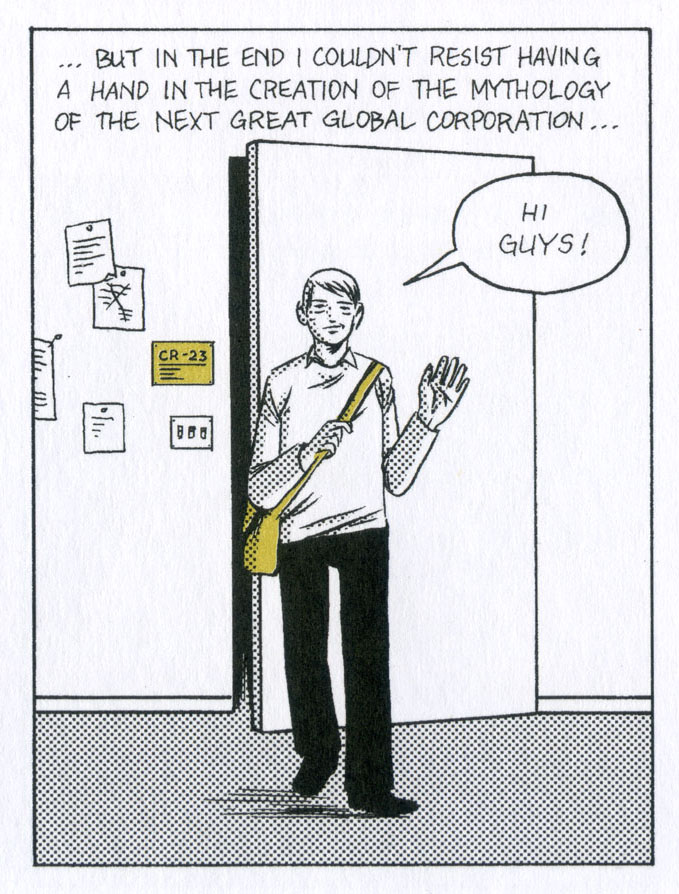
Wordsworth goes on to wish, in that same poem, to just be a pagan. But can such silly near-sighted humans ever get it right? In “Million Year Boom,” an ambitious young man takes a new job that will find him living on a corporate campus for several years. Hired as part of the new marketing team, he is less than impressed with the current company logo that looks like it was lifted out of a clip-art file. However, the company is stuffed with investor capital and the energy of start-up idealism is too much to resist. It’s not until he comes to see that the company’s goal is sort of crazy, that he hesitates. The allergy he’s developed from one of the company’s new species of plants is not a good sign either. But then again, when he thinks it over, a corporate return to the wild could be the sort of crazy that he’s always hungered for.

Kaczynski’s characters are often attempting to push back and find that something that is pure and real. “The New,” throws into bed conflicting beliefs in the authority of first world and third world states. Architecture is seen as a possible solution to the many ills of one struggling nation. Sex and power are confused with the potential of building something “great.” The end is near for everyone when architecture turns into a cosmic portal to unspeakable horror.

So, no, there is no snark here. It is wry humor, told and drawn with a deft touch. Never overburdened or overwraught, what we have are naked apes with too much technology, and too much time, on their hands.

“Beta Testing The Apocalypse” is published by Fantagraphics Books. Visit our friends at Fantagraphics Books here.

2 Comments

Filed under Comics, Fantagraphics Books, Graphic Novel Reviews, graphic novels

TCAF Comics Review: LOOK STRAIGHT AHEAD

Look-Straight-Ahead-Elaine-M-Will-2013

If you’re heading out to the Toronto Comic Arts Festival this weekend, May 11-12, be sure to stop by and purchase a copy of LOOK STRAIGHT AHEAD by Elaine M. Will. This is truly an outstanding work and, as you know, I don’t make comments like that lightly. It takes something to motivate me to strongly like, or dislike, something. This one I really like. LOOK STRAIGHT AHEAD brings to mind Nate Powell’s SWALLOW ME WHOLE. It has its own distinctive style and voice with that same quality that Nate brings to the game. You can check it out at Elaine’s website HERE.

LOOK STRAIGHT AHEAD makes its official debut at the Toronto Comic Arts Festival. Elaine M. Will has the distinction of being in the last group of Xeric Grant recipients. Keep an eye out, the plan is to see this graphic novel in comics shops by this October.

Looking-Straight-Ahead-Elaine-M-Will-2013

Meet Jeremy Knowles. He is a fine young man, trying to survive high school and struggling with manic depression. His friend, Lee, is there for him, despite the fact he has to endure taunts by another fellow student, Jen. If only things could work out for him. If only Erin, that most beautiful and intellectual girl, would notice him. If only he trusted himself, his own artwork. He has his dreams but they, in an odd twist, could consume him.

The art and writing here is spot on. I look forward to seeing this webcomic make its way to print. And, certainly, I look forward to seeing more of Elaine’s work. Make sure to stop by and visit her website HERE.

3 Comments

Filed under Alternative Comics, Comics, Elaine M. Will, Graphic Novel Reviews, graphic novels, Mental Health, Toronto Comic Arts Festival, Xeric Grant

Graphic Novel Review: JERUSALEM by Boaz Yakin and Nick Bertozzi

Jerusalem-First-Second-2013

How ironic if “Jerusalem” were not to receive wide recognition given that it is helping to set the standard for the relatively young literary art form that we know as the graphic novel. The general public is still getting to know it, compare it, and see what it can do. Let them read “Jerusalem,” the new graphic novel by Boaz Yakin and Nick Bertozzi.

“Jerusalem” provides a rich and dense texture to a narrative that invites a thorough reading. You can jump around and check it out but you’ll soon see that this is a multi-layered tapestry. It follows the pace of a good novel without the pretension. It also brings to mind the beautifully melancholy films of François Truffaut. Yakin and Bertozzi bring the colossal subject of Jerusalem down to a basic human level that we all immediately recognize and relate with. The story begins and ends with Motti, a little boy who only seeks love and understanding in his life. You don’t have to worry at all about the history. What you need to know it presented for you in crisp and concise ways.

JERUSALEM-First-Second-graphic-novel-2013

This is a story of family. It is these characters, connected by blood ties, that we rely upon to provide us with some truth, something to hang on to, as we witness the chaos and bloodshed that ensues. Compared to its 5,000 year history, Jerusalem was occupied by the British Empire for only a blip of time. But it was what came from that blip that continues to haunt us all to this very day. It was after World War I that Great Britain took control of land from the Ottoman Empire that was to become Palestine. Our story begins with the British Mandate, on the wane in 1946, giving way to a UN Partition Plan in 1947 that gives way to civil war and the Arab-Israeli War of 1948. The British occupation of a land and people it had no interest or understanding in was a powder keg just waiting to ignite.

Jerusalem-Boaz-Yakin-Nick-Bertozzi

In Motti’s immediate family, he has three brothers who all respond to the times with fervor. There is Avraham, the war hero, who becomes a Communist. There is David, who works the system to help Jews enter Palestine. And the is Ezra who is compelled to resort to terrorism. Motti is but a boy lost in the shuffle. His father is extremely distant, as present as a ghost. His mother is so stern there is little evidence of tenderness. And he has a sister, Devorah, very quiet and afraid. If not for a cousin, Johnathan, there would be no real friend for Motti. And this is not an easy friendship to maintain since Motti’s father, Izak, is at odds with his brother, Yakov.

Jerusalem-Yakin-Bertozzi-2013

Nick Bertozzi has a drawing style that is at once gritty and warm. But it’s more than that. Bertozzi has honed a style that looks effortless and conveys something of the human soul even in his most simple depictions. Whether it is buildings, or people, or specific characters, there is much to admire about his vigorous, expressive, yet well controlled, style.

Boaz Yakin’s script gives a human face to the conflict that arose as the State of Israel came into existence. We find characters compelled into action. There’s a very touching scene, for example, where the children gather to perform a wedding ceremony between two of them. They do this instinctively, from a need for love and order.

Motti, you will come to see, steals the show even though he appears to forever be pushed to the margins. He’s the little boy full of spirit and a willingness to fight. Just the sort of character you’d find in a film by François Truffaut, the creator of many wonderful films about misfits. There is magic in his films and there is magic in this graphic novel.

The graphic novel, of course, has made enormous strides over the years. We are moving past citing a select group of works as landmarks. The general public is working its way to looking forward to the next great graphic novel in the same manner as comics insiders do. “Jerusalem” has that special temperament about it, not self-conscious, not forced, just there to get the job done right. It is a quality that all readers will appreciate.

“Jerusalem” is published by First Second. Visit First Second here. “Jerusalem” is a 400-page hardcover, available as of April 16, 2013. You can get it here.

2 Comments

Filed under Comics, Graphic Novel Reviews, graphic novels, History, Jewish History, Jews, Nick Bertozzi

Review: X’ED OUT by Charles Burns

Charles Burns XED OUT

If you have not yet read what Charles Burns has been up to lately, don’t panic. You have options. There are two installments of his current wild ride, “X’ed Out” and “The Hive.” Both graphic novels can work as stand alones and you will do fine whether you read one first or the other. Essentially, this is a story that follows the main character mostly through flashbacks and alternates with his doppelganger in a parallel story set in a more cartoony and sinister world. Enjoy it as a multi-layered horror story. We’ll focus here on “X’ed Out,” the first graphic novel in the series which came out in 2010. And you can then proceed to a review of “The Hive” in the next post.

XED OUT Charles Burns

“X’ed Out” is as much about the angst of Generation X as it is a horror story. The two themes actually compliment each other rather nicely here. You will find equal amounts of supernatural horror and the self-inflicted horror of disaffected youth. Consider any art school crowd of a generation ago (or any generation, really) and you will find an inner core of self-loathing malcontented rebels ready to set the world on fire. What will it take? Start up a band? How about a magazine? But what will it ultimately take to make the pain go away? What happens when raw idealism and Prozac aren’t enough?

Charles Burns XED OUT Pantheon

We begin with the cartoony doppelganger. He is sitting up after a restless sleep in an old fold out bed. He has a bandage across the side of his head which can’t be a good sign. He has no idea of where he is. And, once he makes his way out into the outside, we see that this is a very strange place he has found himself in. As we progress through the story, we see that this world is more real in some ways than the hipster world that Doug and his girlfriend, Sarah, are so enthralled by. It’s as if the chickens have come home to roost, as if all those extreme misfits staying up late at night have finally summoned up the Devil. There’s a hint that Sarah may have actually done something like that. And then there’s that strange bandage across the side of Doug’s head.

It really is easy to enjoy both of these installments in either order. Although you can sense the force of the narrative progressing from the first book to the second, the numerous transitions in both books can act as so many elements building up, providing clues. Who is the old man in the creepy cartoon world that Doug’s doppelganger is spying on? Wait, now we have a scene with the old man followed by a scene with Doug and they’re all wearing the same purple bathrobe . Is it a much older Doug in one scene? Maybe. But, in another scene, we know the old man is Doug’s father. “X’ed” will definitely leave you wondering about what will happen next, who is who, and what is what. It’s when the last book in the trilogy, “Sugar Skull,” arrives in 2014 that the sequence will be clear and the resolution unmistakable.

“X’ed Out” and “The Hive” are available in bookstores, comics shops and online. You will find in many shops that both books are neatly displayed side by side. Visit Pantheon Books.

3 Comments

Filed under Charles Burns, Comics, Generation X, Graphic Novel Reviews, graphic novels, Hipsters, Horror, Pantheon