Tag Archives: Entertainment

Johnny Carson Farewell Show: May 22, 1992

I remember well Johnny Carson’s final show on The Tonight Show. I fondly recall the show having a mellow yet spontaneous vibe to it. I happen to have been watching it with a pal of mine and he said that Johnny should have been doing more casual and “unplugged” type of shows all along. In fact, I believe he actually did let loose more often than some may think. Of course, all in all, Johnny kept to the brand he created and it came natural to him. He was definitely the cool cat for a cool medium.

I notice a lot of mention being made today of this farewell show, May 22, 1992, but the first-ever show, October 1, 1962, is just as worthy of celebrating. It was mentioned on the final show and for good reason. It was still the dawn of television. We went in laughing only to wake up a few days later to the Cuban Missile Crisis (October 16-29, 1962). There was no particular reverence placed on this new show as demonstrated by the fact there is no preserved video of the first few years. For the first few years, the network was still relying on recording on kinescope which was of poor quality and not particularly archival. That’s why you only have photo stills in the above example to document the first broadcast.

On that first broadcast, Johnny quipped that he had already been knighted as the new king of late-night television (a nod to the out-going Jack Parr) but he was okay with settling for the title of prince. After a monumental 30-year run on the show, it was undisputed that Johnny was king. It is reported that he conducted around 22,000 interviews and was seen by more people on more occasions than anyone else in U.S. television history. It is no mistake to say that Johnny Carson ruled TV, set the gold standard for late-night, and, oddly enough, remains something of an enigma. Such is the life of a king. Set the gold standard, he did. You see the influence everywhere on late-night.

The Larry Sanders Show

It was Garry Shandling’s The Larry Sanders Show (1992-1998), his satirical version of The Tonight Show, that best articulates the delicate balance, the lonely existence, of being known by all while also being understood by few. Garry Shandling would have known as he was set to take over The Tonight Show when the time came but he turned it down. He preferred to do his take on the show for HBO. I can’t help but think of both men when I see the work of each and maybe that’s a testament to the uncanny quality of what both men had to bring to television.

Leave a comment

Filed under pop culture, Television

Dean Haspiel Talks Comics and COVID COP

Dean Haspiel is one of the great cartoonists, both as an artist and writer. You may know him from Billy Dogma or The Red Hook on Webtoon. We enjoyed a spirited comix talk and got to connect the dots on his intriguing new comic book series, Covid Cop. If you’re familiar with Dean’s work, then you know he leans into surreal and satirical work. Please refer to my recent review. We discuss the exciting and evolving ecosystem of independent cartoonists and how Dean is bringing his comics to you, the reader. You can always find him at his Substack and he’ll connect directly with you on purchasing his work.
Once you dive in, you’ll see that this is a fully-realized dystopian world, one that allows us to entertain some distance from a pandemic we are still processing. When we go through such a big event crisis, we turn to great storytelling. Thusly, we can rely upon Dean Haspiel to provide an intoxicating mix of levity and pathos. And there’s even a romance to be found embedded within this work!
What is Covid Cop about? In Haspiel’s dystopian story, Covid is beyond being unstoppable and the government concludes the only solution is to eliminate humans. We follow one lone police officer, Lincoln Bio, as he resists his marching orders and seeks another path out of hell. That is the cut-and-dry description. There’s plenty going on, including how Lincoln manages to survive and what motivates him to somehow rise above all the muck and mire. Did you know that the pandemic is officially over with? Well, until it returns in some other noteworthy variant. Alright kids, there is no chance that Covid Cop is going to go gentle into the night.

People who know me personally, from this blog, or from my comics, know that I enjoy offbeat humor and exploring a topic down to as fine a distillation as possible. That’s not idle crowing at all. It’s just part of what I do. Anyway, Dean and I engage in a bit of that in this conversation. I think we really hit our stride discussing the phrase, “knows where the bodies are buried.” The phrase is what I used to describe Dean to a friend. And, oddly enough, the phrase appears on the first panel of his new comic, Covid Cop!
So, who “knows where the bodies are buried?” The art of conversation is such that it’s easy to lose the thread unless you’re willing to make adjustments along the way. I had meant to segue into something else when I brought up this curious phrase but we proceeded down an interesting, and entertaining, line of thought. What makes for a good conversation? Keep to an agile and nimble mind. Work at it and just be a good egg. A confluence of factors leads to becoming a good cartoonist or cook or conversationalist. You don’t even need to be a “talker,” per se, but it helps. So, I invite you to check out our conversation.

Dean Haspiel’s THE RED HOOK

Dean Haspiel’s BILLY DOGMA

The main point is that we had a good talk. We discuss the creative process at length and that alone is worthwhile. If you’re an indie creator, I’m sure there will be some food for thought. We cover such topics as how to jump start a project and regain your creative flow as well as share some tips and tricks on what it’s like to get your work out into the world.

Seek out Dean Haspiel:
Find him at various events, including the upcoming Awesome Con in DC (June 16-18, 2023). Awesome Con’s Film Festival will include Dean’s short film, THERE IS NO TRY as well as a short film by Dean creative cohort Whitney Matheson, CONTINUITY ERRORS. Great to see these films in a theater!

THERE IS NO TRY by Dean Haspiel

Connect directly with Dean here. Keep up with him on Instagram here. And keep up with him on Twitter here.

Long Live Covid Cop!

Leave a comment

Filed under Comics, Dean Haspiel, Interviews

BLAB! comics anthology (2023) review

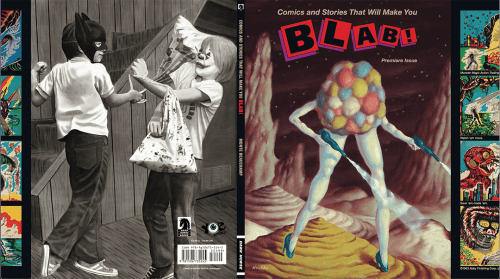
Cover: art by Ryan Heshka

BLAB! Editor: Monte Beauchamp, Dark Horse Books, pp 112, $19.99

Guest Review by Paul Buhle

BLAB!, a creation of the pleasingly twisted mind of Monte Beauchamp and his artists, has been around for quite some time. In fact, the first two issues (1986–87) were published by Beauchamp’s own imprint, Monte Comix. A genius at low-brow art anthologies, Beauchamp began this venture back in the transition or ditch between underground comix and alternative (what might later be called “art”) comics. But art, for Beauchamp, of an almost inexplicable kind.

The title has bounced from his own personal operation, Monte Comix, to Kitchen Sink Press to Fantagraphics and Last Gasp to Dark Horse, where it has become, for reasons known only to Beauchamp, “Blab World!” It was always a planet by itself, and the suspiciously camp rocket-firing goddess on the cover, by Hershka, is clearly interplanetary proof.

Excerpt from “The Death of Comics,” by Noah Van Sciver

Oh, yes, there is some truly understandable stuff here, a lot of it pages by Noah Van Sciver, at 38, the book’s youngest contributor. Louis Wain, a mad artist of cat images in  Victorian Age Britain,  could be a precursive Beauchamp, obsessed with images until he loses his mind. Van Sciver comes back again with a whopper, “The Death of Comics,” aka the story of the best-selling Crime Does Not Pay series. The genius money-making series created by leftwing publisher Ralph Gleason, it encompassed the noir sentiment of the later, disillusioned 1940s as the dreams of antifascist democracy melted into individualism and war-wounded minds that could not be healed.

Excerpt from “The Death of Comics,” by Noah Van Sciver

Van Sciver focuses in on the lives of the Crime Does Not Pay artists, and in particular the genius of graphic sex-and-sadism, Charles Biro. His triumph leads him and the rest of comics into the hands of would-be censors and especially best-selling author Dr. Frederick Wertham. It’s a familiar story to comics devotees, and involves a wider plot of horror comics, MAD’s publisher William M. Gaines, and Congressional hearings that mirrored the hearings held on the purported Communist threat,with near-identical warnings of dangerous Jews poisoning the minds of young Christians. Van Sciver allows himself only a glimpse of the larger picture, because he is following Biro to his own private doom.

Excerpt from “The Death of Comics,” by Noah Van Sciver

A considerable amount of the rest of BLAB! takes us to other strange places in the pulp past, comic book back pages of the 1940s-50s selling miracle hair-replacement liquids, pocket-size miniature monkeys, and other far-fetched hustles aimed at young (or low-capacity) minds. Or to the pulp treatments of great apes, “discovered” only in the mid-19th century, treated as fantastic King Kong types with their hands around near-nude (white) women, or as a link to the link of the “missing link” to the human race, a link that has never been found.  Beauchamp is asking the unasked question, why the obsession, and answering not in prose but by throwing the question back at the reader. Another section offers pages and pages of 19th century attacks on Catholicism, the dangerous threat to everything truly American. Great flying saucer illustrations by Ryan Heshka take us back to the late 1940s and 1950s, the golden era of interplanetary visitations and expectations.

There’s more: Heshka and Beauchamp’s story on Superman’s inventors Siegel and Schuster, taken from Beauchamp’s own anthology Masterful Marks (on great comic artists) is wonderfully weird. He has created no iconic comic figures, neither prompted the empire of capital in comics or been cheated out of it, but he is so much a part of the history, one way or another, that one can hardly tell the larger story without him.

Paul Buhle’s latest comic is an adaptation of W.E.B. Du Bois’s classic Souls of Black Folk, by artist Paul Peart Smith (Rutgers University Press).

2 Comments

Filed under Anthologies, Blab! Magazine, Comics

SIFF: MY LOVE AFFAIR WITH MARRIAGE by Signe Baumane

Signe Baumane is a significant animator, right up there with Bill Plympton. I’m so happy to see her film at Seattle International Film Festival this year. And, if you are in Seattle, you must go! Details on this funny and frank flick follow including how to seek it out in Seattle:

My Love Affair With Marriage uses music and science to examine the biological chemistry of love and gender, as well as the societal pressures on an individual to conform to social mores.

Go to the official movie website here.

Seattle International Film Festival takes place Thu, May 11, 2023 thru Sun, May 21, 2023.

My Love Affair With Marriage at SIFF takes place May 20th and May 21st. Details are right here.

A battle between Zelma’s prefrontal cortex and her nucleus accumbens.

Signe Baumane’s work has been accepted in over 300 film festivals around the world and received many awards. She was also awarded a prestigious Guggenheim Fellowship in 2017.

2 Comments

Filed under animation, SIFF

COVID COP by Dean Haspiel review

COVID COP. Art & script by Dean Haspiel. Dean Haspiel Deep Cuts. 28 pp. $15.

Dean Haspiel is in fine form with this short work in comics that transforms the Covid pandemic into a surreal parody of a sci-fi/horror story. In this scenario, the virus has completely taken over to the point that the government has clamped down hard on anyone disobeying protocol. It’s a take-no-prisoners battle plan and one police officer, Lincoln Bio, is doing his best to follow orders. If you’re a fan of Dean Haspiel, then you can expect that kooky sense of humor, bathed in pathos, made famous in the Billy Dogma comics series.

Our anti-hero Lincoln Bio is aware that he’s living in very strange times making very strange demands on him. How he comes to terms with his marching orders and how he confronts an insurgent group out to kill everyone makes up a good part of this dark comedy. Drawn in the mock heroic style that Haspiel is known for, this comic book will deliver a weird and entertaining jolt right to the jugular and then some. You probably won’t have nightmares from reading this but I can’t guarantee it. And, if there’s a sequel, all bets are off. This comic, by the way, is the first in the developing line of indie comics, Dean Haspiel Deep Cuts.

This comic will defy your expectations, especially if you don’t really know what to expect, and offers up the most recent example of a cartoonist at the top of his game. The winner of a recent Kickstarter campaign, this comic book is making its way to its backers and will make its way to you. Keep up with Dean Haspiel for more details.

4 Comments

Filed under Comics, Comics Reviews, Dean Haspiel

Hurricane Nancy: Keep Dancing!

#453 “When they put you down keep on dancing.”

Hurricane Nancy honors us once again by sharing some of her art. This is #453, entitled, “When they put you down keep on dancing.” All sorts of people can try to put us down. They think they can mistreat others just for the fun of it. That’s when it takes those of us with grace and dignity to persevere, and keep on dancing.

Colorized version!

Be sure to visit Hurricane Nancy’s website where you can purchase her art!

2 Comments

Filed under Art, Comics, Hurricane Nancy

Pop Culture Super Sleuth: Episode 1

This is the first installment of . . .  Pop Culture Super Sleuth . . .

“I’ve been a blogger for almost as long as I’ve been a cartoonist. And then I became a pop culture super sleuth . . . “

*

*

*

*

*

I’m building up steam on this new project. And maybe a little shy. You’ll have to tell me what you think. The character isn’t necessarily me, per se, but a sort of alter ego. It’s fun and it’s all possible in the wonderful world of comics. Am I right? You betcha, I’m right!

Leave a comment

Filed under Barefoot, Comics, Feet, Henry Chamberlain, pop culture, Webcomics

MS DAVIS: a Graphic Biography review by Paul Buhle

Ms Davis: a Graphic Biography. By Amazing Ameziane and Sybrille titeux de la Croix, translated by Jenna Allen. Seattle: Fantagraphics, 2022. 185pp, $24.99.

Guest Review by Paul Buhle

This remarkable and challenging work, translated from the 2020 French edition, offers readers a study in the history of comic or political art by adapting past artists’ work into a new synthesis of narrative. It is not a “biography,” as in “graphic biography,” that readers would expect. We see only the dramatic bits and pieces of Angela Davis’s life, and virtually none of the long aftermath (from the early 1970s until now) that biography readers would expect. And yet capture the drama of Davis’s life, the work does in grand form.

Ms Davis might be contrasted with The Black Panther Party Comic, a well-selling, straightforward visual narrative that a fussy aestheticism of comic art might wrongly call “pedestrian.” This tells the story of the short-lived but extremely dramatic Black Panther Party with suitable details, and would be valuable for anyone who enjoys Ms Davis, which goes the precise opposite direction in so many ways.

In the globalization of comic art, artist Amazing Ameziane and collaborator Sybille Titeux de la Croix credit four American artists: Milton Glaser, Norman Rockwell, Emory Douglas and Bill English. What do they have in common? Less than they have by contrast. Rockwell, who famously celebrated the “American Way of Life” (overwhelmingly the white, middle class way of life in the twentieth century), had moments when he went beyond his assumptions, as in his famed poster art for “The Four Freedoms” proclaimed by Franklin D. Roosevelt in wartime, and still not realized (“Freedom from Want.”) Emory Douglas is the Black Panther Party artist supreme, with his stark, propagandistic drawings. William English, illustrating some of poet William Blake’s works, is as far from commercial illustrator Milton Glaser (best remembered for the 1966 poster for Bob Dylan) as imaginable. And so on. Amezianne/De la Croix pick and choose what they want, in art as well as story.

They invent characters to suit themselves. Angela Davis, growing up in the 1950s South, thereby has an invented black woman friend who stays in Atlanta when Davis moves to New York.  She also has a sympathetic and crypto-feminist journalist pal who struggles with her newspaper bosses to create a news story worthy or at least somewhat worthy of Angela Davis’s incredible life.

To describe the plot is grossly inadequate to the “look” of Ms Davis. Actress Helen Mirren, speaking at the San Diego Comicon after Harvey Pekar’s death, said (in her eloquent way) that Harvey had taught people to read comics “in a new way.”  That is, comics could be about ordinary people in the unprestigious blue collar world of that presumably most ordinary place, Cleveland, around Harvey himself, his troubles and joys, and most definitely his work at the VA Hospital. (That Pekar and his artistic collaborators did this in comic books was another point of originality, following the underground “nothing forbidden” comix.)

The story-telling daily strips, appearing in the Chicago Tribune just about a century ago, made the same artistic and narrative point, more or less. Before 1920, comics readers expected a joke climaxing in the last panel; the following day would begin the story anew. Now readers of the hugely popular dailies would look forward to daily lives that did not change very much, had precious few adventures, but offered a kind of assurance.

How many comics, thinking now on a global scale from the twentieth to the twenty-first century, have set out consciously or otherwise to teach readers to look at comics in new ways, and how many have succeeded? It is an imponderable, although claims could be made in many directions. Sybille Titeux de la Croix and Amazing Ameziane are struggling page by page to make their own large contribution. Their sincerity and their determination, perhaps even more than the expression of their talent, speak for this comic’s value and importance.

Amazing Ameziane: “Ms Davis is the third part of my first SOUL TRILOGY ( Ali / Attica /Angela).”

As history, it can be narrow and even flawed. In its last pages, we learn that Nikita Kruschev’s revelations of Stalin’s crimes, in 1956, sent Communism into its “final throes.”  This is more than a little too anticipative. Angela Davis would not have believed so (she resigned from the CPUSA in 1991). The Vietnam War, the survival of the Cuban Revolution, the Communist role in the South African struggle against Apartheid, the claims of China’s leadership….all these suggest something more than a detail absent in the overview. (On the following pages, the book turns our attention toward Neo-liberalism and here the book is accurate. Class society has grown worse.) Does this limitation harm Ms Davis? No, not much.

Perhaps we are not, after all, reading Ms Davis “as history,” but as an artistic statement about history and about the features in Angela Davis’s personal saga that are larger than herself. Drawing upon the most improbable sources of visual inspiration, changing formats almost page by page, Ms Davis is trying to teach us a different way of looking at comic art. Nothing, for me, is quite as stunning as the reuse of Emory Douglas’s styles, seen so vividly in the Black Panther newspaper of yore, so stripped of visual finery, so expressive in its message, artistically quite as if the artist, like the Panthers, invited death at the hands of violent authorities: revolution or martyrdom. How could Emory Douglas be combined with Norman Rockwell, the graphic artist of middle class contentment in “the best country in the world”? See for yourself.

Paul Buhle’s latest comic is an adaptation of W.E.B. Du Bois’s classic Souls of Black Folk, by artist Paul Peart Smith (Rutgers University Press).

4 Comments

Filed under Black Panther, Comics, Graphic Novel Reviews, Paul Buhle

MoCCA Arts Festival 2023: Notes & Observations

Busy and hectic inside and out.

MoCCA Arts Festival returned to the Metropolitan Pavilion in New York City earlier this month and I have some notes and observations to share with you.

Nonstop activity in a place to see and be seen.

MoCCA took place over a weekend, April 1-2, of which I was able to make it for Sunday. I’m not a New Yorker, at least not a resident but a lifelong fond visitor. As luck would have it, I sort of stumbled upon the event this year–although I have plans to participate next year. With that in mind, I was eager to make the most of my visit as well as share whatever insight I’ve collected over the years with a new friend thru comics, Zebadiah Keneally. Between my partner, the cartoonist and writer Jennifer Daydreamer, and myself, we enjoyed the event all the more with his company. We introduced Zeb to friends and colleagues as we came upon them. First off, we were charmed by two wonderful career cartoonists, Dean Haspiel and Gabrielle Bell. Dean chatted with us in an easygoing manner. He’s excited these days about his new comic, COVID COP, which looks fantastic. Gabrielle is doing great and was there to promote her work with Uncivilized Books.

RisoLab at MoCCA.

The last time I’d been to MoCCA was actually twenty years ago, and it was in full swing, riding an intense wave of interest in alt-comics, held at the grand ole Puck Building in SoHo. It was a huge show with a Who’s Who cavalcade of talent, a truly festive circus-like environment and completely free. I was rudely awakened to find that I needed to pay $25 admission for the day. And I literally had to beg for a program since they were nearly out. By comparison, Metropolitan Pavilion is a smaller venue. That said, I quickly got into the groove of things. There was much to see and, no wonder they were almost out of programs. It was nonstop activity.

Ellen Lindner is one of our great cartoonists. She is devoted to whatever project she takes on, like The Strumpet, which is one of the best comics anthologies I’ve had the pleasure to read. And I also know that lately she’s been devoted to a comics project about baseball. Part One and Two to Lost Diamonds are available now. It was fun to chat with her and introduce her to Jennifer and Zeb. Ellen made a wonderfully insightful comment having to do with the creation of comics and the navigating of a comics career: “Do what you want. Pace yourself. Making comics is hard!” Well, perhaps it was a little more nuanced than that but that’s the gist of it–and I must say that I agree. Comics are hard to make, at least the kind that are worth a hoot.

Joe Sikoryak and When We Were Trekkies.

Joe Sikoryak is a filmmaker who decided to follow his brother, R. Sikoryak, into the world of comics. Joe says that is was during the pandemic that he got the idea of a comics series based upon his early years of fandom. When We Were Trekkies follows the adventures of a group of teenagers back in the ’70s who witness, and take part in, the advent of comics fandom as we know it today, going back to the development of interest in reruns of the original Star Trek television series (1966–69) which would evolve into a pop culture phenomenon. The series will be collected into a graphic novel.

Artist Pan Terzis

Panayiotis (Pan) Terzis is an artist, printer and publisher based in New York. Terzis is the founder of the risograph publishing platform Mega Press. In 2015, Terzis co-founded the RisoLAB, a risograph studio based at the School of Visual Arts. The RisoLAB presence at MoCCA was certainly a hit. It was a pleasure to chat with Pan and to purchase one of his prints.

Nikkos Saviolis, a student at Syracuse University College of Visual and Performing Arts.

I got into a conversation with this young student from Syracuse University and lost his card. And then found it later after I had time to decompress. Your comics look great, Nikkos! I briefly got to speak with Frank Cammuso, the professor of Illustration, and was delighted to learn about the university’s comics courses.

Alex Segura

Alex Segura is a writer you may be familiar with, especially if you keep up with comics. Segura is the author of Star Wars Poe Dameron: Free Fall and the acclaimed Pete Fernandez Miami Mystery series, as well as a number of comics. He was at MoCCA in support of his new novel, Secret Identity, published by Flatiron Books.

MoCCA Arts Festival has survived the pandemic and looks to be on steady ground. I could see only happy and content customers in every direction. This festival began in 2002. I was there for its second year and fondly recall the excitement. Indie comics had crossed a significant threshold in the general public’s recognition and anything seemed possible. There was a giddy feeling crossing generations and everyone was there celebrating: Danny Hellman was there. Sophie Crumb was there. Denis Kitchen was there. Kramers Ergot was arguably at its height and flying high. It was fun. People were excited.

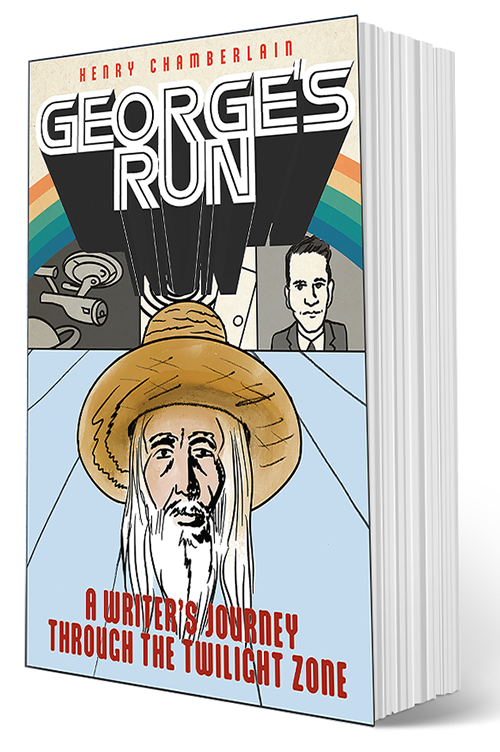
Now, a generation has had time to mature and reflect. Covid has robbed us all of that same innocent euphoria. If it’s there, it’s just not the same. It’s tempered. It’s battle-weary. I’m battle-weary but, as Ellen Lindner pointed out, you’ve got to pace yourself! So, I keep reminding myself that I’m an artist and I’m a cartoonist, even though I don’t really need to remind myself. And, before I made my exit, I stopped by and paid my respects to the Fantagraphics table and kissed the ring of Gary Groth. Well, I say that in jest. It was a pleasure to see him. I handed him a postcard of my new book, George’s Run, and tried my best to give him a fast pitch about it, just for the sake of conversation. You can consider this postcard a preview for my being at MoCCA next year. Anyway, it was a nice thing to do. And I couldn’t help but recalling doing a different pitch for a different book to him at MoCCA all those years ago. I was full of hope then and I’m full of hope now. That spirit is still around. It had better me. It never really left. It’s here. I know it is.

MoCCA Arts Festival returns next year, the weekend of March 16-17, 2024.

2 Comments

Filed under Comic Arts Festivals, Comics, MoCCA Arts Festival

Thaddeus Stevens: The Great Commoner comics review

Thaddeus Stevens: The Great Commoner. writer Ross Hetrick. artist Noah Van Sciver. editor Paul Buhle. Thaddeus Stevens Society of Pennsylvania. 18 pp. $5.

Thaddeus Stevens is an American historical figure who is brought to life in this remarkable mini-comic. You may not recall or recognize the name, and that is part of the reason this little book has come into existence. Stevens is one of the most significant players in the fight for human rights outside of Abraham Lincoln and, some may argue, there is no Lincoln without Stevens. These are the kind of issues dealt with in this pamphlet-sized comic.

Fans of the work of Noah Van Sciver will appreciate the distinctive style and masterful use of the comics medium. If you haven’t gotten a chance, you’ll want to check out Noah’s landmark book from last year, Joseph Smith and the Mormons. You can read our review here. That same intense level of scrutiny, combined with brevity, is on display for this tribute to Thaddeus Stevens. At a brisk and steady clip, each page here packs a punch. We see how pivotal Stevens was in securing freedom and rights for America’s former slaves. Yes, it’s safe to argue that we needed to have Stevens in order to have Lincoln. In other words, we all know and honor Lincoln but credit must be given to the man at the forefront for the fight for freedom and human dignity.

Paper copies are $5 and if you’d like one, send an email requesting one to info@thaddeusstevenssociety.com and one will be sent to you with a self-addressed envelope to send back payment.

Leave a comment

Filed under Comics, Comics Reviews