During a recent visit to Portland, Oregon, I interviewed Jason Leivian, who runs Floating World Comics, one of the best comic book shops you could hope for. This is a comic book shop taken up to the level of a curatorial experience with everything neatly organized in different categories.
Floating World Comics holds the distinction of being one of few comic book shops that also functions as a publisher. During this interview, my goal was to bring out all that is special about Floating World Comics, and Jason Leivian proved to be a most excellent host. I hope you enjoy the video interview below:
I’ve come back with some choice titles published by FWC and we will be taking a look at them in the coming days.
When in Portland, or whenever you wish to find something exceptional in comics online, be sure to visit Floating World Comics.
Among board games, I was always intrigued with the idea of Clue but never played it. I did see the 1985 John Landis movie version and remember being entertained. Clue, which was first released in 1949, always struck me as strange and erudite, compared to the far more popular Monopoly, first released in 1935. Now, cartoonist auteur Dash Shaw has created a 3-part Clue comic book series. All in all, I think Clue: Candlestick, published by IDW and available on comiXology, falls neatly into place with other works by Dash Shaw. It doesn’t matter if Shaw is a fan of the game. What matters is that Clue is an opportunity to do something interesting with comics.
You can tell from these examples that Shaw is having fun interpreting the game as an artist. That said, he also seems to get into the spirit of the game too. He turns Clue into part of his world and the reader, in turn, gets immersed in this hybrid of art and popular board game.
Dash Shaw does a wonderful job with playing with storytelling elements while also keeping the Clue narrative in play. It’s a fun balancing act; and similar, on some levels, to how pop artists related to consumer culture. It helps the creative process if artists remain as open as possible with their subjects. Of course, it depends upon the project, but there is much to gain by remaining flexible. And, as for Clue, who doesn’t like a good mystery?
The third and final installment of Clue: Candlestick is available as of July 17th. You can find it at IDW and comiXology.
BEFORE HOUDINI, script by Jeremy Holt and art by John Lucas
It is a pleasure to have the opportunity to interview writer and graphic novelist Jeremy Holt. His most recent works include After Houdini, Skip to the End, Skinned (Insight Comics), Southern Dog (Action Lab), and Pulp (comiXology), which IGN has called, “…one of the best one-shot comics of the year.” For this interview we try to cover a bit of everything with a focus on Holt’s most recent title, Before Houdini.
HENRY CHAMBERLAIN: Jeremy, thank you so much for doing this interview. We’re going to focus on Before Houdini, your latest title with Insight Comics as well as do our best to bring out something about you and your creative life. I’ll start with the introduction by comic book writer Matthew Rosenberg for Skip to the End, another work you did with Insight Comics. In his introduction, Rosenberg talks about the urgency of punk rock and indie comics: both are raw and unfiltered. That brings to mind your one-shot, Pulp. I think, in the end, whatever the genre, whatever the vibe, you want your work to be honest, right?
PULP, script by Jeremy Holt and art by Chris Peterson
JEREMY HOLT: First of all, thank you for having me, Henry. Over the last ten years of making comics, I’ve thought a lot about the stories that I want to tell. I think, at the beginning, most creators go for those big bright ideas that might get them noticed. I was guilty of that. For instance, I tried doing a zombie story, not realizing that market was pretty saturated. In the course of finding collaborators and pitching to publishers, I’ve found myself taking ten steps backward and having to re-evaluate myself, as a writer and a creator, and really thinking about those stories I want to tell. So, yes, honesty is a very important factor for me.
Share with us how you go about creating a multi-layered character like Jonny, in Skip to the End. He’s got a lot of rough edges. He comes from a certain subculture. And yet people can relate with him. Or maybe sometime from Skinned or After Houdini, whatever comes to mind.
For me, usually it starts with a concept. That’s usually how my ideas begin, with a concept that seems like a really cool idea. Then, from there, I start to develop the main characters, the cast if you will, and then the plot. If those three things don’t actually connect, even after thinking about them for days, weeks, months, I tend to move on. So, as far as characterization, that’s an ongoing process as I’m writing the stories. What I like most about a lot of the projects that I’ve worked on that have resonated with the readers is that, at a certain point, if you’ve done your job as a writer and figured out who these characters are, where they come from, where they’re trying to go, at some point during the writing process, they actually start making their own decisions and speak for themselves. Maybe in an early version of an outline for a specific issue, I may have Jonny saying this but, by the time I am actually writing that scene, so much has happened leading up to the writing of that scene that he ends up saying something more true to his character than I’d even thought to note originally. That’s always fun to see.
Oh, sure, that’s all part of the process. So, share with us what I’m thinking of as a fascination with Houdini. What can you tell us about the creation of the Houdini books?
That’s a great question. To be honest, the idea of writing about Houdini began with the original artist I’d worked with, Kevin Zeigler. We met through mutual friends. We both went to Savannah College of Art and Design. He was a freshman and I was graduating. So, we missed each other by a year. But, through networking, his name kept coming up and so we got together. I would pitch him ideas but nothing seemed to gel. Then I decided to try a really good writer’s exercise: ask my collaborator what they liked to draw. He said he was very interested in Houdini. So, I began to do some research. One book stood out in particular: The Secret Life of Houdini: The Making of America’s First Superhero by Larry Sloman and William Kalush. That book opened my eyes to the idea of Houdini being this covert spy. So, I brought that back to Kevin and we tossed that creative ball around. That is how After Houdini came about, that collaboration.
I’d like you to share something about the storytelling process. You’re a graduate of the the Savannah College of Art and Design, known for its Sequential Art program. I envision you with a skill set to create your own comic alone if you chose to. But you’ve fine tuned your path to focus on being a comic book writer. Should I see you as someone like Ed Brubaker who did create comics in the auteur tradition but ultimately came to the realization he needed to focus on being a writer?
Well, no, not exactly like Ed Brubaker. I studied film. In essence, I was around storytelling but I concentrated on sound design which is more post-produciton, sound editing. I only did that for about a year after college. It really just wasn’t for me. I’d done some writing in high school but I had never viewed myself as a writer. Let’s see, I graduated from SCAD in 2005. I didn’t collect comics as a kid. My oldest brother was a collector. It wasn’t until 2008 that I read The Dark Knight by Frank Miller and that opened up a door and made me want to start writing. I didn’t know anyone. I didn’t know how to start. So, it was a lot of trial and error. That’s what the early years were like.
SKINNED, written by Jeremy Holt and Tim Daniel and illustrated by Josh Gowdy
We all have our own unique perspective on the world and we’re all dealing with something. As a writer, you find ways to dig into a character to one degree or another depending upon the project. Sometimes it’s more direct. Sometimes it’s more subtext. Do you have a preferred approach in your storytelling? More direct or more subtext or does it just depend? I think of your comic, Southern Dog, which basically goes for the jugular.
I try to walk that fine line between both being direct and using subtext. I definitely pull from real life experience as an Asian-American, and being an identical triplet, as well as being adopted. So, identity is something that is at the front of my brain. Skip to the End is probably the only story I’ve written that is not somehow drawing from my own experience. Jonny was a character I knew nothing about firsthand. I’m not a drug addict. I haven’t lost anyone to suicide. So, there was a lot of research I needed to do in order to feel comfortable writing about someone from that perspective. Generally, I try to weave some personal experience into a narrative that isn’t directly taken from my own life since that’s part of the fun of creating stories. You get to live vicariously through these fictional people.
SKIP TO THE END, script by Jeremy Holt and art by Alex Diotto
What do you hope readers will get from your Houdini books?
You get a sense of adventure. Before Houdini has a substantially darker tone than After Houdini since it has my take on Jack the Ripper. I think you get a sense of wonder from these two books. You get fun action adventure stories.
You’re living in Vermont. You came from Brooklyn. Maybe you could share with us what it’s like living in Vermont. And I’m also curious if you’ve had a chance to visit the Center for Cartoon Studies, located in White River Junction, Vermont.
I did spend a good part of a day there. It’s a very small town. It’s very distinct. The Center for Cartoon Studies is right in the middle of this one single winding street. I’ve met its co-founder, James Sturm, before. He gives talks around the country. And I’ve met people who have given talks there or taught or went to school there. Vermont is a pretty small state so you end up rubbing elbows with folks. As far as why I’m in Vermont, I’m recently divorced. My ex-spouse took a job in Middlebury, Vermont so I ended up here. My friends thought I’d move back to New York. And I love New York. I lived there for five years. But, honestly, the quality of life here in Vermont is substantially higher in a lot of ways to the daily grind of living in New York City. And I still go back two or three times a year to visit with friends. It makes for a nice balance.
Page from BEFORE HOUDINI
I can see why the Center for Cartoon Studies would want to be in Vermont. You get to share that same mellow easy-going atmosphere.
Yeah, I think so. There are fewer distractions for a writer. I think, when I was younger, I was naive enough to think that the city providing me with inspiration. And in a lot of ways it did. But it also provided a ton of distractions. Since moving to Vermont I’ve become exponentially more productive than when I was in New York thinking that I was prolific. In fact, I’ve produced more, in a shorter amount of time, than when I was living in New York.
What might you tell us about two upcoming projects, Made in Korea and Virtually Yours? Are you still working on them or are you shopping them around?
Both of those have publishers but I can’t disclose who. As for Virtually Yours, I have finished writing and the artist is well under way working on it. And regarding Made in Korea, I’ve scripted two of six issues. I’ve outlined the entire series. I have a very clear idea of where it’s going. I plan to script the rest of it in the next two months. I’ve pitched a couple of new projects this week so I’m waiting to hear back from those publishers. I need to keep my fingers crossed.
Page from BEFORE HOUDINI
It sounds like you’re in a really great position. You have these impressive titles with Insight Comics and you’ve got a number of new projects well under way. It looks like you’re right where you need to be.
I think so. The important thing for any creator to figure out is working at a pace that isn’t daunting. Obviously, early on, I wanted to be a full-time writer and quit my day job. I do tech support during the day. But, to be honest, I am producing enough work in my free time outside of my day job that I’m hitting my deadlines without a problem. I know that, once I didn’t have a day job, my relationship to my creative work will change. I’ll be depending upon that in ways that I don’t now because I don’t have to worry about making a ton of money off my work. And I kind of like that. I like that there’s no pressure and I can just create and have fun with it. So, I’m not sure that I’m going to quit my day job anytime soon even if I have the opportunity because I think it makes me work harder.
And you have something that is really working, a really well calibrated routine. So, you don’t want to mess with it.
I think so. As a creative person, it’s about moving that goal post, not being afraid to say that something isn’t working, that expectations need to change. That allows you to keep working. For creators that don’t make these adjustments, it’s easy to burn out. You can end up feeling defeated or pessimistic about your career. I think it’s totally normal, totally acceptable, and even helpful, to move that goal post, to set expectations that are right for you at whatever place you are in your life.
Page from PULP
We could pretty much bring this to an end unless you had anything else you might like to add.
This was great. Thank you for your questions. Thanks for your in depth look at my books. That’s a first.
Well, I found Pulp, for instance, at comiXology. It’s there for anyone to find. I highly recommend it. I particularly appreciate the indie flavor to it.
For me, Pulp was a writing exercise. I wanted to see if I could tell a story within 24 pages. I think, from the beginning of the concept all the way through production, it took Chris and me five days to put it all together. It was ridiculously fast, unnecessarily fast. But I still think it’s one of the stronger stories that I’ve written.
It definitely has that urgency and energy that Matthew Rosenberg was talking about in the introduction I began with.
Alay-Oop by William Gropper, introduction by James Sturm, published by New York Review Books, 209 pages, $24.95.
A growing interest in the origins of comic art—a subject that could direct the reader toward cave paintings but more logically offers twentieth century precursors—has prompted the return of long-forgotten names like Lynd Ward and Frans Masereel, and just as naturally, reprints of their work. These notables and others peaking before the Second World War favored wood-cuts over drawing on paper, and also favored an art form now known familiarly as the “wordless novel.” It’s a fascinating memory corner, full of biting social criticism, but so different from the famed agitational cartoons, or for that matter, mural art of the New Deal period, that any common ground is little understood. Reader, meet William Gropper.
We can say many useful things about Gropper the artist, but for our purposes, there is every reason to start with Alay-Oop. It is a simple tale of a trapeze artist so muscular that she may not be beautiful in any classic sense, but she is admirably limber, a skilled and daring performer. She is wooed by an older and rich, plump opera singer, with throngs of fans of his own. He takes her out (with her own acrobat-partner in tow), romances her and persuades her to marry. A few pages of her dreaming, heavily erotic in symbolism, shows us that she is willing, and her swain promises her the skies. Her rather handsome fellow acrobat is, then, left out in the cold. Soon, she has beloved children but a troubled marriage. She finds her way, she reaches her way through her acrobatic skills, to her own version of a happy ending. This is a memorable Strong Woman Story, and may (as the introduction suggests) reflect the strength of Gropper’s own real life mother character, when his father, an autodidact intellectual, let the family down.
A May-December romance. Will it last?
Now, back to the Gropper famous in his own milieu. Communists and Popular Front sympathizers, together numbering into the high hundreds of thousands from the mid-depression to the beginning of the Cold War, would recognize Gropper’s work in a minute. His famed and ferocious “Bank Night” drawing, with the fat capitalist landlord reaching into the slums for grotesque profits, alone memorably identifies both the artist’s skills and his temperament. Personal testimony: Recovering from a day at a pre-induction Army physical in 1966, I was driven by famed Yale University peacenik Staughton Lynd out to stay the night with a Jewish chicken farmer. There, on the kitchen wall, was a famed Gropper print, with ugly Senators, most likely Dixiecrats, at a US Congress hearing, yawning with unembarrassed tedium at the social crisis of the Depression. That was the first Gropper that I ever saw.
Alay-Oop evidently comes from a different place if definitely not a different artist. Gropper himself had actually attended a radical art school, with giants like Masses magazine artists like Stuart Davis and Dada /Surrealist avant-gardist Man Ray. Instructor Robert Henri personally escorted young Gropper to the 1913 Armory Show that introduced modernism to the backward US intelligentsia. The young man had the talent and connections to make it as an illustrator in a grand era for newspaper illustrators—but was bounced from a commercial staff job as too radical.
You could say that he found a place for himself, an eager audience intense if not commercially helpful, at the Liberator and New Masses, two beautiful magazines that attached themselves to “the New Russia” without quite being overwhelmed by politics. By the early years of the Depression, Gropper’s work was overwhelmingly agitational, with the Daily Worker its largest outlet. Alay-Oop may be the first suggestion that his heart belonged elsewhere, at least in part.
What inspired him to comic art? Belgian Frans Masereel was so famous in Europe that leading novelists wrote introductions to his classic woodcut works. Back in the US, Lynd Ward’s mordant God’s Man sold wildly, far beyond the art crowd that seemed the intended audience. Hugely popular funny pages artist Milt Gross published what some regard as the actual earliest comics novel, He Done Her Wrong (1930), a satire on the soap opera-like American adventure novel. Alay-Oop appeared in that same year, but can only be described as a genre of its own. If it has successors, they come generations later.
James Sturm, who wrote the Introduction to the volume under review but co-founded the Center for Cartoon Studies in Vermont, suggests we are not likely to find out. In his style, Gropper was not austere like Masereel or Ward, nor satirical like Gross. He was aiming for something else, and that may be a reason why the book got lost so quickly and easily. Gropper himself moved toward a very different and unique high point of his artistic career: the opportunities opened by the New Deal. Muralist for the Works Progress Administration, popular book illustrator, artist of a folk-lore map of the USA (with little figures representing various traditions), Gropper the erstwhile revolutionary was “discovering America” in his own terms, and good at it. He had also become, for the moment, also a considerable painter, mostly of the social themes around him, and remembered from his impoverished youth.
Much of the remainder of Gropper’s life seems to have devoted rather less to leftwing causes, and rather more to painting, but also to making a living as an architectural artist, where he achieved a certain distinction. After the Second World War, with its artistic high points of sympathy for the Russians and anti-fascism generally, his opportunities but perhaps his political eagerness as well, were seriously restrained. His grandson is quoted in the introduction as saying that grandpa was not all that political—which is about what an old man would tell a kid in the 1950s. All this nevertheless suggests that Alay-Oop reaches out toward something elusive, but that is hardly a criticism of any artistic creation.
The book is certainly successful in itself, with a line of drawing, as Sturm suggests, so fresh and fluid that it looks like “the ink is still wet” (p.10). We also hear from his grandson that Gropper, drawn to vaudeville and the circus, admired performers as more honest and more fully human than politicians. Perhaps we need no further guide. Anyone can search through Google Images and admire the breadth of Gropper’s work. It would be good to have an anthology that gives us a sense of them.
Paul Buhle, co-editor of the Encyclopedia of the American Left, has produced a dozen comics.
The cartoonist Typex presents a comics biography of the artist Andy Warhol that is like nothing you’ve ever seen before. If you thought you knew Andy Warhol, then read Andy: The Life and Times of Andy Warhol, published by SelfMadeHero, an imprint of Abrams. This is quite an ambitious and fascinating biography, a work of art in and of itself. Typex delivers such a detail-rich account in this 562-page book and leaves you wanting more! He does this by keeping to a crisp and finely-tuned and organized narrative. We go from one period of time to the next, evoking the quotidian while distilling the essential. In the process, the reader is treated to a behind-the-scenes look at Andy Warhol’s personal and professional life.
Andy Warhol meets Edie Sedgwick
An inquisitive cartoonist like Typex is not one to be easily satisfied with a standard comics biography, especially for such a towering figure in art and pop culture as Mr. Andy Warhol. Love him or hate him, Warhol has left a significant mark on the culture and, if not for never fully recovering from a murder attempt and a botched up gallbladder operation, he would have remained active that much longer. He would have found a way. That is what this book is all about: finding your way even when you might seem, like Andy Warhol, to be the most unlikely person to do so.
Typex is most interested in subverting any Warhol hagiography and bringing Warhol down to a human scale. Perhaps influenced by the books he chose for reference material, Typex often tamps down Warhol’s reputation in favor of depictions of him munching on Hershey chocolate bars and lusting over young men. No doubt, Warhol was a highly idiosyncratic individual but he was nobody’s fool and a workhorse. Scant mention is given in Typex’s book to Warhol’s contributions to art history. Typex acknowledges Warhol’s commentary of consumer culture but rather reluctantly. Very little is said about Warhol’s landmark use of serial imagery or his revolutionary use of silkscreens. Warhol made art history, after all. That is a major accomplishment and it sort of gets a bit lost in this otherwise marvelous book. You can say this book is not where you go for art history lessons, per se. This is a book decidedly about a scene or a set of scenes. Then again, it’s what’s happening in those scenes where you find the most interesting art.
Adding to the level of interest Typex has for his subject is how he’s presents his work. He has full page and two-page spreads to evoke the energy and mayhem of various moments. And, for much of the book, he keeps to a nicely packed grid format, nine panels per page. He goes that extra mile by anyone’s standards with including a program guide of notable players from each time period. In fact, Typex is just as concerned with the characters surrounding Warhol than simply Warhol himself. That could account for the somewhat slim analysis of Warhol’s actual career and work. You have to find a way to balance it all out and properly address Edie Sedgwick, The Velvet Underground, Valerie Solanas, Jean-Michel Basquiat, and the countless followers all in search of their own fifteen minutes of fame. It is Valerie Solana who ultimately stands out among the pack with her unhinged grasp for fame and attempt on Warhol’s life. And it is Basquiat who breathes new life into Warhol just as the two of them are nearing the end.
Warhol was driven and he also had a lot of help from his evolving network of colleagues, mentors, and a myriad of aspiring artists, dreamers, and party people. The Andy Warhol phenomenon did not happen overnight nor did it exist without various setbacks. Andy Warhol was neither god nor monster. It all comes back to the fact he was driven. He had the skill, the intellect, and the resources to actually make art history and, despite any naysayers, that’s exactly what he did. Typex explores this ambition as he sees fit while also demystifying the man and his times. Overall, this is quite a fascinating read to be added to other notable books on one of the most celebrated artists of the 20th century. In the end, I believe Andy Warhol would have approved of this book.
Cartoonist Typex
Typex is a Dutch illustrator and graphic novelist. A graduate of the Amsterdam College for the Arts, his work appears in many nationwide newspapers and magazines. He has illustrated numerous children’s books and has published some of his own. His graphic novel biography, Andy: The Life and Times of Andy Warhol, is published by SelfMadeHero, an imprint of Abrams. He lives in Amsterdam.
French Comics Association
You can see Typex this weekend if you’re in the D.C. area and this event happens to fit into what you’re doing. Typex will be there as part of the invited guests touring with the French Comics Association. The FCA will be taking part in this weekend’s American Library Association Conference. Okay, if that makes sense, then congratulations, you are a true Typex fan and well above average in every way.
The French Comics Association brings together many of the major publishers of French comics, including Dargaud, Casterman, Delcourt, Dupuis, Gallimard BD, Glénat, Le Lombard, Rue de Sèvres, and Soleil. As part of its mission to promote Franco-Belgian comics in the United States and worldwide, the association aims to promote comics translated into English, to support the U.S. publishing industry, and to stimulate cultural exchanges on the basis of literature and visual narratives.
Wonderful things often take place in the world of alt-comics. I’m talking about when a bigger publisher lends a hand to help a smaller publisher. A case in point is the graphic novel, Jeremiah, which joins AdHouse Books in promoting and distributing and One Percent Press in publishing this remarkable work. There are quite a few gems out there among indie comics and Cathy G. Johnson proves that wonders never cease. Johnson’s work has a beauty that looks effortless and pure. In the span of 160 pages, she mesmerizes the reader with her gentle yet powerful watercolor comics.
“You are not a child.”
This is the story of Jeremiah, a young man who seems to be a blank slate with no past or future, just a country boy out in the middle of nowhere. Jeremiah may seem pretty simple and, in a lot of ways, he is. But he also has his own set of complex desires. Johnson masterfully rolls out a narrative pared down to its essentials while brimming with ambiguity and mystery. Just what is the relationship between Catie and Jeremiah? Perhaps a handyman can help sort through an accumulation of despair and confusion.
A boy’s desire may consume him.
Johnson conveys emotion in her artwork in a very direct and economical way. She can evoke years of longing and melancholy with just the right amount of lines and wash. Poor Jeremiah. He’s still just a boy and his mounting desire may consume him if he doesn’t free himself. Johnson practices the subtle art of restraint in telling his story; and, in the end, it all comes out when Johnson is ready to release the floodgate.
Lost among the corn fields.
For more details, be sure to visit Cathy G. Johnson right here.
Robert Sikoryak, aka R. Sikoryak, is an artist that I’ve always admired. You have probably seen his work grace the cover of issues of The New Yorker or maybe you know him from one of his comics adaptations of literature classics. He’s best known for featuring his virtuoso adaptation of masters in the comics medium in the service of a satirical work, like Masterpiece Comics. Another great example is the recent Terms and Conditions, an ambitious and hilarious comics adaptation of the iTunes contract we all must agree to but never bother to read.
NEW YORKER COVER
Robert Sikoryak was formerly an associate editor and contributor to RAW, the groundbreaking 1980s comic anthology. He has also drawn for The Daily Show with Jon Stewart, The Onion, and Nickelodeon. During a recent visit to New York, I got a chance to interview Mr. Sikoryak about a number of things, including his ongoing Carousel, a revue, going back to 1997, that features a number of notable cartoonists such as Lauren Weinstein, Michael Kupperman, and Jason Little who present their work as part of a slide show performance. It is my pleasure to present to you the following interview. A video portion is also available and you can access that below too.
Illustration for The Nation by R. Sikoryak
Read the interview below and do make sure to go to the video as well which covers different aspects, specifically Mr. Sikoryak’s early career. All in all, as I said to him, his 30+ year career adds up to such an impressive professional life. I like to bring out the term, “legend,” but Sikoryak would not hear of it! He’s very modest, indeed. And quite generous in sharing insights. I’ve done numerous interviews and do my level best to respectfully bring out the best in those individuals I have the privilege to interview because, for me, it’s a sacred trust that I’ve entered into. And it’s an added bonus when you get to engage with someone who is just as passionate about sharing information with the reader. For instance, I asked Sikoryak about starting out as a cartoonist and he was very careful to explain how, even as a child, he was intrigued with creating parodies, which is a linchpin to his career.
MASTERPIECE COMICS
Let’s turn our attention to the self-published indie comics known as, “mini-comics.” A lot of cartoonists find that, once they’ve created a mini-comic, it gets in their blood and they’re hooked. Tell us about your experience with mini-comics.
I’d say it has gotten more into my blood lately. I had done a few mini-comics when I was younger but it was only after I’d started working with Kriota Willberg, and going to comics festivals, that I got the bug to do more minis. She was doing them as well and so we did them together. It’s like I was saying earlier, sometimes it’s easier to get rolling if you have a community to work with even if you’re doing it yourself. If you’re working on a project together that can sometimes spur you to action a little faster. We also started doing 24-hour comics and that helped me break out of some of my habits of working. When I was doing Masterpiece Comics, I was spending a lot of time refining the story and the art and honing it all done to exactly what I wanted. That approach was very specific and time-consuming unlike my commercial work where I need to turn around the artwork a lot faster. So, I could get caught up tweaking my own work when there wasn’t an imminent deadline. That said, 24-hour comics helped me think of ways to try to work faster. And that approach helped inspire how I worked on Terms and Conditions.
Steve Jobs and Silver Surfer!
Share with us how you used the 24-hour comics working methods in Terms and Conditions.
For 24-hour comics, I wanted to work with a text that was already written. So, the first ones that I did were poetry comics. I did one with Walt Whitman and another one with Edgar Allan Poe. I took existing poems of theirs and illustrated them. The Walt Whitman poem was a Jack Kirby monster comic. The Edgar Allan Poe one was done in the style of Richie Rich. Those were fun and I thought of them as rough drafts towards making comics with text. This was around 2014. I started thinking about how comics had evolved in the last twenty years since I’d graduated from school. I wanted to do a graphic novel. I’d only done short works up until then. What could I do in a long form? I was looking for something new to adapt and then I thought about the iTunes contract. The big joke about it is that it’s long. I’m always looking for an absurd angle for making comics. To quote Apple, I was looking for a way “to make things different.”
From Terms and Conditions
One of the best things about it is that you don’t have an emotional connection to the iTunes contract. There’s not a visual component to them. There’s no plot, no characters. Some people might argue that there’s some kind of narrative. But there’s not the drive that you’d find in a traditional story. The images could reflect anything and even go beyond the text. The images could refer to anything. I wasn’t going to be literal with a character just reading the text. I was going to bring in other images. I took pre-existing comics pages and modified them. I created a main character from Steve Jobs since he already had a specific uniform. Zuckerberg and Bezos have a look: the glasses, turtleneck, jeans, and sneakers. But Jobs had an actual costume he wore. I didn’t have to make any of the comics characters look exactly like Steve Jobs since people recognize what that costume signifies. Every page of the book is drawn in a different style with the main character dressed in the Steve Jobs outfit. The Jobs costume is as iconic as the Charlie Brown zig zag so that’s perfect. Once I had all this set up, it became easy to start the comic.
From Terms and Conditions
For the 24-hour comics first draft to Terms and Conditions, I did ten pages and they were very specific choices. I had Little Lulu, Rex Morgan, Astro Boy, the Dark Knight, X-Men, Peanuts, Sandman, Dilbert, Spider-Man, and The Walking Dead. All with the Steve Jobs main character running throughout these pre-existing pages from all these landmark comics. After I drew them, then I inserted the iTunes contract text into them. I wasn’t drawing them anticipating the text. For the most part, I didn’t know what the text would say in relation to the drawings. Some pages ended up getting shuffled around. I moved the Rex Morgan page to the beginning because I wanted something banal, very basic and straightforward, to start off with. Something grounded in reality before moving on to something more fantastical. I ended up putting out the first 30 pages as a mini-comic. I was only selling it at some comic shops and online. I drew it in chunks of ten or twelve pages. At some point, the iTunes contract got longer! I had to add 25 more pages. It actually allowed me more pages to play with and include more people I like Allie Brosh, Fiona Staples, Raina Telgemeier, and Kate Beaton. People who have a big impact on what’s happening in comics right now. I’d never done that before where I addressed the current generation of people in comics.
Steve Jobs and Kate Beaton!
I also wanted the book to evoke the internet: everything is in this book. Obviously, that’s an illusion on the internet just as it is in the book. I was going for an sense that anything can happen, that you can stumble upon any style of comics. I also wanted it to be international and not just be about my own tastes. My instincts told me that I wanted to represent all that is possible in comics.
From Terms and Conditions
I come from an art background and I can certainly appreciate that you’re working with comics, treating comics, at the level of an art form, which it is.
I was thinking about conceptual art. Kind of the way that John Cage would approach something. Cage would talk about using chance to compose music. Cage would try to get out of his own head when composing, like consulting the I Ching or more elaborate means to take it away from what he might make if he were solely making aesthetic choices. In a sense, Terms and Conditions, tries to get closer to that approach.
Steve Jobs meets Wonder Woman!
I go look at the iTunes store to see what’s popular and there would be Transformers and My Little Pony and that made sense since these are properties that exist in multiple media. That led me to putting in a Transformer page and a My Little Pony page since they are a big part of comics too.
After the mini-comics of Terms and Conditions came out, I asked Françoise Mouly what she thought I might do next. She suggested that I put them on Tumblr. I did it and let friends know about it. I ended up getting a lot of media attention just from the Tumblr. That was crazy. I didn’t yet have the Drawn & Quarterly book. That was still a year away from happening. I hit a nerve that I didn’t realize I would. It became an internet sensation for a second! Which is a long time for me. That was really gratifying and exciting.
That’s the theory, that you create something first on the internet, create some buzz and then approach the publisher. Or, best case scenario, the publisher approaches you.
Yes, I’d worked with Drawn & Quarterly for many years. They’d serialized by Masterpiece Comics in their anthology and then collected them into a book. They knew me. I wanted them to do it. And they said yes, after checking with their lawyers on legal issues. And we have not heard from Apple.
From The Unquotable Trump
Not even a peep from Apple?
I could be wrong but maybe it’s better for them not to say anything. They probably don’t want to encourage people to do this. I think I’ve gotten approval from their silence. I take that as a sign. I know they’ve seen it. I don’t know how they couldn’t. I’m pretty sure that some of the people who interviewed me contacted them for comment. They didn’t respond. I know people within the company and they say it’s great. But no official comment. I can see that if Apple actually said it didn’t like it then that would seem punitive and, if they did the opposite and said they liked it, then that would open the floodgate for others to do their parodies.
People are going to do what they want anyway. Like me, I wasn’t even planning on doing such a book. I was looking for a new way to break from my habits of making comics. I wanted to think of comics in a different way and the work did all that. Having it come out as book was amazing and great but only something you can hope for, not count on.
CAROUSEL Comics Performances and Picture Shows, hosted by R. Sikoryak
Tell us about how Carousel came about.
When I was in college, I was flirting with performance art. I happened to see Roz Chast do a reading of her gag cartoons at an event in the early ’90s. I was really struck by seeing the artist with their work on stage. She was charming. The audience loved it. I thought about how theatrical it was since there’s the charge of being very in the moment in front of a live audience. And I thought I needed to do this with my own comics. I worked a little bit with theater companies and I was already hosting variety shows and that sort of thing. Converting my comics into a slide show, around 1992, was a whole new thing for me. Other people had done it before me but that really worked for me. My strongest material was my comics! So, I started doing my comics as slide shows. Within a few years, I had met other people in the scene from variety shows and other artists who made visual storytelling for theater. Like Brian Dewan who showed the film strip last night. He’s someone who was in my earliest shows. He’s a musician and a visual artist. He makes these idiosyncratic pseudo-educational slide shows dealing with big philosophical issues, which I love.
Carousel photo by Andrea Tsurumi
By the late ’90s, I’d organized my slide shows into what’s become Carousel. In the early shows, I had people like Ben Katchor, David Sandlin, and a lot of other people from the downtown performance scene. By 2001, it had become my main performance habit. So, four to eight times a year, I do these shows where I invite cartoonists and other visual artists. I’d had on people who do live music with projections, people who do drag with projections. Cartoonist Matthew Thurber makes these large scrolls. The drag queen I had on recently is Sasha Velour, who won Rupaul’s Drag Race a couple of seasons back. I met her as a cartoonist. Her current performances still retain a vital visual element.
Carousel
Mine are more like radio plays or podcasts with actors reading lines for the all the different parts with background music. Or, as in the case of some of the other people you saw last night, they will talk about their work or tell stories that are visually supplemented. Or, in one case, Hilary Campbell showed her rejected New Yorker cartoons which is a very straightforward way of doing it and very comedic. I think it’s very excited to be able to see the person with their work. Everybody does it a little differently. It seems like a simple enough idea. I like to have six or seven people in each show. I think the personality of each artist gets to come through. In the best cases, you can really get some insight into what the work is about. I’ve had shows where I go back and reread the comic after having listened to them read. It’s endlessly interesting. It’s a way to bring it to people who might not see it otherwise. Certainly, with the internet, it’s easier to come across this stuff but even so a lot of the people who present don’t necessarily put their work out in that way. Doing it in the theater brings in a different crowd. So, you get to show theater people in a different form.
Carousel
The comics came to life in such an organic way and you just don’t know how people, or the cartoonist, might react.
It reminds me a bit of the commentary track on a DVD. It all depends on the work people make. My work tends to be conceptually tight so I tend to honor it as it is. But it’s great to see how people might explode the format and find other ways of doing it.
Anything else you’d like to add?
I’m working on a new volume of Masterpiece Comics. My latest mini-comics help update folks that there’s more on the way. I do storyboards for an animation studio. I teach at Parsons. I’m doing more book illustrations. I try to keep myself surprised.
Well, we can leave it there. Thank you so much, Bob.
Thank you, Henry
Visit R. Sikoryak right here. For more information, and how to purchase, Terms and Conditions, Masterpiece Comics and The Unquotable Trump, visit Drawn & Quarterly right here. When in New York, check to see if your schedule and the Carousel schedule align right here.
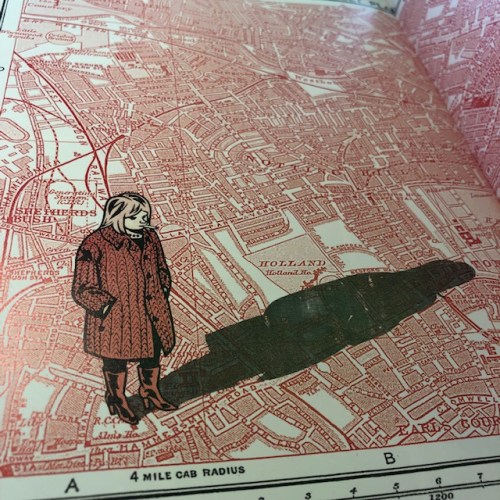
Maggy, the classic hard luck girl. She’s the one that gets away with nothing but keeps on trying. Maggy, the perfect anti-hero for this brilliant shaggy dog crime fiction! Maggy Garrisson is a new graphic novel published by SelfMadeHero, an imprint of Abrams Books. The script is my legendary cartoonist Lewis Trondheim. The art is my acclaimed cartoonist Stéphane Oiry. Let’s take a closer look.
Anyone reading this like Bridget Jones? Maggy is similar to Bridget as she’s outspoken and smarter than given credit for. She’s also quite persistent although there’s no arguing that she’s inclined to slow down at a London pub with a pint of Guinness. So, a bit of a walking contradiction, just what we like in a good offbeat main character. Maggy literally stumbles onto her new job, after having been unemployed for a couple of years. It’s not much of a job, a secretary to a two-bit detective, but this is Maggy we’re talking about.
For those well-read in comics, you will be inclined to compare Maggy with another Maggie found in Jaime Hernandez’s series, Love and Rockets. The artwork by Stéphane Oiry in this book is up to the task of evoking that high level of gritty comics realism. I must say, it is quite a treat to read this book as it collects three interconnected stories to create a rich tableau or grifters, drifters, and other sordid malcontents. I had a great time when I picked up the first story a while ago and reviewed it here. It would do an ole cartoonist like me some good, and you too in the bargain, if I might get a chance to talk to the creative team behind this book. Well, if not soon then soon enough. For now, this book will suffice.
No doubt, the material in this book would adapt very well for Netflix. Interesting point here: the book is so finely put together, from the precision details to the vivid colors, that Netflix can wait. Yes, it’s that good: a gripping tale married to a feast for the eyes in artwork. Trondheim has such a beautiful and distinctive cartoony style to his comics so it makes sense that he’d want the art for this crime fiction to go to Stéphane Oiry who excels in a hybrid style of cartoony and realistic. For one thing, his background in architecture definitely shows through in all his crisp and finely detailed backgrounds. And his development of characters is exquisite. Oiry knows how to get into the head of our high-strung Maggy. Oiry, a fine student in the masters of comics, channels Love and Rockets in a way that makes it his own. This is Oiry’s working-class London and welcome to it.
Like many a good detective story, there are enough MacGuffins here to dazzle any Hitchcock fan. This is a decidedly character-driven story but that’s not to say we’ve got an empty plot. In fact, the prevailing theme will strike a chord with anyone: don’t take what doesn’t belong to you. And if that doesn’t sink in, how about this: leave well enough alone that which might come back and kill you. You see, Maggy, the firebrand, is the sort who finds it hard not to play with fire. And you, I’m sure, will find it hard to put this book down.
This is a perfect read! Maggy will surely not be forgotten by any reader. I’ll give this book a perfect score: 10/10.
Maggy Garrisson is a 152-page full color hardcover, available as of June 11, 2019. For more details, visit Abrams Books right here.