Category Archives: Henry Chamberlain

Kindness, Not Kings

The NO KINGS protest demonstrates People Power works. Freedom of expression is powerful. You don’t have to agree with everything but the voices from a turnout of 7 million, the biggest one-day demonstration in fifty years can’t be dismissed. And so it goes. This is a process. The American experiment is a process.
.
.

In case you wonder what the protesting is all about: Here is an excerpt from The Intercept 10/19/2025 Jessica Washington

Politics Reporter

.

.
.

For the last month, the Trump administration has kept Chicago under siege. Customs and Border Protection agents arrested a 15-year-old U.S. citizen earlier this week after unleashing tear gas into a crowded residential neighborhood. Earlier in October, masked federal agents raided a five-story apartment building in a predominantly Black neighborhood of Chicago and zip-tied naked children as they dragged their parents away.

.

.

The Trump administration claims that Chicago is unsafe and needs order, despite the fact that the city experienced its lowest homicide rate in 60 years this summer. But instead of investing in underfunded schools or attempting to eradicate poverty, which have been shown to increase public safety, the administration is pouring millions into the militarization of American cities and fighting a court battle to federalize the National Guard in Chicago.

#comics #comicsart #drawing #politicalcartoons #news #nokings @resist.riseup.movement

Leave a comment

Filed under Henry Chamberlain, Political Cartoons

Cartoon Art Museum in San Francisco: George’s Run author Henry Chamberlain 08/24/2025

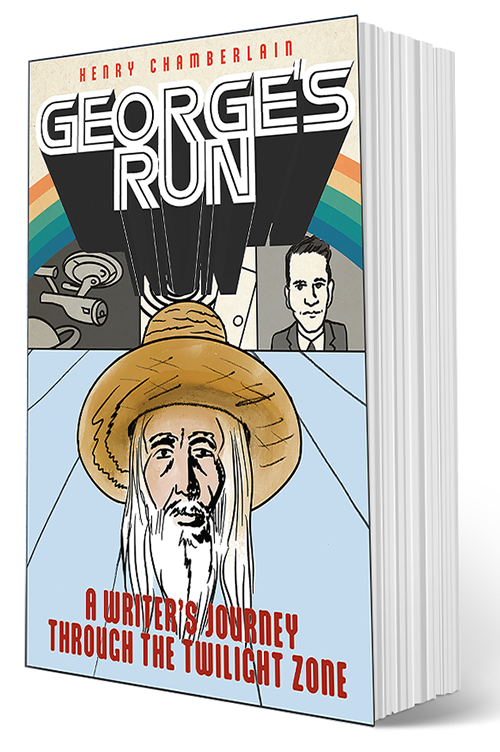
I have an event coming up at San Francisco’s Cartoon Art Museum, 781 Beach Street, on Sunday, August 24th, 2-4pm to talk about my graphic narrative, George’s Run: A Writer’s Journey Through The Twilight Zone, published by Rutgers University Press. It would be so great to have you there if possible.

If you are a science fiction fan, or love various forms of related genres, this is for you. Science fiction acts as a convenient umbrella but, if I was asked to dig deeper in my description, it would be Dark Fantasy. My book is about a group of writers who, individually and in their combined efforts, basically invented a lot of the pop culture we take for granted today. Specifically, I’m talking about the writers behind the original Twilight Zone and Star Trek.

We’ll have a slide show lecture format where I’ll share as much as I can about how I went about creating my book. George Clayton Johnson is our guide, one of the last writers from that 1950s-70s era of golden age television writing. I got to know George pretty well and our friendship led to my book. We’ll have plenty of time for a Q&A as well as overall discussion. I’ll take my cue from the audience. I’m happy to do demonstrations of my art style and chat about making comics too. Feel free to draw or write along the way, and we can share results after we’ve had time to discuss. Hey, this is as open-ended as you like. We might even have some snacks. Seriously, comment here or get a hold of me via email and I’ll consider any ideas.

One step at a time. First, let’s plan on meeting up at the Cartoon Art Museum on August 24th.

Leave a comment

Filed under Comics, George Clayton Johnson, Henry Chamberlain

Waymo is My Friend: comics by Henry Chamberlain

I have grown quite curious, and sympathetic, to the comings and goings of Waymo cars. This is a discussion we are all gradually, yet steadily, beginning to share as Waymo becomes better known. If you’ve never heard of Waymo, I can appreciate that. And, if you’re hip to it, please stick around as well. I’ll share with you what I’ve experienced firsthand. In fact, you can view a YouTube video I did all about it here:

So, how many Waymos does it take to start a movement? I asked Google and, since it should know, especially since it runs Waymo, it states: “As of October 2024, Waymo operates around 300 driverless cars in San Francisco. This is part of a national fleet of about 700 driverless cars.” That seems like a fair amount! The rest of “the fleet” of robotaxis is in Austin, Phoenix and Los Angeles (with more cities emerging, like Atlanta). Nice start, don’t you think? Waymo was so special, only a few months ago, that you needed to be on a waiting list to get access to the app. On a visit to San Fran in November, it was no big deal for me to get the app and hop into a Waymo. As of this writing, the big thing right now is people posting their first Waymo rider experience. That is not going to end anytime soon. People’s reaction to Waymo appears to run the gamut from all-in early adopter to cautious newcomer.

I have to admit that Waymo, or any extended thoughts on self-driving cars, was not on my radar before my visit to San Francisco last November (just prior to the election of you-know-who). Waymo was way in the back of my mind, along with a million other bits of news items and random factoids. And, then, suddenly, I find myself loading up a new app and hopping into the future. I had recently read Mr. Penumbra’s 24-Hour Bookstore by Robin Sloan, the now-classic 2012 novel that plays with the tension and intermingling of bookish old hippie culture and nervy high tech in San Francisco. The night before, I had gone to a reading at the epicenter of the old guard counterculture, City Lights Bookstore. The moment I was finally inside, I felt a sense of relief and resolution: I had waited a certain amount of time; I had figured out a new app; I was already in the throes of being driven without anyone behind the wheel when it steadily became a new normal. Here I was, this bookish neo-hippie inside this futuristic vehicle (a taxi with a robot for a driver!) but I wasn’t quaking in my sandals!

In fact, there is more of a process in breaking in a new human driver interaction than there is in letting a machine do the work. And that, in a nutshell, is the essential difference; the crossing of a threshold done with each new innovation: letting go and letting the machine do the work!

Did the machine do as good as job as I would like? Well, a driverless car will inevitably be a better driver, overall, than I could ever hope to be what with the help of sensors, radar and cameras. A machine never gets tired or distracted. That said, a machine does not have the human touch, that common sense that tells a human driver what to do in a human moment. Anyway, while I was on this recent trip, I used a Waymo on three separate rides. I noticed that the Waymo does not truly know how to improvise. It will not do well with more obscure pickup spots, but neither will a human driver. A Waymo may opt to pick you up at an alternate location for no good reason, at least not for your benefit, and the same can be said for a human driver. A Waymo may pull over to the curb, again for no clear reason, at least not for your benefit, and so too a human. All that said, I never felt unsafe in a Waymo. We still have a long road ahead for Waymo but, overall, I remain optimistic. And, heck, I don’t always like to make small talk and the Waymo is more than cool with that.

For more comics, art and related items, visit henry-chamberlain.com.

2 Comments

Filed under Comics, Henry Chamberlain, Technology

Comics by Henry Chamberlain: The Flaneur Seeks a Hamburger

Clem, our trusty man-about-town, seeks a tasty treat. Let’s follow along as our favored flaneur negotiates his way to America’s favorite, the humble yet mighty & hearty beef patty. Where’s the beef? Well, it’s been here all along! Ah, always remember my dear sweet friend, that what matters most is the journey and not the destination. Until again, maintain your courage (thinking about Dan Rather right now), you never know when you’ll need it next. Back to the subject at hand, nowadays, a simple fast food transaction can escalate into an existential crisis.


Fin

Leave a comment

Filed under Comics, Flaneur, Henry Chamberlain

Comics: Henry Meets Griffy, ongoing process

Just a barefoot artist in search of the meaning of life.

Here is a follow-up on a 5-page comic that will appear in the first full-length issue of Pop Culture Super-Sleuth, which will debut at this year’s San Diego Comic-Con. I will post more as time allows and when it makes sense. In fact, I really should do more of these work-in-progress posts.

Continue reading

Leave a comment

Filed under Bill Griffith, Comics, Henry Chamberlain, Zippy the Pinhead

Comics: Henry Meets Griffy, a bit of comics journalism

Page from “Henry Meets Griffy,” original ink on bristol.

Here’s the first page to a comic I did based upon an in-person interview I did with the legendary underground comix artist Bill Griffith. We hear a lot about comics journalism and it got me thinking that I need to share more of my deliberate form of “comics journalism,” when you go that extra mile (many miles, in fact) to document a moment in words and pictures. It’s not easy and it can drive you a little batty. But, if you’re in the right zone, things will bubble up to the surface that you might not have noticed before. You can’t force the process if you want the best results, especially with a more contemplative visual essay. Things will emerge when they’re good and ready to emerge with something that has logged some time and distance. Sure, you can create something quick right on the spot too. There’s a time and place for both approaches.

A full page of comics.

I will post more as this all comes together. It’s a process, as my loyal readers appreciate. The originals are mostly inked and now I’m considering what other tweaks I might do and what may happen when I scan this and add color.

Leave a comment

Filed under Bill Griffith, Comics, Henry Chamberlain, Zippy the Pinhead

Anatomy of a Painting: Big Girl in Woods by Henry Chamberlain

Gaining a foothold on a new work.

***

Getting Closer to What You Want.

Here are a couple of process samples of a painting I’m working on. The idea is of a lone figure running away. She is a looming figure. The landscape is desolate and foreboding. Will she make it to her destination? Ideas come to us when we least expect it. I love the figure in all its aspects. Whenever possible, I will draw from life. I’ve been a model too and having that experience, I think, helps to elevate the work. After a certain point, you have developed so much muscle memory of drawing that you often will simply draw from memory and that results in some of the most spontaneous and authentic work.

With that in mind, I’m always open to commissions and have work for sale, either originals or prints. Just contact me for details. You can contact me here. And you can see some more of what I do here. I’m still considering what to sell and what not to sell. This project I’m showing you now will eventually be turned into a print. I will be busy next year, and the following years, with more comics and art conventions in the works. I will definitely be selling comics as well as prints at these events, etc. It just seemed a good time to post something about this activity and get the ball rolling some more. I continue to write, draw comics and make paintings!

2 Comments

Filed under Art, Comics, Henry Chamberlain

Comics by Henry Chamberlain: Keep the Aspidistra Flying!

Whatever you do, don’t make waves unless you’re okay getting wet. And keep the aspidistra flying! What on earth am I talking about? Well, here’s a comic with some rather puffed up characters, at some afternoon tea party, chattering away about some nonsense. I don’t begrudge them their good fun one bit as they provide some light entertainment. Enough said.

Leave a comment

Filed under Comics, Henry Chamberlain, Webcomics

GEORGE’S RUN, a graphic novel review by Paul Buhle

This is the book for any fan of comics, pop culture, and great stories!

George’s Run. by Henry Chamberlain. Rutgers University Press. 2023. 226 pp. $27.95.

Guest review by Paul Buhle

I leapt at the chance to write my foreword, what came to be called “A Historical Portal,” in Henry Chamberlain’s graphic novel, George’s Run. Now, with some time to reflect upon it, deeper and more personal observations come to me.

The Twilight Zone offered me proof positive—to this future editor/publisher of a little magazine dedicated to demonstrating the significance of popular culture—that a generation had been more than enriched by it. George Clayton Johnson, a writer for the show, as well as Star Trek, had a lot of insight to deliver, and Henry Chamberlain was the one to winnow it out and to illustrate it.

Astute critics of American cinema have often remarked that the Star Wars series of blockbuster movies, beginning in 1977, marked the return of films but also chunks of television shifting from serious social themes of the later 1950s to later 1970s, back to the Outer Space version of cowboys-and-Indians, with the “Indians” now aliens, some of them friendly (aka “on our side”) and others dangerously hostile. Many critics observed, after the 1999 Star Wars feature, The Phantom Menace, that “African Americanism,” aka Minstrelsy, had been transformed into amusing-looking aliens with humorous talk or behavior. The source of this gloomy transformation might be attributed to the world cinema market for action films or some other external cause, but it is hard to avoid the consequences for Hollywood-produced films as art or cultural/political statements. The social movements of the 1960s shook up Hollywood and created a socially critical audience whose favorite films came and went, in the following decade or so. M*A*S*H, their TV equivalent, was by the end of the century the most “re-run” of all shows and also held the most “peacenik” sentiments. It counted.

In this light, The Twilight Zone looms as a late, major statement of a different era. Rod Serling was a serious and important figure in US culture, a critic and artist who after trying various professions and skills, radio broadcaster to television writer, created the most important television drama in the era when television had a monopoly on media attention.

It was a moment when live television drama, vibrant and often socially critical despite the Blacklist and cultural cold war,  hard shortly before reached its peak with a half-dozen theatrical-style shows, just as it poised to rushed production from New York to Hollywood. The Twilight Zone could not have worked as live drama, but it had the dramatic quality of what had gone before. Even in melodrama and seemingly far-fetched plots, the acting was serious. The show was showing something and saying something, working urgently to open up minds. At the right place and time, George Clayton Johnson found himself and helped make television and pop culture history.

George’s collaboration with Rod Serling occupies a central place in George’s Run. But the meeting of George Clayton Johnson with Ray Bradbury offers us something from the comic that retains all its meaning, six decades later.  Bradbury (a museum bearing his name and artifacts, in my wife’s hometown of blue collar Waukegan, Illinois, opened last year) stands for a starkly different view of science fiction and its role in opening minds. His stories, adapted to EC Comics shortly before the massive wave of repression, offered readers a glimpse of the horrors ahead if the atomic/nuclear arms race were not halted but also a glimpse of aliens and civilizations that had something to teach the self-proud human race. Farenheit 451 along with a large handful of short stories  best realized the social criticism made by a raft of science fiction writers, including some others who knew George well.

Onward and upward.

That George went onto Star Trek is logical, as part of the trajectory of a fantasy writer’s life. But there is much more. The world of fan publications and fan events can be traced back to networks of amateur (unpaid, mostly unpublished) writers who traded their own mimeographed newsletters as early as the 1920s. Sci-Fi fans gathered here, virtually, and then in person by the  middle 1960s, trading publications directly, meeting and partying with authors as well as each other. “Trekkies,” a much-discussed phenomenon, led in time to comics events, later to Comic-Cons and all the regional events of today, sometimes grand but most often with self-publishers in the booths, chatting and selling copies to whoever the passers-by they could convince.
The subject of Star Trek itself remains, for many fans and scholars, important and bears symptoms of the richer mix of American popular culture emerging at the moment of its production. This brings us to the topic of the Other, a theme that endlessly drives discussion. Yes, Leonard Nimoy started in Yiddish theater; Spock is culturally Jewish without a doubt. And Uhuru is a staggeringly beautiful African American woman with all the sexualized implications, even if hardly acted out. And so on. But these, considered seriously, are minor notes. George Clayton Johnson’s scripts quietly urged viewers to ponder the fate of humanity within the cosmos, to get off the pedestal of human-centeredness and come to grips with terrestrial reality.

George’s Run bears all this meaning and so much more.  But there is one more, albeit indirect, connection too delicious for me to leave out. Rod Serling called upon the blacklisted screenwriter Michael Wilson—before being purged from Hollywood, he had scripted the 1951 Oscar-winning A Place in the Sun—to help develop a crucial subplot that most viewers have taken in subconsciously.  The humans are now allowed to speak. But when the human played by Rod Taylor asks to speak, the Chairman of the Tribunal interjects, “the exhibit is indeed a man, therefore it has no rights under ape law.” Those outside the definition of having the right to speak, cannot be allowed to speak, for fear that they will bring down the system.  It was a plot that could easily have been taken out of Berthold Brecht’s Life of Gallileo, including the responsibility of the scientist to speak up against the threats facing society.

Such weighty considerations would have been thought, only a few decades ago, as being properly far beyond the scope of anything resembling comic art. Now, at last, we know better. Henry Chamberlain has given us a gift in George’s Run. Let us use it well.

Paul Buhle

Leave a comment

Filed under Comics, George Clayton Johnson, Henry Chamberlain, Paul Buhle, The Twilight Zone

SDCC 2023: George Clayton Johnson and GEORGE’S RUN

Are you going to San Diego Comic-Con this year? I am! This is not a regular thing for me and it’s always a big deal when I do get to go. I am going in support of my new graphic novel, George’s Run: A Writer’s Journey Through The Twilight Zone, published by Rutgers University Press. The official program schedule has been announced and it includes a panel discussion focusing on my new book and celebrating the great man himself: George Clayton Johnson: Master Storyteller is scheduled for Sunday, July 23, from 12:30 – 1:30 pm, in room 29CD.

George Clayton Johnson contributed brilliant writing for some of the most iconic and beloved shows in television history, including the original Twilight Zone and Star Trek. The 2023 schedule for panels is the place to go for any and all info on panels. My panel, again, is Sunday, July 23, 12:30 – 1:30 pm in Room 29CD. I’m just thrilled to be able to pay tribute to George in this way. We have a wonderful group of folks for the panel and it will surely be a fun, informative and inspiring discussion.

Room 29CD. Sunday, July 23, 12:30 – 1:30 pm.

3 Comments

Filed under Comics, George Clayton Johnson, Henry Chamberlain