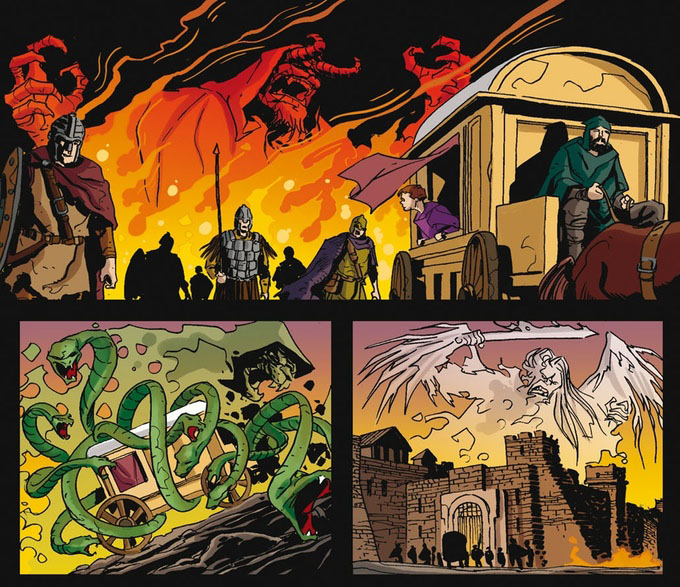
Romulus Augustus is one of the most vilified and controversial of leaders in history. Known as “Romulus Augustulus,” or “Little Augustus,” he was the product of a coup that was ill-fated from the very start. His father, Orestes, in charge of the military, pushed out the emperor, Julius Nepos. Then Orestes installed the boy as emperor. Romulus reigned over the last days of the Roman Empire. His reign lasted less than a year, from AD 475 to AD 476. Orestes, arrogant and distracted, would be overwhelmed by a mutiny led by one of his own senior officers, Flavius Odoacer. In short order, Orestes would be executed. Romulus would be sent into exile. The boy king remained an enigma, a mystery. Travis Horseman adds to this intrigue with his comic book series, “Amiculus: A Secret History.”
Procopius of Caesarea continues to find the true story of Romulus, the boy emperor.
The details add up very nicely in this well-researched comic narrative based on Romulus Augustus. Travis Horseman has created one of the most unique works in comics which combines elements of speculative history and the supernatural. The second volume to “Amiculus: A Secret History” is truly a second act, an opportunity to delve deeper into the characters. We learn more about each player including the evil force lurking amid the shadows, the mysterious figure Amiculus. It is this demonic Amiculus who enables the barbarian hordes to overrun the western region of the Roman Empire which Orestes and Romulus only had a tenuous grasp on to begin with.
What is Amiculus?
This comic is a fine example of what is possible when a creator gets fully immersed in a subject. Horseman has teamed up with a kindred soul in artist Giancarlo Caracuzzo. Both are driven and that resonates with the reader. While the narrative can get bloody, it is not exploitive violence. Essentially, it is strategic and, at times, only implied. Much of the blood is due to the ruthless Orestes. But this would not be story without his bloodlust. That said, I think this would prove a great gateway for teens to learn more about ancient Rome. I would also not be surprised to see the Amiculus series adapted for television or some other format on the screen. For now, we have this very inventive and engaging comic.
On the Wagon Train! Illustration by Henry Chamberlain.
Wandering through Tacoma can be like time travelling with so many finely restored historic landmarks. Add to that all the classic cars driving down the avenues. And add to all that the Washington State History Museum. It is a massive fortress filled to the brim with all sorts of pathways and portals into the past.
Yes, I gravitated to the pop culture!
I know that I love novel uses of words and pictures. It’s not just because I create comics and graphic novels. As both a writer and artist, and as a lifelong learner, I have always cherished the unique place that museums of all kinds have in our lives.
Washington State History Museum
I am especially grateful for the Washington State History Museum as an essential resource for state history. It serves as the state’s attic, a very special venue for all manner of items, large and small, a place for careful study.
Watercolor painting of Chief Leschi
Museums are for all ages. It could not be any other way. Mentors and cubs alike make great use of museums. But it is no secret that museums hold a special place for the kids. The great push forward from one generation to the next must always include quiet contemplation amongst the artifacts of bygone eras.
A small drama plays out at the train set.
And when you come right down to it, I love good visuals, which this museum has plenty. And, among them all, I love that massive train set! Like any elaborate train set worth its weight, this one has some unexpected dramatic scenes peppered about, even an accident site complete with ambulance and accident victim. We can only hope it was a minor accident!
Train Set at the Washington State History Museum
The train set exhibit brings to mind a fellow who has dedicated a big portion of his life to creating what is probably the world’s longest and most complex train set display encompassing football fields of space. That’s Northlandz in New Jersey. But this is not a competition. He has his train set and this wonderful museum has its train set, which is pretty massive!
Brass Lantern Clock, circa 1630
Vintage Women’s Suffrage Placard
Washington State History Museum is located at 1911 Pacific Avenue in the heart of Tacoma’s Museum District, adjacent to Union Station. For more details, visit the website right here.
“Route 66: Dream of The Mother Road,” currently on view at America’s Car Museum
America’s Car Museum has the proud distinction of being the largest car collection in North America with 165,000 square feet of exhibit space for a 350 car gallery. For anyone who loves the open road and has a sense of adventure, you will definitely want to see “Route 66: Dream of The Mother Road,” currently on view. Take your time to wander and enjoy all the exhibits. This is the place to celebrate automobiles of all kinds dating back to the earliest vehicles all the way up to the present and beyond.
Next to a Plymouth Barracuda
To get a sense of the spirit behind this dazzling collection, you’ll want to see “Lucky’s Garage,” a tribute to the LeMay family that has made this collection possible. Here you can imagine Harold LeMay leisurely toiling away as he works on his latest car project. “Lucky” was Harold’s nickname. As he saw it, a lot of hard work finally led to being “lucky.” That said, Mr.LeMay was hard working indeed amassing a collection of over 3,000 vehicles and thousands of artifacts, earning him a place in the 1997 Guinness Book of World Records.
“Lucky’s Garage,” a tribute to Harold E. LeMay
America’s Car Museum is certainly a testament to Harold E. LeMay’s dedication to his community and his passion for cars. Walk through the four stories of display space and you can’t help but get caught up in the heady mix of vivid history and a sense of excitement. Just letting my imagination run wild and thinking about all the heart and humanity behind all these classic cars made my head spin.
Wow, a 1931 Auburn Boattail Speedster!
What a beauty, a 1960 Chevrolet Corvette!
You get lost in them, decade by decade. Do you want to know how to instantly gain some insight into American history? Just go back to our love affair with cars.
You don’t have to know anything about cars to understand how so many have fallen under the automotive spell. You will find favorites among so many wonderful dream cars. Hey, here’s one you can’t help but love, an undisputed classic, the DeLorean DMC-12, which gained immortality when one of them appeared in “Back to the Future.”
LeMay – America’s Car Museum is located at 2702 East D. St. in Tacoma. It is adjacent to the Tacoma Dome. You can find easy access to it via the link rail. Be sure to visit the website right here.
“The Death of Stalin” is a digital graphic novel presented by Europe Comics and is one of various select titles from Europe Comics being promoted at this year’s Comic-Con International in San Diego. This is quite an audacious, vivid, and insightful look at the strange events occurring shortly after Joseph Stalin had a stroke: the chaos and the subsequent grab for power. It is highly accessible: drops you right in, as if you were a fly on the wall, a fly that Stalin, himself, would have thought nothing of swatting and flicking away.
Who was Joseph Stalin? If you’re too young to have a frame of reference, that’s understandable. Think World War II. Think dictator. Then add to that one of the great mass murderers in history responsible for the deaths of millions. Joseph Stalin was the Soviet Union’s dictator from 1924 to 1953. And, in that time, he ordered the deaths of an estimated 50 million of his own citizens. So, you can imagine that his death would be a pretty big deal.
It once was common to find in your newspaper a grainy official photo of the Soviet leaders proudly reviewing the annual May Day parade displaying Soviet military might. That very same photo would, at a later date, pop back into those same newspapers with the latest news from the mysterious world of the Soviet Union. But the photo was altered: someone had been erased and replaced with someone else. There was plenty of doctoring of photos and executing of comrades during Stalin’s regime. While that may seem primitive by today’s standards, you can see something similar going on in North Korea. I feel like Rachel Maddow now as I hope I impress upon young readers that Kim Jong-un’s regime is a small scale throwback to what the Soviet Union was like.
Who Will Take Over After Stalin?
To best convey the inner workings of the Kremlin during the last days of Stalin requires a dedication to characters. Go back to that grainy photo of politburo leaders at the May Day reviewing stand. How do you give those ghostly figures some life? Now, that must have been a challenge. This book is up to the task thanks to both a lively script by Fabien Nury and compelling art by Thierry Robin. Without a doubt, you are that fly on the wall. We are told that truth is stranger than fiction. Did Stalin, the night before he had his fatal stroke, really force the national symphony to replay a concert they had just performed just for the benefit of his own personal recording? I would not be surprised.
This two part story will thrill political junkies as well as history buffs. We see a relatively young Nikita Khrushchev as he maneuvers for power. In 1953, he was a mere 59 years-old! That’s “young” for Soviet leaders. In a matter of days, the tide would turn in his favor and he would replace Stalin. But not before a chaoic, bloody, and sometimes comical, turn of events. That said, this intriguing story will prove insightful and entertaining for any reader of any age.
“The Death of Stalin” is now available at Europe Comics, which launched in November 2015 by a coalition of nine comics publishers, two rights agents, and an audio-visual company, from eight different European countries. Europe Comics is working towards the creation of a pan-European comics catalog, available in English and digital format, a website with comics information for readers and professionals, and a series of author tours and events across Europe and the USA.
DIVINITY II is a satisfying time travel thriller. I love a good time travel tale and this series from Valiant takes us to some very interesting places. You can well imagine that if Vladimir Putin was ruling over the only superpower on the planet that he’d be quite alright with that. A chilling thought but just the right frame of mind to enjoy this comic. Great script by Matt Kindt and a very kinetic style to the artwork by Trevor Hairsine.
A whisper in Gorby’s ear.
We have one rogue character, cosmonaut Myshka, with the potential to shift the balance of power in favor of the Soviet Union that she so dearly misses. Hey, you learn quick that changing history is not exactly a piece of cake. You can’t just whisper into a world leader’s ear, suggest a change of course, and then expect to de-wrinkle a moment in time. Just not gonna happen. Of course, you need a very persistent sort to keep trying and that’s our Myshka. She’s set to give pep talks to everyone from Stalin to Gorbachev. Stay resolute, dudes, Communism is here to stay!
Fun stuff! We’ve seen way too many time travel tales about killing Hitler and saving JFK. That said, I wouldn’t mind a whole series, at least a one-shot issue, dedicated to Jeb Bush going back in time to kill baby Hitler. You remember Jeb Bush, right? Oh, how time flies!
Truth is far more complicated than legend. In a new graphic novel, Ethan Hawke and Greg Ruth find an honest way to address the Native American story in “INDEH: A Story of the Apache Wars.” Hollywood has a long history of perpetuating the myth of “Cowboys vs. Indians,” of noble white men just doing what needed doing against the fierce and random attacks of primitive savages. In this book, we get an even-handed clear depiction: a steady and calm narrative that builds to a quick-paced chain of events.
Ethan Hawke adds subtlety, shades of meaning, to the sort of story that usually gets overblown and exaggerated. He has the inevitable violence in there but he really digs deep into the causes of conflict: the U.S. military mishandles information in some cases and individuals engage in abuse in other cases. By 1872, hostilities should have been on a steady decline but, due to unfortunate factors, all would come to a head in the Apache wars.
At the center, is the famed steadfast warrior, Geronimo. Alongside him, is the warrior turned reluctant diplomat Cochise. We come to see that the Apache did not enter into bloodshed lightly. But, after not only one’s land is taken, but one’s family is slaughtered, blood will be shed. When literally everything is taken from you, your very existence threatened, what do you do? You fight back!
Reading INDEH
Quite remarkable that such a book exists. Here you have a compelling story told in the comics medium, which gives it that greater reach and accessibility, and gives it a unique vision. I can only imagine that Ethan Hawke, such a celebrated and talented individual, must have gained so much from his discoveries and creative effort in putting together this script.
It did begin as a screenplay. However, the realities of Hollywood left Hawke with the realization that his idea for a movie could be better served by a graphic novel. When Hawke approached the legendary Greg Ruth about being the artist, Ruth insisted that they were entering a new world, the world of comics, and to make that collaboration work, Hawke would need to rethink the script. And so Hawke did just that!
Enhanced by Greg Ruth’s lively brushstrokes, we see the varied nuances to the conflict. We find that, despite the mounting chaos and violence, there were parties on both sides who were more than willing to listen to reason. And, amid the carnage, betrayal, and despair, there was the defining figure of Geronimo. Skillfully avoiding a heavy hand, both Hawke and Ruth give Geronimo his due. Yes, it did reach a point where he was motivated by revenge but he was also motivated by survival.
INDEH by Ethan Hawke and Greg Ruth
If we are to grow and evolve as a people, we need to better understand where we’ve come from. What INDEH does is provide us with a clear picture, one that even today we rarely see. Ultimately, we find here a story of a people abandoning a life full of life and succumbing to a life closer to death. Perhaps future generations would dream. These warriors had to admit they had given way to being “Indeh,” or “the dead.” But what would be the greatest tragedy is if they had died in vain. This book is a tribute to the Apache, and Native Americans in general, and it will definitely enrich the reader.
INDEH is a beautiful 240-page hardcover, fully illustrated, black & white with graytones, published by Grand Central Publishing, an imprint of Hachette Book Group. For more details, go right here.
Here is a clear and concise survey of Chinese history and culture that is sure to please. “Foundations of Chinese Civilization, Volume I” covers the Yellow Emperor to the Han Dynasty (2697 BCE – 220 CE). It is by Jing Liu, an artist and entrepreneur from Beijing, China, and published by Stone Bridge Press.
The Great Wall of China
This 168-page trade paperback will prove to be one of the most handy primers you have come across. Adopting a comic book format, the art here is spare and to the point. The neat and orderly presentation of facts will truly win you over.
Confucius’s Roadmap to Life
And it’s not just tidy facts we have here. There’s heart too. Jing Liu has thoughtfully condensed various concepts and ideas while striving to briefly articulate what is compelling about them. I love how Liu gradually builds up his presentation on Chinese philosophy. Dating back to the Zhou Dynasty (1046 – 256 BCE), the elites developed schools of thought. This led to six major schools, leaders emerged, such as Confucius (551 – 479 BCE). And a civilization continued to flourish.
Reading “Foundations of Chinese Civilization” by Jing Liu
“Foundations of Chinese Civilization: The Yellow Emperor to the Han Dynasty (2697 BCE – 220 CE)” is the first book in the five-volume Understanding China Through Comics series. For more details, visit Stone Bridge Press.
Faith Erin Hicks is one determined and dedicated cartoonist. She has created a remarkable output of work which includes the graphic novel, “Nothing Can Possibly Go Wrong,” with Prudence Shen, which began as a webcomic later to be published by First Second as a graphic novel. And “The Adventures of Superhero Girl,” also a webcomic turned into a graphic novel, published by Dark Horse Comics.
A lot of Faith’s work began as webcomics. In fact, that is how it all began. She just drew, and drew, and drew, and posted her work. In this interview, I chat with Faith about her work in webcomics and we also focus in on her current title, “The Nameless City,” just published by First Second Books.
There is more to this story so be on the lookout for “The Stone Heart.” I hope you enjoy this conversation which took place today at Emerald City Comicon.
This is one of the most beautiful educational graphic novels I’ve seen this year. And what a subject, beer! It’s a long title but worth it: “The Comic Book Story of Beer: The World’s Favorite Beverage from 7000 BC to Today’s Craft Brewing Revolution.” Inspired, I chatted about the book with my old friend, Roy, at a local pub, Ballard’s own Stoup Brewing, while I went about preparing for this review. “Roy,” I said, ” I am always grateful that, in Seattle, you can literally walk out the door of one’s home and be within walking distance of a first-rate pub.” “Indeed, and Stoup is such an inviting place,” Roy observed. “Ah, to sit back and marvel over all the great things about beer. That’s the life!”
Stoup Brewing in the Ballard neighborhood of Seattle
You had me at beer. What “The Comic Book Story of Beer” does is provide you with everything you ever wanted to know about beer in a pleasing full-color, lushly illustrated graphic novel. We begin with a young man bumbling along tasked with getting beer for a special occasion. Once inside an upscale specialty supermarket, he is lost among all the microbrew options. A helpful store employee pops in and conveniently begins our story. From then on, we are on a rollercoaster of information, often colorful and intriguing.
How did beer play an important role in everything from the rise and fall of Ancient Rome, the Dark Ages, the Age of Exploration, the spread of capitalism, and the Reformation? Well, without fear of overstatement, beer is something of a wonder drink. In this clear and concise narrative, Jonathan Hennessey and Mike Smith weave a most compelling narrative on the health benefits and motivating powers of beer as well as guide you through beer’s robust history. It’s really an exciting story that finds a perfect home within comics.
This book does yeoman service in the name of presenting information in an accessible manner. I really admire the artwork of artist Aaron McConnell. I had the pleasure of reviewing his artwork for “The Gettysburg Address: A Graphic Adaptation,” also with writer Jonathan Hennessey, which you can read here. For this book on beer, McConnell masterfully brings to life abstract subjects like pasteurization, “original gravity,” and “lagering.”
Co-writer Mike Smith adds another layer of authenticity as the beer expert that won over Jonathan Hennessy to the idea of writing a beer book in the first place. It all began when Mike gave Jonathan a tour of Mayflower Brewing Company in Plymouth, Massachusetts. The wealth of information that Mike shared with Jonathan was just too good to pass up. It makes its way into a book that will win you over with its insider insight. For example, our main story is paused by intriguing beer profiles like the one on Belgian Wit and how it was single-handedly saved by a milkman from Flanders. No doubt, this is a pleasing book to behold and easily makes for the perfect gift for anyone into comics and/or beer.
THE COMIC BOOK STORY OF BEER is a 180-page trade paperback published by Ten Speed Press, an imprint of Penguin Random House, and is available as of September 22nd. You can find it at Amazon right here.
Steve Jobs, we feel we know him and yet he is something of a mystery and there is an enormous amount to cover. Jessie Hartland has created an illustrated work, a “graphic biography,” that brings the public figure down to a human scale: “Steve Jobs: Insanely Great,” published by Schwartz & Wade Books, an imprint of Penguin Random House. Read my review here.
Jessie Hartland is the author of the highly acclaimed graphic biography, “Bon Appetit: The Delicious Life of Julia Child,” described by the New York Times as “bursting with exuberant urban-naif gouache paintings and a hand-lettered text that somehow manages to recount every second of Child’s life.”
For her book on Steve Jobs, Ms. Hartland provides us with an engaging and comprehensive look at one of the great technology trailblazers of our time. “Steve Jobs: Insanely Great” is another wonderful example of an all-ages book providing a significant amount of information in a concise and entertaining way. While Jobs is a problematic role model at best, he remains a most intriguing individual.
The full interview with Jessie Hartland follows and includes the podcast at the end.
Henry Chamberlain: Do you believe that your book has brought Steve Jobs down to a human scale and made him accessible to readers? What would you say is your purpose in bringing this book out?
Jessie Hartland: I think more people are reading my book than would normally sit down with a 600-page biography. So, more people are learning about him. He’s such a fascinating guy. I had just turned in the book on Julia Child, which was also a graphic biography, this one was in color. And I was searching for who to write about next. I was considering a scientist or an artist. And then Steve Jobs dies. He seemed like just the right person to write about. It had begun as a picture book, more like the Julia Child book I’d done, for younger kids. The more I read about him, the more I wanted to write about his whole life. My editors had originally envisioned the book ending with the Apple I computer. Only 200 of those computers were sold and that’s not what he’s known for. So, I went back to my editors and said I really wanted to cover his whole life, I want to do it in black and white, and just run with it. I didn’t want to limit the page count and I wanted it to be more for middle grade or teenagers.
HC: What was your thinking with going with black and white? Was that to instantly signal the reader that this is more serious content?
JH: I think a lot of the graphic novels out there are black and white. I like the stark quality of black and white. I like Marjane Satrapi’s “Persepolis.” I could have used color. It wasn’t really discussed. I think I wanted it to be more about the drawings, the lines, and the words rather than these gauche paintings. If I had done gauche paintings for this one, I probably would still be working on it.
HC: This must be quite pleasing to have these two major films coming out coinciding with your book. That didn’t turn out that way with your book on Julia Child.
JH: Yes, that’s a funny story. I came up with the idea for the Julia Child book years ago, probably two or three years before the film, “Julie and Julia.” I had different editors then and they were saying that no one cared about Julia Child anymore. And so the book ended up without a home. Only later, with my editors at Random House, did the book find a home. The 100th anniversary of Julia Child birth was coming up and there would be press for that. But, had we moved forward earlier, my book would have coincided with the film.
HC: But now you’ve got two major films. The new Alex Gibney documentary, “Steve Jobs: The Man in the Machine,” comes out this week, September 4th.
JH: Oh, really?
HC: And then you have what I can only imagine will be a very important film, with an Aaron Sorkin screenplay, simply entitled, “Steve Jobs,” coming out next month, October 9th. There have been all the books, these two major films. I can’t think, in recent memory, of so much notable work springing forth from one public figure.
JH: He’s such an interesting character. Here’s this guy, this rebel, this iconoclast. He dropped out of college after only one semester. And then he takes a calligraphy class. He starts a little company in his parent’s garage with Woz and it grew to become the world’s most powerful company. It’s just amazing. Who wouldn’t want to know more about him?
HC: We’re at a very interesting turning point with graphic novels. More and more people are understanding that they aren’t just for kids, if they ever were, really.
JH: Yes, that’s right.
HC: You create a perfect all-ages book with issues that can be discussed between a parent and child. You bring in the issue of his experimenting with drugs. You bring in the issue of his not ready to be a dad the first time around. These are big issues but kids can appreciate the realities of life and these are things that are fair game to include.
JH: I didn’t want to leave out the low points in his life. His denying the paternity to his first child with his high school girlfriend. And, of course, the drug use. He said so much about how important that was. He really liked these psychedelic drugs and they gave him a different viewpoint of the world. For him, it was like looking down from another planet and seeing the big picture. It helped him with his intuition and imagining what kind of products people would want in the future before they knew what they wanted. He didn’t like to do market research. He liked to quote Henry Ford, another great businessman. Ford would say that, if he left it up to the public to decide what they wanted, they would have asked for a faster horse.
HC: I wanted to ask you about your process. You do a variation on storyboarding. I imagine that you work larger than print size and then reduce your pages to fit inside your binder where you can then shuffle them around as you need.
JH: Yeah, I work a little bit bigger than print but not by too much. Those binders are really important. This book took up two of them since it was so long. The pages let me shift things around. It’s really important to organizing the material. It took two years to siphon through that quantity of material, to winnow it down, and get everything in order. It took a while to wrap my mind around the fact that iTunes came around before the iPod. And then the events involved with Pixar were complicated to sort out.
HC: Where did his catch phrase, “Insanely Great,” originate from?
JH: Oh, I think that goes way back to when he was a teenager. Yes, I love using that in the book. Woz had the idea for a home computer and his employer, Hewlett Packard, wasn’t interested in developing it at that point. And then Woz showed the circuit board to Steve and Steve says, “Insanely great! Let’s start a company!” Jobs was the great salesman with the big picture. Woz was this engineering genius.
HC: Steve Jobs was at the right place and at the right time in so many ways.
JH: Yes, he grew up in and spent his whole life in Silicon Valley. It used to be known simply as Santa Clara Valley. His father was a machinist. He was adopted. His biological parents were graduate students at the time. One of the parents objected to the marriage on religious grounds. Steve was adopted, grew up in the suburbs of Santa Clara. His father worked in the tech industry. He didn’t go to college but he was a tinkerer and he and Steve would go to the local junkyard, fill up the truck with things, and do projects together. They’d put things together. There were tools all around. And the neighborhood was just swarming with engineers. Steve got to know a lot of the neighbors and how things work and what was going on. It was a very exciting time in what was to be known as Silicon Valley.
HC: Steve could just pick up the phone and start talking to the founder of Hewlett Packard.
JH: Yes! That’s right. He needed some parts for his frequency counter, a device that measure the pulses per second in an electronic signal. He had some of the pieces he needed but he was missing some. He knew that the head of Hewlett Packard lived nearby. So, he looked up Bill Hewlett in the phone book and called him up. Bill was so impressed with the young Steve Jobs that he offered him a summer job.
HC: I am looking at a page from your binders. And I was thinking last night, what if Steve Jobs was standing beside you and looking at your process. He might say to you that he had an “insanely great” way to speed up your work flow. However, I am not sure that I would classify your system so much as “low tech” as “hands on.” I don’t believe that there would be a satisfactory alternative for how you work.
JH: I like having little bits of paper around. I like sketching in a cafe and then slip that work into a binder. It is so hands on. And I love painting, working in gouache. This whole book was done in pen and ink. I went through six bottle of India ink and 24 Prismacolor pencils. It’s all hand-drawn. And people will snicker that I didn’t use a computer. But I did. With the gray tones, I had an assistant help me prepare all those files.
HC: Thanks so much for this chat. I know you want to pursue more graphic biographies. You have the one about pioneering computer programmer Ada Lovelace.
JH: That one, the Ada Lovelace book, is written by someone else and will be a picture book for younger readers. Currently, I am working on some art for a local show here on Long Island. The art will resemble totem poles. These will be called, “floatem poles.” They’re made from the flotsam and jetsam that washes up on the beach. And I’m working on some other books. I’m working with an entomologist on a book about insects. And I’m working on a book that features Tartufo, a truffle hound and that will be set in either Italy or France. I am going to Europe in a week to research that.
HC: I wish you a great trip. And thank you for your time.
JH: Thank you.
The podcast is below:
You can find “Steve Jobs: Insanely Great” at Amazon right here. You can visit Jessie Hartland right here.