Review: ‘The Domesticated Afterlife’ by Scott Finch

The Domesticated Afterlife. Scott Finch. Antenna Works. New Orleans. (available thru Domino Books) 200pp. $18

There are certain things I love and respect: compelling art like finely-crafted comics; and places that can make your heart sing like Louisiana. So, it’s a double-pleasure to feast upon this work of comics by Baton Rouge artist Scott Finch. He is the real deal: an artist who can make art-making look easy, as natural as breathing, because of all the work that he does to reach that level of grace and ease.  Too many artists can fall into a perpetual trap of producing slapdash work which is lifeless to say the least. The more that I’ve seen of Finch’s work, the more that I appreciate his level of commitment. Finch treats the comics medium with a genuine artistic sensibility. What Finch does is precisely what I aim for with my own work so I know of what I speak. If you’ve spun a comics narrative about animals in some domesticated afterlife, and you’re an artist with a consistent vision like Finch, then expect to find your very essence deep in that world.

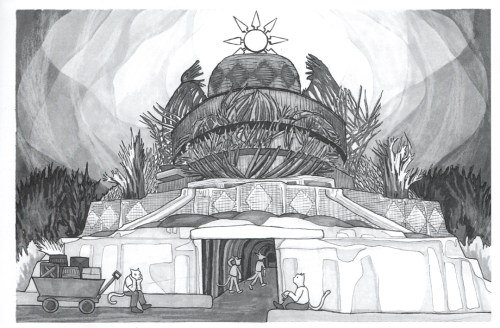
We are decades away from a true metaverse, a complete virtual reality landscape where we are totally sucked into another world. That’s a good thing so enjoy reality while you still can before everyone has drunk the Kool-aid. What we’ll experience now with such entities as Facebook lurching into the future should be bad enough. That said, the metaverse is alive and well in fiction and comics is especially adept at evoking such a loopy terrain in the right hands. Finch is just the kind of artist to tap into the potential of the comics medium. This is both a philosophical and mythological work on a grand scale; a grand opera about a metaverse of humanoid animals, mostly dogs and cats, at the mercy of chicken-like creatures. The dogs and cats fend for themselves as best they can in this virtual world. Their minds, their psyches, have been tampered with to such an extent that all they know is that something isn’t quite right and maybe they want to reach for a portal to the outer darkness, what they assume is the real world.

Finch’s arcane sense of humor informs this comic’s cryptic sense of logic–which is totally cool. It’s difficult enough losing yourself in a work of comics given that a lot of comics doesn’t even try to challenge or engage the reader. Don’t get me wrong, there’s plenty of the good stuff out there but you need to look. This comic delivers with page after page of striking imagery and a whipsmart narrative. Finch is a painter and that special insight shows here as you’ll delight upon one panel after another that could easily be worked into a stand-alone drawing or painting. As I’ve always maintained, it takes someone with a well-cultivated sensibility, part novelist, part painter, to truly make the most of comics as an art form and Finch proves he’s up to the task.

Single Panel Excerpt from The Domesticated Afterlife

The story itself, with its byzantine subplots, provides so many delicious and thought-provoking moments that you are bound to get hooked. This is a world where animals act like humans: they don’t eat to live; they live to eat. They are utterly disconnected from the natural world–and what kind of life is that? It’s a twisted world where dogs and cats are outsmarted by chickens. Everyone is weak but just strong enough to claw at each other. We naked apes are so prone to folly that our own metaverse, with chickens ruling over us, could be our destiny. Finch’s book is one part cautionary tale and one part just good old-fashioned loopy fun.

4 Comments

Filed under Comics, Comics Reviews, Graphic Novel Reviews, Metaverse

Comics: ‘Leaving Home Planet’ by Hurricane Nancy

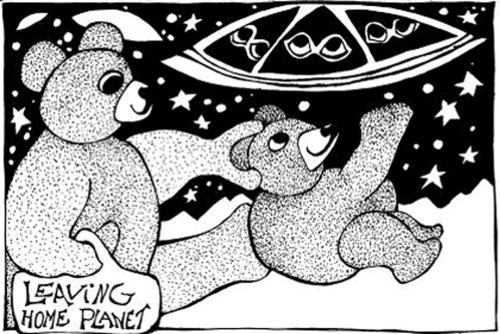
Making Changes comic strip by Hurricane Nancy

Hello, friends, Hurricane Nancy graces the site with another Making Changes comic strip. This one is entitled, “Leaving Home Planet.” Here are some notes from Nancy on this comic strip:

“Leaving the Planet is the old story, your parent kicks you out to go to college some such thing and on the planet of the Teddy bears there is public transportation to the college planet (and others not in this strip). So our teddy goes. There are sentient beings from other places.

The teddy also hooks up with a gal from another planet at college and heads back  to teddy planet with her and their kid. By public interstellar transportation.”

Be sure to visit Hurricane Nancy at her website right here.

6 Comments

Filed under Comics, Hurricane Nancy

Paul Buhle on Comics: ‘The Day the Klan Came to Town’

The Day the Klan Came to Town. Written by Bill Campbell, Art by Bizhan Khodavandeh, Foreword by P. Djeti Clark.  Oakland: PM Press, 2021. 128pp, $15.95.

Guest Review by Paul Buhle

This review begins with a personal revelation. I am more than comfortable to recall, privately and in public, the saga of my great great (maternal) grandfather, the farmer-abolitionist who marched with Sherman through Georgia. He lived long enough to spend time with my mother when I was a youngster and to regale her with stories of the Civil War. I am less comfortable contemplating my paternal grandfather, a pattern-maker and small shop-keeper who seems to have joined the KKK in Illinois shortly before he abandoned the family. Or was kicked out.

White folks by the millions have restless skeletons in their closets, of that there can be no convincing denial. How could it not be so in a deeply racist society? But some experiences are very different; and some involve real racial solidarity. The Day the Klan Came to Town offers us vivid details and precious insights. This story unfolds in African American comics writer Bill Campbell’s own home town in Carnegie, Pennsylvania, a town ironically and iconically named for one of the great cruel industrial tyrants of the American nineteenth century. (Admittedly, Andrew Carnegie was also the great benefactor of libraries and other public institutions.)

Clark reminds us immediately that the 1920s vintage KKK, perhaps as strong in parts of the North as of the South and largely in control of Indiana politics for at least a decade, could take shape as anti-Catholic, anti-Semitic, anti-immigrant, anti-black or all three, depending upon local circumstances. Campbell has taken pains to study the contemporary documents, maps and other records, of a conflict that really took place, one of many in the years shortly following the First World War. He reminds us that this is, importantly, often enough also an immigrant drama. Like many parts of Pennsylvania, industrial or mining, the conflict posed Irish, Cornish, Slav and several regions of Italians against each other as competitors for jobs, and against African Americans, in the schemes of rising capitalists to divert class resentments away from the strike waves of wartime.

Here we have, in Carnegie, Sicilian immigrants unlikely even to identify with a common national origin. They would not have been considered “white” until at least the 1930s in the US. Many a newly-erected KKK hall (as in my own hometown in Central Illinois)  of the 1920s bore the proud self-identification of “WHITE AND PROTESTANT,” marking Catholics clearly unwanted. Most Italian immigrants, especially those from Southern Italy had little political background in the Left or labor, but many responded to the appeals of the IWW and its working class militancy, likewise to unions organizing in the mine fields among other places. We count leading Italian-American leftists as some of the greatest organizers and poets, but they don’t seem to have got themselves to Carnegie, PA.

Here, in the first pages of the comic, Klan organizers present themselves as leaders of a respectable civic organization out to protect “American” cities from purported outsiders and non-whites. We soon flash across the seas to Racalmuto, Sicily of 1915, where young miners suddenly face the draft imposed upon them for cannon foder in the First World War.  They wisely choose migration.

Barely “Americanized,” they face a racist mob clothed in KKK uniforms. The African Americans among the city dwellers, not a large but a significant portion, respond first because they recognize the Klan.  Sicilians, in turn, recall the Fascisti and the rise of Mussolini sponsored by the ruling classes to defeat labor’s claim on the government. The artist is especially adept at moving back and forth, continent to continent, language to language. They learn to fight back.

The author and artist strive to emphasize the multi-racial and multi-cultural, multi-lingual character of the fightback, and a more severe critic might say that they try too hard. The shifts, Irish and Jewish and Italian to East Indian and Latin American, not to mention women and men taking their own roles or battling hand in hand, can be jarring at times. But the fightback of the immigrant crowd against the Klan offers page after page of real comic action.

This is a tight, well-drawn work in the best of comic traditions.

Paul Buhle

Leave a comment

Filed under Comics, Graphic Novel Reviews, Paul Buhle

Review: ‘Teachable Moments’ by Freddy Funbuns

TEACHABLE MOMENTS!

Teachable Moments. Freddy Funbuns. on-going series. self-published. 80pp. $5

There’s a hint of the great alt-comics artist Steve Weissman in the work of emerging talent Freddy Funbuns. Okay, stick with me. If you know who Steve Weissman is then you earn extra bonus points and qualify for the coveted place of honor among the true comics cognoscenti. And, if not, that’s why I’m here! My point is that I want to stress that the cartoonist I’m about to share with you has a nice bag of tricks to play with. I don’t always enjoy gross-out comics but I see a method to the madness. In fact, I direct your attention to the Morbidly Beautiful site for a fine example of some other Funbuns comics laced with a hillbilly horror theme.

To say that Freddy Funbuns loves crude humor is putting it mildly. Where does it come from? Well, look around you: from South Park to your latest meme. Some will ignore it or dismiss it. Others will embrace it or at least appreciate it. In the spirit of the hillbilly horror genre, this comic chronicles the misadventures of a loser couple, Darvis, a 38-year-old morbidly obese man-child and his girlfriend, a 51-year-old woman he met on Tinder, known only as “Babe.” Between the two of them, it’s a glorious celebration of bodily functions, ill-advised sex acts, and food porn. It’s definitely not for everyone but this stuff has its fans because when Funbuns sees a red light, he instinctively floors it. For the record, what Funbuns is doing is brilliant whether or not you can stomach too much crude humor. And it’s not relentless either. Funbuns will take a relative pause here and there with more gentle weirdness.

It’s a dog’s life.

One example of a quieter moment has Darvis enjoying the sunshine and contemplating having more freedom while working from home. It allows him time to walk..the plant. Not the dog? No, not the dog who really needs to go outside! This joke could easily make it past any censor from any animated series. Maybe it’s a good example of Funbuns at a more restrained level. Your mileage may vary.

Can’t we all just have a little fun?

Yet another more quiet moment has Darvis and Babe just trying to act normal and have a nice day out. It almost happens. There’s a bit of tacky conversation. Then there’s the anticipation of getting to their fun destination. Finally, there’s the big let-down and time to blame someone for failed plans. We’ve all been there…and it’s very funny.

Amid all the weirdness, there’s the artist plotting his next move. I think the reference to Goya on the cover of Volume Three speaks to this artistic process going on behind the scenes. What will Funbuns do next? Time will tell! The intellect and the heart is in the right place. The crude humor wears thin over the long haul but sometimes you just can’t turn away. And sometimes everything lines up and the whole thing is spot on. Here is to more of those kind of teachable moments.

Leave a comment

Filed under Comics, Comics Reviews, Comix

Review: ‘A Study in Ink’ by Angela Krieg

A Study in Ink by Angela Krieg

“A Study in Ink” is a 32-page zine by artist Angela Krieg detailing the first six months of 2021, leading up to her first art show. This zine acts as a showcase for work; provides a window into a young person’s life struggles; and is a idiosyncratic document representing the COVID-19 era.

Perhaps the most appealing thing about a zine is that it is part of a DIY culture which sets no limitations and embraces authenticity over polish. Many a zine embraces typos and a more raw approach. Krieg’s zine has that kind of energy; it is more like a peek into a private sketchbook, warts and all, rather than a crafted finished work. That said, like many a sketchbook, there are certain gems that stand out. Some of the best examples here give the reader a taste of Krieg’s lean and direct style. It all adds up to a fun and interesting look at a small batch of artist notes and drawings.

A young artist’s life.

The very best example pares it all down to a bunch of words and one picture. At the bottom of the page is Krieg, eyes shut and appearing to hold it together. Atop her, various concerns loom overhead: mental health, motivation, COVID-19, taxes, cold, time and work. It’s a powerful image and a glimpse at what lies ahead for a promising new talent. You can find out how to purchase this zine, as well as review a variety of graphic artwork and services, at Krieg’s website.

Leave a comment

Filed under Zines

Paul Buhle on Comics: ‘Mutual Aid: an Illuminated Factor of Evolution’

Mutual Aid: an Illuminated Factor of Evolution. By Peter Kropotkin, illustrated by N.O. Bonzo, with an Introduction by David Graeber and Andrej Grubacic. PM Press, 317pp. $20.00

Guest Review by Paul Buhle

This large and beautiful book is so much like a comic that it cannot be described effectively in any other way. “Illustrated text” would not convey, especially for the younger readers of graphic novels, what has been accomplished here, and especially because 21st century readers “see” the pages differently from their predecessors and perhaps closer to ways that children have always “seen” favorite books—or at least the ways this reviewer saw them, literally learning to read by reading comics.

That said, we come immediately to David Graeber himself as a 21st century comet, rising into the sky and sinking again with his sudden, untimely death in 2021. His final text, an extended exploration of archeological history seeking the presence of largely peaceful, pre-state societies, has not convinced all readers by a long shot, but made his political points effectively. Class society seems to have been a fairly recent experience for Homo Sapiens, and its supremacy does not seem to have come from superior production of needed goods or any variant, such as organized agriculture. Yugoslavian-born Andrj Grabacic, a past collaborator with Staughton Lynd, obviously brings his own anarchistic fashion of political analysis into the mix.

Kropotkin, the Russian aristocrat, had a lot in common with other 19th century reformers including Marx: society, they believed, could be transformed by better, more scientific information and application. We had not yet entered the 20th century, where war became the decisive factor “for the West” that it had already been for the colonized world since the 17th century, at least. The choices for human society appeared to be more open and more peaceful until the First World War smashed so many illusions.

Mutual Aid, with its splendid subtitle, argues that society engages in communal relations at all times, making “capitalism” and “nationalism” the intruders. Marx saw the new society within the old in the sphere of socialized labor, no matter how brutal and alienated. Kropotkin looked outward.

The charm of this reprint, with splendid art, begins for today with the prince’s insistence upon “mutual aid among animals,” a powerful argument for its time, but more likely to be recognized now. Kropotkin insists, for instance, that a greedy sparrow seeking to monopolize nesting areas will be stopped by the flock. Contrary examples can certainly be found, but from scientific discoveries of “mother trees” to closer examination of interspecies collaboration, it seems science may be catching up with the prince who famously resigned his title.

Of course, Kropotkin’s main subject is human society, and if his arguments are somewhat familiar, the drawings of Bonzo are startling. I do not even recognize the name of this postmodern, feminist artisan, who lives in Portland and helped to create the Antifascist Coloring Book. Whatever the case, this is the closest to a reanimation of Williams Morris’s visions that I have seen in recent times. “Swipes,” in old comic book language, are taken freely from illustrations six generations past, but updated charmingly. We discover for instance with “harm reduction,” widespread enough to become a social movement in itself, that modern-day cooperators are re-learning how to help others through easing their bouts of addiction.

The chapter called “Mutual Aid in the Medieval City” is bound to remain a personal favorite of mine, because here Kropotkin comes so close to Morris, drawing upon similar sources, such as the histories of the guilds. We see the words of the text, and around them the images of working men and women who believed deeply in what they did. We can see cooperation, in other words, in a new light.

Quite a book, quite a revival of Kropotkin.

Paul Buhle

2 Comments

Filed under Comics, Comics Reviews, Paul Buhle

Interview: Terry Blas, Claudia Aguirre and LIFETIME PASSES

Terry Blas and Claudia Aguirre are the creative team behind Lifetime Passes. This is a graphic novel that I reviewed recently and I encourage you to check it out for yourself as well as give as a great holiday gift. In this interview, you can see that Blas and Aguirre are totally in sync for the sake of a good story. And this is quite a tale revolving around a group of teenagers wrapped up in the theme park lifestyle. They hatch a plan to snag lifetime passes to their local theme park, Kingdom Adventure. The kids discover that if someone in their party dies in the theme park that, in order to avoid any legal entanglements, the theme park issues out lifetime passes to everyone in the group. Our main character, Jackie Chavez, works at a senior living facility. Jackie charms her way into putting together a new theme park activity program at Valley Care Living retirement home. With that in place, it’s just a matter of time, Jackie and her friends think, before one of the seniors in their care ends up dead at the theme park–and so the group gets lifetime passes! So, you’ve got at least three genres working here: coming-of-age, humor, and horror!

Growing up is always hard to do.

Growing up is never easy. This wonderful graphic novel weaves a tale we can all relate to. The main character of Jackie Chavez proves to be an engaging character with a lot to learn. Helping her along the way to seeing what really matters in life is Phyllis, one of the seniors that Jackie and her friends have ensnared in their diabolical little plot. Will Jackie gain a lifetime’s worth of wisdom before too much more time passes and it’s all too late?

Just click the link above to see the video interview. LIFETIME PASSES is available as of November 23, 2021. For more details, just go to Abrams Books.

Leave a comment

Filed under Abrams ComicArts, Comics, Interviews, Young Adult

Book Review: ‘Tenderness’ by Alison MacLeod

Tenderness. Alison MacLeod. Bloomsbury. London. 2021. 640pp. $24.49

Editor’s Note: This book is ready for pre-order purchases. Available in the US as of 11/09/21.

Tenderness is a feast of a novel. This is easily one of the best current reads. And it all has to do with what once was an obscure novel nearly killed in the cradle. Many people have at least heard of Lady Chatterley’s Lover, by D.H. Lawrence, originally published privately in 1928 and finally made available in 1960 after an infamous obscenity legal battle in the UK and the US. Oddly enough, even after surviving the courts, this most misunderstood of novels was nearly killed again in a self-imposed academic attempted murder by feminist scholars because of what they deemed as certain less than enlightened depictions of some female characters in the novel. It is a case of cancel culture from another era. Today, the novel has well cleared the hurdle of extinction. At this writing, Netflix is in production for a spectacular new film version starring Emma Corrin (The Crown) as Constance Chatterley. Now, back to the novel in question. Tenderness explores the world of Lady Chatterley primarily from the inner world of the author and the behind the scenes tug-of-war between killing and saving the book. This culture war is led by FBI Director J. Edgar Hoover on the side to suppress, and future First Lady Jacqueline Kennedy on the side to save.

1960: Lady C helps usher in the Sexual Revolution! Keystone/Getty Images

The hallmark of any great historical novel is how it juggles many points of view. One of the paths this novel cuts is political. Jackie Kennedy is a classic icon: familiar while shrouded in mystery. There is nothing officially documented about Jackie Kennedy in support of Lady Chatterley but, for the sake of this historical novel, she makes for a perfect advocate. MacLeod places Jackie in attendance at a 1959 public hearing on Lady C which, in turn, results in an FBI surveillance snaphsot of her that sets in motion a whirlwind of clandestine activity by Hoover and his henchmen to bring down JFK’s presidential bid. Anyone who knows anything about Lady C, or has actually read the book, knows that this novel has as much, or more, to do with political power than with sex. Clearly, Jackie is the ultimate symbol of a political bedfellow. In 1960, Jackie was still closer to the limited world of Lady C, trapped in her own sexless marriage. The only power a woman in her position could rely upon was found through marriage. And the only control a man could rely upon over a woman, at that time, was through marriage. It is the institution of holy matrimony that is threatened by Lawrence’s controversial novel. That is actually the most “obscene” thing in the novel any detractor could say against it.

The day in 1960 when Lady Chatterley’s Lover was published after a long legal battle. Derek Berwin/Getty Images

MacLeod’s love for literature rings true in this novel which acts as a love letter to Lady C and great fiction. As any masterful writer knows, one of the most appealing aspects of embarking upon a novel is the opportunity to treat it as a vast canvas upon which you can paint your greatest passions. This passion for storytelling is brought out in the character of Dina, an ancestor to friends of the family of D.H. Lawrence, and a budding literary scholar. It’s more than a good chance that Dina stands in as an alter ego for MacLeod. It is through Dina that MacLeod can express her greatest admiration for Lawrence’s landmark work, both erudite and heartfelt. It may have been only a matter of time before just the right author came along and channeled D.H. Lawrence. Tenderness was to be the original title for Lawrence’s novel as it gets to the heart of his theme that we inevitably must give way to the demands of the body. MacLeod honors that theme with her invigorating book.

Leave a comment

Filed under Book Reviews

Review: LIFETIME PASSES

Lifetime Passes. by Terry Blas and Claudia Aguirre. Abrams ComicArts, SURELY, New York. 2021. 160pp. $23.99

Editor’s Note: This book is ready for pre-order purchases. Available as of 11/23/21.

How we treat each other, and ourselves, is at the core of wellness. We all have some connection to care-giving, whether on a personal level or a professional level. My past work as a caregiver still inspires me and informs me. Lifetime Passes, is a wonderful new graphic novel that explores the interconnections between those providing care and those receiving care. It’s not as simple as some may think.

Writer Terry Blas and artist Claudia Aguirre together weave a story that speaks to the shared responsibilities of caregivers and those cared for. First of all, no one wants to feel like they’re being “cared for” so a delicate balance must be struck. It’s during a journey of self-discovery that Jackie Chavez comes to appreciate the nuances of respect and self-respect. It’s a process that takes Jackie from being a kid who just wants to blend in with everyone else to someone willing to take a stand and to lead.

Jackie Chavez is in a predicament that is going to take time to figure out. It’s a problem liable to spin out of control. But, oddly enough, it also seems like Jackie is having the time of her life. Blas and Aguirre are sensitive to a young person’s perspective and life struggles. This is a portrait of a Mexican teenager who has been separated from her parents due to the immigration laws currently in place and so it’s just her and her aunt Gina. Jackie helps her aunt at work at the Valley Care Living retirement home. Over the years, Jackie has relied upon visits to the Kingdom Adventure theme park in order to cope with the stress of feeling like an outsider. What she never expected was to have an elder care facility and a theme park collide in her life. It’s a nicely-paced story told with wit and heart.

Claudia Aguirre’s artwork is soulful and touched with a whimsical spark. All the characters, whether noble or less than noble, come to life. The reader will be engaged and immersed in this coming-of-age tale. Jackie Chavez is someone who, at first, wants nothing more than to be alone but is willing to compromise in order to fit in. She is set upon a misadventure that will demand she think differently and show her a whole new way to live.

1 Comment

Filed under Comics, Comics Reviews, Graphic Novel Reviews

Review: BALLAD FOR SOPHIE

Ballad for Sophie

Ballad for Sophie. by Filipe Melo and Juan Cavia. Top Shelf Productions. 2021. 320pp. $24.99

Editor’s Note: This book is ready for pre-order purchases. Available as of 11/02/21.

Ballad for Sophie is a gorgeous graphic novel. It delights the eye and not in any obvious way. We are often led to think that what we want is a perfect smooth finish but this work shows us that we can have it all: a crunchy complexity to the rendering guiding a vision. There are what appear to be, at closer look, a lot of preparatory lines that are kept in. These type of lines usually act as marks towards the final work. Here they act as another layer of texture, vibrancy and energy. It is quite fitting for a work dealing with music! This is a very special book created by a very special creative team who have been working together for nearly two decades. Filipe Melo is a Portuguese musician, award-winning film director, and author. Juan Cavia has worked as an art director and illustrator since 2004. (A sidenote: Melo has composed a theme song to accompany this graphic novel which you can find here.)

An old legend takes account of his life.

A graphic novel with an added layer of squiggly lines is not  really a part of any comics publisher’s reliable house style plans. And yet here it is–and it’s most welcome. Often, a publisher wants to find just the right balance of getting out of the way even if a favored house style provides a nice security blanket. In this case, we have a work that already had a go elsewhere, originally published by Tinta da China, based in Lisbon, and now embarking upon an English translation edition with Top Shelf Productions. That said, this European graphic novel fits in well with the very best work (Blankets, Essex County trilogy, March trilogy)  from Top Shelf. In fact, all these titles share a hand-drawn expressive quality, whether loose or more lean and clean. Top Shelf is always mindful of a winning recipe and here we have a win-win.

Allowing the creative instinct to have its say.

I think it speaks to the distinctive quality of this book that I can write a whole review and only focus on the style. Some graphic novels are like that, as much, or more so, about finding an arena to draw as it is about telling a story. And that requires an artist with a masterful touch. You can’t expect a novice to really measure up like this. Even a master will have doubts when giving way to creative flourish. But Juan Cavia really lives and breathes linework and so he can afford to take some detours. In an interview with Top Shelf’s editor Leigh Walton, he describes his pursuit of quirky lines as a way to be true to the artist and to evoke a certain level of personality.

Balancing, and rendering, past and present.

This is a rivalry story, in the spirit of the great rivalry story, Amadeus. So, we have two prodigy piano players battling out over the course of their lives. The story is set in the small French village of Cressy-la-Valoise, framed around the trope of a young journalist interviewing a dying old legend. The cub reporter is the story’s namesake, Sophie, and the old legend is Julien Dubois, one of the two rivals. Julien comes from a wealthy family; his opponent, François Samson, is a janitor’s son.  The story goes back and forth between the conversation between Sophie, the youth, and Julien, the elder, and looking back to the past. For the scenes in the past, Cavia’s expressive style is emphasized with linework, halftones and a more muted color palette in order to evoke a more retro vibe.

This is comics at its higher levels.

And that’s really all you need to know. I’ve basically tried to keep my focus on the book’s style and it is a formidable one. This is easily the best rendered graphic novel for the year, or at least it should be on everyone’s end-of-year top ten lists.

2 Comments

Filed under Comics, Comics Reviews, Graphic Novel Reviews, Music