Sharon Rudahl was at the forefront of underground comix as a founder of Wimmen’s Comix, the first on-going comic drawn exclusively by women, beginning in the 1970s. Since then, she has created a range of fascinating underground comix including Crystal Night, which was reprinted in full in Dan Nadel’s Art In Time collection. Rudahl has created two graphic novels, A Dangerous Woman: The Graphic Biography of Emma Goldman and A Graphic Biography of Paul Robeson: Ballad of an American. Read my review here. It is a pleasure to get a chance to share this conversation with you.
Ballad of an American: A Graphic Biography of Paul Robeson
I began our talk by mentioning that Sharon marched with Martin Luther King Jr. as a teenager. I said that it appears that she has always been an activist. To that Sharon said that she’s found herself speaking out as often as possible. In fact, Sharon began her career as a cartoonist with anti-Vietnam War underground newspapers. She’s been active ever since and has participated in numerous publications and exhibitions in dozens of countries over the last 50 years. Always a fighter, she proved to be just the right person to take on a graphic biography of another social justice warrior, Emma Goldman.
A Dangerous Woman: The Graphic Biography of Emma Goldman. by Sharon Rudahl. edited by Paul Buhle. The New Press. 2007. 115pp. $17.95
Emma Goldman (1869-1940) is not an obvious choice for the subject of a graphic novel. Unless you’re into political science, you probably have never heard of her. But since when is it an obstacle to read a book about someone you’ve never heard of? It’s absolutely not an obstacle. More of an invitation. You see, Emma Goldman was a trailblazing anarchist who became known as “Red Emma” and, when she was deported from the United States in 1919, J. Edgar Hoover called her “one of the most dangerous women in America.” Comic artist Sharon Rudahl brings Emma Goldman to life in her graphic novel. It was a pleasure to review Rudahl’s graphic novel on Paul Robeson. You can read that here. And it seemed only natural to take one more look back to her graphic novel on Emma Goldman.
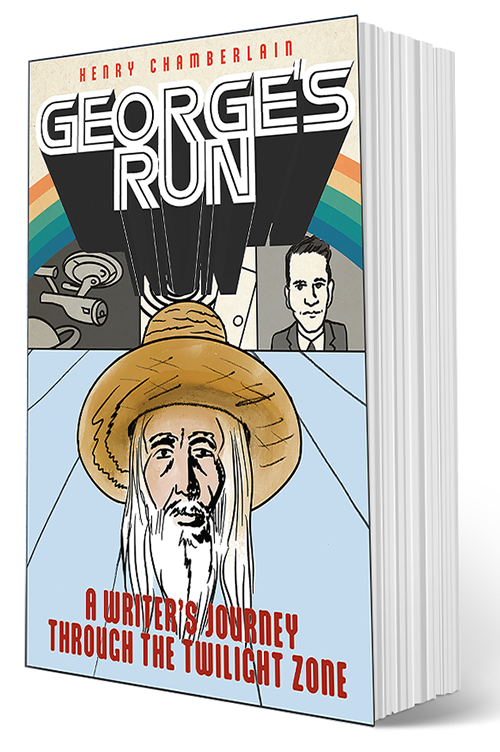
From Henry Chamberlain’s graphic novel, George’s Run
William F. Nolan was one of the grand old men from the golden age of science fiction and horror spanning pulp fiction, television and the movies. Starting out as an illustrator in Kansas City, Nolan ultimately made his way to Hollywood and became part of a group of writers within the orbit of Ray Bradbury, and subsequently Charles Beaumont, all trying to break into television. As part of the inner circle of writers, casually known as, “The Group,” little by little, Nolan gained some ground.
There are times when an illustration is most apt. Summer Movies: 30 Sun-Drenched Classics, by John Malahy and Turner Classic Movies, published by Running Press, inspired me to highlight some of my own favorites from this fun and informative book! Among a number of factoid-filled books, this one really stands out for some very specific reasons. This is not just a listing of popular titles. You will actually learn a lot here–about fan favorites and less familiar classics. I’m very impressed with the genuine attention to detail as the author invites the reader to try out some lost gems, like 1928’s Lonesome about a couple of star-crossed lovers who have a dream date at Coney Island and then, by the hard luck of fate, get lost from each and frantically try to reconnect.
EDITOR’S NOTE: The New York Post headline says it all, Sex Abuse Rituals at NJ Boarding School Exposed — in Cartoons by Survivor. The newspaper does an admirable job of describing the nuances of graphic novels and Glenn Head’s new book, Chartwell Manor. And The New York Post has no qualms about laying it out as it is: “Don’t let that whimsical cover art throw you: Head’s unflinching book recounts his two years at the now-defunct Mendham, NJ, boarding school run by headmaster “Sir” Terence Michael Lynch — a serial sexual abuser who manipulated young boys into “cuddling sessions” after fondling and beating their nude bodies.” The New York Post also provides an outstanding public service by underscoring the fact that survivors of Chartwell Manor still have time to file a suit against the Chartwell administration of aiding and abetting Lynch, and others, in the abuse of children. Time is running out for Chartwell Manor victims to join those who’ve already filed claims against surviving Chartwell administrators accused of letting Lynch — and other accused faculty — cultivate a culture of abuse. The deadline to file is November 30, 2021. Contact Jeff Anderson & Advocates law firm today.
I’ve been writing about comics and creating comics for many years now–and loving it. In the very near future, I hope to have some news about a book of my own. For now, I want to keep my nose to the grindstone and this is one very special reason to do so. This is an interview with master cartoonist Glenn Head. For those of you familiar with comix, especially those chock full of underground comix DNA as I just talked about in my last post, then this will be a welcome treat. Maybe you’ve gotten a chance to check out Head’s new book, Chartwell Manor, about the abuse that Head experienced at the boarding school, but just as important, the aftermath. Well, this interview helps to put things into further context from the standpoint of Glenn’s previous graphic novel, Chicago, as well as his career as a whole.
Snake Eyes (1990, 1992, 2001) was a comix anthology (editors: Glenn Head and Kaz) with some of the best comix talent going on at the time. It’s a great place to get a sense of what independent comics are about. It seems like we have subcultures within subcultures in the world of indie comics. Some cartoonists prefer a more soft approach while others need a harder one, and everything in between. So, with that in mind, we’ll explore the pages of Issue 3 of Snake Eyes. We will also take a look at a separate project, that ties in with what I’m talking about, Glenn Head’s Avenue D, from 1986.
Glenn Head’s Snowman in Snake Eyes
In an interview focusing on Snake Eyes, Glenn Head made the distinction between short-form comics and long-form graphic novels. For him, at the time (2001), he seemed to be saying that he found comics to be packed with energy and immediacy, while graphic novels had fallen into more of a form for a slower-paced drama to unfold. I think that is a subject for discussion than can always be added to byway of various comparisons and further refinement of articulating what it means to do comics as opposed to graphic novels. Basically, we know. But it’s always fun to discuss. And, sometimes, I wonder if we’re all on the same page! Seriously, the notion of comics is extremely broad if you include any and all possible forms, literally throwing in the kitchen sink for good measure.
A Charles Johnson self-portrait. If you know who R. Crumb is, then you really need to know who Charles Johnson is!
IT’S LIFE AS I SEE IT, cover designed by Kerry James Marshall
Chicago is one of the great cities for comics with a rich history dating back to the dawn of the comic strip supported by world-class newspapers. The Museum of Contemporary Art Chicago honors this tradition with Chicago Comics: 1960s to Now(June 19-October 3, 2021), curated by Dan Nadel. In the process, Nadel also edited a book that focuses on Black cartoonists entitled, It’s Life As I See It: Black Cartoonists in Chicago, 1940 – 1980, published by New York Review Comics. The title of the book comes from a gag panel cartoon by the cartoonist, and National Book Award-winning novelist, Charles Johnson. And the actual cartoon dates back to a collection of Charles Johnson cartoons, Black Humor, published in 1970, when Johnson was only 22 years-old. The two books document where Black cartoonists have been and point to a persistent struggle to rise upward. Discussion of the facts can only help to chart a course for the future—and it’s essential to look at all sides.
The Minamata Story: An EcoTragedy. Written by Sean Michael Wilson and drawn by Akiko Shimojima. Berkeley: Stone Bridge Press, 2121. 205pp, $14.95.
The Many Not the Few. Written by Sean Michsel Wilson and drawn by Robert Brown. Oxford and Lancashire: Workable Press, 2019. 200pp, $18.95.
Sean Michael Wilson: Left Comics Sui Generis
A marvelously talented Scottish script writer, Sean Michael Wilson, is notable in the fast-emerging world of the nonfiction graphic novel, with a handful of awards and some twenty graphic novels to his credit. Like the most talented of left-wing film screenwriters from Hollywood to London to Tokyo and far beyond—suffering blacklisting and severe persecution in the Cold War era and not getting many good jobs right up to the present day—Wilson knows how to prepare his work for the next step in production. The writer works behind the scenes, so to speak, and becomes in a sense invisible, all the more so because the artist “adapts” any script, by necessity, to the demands of art and audience.
Francois Vigneault is an accomplished illustrator and cartoonist. For his latest project, he teams up with a stellar creative team, including Rick and Morty co-creator, Justin Roiland, to create ORCS IN SPACE, a delightful outer space adventure for all ages, published by Oni Press. What follows is a fun and informative chat with a lot of food for thought for those trying to break into the middle grade market–or just looking for a good read for the kids in your life.
ORCS IN SPACE kicks off with a special double issue as of July 7, 2021 and then continues as a monthly series. The first collected volume comes out in October and I’ll remind you guys around that time–just in time for the holidays!
I hope you enjoy this video interview and, if you can, be sure to do all those good things: LIKE, SUBCRIBE, and COMMENT at the YouTube Channel! Thank you.
John Cei Douglas is a freelance illustrator based in London who got on my radar with his new book, All the Places in Between, which I recently reviewed. We exchanged some email and arranged to do a conversation. To prepare for it, I read a good bit of the comics that Douglas has done since completing his MA in Illustration from Camberwell College of Arts in 2013–including his Masters thesis, Show Me the Map to Your Heart.
All the Places in Between
One striking thing about the comics and illustration of John Cei Douglas is how fluid and effortless he makes it all look. There’s a certain calm and thoughtful quality to his work that is very appealing. There’s also plenty of action and frenetic energy to be found. It’s all part of a distinctive quirky universe.
The distinctive and quirky universe of John Cei Douglas
Another striking fact to keep in mind is that, even once you reach a point of success in a career in illustration, you can never take anything for granted. That is a point that Douglas can’t stress enough. He is in it for the long term and, from what I see, he’s found a niche from where he can continue to grow and prosper.
English Summer. illustration by John Cei Douglas.
I hope you enjoy this conversation where Douglas provides insights into his creative process. For the creation of his new book, All the Places in Between, Douglas relished in giving himself space to explore where the story was going. There was no set blueprint he was working from and I think readers will appreciate those unexpected twists and turns. As I stated in my review, this is a story as much about evoking a certain feeling as it is anything else–definitely a journey worth taking.
Visit John Cei Douglas at his site here. All the Places in Between is published by Liminal 11.