Tag Archives: Art

Nudism Comes to Connecticut comics review

Unashamed Comic Nudes!

Nudism Comes to Connecticut. By Susan Chade and Jon Buller. Seattle: Fantagraphics, 175pp, $30.

Nudism (many prefer “naturism”) is more familiar than most Americans can now imagine. The omnipresent rural skinny-dipping probably did not draw much upon a rich and varied European (or other) nudist traditions among the respectable classes as well as others. Communitarian groups in the US developed a nudist ideology of sorts, as far back as the 1890s, but memories of Walt Whitman and even Benjamin Franklin “air bathing” had likely been forgotten by the time the Greenwich Village fashionable set disrobed in Cape Cod summers of the 1910s.

Nudism Comes to Connecticut, written and drawn by a veteran children’s book team, offers a convincing historical experience of free thinking Yankees during the 1930s. They make creative use of a real text, Frances and Mason Merrill’s Nudism Come to America (1932), a volume itself no doubt reflecting the free-spirited, short-skirted 1920s Flapper Era.

Somewhere around Lyme, Connecticut, not far from Manhattan by train,  a Hungarian immigrant hatches a plan for rural land use. A few years earlier,  an American diplomat unhappy at his job in Budapest shared with a friend some of the current German magazines extolling nudism’s many healthful benefits. Back home in the US in 1915, the American and his wife, a native Estonian, take over a defunct hotel in a pleasant landscape, near an underused lake.

Here, somewhat embroidered fiction really does more or less coincide with fact. The idea of “cooperative colonies,” guests and residents doing most of the maintenance and in turn owning shares in the property, was very much alive in the European middle classes of the pre-fascism days, and even philanthropically extended, for periods of the summer, to groups of urban slum dwellers. Before Stalin’s rise to power, a nudist culture of Russian “Proletcult” also seemed to take hold: it was considered especially good for workers to get naked in the countryside, when possible. By the later 1920s, these experiences even gained a pedigree of American scholarly interest.

No surprise, then, that out in the Connecticut woods, not far from a lake, a “cabin colony” sprung up, built on loans and the wishful thinking that it might pay for itself. Takers seem to enjoy themselves thoroughly, even with husbands and wives understandably nervous about their own mates in the buff. As in real life nudism, nude  versions of barely competitive games like volleyball seem to be the mandatory accompaniment to swimming. The comic portrayals of nudes here are tasteful and charming, if not quite realistic to sagging flesh.

The community thrives for a while, never quite overcoming the resentment and hostility of some neighbors, and then runs into the economic collapse of the economy in the Depression. The quasi-utopian adventure ends. As the author/artist team concludes, “most of this actually happened.” (p.173).

It is a footnote, perhaps not so far from this realistic comic, that by the 1960s, bohemian-minded American readers of Bertold Brecht, Georg Luckacs and Wilhelm Reich would draw the conclusion that nudism had to be, was indeed inevitably, political. The bohemian-radical tradition had already been revived after the Second World War in other parts of the world including both Germanies. Although this detail has been largely forgotten, the East Germans, the most proportionally nudist population in the world, actually resisted Russian edicts and took pleasure where they could under a repressive regime. Just as amazing, the bureaucratic class joined them.

Spending their summers on the Cape, American veterans of antiracist and antiwar activism staged dramatic nude-ins at the National Seashore during the middle 1970s. This political action would lead to decades of lobbying politicians for more “free beaches,” an idea that has come, gone and perhaps come again in parts of the US. Today’s nudists should enjoy the innocence of Nudism Comes to Connecticut, so deftly defying the hostility of religious conservatives and  lawmakers right up to the present. “Naturism” seems to have escaped comic art otherwise, save for a few brief, wry commentaries in underground comix. Perhaps the subject has only been waiting for its comic art re-creation.

Paul Buhle

Leave a comment

Filed under Comics, Comics Reviews, Paul Buhle

SDCC 2023: A Refocus for Comic-Con Amid Writer/Actor Strikes

So, what happens when Comic-Con is not Comic-Con, at least not what many people might expect? The famous Hollywood celeb-fest at Hall H is not happening this year due to participants pulling out of all the big ticket panels amid the writer and actor strikes. It’s not a pretty picture and some cry foul but the show must go on and, in many ways, there is a light at the end of this tunnel in terms of a refocus to the roots of Comic-Con: comic books! With the spotlight off of Hollywood blockbusters and related projects, Comic-Con will, in fact, be returning in a big way to how it all began, as a gathering place for comic book enthusiasts. And that’s got to be a good thing.

It’s all about writers working with, and supporting, writers.

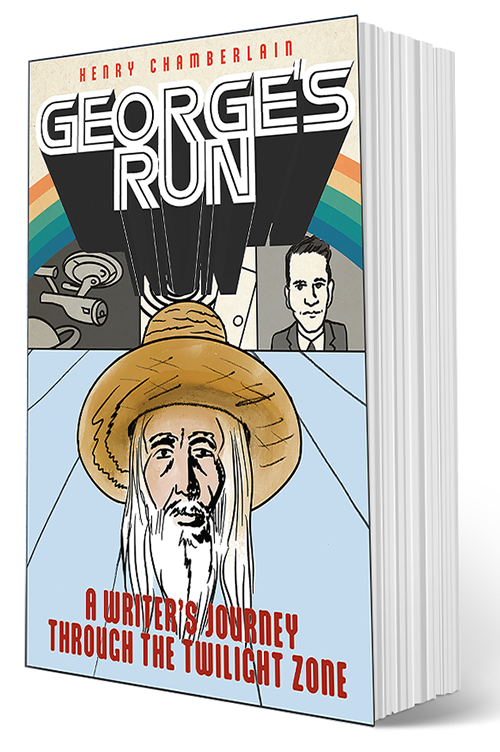
My panel at this year’s Comic-Con, along with the smaller scale, down-to-earth panels, is still on. And it happens to be all about writers and the creative process. George Clayton Johnson: Master Storyteller is about my new book, George’s Run. It features George Clayton Johnson and his meteoric rise as a writer. And it is through his journey that you learn about the group of writers responsible for what we take for granted today as dark fantasy, as well as a more nuanced and personal science fiction and horror. The point is that the creative process is at the core of what we’re talking about. I invite you to go to my panel which celebrates the very essence of Comic-Con. In fact, George was a great supporter of Comic-Con right from the start. He loved the sense of community of people joined together by the magic of comic books.

Here is a report from CBS 8 San Diego (archived on YouTube):

As Hollywood continues to grapple with the impact of the writer’s strike and the all-but-certain actor’s strike, the standoff is creating new problems for San Diego Comic-Con. Several of Hollywood’s biggest companies have now decided to skip panels in Hall H, which is typically the biggest attraction and the longest wait time of the convention. In years past, Hall H panelists would discuss current and upcoming projects as well as promote future ones. This year is a little different. Disney, Marvel, Lucas Films, HBO, Sony, Netflix, DC Studios, and Universal have announced they will be pulling out from Hall H presentations, the Hollywood Reporter said on July 8. In a statement to CBS 8, a spokesperson for Comic-Con says in part, “With regard to the strike and its possible effects on Comic-Con, we tend to refrain from speculation or forecasting. Our hope is for a speedy resolution.” While the status of some things at Comic-Con are still up in the air, there is still plenty to be excited about at the Comic-Con and the Comic-Con museum.

Leave a comment

Filed under Comic-Con, Comics

MY BODY, OUR RIGHTS, World War 3 illustrated #53 review

WW3 Strikes Again!

MY BODY, OUR RIGHTS, World War 3 illustrated #53. Edited by Paula Hewitt Amram, Sabrina Jones and Rebecca Migdal, assistant editor Seth Tobocman.  AK Press, 212pp. $15.

This is, for starters, an incredible bargain of a comic or any illustrated book these days. The two-hundred-plus pages are packed with work from what seems like hundreds of artists but in reality comes down to 35. Its appearance, almost but not quite needless to say, is prompted by the draconian attack upon abortion and women’s control of their bodies by the Supreme Court and the legislatures plus courts of dozens of states. To say that even the limited advances made in the last fifty years are now threatened is a vast understatement. This book offers a struggle against a species of sexual fascism, and like the antifascist struggles of old, holds our attention with its urgency.

Two fresh themes especially attract the reviewer’s attention. In the true tradition of WW3, the rising crop of talent is harvested. This time around as well, more gender fluidity is apparent: another development in radical comic art showing itself in narrative and drawing styles adapted and created anew.

Cover art by Sabrina Jones

The reviewer will inevitably pick favorites and “Post Procedure” by Sabrina Jones, the opening story after a two-page table of contents that also serves up an anatomical lesson,  shocks with its candor. This could be the artist’s own story—and, indeed, does happen to be her story— or the normal saga of trauma (with some occasional exuberance) in a young woman’s life. A sexually active single feminist gets pregnant by accident, and now what? Having a baby appeals greatly, being stuck as a parent and a single parent has much less appeal. There’s a bitter-sweetness here that says more than the reviewer’s words can express.

There are ample other looks backward, for the historically-minded, like this reviewer, to earlier times. Back then, especially before 1949, birth control information let alone legal abortion would be practically unknown among wide classes of Americans. Several gripping pieces here including Tom Keough’s “What My Catholic Religion Taught Me about Abortion,”“A Choice of Life,” by Sam Migliore and “You Could Be a Broom!” by Emily Waters, together lay out what we expect from the Religious Right but what young people are not prepared to deconstruct. Others, notably “Lifeblood Driving” by Lee Marrs, carefully recollect a history of abortion struggles including “bad new days” and…the courageous Resistance. Sue Simensky Bietala’s  “Thank You Nurses,” means a lot to this reviewer, the son of a nurse and social worker who offered illegal advice to married and unmarried women in Manhattan of the 1930s.

The sagas of irresponsible males, dangerous abortions and long-time struggles for sanity remarkably bring forth some great humor. “Late,” by Joyce Farmer, recalls a time not so far away, back in the middle 1950s, with a young woman already engaged but not at all happy to be “late” month after month, then pregnant and married to an unsympathetic husband, and then onward in life. If this sounds grim, Farmer makes every panel weirdly humorous and weirdly very realistic, in the comic-art sense.

Other high points surely include a fantasy high point, “The Doll’s Picnic” by Jenny Gonzalez-Blitz, and sometimes grim as well as brave adventures in the world of gender-identity as in “I Survived the Horror of Puberty” by Liz Keough, and “Trans+binary Reproductive Health Care,” by Jessica Raynor Sturdivant. Not to mention the direct frontal attack on the current Supreme Court by the Guerilla Girls and by Sue Coe, herself the best known of the artists here.

For me, these strips and others in the book, so widely varied in styles but so keyed in on the issues, collectively bring us back to that old question, “What is comic art anyway?” Apparently, the answer could be “whatever a sequential drawn narrative can do.” To make such an observation is at once too vague and too little appreciative of what is going on in these pages.

Paul Buhle

1 Comment

Filed under Comics, Comics Reviews, Paul Buhle, World War 3 Illustrated

Ian McGinty and #comicsbrokeme: Death of a Cartoonist and Aftermath

Welcome to Showside by Ian McGinty

The death of cartoonist Ian McGinty, at age 38, is being attributed to the stress of working in the comic book industry. This has triggered horror stories pouring out on social media that are supposed to be focusing on working in a deadline-driven environment for little pay.

Recently, a comic book writer and artist named Ian McGinty passed away. He was only 38 and had worked on big-name properties like Adventure Time and Invader Zim, as well as his own comic, Welcome to Showside (pictured above). On Twitter, McGinty’s mother has spoken out and urged people to support other cartoonists. While the cause of McGinty’s death isn’t public information, others in the industry have expressed concern knowing how hard he was pushing himself to work.

The hashtag #ComicsBrokeMe erupted on Twitter and folks have been sharing their own experiences in the industry. It’s heartbreaking to think about because the reality is that the people that help make the content you love are undervalued. And this goes hand in hand with the WGA strike because ultimately, creatives across the board are typically underpaid. Meanwhile, the higher ups are continuing to get richer.

The death of Ian McGinty is very sad. Here’s what I think. The reality about the comics industry, even within the indie community, is that there’s still so much work to be done regarding cartoonists supporting each other. The reality is that distant people in authority (gatekeepers, so-called experts, and basic assholes)–or even colleagues, are NOT going to care about you as much as you need to be caring about yourself. Maybe you’ll get lucky and you’ll experience someone paying it forward for you. That definitely happens. And that can take a lot of patience before something like that comes your way. Special and good people are out there.

In general, I strongly advise any young person embarking upon a creative career, especially in comics, to love and respect themselves fiercely. Now and then, cartoonists support each other unconditionally but there’s still so much growing up within the comics community that is essential before the next big step forward–if it ever comes. The truth is that there will always be a callow darkness to anything so inextricably linked to youth culture. The focus on the comics industry breaking people is valid but that’s not going to change anytime soon–if it ever does. First and foremost, protect yourself and your own integrity, health and sanity. There’s exceptions but, in general, no one is going to care about you as much as you need to be caring about yourself. That’s just a given. A healthy you is all that matters. Of course, we need change and must fight for it every chance we get. A healthy you gives you the strength to do anything, including speaking out for better working conditions.

Anything worthwhile takes time–and tenacity! Hey, cartoonists far and wide, support each other every step of the way.

Leave a comment

Filed under Cartoonists, Comics

Art: ‘Feelings, Facts’ by Zebadiah Keneally

Feelings, Facts.

Here is a work by artist Zebadiah Keneally. This is original art that I received as a gift and I thought I’d share it with you. I’m assuming the text in the piece is the title: “Feelings, Facts.” If you haven’t already, you can find my in-depth interview with the artist here where we discuss his debut graphic novel, All The Things I Know.  I think this piece is quite a striking observation of the zeitgeist: a time of extraordinarily heightened emotions that cloud our reason. We stay on this path and we’re guaranteed a big fall. Some would say we’re already in free fall.

Be sure to seek out Zebadiah Keneally’s mind-blowing epic graphic novel featuring a search for self and a battle royale between gods and humans. All The Things I Know is published by Apartamento.

Leave a comment

Filed under Art, Comics

George’s Run: A Graphic Novel in Tune with Reader

Here’s my simple and direct approach at a book trailer in support of my new graphic novel, George’s Run: A Writer’s Journey Through The Twilight Zone, published by Rutgers University Press.

George’s Run is an inspiring and informative book about the golden age of television, specifically the heady late ’50s and early ’60s which gave us The Twilight Zone and Star Trek. This is a story about storytelling and I want folks to know about it. Necessity is the mother of invention and that led me to create this book trailer. Not bad, huh? I love the sketchbook-comes-to-life vibe. With the book trailer, I went back to the roots of this book which has always been a heart-felt effort to be in tune with the reader. This is a story about a regular guy who ends up doing extraordinary things. While George’s life gathers complexity over time, and the interconnections can get pretty involved, the core of this story is as simple and direct as the value of chasing your dreams, going against the odds.


Leave a comment

Filed under Comics, George Clayton Johnson, graphic novels, The Twilight Zone

THE TALK by Darrin Bell graphic novel review

The Talk by Darrin Bell

The Talk. Darrin Bell. Henry Holt & Co. 352 pp. $29.99 hardcover.

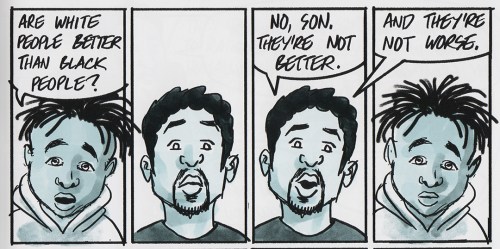
Darrin Bell does a remarkable job with his new book, in fact, his debut graphic novel. Bell is best known for short-form work: editorial cartoons (won the Pulitzer Prize) and comic strips (check out Candorville). The graphic novel format opens things up in ways that Bell takes to with grace and artistry. The goal here is not only to sum up his life but to go backwards and forwards generations. This graphic novel revolves around “the talk” that Black families have with their children to prepare them to navigate a world of prejudice and racism.

So, why doesn’t it look like a real gun?

Bell begins his book by sharing what “the talk” ended being like for him as a 6-year-old. His parents had recently divorced and so Bell received two separate, and very different, responses from his white mother and his Black father. Bell’s mother was prompted into it after having to explain her choice in fulfilling his request for a toy gun. She chose a bright green plastic water gun. She explained it had to be very obvious it was a toy in order for Darrin not to be mistaken for carrying a real gun by police who were predisposed to assuming he was a criminal with a weapon. What happens next is pivotal. Darrin runs out to play with his new toy and ends up being harassed by a police officer who uses the toy gun as a pretext to still give him a hard time.

We’ve got you surrounded.

Later, Darrin faces another challenge when a white schoolyard bully taunts him about his appearance, calling him, “big lips.” Darrin asks his father what he should do about it and this sets up the father’s turn with talking about race. Bell returns to this moment throughout the book to say that his father had let him down by turning inward, distant, and just staring out into space. However, that’s not exactly what happens. His father may not explicitly respond with a road map on how to deal with bigots but he certainly talks about his experience. It leads to one of the most compelling moments in the book with Darrin’s parents as a carefree mixed race young couple who are abruptly forced to deal with the fact that the local folk are not amused about mixed race couples. That said, Bell lets the reader decide if his father perhaps did the best he could with his more guarded response.

Remember the 2000 election vote count problem?

Overall, I think Bell appreciated the chance to spread out and follow various threads of thought over the span of many pages. I know it’s a balancing act in terms of expressing feeling and citing facts. Every time you present a specific, as opposed to a generality, you make your case that much stronger. Buried deep in the book is one such fact I know still gives many pause: the manipulation of the vote count in Florida that handed the presidency to George W. Bush in the 2000 race. As Bells states: “The Bush campaign’s Florida chairwoman (who also happened to be Florida’s secretary of state, in charge of the election) purged tens of thousands of Black voters from the voter rolls. Reportedly, she used a ‘felon list’ to disqualify them, even though it turned out they didn’t belong on that list.”

Lost in the aether.

Bell speaks of “the aether,” what some believe to be the foundation of our very existence. Bell uses this as a metaphor to describe those in power, the dominant culture, the white culture, inextricably linked to money, power and authority. Bell runs with it in one of the most inspired passages in the book that follows a college workshop of elite white students with Bell, the only Black student, discussing slavery. The white students push the narrative that people simply didn’t know any better when it came to owning slaves leaving Bell to argue that actually, at least 10 million people did know better: the slaves! Later on, Bell is called in by a professor who is threatening to fail him because he must have plagiarized his paper. How could he, an undergrad, possibly write so eloquently about “the aether” and such things when her own graduate students aren’t as articulate?

Why don’t some people have empathy?

I know that there will always be a certain number of readers unfamiliar with the world of graphic novels who are ready to complain that a long-form work of comics could be pared down to just a few pages but that’s not the kind of world I’d want to live in. A graphic novel inhabits its own world where it will expand in order to process and contract in order to highlight ideas in concise ways. I’m sure any experienced reader wholeheartedly agrees. This book is an opportunity to explore issues of race, how Americans have gotten it wrong for so long, what’s at stake, and how do we move closer to a better place. Bell has honed his skills of cultural observation over many years as a social commentator in comic strips and editorial cartoons. He’s refined his skills up to the breaking point and back. This graphic novel is a testament to his efforts.

Leave a comment

Filed under Comics, Graphic Novel Reviews

B. is Dying (#5) by Tom Hart comics review

B. is Dying (#5). by Tom Hart. Sequential Artists Workshop. 2023. 24 pp. $8.

Tom Hart’s new comics series is about a man dying in a ditch. Well, ostensibly so. Yeah, there’s a lot more to it than that. Tom Hart’s work looks incredibly alive as if it is being created as he’s thinking it. But the end result, the actual content, has been refined in a million different ways. So, come take a look at one of the most alive comics about dying, or any subject.

Tom Hart speaks to the utter disconnection we all must confront as human beings. It’s an existential crisis on a personal and global level, even a cosmic one. The focus here is on the planet and how we interact with it. As a cartoonist, Hart gives it his all to express his dismay and heart-felt desire to find some answers. The reader is led on a journey atop the crust of Mother Earth. What does that mean? It’s a perfect metaphor for how we usually interact with nature, all superficial, never digging deeper.

With a gentle nudge, Hart gets me to thinking about how we routinely take our environment for granted: we exploit it, endanger it and rape it. We are more prone to tear it apart than we are to try to understand what we call home. How can we ever ignore our own home? And yet we do. This comic expresses the collective nightmare we are all having, whether we choose to accept it or deny it. If we’re being honest with ourselves, we’re all afraid. Hart leans into that fear with his comics: direct and simple, but not so simple, more elegant-simple. Ah, yes, Tom Hart, the master of the elegant-simple.

I appreciate these comics on many levels, not the least of which is on an entertainment level. I’m thinking of how I cherish any time I spend viewing the work of Buster Keaton or, say, Peter Sellers at their soulful best. I can only imagine what Peter or Buster would have done if they appeared in a Tom Hart comic.

There’s the main character to Tom’s story, a lanky Everyman with hair sticking straight up. He is self-aware enough to know that he’s merely walking on the crust of the Earth. If only all of us could reach that point! It troubles him. It frightens him. It gives him nightmares. He dreams that he’s a helpless/hapless parakeet somehow let loose from the home he’s known as a pet and sprung free into the wild. He is out of his element. He is clueless. He has no real notion of how to interact with nature, just like–you guessed it–the average human being.

Tom Hart’s Everyman is just self-aware enough to know that something’s wrong. He thinks he may have come from a great place but has lost his way. It’s all too easy to lose one’s way, especially if you’re on such an uncertain path. This is not new. This has been going on for a very long time, for as long as there have been humans. Tom Hart has been at his comics-making craft for a long time too, for decades. Tom even makes a reference in the introduction to this issue to a recurring theme in his comics of a lone man in a vague landscape in an existential crisis.  Tom’s experiments have led to masterful award-winning work year after year. And one thing is clear: Tom Hart has not lost his way. In fact, Tom has many followers who wish to create comics every bit as good as his comics. Learn more about Tom and his Sequential Artists Workshop where you too can learn the fine, subtle and rewarding art of making comics.

7 Comments

Filed under Comics, Comics Reviews, Sequential Artists Workshop, Tom Hart

The Compleat Moscow Calling (Amatl Comix #5) review and interview

The Compleat Moscow Calling

A young American journalist had the time of his life chronicling the Yeltsin years in Russia. A heady, disruptive and chaotic time to say the least. There was Jose Alaniz, the first to plant his cartoonist flag: Moscow Calling, was the first daily English-language comic strip to be published in Russia. It ran in the Moscow Tribune for nine months beginning in the fall of 1993. Over the years, Alaniz kept adding to the initial story and that has led to this collection published by Amatl Comix, an imprint of San Diego State University Press.

If you’re a fan of Richard Linklater’s 1990 cult classic film, Slacker, then this could be for you. Imagine Austin, or Seattle, back in the grungy free-wheeling early ’90s and then drop that absurd hype and mayhem into the cauldron of dysfunction that was post-Soviet Russia under the less than steady leadership of Boris Yeltsin. Yes, anything goes until it all goes up in smoke.

Moscow Calling comic strip excerpts (1993)

That is the scene that a young Alaniz was privy to and navigated within as a newly-minted college graduate overstaying his last semester abroad in Moscow by a few years, with a spirit for adventure and a burning desire to avoid a daily grind back in the States. The comic strip that held these misadventures together is dutifully archived in this collection, given a deluxe treatment with added material and even an excerpt from a novella. Essentially, it’s a treasure trove of material to enhance the experience of reading the comic strip in question. All lots of fun for the academically inclined as well as the free spirit with a hopeless case of wanderlust.

Yeltsin gives way to Putin.

As Jose points out during our interview, the main character of Pepe serves as a bit of an alter ego, at least in the sense that his story loosely follows Jose’s own progress: going from an expat hanging out with other expats to making new friends among the natives. Of course, Pepe’s progress is spiked with larger-than-life mishaps most befitting the comic strip world. But there is that nagging feeling that both Pepe and Jose are privileged, finding ways to be plucked out of harm and discomfort. In the end, it is Jose’s insight and humility that adds another layer of charm to this engaging and inventive comic strip.

The Compleat Moscow Calling

Jose Alaniz is in a wonderful position to continue what he’s begun with Moscow Calling–and he has every intention of doing so. I know, for a fact, that the comics medium attracts all kinds of people for a multitude of reasons. The ones who stick around, I mean a lifetime of working at this craft, of genuinely exploring and growing, are people attracted to the uncanny power of words and pictures. The strongest connection tends to create auteur-cartoonists. I’m one of them. Jose is one of them. It’s not a boast. Some may say it’s a curse!

If you are a writer-cartoonist, then you will find yourself forever being tugged by the demands of prose and visual mastery. That said, I know it’s a gift too. It doesn’t come easily, all tied in a bow at your front door one crisp and bright morning–although many may think that will magically happen. No, it’s a balancing act and a juggling act. Ultimately, you need to figure it out on your own, work at it alone, but that’s how it needs to be. I know that Jose has the ability and the passion to pursue his comics narrative adventures. This collection is an exciting portal into one person’s creative journey byway of accepting the challenge of being a stranger in a strange land.

I hope you enjoy my interview with Jose Alaniz. I ask that you consider dropping by and leaving a Like and Comment. Likes and Comments are the lifeblood of any YouTube Channel and are always very much appreciated. Subscribe to my YouTube Channel too and I’ll be most grateful. Be sure to order your copy of The Compleat Moscow Calling by visiting Amatl Comix.

Leave a comment

Filed under Comics, Comics Reviews, Interviews

George’s Run creator Henry Chamberlain on KPR

Today, I want to share with you an interview I did with Kansas Public Radio. We discuss George Clayton Johnson’s unique role in science fiction and pop culture in my new book , George’s Run, published by Rutgers University Press. The show is Conversations, hosted by Dan Skinner. Listen to it here.

As I proceed down this path of being interviewed and explaining my process to different people on various formats, I find I keep connecting new dots. One recent eureka moment for me was simply contemplating the fact that The Twilight Zone has long since established itself in the canon of pop culture, and given the fact that George Clayton Johnson wrote some of the most iconic episodes of the show, that alone secures his legacy. In George’s unique case, he also happened to have been involved in other huge pop culture phenomena, including Ocean’s Eleven, Star Trek, and Logan’s Run.

George’s Run: A Writer’s Journey Through The Twilight Zone is published by Rutgers University Press and is available now.

Leave a comment

Filed under Comics, George Clayton Johnson, Henry Chamberlain, Interviews