Tag Archives: comic books

George’s Run creator Henry Chamberlain on KPR

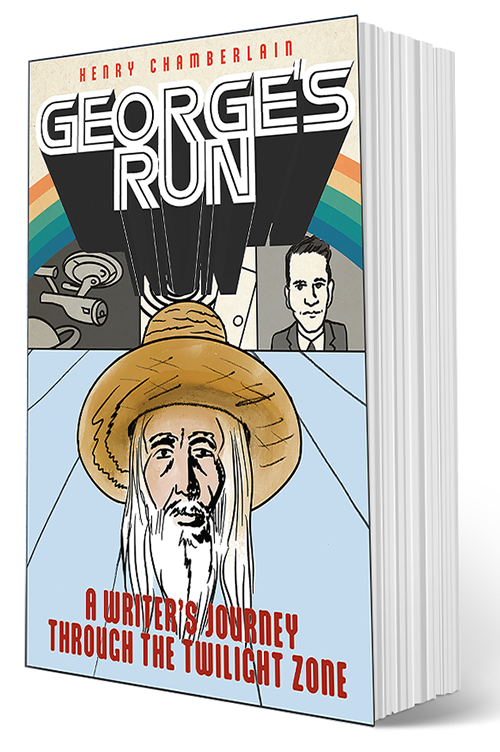
Today, I want to share with you an interview I did with Kansas Public Radio. We discuss George Clayton Johnson’s unique role in science fiction and pop culture in my new book , George’s Run, published by Rutgers University Press. The show is Conversations, hosted by Dan Skinner. Listen to it here.

As I proceed down this path of being interviewed and explaining my process to different people on various formats, I find I keep connecting new dots. One recent eureka moment for me was simply contemplating the fact that The Twilight Zone has long since established itself in the canon of pop culture, and given the fact that George Clayton Johnson wrote some of the most iconic episodes of the show, that alone secures his legacy. In George’s unique case, he also happened to have been involved in other huge pop culture phenomena, including Ocean’s Eleven, Star Trek, and Logan’s Run.

George’s Run: A Writer’s Journey Through The Twilight Zone is published by Rutgers University Press and is available now.

Leave a comment

Filed under Comics, George Clayton Johnson, Henry Chamberlain, Interviews

Maximus Blade (#1) comic book review

Cover art by Franco Bevilacqua

Maximus Blade #1. w. Chris Warren a. Ken Lavin Chris Warren Media. $4.99

The first issue of a comic book, especially from an independent publisher, can be a very exciting thing and Maximus Blade does not disappoint. The writing is crisp and crackling with urgency and humor. The art is spot on, transporting the reader through time and space with a cast of engaging unlikely heroes up against a truly motley crew of villainous baddies.

Maximus Blade, a sentinel on a mission.

Our story takes places way into the future, 2480, enough to make my head spin. But that’s part of the fun, of course. Time enough for all sorts of mayhem to have happened leaving good ole planet Earth a mere shell of its former self. Time enough for the upper class to have gone even higher, all the way to an outpost on Earth’s moon. Everyone else stays behind back on Earth which has devolved into a Mad Max wasteland.

“When” the hell am I?

Despite all the dystopia, there is hope, or at least it seems that way. There’s no shortage of possibilities to this comic. Meet Steve, a guy from our own present who had it all, only to be swept up by a time portal. Meet Penelope, a member of the super elite who lives on the moon but not anymore. And meet Maximus Blade, the result of some heavy genetic mutations and not much for words. Between the three of them, you’ve got everything you need to keep the adventures rolling along quite nicely.

Maximus Blade and Steve.

My favorite scene in this issue is probably the first scene between Maximus Blade and Steve, who is no slouch back where he comes from but is totally out of his depth in the distant future he’s been teleported into. Maximus, in the few words he grunts, makes it pretty clear he needs a tech guy and fast. Steve hesitates, but not for long. Just as Maximus is walking away for good, abandoning the “stupid kid” to certain death, Steve chimes in to say he’s actually the best tech guy ever. It’s a funny moment and pivotal to what happens next. I’m not sure why Maximus was so easily convinced but maybe we’ll find out in the next issue. For now, Max, Steve and Penelope are up to their eyeballs in death-defying adventure. This comic does a fine job with balancing action and humor leaving the reader wanting more. Not bad at all for a first issue.

Leave a comment

Filed under Comics, Comics Reviews

George’s Run Chronicles The Rise of Genre

It begins with a little hook . . .

Then a question . . .

An initial response, and quick answer . . .

Then your concise answer!

That’s the magic and power of graphic storytelling.

Yes, the gang, or The Group, is all here!

I was just minding my own business when I stumbled upon a delightful review on Amazon of my new book, George’s Run. This was from I Forgive Heathcliff (depending upon your browser, you may need to do a separate search) and it gets to the heart of what my graphic novel is all about. All I can say to any fellow creative, no one will love and understand your work as much as you do until, all of a sudden, it does click and people do get it! This review made me think and gave me pause. It helped me to better appreciate my own efforts. One of the goals of my graphic novel is to connect the dots and make the subject at hand accessible. That is what graphic novels do best. Here’s an excerpt from I Forgive Heathcliff’s review:

The best thing about this graphic novel, spurred on by the brief, blossoming friendship between George Clayton Johnson and Henry Chamberlain which describes George’s life and adventures as a writer, is the sweet and straightforward artwork combined with a sort of stream of consciousness storytelling that picks you up and floats you along, moving forward through years, events, and situations. I particularly loved the author’s humorous, respectful nod toward the entire group of sci-fi, fantasy, and horror writers by depicting them as shambling zombies.

So, yeah, this review got me to thinking. I did hit the nail on the head. I have George as our guide, our main character, who connects us with a significant movement in contemporary writing. It doesn’t get much better than that, folks. You’ve got one of the most colorful and engaging of individuals, George Clayton Johnson, who acts as a main character in a novel about his own life and times while also taking on the role of tour guide into the inner workings of much of what we take for granted today in entertainment, both high and low culture. The members of what came to be known as The Group were fully aware of what they were doing: along with a wide variety of offshoots and variants, they were primarily engaged with reshaping genre writing for a contemporary audience.

Well, what can I say? I can and will keep saying more and more! For now, if you’re looking for one of those kind of books that helps make sense of it all while also being a fun read, then George’s Run is the book for you. You can buy it directly from the publisher, Rutgers University Press, or any number of other platforms and outlets, including Amazon.

4 Comments

Filed under Comics, George Clayton Johnson, Henry Chamberlain

Dean Haspiel Talks Comics and COVID COP

Dean Haspiel is one of the great cartoonists, both as an artist and writer. You may know him from Billy Dogma or The Red Hook on Webtoon. We enjoyed a spirited comix talk and got to connect the dots on his intriguing new comic book series, Covid Cop. If you’re familiar with Dean’s work, then you know he leans into surreal and satirical work. Please refer to my recent review. We discuss the exciting and evolving ecosystem of independent cartoonists and how Dean is bringing his comics to you, the reader. You can always find him at his Substack and he’ll connect directly with you on purchasing his work.
Once you dive in, you’ll see that this is a fully-realized dystopian world, one that allows us to entertain some distance from a pandemic we are still processing. When we go through such a big event crisis, we turn to great storytelling. Thusly, we can rely upon Dean Haspiel to provide an intoxicating mix of levity and pathos. And there’s even a romance to be found embedded within this work!
What is Covid Cop about? In Haspiel’s dystopian story, Covid is beyond being unstoppable and the government concludes the only solution is to eliminate humans. We follow one lone police officer, Lincoln Bio, as he resists his marching orders and seeks another path out of hell. That is the cut-and-dry description. There’s plenty going on, including how Lincoln manages to survive and what motivates him to somehow rise above all the muck and mire. Did you know that the pandemic is officially over with? Well, until it returns in some other noteworthy variant. Alright kids, there is no chance that Covid Cop is going to go gentle into the night.

People who know me personally, from this blog, or from my comics, know that I enjoy offbeat humor and exploring a topic down to as fine a distillation as possible. That’s not idle crowing at all. It’s just part of what I do. Anyway, Dean and I engage in a bit of that in this conversation. I think we really hit our stride discussing the phrase, “knows where the bodies are buried.” The phrase is what I used to describe Dean to a friend. And, oddly enough, the phrase appears on the first panel of his new comic, Covid Cop!
So, who “knows where the bodies are buried?” The art of conversation is such that it’s easy to lose the thread unless you’re willing to make adjustments along the way. I had meant to segue into something else when I brought up this curious phrase but we proceeded down an interesting, and entertaining, line of thought. What makes for a good conversation? Keep to an agile and nimble mind. Work at it and just be a good egg. A confluence of factors leads to becoming a good cartoonist or cook or conversationalist. You don’t even need to be a “talker,” per se, but it helps. So, I invite you to check out our conversation.

Dean Haspiel’s THE RED HOOK

Dean Haspiel’s BILLY DOGMA

The main point is that we had a good talk. We discuss the creative process at length and that alone is worthwhile. If you’re an indie creator, I’m sure there will be some food for thought. We cover such topics as how to jump start a project and regain your creative flow as well as share some tips and tricks on what it’s like to get your work out into the world.

Seek out Dean Haspiel:
Find him at various events, including the upcoming Awesome Con in DC (June 16-18, 2023). Awesome Con’s Film Festival will include Dean’s short film, THERE IS NO TRY as well as a short film by Dean creative cohort Whitney Matheson, CONTINUITY ERRORS. Great to see these films in a theater!

THERE IS NO TRY by Dean Haspiel

Connect directly with Dean here. Keep up with him on Instagram here. And keep up with him on Twitter here.

Long Live Covid Cop!

Leave a comment

Filed under Comics, Dean Haspiel, Interviews

COVID COP by Dean Haspiel review

COVID COP. Art & script by Dean Haspiel. Dean Haspiel Deep Cuts. 28 pp. $15.

Dean Haspiel is in fine form with this short work in comics that transforms the Covid pandemic into a surreal parody of a sci-fi/horror story. In this scenario, the virus has completely taken over to the point that the government has clamped down hard on anyone disobeying protocol. It’s a take-no-prisoners battle plan and one police officer, Lincoln Bio, is doing his best to follow orders. If you’re a fan of Dean Haspiel, then you can expect that kooky sense of humor, bathed in pathos, made famous in the Billy Dogma comics series.

Our anti-hero Lincoln Bio is aware that he’s living in very strange times making very strange demands on him. How he comes to terms with his marching orders and how he confronts an insurgent group out to kill everyone makes up a good part of this dark comedy. Drawn in the mock heroic style that Haspiel is known for, this comic book will deliver a weird and entertaining jolt right to the jugular and then some. You probably won’t have nightmares from reading this but I can’t guarantee it. And, if there’s a sequel, all bets are off. This comic, by the way, is the first in the developing line of indie comics, Dean Haspiel Deep Cuts.

This comic will defy your expectations, especially if you don’t really know what to expect, and offers up the most recent example of a cartoonist at the top of his game. The winner of a recent Kickstarter campaign, this comic book is making its way to its backers and will make its way to you. Keep up with Dean Haspiel for more details.

4 Comments

Filed under Comics, Comics Reviews, Dean Haspiel

Pop Culture Super Sleuth: Episode 1

This is the first installment of . . .  Pop Culture Super Sleuth . . .

“I’ve been a blogger for almost as long as I’ve been a cartoonist. And then I became a pop culture super sleuth . . . “

*

*

*

*

*

I’m building up steam on this new project. And maybe a little shy. You’ll have to tell me what you think. The character isn’t necessarily me, per se, but a sort of alter ego. It’s fun and it’s all possible in the wonderful world of comics. Am I right? You betcha, I’m right!

Leave a comment

Filed under Barefoot, Comics, Feet, Henry Chamberlain, pop culture, Webcomics

MS DAVIS: a Graphic Biography review by Paul Buhle

Ms Davis: a Graphic Biography. By Amazing Ameziane and Sybrille titeux de la Croix, translated by Jenna Allen. Seattle: Fantagraphics, 2022. 185pp, $24.99.

Guest Review by Paul Buhle

This remarkable and challenging work, translated from the 2020 French edition, offers readers a study in the history of comic or political art by adapting past artists’ work into a new synthesis of narrative. It is not a “biography,” as in “graphic biography,” that readers would expect. We see only the dramatic bits and pieces of Angela Davis’s life, and virtually none of the long aftermath (from the early 1970s until now) that biography readers would expect. And yet capture the drama of Davis’s life, the work does in grand form.

Ms Davis might be contrasted with The Black Panther Party Comic, a well-selling, straightforward visual narrative that a fussy aestheticism of comic art might wrongly call “pedestrian.” This tells the story of the short-lived but extremely dramatic Black Panther Party with suitable details, and would be valuable for anyone who enjoys Ms Davis, which goes the precise opposite direction in so many ways.

In the globalization of comic art, artist Amazing Ameziane and collaborator Sybille Titeux de la Croix credit four American artists: Milton Glaser, Norman Rockwell, Emory Douglas and Bill English. What do they have in common? Less than they have by contrast. Rockwell, who famously celebrated the “American Way of Life” (overwhelmingly the white, middle class way of life in the twentieth century), had moments when he went beyond his assumptions, as in his famed poster art for “The Four Freedoms” proclaimed by Franklin D. Roosevelt in wartime, and still not realized (“Freedom from Want.”) Emory Douglas is the Black Panther Party artist supreme, with his stark, propagandistic drawings. William English, illustrating some of poet William Blake’s works, is as far from commercial illustrator Milton Glaser (best remembered for the 1966 poster for Bob Dylan) as imaginable. And so on. Amezianne/De la Croix pick and choose what they want, in art as well as story.

They invent characters to suit themselves. Angela Davis, growing up in the 1950s South, thereby has an invented black woman friend who stays in Atlanta when Davis moves to New York.  She also has a sympathetic and crypto-feminist journalist pal who struggles with her newspaper bosses to create a news story worthy or at least somewhat worthy of Angela Davis’s incredible life.

To describe the plot is grossly inadequate to the “look” of Ms Davis. Actress Helen Mirren, speaking at the San Diego Comicon after Harvey Pekar’s death, said (in her eloquent way) that Harvey had taught people to read comics “in a new way.”  That is, comics could be about ordinary people in the unprestigious blue collar world of that presumably most ordinary place, Cleveland, around Harvey himself, his troubles and joys, and most definitely his work at the VA Hospital. (That Pekar and his artistic collaborators did this in comic books was another point of originality, following the underground “nothing forbidden” comix.)

The story-telling daily strips, appearing in the Chicago Tribune just about a century ago, made the same artistic and narrative point, more or less. Before 1920, comics readers expected a joke climaxing in the last panel; the following day would begin the story anew. Now readers of the hugely popular dailies would look forward to daily lives that did not change very much, had precious few adventures, but offered a kind of assurance.

How many comics, thinking now on a global scale from the twentieth to the twenty-first century, have set out consciously or otherwise to teach readers to look at comics in new ways, and how many have succeeded? It is an imponderable, although claims could be made in many directions. Sybille Titeux de la Croix and Amazing Ameziane are struggling page by page to make their own large contribution. Their sincerity and their determination, perhaps even more than the expression of their talent, speak for this comic’s value and importance.

Amazing Ameziane: “Ms Davis is the third part of my first SOUL TRILOGY ( Ali / Attica /Angela).”

As history, it can be narrow and even flawed. In its last pages, we learn that Nikita Kruschev’s revelations of Stalin’s crimes, in 1956, sent Communism into its “final throes.”  This is more than a little too anticipative. Angela Davis would not have believed so (she resigned from the CPUSA in 1991). The Vietnam War, the survival of the Cuban Revolution, the Communist role in the South African struggle against Apartheid, the claims of China’s leadership….all these suggest something more than a detail absent in the overview. (On the following pages, the book turns our attention toward Neo-liberalism and here the book is accurate. Class society has grown worse.) Does this limitation harm Ms Davis? No, not much.

Perhaps we are not, after all, reading Ms Davis “as history,” but as an artistic statement about history and about the features in Angela Davis’s personal saga that are larger than herself. Drawing upon the most improbable sources of visual inspiration, changing formats almost page by page, Ms Davis is trying to teach us a different way of looking at comic art. Nothing, for me, is quite as stunning as the reuse of Emory Douglas’s styles, seen so vividly in the Black Panther newspaper of yore, so stripped of visual finery, so expressive in its message, artistically quite as if the artist, like the Panthers, invited death at the hands of violent authorities: revolution or martyrdom. How could Emory Douglas be combined with Norman Rockwell, the graphic artist of middle class contentment in “the best country in the world”? See for yourself.

Paul Buhle’s latest comic is an adaptation of W.E.B. Du Bois’s classic Souls of Black Folk, by artist Paul Peart Smith (Rutgers University Press).

4 Comments

Filed under Black Panther, Comics, Graphic Novel Reviews, Paul Buhle

Thaddeus Stevens: The Great Commoner comics review

Thaddeus Stevens: The Great Commoner. writer Ross Hetrick. artist Noah Van Sciver. editor Paul Buhle. Thaddeus Stevens Society of Pennsylvania. 18 pp. $5.

Thaddeus Stevens is an American historical figure who is brought to life in this remarkable mini-comic. You may not recall or recognize the name, and that is part of the reason this little book has come into existence. Stevens is one of the most significant players in the fight for human rights outside of Abraham Lincoln and, some may argue, there is no Lincoln without Stevens. These are the kind of issues dealt with in this pamphlet-sized comic.

Fans of the work of Noah Van Sciver will appreciate the distinctive style and masterful use of the comics medium. If you haven’t gotten a chance, you’ll want to check out Noah’s landmark book from last year, Joseph Smith and the Mormons. You can read our review here. That same intense level of scrutiny, combined with brevity, is on display for this tribute to Thaddeus Stevens. At a brisk and steady clip, each page here packs a punch. We see how pivotal Stevens was in securing freedom and rights for America’s former slaves. Yes, it’s safe to argue that we needed to have Stevens in order to have Lincoln. In other words, we all know and honor Lincoln but credit must be given to the man at the forefront for the fight for freedom and human dignity.

Paper copies are $5 and if you’d like one, send an email requesting one to info@thaddeusstevenssociety.com and one will be sent to you with a self-addressed envelope to send back payment.

Leave a comment

Filed under Comics, Comics Reviews

‘Derborence: When the Mountain Fell’ GN Release in US from Helvetiq

Helvetiq, a publishing house based in Switzerland, announces: Derborence: When the Mountain Fell, based on the classic by C. F. Ramuz of the same name, is being released today in the US and has already been released in Europe in French and German. This graphic novel adaptation highlights the mysteries hidden in the great mountains of Switzerland and is the first in a series of adaptations of C. F. Ramuz’s novels. Derborence is the story of a devastating alpine landslide, of the grief-stricken villagers who are haunted by what they believe is the ghost of a man who should not have survived, and of a woman who refuses to give up hope.
So, that’s the initial brief version of the press release. I love the look and feel of the PDF that I just received so I decided to just jump in and post this. Am I familiar with the work of Fabian Menor? Hmm, I appreciate the loose style.  For loyal readers of this site, you know that I’ll sometimes point you in the right direction with a quick note and circle back later with more. Keep this under consideration and, as I suggest, I will come back to it before you know it.

Leave a comment

Filed under Comics, Comics News

Visions of Taiwan comics review

Visions of Taiwan. Ray Hecht, editor. Lei Press. 2023 51pp. $4.99

I’ve been following the work of Ray Hecht for years now and it has been fascinating to see him develop as a writer, artist, and now as the leading force behind this collection of short works in comics. Hecht is a devoted and creative explorer trying to make sense of the world. The goal for this book is to make some sense of Taiwan, a country many of us know very little about other than it being forever threatened by China. The main service this book provides is to offer up some slice-of-life vignettes from a variety of artists at various stages in their careers.

Panel excerpt from “Walks & Talks,” by Patty Hogan and Todd Allen Williams

Every comics anthology is a delicate ecosystem that is cared for and nurtured into existence by its editor. I’m happy to say that Ray Hecht has delivered a charming and enlightening book. This is a mellow and easygoing journey, seven stories in all, written and drawn by eight contributors. Instead of dramatic epiphanies, you’ll find more of a contemplative vibe: observations on the struggles to fit in and to simply survive. There is plenty of common ground to be found here among life and work issues. In many ways, it’s the very act of dislocation that seems most compelling and the overriding theme. And sometimes that’s really all we need: some signs of life and shared humanity.

Panel excerpt from Ray Hecht’s “How Not to Get Your Scooter License in Taiwan.”

In the case of Ray Hecht’s contribution, the theme is dealing with the tensions of isolation during lockdown. Hecht’s solution was to finally get his scooter license so that he could drive around within the allowed perimeters where he lives in Taiwan. It’s a very honest and funny story and another fine example of Hecht’s sharing of his expat experiences.

Art by Fabienne Good

Among other contributions, Fabienne Good offers up some lively illustrations for her piece, “An Island of Inspiration,” which is just the sort of clean and idiosyncratic style that buoys the whole discussion. Well done work by all involved! Seek this book out. It can be your new travel companion and guide whether or not you might be thinking about your own visit to Taiwan.

7 Comments

Filed under Comics, Comics Reviews, Taiwan