Here is a work by artist Zebadiah Keneally. This is original art that I received as a gift and I thought I’d share it with you. I’m assuming the text in the piece is the title: “Feelings, Facts.” If you haven’t already, you can find my in-depth interview with the artist here where we discuss his debut graphic novel, All The Things I Know. I think this piece is quite a striking observation of the zeitgeist: a time of extraordinarily heightened emotions that cloud our reason. We stay on this path and we’re guaranteed a big fall. Some would say we’re already in free fall.
Be sure to seek out Zebadiah Keneally’s mind-blowing epic graphic novel featuring a search for self and a battle royale between gods and humans. All The Things I Know is published by Apartamento.
Tom Hart’s new comics series is about a man dying in a ditch. Well, ostensibly so. Yeah, there’s a lot more to it than that. Tom Hart’s work looks incredibly alive as if it is being created as he’s thinking it. But the end result, the actual content, has been refined in a million different ways. So, come take a look at one of the most alive comics about dying, or any subject.
Tom Hart speaks to the utter disconnection we all must confront as human beings. It’s an existential crisis on a personal and global level, even a cosmic one. The focus here is on the planet and how we interact with it. As a cartoonist, Hart gives it his all to express his dismay and heart-felt desire to find some answers. The reader is led on a journey atop the crust of Mother Earth. What does that mean? It’s a perfect metaphor for how we usually interact with nature, all superficial, never digging deeper.
With a gentle nudge, Hart gets me to thinking about how we routinely take our environment for granted: we exploit it, endanger it and rape it. We are more prone to tear it apart than we are to try to understand what we call home. How can we ever ignore our own home? And yet we do. This comic expresses the collective nightmare we are all having, whether we choose to accept it or deny it. If we’re being honest with ourselves, we’re all afraid. Hart leans into that fear with his comics: direct and simple, but not so simple, more elegant-simple. Ah, yes, Tom Hart, the master of the elegant-simple.
I appreciate these comics on many levels, not the least of which is on an entertainment level. I’m thinking of how I cherish any time I spend viewing the work of Buster Keaton or, say, Peter Sellers at their soulful best. I can only imagine what Peter or Buster would have done if they appeared in a Tom Hart comic.
There’s the main character to Tom’s story, a lanky Everyman with hair sticking straight up. He is self-aware enough to know that he’s merely walking on the crust of the Earth. If only all of us could reach that point! It troubles him. It frightens him. It gives him nightmares. He dreams that he’s a helpless/hapless parakeet somehow let loose from the home he’s known as a pet and sprung free into the wild. He is out of his element. He is clueless. He has no real notion of how to interact with nature, just like–you guessed it–the average human being.
Tom Hart’s Everyman is just self-aware enough to know that something’s wrong. He thinks he may have come from a great place but has lost his way. It’s all too easy to lose one’s way, especially if you’re on such an uncertain path. This is not new. This has been going on for a very long time, for as long as there have been humans. Tom Hart has been at his comics-making craft for a long time too, for decades. Tom even makes a reference in the introduction to this issue to a recurring theme in his comics of a lone man in a vague landscape in an existential crisis. Tom’s experiments have led to masterful award-winning work year after year. And one thing is clear: Tom Hart has not lost his way. In fact, Tom has many followers who wish to create comics every bit as good as his comics. Learn more about Tom and his Sequential Artists Workshop where you too can learn the fine, subtle and rewarding art of making comics.
COVID COP. Art & script by Dean Haspiel. Dean Haspiel Deep Cuts. 28 pp. $15.
Dean Haspiel is in fine form with this short work in comics that transforms the Covid pandemic into a surreal parody of a sci-fi/horror story. In this scenario, the virus has completely taken over to the point that the government has clamped down hard on anyone disobeying protocol. It’s a take-no-prisoners battle plan and one police officer, Lincoln Bio, is doing his best to follow orders. If you’re a fan of Dean Haspiel, then you can expect that kooky sense of humor, bathed in pathos, made famous in the Billy Dogma comics series.
Our anti-hero Lincoln Bio is aware that he’s living in very strange times making very strange demands on him. How he comes to terms with his marching orders and how he confronts an insurgent group out to kill everyone makes up a good part of this dark comedy. Drawn in the mock heroic style that Haspiel is known for, this comic book will deliver a weird and entertaining jolt right to the jugular and then some. You probably won’t have nightmares from reading this but I can’t guarantee it. And, if there’s a sequel, all bets are off. This comic, by the way, is the first in the developing line of indie comics, Dean Haspiel Deep Cuts.
This comic will defy your expectations, especially if you don’t really know what to expect, and offers up the most recent example of a cartoonist at the top of his game. The winner of a recent Kickstarter campaign, this comic book is making its way to its backers and will make its way to you. Keep up with Dean Haspiel for more details.
From Apartamento comes All The Things I Know, by New York City artist Zebadiah Keneally. This is a most audacious 380-page epic of a graphic novel that explores what it means to be human, especially when the world is on the brink of collapse.
I’ll say here that this book is a big deal. It is both a whimsical and serious work which tackles profound issues while also being fun and highly accessible. As you will learn from this interview, it’s a long process that requires dedication to do right. Zebadiah Keneally is coming to it from a fine arts background which is a distinct plus since it just means more tools to work with. There are many more layers of things going on, including video and performance. In fact, Keneally’s performing as the characters in the book is a whole thing all to itself.
There’s so much to be said about this monumental work. It was provided to me in a PDF preview and, I must say, it’s even better when you get your hands on the actual book! Keneally has tackled the great graphic novel with all he’s got as an artist and writer. It is a mashup of a quirky shaggy dog kind of story and a great epic fable. Anything is possible when you have gods and humans at odds with each other. And, at the center of it all (or at least he’d like to think so), Hamburger Vampire, a mad villain of monstrous proportions, both tragic and comical. This is a new generation’s weird comics, a new voice calling out to anyone who will listen that it’s time to wake up and live your best life.
So, yeah, I highly recommend that you get this book. Just go over to Apartamento for the details. It’s a big book but I’m working off this theory that people love a big book with big ideas. This is one of those monumental graphic novels, with lots going on, and it definitely benefits from taking the time to get to know it better. Take it with you to a cafe, or to the beach. Really, this worked for me.
We discuss pages from the book.
Once I took the time and leisurely read this on the beach, I began to connect the dots, and felt equally enlightened and entertained. And then, to top it off, I got the chance to interview the creator. There’s a lot of things that go into a good interview: lots of prep work; and even a bit of luck as things come together during a conversation. That said, I hope you enjoy this chat, conducted on Zoom and email follow-up, and welcome a new rising star in the world of art-comics.
HENRY CHAMBERLAIN: Thank you for joining me for this interview.
ZEBADIAH KENEALLY: It’s a honor that you’d want to talk about my book. It’s really cool.
I want to start with a question from out of left field. Tell us about Detective Lovebeard. I swear to you, I seem to have zoned out that heart-shaped beard when I first read your book as a PDF. Of course, I saw it but I didn’t read it for all its worth. If that makes sense. Can you chat about this character?
Interesting! Well, I studied printmaking as an undergraduate and I got involved with a community print studio. I was playing around with the chine collé technique and came up with this image of two heart-shaped beards with sunglasses. For some reason, that really stuck with me. I was mashing things together for my characters. Part of what propels my graphic novel is a murder committed by the character Pittsburgh Cat. Lovebeard pursues him. He becomes this symbol of logic and reason. I wanted to explore that kind of thinking being taken to the extreme and reaching a breaking point.
Imagine that you’re at the grand opening of an art show presenting pages from your book. How would you describe it to a passersby audience?
My elevator pitch goes something like this: All The Things I Know is the story of an evil villain bent on world domination and mind control who goes by the name of Hamburger Vampire. He is a snake oil salesman and capitalist par excellence. His attempts to control the world are foiled by none other than God. He gets resentful and hires Jupiter, Neptune and Pluto, out of retirement in Hades, to help him kidnap God so that he can control the world.
Meanwhile, a failed artist and down-and-out drug addict, Pittsburgh Cat, bottoms out on the beach in Miami. After accidentally killing a motel proprietor, he’s pursued by Miami’s most revered detective, Lovebeard. Pittsburgh Cat meets God on the beach. God takes him through a wormhole, right in front of the detective’s eyes. His world-view begins to crumble as he pursues Pittsburgh Cat through mystic circumstances. They end up meeting Lara, the librarian. And together, they team up to save the world from Hamburger Vampire.
It sounds to me like you had more fun answering the first question!
(Laughter)
Well, that’s marketing for you. It’s essential. You need to support your book.
I was performing a bit with that last answer.
Let’s explore the book, get lost in the pages. If a reader relaxes with it, all sorts of treats are revealed. How long does it take you to create a typical page?
About four to five hours. Especially the right page you’re on now depicting a pharmaceutical factory and that hand of a doctor writing a prescription. That was a very involved drawing. The timeline on the creation of this book is nonlinear. And these pages you’re looking at were drawn in 2016. At the time I was drawing a lot on the commute to and from work. These pages were drawn on the New York City subway.
Wow. I love knowing that! I’m trying to imagine you on the train. How big are these pages?
Not much bigger than what they look like in the book. 19 by 28 centimeters, or 7 by 10 inches.
What sort of pen do you use?
I drew these with a Micron #8.
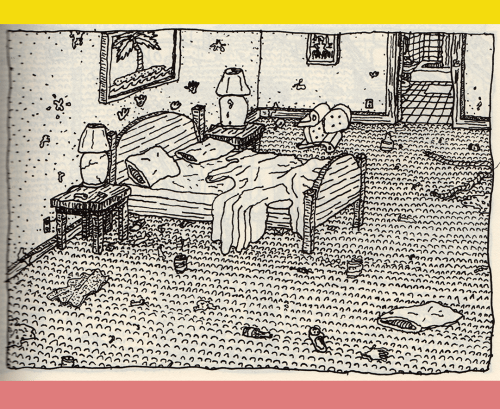
A lot of artists will relate to that. I marvel over the busy energy to these pages, like Pittsburgh Cat rolling through the landscape. Or here’s an example that depicts an absurdly cluttered room but the actual style of drawing is very clean and precise.
Even though I went to art school, in a lot of ways, I taught myself to draw. I threw out a lot of the rules for figure/ground relationship. Everything is in focus. I don’t draw in a way that will lower the contrast in the middleground or background. Everything is crystal clear. When I imagine one of these scenes, I imagine every single little detail, which can make my drawings feel a little overwhelming to surrender to. But it feels honest in how this stuff exists within me.
I wanted to add something about Pittsburgh Cat that you’d mentioned about him rolling. There’s that intervention he has with God on that cliff that begins this rolling process. This scene came to me in a dream. It was a technicolor cartoon dream. One of the only ones I’ve ever had. I woke up in the middle of the night kind of stunned. This was how Pittsburgh Cat was introduced to me. These panels happened. This is the recording of my dream. And, at the end of the dream, when he lands on the beach in Miami, this logo screen came up and it said, “Pittsburgh Cat,” and it showed his face, in these pulsating bubble letters. I asked myself, Who is this? What’s happening here? And I actively began to imagine where the story went from there.
That’s wonderful, so genuine. There’s patterns running throughout the book, whether it’s eyeballs or other repeated imagery, like here, with a hand pointing. You’ve got Hamburger Vampire in the forefront. His right hand is pointing at Corporate Woman. And his left hand is agitated, pointing with a hand repeated three times at the elevator button. Can you tell us something about composing a panel like this?
I grew up watching Looney Toons and Tom & Jerry, those kind of classic cartoons. There are emphasized moments when, for example, a character’s eyes will jump out of their head or they’ll take off running and their first few steps will be moving in place before they move through space. I always loved that effect. Honestly, I don’t think I’m good enough a draftsman to render that stuff the way other artists have done but I still wanted to try to capture that essence. The page you’re referring to, it was an essential plot point but visually it was missing some motion and energy. So, I’ll often employ that technique of repeated imagery.
Of course, I love all the things you do with the dope vape motif. It’s not just the hipsters, even the mayor is hooked on dope vape!
(Laughter)
And it just keeps building. Finally, you’ve got a mob of people, dancing in step, like a scene from Thriller, all hooked on dope vape.
Some years ago, in Brooklyn, this street drug, Bath Salts, got really popular. There’s this notoriously hectic subway transfer point, Myrtle/Broadway. At the peak of the Bath Salts epidemic, there were addict zombies lining the streets. Bath Salts had the effect of paralyzing people, similar to heroin. It was a pretty horrific sight. It’s one of those truth-is-stranger-than-fiction moments. It captured my imagination and pointed out to me the kind of desperation that is prevalent in the culture, the need to escape from all the pressures that exist at this moment in time. That subtext was a way to underscore conceptually what I wanted Dope Vape to represent in the story.
Zebadiah Keneally as Hamburger Vampire
What I’ve observed from a lot of comics critics, is that they embrace a certain kind of weird. Everyone will bow down to Gary Panter, for example. But for the new kids on the block, they’ll be harder on them. How are you handling this as your book goes out into the world?
That’s a tough question for me to answer. I immediately thought about your comment (in your review in The Comics Journal) about the scatological God. That particular scene had been inspired by a portion of Carl Jung’s autobiography where he relays this, hardly offensive, dream of God defecating on a cathedral, and how that began his trajectory as an eminent psychologist. His thinking has influenced me a lot so it was important for me to make a nod there. In that sense, I believe I’ve experienced more of that tougher eye.
On the other hand, I feel very much like an outsider in the comics world because I’ve come into it from a fine arts background. When I took on this graphic novel project, it challenged me as to who I was for a bit. Aside from your review in The Comics Journal, I feel that it hasn’t been noticed at all in the comics community at large. I don’t feel like I’m a part of that community at this point.
I’m happy to be taken to task on my review. I think I might be on to something when I say that it can be hard for people to accept the new weird, not that your work is only “weird,” but it’s something new, the new kid on the block.
I’m grateful for getting a chance to see your work in the first place. Of course, a PDF is a completely legitimate way to read something but not ideal in many ways. Not to overstate this, but I’m so happy to have gotten to experience your book in print. Reading an actual book helped me catch all the details and truly appreciate what you’ve accomplished.
Well, I’m happy to hear that, Henry.
I wanted to say something about how you handle the human figure. It’s all very artfully done, very beautifully done, gorgeously clean work. Were you ever at a crossroads when you had to confront drawing the gods nude?
Honestly, it really wasn’t a question for me.
There you go.
(Laughter) I wrote a script for this first and it’s more pages than the graphic novel and the gods figured large into that script. At one point, before I started drawing, I thought, I’m going to have to draw these guys naked a lot. I’ve always been taken by the human form and loved figure drawing when I was in my twenties and obsessed over rendering bodies and strong lines. There’s something primal and unabashed about how the gods behave and conduct themselves that their full frontal nudity corroborates.
Yes! I wholeheartedly agree. I think more cartoonists should embrace the human form. I think you just draw so well. It reminds me at times of Mary Fleener. You could say you’re a new generation’s Mary Fleener. Well, you’re doing your own thing and so well. I can’t emphasize that enough.
We’ll go through some more pages. Here’s one with Lovebeard in the library. It’s so gorgeous. You’ve drawn every single book there.
It’s so nice to hear you point that out. I look at the work of other artists and admire the way they edit and leave out details. I’ve tried to embrace the less-is-more approach but it never feels right to me. At heart, I’m a maximalist!
You’re not overthinking it. That’s just your natural way of tackling things. Did you ever worry if it was all going to come together, through the years of work, or did a certain rhythm sustain you?
Sometimes I wondered if it would all come together. I began working on the first draft around 2009-2010 and it was a slow process and I didn’t get very far. By 2012, I really started working on this story. I drew in a much looser and gestural way, about 450 pages. I was trying to tell the whole story only through drawings. But it seemed like I’d weaved something together that wasn’t working.
I began drawing another version in 2016. I was doing these very detailed time-consuming drawings, without a script. I found that the pace I was at was preventing me from telling my story. I set it aside but it wouldn’t leave me alone. When the pandemic hit and lock down began, I knew this was the time to write the script and that would guide the drawings. I began that process. I had enough drawings from the 2016 version to make a pitch to Apartamento and they, to my surprise, picked it up.
This provided the opportunity to work from the script and translate it into drawings. That was a total task. At many points, I was uncertain about getting everything into the drawings based on the groundwork I’d created in words. I had to do a lot of editing and get rid of a lot of favorite plot lines. I wasn’t sure I’d be able to do it and stunned when I’d completed it!
Is there something you could tell us about Hamburger Vampire, since the character goes so far back into work?
I moved to New York City in 2009 and I got a job delivering mail to Goldman Sachs. I’d graduated college just before the recession had hit. Work was hard to come by. And suddenly I’d found myself working for this bank that had a huge role in this financial crisis. I felt like I was working in the gates of hell to some extent.
I would hide out in a janitor’s closet on the 26th floor and draw when it was slow in the mail room. And, all of a sudden, as I was reassociating, there before me was a hamburger with a lettuce mustache and vampire fangs. I looked at it and said, “Oh, that’s Hamburger Vampire.” He immediately became an evil entrepreneur: just that kind of greed; that self-serving desire to the max. I really wanted to look at what that would look like for an individual who had no compunction about running roughshod over anyone to get their way. That must have been around 2009-2010 that he was served up to me on a platter. His characteristics, I imagined, were always related to Donald Trump: so that kind of gregarious/mafioso con man–with a lot of power.
Can you describe your relationship with Apartamento. They hadn’t done a graphic novel before your book. How did that come about?
It came about quite naturally. I had made a zine with a publisher out of Zurich, called Nieves Books. And through that I got introduced to the executive editor at Apartamento, Robbie Whitehead. Robbie asked me to illustrate their annual cookbook which they do as fundraiser for a cancer foundation in Barcelona. I was so excited about that opportunity and brought everything I had to that project. We did a Zoom interview to discuss that cookbook and they had seen all the things I’d been doing and wanted to know more about me as an artist. There was no way to talk about that without talking about Hamburger Vampire, who is a character that I’ve done a number of videos and performances as over the years. I discussed my graphic novel and Robbie was interested. It took a while to get everyone on board but it all worked out.
Toxicus Masculinum, Sweet Lorraine, Brooklyn, NY with Elliot Purse. Curated by Katie Hector, 2020
Can you give us a little taste of your experience working with art galleries?
What is essential is getting involved with communities of artists. For example, when I was younger, it was being part of a group of artists at the Robert Blackburn printmaking workshop in Manhattan. From there, I met artists working on independent risograph publishing and I got to collaborate with them. They would put on exhibitions and I would perform at a bunch of those. I would go to a lot of gallery openings of people that I knew from the print shop, from college or who I had met a party.
So, I’d just meet people, make friends, invite them to my studio. You build connections with people who are doing creative things. The opportunities to show in galleries grow from those friendships and connections. Jacqueline, who runs Good Naked, is really wonderful. She saw my work on Instagram. She had made a decision to start a gallery at that point and she DM’d me and asked if she could come visit the studio. I showed her some drawings that ended up in this book, among other things. We had a conversation and discovered we had similar values in things in regards to art: being genuine and playful with a certain entertainment bent to it. She invite me to paint a mural in her gallery. That gave me an opportunity to scale up; most of my drawings are pretty intimate, you know, 8.5 by 11 or 10 by 7. It was really exciting to go big–and have a wall!
As we wrap up, let me ask you about the title of the book, All The Things I Know. That begs the question as to what this book means to you. What does the title mean and what are “all the things” that you know now, after all these years, from having created this book?
It’s a funny title, All The Things I Know. It gives the impression of being a memoir which this book isn’t in any practical sense. Around the time I started working on this story, I had had an idea about a performance that went like this: I lock myself in a studio for an unspecified period of time, cover the walls with paper and endeavor to write all the things I know, not leaving until I had completed my task. I didn’t have the gall to actually do that, and I got obsessed with the characters in the story so I threw myself into that. I had no idea what to call this book I found myself working on, so I decided to call it All The Things I Know, after this zany performance art idea I thought I wanted to do. Fast forward a year into working on the first draft and I realized that all the characters were me – or aspects of my psyche. I did the long division and saw that they represented my desires: for the material, for the intellectual, for the spiritual (Hamburger Vampire, Lovebeard and Pittsburg Cat respectively). With them, I was imagining what the collision of these drives might look like; I began to understand the book as a psychic memoir. When it came time to finalize the title 10 years later, I’d been calling the book All The Things I Know for so long that I could not imagine titling it anything else, despite my worries about misleading readers. Wanting to ground the title in the story, I wrote it into a scene where Pittsburgh Cat bemoans the rapidly shifting tides of his life, saying to God, “Listen dude, I don’t know what I know anymore. All the things I know … or thought I knew have been eviscerated–” That’s more or less how I feel, after all these years, having created this book.
Thank you so much, Zebadiah.
Thank you, Henry.
All The Things I Know is published by Apartamento. And you can also find it at various other outlets, including Amazon.
You can find Zebadiah Keneally here. And make sure to see the zany promo video at Apartamento!
Public Domain (#5) writer/artist Chip Zdarsky Image Comics (19 Oct 2022 issue) $3.99
Chip Zdarsky is an exemplary, stupendous, and extraordinary comics creator, someone I’ve admired since his groundbreaking work with Matt Fraction on Sex Criminals. But, before I embarrass myself any further, let the following video create the right mood. Maybe you are already a fan but, if you’re new, let Chip Zdarsky speak for himself:
Okay, so, Sex Criminals was written by Matt Fraction and illustrated by Chip Zdarsky. For Public Domain, Zdarsky is both the writer and artist. And that fact alone is worth the price of admission. We get full-on Chip Zdarsky, filled with whipsmart humor. People still use “whipsmart,” don’t they? Anyway, this is a love letter to the comic book from somebody who really gets it, and has seen it all from working on many of the biggest comic book franchises. Zdarsky knows where the bodies are buried or, in other words, how corporate comics are made. And, well, that’s not always to the satisfaction of comics purists or to anyone who appreciates a well-thought-out story. That’s the theme here: the little guy (Jack Kirby or Bill Finger, etc.) going against the suits who take the lion’s share of the profits and exploit the work created by the likes of a Kirby or a Finger. The little guys vs. the suits. And that’s not to say that little guys can’t be physically big and/or wear actual suits.
From #4: Let’s make some comics!
Issue Five is a great jumping on point as the stage is set for the old true blue creator of the iconic (and movie franchise) comic book character, The Domain, to get his chance to create his own new stories and own the rights to them. Syd Dallas never really cared about the business side to comics and allowed his employer, Singular media, to rob him blind. That all changed when a perfect storm of circumstances led to a legal fight. Now, suddenly, Syd Dallas is leading his own comic book company featuring the new adventures of The Domain. This is a far-fetched adventure even for Syd but his sons, both at loose ends, force him to find the will and the grit to give it a go. Add to the mix a young aspiring writer, Tanya, who used to work for Syd’s less than scrupulous creative partner, Jerry Jaspers.
From #4: Enter Tanya!
In this latest issue, it’s up to Syd to get on with creating comics. Along with his two wayward sons, Miles (the ex-reporter with a bad temper and gambling addiction) and David (the tattoo artist with the shit-eating grin). Some of the best moments involve Miles and David and are seemingly nothing moments of apprehension and ennui. One favorite line from the new issue: “S’all good, man. Just a bunch of unemployed people pretending to not be unemployed.”
From #4: We love comics!
All in all, the banter and social commentary adds up to a delicious dark satire on the less than innocent comics industry. But who among us is innocent, right? Ah, well, now that’s the frame of mind to be in for this snarky, yet heart-felt, tale. Getting back to the issue of creating quality work, it all comes back to it being well-thought-out work and that’s where Zdarsky has got you covered. He actually writes! Maybe that’s his big secret: to actually write with integrity and, heck, you just might create something worth reading. Who knew?
Public Domain is published by Image Comics. Issue Five comes out 19 October 2022. If I did any rating, I’d give this one 10/10.
Dirty Pictures: How an Underground Network of Nerds, Feminists, Misfits, Geniuses, Bikers, Potheads, Printers, Intellectuals, and Art School Rebels Revolutionized Art and Invented Comix. by Brian Doherty. Abrams Press. 2022. 448 pp. $30.
Comix! No, not just comics. Comix is the term we use to describe all the work created by independent comics creators (often auteur cartoonists doing both the writing and the drawing) dating back to the Sixties underground up to today. Brian Doherty has had a great time digging into the roots of, and connecting the dots to, this quirky offshoot of the comics medium. First off, I gotta say that Doherty is quite in tune with his subject and cuts to the chase. Perhaps the biggest question that comes up on this topic is What in the hell was R. Crumb thinking? Well, you won’t get far without an open mind on this. Doherty gets to the heart of the matter with a quote from 1972. A reporter for The New York Times asked what Crumb’s intention was in creating some of his most macabre and provocative work. Crumb answered, “I don’t know. I think I was just being a punk.” Then Doherty adds to that the fact that Crumb and his fellow cartoonists were all bucking a highly restrictive system of censorship. Nothing was allowed at the risk of offending anyone! If that sounds familiar, well, it won’t be lost on anyone reading this book. The point is, Crumb was indeed reacting to something, rebelling against something. Did he go too far? Or was it more one guy’s approach, along with a whole slew of other cartoonists, both men and women, with their own fiery takes on society? I think this whole book rests upon the assumption that a reader can walk and chew gum at the same time. In other words, yes, there is a possibility of seriously looking at the most controversial facets of comix without retreating from it. One key aspect to understanding is to look at the motivation to rebel. As Doherty reminds us, the “x” in comix is there for a reason: to distinguish comix from mainstream comics, the all too often watered-down and lame opposition, particularly during the days of the Comics Code.
Once we get something of a handle on Crumb, the rest of comix is a piece of cake! Well, maybe not. But that’s basically the arc we’re following: the great warriors, led by Crumb, out to raise hell; then, the reaction to all this ruckus, which included anyone offended by the first wave of mayhem; ultimately, a long process of the original “filth” working its way through the rest of the culture; and finally, all the accounts settled and those left standing declared the champions: Crumb, Spiegelman, and so on. Doherty does an impressive job of maintaining the flow of events, logically moving from one place, one publisher, one movement, after another. For those old enough to remember some of this history, it rings very true. Doherty has written the kind of book that many of us knew was possible. It involves keeping an eye on the key players and examining their aspirations and actual activities. Again, it’s impossible to avoid both Crumb and Spiegelman, both very aware of the fact they had reputations to either maintain or enhance. And then, of course, you had all sorts of other activity brewing, not the least of which was the feminist contingent led by Trina Robbins and her crew at Wimmen’s Comix. Robbins and her women cartoonists were determined to fight fire with fire.
Like any great art movement, comix is the story of the artists who led the way as well as of those to have taken up the mantle. What sustains the character and spirit of comix today harkens back to the highly charged independent streak of the original underground. You can’t have comix, or anything that resembles it, without a healthy embrace of the subversive, the experimental, and the guts to see through the most outrageous expression. It may offend. In fact, it definitely will offend and there will be consequences to pay. But, all in all, we’re far better off when an artist isn’t restricted or afraid to just be a punk, as Crumb summed it up. But art cannot remain in a vacuum or it will die. As Doherty points out, a new wave of artists brought in refinements. Most notably was a finer sense of the literary as demonstrated by Los Bros Hernandez and their ambitious Love and Rockets comics willing to take on richer and subtler literary aspirations. I’ve been a champion of the term, “alternative comics,” as I see it as a very valuable distinction. It’s nice to see Doherty using it here. He points out that pivotal break with the past as the underground ruckus rebellion gave way to a more cerebral alternative vibe. Indeed, it was to be a new and significant development to the still unfolding world of indie comics, a world that has given shape to the highly personal and strange creature we know today as the “graphic novel.” Sure, there are still diehard purists who claim to not understand what is meant by that term outside of being a brazen marketing tool. But people do know what a graphic novel is, or can be, just as they know what is meant by the term, “comix.” And that’s because, believe it not, people can really walk and chew gum at the same time. If they couldn’t, well, we’d really be in a lot more trouble. Doherty’s book is a very welcome addition to our understanding of comix, from its origins up to its current offshoots, offering common sense insight.
DIRTY PICTURES is available beginning June 14, 2022 and ready for pre-order. Visit Abrams Press.
This vest-pocket size story-and-comic arrives to a world without…vests! But it is the same size, more or less, as those once-famous Little Blue Books, printed by the millions in Girard, Kansas, at the former office of the Appeal to Reason, aka Temple of the Revolution. That hoped-for revolution had been quashed by the repressive blows of the Woodrow Wilson government against antiwar socialists. The print revolution of Little Blue Books, if it may be called so, is actually part of a larger saga about comics as an art form and its connections with Modernism-become-Post and Post-Post Modernism.
Art Spiegelman and Robert Coover. From Street Cop.
Readers of Comics Grinder need not hear much about Spiegelman. Maus won a Pulitzer and has circled the world dozens of times. It may be said to have validated comics as art, at least in the US, where that designation had lagged. But actually the advance was twice-over, because Art and his wife Francoise Mouly had created, via their RAW Magazine of the 1980s-90s, an avant garde sensation. A collaborator, Ben Katchor, caught the flavor best by suggesting that RAW positioned or marketed itself as the organ of comics seen anew, a child of obscure or forgotten avant-garde French poetry and art. It was perhaps an extended reach if not actually a dubious claim, but never mind. The occasionally-appearing RAW was unlike any comic ever produced, more global, more arty, and in a curious way, the uneasy cousin of Robert Crumb and Aline Kominsky’s Weirdo, which was just plain…weird.
Novelist and lit prof Robert Coover is nothing if not the ungrateful, bastard grandchild of modernism, or possibly in his own world of categories. In novel after novel, story after story, Coover manages to lambaste the disordered society, indeed the disordered world, that we live in. Here, in a Manhattan of the future, neighborhoods are manufactured anew through computer printing, and they are never quite solid. The notoriously corrupt as well as brutal NYPD is put into a situation at once hopeless (cops chasing robbers into buildings disapper entirely) and favorably permissive toward ever higher levels of brutality. Actually, we seem well on our way to parts of this dreaded future already.
Coover’s protagonist is the cop of title, an ex-criminal badly paid, but without any other definition to his life, and true to noir traditions, he continues on what could only be called existential grounds.
I do not object in the least to flying cars, low-down characters of all kinds, to say nothing of a collapsing city-scape. This part actually seems closest to current reality, although the destruction of historic architecture is part of Capital’s plan. When our cop steps into a ghoulish pet shop with very ghoulist pets, I stop to object. My own work environment has avians walking and flying around me through the day. Ghoulishness is not in their remit. Or perhaps we are in a worse version of The Birds, where the animals are wreaking revenge upon the wrong-doing humans?
The story seems to dissolve somewhere around here, but the illustrations by Spiegelman remain wonderfully strange in their shape and colors. The artist who once did bubble gum cards, mixing the mundane with the more or less fantastic, delves popular culture imagery again and again here. The cop himself looks remarkably, sometimes, like Sluggo. This is a hell that is, at least, pretty funny.
We turned to the subject of the performance artist Brother Theodore and that helped connect the dots to Martin Olson‘s new book, The Conquest of Heaven, which I’ve reviewed in my previous post. It’s an intriguing and hilarious exploration of the addled yet persistent mind of the Lord of Darkness himself. On one level, it’s a very funny book. On a deeper level, it’s every bit the satire on what we humans let ourselves believe and what can pass for reality. Serious followers of comedy will most likely already be familiar with Brother Theodore. I kick myself now, because I can’t say I knew about him until recently and that’s only because I found out about him from Martin.
My introduction to this comic is this clip from The Merv Griffin Show. I can’t say that I was ever a big fan of Merv Griffin. He seemed to be the sort of talk show host that was easily parodied by other comics, like Martin Short. But now I come to see that Merv Griffin was pretty hip to groundbreaking comedy as he was an early supporter of Brother Theodore. If you are new to him and you view this clip, you can’t help but think that Andy Kaufman was taking notes….
So, if you view the clip, this will make more sense. In a nutshell, here you have one of the early wave of nontraditional comic artists. Brother Theodore was weird but that was the whole point of his act, to express the utter absurdity of life. As Martin points out, it’s nihilistic material that you make your way through to a redeeming payoff. And so I see some of that going on in Martin’s new book with Satan as the main character, an outrageous creature saying the most offensive things, but alternating with some poetic whimsy. Anyway, I wish I’d taken my search a little further and viewed the more recent clips of Brother Theodore in the ’80s on Late Night with David Letterman. Ah, that would have been more recent material to talk to Martin about. The thing is, this was simply a potential question I had pinned to the back of my mind. As it is, I did get a wonderful response regarding the above clip which includes Martin recalling what it was like for him as an impressionable 10-year-old to see this crazy and weird humor.
For those who are fascinated by the writer’s craft, we also chatted about the great science fiction writer Robert Sheckley. In fact, that’s just before we dived into talking about Brother Theodore. In the case of Sheckley, this is another mad genius who loved quirky humor. There’s a nice moment during our talk when Martin recalls Sheckley’s guiding principle in keeping his stories rich and alive: “Sympathize with all things!” And so Martin finds a way to even sympathize with the Devil!
Okay, that seemed a perfect place to stop but I need to just add that, having read both books in the series thus far, I can confidently say that one compliments the other. To hear Martin confirm that there will indeed be another book to fulfill the trilogy is wonderful news. Martin has, by turns, found himself creating his own universe upon which to comment on the human condition and the like, essentially having endless material to play with on the less than stellar condition of the cosmos. All this brings to mind Douglas Adams, and he did pretty well for himself as I recall.
For more on Martin Olson and his work go right here.
Pinko Joe: A New Kind of Graphic Novel. Christopher Sperandio. Argle Bargle Books. 2020. 96pp. $21.99
Artist Christopher Sperandio is onto something. As he related to us in a recent interview, it dawned on him what he could do with public domain comics and it just killed him that he hadn’t thought of it sooner. As reviewed here at Comics Grinder, the latest book in this series is Greenie Josephinie. We are going to go back just a bit and focus on the title that kicked it all off last year, Pinko Joe.
Enter a man in a bright pink suit.
Due to the pandemic, I think this series, like so many titles, is still getting on reader’s radars. But this is not a problem in the long run. There’s an eerie timeless quality to this multi-layered work that defies easy categorization. The source material is from the past (shifted and unmoored) in the service of subverting various issues from the present and let loose upon an uncertain and distant future. We see testament to the beauty of this process from the very opening page, filled with disparate images (featuring a guy in a bright pink suit that David Bowie would have been pleased to wear) from some long forgotten past, images that are being propelled into a loopy present and future. Enter a man in a bright pink suit, nicknamed, “Pinko Joe,” by the merciless right-wing media.
“Capitalism is always evaluated against dreams! Utopia is a dream! It doesn’t exist!”
My theory is that every comics genre gives off a certain vibe, even if the excerpt you are viewing is totally out of context and you can barely figure out what is going on. That is part of the beauty behind what Sperandio is up to since his source material runs the gamut of genres: crime, romance, science fiction and horror. Then you lay on top of that the subversive adventures of Pinko Joe, a down-on-his-luck wage slave/activist from another planet! It becomes a battle royale between the socialists led by Pinko Joe and the uber-capitalist gangsters in an alternate reality where Eisenhower is at the helm of a third term and the rise of the very military-industrial complex he warned about–and which he can dismantle with a little help from his friends!
The wild and droll world of Pinko Joe!
The narrative to this graphic novel is broken up into episodic chunks just as you find in a comic book. While this is definitely a very different kind of graphic novel, and will definitely appeal to a certain discerning reader, the droll political humor is really funny and has broad appeal. Think of the audience for The Daily Show or for Real Time with Bill Maher. Let’s break down a random full page. Based upon the list of sources at the back of the book, this is probably originally a page from a comic book, Crime Must Pay the Penalty, published by Ace Magazines, October 1950. On the page, a dapper young man appears to defend a wealthy family from thugs. In the Sperandio treatment, it is Pinko Joe who is defending a father and daughter business from capitalist gangsters. The dialogue is fun and irreverent. Panel 2 makes a nice stand-alone as Pinko Joe knocks out one of the “fascists.”
“Knuckles for you, fascist!”
There’s a pure vision to what Sperandio is doing and I’m sure it will guide him onwards. Many an artist has come before with a tribute or a revisiting of past art. This tribute and revisiting by Sperandio, a manipulation of comics, and a comic all its own, is something Andy Warhol would have applauded. Maybe Warhol would never have ventured in such a direction himself or maybe he might have hired Sperandio to join him. My guess is that Sperandio would say thanks, but no thanks.
Find PINKO JOE and GREENIE JOSEPHENIE, along with other fine books, at Argle Bargle Books!