Tag Archives: Dark Horse Comics

Eric Drooker: NAKED CITY interview

Eric Drooker is that consummate artist, the ideal artist that young people generally aspire to be. Take a look at the short film below to gain some perspective on Mr. Drooker. This is a short film he did in New York in 1981, a tumultuous time with undeniable relevance to today; a timeless film. We will always need to remind ourselves we have nothing to fear but fear itself. I had the honor of putting together this studio visit with the artist. We discuss his latest graphic novel, Naked City, published by Dark Horse Comics. In it, we find a set of characters, representative of all humanity, who are basically reminding themselves that they have nothing to fear but fear itself.

Born and raised on Manhattan Island, Eric Drooker began to paste his art on the streets at night as a teenager. Since then, his drawings and posters have become a familiar sight in the global street art movement, and his paintings appear frequently on covers of the New Yorker.

Eric Drooker in his studio.

His first book, Flood, won the American Book Award, followed by Blood Song (soon to be a feature film). Naked City is the third volume in Drooker’s City Trilogy. His graphic novels have been translated into numerous languages in Europe, Latin America, and Asia. After designing the animation for the film Howl, he was hired for a project at DreamWorks Animation.

The City Trilogy: Flood (1992), Blood Song (2002), Naked City (2024).

Drooker’s art is in the permanent collection of the Whitney Museum, the Museum of Modern Art, the Brooklyn Museum, and the Library of Congress. He is available for speaking engagements and frequently gives slide lectures at colleges and universities. Mr. Drooker’s art is available for sale at his website.

At heart, Eric Drooker is a street artist with all the energy that comes with it: everything from his zest for creating work to his zeal for talking about his art. Just give the floor over to him and he’ll work his magic, maybe even play the harmonica if necessary.

The New Yorker, October 28, 2024, The Money Issue. “Crushing Wealth” by Eric Drooker.

“Troubadour” by Eric Drooker.

The New Yorker, March 6, 1995, “Under Bridges” by Eric Drooker.

“Tomorrow” by Eric Drooker.

While I was in his studio, he picked up a copy of The New Yorker magazine, with his art gracing the cover, an issue published just the prior week, and launched into a talk about how the magazine cover functions as a form of street art. While the magazine has a healthy readership, it also reaches a vast number of people who regularly consume just the art on the cover as they come across the magazine on display in various locales whether in a bookstore or in the dentist’s office.

The New Yorker, November 9, 2009, “Autumn in Central Park” by Eric Drooker.

The New Yorker, August 6, 2007, oil on canvas, 20″x16″, “Urban Jungle” by Eric Drooker.

Naked City got on my radar earlier this year and I’m so grateful that I got an advance copy. My friend, and colleague in the comics world, Paul Buhle, wrote the review for us here at Comics Grinder. Without a doubt, Naked City is a significant graphic novel with the added distinction of being part of a trilogy, part of a great artistic process. We, as artists, can and must do some planning ahead on projects while, at the same time, allow the art process to do its thing. Such is the case with Naked City. It is as much a graphic novel about being an artist as it is simply about being human and being true to yourself.

“The Argument” by Eric Drooker.

4 Comments

Filed under Comics, Eric Drooker, Interviews

NAKED CITY by Eric Drooker graphic novel review

NAKED CITY:  A Graphic Novel. Eric Drooker. Milwaukie, Oregon: Dark Horse Books, 2024. 329pp. $29.99.

Guest Review by Paul Buhle

For many an aged connoisseur of film and television history, the title of Eric Drooker’s new comic conjures up fond, familiar images. A 1948 film offered the nearest Hollywood approach to Italian “New Realism,” and was directed by Jules Dassin,a left-wing film director about to flee the US and the blacklist for a legendary role in Greece (think Never On Sunday). On the surface a mere “policier,” it captured the grit of Manhattan as a manufacturing city, including a police chase on foot through crowds of working class types, never seen in quite this way before or perhaps after. “Naked City” made a titular reappearance for good reasons, one of the finest “New York Era” television efforts (1958-63) which began each episode with a vivid view of Manhattan, and plots that often featured police as social workers dealing sympathetically with broken lives.

Drooker himself actually fled New York for Berkeley, decades ago. But he co-founded the annual, hard-hitting anthology World War III Illustrated before departing, and has returned spectacularly—in his dreams, that is.

We are in the world of existential experience. Artists and musicians trying to make a living and make their way and also find some kind of companionship, where possible. Street scenes, park scenes, people who aren’t nearly as dangerous or unfriendly as they look, and cops who are a lot more casually brutal than the press would have us believe. Drooker, as in an earlier Manhattan GN, Flood, does not need much dialogue and some pages have hardly any at all.

Let’s try another analogy. One of the most useful observations of European art historians generations ago captured a crucial turn away from narrow religious art. For a thousand years, more or less, painters had drawn human beings at close quarters, engaged in one or another religious expression. And then, not necessarily for non-religious purposes, the landscape began to appear as something in itself, something to  be seen, reflected upon, captured in art.

It was a giant step forward, anticipating the following steps in which humans would reappear but in a new light. Bruegel was already there, in a sense, but by the nineteenth century, a flood of art, more and more secular, placed ordinary people in ordinary lives. Or exotic people in their ordinary lives somewhere far from the Euro-centered world. Only one step remained, in the lowly comic pages of the yellow press, to allow ordinary as well as extraordinary people to talk, make jokes, swear, and generally carry on.

Thus comic art, long unrecognized as any kind of art. Drooker brings us back to landscapes, but as cityscapes. Interiors and exteriors alike, not to mention the subway caverns, not to mention music venues. Not to mention balmy days, and snowstorm days, tenement to public park.

The plot is fairly thin and the characters not developed with notable complexity because Drooker wishes to direct the reader’s attention elsewhere. Our protagonist, a young woman coming from a rough background, has aspirations as a singer. She naturally can’t pay even a meager rent without finding some kind of work when nearly every kind is obnoxious as well as unrewarding. By accident, she becomes an artist’s model and we enter the world of the artist himself.

Here, any comic art volume will poke around a little, raising inevitable analogies to the comic artist’s own artistic vision, work and troubles. This guy is more than a generation older than our protagonist, has no apparent sexual designs upon her but also no sense of a career more successful than following his agent or exhibitor’s advice. He may not come to a happy ending because hardly anyone does here. The City is rough on the ordinary aspirant to artistic fame or even relative stability. The lonely streets are too dangerous, just for starters.

She is lucky enough to escape the worst dangers except the sense of being alone in a world of skyscrapers, tenements and offices. She is lucky enough to be recognized as a singer with talent. But something is definitely missing.

Drooker is a socialist and environmentalist as his art has always explained to readers. He does not thump any key here, no political causes are highlighted, if the plight of the working stiff is always on display. He is pointing in another direction. She is undocumented and in that way always endangered,  her memories of her family’s political persecution in Mexico stand for themselves, part of a past that she has left behind except in wistful moments.

She is, finally, one more stranger in the metropolis. Like millions of others facing the same dangers, including deportation. And with similar hopes. She is not allowed her own special songs to them. But she endures.

Actually, it is the Yiddish language short stories and novels about Manhattan from the 1890s to the 1940s that seem the closest to Drooker. Strangers in a language that will remain forever alien West of the Hudson. Inclined toward visionary social solutions based on culture as much as politics, the artist, even the ordinary lover of art, group-music singer or musician to film-maker and even cartoonist, those curious Jews left a mighty legacy that Drooker follows.

Then again, Drooker could also be seen in Tompkins Square Park, where Allen Ginsberg discovered his art on anti-gentrification posters, introduced himself to the artist and began a process that culminated in a Drooker/Ginsberg collaboration of poetry and comics. Quite something to remember. And again, quite the city saga.

Ginsberg discovered Drooker as Drooker had discovered Ginsberg. Together—which is to say a new collection of Ginsberg’s poetry illustrated by Drooker, published in 2006—they created a unique comic. We can appreciate the partnership best with Ginsberg’s words, from Drooker’s website:

Essay by Allen Ginsberg

Drooker’s Illuminations

I first glimpsed Eric Drooker’s odd name on posters pasted on fire-alarm sides, construction walls checkered with advertisements, & lamppost junction boxes in the vortex of Lower East Side Avenues leading to Tompkins Square Park, where radical social dislocation mixed homeless plastic tents with Wigstock transvestite dress-up anniversaries, Rastas sitting on benches sharing spliff, kids with purple Mohawks, rings in their noses ears eyebrows and bellybuttons, adorable or nasty skinheads, wives with dogs & husbands with children strolling past jobless outcasts, garbage, and a bandshell used weekly for folk-grunge concerts, anti-war rallies, squatters’ rights protests, shelter for blanket-wrapped junkies & winos and political thunder music by Missing Foundation, commune-rockers whose logo, an overturned champagne glass with slogan “The Party’s Over,” was spray-painted on sidewalks, apartments, brownstone and brick walled streets.

Eric Drooker’s numerous block-print-like posters announced much local action, especially squatters’ struggles and various mayoral-police attempts to destroy the bandshell & close the Park at night, driving the homeless into notoriously violence-corrupted city shelters. Tompkins Park had a long history of political protest going back before Civil War anti-draft mob violence, memorialized as “. . . a mixed surf of muffled sound, the atheist roar of riot,” in Herman Melville’s The Housetop: A Night Piece (July 1863).

Paul Buhle

4 Comments

Filed under Dark Horse Comics, Eric Drooker

Maskerade #7 (Kevin Smith) comics review

Fans of Kevin Smith, and fans of the offbeat and unusual, have been keeping tabs on the Kevin Smith-led Secret Stash Press imprint at Dark Horse Comics. So far, it has offered fans a couple of titles: Quick Stops, an anthology series set in the world of Kevin Smith movies;  and Maskerade, a crime noir about a cut-throat vigilante. The latest issue, number 7 (of 8), comes out August 9th and here’s a taste of this wild and woolly thriller.

Writers Kevin Smith and Andy McElfresh came out of the gate with this title like two bats out of hell. This is grim stuff mashed up with dark humor, smashed with even darker stuff. Ah, but if that’s what your horror radar has been looking for, then it must be pinging like crazy. This is high-octane horror more than anything else. There’s humor but it’s not there to lighten the horror load as much as it’s there to set up the next jolt. As long as you, my dear mature reader, know that going in, you should be good to go.

Our main character, Felicia, is a female version of every character that Liam Neeson portrays in movies now, a character bent on revenge and willing to do anything, literally anything, to exact vigilante justice. So, if you haven’t already, be prepared for blood to spurt out all over the place and, well, prepare for blood to flood any nook and cranny. You will see red over and over again. The artwork by Giulia Gualazzi is on point, and compliments all the action and horror, and blood. Colorist Giulia Brusco is quite adept at providing vasts quantities of the color red, which is, as I suggest, the prominent color in this comic book. You like red, well, you’ll see lots of it here.

No vigilante story is complete without the villain, or villains, getting ample amounts of comeuppance. You thought you could get away with that, Mr. Evil? Think again! Here’s a poker through your hand; and how about we saw off your . . . yeah, that should do it! In this issue, one of the Mister Evils in this story somehow escapes the cage he was placed in and, against all odds, has somehow managed to turn the tables on Felicia. There’s a good bit of high tech shape-shifting going on in this comic and it looks like one Mr. Evil managed to outwit Felicia with her own shape-shifting powers. That makes for a very interesting issue leading up to the grand finale. So, if you’re a big fan of Kevin Smith, this is the mother lode. And, if you’re new to Kevin Smith, especially his weird brand of comic books, you’ve been warned. Who knows, you might love it!

One last word, I sincerely do have to tip my hat to everyone involved with this comic. Horror comics have a long history and tradition. It’s not easy to maintain the pace once the scenario is in place and the key players have been set loose. No doubt, our main player, Felicia, is quite a force of nature. And all the baddies have what’s coming to them. This is a well-oiled comic, that really works, and that’s saying a lot.

Rating: 4 out of 5.

Maskerade is published by Dark Horse Comics, available as of 9 August 2023.

Leave a comment

Filed under Comics, Comics Reviews, Dark Horse Comics, Kevin Smith

BLAB! comics anthology (2023) review

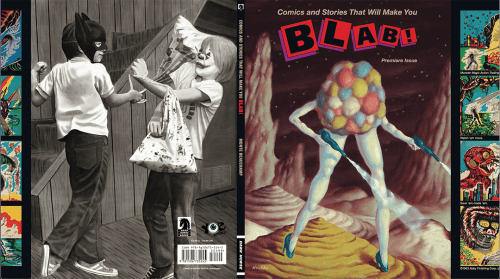
Cover: art by Ryan Heshka

BLAB! Editor: Monte Beauchamp, Dark Horse Books, pp 112, $19.99

Guest Review by Paul Buhle

BLAB!, a creation of the pleasingly twisted mind of Monte Beauchamp and his artists, has been around for quite some time. In fact, the first two issues (1986–87) were published by Beauchamp’s own imprint, Monte Comix. A genius at low-brow art anthologies, Beauchamp began this venture back in the transition or ditch between underground comix and alternative (what might later be called “art”) comics. But art, for Beauchamp, of an almost inexplicable kind.

The title has bounced from his own personal operation, Monte Comix, to Kitchen Sink Press to Fantagraphics and Last Gasp to Dark Horse, where it has become, for reasons known only to Beauchamp, “Blab World!” It was always a planet by itself, and the suspiciously camp rocket-firing goddess on the cover, by Hershka, is clearly interplanetary proof.

Excerpt from “The Death of Comics,” by Noah Van Sciver

Oh, yes, there is some truly understandable stuff here, a lot of it pages by Noah Van Sciver, at 38, the book’s youngest contributor. Louis Wain, a mad artist of cat images in  Victorian Age Britain,  could be a precursive Beauchamp, obsessed with images until he loses his mind. Van Sciver comes back again with a whopper, “The Death of Comics,” aka the story of the best-selling Crime Does Not Pay series. The genius money-making series created by leftwing publisher Ralph Gleason, it encompassed the noir sentiment of the later, disillusioned 1940s as the dreams of antifascist democracy melted into individualism and war-wounded minds that could not be healed.

Excerpt from “The Death of Comics,” by Noah Van Sciver

Van Sciver focuses in on the lives of the Crime Does Not Pay artists, and in particular the genius of graphic sex-and-sadism, Charles Biro. His triumph leads him and the rest of comics into the hands of would-be censors and especially best-selling author Dr. Frederick Wertham. It’s a familiar story to comics devotees, and involves a wider plot of horror comics, MAD’s publisher William M. Gaines, and Congressional hearings that mirrored the hearings held on the purported Communist threat,with near-identical warnings of dangerous Jews poisoning the minds of young Christians. Van Sciver allows himself only a glimpse of the larger picture, because he is following Biro to his own private doom.

Excerpt from “The Death of Comics,” by Noah Van Sciver

A considerable amount of the rest of BLAB! takes us to other strange places in the pulp past, comic book back pages of the 1940s-50s selling miracle hair-replacement liquids, pocket-size miniature monkeys, and other far-fetched hustles aimed at young (or low-capacity) minds. Or to the pulp treatments of great apes, “discovered” only in the mid-19th century, treated as fantastic King Kong types with their hands around near-nude (white) women, or as a link to the link of the “missing link” to the human race, a link that has never been found.  Beauchamp is asking the unasked question, why the obsession, and answering not in prose but by throwing the question back at the reader. Another section offers pages and pages of 19th century attacks on Catholicism, the dangerous threat to everything truly American. Great flying saucer illustrations by Ryan Heshka take us back to the late 1940s and 1950s, the golden era of interplanetary visitations and expectations.

There’s more: Heshka and Beauchamp’s story on Superman’s inventors Siegel and Schuster, taken from Beauchamp’s own anthology Masterful Marks (on great comic artists) is wonderfully weird. He has created no iconic comic figures, neither prompted the empire of capital in comics or been cheated out of it, but he is so much a part of the history, one way or another, that one can hardly tell the larger story without him.

Paul Buhle’s latest comic is an adaptation of W.E.B. Du Bois’s classic Souls of Black Folk, by artist Paul Peart Smith (Rutgers University Press).

2 Comments

Filed under Anthologies, Blab! Magazine, Comics

PEARL III #1, Dark Horse comics review

Pearl, a girl in trouble!

Is Brian Michael Bendis the hardest working guy in comics? Or is it that Greg Rucka fella? When I see yet another girl trouble comic with a very well established name attached to it, that gives me pause. That’s not to say this isn’t worth checking out. When in doubt, don’t pout! First, there are plenty of fans who are looking for a certain itch to scratch. This is the story of Pearl, a tattoo artist who was born into the yakuza underworld. Pearl is a critically acclaimed Jinxworld title partnering with Dark Horse. And the talent behind it, Bendis and artist Michaeli Gaydos, are also behind the celebrated Jessica Jones title. So, all in all, an exceptional crew at work on satisfying a certain itch.

A girl with a gun. Blam! Blam! Blam!

For those catching up, Pearl found out about her parents and her connection to mobsters in previous volumes of this on-going series. In this misadventure, the big mystery to solve is summed up in the question, “Who is the ghost dragon of San Francisco?” Who, indeed! If we can find that out, then it unlocks other questions, and so on down the line. All in all, this is supposed to be a fun roller coaster of a ride, all wonderfully rendered by Gaydos. What matters most here is whether a casual reader of this genre, such as myself or maybe yourself, can claim a good reading experience from this. In other words, is this as compelling as viewing Ozark or maybe perhaps some notches below that? That show comes to mind since we have a young person in over her head because of her criminal parents. Anyway, as far as satisfying an itch to scratch, it does a nice job. I’m not going to say this is at the level of Ozark but few things are. If you’re already a fan, this is definitely for you.

We need to talk.

So, what exactly happens in this comic? In a nutshell, you get a lot of cool dialogue and a bunch of crunchy and gritty action. All for the price of a latte. Not bad. Not bad at all. This comic is so completely in the Dark Horse wheelhouse and that’s a very good thing. This is a fine example of the girl trouble comic. Even the most casual of readers will get a kick out of it. This is the first issue in this new mini-series so a terrific place to jump right in.

PEARL III #1 comes out May 25, 2022, 32 pages, priced at $3.99, from Dark Horse Comics.

Leave a comment

Filed under Comics, Comics Reviews, Dark Horse Comics

Book Review: IMPACT Comics from Dark Horse EC Archives

EC Archive: Impact

Guest Review by Paul Buhle

EC Archives: Impact. Milwaukie, OR: Dark Horse, 2020.  168 pages. $49.95.

Impact Comics, which lasted only 5 issues, would be memorable if for only one story. As Greg Sadowski, the forgotten fan-biographer of artist Bernard Krigstein suggests,”Master Race,” a mere eight pages and scripted by Al Feldstein (Mar., 1955), is the masterpiece of anti-fascism but also of comic art design and execution. It enters the mind of the Holocaust survivor as he discovers, tracks down and wreaks revenge upon a human monster within the bowels of Manhattan’s subway system.

How could this humble popular art carry the weight of serious modern art, so serious that it escapes the then-current cult of abstract expressionism? This is the story worth telling.

Impact Comics (1955) may be viewed simply as a technical triumph of popular might. The story lines are taut, the art is crisp, and if we were to choose a single outstanding feature, it might actually be the coloring work of Marie Severin, master craftsperson of the field. We might also view Impact within a broader context.

MASTER RACE, original first page, March, 1955.

Comic art, comic book art and narrative, must be amongst the most improbable subjects in all of art history. Or perhaps this was true until the recent rise of comic art studies in college courses, online journals,  and Comi-Con panels bringing together living artists with aficionados. But never, since the rise of the fan world and press, has the comics field been without its own small legion of self-taught scholars and devotees, going way back to the early 1950s. In this small world grown surprisingly larger, EC publications have had a special place of honor. EC war, science fiction and above all humor publications brought traditional comic book art to its apex and….edge of demise. Impact, with only a handful of others, remains or rather retains in its best stories, a treasured sample of what might have been.

The longer backstory will be familiar to most readers, and can be noted briefly here. Comics publisher Max Gaines’s sudden death in 1949 threw his mini-empire into the hands of his widow and son. The younger Gaines, to his own surprise a shrewd and driving businessman, hired some of the great talents of the field, including of course Harvey Kurtzman, destined to transform the field of printed humor with Mad Comics and, more famously, Mad Magazine.

By the early 1950s, time was truly running out for EC comics as constituted. Congressional investigations and the imposition of the Comics Code would drive the most lucrative EC genre, i.e., horror, to the wall, and with it the whole venture of EC comics. Perhaps television would have swallowed up the field soon enough anyway? We do not know. But millions of readers, not all of them under the age of 20, were reading and buying comics of a wide variety so long as they were available, with print runs often in the hundreds of thousands.

EC became known, through nearly all its lines of merchandise, for “snap” endings, the surprise on the last page or even in the final panel, carrying the message of the story at large. Strikingly unlike its competitors, EC also had an unusual propensity for what might be called social themes. Its Sci Fi line featured the world of post Atomic war destruction, or space travel revealing some weakness—less often, strength—in human nature. (Some of the best story lines were adapted, or swiped, from Ray Bradbury.) Military history offered something almost unknown in other companies’ war comics: the tragedy faced by civilians in both sides, and the horror that might be found in the eyes even of the victorious American patriots.

Artist Bernie Krigstein taps into the zeitgeist of an anxious era.

In the “Age of Anxiety,” when psychoanalysis was said to have replaced Marxism or any other social reform theory as a favorite pastime of intellectuals, EC actually had its own short-lived Psychoanalysis Comics. But seen carefully, psychological issues penetrated all of EC’s lines, as soldiers, space travelers and even perpetrators of murder seemed terribly troubled, driven by urges that they finally could not control.

Bill Gaines evidently viewed the creation of Impact as a kind of bracing mechanism against the end of his little empire. Al Feldstein, the all-purpose editor also taking over Mad Magazine from Kurtzman, who resigned in 1956, was the hard-driving editor seemingly willing to take on anything, and make Impact as nearly perfect as he could. The determination by writer (often enough, Feldstein himself) and artist, shine through in one way or another on nearly every page and every panel.

ShockSuspense (1954), the earliest entry in the then-new Impact series, was closer to horror comics with violent and sometimes supernatural stories. It was also more politically dramatic, now and then. A KKK-style lynching story of Southern life substituted a bosomy white dame for a black man, but dealt heavy blows to violent prejudice. Another story showed a redneck crowd beating to death an actual veteran who did not take off his hat to salute the flag because…he was blind.

Most of the Impact under review stayed closer to the hard-hitting, small films and often live television drama of the time, where a rising business executive realizes the more rottenness of the world he has entered, or the frantic striving for domestic happiness in the suburb leads to bitter alienation and heavy drinking. The protagonists here are cheating themselves and others of happiness, cutting corners in business and life, or even by accident of some childhood trauma cutting themselves off from adult fulfillment. What remains the most vivid, in the “snap” ending, is that uncertainty of life itself in the supposed paradise of modern consumerism at its apex.  And the possibility, if not perhaps likelihood, that wrong-doers will get their punishment in one way or another.

Steven Ringgenberg’s Foreword offers us a general picture of the publication within EC’s frantic efforts for life, Grant Geissman’s Introduction expertly guides us through the intentions of Gaines and Feldman as they marched through the bi-monthly schedule toward something that, as it turned out, was only a prelude to the fabulous success of Mad Magazine.

Excerpt from MASTER RACE, known as “The Citizen Kane of Comics.”

It would be almost inside baseball to note that Jack Davis, among the most brilliant of all Mad Comics artists, did all the front covers of the series, or that he was joined in the stories themselves by a distinguished crew of George Evans, Jack Kamen, Graham Ingels, Joe Orlando, Reed Crandall and of course, Bernard Krigstein. And of course Marie Severin, who was also the last of the EC bunch to live well into the 21st century.

Only those who went on to Mad Magazine, foremost Orlando, were to gain much recognition. Krigstein, who led the failed effort to unionize the field of comic book artists (publishers bought off the best talent and threatened to fire everyone else) during the early 1950s, became an art teacher and painted for his own pleasure, mostly landscapes.

Thus did a genre and its makers disappear. But not without leaving behind a legacy of sorts, and a print item to be repurposed for the next generations. Impact was first reprinted by Gemstone Publishing in 1999 and here, by Dark Horse, presented again in fine form with fresh introductory and explanatory material.

EC Comics Archives: Impact is published by Dark Horse Comics.

Paul Buhle‘s next comic, drawn by Sharon Rudahl, is a life of Paul Robeson (Rutgers University Press, October, 2020.

6 Comments

Filed under Book Reviews, Comics, Guest Column, Paul Buhle

Review: BANG! #2 by Matt Kindt and Wilfredo Torres

BANG! #2

BANG! published by Dark Horse Comics, writer Matt Kindt (MIND MGMT), artist Wilfredo Torres (JUPITER’S CIRCLE), colorist Nayoung Kim and letterer Nate Piekos. Issue 2 out on March 17, 2020.

BANG! #2

Dark Horse is doing very well with its comic book series BANG! John Shaw, its main character, must be America’s favorite barefoot tough guy since Die Hard‘s John McClane. Yeah, there’s a real foot thing going on here so you can file this under “Comics with a Foot Theme.” John Shaw is credited with sensitive feet and described in the book like this: “He’s barefoot. They never hear him coming.” And he even has a pretty good plot to work with: he’s the guy staying one barefoot step ahead of the terrorists in order to stay alive and possibly save the fabric of reality. Matt Kindt has always been a creator who works best with offbeat stories and this looks to have checked all the boxes on weird compelling adventure.

BANG! #2

The first printing of BANG! issue 1 sold out ahead of publication, following widespread press attention and endorsements from Keanu Reeves and some of the comic book industry’s most respected writers and artists. Issue 2 of BANG! is on sale from Dark Horse Comics on March 17, 2020.

The barefoot warrior.

Rating: 10 out of 10

2 Comments

Filed under Comics, Comics Reviews

Review: APOCALYPTIGIRL: AN ARIA FOR THE END TIMES by Andrew MacLean

APOCALYPTIGIRL: AN ARIA FOR THE END TIMES

Sometimes, a work of comics takes on a life of its own, irrespective of its creators and anything else. I think that’s what makes ApocalyptiGirl so appealing. This is a second edition of Andrew MacLean’s whipsmart comics, published by Dark Horse Comics. Now, a regular reader of comics needs a very good reason to keep turning the page and this loopy and hip dystopian comic does the trick. A lot of comics fall into traps, like trying to be too clever or explaining too much and often turn out to just be boring. ApocalyptiGirl is not boring. It is the opposite of boring: fun, engaging, a live wire act of comics!

APOCALYPTIGIRL: AN ARIA FOR THE END TIMES

This is the story of Aria, a lanky young woman and her pet cat, Jelly Beans, living in a series of abandoned subway cars and surviving some post-apocalypse mess of some kind. I don’t really care what kind and neither do you. We’ve had too many post-apocalypse scenarios so we simply accept the premise and move on. It’s smart to do so. Either you have some really compelling reason for everything having blown up to bits or you accept it and focus on your main character. Aria and Jelly Beans are fun to see move around and do things. The whole comic has a very pleasing look about it: fine crisp linework, nicely balanced and dynamic colors, strong composition all the better to keep your eyes moving along.

ApocalyptiGirl: An Aria for the End Times, originally published in 2015, is available in a second edition hardcover, with bonus material, releasing on March 4, 2020. For more details, visit Dark Horse Comics right here.


Leave a comment

Filed under Comics, Graphic Novel Reviews

GoFundMe: Comic Book Artist Joyce Chin Recovering From a Stroke

Joyce Chin

Joyce Chin is a highly respected comic book artist who has suffered a setback. She was on her way to a comics convention in Chicago when she experienced a sub arachnoid hemmorage in the O’Hare airport terminal. A stroke. At the same time, she also fractured her ankle. You can imagine the pain and agony–and the hospital bills. Ms. Chin needless to say, did not attend C2E2. Instead, she spent nearly two weeks in the ICU ward of Presence Resurrection hospital in Chicago undergoing multiple procedures and diagnostic tests. Lucky for her, she is on her way to recovery but she has mounting medical bills to attend to. Visit the Joyce Chin GoFundMe and help in any way that you can.

Joyce Chin cover

Joyce Chin is a comic book penciler, inker, colorist, and cover artist. She has created content under the Marvel Comics, DC Comics, Dynamite Comics, Image Comics, Dark Horse Comics, and IDW Publishing labels. A large portion of Chin’s work has been in creating comic book covers. Visit the Cartoonist Joyce Chin Recovering From a Stroke GoFundMe right here.

Leave a comment

Filed under Comics, GoFundMe

Emerald City Comic Con 2019: Dark Horse Comics Announces Schedule

Stranger Things #1 Convention Exclusive cover by Kyle Lambert

And we’re off and running with ECCC News! If you’re in Seattle and love comics, then you’ll be at Emerald City Comic Con, March 14-17, 2019. For all you Dark Horse Comics fans, have you heard….Dark Horse Comics Stranger Things #1 Convention Exclusive cover by Kyle Lambert is debuting at ECCC! Get your hands on one of these at the Dark Horse booth (#2208) or the Official ECCC Store while supplies last! Check out more ECCC Exclusives http://fal.cn/i92Q

And here’s your Dark Horse schedule of ECCC events…

Press Release:

Visit Dark Horse Comics at Booth #2208 during Emerald City Comic Con to meet some of your favorite creators and get your hands on some free swag, such as comics, pins, posters, and more! Get colorin’ on our communal coloring wall! The wall will feature pages from the #DHColors Coloring Book line! Canvases will vary throughout the weekend but include pages from Steven Universe Coloring Book Volume 1, The Legend of Korra Coloring Book, Avatar: The Last Airbender Coloring Book, Jurassic Park Coloring Book, and Jurassic World: Fallen Kingdom Coloring Book.

Dark Horse Direct will have a display with exciting upcoming products in the Dark Horse booth. Check it out after your favorite signing!

Special appearance in the Dark Horse booth from our friends at Happymatic Photo Booth! Come by with your friends or in cosplay and get your picture taken as a souvenir – for FREE!

We’ll also have a variety of Dark Horse comics, graphic novels, art books, and collectibles for sale in our booth.

Check out our signings and panels, too!

DARK HORSE ECCC 2019 SIGNING SCHEDULE

All creators signing in our booth offer their autographs for FREE. FREE prints, comics, or posters are provided for most of our signings (while supplies last). You may purchase or bring items to be signed; however, we may restrict the type or number of items to be signed as necessary.

Lines may also be closed for some signings due to crowding or time restrictions.

All events are subject to change. Some restrictions apply. Please see Dark Horse Comics staff if you have questions.

THURSDAY, MARCH 14

11:00 AM-11:50 AM:

ALIENS VS PREDATOR, PREDATOR: Brian Albert Thies

12:00 PM-12:50 PM:

TOMB RAIDER, TOMB RAIDER: INFERNO: Phillip Sevy

1:00 PM-1:50 PM:

WILLIAM GIBSON’S ALIEN 3, ANGEL CATBIRD: Tamra Bonvillain

STARCRAFT: SOLDIERS: Andrew R. Robinson

2:00 PM-2:50 PM:

LIFEFORMED: CLEO MAKES CONTACT, EXTRAORDINARY: A STORY OF AN ORDINARY PRINCESS: Cassie Anderson

3:00 PM-3:50 PM:

EMPOWERED: Adam Warren

MYSTERY SCIENCE THEATER 3000: Todd Nauck

4:00 PM-4:50 PM:

PROS AND (COMIC) CONS, SECRET LOVES OF GEEKS, SECRET LOVES OF GEEK GIRLS: Hope Nicholson, Amanda Deibert, Megan Kearney, Tia Vasilou, Vita Ayala, Valentine de Landro

5:00 PM-5:50 PM:

BEASTS OF BURDEN: WISE DOGS AND ELDRITCH MEN: Benjamin Dewey

FRIDAY, MARCH 15

11:00 AM-11:50 AM:

CRIMSON LOTUS: Mindy Lee

JOE GOLEM: OCCULT DETECTIVE: Patric Reynolds

12:00 PM-12:50 PM:

ROCKET ROBINSON AND THE SECRET OF THE SAINT: Sean O’Neill

1:00 PM-1:50 PM:

GOD OF WAR: Tony Parker, Chris Roberson

HELLBOY AND THE B.P.R.D.: 1956: Chris Roberson

2:00 PM-2:50 PM:

CALAMITY KATE: Magdalene Visaggio, Corin Howell

THE GIRL IN THE BAY: Corin Howell

3:00 PM-3:50 PM:

MATA HARI: Ariela Kristantina

LAGUARDIA: Tana Ford

4:00 PM-4:50 PM:

BERSERKER UNBOUND: Mike Deodato

GRENDEL: Matt Wagner

5:00 PM-5:50 PM:

STRANGER THINGS, STARCRAFT, PROJECT TBA: Jody Houser

SATURDAY, MARCH 16

11:00 AM-5:00 PM:

FIGHT CLUB 3, BAIT: Chuck Palahniuk

5:30 PM-6:30 PM:

THE UMBRELLA ACADEMY: HOTEL OBLIVION: Nick Filardi

SUNDAY, MARCH 17

11:00 AM-11:50 AM:

BANDETTE: Paul Tobin, Colleen Coover

PLANTS VS. ZOMBIES: Paul Tobin, Ron Chan

THE WITCHER, COLDER: Paul Tobin

12:00 PM-12:50 PM:

MINECRAFT VOLUME ONE: Sarah Graley, Sfé R. Monster

1:00 PM-1:50 PM:

THE ONCE AND FUTURE QUEEN: Adam P. Knave, D.J. Kirkbride

2:00 PM-2:50 PM:

DISNEY RALPH BREAKS THE INTERNET: CLICK START–A SELECT-YOUR-STORY ADVENTURE: Amy Mebberson

3:00 PM-3:50 PM:

MYSTICONS: Megan Levens

DARK HORSE ECCC 2019 PANEL SCHEDULE

Please join us at the panels below, brought to you by Dark Horse Comics and friends! Please visit this link for more panels featuring Dark Horse creators and guidelines for attending panels.

THURSDAY, MARCH 14

Artists Who Write: The Craft and Creation of Comics
12:15 PM – 1:15 PM
TCC L3-R3
Panelists: Tana Ford, Adam Warren, Matt Wagner, Cassie Anderson

Many comics creators possess a diverse skill set that they’ve used to carefully hone their craft of sequential storytelling. Join Dark Horse and a panel of creators as they discuss turning an idea into a full-fledged story, and how they continue to keep their art and writing fresh.

Marketing Your Own Comics Without Being a Nuisance
1:30 PM – 2:30 PM
TCC L3-R1
Panelists: Melissa Meszaros, Cara O’Neil, D.J. Kirkland, Daniel Barnes, Sarah Graley, Paul Tobin, Greg Smith, Anne Smith

The key to success in comics is knowing you are the direct line to your fans—but how do you shamelessly promote your work without going overboard? Join marketing teams from Oni Press and Dark Horse Comics, with a handful of successful self-made comics creators to learn the best social media and marketing tactics for your self-published comics.

FRIDAY, MARCH 15

Peeling Back the Layers: The Process of Bringing a Comic to Life
11:15 AM – 12:15 PM
TCC L3-R4
Panelists: Tamra Bonvillain, Tony Parker, Magdalene Visaggio

It takes a team of talented individuals to bring a comic book to life. Join Dark Horse and a panel of writers, artists, colorists, and letterers whose creativity and hard work produce the best comics on the shelves. Dark Horse would like to peel back the layers on the work of comics’ unsung heroes and celebrate their contributions to our beloved art form.

SATURDAY, MARCH 16

Stranger Things Publishing
11:00 AM – 12:00 PM
WSCC 611
Panelists: Elizabeth Schaefer, Spencer Cushing, Jody Houser, Ibrahim Moustafa

The story of Stranger Things continues in the official books and comics! Join editors from Dark Horse and Del Rey Books, along with author Gwenda Bond (Stranger Things: Suspicious Minds), writer Jody Houser (Stranger Things comics), and artist Ibrahim Moustafa (Stranger Things Free Comic Book Day comic) as they explore the further adventures of our favorite characters from Hawkins, IN.

Dark Horse Manga
1:30 PM – 2:30 PM
TCC L3-R1
Panelist: Carl Horn

Dark Horse’s history with Japanese comics can be traced back to the company’s earliest years, with a legacy that includes such legendary series as Lone Wolf & Cub, Berserk, and many more! Now, Dark Horse continues to publish some of the industry’s best-selling titles, like Mob Psycho 100, Unofficial Hatsune Mix, I Am a Hero, Danganronpa, Blade of the Immortal, Cardcaptor Sakura, and many more! Join Dark Horse Editor Carl Horn for a look at the past, present, and future of manga at Dark Horse!

SUNDAY, MARCH 17

Growing Up With Comics: Introducing Younger Readers to Graphic Storytelling
10:45 AM – 11:45 AM
TCC L3-R1
Panelists: Sean O’Neill, Sfé Monster, Sarah Graley

Comics are a great way to get kids interested in art, reading, and storytelling—and, well, they’re fun! Join Dark Horse comics creators to discover and discuss the ever-growing library of incredible all-ages comics!

Leave a comment

Filed under Comics, Dark Horse Comics, ECCC, Emerald City Comic Con, Netflix, pop culture, Seattle, Stranger Things