Tag Archives: Entertainment

Zebadiah Keneally Interview: The New Face of Weird Comix Talks About ‘All The Things I Know’

From Apartamento comes All The Things I Know, by New York City artist Zebadiah Keneally. This is a most audacious 380-page epic of a graphic novel that explores what it means to be human, especially when the world is on the brink of collapse. 

I’ll say here that this book is a big deal. It is both a whimsical and serious work which tackles profound issues while also being fun and highly accessible. As you will learn from this interview, it’s a long process that requires dedication to do right. Zebadiah Keneally is coming to it from a fine arts background which is a distinct plus since it just means more tools to work with. There are many more layers of things going on, including video and performance. In fact, Keneally’s performing as the characters in the book is a whole thing all to itself.

There’s so much to be said about this monumental work. It was provided to me in a PDF preview and, I must say, it’s even better when you get your hands on the actual book! Keneally has tackled the great graphic novel with all he’s got as an artist and writer. It is a mashup of a quirky shaggy dog kind of story and a great epic fable. Anything is possible when you have gods and humans at odds with each other. And, at the center of it all (or at least he’d like to think so), Hamburger Vampire, a mad villain of monstrous proportions, both tragic and comical. This is a new generation’s weird comics, a new voice calling out to anyone who will listen that it’s time to wake up and live your best life.

So, yeah, I highly recommend that you get this book. Just go over to Apartamento for the details. It’s a big book but I’m working off this theory that people love a big book with big ideas. This is one of those monumental graphic novels, with lots going on, and it definitely benefits from taking the time to get to know it better. Take it with you to a cafe, or to the beach. Really, this worked for me.

We discuss pages from the book.

Once I took the time and leisurely read this on the beach, I began to connect the dots, and felt equally enlightened and entertained. And then, to top it off, I got the chance to interview the creator. There’s a lot of things that go into a good interview: lots of prep work; and even a bit of luck as things come together during a conversation. That said, I hope you enjoy this chat, conducted on Zoom and email follow-up, and welcome a new rising star in the world of art-comics.


HENRY CHAMBERLAIN: Thank you for joining me for this interview.

ZEBADIAH KENEALLY: It’s a honor that you’d want to talk about my book. It’s really cool.

I want to start with a question from out of left field. Tell us about Detective Lovebeard. I swear to you, I seem to have zoned out that heart-shaped beard when I first read your book as a PDF. Of course, I saw it but I didn’t read it for all its worth. If that makes sense. Can you chat about this character?

Interesting! Well, I studied printmaking as an undergraduate and I got involved with a community print studio. I was playing around with the chine collé technique and came up with this image of two heart-shaped beards with sunglasses. For some reason, that really stuck with me. I was mashing things together for my characters. Part of what propels my graphic novel is a murder committed by the character Pittsburgh Cat. Lovebeard pursues him. He becomes this symbol of logic and reason. I wanted to explore that kind of thinking being taken to the extreme and reaching a breaking point.

Imagine that you’re at the grand opening of an art show presenting pages from your book. How would you describe it to a passersby audience?

My elevator pitch goes something like this: All The Things I Know is the story of an evil villain bent on world domination and mind control who goes by the name of Hamburger Vampire. He is a snake oil salesman and capitalist par excellence. His attempts to control the world are foiled by none other than God. He gets resentful and hires Jupiter, Neptune and Pluto, out of retirement in Hades, to help him kidnap God so that he can control the world.

Meanwhile, a failed artist and down-and-out drug addict, Pittsburgh Cat, bottoms out on the beach in Miami. After accidentally killing a motel proprietor, he’s pursued by Miami’s most revered detective, Lovebeard. Pittsburgh Cat meets God on the beach. God takes him through a wormhole, right in front of the detective’s eyes. His world-view begins to crumble as he pursues Pittsburgh Cat through mystic circumstances. They end up meeting Lara, the librarian. And together, they team up to save the world from Hamburger Vampire.

It sounds to me like you had more fun answering the first question!

(Laughter)

Well, that’s marketing for you. It’s essential. You need to support your book.

I was performing a bit with that last answer.

Let’s explore the book, get lost in the pages. If a reader relaxes with it, all sorts of treats are revealed. How long does it take you to create a typical page?

About four to five hours. Especially the right page you’re on now depicting a pharmaceutical factory and that hand of a doctor writing a prescription. That was a very involved drawing. The timeline on the creation of this book is nonlinear. And these pages you’re looking at were drawn in 2016. At the time I was drawing a lot on the commute to and from work. These pages were drawn on the New York City subway.

Wow. I love knowing that! I’m trying to imagine you on the train. How big are these pages?

Not much bigger than what they look like in the book. 19 by 28 centimeters, or 7 by 10 inches.

What sort of pen do you use?

I drew these with a Micron #8.

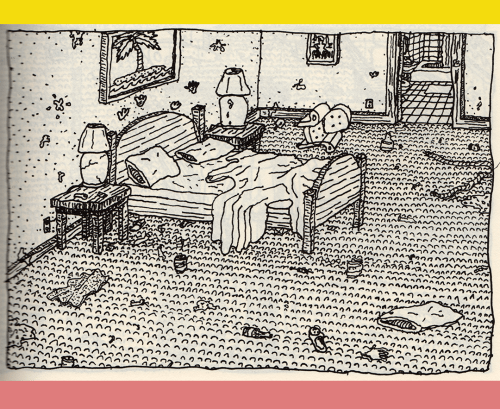
A lot of artists will relate to that. I marvel over the busy energy to these pages, like Pittsburgh Cat rolling through the landscape. Or here’s an example that depicts an absurdly cluttered room but the actual style of drawing is very clean and precise.

Even though I went to art school, in a lot of ways, I taught myself to draw. I threw out a lot of the rules for figure/ground relationship. Everything is in focus. I don’t draw in a way that will lower the contrast in the middleground or background. Everything is crystal clear. When I imagine one of these scenes, I imagine every single little detail, which can make my drawings feel a little overwhelming to surrender to. But it feels honest in how this stuff exists within me.

I wanted to add something about Pittsburgh Cat that you’d mentioned about him rolling. There’s that intervention he has with God on that cliff that begins this rolling process. This scene came to me in a dream. It was a technicolor cartoon dream. One of the only ones I’ve ever had. I woke up in the middle of the night kind of stunned. This was how Pittsburgh Cat was introduced to me. These panels happened. This is the recording of my dream. And, at the end of the dream, when he lands on the beach in Miami, this logo screen came up and it said, “Pittsburgh Cat,” and it showed his face, in these pulsating bubble letters. I asked myself, Who is this? What’s happening here? And I actively began to imagine where the story went from there.

That’s wonderful, so genuine. There’s patterns running throughout the book, whether it’s eyeballs or other repeated imagery, like here, with a hand pointing. You’ve got Hamburger Vampire in the forefront. His right hand is pointing at Corporate Woman. And his left hand is agitated, pointing with a hand repeated three times at the elevator button. Can you tell us something about composing a panel like this?

I grew up watching Looney Toons and Tom & Jerry, those kind of classic cartoons. There are emphasized moments when, for example, a character’s eyes will jump out of their head or they’ll take off running and their first few steps will be moving in place before they move through space. I always loved that effect. Honestly, I don’t think I’m good enough a draftsman to render that stuff the way other artists have done but I still wanted to try to capture that essence. The page you’re referring to, it was an essential plot point but visually it was missing some motion and energy. So, I’ll often employ that technique of repeated imagery.

Of course, I love all the things you do with the dope vape motif. It’s not just the hipsters, even the mayor is hooked on dope vape!

(Laughter)

And it just keeps building. Finally, you’ve got a mob of people, dancing in step, like a scene from Thriller, all hooked on dope vape.

Some years ago, in Brooklyn, this street drug, Bath Salts, got really popular. There’s this notoriously hectic subway transfer point, Myrtle/Broadway. At the peak of the Bath Salts epidemic, there were addict zombies lining the streets. Bath Salts had the effect of paralyzing people, similar to heroin. It was a pretty horrific sight. It’s one of those truth-is-stranger-than-fiction moments. It captured my imagination and pointed out to me the kind of desperation that is prevalent in the culture, the need to escape from all the pressures that exist at this moment in time. That subtext was a way to underscore conceptually what I wanted Dope Vape to represent in the story.

Zebadiah Keneally as Hamburger Vampire

What I’ve observed from a lot of comics critics, is that they embrace a certain kind of weird. Everyone will bow down to Gary Panter, for example. But for the new kids on the block, they’ll be harder on them. How are you handling this as your book goes out into the world?

That’s a tough question for me to answer. I immediately thought about your comment (in your review in The Comics Journal) about the scatological God. That particular scene had been inspired by a portion of Carl Jung’s autobiography where he relays this, hardly offensive, dream of God defecating on a cathedral, and how that began his trajectory as an eminent psychologist. His thinking has influenced me a lot so it was important for me to make a nod there. In that sense, I believe I’ve experienced more of that tougher eye.

On the other hand, I feel very much like an outsider in the comics world because I’ve come into it from a fine arts background. When I took on this graphic novel project, it challenged me as to who I was for a bit. Aside from your review in The Comics Journal, I feel that it hasn’t been noticed at all in the comics community at large. I don’t feel like I’m a part of that community at this point.

I’m happy to be taken to task on my review. I think I might be on to something when I say that it can be hard for people to accept the new weird, not that your work is only “weird,” but it’s something new, the new kid on the block.

I’m grateful for getting a chance to see your work in the first place. Of course, a PDF is a completely legitimate way to read something but not ideal in many ways. Not to overstate this, but I’m so happy to have gotten to experience your book in print. Reading an actual book helped me catch all the details and truly appreciate what you’ve accomplished.

Well, I’m happy to hear that, Henry.

I wanted to say something about how you handle the human figure. It’s all very artfully done, very beautifully done, gorgeously clean work. Were you ever at a crossroads when you had to confront drawing the gods nude?

Honestly, it really wasn’t a question for me.

There you go.

(Laughter) I wrote a script for this first and it’s more pages than the graphic novel and the gods figured large into that script. At one point, before I started drawing, I thought, I’m going to have to draw these guys naked a lot. I’ve always been taken by the human form and loved figure drawing when I was in my twenties and obsessed over rendering bodies and strong lines. There’s something primal and unabashed about how the gods behave and conduct themselves that their full frontal nudity corroborates.

Yes! I wholeheartedly agree. I think more cartoonists should embrace the human form. I think you just draw so well. It reminds me at times of Mary Fleener. You could say you’re a new generation’s Mary Fleener. Well, you’re doing your own thing and so well. I can’t emphasize that enough. 

We’ll go through some more pages. Here’s one with Lovebeard in the library. It’s so gorgeous. You’ve drawn every single book there.

It’s so nice to hear you point that out. I look at the work of other artists and admire the way they edit and leave out details. I’ve tried to embrace the less-is-more approach but it never feels right to me. At heart, I’m a maximalist!

You’re not overthinking it. That’s just your natural way of tackling things. Did you ever worry if it was all going to come together, through the years of work, or did a certain rhythm sustain you?

Sometimes I wondered if it would all come together. I began working on the first draft around 2009-2010 and it was a slow process and I didn’t get very far. By 2012, I really started working on this story. I drew in a much looser and gestural way, about 450 pages. I was trying to tell the whole story only through drawings. But it seemed like I’d weaved something together that wasn’t working.

I began drawing another version in 2016. I was doing these very detailed time-consuming drawings, without a script. I found that the pace I was at was preventing me from telling my story. I set it aside but it wouldn’t leave me alone. When the pandemic hit and lock down began, I knew this was the time to write the script and that would guide the drawings. I began that process. I had enough drawings from the 2016 version to make a pitch to Apartamento and they, to my surprise, picked it up.

This provided the opportunity to work from the script and translate it into drawings. That was a total task. At many points, I was uncertain about getting everything into the drawings based on the groundwork I’d created in words. I had to do a lot of editing and get rid of a lot of favorite plot lines. I wasn’t sure I’d be able to do it and stunned when I’d completed it!

Is there something you could tell us about Hamburger Vampire, since the character goes so far back into work?

I moved to New York City in 2009 and I got a job delivering mail to Goldman Sachs. I’d graduated college just before the recession had hit. Work was hard to come by. And suddenly I’d found myself working for this bank that had a huge role in this financial crisis. I felt like I was working in the gates of hell to some extent.

I would hide out in a janitor’s closet on the 26th floor and draw when it was slow in the mail room. And, all of a sudden, as I was reassociating, there before me was a hamburger with a lettuce mustache and vampire fangs. I looked at it and said, “Oh, that’s Hamburger Vampire.” He immediately became an evil entrepreneur: just that kind of greed; that self-serving desire to the max. I really wanted to look at what that would look like for an individual who had no compunction about running roughshod over anyone to get their way. That must have been around 2009-2010 that he was served up to me on a platter. His characteristics, I imagined, were always related to Donald Trump: so that kind of gregarious/mafioso con man–with a lot of power.

Can you describe your relationship with Apartamento. They hadn’t done a graphic novel before your book. How did that come about?

It came about quite naturally. I had made a zine with a publisher out of Zurich, called Nieves Books. And through that I got introduced to the executive editor at Apartamento, Robbie Whitehead. Robbie asked me to illustrate their annual cookbook which they do as fundraiser for a cancer foundation in Barcelona. I was so excited about that opportunity and brought everything I had to that project. We did a Zoom interview to discuss that cookbook and they had seen all the things I’d been doing and wanted to know more about me as an artist. There was no way to talk about that without talking about Hamburger Vampire, who is a character that I’ve done a number of videos and performances as over the years. I discussed my graphic novel and Robbie was interested. It took a while to get everyone on board but it all worked out.

Toxicus Masculinum, Sweet Lorraine, Brooklyn, NY with Elliot Purse. Curated by Katie Hector, 2020

Can you give us a little taste of your experience working with art galleries?

What is essential is getting involved with communities of artists. For example, when I was younger, it was being part of a group of artists at the Robert Blackburn printmaking workshop in Manhattan. From there, I met artists working on independent risograph publishing and I got to collaborate with them. They would put on exhibitions and I would perform at a bunch of those. I would go to a lot of gallery openings of people that I knew from the print shop, from college or who I had met a party.

So, I’d just meet people, make friends, invite them to my studio. You build connections with people who are doing creative things. The opportunities to show in galleries grow from those friendships and connections. Jacqueline, who runs Good Naked, is really wonderful. She saw my work on Instagram. She had made a decision to start a gallery at that point and she DM’d me and asked if she could come visit the studio. I showed her some drawings that ended up in this book, among other things. We had a conversation and discovered we had similar values in things in regards to art: being genuine and playful with a certain entertainment bent to it. She invite me to paint a mural in her gallery. That gave me an opportunity to scale up; most of my drawings are pretty intimate, you know, 8.5 by 11 or 10  by 7. It was really exciting to go big–and have a wall!

As we wrap up, let me ask you about the title of the book, All The Things I Know. That begs the question as to what this book means to you. What does the title mean and what are “all the things” that you know now, after all these years, from having created this book?

It’s a funny title, All The Things I Know. It gives the impression of being a memoir which this book isn’t in any practical sense. Around the time I started working on this story, I had had an idea about a performance that went like this: I lock myself in a studio for an unspecified period of time, cover the walls with paper and endeavor to write all the things I know, not leaving until I had completed my task. I didn’t have the gall to actually do that, and I got obsessed with the characters in the story so I threw myself into that. I had no idea what to call this book I found myself working on, so I decided to call it All The Things I Know, after this zany performance art idea I thought I wanted to do. Fast forward a year into working on the first draft and I realized that all the characters were me – or aspects of my psyche. I did the long division and saw that they represented my desires: for the material, for the intellectual, for the spiritual (Hamburger Vampire, Lovebeard and Pittsburg Cat respectively). With them, I was imagining what the collision of these drives might look like; I began to understand the book as a psychic memoir. When it came time to finalize the title 10 years later, I’d been calling the book All The Things I Know for so long that I could not imagine titling it anything else, despite my worries about misleading readers. Wanting to ground the title in the story, I wrote it into a scene where Pittsburgh Cat bemoans the rapidly shifting tides of his life, saying to God, “Listen dude, I don’t know what I know anymore. All the things I know … or thought I knew have been eviscerated–” That’s more or less how I feel, after all these years, having created this book.

Thank you so much, Zebadiah.

Thank you, Henry.

All The Things I Know is published by Apartamento. And you can also find it at various other outlets, including Amazon.

You can find Zebadiah Keneally here. And make sure to see the zany promo video at Apartamento!

7 Comments

Filed under Comics, Comix, graphic novels, Interviews, New York City

Hurricane Nancy: Love is Love

#443 Kisses for Valentines.

Hurricane Nancy presents a beautiful work of art on the subject of love. In her own words: “I was taught as a child only to love and kiss those in my body type and social group, then in the ’60s I became a hippie and could kiss anybody, then later realized I am a spirit, not the body, so kissing and love is unlimited.”

I will sometimes add a splash of color to Nany’s black & white art and this one gets a tint of pink!

Be sure to visit Hurricane Nancy’s website where you can purchase her art!

3 Comments

Filed under Comics, Hurricane Nancy

Paul Buhle on Comics: The Cargo Rebellion: Those  Who Chose Freedom

The Cargo Rebellion: Those  Who Chose Freedom. By Jason Chang, Benjamin Barson, Alexis Dudden and (artist) Kim Inthavong. PM Press, 2022, $16.95.

Guest Review by Paul Buhle

This is a good-looking experiment in a kind of collective art-and-text. So much has now been written about the Trans-Atlantic slave trade—no full blown comic yet—that the subject of the “Coolie Trade” can now seem to have been somewhat neglected. Actually, Asian-American scholars, among others, have been working long and hard on documenting this story. But we have here a effort to bring the story to light for young readers in particular.

Legitimized by the Opium War of the 1840s, the forced opening of Hong Kong to British domination also opened wide labor contracts for impoverished Chinese workers from Hawaii to California and parts South, China to Peru. The artist and writers treat this passage as a slavery-equivalent and they have a point. Like the transport of workers from India to the Caribbean later in the century, it was coercion-or-starvation, albeit one that, for some, would bring integration into economies in post-slavery times, with possibilities of collective struggle emerging sooner in their trajectory.

The comic art helps to propose a different way of viewing struggle on the high seas. The American government wanted the struggle to be seen as piracy, on the basis of a dubious “law of the sea” passed in 1836. The Chinese Quing courts insisted that Americans had deceived and kidnapped the victims. Abraham Lincoln ended the “coolie trade” formally in 1862, although the book asserts on good authority that racial stigma rather than something like Black emancipation prompted the “great emancipator” to take this step.

The traffiking in human lives, Chinese lives, continued in the American West as railroads were built and assorted industries, notably cigar-making, opened the way for underpaid servile labor. Sam Gompers himself, outspokenly racist leader of the newly-created American Federation of Labor (AFL), testified to Congress against the presence and not merely the continuation of Chinese immigration and immigrants.

The Cargo Rebellion closes with a short scholarly essay on the “Robert Boone Mutiny” of 1852 and a commentary on “Teaching Asian Indenture” by Jason Oliver Chang. One could lament that the comics themselves do not take up enough of the pages in this book. But that the larger subject could be tackled with such energy and effort dulls this complaint. It’s a good book.

Paul Buhle

3 Comments

Filed under Comics, Graphic Novel Reviews, Paul Buhle

GEORGE’S RUN, Sci-Fi Graphic Novel in March Previews

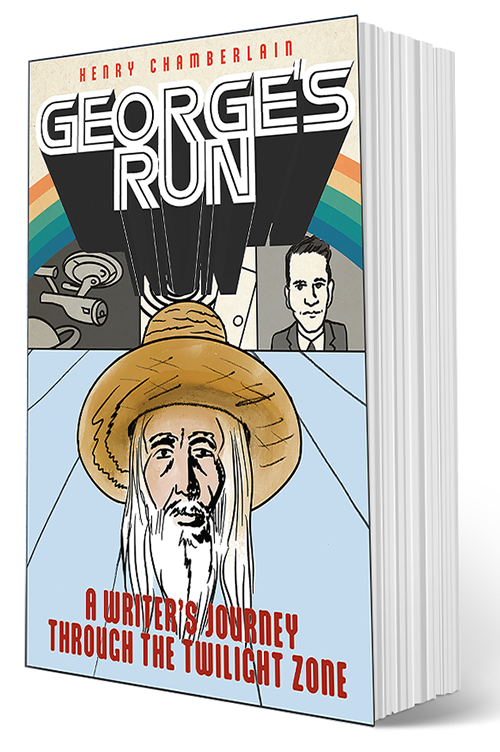
The time has come to start spreading the news. My graphic novel, George’s Run, will be out soon. It is in the March edition of Previews, and you can find it here. The book will become available as of May 12, 2023, published by Rutgers University Press–and I could not be more thrilled. If you’ve ever set foot in a comics shop for any significant amount of time, then you’re aware of the monthly Diamond Comic Distributor Previews catalog. Each catalog provides previews of comics and graphic novels that will be available in the next couple of months. The issue for March, which comes out on February 22, features items scheduled to ship in May 2023 and will have my book in it. This is a big step towards getting the book out into the world! And, for a comics fan, it’s a huge big deal.

This is the book for any fan of comics, pop culture, and great stories!

George’s Run has been years in the making. If you’re one of my loyal followers, then you already know that this book is about the power of storytelling, a special blend of it going back to pulp fiction, especially science fiction. I’ll keep you posted every step of the way. For now, if you happen to visit your local comic shops, ask them to check out my book in the March Previews catalog and seriously consider ordering some copies of George’s Run. Your support means everything to me!

Here I am debuting a mini-comic version of George’s Run at Short Run!

An early color version of a page from the book.

I love the promotional material put together by Rutgers. It sums it all up quite nicely:

George Clayton Johnson was an up-and-coming short story writer who broke into Hollywood in a big way when he co-wrote the screenplay for Ocean’s Eleven. More legendary works followed, including Logan’s Run and classic scripts for shows like The Twilight Zone and Star Trek. In the meantime, he forged friendships with some of the era’s most visionary science fiction writers, including Ray Bradbury, Theodore Sturgeon, Richard Matheson, and Rod Serling.

Later in life, Johnson befriended comics journalist and artist Henry Chamberlain, and the two had long chats about his amazing life and career. Now Chamberlain pays tribute to his late friend in the graphic novel George’s Run, which brings Johnson’s creative milieu to life in vividly illustrated color panels. The result feels less like reading a conventional biography and more like sitting in on an intimate conversation between friends as they recollect key moments in pop culture history, as well as the colorful band of writers described by Chamberlain as the “Rat Pack of Science Fiction.”

Here is more marketing material:

New Graphic Novel Traces the Origins of Pop Culture Through the Life of Eccentric Storyteller George Clayton Johnson

“George Clayton Johnson was one of the most brilliant and important writers of the 20th Century, creating classic episodes of The Twilight Zone and Star Trek, as well as co-authoring Logan’s Run and Ocean’s Eleven. George’s Run spectacularly and charmingly invites you on the amazing journey of his life and legacy, from 1929 through the Fifties and Sixties to 2015 and beyond. It’s a trip down Memory Lane via time machine and rocket ship—and it will definitely blow your mind!”

—Marc Scott Zicree, author of The Twilight Zone Companion

George Clayton Johnson

George’s Run: A Writer’s Journey Through the Twilight Zone (Rutgers University Press; May 12, 2023, 978-1-9788-3420-0; $24.95) is a mashup of gonzo journalism and whimsical storytelling with the overarching theme of how a group of writers influenced each other to create some of the greatest pop culture of all time. This is an exploration of self and creativity.

The reader follows cartoonist-journalist Henry Chamberlain as he seeks to reveal secrets and insights from a unicorn from a golden era. George Clayton Johnson was one of the greatest television writers of the 1960s. George showed up, as if out of nowhere, to command a significant place at the writer’s table for the original Twilight Zone and Star Trek. Co-writing the cult classic novel, Logan’s Run, was to be the cherry on top of a career that began, believe it or not, with George co-writing the story that was to become the original Rat Pack classic, Ocean’s Eleven.

Henry Chamberlain is a cartoonist, artist and writer living in Virginia Beach, originally from Seattle. Henry regularly writes about comics and pop culture on his blog, Comics Grinder. He writes for other venues, including The Comics Journal.

5 Comments

Filed under Comics, George Clayton Johnson, science fiction, The Twilight Zone

ARCA by Van Jensen & Jesse Lonergan review–clever dystopian graphic novel

ARCA. IDW Publishing. w. Van Jensen. a. Jesse Lonergan. 176 pp. $16.99

Welcome to your next favorite dystopian graphic novel. This is a devilishly good take on the one-percenters behaving badly trope. The focus is on Effie, short for Persephone. She is one of “the settlers,” the youth who are in servitude to “the citizens.” When settlers turn eighteen, they are promoted to something better, although it is unclear what that is. Earth, they’re told, had to be abandoned because of all the usual reasons and so everyone is on this spaceship heading towards “Eden.” But Effie isn’t buying it and it’s up to her to figure out what is really happening.

Things are not what they seem; they never are. The more twisted the reality, the more profound the journey to find out the truth. This is what makes Effie’s journey so dangerous–and compelling for the reader. From the very beginning, I was intrigued by all the heaviness hanging over Effie. Heck, the first page has Effie flying in a plane full of skeletons. She goes for the emergency exit, yanks open the door, and gasps for air when she’s flung out into outer space. It’s a nightmare but, her wide-awake world isn’t much better. Effie is constantly being monitored. People are disappearing. She risks her life every day for the chance to read a book. She’s not even supposed to know how to read.

Van Jensen (Superman, The Flash, Green Lantern) knows how to write a slow burn story with a propulsive bite. Jesse Lonergan (Hedra, Planet Paradise) has a loose and lively drawing style. Together, they bring to life a quirky and moody sci-fi thriller. Everything about this story gives off a disturbing and muted vibe, like you’re somewhere you shouldn’t be, finding out secrets you shouldn’t know. In this low-key and understated world, Effie is queen. She is a very reserved person forced to push back, and bit by bit, in a quiet and determined way, she gets closer to her would-be killers. Like any good work of science fiction, you get hooked in by the weird kid in the corner who nobody notices, until they need a hero.

A few notes on the art. I’m really pleased to see Lonergan having fun and experimenting. He spills over all the action, including the atmosphere, into various panels in unexpected and creative ways. There’s a moment when a glass full of eyeballs (don’t ask) is knocked over flinging eyeballs that bounce from panel to panel. This approach is part of Lonergan’s signature style and he does it very well with bookshelves, crowd scenes and things that go boom. The color is also applied in a dreamy and spacey way (soft watercolors that glide and pop)  that compliments this more loose and fluid way of drawing. Nathan Widick brings home lettering and design that is spot on. The final results are fantastic and a joy to take in. I’d love to have him help me with my next comics project.

Science fiction means a lot of things. Often, we’re working with a vocabulary, both written and visual, going back to classic 1950s pulp-style science fiction. This book is in that spirit and turns it on its head. Effie is a classic sci-fi hero, unlikely and unassuming. But she’s not a shrinking violet. She’s more of a lone wolf. Leave her alone unless you need her. The best science fiction is not just about the future, robots and time travel. No, the best science fiction is about people. Readers want that; they hunger for it. This is a clever dystopian graphic novel following the rhythms of a bookish lone wolf. And remember, she’s not even supposed to know how to read. The elites don’t have a clue who they’re messing with. But now you do.

ARCA is available on July 11, 2023. You can pre-order it here.

3 Comments

Filed under Comics, Graphic Novel Reviews, IDW Publishing, Sci-Fi, science fiction

Drawing Prompt: Hourly Comic Day 2023

Carson Ellis at 5 am.

I’ve done my share of 24-Hour Comics Day. This world-wide event among cartoonists is held on the first weekend in October. There’s another drawing prompt that is becoming as popular as 24HCD, the Hourly Comic Day, which is observed on the first day of February. What you see here are some examples of what artist Carson Ellis did for this year’s Hourly Comic Day.

You can also check out hourly comics from artist Vera Brosgol here. Or how about the work of artist Lucy Bellwood here. In fact, Hourly Comic Day is indeed quite the thing, dating back to 2005. You can check out a recap of artist Lucy Knisley’s work for 2022 here. 24 Hour Comics Day has entered the status of legend, dating back to 1990! But, as I say, Hourly Comic Day is establishing itself, much like Inktober has become a big deal.

Carson Ellis at 6 pm.

Let’s give ourselves some leeway this year. I invite you to participate in a drawing prompt during this month. Pick a day that works best for you and do this: draw a comics panel (basically a drawing and some text) that describes your day, one per each hour you are awake that day.

Carson Ellis at 8 pm.

Keep it simple and you can’t go wrong. You can send me what you come up with if you like and I’ll post it. Depending upon what folks send me, if anything, I’ll figure it out. So, yeah, give it a try. Seriously, I invite you to give it a try. I will follow up with my own drawings before the end of this month.

Carson Ellis at 9 pm.

Leave a comment

Filed under Art, Comics, Drawing

Blood of the Virgin by Sammy Harkham review — Painfully Honest Scenes From a Marriage

Pantheon edition of BLOOD OF THE VIRGIN

Blood of the Virgin. Sammy Harkham. Pantheon, Penguin Random House. New York. 2023. 296 pp. $30.

A quick and apt description of the comics created by Sammy Harkham would be “painfully honest.” While this sentence alone may not mean very much to the vast sea of potential readers, it will resonate with many, not only the comics aficionado but the general reader. This particular work is at the masterpiece level when it comes to full-length graphic novels. Fans and critics alike have been patiently waiting for the various parts they’ve read published elsewhere to all come together and so here we go: a story about Hollywood, its underbelly; in fact, the exploitation scene of the 1970s. Our anti-hero, Seymour, working at one of these cheap movie studios and patiently waiting his turn, has been promoted leaving him in charge of his own movie. This level of responsibility, and relative notoriety, easily consumes him threatening an already shaky relationship with his wife, Ida.

Over a decade in the making.

Like any worthwhile graphic novel project, this book has been many years in the making. The bulk of the book was created in installments and appeared in the author’s own self-published comic book, Crickets, as well as his legendary ongoing comics anthology, Kramers Ergot. Anyone who seriously follows the indie comics scene will at least be aware of Sammy Harkham. Diehards will closely follow his every turn. And, for the vast majority of readers, this will be the first time they are exposed to this work.

Oh, Little Piglet!

Harkham’s cartooning style is a classic approach in the great tradition of working from reality and paring away to the essentials. This style fits in with great comics from the last century like MAD Magazine. It’s a very readable style that embraces personal moments between characters. We see Seymour and Ida, over and over again, at their best and worst. We certainly see plenty of Seymour at his worst. The stage is set early on with the big hint that Seymour doesn’t appreciate his wife and maybe the same goes for Ida. We proceed waiting for the other shoe to drop. The whole business with exploitation movies may as well be one big MacGuffin compared to what happens to these two. Harkham makes us care over and over again.

Hollywood, then and now, has always been a tough business.

Hollywood looms large over everything. That can’t be denied. Seymour is in the storytelling business, even if it’s a very small and cheesy slice of it. Maybe he just needs to be a part of it, a way to live forever. It’s more than half way into the book before there’s any mention of why Seymour does what he does. He claims to love horror movies. Even the cast he’s directing admit they love rock bands more than movies. Maybe Seymour loves the movie-making process more than just movies. That remains a question. Seymour himself remains a question.

Kvetching and kibitzing at Canter’s Deli.

Seymour’s story is about a young man who must do something. If it isn’t making movies, then maybe it would be making comics. Throughout the book, we see him following his passion of making something of himself. He doesn’t really know all that much about movies, about women, about the world around him. All he really knows is that he must do something. One epiphany may lead to another but, while you’re busy living your life, it can look like one big mess. And it is a mess. As Ida puts it, “Even at its best, life is just really annoying.” In the end, Ida and Seymour are an immature young married couple who can’t afford yet to fully appreciate each other, themselves, or even their child. Such is life and Sammy Harkham manages to strike the right chord with each and every painfully honest key.

Is it worth turning your life upside down for five minutes of faux wisdom?

It’s funny how a story that spans a few weeks can take fourteen years to complete. Such is the nature of bringing to life a fully-formed comics masterwork. If you are among the select number of comics aficionados who have diligently followed this story as it came out in issues of Crickets, and think you’re done with it, I encourage you to read the whole thing through now in its collected form. It may not be as you remembered it. Maybe it’s not, at its core, a story about storytelling. Well, that’s only part of it. After giving this a read from beginning to end, I stand by my interpretation that it’s a steady and deliberate look at callow youth trying to make sense of it all. It’s certainly not only about Hollywood ambition. If it was, Harkham wouldn’t have devoted an entire issue of Crickets to Ida’s sudden detour, her visit to see her parents in Auckland.

Portrait of a Young Couple.

This story is exploring the existential crisis we all must confront. Is Seymour going to find salvation in the movie business? Unless he’s really serious about seeking out what is most artful in the horror movie genre, then maybe he’s just as likely to move on to other pursuits. But, at this particular point in time, movie-making is his thing. What is it that matters most to Seymour? Even with his movie passion supposedly locked in, he would be hard pressed to articulate what his priorities are. Other readers will have their own opinions. This is one of those special graphic novels that genuinely invites its own book club! Who knows, maybe Blood of the Virgin will ascend to that most coveted of heights: spoken in the same breathe with Maus and Persepolis. It’s that good!

Blood of the Virgin is now available for pre-order. The Pantheon collected edition comes out May 2, 2023.

2 Comments

Filed under Comics, Graphic Novel Reviews, Kramers Ergot, Sammy Harkham

We Are Not Alone review — Roku Original is a Delightful Sci-Fi Comedy Series

The Office on the dark side of the universe.

We Are Not Alone, a new Roku Original, debuts on January 27 on The Roku Channel and it is a promising sitcom: not one moment is wasted; solid casting; creative production value for a low budget sitcom; engaging story; solid humor; characters jump right in. In my previous post, I discussed what content like this can mean for Roku’s future. In this follow-up post, I share a few observations from viewing an advanced release. From what I can tell, this is a feature-length pilot for a sitcom.

Continue reading

Leave a comment

Filed under Roku, Sci-Fi, Television

Roku Original Sci-Fi Comedy: WE ARE NOT ALONE

Maybe, like me, you are a Roku person. And maybe you noticed this new offering, a sci-fi comedy, We Are Not Alone. I’m intrigued. I’m intrigued on two main tracks: first, I genuinely think I’ll like watching this; next, I have a feeling this could be one of those turning points which adds to Roku’s profile as an original content provider, as it moves beyond its original purpose of just making streaming devices. Last year’s Weird: The Al Yankovic Story was a significant step forward for Roku as a serious original content provider.

Continue reading

Leave a comment

Filed under Roku, Television, TV Reviews

Hurricane Nancy: Animals and Free Speech

How is your year shaping up?

A new year is off and running with its inevitable highs and lows. “Here’s to life being good, despite it all!” answers artist Hurricane Nancy. Add to that a couple of new works to consider this time around, with accompanying commentary by the artist . . .

Continue reading

9 Comments

Filed under Art, Comics, Hurricane Nancy