I am both a fan and creator of comics. I believe people have come to know me as a thoughtful guy. I hope you enjoy the views expressed here at Comics Grinder.
One thing I love in this life is an awesome comic book shop. Such is the case with Meltdown Comics & Collectibles. On the Sunset Strip, this is the place you want to make time for during a visit to Los Angeles. And, if you’re a native, then you likely know what I’m talking about. Okay, let’s say you’re a tourist and you have your list of places to go to while in LA, well, I am here to tell you that Meltdown is a landmark you’ll want to hit.
MELTDOWN 7522 Sunset Blvd
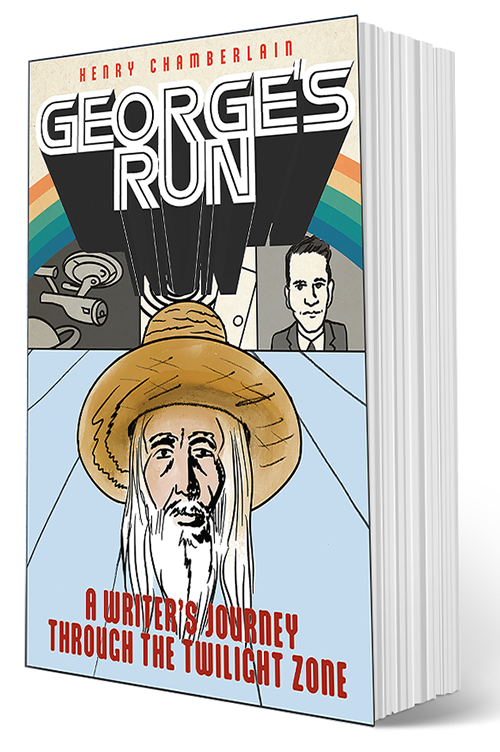
In the spirit of full disclosure, I was at Meltdown to promote my own ongoing comics series, GEORGE’S RUN, about the life and times of screenwriter George Clayton Johnson. However, as my regular readers know, and those of us in the industry fully appreciate, this is a labor of love, very interconnected, so I’m there just as much to embrace the scene and my fellow creators. Stay tuned because I will be posting reviews of some awesome comics that I picked up during my visit. If you are a creator, be sure to contact me about reviewing your work. For this post, I am providing you with a little guided tour that will whet your appetite.
ZINES & MINICOMICS
As you can see from the photos and video, Meltdown is a fully stocked, and fully loved, place for comics and related items. Keep in mind, for those of you still unsure, that comics are not only part of the zeitgeist. Comics are definitely an art form in their own right. That’s been said many times and bears repeating. Comics provide an outlet, a platform, that is a highly specific form of expression. It attracts many stripes of folk including some of the brightest and whipsmart. The word “comics” means many things and, no doubt, is inextricably linked to the world of comedy, even when it’s far from funny. It’s no surprise then that the likes of comedy genius Patton Oswalt cannot help but love comics and write for comics too.
STAFF PICKS
The day I made my visit, a special Bernie Sanders event was being set up. There are all kinds of cool things going on here from music to comedy. And, of course, there are all sorts of special comics events. The next big one is a March 18th signing by Daniel Clowes in support of his latest masterpiece, “Patience,” published by Fantagraphics Books.
MIKE LE’S OPEN IP WALL
Here’s the deal, there is not, or should not be, a great divide between indie/alt comics and superhero comics. That’s a given for a lot of us. But it’s one of those things I feel compelled to repeat as often as necessary. I want readers out there who have not been around comics for a while to come back and see what’s been brewing. That just instantly comes to mind when I’m in such a fine place as Meltdown. The love and the knowledge is clearly here, each member of the staff is carrying the torch. You see it in the careful and thoughtful displays and staff picks. What Amoeba Music is to music, Meltdown is to comics. I rest my case. So, be sure to visit our dear friends at Meltdown right here.
I found myself in Los Angeles these last few days of February for a number of reasons. Let me put it to you this way, I was there as much to enjoy a day long visit to the Los Angeles County Museum of Art as I was for anything else. And, of course, I devoted a chunk of time to the Oscars. Here is the key to a lot in life: keep an open mind. Now, when it comes to entertainment, the more flexible you are, the better. I keep things to a broad spectrum, from the intellectual to the spectacle. That said, I’ll share with you some observations from this last visit. In the end, we can explore the idea of what it is to be entertained.
The Gumbo Pot in the Farmers Market, Los Angeles
Seattle is my home base. It is in this relatively small, yet bustling, city that various forms of entertainment are created by some very talented individuals in music, film, fiction, comics, and so on. And then there are just as many, perhaps even more, individuals involved in commenting on all this creative work. That’s something I am very sensitive to as I am both a creator and a commentator. Let’s just say I appreciate when the air has gotten too thick. Sometimes, you just want some frog legs at The Gumbo Pot in the Farmers Market, which I definitely enjoyed. And, to be sure, the level of discourse at tables was quick, smart, and unpretentious. If I say I am going to talk to you about the true meaning of fiction or entertainment, it’s in the spirit of an open discussion without the pretense. Please, we have too much of that.
Chris Burden’s “Urban Light,” at LACMA
It’s all about going from the specific to the general. Take the time to give one particular subject its due, focus on that, consider its merits, and then reap the rewards of entertainment and insight. I will compare for you two events in Hollywood that are closely related: a tribute to screenwriter George Clayton Johnson at the American Cinematheque this last Friday; and then some observations on the Oscars this last Sunday. I really wasn’t planning on doing this. I want to keep it light but offer you a few ideas. The best thing I can do is jump right in with some observations beginning with the tribute. Here, I want to make clear that much depends upon your understanding and knowledge.
George Clayton Johnson tribute at the American Cinematheque in Hollywood
If such things as the literary background of The Twilight Zone are new to you, then perhaps this will spark interest. I know a great deal about this subject, particularly the writers known as, The Group, from which much of this springs from. George Clayton Johnson was a key member of The Group. He had within his power the ability to write some of the most compelling magical realism. That’s important because, despite the many disadvantages he had in life, he was a writer with not only a vision but a determination. George went on to create some of the most iconic and beloved episodes of The Twilight Zone which is the gold standard for what can be done when melding the art forms of fiction and television. Don’t let yourself think that Masterpiece Theater holds the key. That is too obvious a venue. Actually, it is within The Twilight Zone, at its best, that you will find much that is stimulating and intriguing with great literary merit.
George Clayton Johnson tribute at the American Cinematheque in Hollywood
So, here you have this very special individual, George Clayton Johnson, who understood better than most, the fundamental inner workings of fiction. He took his insight, skill, and hard work and did what he did with it. He primarily wrote for television. All of his work on The Twilight Zone is remarkable. This led to him writing the first episode of Star Trek to be broadcast. Among other TV work, he wrote an exceptional episode of Kung Fu where the main character experiences a flashforward, as opposed to a flashback, to help him save his life. And, to cap it all off, George and William F. Nolan wrote the classic dystopian novel, Logan’s Run. Beyond those achievements, it is George’s life story that is inspiring. He was close friends with such greats as Ray Bradbury and Theodore Sturgeon. George was simply a man who loved to keep it simple: write what you believe in, give back to the community, love thy neighbor. The outpouring of love and admiration for George at this tribute was very moving. I had the opportunity to get to know George. I can fully understand how bright his light shines.
Chris Rock tells it like it is at the Oscars.
A couple of nights later, lo and behold, it’s the Oscars. Now, mind you, I did not have any set plans. How I wish my Comics Grinder credentials would have gotten me a press pass. Perhaps they would had I pursued it. I’ll tell you something, I am a keen observer and a friendly interviewer. I can easily adapt to any situation. This segues to what I did for Oscars night. Due to a few things going on that night, I found myself outside the Hollywood Roosevelt Hotel. Let me back track a bit, a buddy of mine suggested that as a great spot to maybe see something going on. In fact, the plan was to meet up with him. I show up and, yes, it is a great spot, right on the corner of Orange and Hollywood overlooking that whole block of Madame Tussauds, Grauman’s Chinese Theatre, and the Dolby Theatre.
25 Degrees at the Hollywood Roosevelt Hotel
Well, on that corner are a bunch of onlookers, of course. Shades of “The Day of the Locust.” I mingled for a bit. No one knows exactly what to expect, if anything. I then made my way into the Hollywood Roosevelt and 25 Degrees, one of the hotel’s seven bars. 25 Degrees is known for its gourmet burgers and onion rings, which I fell in love with. I patiently waited for a cozy table overlooking the bar and two big screen TVs broadcasting the Oscars. Chris Rock was doing his monologue. I saw any number of what appeared to be otherwise jaded industry folk carefully listening and giving way to outbursts of laughter. Just as I was assured by my hostess that I could have the table, this one lady sat down at that very same table. The hostess explained to her that I had already been given that table but I said it was alright. Sure, it’s the Oscars, I’ll share the table. Well, it was definitely for the best. The lady turned out to be an executive with a Mexican network. We ended up chatting about the decline of culture in general and the disturbing rise of Donald Trump.
Behind the scenes at the Oscars
It always comes down to the coveted issues of time and space. That table had a fixed value of one hour. You could not stay at that table beyond an hour. I sweet talked my hostess into letting me begin a new hour given that I had to share it. In the meantime, my new friend, the Mexican TV executive, had hoped that I could hold on to the table as she had wanted to return after a while. Well, there must have been a lot of discussion in the back. At first, yes, I could keep the table if I ordered more food. After having the delicious Patty Melt, and a half jug of Pinot Noir, I opted to start with a Dark and Stormy. Later, the supervisor negotiates with me. It turns out that the table really needs to be relinquished. If I am alright with moving to the bar, he will treat me to another drink. Well, that’s fine with me. And, well appreciated too!
Behind the scenes at the Oscars
We always hear the long-running jokes about the Oscars being too long. The crowd that night enjoyed every minute of it and would have been happy to see more. The high points were the Chris Rock monologue, the announcement for Best Actor to Leonardo DiCaprio, and the announcement for Best Picture to “Spotlight.” In between, and throughout, careful attention was given to each category. I ended up chatting a bit with other patrons at the bar. The consensus seemed to be that this was one of the best Oscars. I certainly found myself in a perfect setting. The bar, with its old-school charm, was impeccable.
Here I am in front of the American Cinematheque in Hollywood.
One Oscar tradition never fails to move me. That’s when a tribute is given to notable members of the Academy who had passed away in the previous year. I was certain that George Clayton Johnson would receive a mention. While he wrote primarily for television, he also co-wrote the story that was the basis for “Ocean’s Eleven” and he also co-wrote an Academy Award nominated animated feature with Ray Bradbury, “Icarus Montgolfier Wright.” But he did not get his mention. That left a sad note hanging in the air. But it was still grand to be at the Hollywood Roosevelt on Oscar night. I can tell you, I can share with you, the fact that both nights, the tribute to George and Oscar night, were both magical. George is still remembered and people will enjoy his work whether they realize he wrote it or not. George will always be part of that magic that people seek out whether they know it or not.
Great fiction comes from all over: horror, dark fantasy, mystery, and so on. William F. Nolan writes in various genres. You may know him from his work with Dan Curtis, such as the classic horror film, “Burnt Offerings.” Or perhaps you know him from co-writing, with George Clayton Johnson, the classic dystopian novel, “Logan’s Run.” Mr. Nolan has gained great recognition and won numerous awards and honors. Just last year he was named the Grand Master at the World Horror Convention in Atlanta. In this interview, we spend a good time chatting about horror as well as fiction in general. And we definitely visit the subject of the Southern California Sorcerers, otherwise known simply as The Group.
“Burnt Offerings” from 1976
During our conversation, Bill shared a very special moment regarding his friend and fellow writer, George Clayton Johnson, who passed away this last Christmas. He offers up for us a picture of a fresh-faced, and beaming, young George bursting upon the scene, circa 1957. He has shown up at a meeting of The Group and asks if he may join in with the illustrious and ambitious writers. Someone asks George what he has to show for himself. And, George, just having received his box of author copies, proudly shows the men what he’s been up to. “Hey guys,” George says, “I co-wrote this really cool thing called, ‘Ocean’s Eleven!'” And the rest is history!
This interview was conducted Monday, February 22nd. William F. Nolan is going strong, just shy of his 88th birthday on March 6th. If you love a good story, or if you are an aspiring writer yourself, or if you’d like to know something about the Sixties zeitgeist, then this interview is for you. In the span of about twenty minutes we cover a lifetime of observations and insight.
Henry Chamberlain: Thank you for getting together with me, Bill. I wanted to cover the writer’s life with you in this interview. First off, a good horror story has been compared to placing a frog in gradually boiling water. What can you tell us about the boiled frog method of storytelling?
William F. Nolan: Allow me to veer off a bit from the boiled frog to tell you how I approach telling a story. Really, how I tell a story is like the other night when I was in bed, half asleep and half awake, a state where I get all of my ideas. I was thinking of these deadly flowers. They had the power to stop the human heart. They were alive and, if you didn’t treat them right, they could turn against and stop your heart. There’s this couple who decide to rent this place on the beach. It looks like a great place. The owner lets them know that they have to take care of these special flowers but the couple ignore him, they don’t do it. And they end up being killed by the flowers. Their dead bodies are found on the beach. That’s how I form an idea for a story. I get an opening in my head for the concept and then I get the ending. Finally, I fill in the middle. That’s how I write a horror story, or any other kind of story.
Discoveries Best of Horror and Dark Fantasy edited by James R. Beach and Jason V Brock
HC: There’s a story of yours, “Stabbed by Rob,” in the recently published collection of dark fantasy from Dark Discoveries, edited by James R Beach and Jason V Brock. That story is a perfect example of that boiled frog method. There are a number of touches of humor, including your mentioning a glow-in-the-dark statue of Jesus. And the story keeps turning up the heat to the very last sentence.
WFN: Well, I believe you really can’t get away without some humor in a horror story. Horror is too stark, raw, and unflinching. You need to be able to live in it. You’ve got to lighten it with some humor. All my horror stories have elements of humor. You need to let the reader breathe. You can’t go from the first page to the last and do straight horror. That’s the problem with H. P. Lovecraft for me. Lovecraft has no sense of humor. He was a brilliant writer. He was a brilliant innovator. But no sense of humor. By the time you finish “The Shadow over Innsmouth,” you’re exhausted. I want my readers to relax a little, to breathe, and have a good chuckle while they’re being frightened. That’s my method of writing horror.
HC: I’m glad that you mention Lovecraft because I’ve had difficulty with him too. Your adaptation with Dan Curtis of Robert Marasco’s 1973 novel, “Burnt Offerings,” has just the right touches of humor at the start, and they give way to a more sinister mood. There’s a balance.
WFN: Yes, that was adapted from the Marasco novel which had no humor whatsoever. I told Dan Curtis, who directed, and produced the film with me, that we were going to need to lighten up the material because it was too stark. I’m glad that you appreciate the humorous elements in the film. As I say, I just don’t think you can do horror without lightening it up a little bit.
HC: Then there’s Ray Russell’s work. Perhaps more of a touch of elegance than humor. I love the way Ray Russell masterfully brings up a lot of pretty grim stuff in his work. He knows what to leave in and what to mostly imply. I’m thinking of “Sardonicus,” “Sagittarius,” and “Sanguinarius.”
WFN: Ray Russell was one of my closest friends for years. We would talk about how to write in terms of horror. And we both agreed on the same thing that you’ve got to put some humor into it in order to lighten the whole thing. I love Ray’s work. He passed on some years back. He would be happy to hear that you enjoy his work.
Just Part of The Group: Charles Fritch, Chad Oliver, Charles Beaumont, Richard Matheson, and William F. Nolan, circa 1954.
HC: There were all of these amazing writers that you got to be close with in social settings and in work sessions. All of you together were the Southern California Writer’s Group.
WFN: There were eleven of us. We didn’t think of ourselves as anything special. We were all trying to make a living, pay the rent, pay the mortgage, stay afloat. We wrote science fiction and fantasy in a modern vein. We took it away from the Lovecraftian type of fiction and wrote a modern type. It was sort of pioneered by Richard Matheson and Ray Bradbury who were part of our group. We all worked from the same principle: you can do modern horror but it has got to be something that people can believe in. It has to be realistic. It should happen today, in somebody’s kitchen. It could happen in a kitchen. You don’t have to go to a haunted castle, back in Transylvania, to have horror. Horror can happen on your doorstep. Horror can be a terrorist with a submachine gun that sprays lead over you while you’re eating in a restaurant. That’s horror. Horror takes many forms. We all tried to work within that scope.
Yeah, eleven of us. Matheson, Bradbury, myself…Charles Beaumont was sort of the hub of the thing. We had Jerry Sohl. We had Robert Bloch, known for “Psycho.” We’d all gather together at each other’s houses, at all-night coffeeshops and talk shop, editors, and markets. We were quite a group. All these years later, people look back on us as pioneers in the field. And that’s nice but, at the time, we were just trying to make a buck, just trying to make a living.
HC: Well, sure, you guys were so close to it all. You would need to stand back to see it clearly. What you guys did was take gothic literature and give it a modern cool. That’s essentially it.
I AM LEGEND by Richard Matheson
WFN: Yeah. I still think that you can credit Richard Matheson for a lot of that. Stephen King said that he was influenced more by Richard Matheson, than any other author, because he took horror out of the castle and brought it into the kitchen. And I agree with him. We all tried to do that. We all felt that was the way to go. We weren’t interested in something ancient. We wanted something real, something of today.
HC: You list eleven members of The Group. Was there any time that all eleven of you met under one roof?
WFN: Three or four of us were into auto racing. Richard Matheson, Jerry Sohl, and Robert Bloch didn’t care at all about that. But Charles Beaumont, John Tomerlin, and myself were heavily into Grand Prix sports car racing both here and in Europe. We actually flew to Monte Carlo one year for the Grand Prix. And we went to Sebring Raceway in Florida for the races there. The Beaumont kitchen in North Hollywood, his upstairs kitchen, is where most of us would meet. George Clayton Johnson was part of that group too. We would meet there. But there was never a meeting of all eleven of us at one time. It was three or four of us at at time at different places. We’d go to movies together. We’d meet in coffeeshops.
Musso and Frank Grill
HC: I imagine that you guys enjoyed Musso and Frank Grill.
WFN: We loved Musso and Frank Grill. It has all that history: Hemingway, Fitzgerald, and William Faulkner. The murals never changed. The seats are the same. When you’re sitting there, it’s like you’ve gone back in a time machine. We loved it. I still love it. I love to go whenever I’m in L.A.
HC: You touched upon George. I have to say that I can imagine that he loved the fact that he got to pass away on Christmas Day. Such a magical thing. Such an act of will.
WFN: That was no accident. He was ill. He was in hospice care for about a week before that happened.
HC: Oh, yeah.
WFN: The doctors were saying that he could go at any minute but George, subconsciously, since he couldn’t verbalize it at that stage, was saying that the doctors couldn’t tell him when he was going to die. He was always an independent guy. He was saying: “I want to die on Christmas Day since that was the birthday of Rod Serling, who made me famous for my writing for The Twilight Zone.” He was able to die three days past when he was expected to die. He was able to fool all the doctors. That was no accident.
George Clayton Johnson and William F. Nolan, circa 1957, illustration by Henry Chamberlain
HC: Yes, that’s what I meant. I was honored to interview George a number of times and got to meet him in person. Would you share with us a little more of the flavor of the era and a picture of George at one of these bull sessions at The Group that may come to mind?
WFN: Four or five of us were sitting in the living room of the upstairs apartment of Charles Beaumont one night. There was a knock at the door. This is around 1957. The Group was around from the ’50s to ’60s. So, there’s a knock at the door. We open the door and there’s George Clayton Johnson with a package under his arm. He said, “I’m George Clayton Johnson. I want to join you guys. I want to be with you. I’ve heard about you and I want to join you.” Someone asked, “Are you a writer?” He said, “Yes, I am,” and he held up the package, “It’s called, ‘Ocean’s Eleven’ and I just sold it to Frank Sinatra!” That’s what got him started with The Group.
HC: That’s beautiful. I wanted to ask you about the literary tradition that The Group worked from. I’m sure that Nathaniel Hawthorne, Mary Shelly, all the gothic writers, were subjects of conversations for all of you.
WFN: You can’t write out of a vacuum. We’re all influenced by other people. Ray Bradbury was influenced by Herman Melville, William Shakespeare, and George Bernard Shaw. We were influenced more by such horror writers as Arthur Machen and Algernon Blackwood. I started out reading H.G. Wells’s “The Time Machine” and “War of the Worlds” when I was a boy growing up in Kansas City, Missouri. And then I discovered Bradbury and Weird Tales. Ray Bradbury and I became close friends and that lasted 50 years. We’re all standing on the shoulders of other people. We all read Hawthorne and Robert Louis Stevenson. We were influenced by them but we wanted to take our fiction into a modern setting and move it forward and I believe we succeeded.
Photo by Ralph Morris, Hollywood Blvd. 1960
HC: I wanted to close out by asking if you could give us a little more of a flavor of Los Angeles in the ’50s and ’60s. I can just imagine: you had the ghost of Raymond Chandler; old Hollywood giving way to new Hollywood; Forey Ackerman and the rise of geek culture. L.A. in the Sixties, it doesn’t get much better than that.
WFN: I read Raymond Chandler, Dashiell Hammett, the hard-boiled school, James M. Cain. I’ve read books on Chandler and Hammett. I’m a big hard-boiled fan. Los Angeles was a hard-boiled city in those days. Dashiell Hammett glorified San Francisco. But Los Angeles was also part of that era where corruption ruled in high places. It was a violent and colorful era captured beautifully by Raymond Chandler. If you read the work of Raymond Chandler, you’re learning a lot about Los Angeles as he experienced it.
I can tell you that there was a lot of smog. I used to live in Burbank, right against the mountains. The smog was terrible. I did move around different parts of Los Angeles. It changed quite a lot during the many years I was there. It’s not the same city that it used to be.
HC: I love Los Angeles and love looking for signs of yesteryear. They’re around if you know where to look for them.
WFN: If you go to Pasadena, there’s the old bridge that Raymond Chandler wrote about in one of his novels. The bridge that Philip Marlowe drove over at night. It’s still standing there. I wrote a piece entitled, “Marlowe in Los Angeles.” I toured all the places he used to go to, including Musso and Frank Grill. Chandler was an insatiable researcher, always moving around, and usually within the greater Los Angeles area. He grew to know it beautifully. Hammett made San Francisco famous with “The Maltese Falcon.” Chandler did the same for Los Angeles with “The Big Sleep.”
HC: I wish you a great year ahead, Bill. Any projects we can look forward to soon?
WFN: I had a collection of my poetry come out last year. This year we’ll have a new collection of my essays. I’m working on a new collection of short stories. I just wrote three new stories this month. So, even though I’ll be turning 88, I feel like I’m still 28.
HC: I can feel the energy. Thanks again, Bill.
WFN: I really enjoyed this. Thank you.
You can listen to the podcast interview by just clicking the link below:
Keep up with William F. Nolan at his website right here.
An Australian comic with an ambitious vision will appeal to fans of fantasy and dragons. The series goes by the name, “Luminous Ages.” This is a spirited work created, written, and illustrated by Anthony Christou. I think this first issue goes a long way in setting the tone to a free-wheeling adventure. It’s not so much what I have read in the actual text thus far that I’m too concerned with. I’m mostly intrigued with a drive and energy running throughout. I expect good things to come as Christou delves further into his saga. He seems to genuinely be invested in the genre. If you are interested in such things as what a character’s “mage trait” is, then this comic could be for you. If you’d like to jump on board and help Christou develop his series further, be sure to visit his Kickstarter campaign, which runs through February 29th, right here. For ongoing information, be sure to visit the official site right here.
Drew Ford has been in the comics industry for many years. He has worked with various independent publishers and led the way to bring back a number of quality comics and graphic novels at Dover Publications. Now, he is returning to bring back his own work in comics with the anthology, COSMIC WAVES. It is a collection of six science fiction stories written by Ford with artwork by an assortment of talented artists. Check out his crowdfunding campaign at Indiegogo, running thru March 11th, right here.
When you write a story about the Devil, you are in some sense, summoning him. You cannot take that lightly for one very good reason: if you don’t take it seriously, you will amount with less than a gripping story. Ray Russell knew not to disturb Satan for no good reason. Russell was, by extension, part of the original Southern California Writers Group of the Sixties. This was “The Group,” the guys who went on to do such amazing things as write for the original Twilight Zone. Ray was not so much a regular at gatherings but he knew the art of writing as well as the best of them. He published the best of them as the fiction editor at Playboy, no less. And his own writing rose to the occasion too. One shining example of this is his 1962 novel, “The Case Against Satan.”
The early Sixties were dripping with modern cool with trailblazers bursting upon all the arts. In writing, one fertile ground was pushing the limits of gothic and dark fantasy. It is in “The Case Against Satan” that Russell broke new ground and created the contemporary demon possession story. It is more than fair to say that it was the precursor to William Peter Blatty’s 1971 novel, “The Exorcist.” And, most assuredly, it is a novel still every bit as chilling today, oddly enhanced by its vintage. Certain modes of communication, like social media, just weren’t available to our characters in 1962 while others were more commonly relied upon, like a simple pamphlet, printed by the local zealot, and circulated amongst the neighborhood.
This is a story that depends a lot upon communication. Susan, a pretty sixteen-year-old, will prove a most enigmatic figure who may, or may not, be possessed by Lucifer himself. Her every word seems to harbor a double meaning. And, as we progress, all depends upon what is true and what is false. This is also a philosophical story as Susan will bring two men with very differing views together to help save her soul. The argument between them is one of faith. Can you only believe what you choose to believe or, when push comes to shove, must you give yourself completely over? The question is whether Satan actually exists. Sure, God is relatively easy to believe in. But, if there is a God, is there not a Satan?
Russell is more than just a master of the horror genre. You could say that simply writing horror is only the first step. In order for it to matter, the writer has to take on his own leap of faith. The writer has to have skin in the game, so to speak. Well, Russell is, without a doubt, a writer willing to give his skin, and heart, over to what he did. He has a way of drawing you in completely too. You arrive closer and closer to the bogeyman to find yourself butting right up against him and then you may gasp, or you may be in awe, as to how you got there. Russell does not hammer away. He may mention something only once but that one time will suffice. You cannot help but bookmark it and eagerly anticipate a return.
Much in line with the trim and fast-paced novels of the era, like Robert Bloch’s 1959 novel, “Psycho,” this is story that is very focused, very much a page-turner, with an eerie elegance running throughout. It breaks my heart to think that this was never turned into a major motion picture. With some adjustments, it could still be made as an updated version. Or, better yet, you could remain close to the spooky cool of the original.
Perhaps it might do well to adapt this story into a play. “Doubt” comes to mind. For this is very much a story about overcoming one’s doubt. It is, in large part, a story about Gregory, a priest in crisis, at a crossroads in early middle age. And his counterpart, mentor, and friend, is a visiting bishop. In fact, the meeting between them was to be fleeting at best. However, circumstances would dictate otherwise. Above all else, Russell masterfully balances the inner and outer turmoil of these two, among a cast of other characters emerging from varied backgrounds, all brought together by a demon possession, that may or may not be true.
“The Case Against Satan” is a 160-page paperback published by Penguin Random House. For more information, and to purchase, visit our friends at Penguin Random House right here.
Screenwriter/director Adam McKay, known for “Anchorman” and “Talladega Nights,” and now, “The Big Short,” was asked recently, in an interview with The Wrap, what subject he’d like to tackle next. Without hesitation, he said that subject would be climate change. He said, by far, it is the biggest story to tell today. The creators of this new comic, published by Image Comics, would definitely agree. SNOWFALL (story by Joe Harris; art by Martin Morazzo) is about an Earth so harmed that it is no long capable of naturally creating snow. To add further insult to injury, corporations have found a way to profit from the fact there is no longer any natural snow!
Like an invigorating winter morning, this is one crisp and poetic comic. This will appeal not only to the Bernie Sanders contingent (which is growing by the hour) but to a wide spectrum of readers who may disagree on the details but who can feel in their gut that things have been steadily going south. Our story is set in the not-too-distant future. 2045, to be exact. Is that not-too-distant enough for you? I think it’s a good sweet spot, just far enough away. Corporations took over once the damage to the environment had gotten over the heads of government. In fact, the Hazeltyne Corporation oversees the “Cooperative States of America.”
To be sure, a tragic scene like this needs at least one hero and we get one in the White Wizard. He is a loner, part genius, part crazed zealot. What we get here is a dazzling opener of a first issue with the White Wizard lurking around in the background like some folklore legend. But one rebel can lead to another and so it goes with a college student that has plans of his own. Those plans include the White Wizard. However, the White Wizard did not get the memo.
SNOWFALL #1 is available as of February 17th. For more details, visit our friends at Image Comics right here.
Alvin Buenaventura examining proofs of an upcoming oversized comics project from Pigeon Press
Alvin Buenaventura, a beloved figure in the world of independent/art comics, has passed away. If you want to understand the evolution of the comics medium, you must look to what comics publisher Alvin Buenaventura accomplished in the last decade.
A tradition of excellence.
Look through any respectable comic book shop and you will find stellar work published by his Buenaventura Press and subsequent Pigeon Press with titles like Johnny Ryan’s Comic Book Holocaust and Vanessa Davis’ Spaniel Rage.
Kramers Ergot #7 anthology from 2008
One crowning achievement for Mr. Buenaventura was publishing Sammy Harkham’s Kramers Ergot #7 anthology in 2008. It was one of those heroic works towering at 16″ x 21″ to mirror the size of newspaper comics of the early 20th century. It included cartoonists Daniel Clowes, Matt Groening, Seth, Gabrielle Bell and Jaime Hernandez.
The comics community is generous to a fault. We all realize how much of a labor of love comics is. In fact, in a very real sense, no matter what, that is all it really is. A labor of love. An exemplary example of someone who lived by that credo was Alvin Buenaventura.
A publishing legacy.
Alvin Buenaventura’s life and work will live on. He has made a major and lasting contribution to elevating the comics medium to an art form.
“Schrödinger’s Cat” illustration by Henry Chamberlain
Schrödinger’s Cat makes some notable appearances in Jason V Brock‘s collection of short stories and poems entitled, “Simulacrum and Other Possible Realities,” published by Hippocampus Press. Whether dead or alive, or somewhere in between (a zombie cat?) the famous cat from the 1935 thought experiment has its place among a number of thought-provoking items to be found here. Now, the idea behind Schrödinger’s Cat is that a reality is not pinned down until the very act of it being observed. So, before it is observed, the famous cat in the box could be existing in more than one reality. It is the Observer Effect, once the box is opened, that locks in a reality. Or so it would seem.
Jason V Brock is a lover and writer of strange tales that incorporate Gothic lit, sci-fi, and horror. There are a number of very useful labels, including weird fiction and dark fantasy. Or as a dear mutual friend, writer George Clayton Johnson, simply called it, this is work with “a touch of strange.” What you will find in this collection is an ambitious vision that harks back to any number of writers: Charles Beaumont, Richard Matheson, Rod Serling, Ray Bradbury, George Clayton Johnson, William F. Nolan, and John Collier, to name a few.
Consider the title story, “Simulacrum.” What I find appealing about this story is how well it fits in with work from the writers I’ve just mentioned and carries its own distinctive voice. Brock has a sensual vibe to his style that makes his characters all the more palpable. He takes the time to linger on key details to create a credible interior life. For a story so invested in matters of identity and questions on reality, Brock lays the essential groundwork to make us believe in our main character, Misty. We have gotten inside her head during an opening scene and we discover that we have only begun to delve into layers of mental terrain both real and imagined. Expect a visit by Schrödinger’s Cat. It is quite a story. In fact, I would not be surprised to see Brock develop it into a full length novel at some point.
“Simulacrum and Other Possible Realities” by Jason V Brock
Another story that greatly appeals to me is “Where Everything That Is Lost Goes.” Here too, Schrödinger’s Cat has a role to play. Again, we are confronted with matters of who we are and what our true purpose is. This story I could see remaining a short work in the spirit of the classic short stories by John Collier. If you’re not familiar with Collier, he is one of the masters of the fanciful story with a perfect twist at the end. What happens in Brock’s tale is a matter of a man confronting his past, present, and future, as embodied in a chance meeting with a friend he had lost touch with some forty years ago. The meeting takes place in an old restaurant. The main character looks across the room and sees his old friend, except his old friend has not aged a day since they last met, forty years ago. If that sounds like a story out of The Twilight Zone, rest assured that is not lost on Brock. The main character, after all, is named Rod, no doubt a nod to The Twilight Zone’s creator, Rod Serling. Yes, indeed, if there should be another revival of the classic television show, this story would fit right in.
“Simulacrum and Other Possible Realities” is a 248-page trade paperback published by Hippocampus Press. For more information, and to purchase, visit our friends at Hippocampus Press right here.
High school is a pretty crazy time: either you don’t fit in or, even if you do, you always wonder if you could fit in better. Lots of confusion. It’s a wonder that anything ever gets done with all these emotional fluctuations and raging hormones. Enter a pint-sized Hispanic girl named, Jonesy. She could have had it all, friends, admirers, lovers, but she chose to be weird. Not really an intentional thing on her part. But, as you can see in the first issue of this limited series comic book, Jonesy is a girl on a flight path all her own.
JONESY is brought to you by Boom! Studios and brings together the comic talents of writer Sam Humphries and artist Caitlin Rose Boyle with colors by Mickey Quinn and letters by Corey Breen. This comic will appeal not only to fans of Bryan Lee O’Malley, what with his outspoken characters in poppy shenanigans, but also to that broader demographic: anyone who survived high school. Jonesy has found a way to not only survive but to thrive: she has magic powers! Well, some might say that’s a cop out to have a kid on the margins rely upon her super powers. And that’s okay. Her super powers aren’t all they’re cracked up to be.
As you’ll find out in this hilarious first issue, Jonesy appears to have the power to make people fall in love. What will she do with such power? It seems like she should be able to rule the school as she parades around with whoever she casts under her spell. Not so easy. Much like everything else in high school, Jonesy’s control of her powers is awkward and emerging, at best. This first issue offers up an original and lively comic that will be fun to keep up with. I think Jonesy has won me over and she didn’t have to cast a spell on me either.
JONESY is available now. For more details, visit our friends at Boom! Studios right here.