So Buttons #14. w. Jonathan Baylis. various artists. Alchemy Comics. 36pp. $10.
Jonathan Baylis and his anthology So Buttons, comics by a variety of top tier cartoonists based upon Baylis’s life stories and observations (a la Harvey Pekar), has been around for more than a minute, more like over a decade. Folks in the comics industry might even take it a little for granted as they just assume it will always be around. Well, such a comic book is a very special thing. I reviewed the previous issue, Lucky #13, you can read my review here). And I thought I’d say a few words about the most recent, the current #14. Well, it has the Harvey Pekar vibe nailed down just fine, as usual–and that’s a good thing, certainly not something to take for granted at all.
Look at it this say, for those still dipping their toes into indie comics, Baylis provides an essential service. Those still just starting out, figuring it all out, can turn to a comic book like this and it’s like being invited backstage, or to an after party hootenanny. Your ticket, you lucky bastard, to get to hang out with some of the coolest cartoonists just shooting the shit and having fun. That’s the very best way to approach this collection. I’ll go over a couple of examples from a couple of my favorite cartoonists.
Alright, example Numero Uno, is words by Baylis and artwork by none other than Brian “Box” Brown. I never found out why Brian has “Box” for a nickname. I’m sure there’s a story there. He might have even told me once but I don’t think so. By the way, Brown is one of the great explainers via comics. I’m a big fan of his work, like his take on cannabis. I’m a big supporter of cannabis and so it was a total flat out honor to review and interview Brown on his book, CANNABIS: The Illegalization of Weed in America. Anyway, the whole spirit of these comics stories is that they are highly anecdotal: one part ephemeral; one part very personal. Gently mix for best results. I suppose it’s basically one of the stories you might save to share with a group of friends at a bar, that sort of thing. A little gem you keep in your pocket for just the right moment. In this case, Baylis wishes to put into perspective his love for The Howard Stern Show and, in the process, share a bit about his life’s journey. I believe it all adds up with great authenticity: a neat combination of writer and artist. I mean, it really feels very conversational and something you won’t find just anywhere. You had to be there, in that bar, hanging out. In the room when it happened.
Another fine example: and this one is more of a set-up to get something off one’s chest, that’s the motivation here, I think. Words by Baylis and artwork by the lovely Sophia Glock, who happens to be one of the very first cartoonists that I reviewed early on in my career as a comics reviewer. It was, I believe, Sophia’s very first mini-comic, The Deformitory. And, it was a great treat to review Glock’s Passport, an amazing coming-of-age graphic novel. In this vignette, Baylis wants to explain why he was so late to the party in reading the work of The Hernandez Brothers, specifically Love and Rockets. Well, is there an explanation for such an egregious error? Ha! I kid. You know, we are only human and we don’t really need to explain ourselves, now do we? One explanation forces yet another explanation ad infinitum, risking cancellation, tar and feathering and total and utter banishment. Of course, if you really want to explain yourself, then, by all means, do so! Baylis wants to: he begins to imply that he wasn’t all that clear on why Los Bros have been granted such a lofty place within the indie comics ecosystem. This triggers an argument by Glock on behalf of such an esteemed status. In the end, Baylis is, more or less, convinced; leaning more towards unconvinced. Again, another one of those moments that you can be grateful was caught and preserved within these pages.
By all means, seek out this gift to the comics community and anyone hankering for a good yarn. I believe Baylis, and company, are all just getting their second wind and there’s much more ahead. In fact, I look forward to what Baylis continues to do with this unique platform. The price of admission is reasonable and you never know who might show up to the party.
I’ve reviewed a number of anthologies, and read even more than I’ve shared, and the main thing I always come back to is clarity of purpose. The problem with comics anthologies based on tragedy is the slippery slope of coming across as maudlin but, in the case of L.A. STRONG, I believe the end result works. What drives home the point is that here is a book where the proceeds from sales go to help those hurt by the Los Angeles fires. The publisher of this project, Mad Cave Studios, states that 100% of the profits are being donated to relief efforts. This book is being made immediately available to retailers via Lunar Distribution. So, if you own a comic book shop or bookstore, then this will be of special interest to you. For comics fans, L.A. STRONG will be available as of 03/19/25, and you can pre-order.
Art: P.J. Holden. Text: Geoff Ryman. Lettering: Jeff Eckleberry.
Art: Nicola Izzo. Text: Stephanie Phillips. Lettering: Jeff Eckleberry.
Art by Nicola Izzo.
Getting a chance to look over the sample pages, I gotta say that the above piece with art by Nicola Izzo really stands out. Honestly, you could buy this comic for this page alone.
Retailers, head over to Lunar or check out the mailer you have already received:
The comic book industry pulls together to support fellow creators who lost homes to the tragic 2025 Los Angeles fires with this benefit anthology special. Featuring contributions from Barbara Kessel, Brian Azzarello, Brian Michael Bendis, Christos Gage, Dan DiDio, Daniel Kibblesmith, Frank Tieri, Greg Pak, Jimmy Palmiotti, Jody Houser, Marv Wolfman, Paul Cornell, Rob DenBleyker, Sina Grace, Stephanie Phillips, Steve Orlando, Alex Cormack, Alison Sampson, Amanda Conner, Christian Ward, Geraldo Borges, Ian Churchill, Michael Avon Oeming, Nico Leon, Rian Gonzales, Salvador Larroca, Sami Kivelä, and many, many more. Together, as a community, we can be L.A. strong for one another! 100% of the profits will be donated for relief efforts.
Art: Janet Sung. Text: Christos Gage. Letterng: Jeff Eckleberry.
Retail:
$9.99
Initial Due Date:
2/24/2025
FOC Date:
2/24/2025
In-Store Date:
3/19/2025
UPC:
60196140480900111
Product Code:
1224MA843
Art: Rian Gonzales. Text: Jody Houser. Lettering: Jeff Eckleberry.
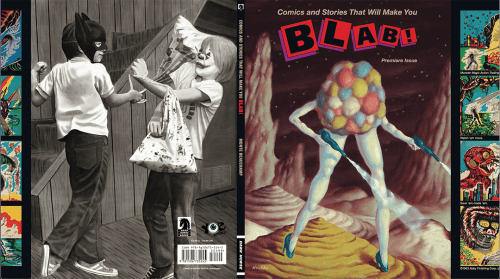
BLAB!, a creation of the pleasingly twisted mind of Monte Beauchamp and his artists, has been around for quite some time. In fact, the first two issues (1986–87) were published by Beauchamp’s own imprint, Monte Comix. A genius at low-brow art anthologies, Beauchamp began this venture back in the transition or ditch between underground comix and alternative (what might later be called “art”) comics. But art, for Beauchamp, of an almost inexplicable kind.
The title has bounced from his own personal operation, Monte Comix, to Kitchen Sink Press to Fantagraphics and Last Gasp to Dark Horse, where it has become, for reasons known only to Beauchamp, “Blab World!” It was always a planet by itself, and the suspiciously camp rocket-firing goddess on the cover, by Hershka, is clearly interplanetary proof.
Excerpt from “The Death of Comics,” by Noah Van Sciver
Oh, yes, there is some truly understandable stuff here, a lot of it pages by Noah Van Sciver, at 38, the book’s youngest contributor. Louis Wain, a mad artist of cat images in Victorian Age Britain, could be a precursive Beauchamp, obsessed with images until he loses his mind. Van Sciver comes back again with a whopper, “The Death of Comics,” aka the story of the best-selling Crime Does Not Pay series. The genius money-making series created by leftwing publisher Ralph Gleason, it encompassed the noir sentiment of the later, disillusioned 1940s as the dreams of antifascist democracy melted into individualism and war-wounded minds that could not be healed.
Excerpt from “The Death of Comics,” by Noah Van Sciver
Van Sciver focuses in on the lives of the Crime Does Not Pay artists, and in particular the genius of graphic sex-and-sadism, Charles Biro. His triumph leads him and the rest of comics into the hands of would-be censors and especially best-selling author Dr. Frederick Wertham. It’s a familiar story to comics devotees, and involves a wider plot of horror comics, MAD’s publisher William M. Gaines, and Congressional hearings that mirrored the hearings held on the purported Communist threat,with near-identical warnings of dangerous Jews poisoning the minds of young Christians. Van Sciver allows himself only a glimpse of the larger picture, because he is following Biro to his own private doom.
Excerpt from “The Death of Comics,” by Noah Van Sciver
A considerable amount of the rest of BLAB! takes us to other strange places in the pulp past, comic book back pages of the 1940s-50s selling miracle hair-replacement liquids, pocket-size miniature monkeys, and other far-fetched hustles aimed at young (or low-capacity) minds. Or to the pulp treatments of great apes, “discovered” only in the mid-19th century, treated as fantastic King Kong types with their hands around near-nude (white) women, or as a link to the link of the “missing link” to the human race, a link that has never been found. Beauchamp is asking the unasked question, why the obsession, and answering not in prose but by throwing the question back at the reader. Another section offers pages and pages of 19th century attacks on Catholicism, the dangerous threat to everything truly American. Great flying saucer illustrations by Ryan Heshka take us back to the late 1940s and 1950s, the golden era of interplanetary visitations and expectations.
There’s more: Heshka and Beauchamp’s story on Superman’s inventors Siegel and Schuster, taken from Beauchamp’s own anthology Masterful Marks (on great comic artists) is wonderfully weird. He has created no iconic comic figures, neither prompted the empire of capital in comics or been cheated out of it, but he is so much a part of the history, one way or another, that one can hardly tell the larger story without him.
PaulBuhle’s latest comic is an adaptation of W.E.B. Du Bois’s classic Souls of Black Folk, by artist Paul Peart Smith (Rutgers University Press).
Unversed Comics Anthology from Pacific Northwest College
It all began with a dream to put together an anthology as part of a comics course led by instructor Jonathan Hill of the Illustration Department at Pacific Northwest College. It would ultimately result in the Unversed Comics Anthology that you can find right here. And the timing could not be better as there is currently a Kickstarter campaign, until June 7th, in support of what looks to be the final collection ever. You can support Postscript right here. Ah, yes, my comics instinct never fails me! So, let’s take a look at the previous editions as we look forward to the next.
What is evident from these books is that its editor, Jonathan Hill, got everyone to bring their A-game. It’s not all just a bunch of talk with these kids. These young cartoonists are all determined and follow through. One fine example of this spirit is the piece, “Of All the Mundane Things,” by Tandy Kunkle, from the first Unversed collection. We begin with a young couple, half dressed, about to start a new day, when the young woman learns that her father has died. Within ten pages, Tandy Kunkle vividly shares with the reader a young person’s loss. The artwork is very inviting, direct, and authentic. It’s one of those minimal styles that really wins you over with its specificity. Kunkle’s prose is equally spare and crisp. She keeps to her theme with confidence. Steadily, you see how the little things in life add up and resonate all the way to the last panel.
“Of All The Mundane Things,” by Tandy Kunkle
By the time of the second anthology, Jonathan Hill has learned quite a lot about putting together an anthology. Again, a stellar collection. Another example from this talented group: “Pins & Needles,” by Justice Geers which focuses on the theme of permanent change byway of a story on tattoos. We begin with Quin, a confident young woman willing to confront life’s challenges. As our story unfolds, Quin develops a passion for tattoos and soon enough has a tattoo sleeve down one arm and then the other. Before too long, she discovers a career path as a tattoo artist. Justice Geers gives the whole narrative an authentic vibe.
“Pins & Needles,” by Justice Geers
“Believe,” by Seaerra Miller has a bold and polished style that’s fun to follow. This is another powerful father/daughter story and comes to such a rewarding end. If a daughter believes in her dad, then that’s all that matters. Well, I do believe this is one of my favorite short works in comics I’ve read lately.
“Believe,” by Seaerra Miller
“Changeling,” by Sarah Hickey, has a nice organic vibe running throughout. All is not well in the community of Elm Bend. It’s common knowledge that magic can wreak havoc on a town. I love the matter-of-fact dialogue as Tania and Robin catch up. Tania has been away training with fairies. Robin, formerly Posey, has been processing the experience of transitioning. Both are at a crossroads. What a perfect moment for Tania to conjure up a constellation of chrysanthemums.
“Changeling,” by Sarah Hickey
“Ambition,” by Clive Hawken, is a whole lot of weird expressive goodness. Clearly, Hawken enjoys letting loose with his drawing and that carries over to his lettering. For this sci-fi piece, we have some pretty grim pilgrims biding their time on their doomed planet. And the a choice is made and nothing will be the same again.
“Ambition,” by Clive Hawken
I hope this review stirs your interest! The Unversed Comics Anthology series has proven to be a great showcase for exciting new comics talent. That says a lot. There can be a lot of pitfalls along the way in creating a comics anthology and this series has avoided them. You instantly can see the dedication and quality to this work.
The third and final Unversed Comics Anthology, going out bigger and bolder than ever before with 576 pages made up of 40 talented contributors, coming together to say goodbye for the last time.
Click the link below to pledge to the Kickstarter and get your hands on a copy of Postscript!
It Occurs to Me That I Am America: New Stories and Art
What does it mean to be American in these strange times we live in? We have someone in power who behaves like a self-serving gremlin, determined to dismantle and foment unrest, boasting a horribly inarticulate screed. Here is a collection from some of the most respected names in the arts that acts as an answer to what it is to be American. It is entitled, It Occurs to Me That I Am America: New Stories and Art, published by Touchstone, an imprint of Simon & Schuster. This title came out in 2018 and it deserves to be on everyone’s radar in 2019 and for years to come.
Vote Hillary by Deborah Kass
Sometimes, perhaps too often, we get such a gem of a book that deserves a whole new shout out. Let me run through for you what makes this one special. Gathered within 375 pages are works by talented artists and writers all tackling a common theme in refreshingly unexpected ways. The book is edited by celebrated artist and novelist Jonathan Santlofer, with an introduction by Pulitzer Prize winning novelist Viet Thanh Nguyen. The roster of creators runs the gamut from exciting new talent to established legends. Each piece is a highly original voice. You’ll find, for instance, Hate for Sale, by Neil Gaiman, a poem tailor-made for today and yet unnervingly timeless. Or how about Joyce Carol Oates, “Good News!”a cautionary tale that nicely channels Ray Bradbury.
Little House on the Prairie Holding Company LLC by David Storey
Among visual art, one that immediately strikes just the right defiant tone is Vote Hillary, by Deborah Kass, a screen print channeling Andy Warhol with Trump replacing Nixon as the subject. Another compelling piece is The Ugliest American Alphabet, by Eric Orner, where he recounts all that is dismaying about Trump using every letter of the alphabet. Some other thoughtful work in comics comes from Roz Chast with Politics; and from Mimi Pond with Your Sacred American Rights Bingo. And one of the most beguiling works in comics in this book is a tryptic by Art Spiegelman. To be sure, all the work here is not espousing one particular point of view. You’ll find a bit of everything when it comes to articulating all things American. It’s not as easy as simply pointing fingers. It’s complicated, right? All in all, you have 52 distinctive voices here sharing with you just how complicated it all is in the best spirit of vigorous critical inquiry.
Your Sacred American Rights Bingo by Mimi Pond
I will finish up here by taking a closer look at the piece by Alice Walker, Don’t Despair. It is one of the shortest works and comes towards the end of this collection. She recounts how growing up in rural Georgia, all white men seemed to be like Donald Trump, petty and hateful. She looks back and wonders how she survived those times. Part of the answer is that Walker comes from a long line of ancestors who chose to live or die on their feet. Her family would survive, even proper, in the tiniest of spaces allowed to them by white people. Fast forward to today, Walker asks Is living under a dictatorship all that of a surprise? Her solution: Study hard! Study who you’re really voting for! And don’t rely on just voting for someone! “It is our ignorance that keeps us hoping somebody we elect will do all the work while we drive off to the mall.” Walker isn’t just offering hope. As she puts it, she’s offering counsel. Real change is personal and involves relating with each other. It is a time for an awakening and the choice is ours.
The Ugliest American Alphabet, by Eric Orner
It Occurs to Me That I Am America: New Stories and Art is a 375-page hardcover, with black & white and color images, published by Touchstone, an imprint of Simon & Schuster.
The Best American Comics 2018, with series editor Bill Kartalopoulos, and editor Phoebe Gloeckner, is another impressive collection of comics that are offered to the reader as among the best of the last year. Think of it as a comics art festival all in one book. Don’t expect much in the way of mainstream comics: no big publishers, let alone superheroes. What you will find a great deal of is a treasure trove of activity on the fringes.
While comics can be created in a myriad of ways, some patterns hold true. The most distinctive common trait is that work in the alt-comics scene is usually the work of one original voice that knows the work best and is compelled to shout it from the mountain tops with little or not additional assistance. Here are some examples for this year’s BAC anthology:
Kevin Hooyman
Kevin Hooyman fits more into the heroic mold of the hermit cartoonist. There are any number of glorious examples of this type of commitment. It leads to some of the most idiosyncratic, and compelling, work around. People can take sides and claim this is the only kind of comics that really matter. The truth is that including Hooyman’s work in this alt-comics anthology helps to set the tone and continue to build on what is possible in this medium.
Richie Pope
Richie Pope is an excellent example of an indie-pro hybrid. It happens and more often that you might think: a rebel/eccentric who, when he is assigned a client, will naturally keep to deadlines and go to meetings. Consider Pope’s work to have that extra professional snap and polish.
Lale Westvind
Lale Westvind is another hybrid. This time: cartoonist-animator. This is always an intriguing combination of skill sets. Westvind can bring to bear her rigorous animation background in the service of art comics–giving it that added lift.
Tara Booth
Tara Booth is another example of a cartoonist identifying as an outsider and challenging the reader, whether mainstream or not. That said, she’s also a masterful artist with a deceptively simple style.
Max Clotfelter
Max Clotfelter is high on the list of cartoonists who aim to provoke. He is a guerilla artist who defies the general reader’s expectations. It’s an ethos rooted in punk and DIY: the more raw and simple the better. A more raw approach is something cartoonists like Art Spiegelman advocated and yet, as underground cartoonists progressed in what became actual art careers, refinement was never far behind raw. So, the balancing between the raw and the cooked will go on.
Geof Darrow
Geof Darrow is another independent cartoonist who is also at home with big publishers like Dark Horse Comics from which Darrow’s piece in the book originally appeared. Darrow is a shining example that technical skill and masterful creation within the traditional structures of comics is something to celebrate and not distance one’s self from in favor of seeking out the most experimental of creators.
Bill Kartalopoulos has much to be proud of in all his efforts to support and to better understand the ever-shifting world of contemporary comics as an art form. He makes choices as to what may end up in the book. Then an esteemed guest editor makes the final calls. After that, well, it’s up to the selected creators to take it from there. Some may find themselves relatively rising and some may find themselves relatively coming up short. And others may just slip out the back door and never be heard from again.
The Best American Comics 2018 is a 416-page hardcover, in b&W & color, published by Houghton Mifflin Harcourt. Visit HMH right here.
For a sampling of some of the best independent cartoonists today, one great source is the NOT MY SMALL DIARY anthology, edited by Delaine Derry Green. Cartoonist John Porcellino, known for his “King Cat” comics, has called Delaine’s anthology, “One of the most important comic-zines in history.” Here is a look at Issue 19: Unexplained Events, which showcases the work from 43 talented artists.
Panel excerpt from Kevin Van Hyning’s “The Curse of Macbeth”
So, the theme of “unexplained events” leaves open a wide field of opportunities from things that go bump in the night and beyond. One of the most inventive, jarring, and downright entertaining pieces comes from Kevin Van Hyning. It’s a pretty messed up misadventure and I hope and pray that nothing close to this actually happened to Kevin. Like a lot of creative people, myself included, Kevin has many outlets, like performing on stage. In “The Curse of Macbeth,” we see what can happen when an actor confronts the age-old superstition of daring to say “Macbeth” before a show. It’s supposed to be very bad luck! And, as it turns out in this comic, it’s the sort of bad luck that can knock your teeth out! Inspired work! A big takeaway for me is learning of this curse as I don’t believe I’d ever heard of it before. But it has a long tradition dating back to the very first time it was performed in 1606. Teeth kept being knocked out and worse!
David Lasky’s “Mothman”
As a cartoonist myself, who has observed and commented upon the comics scene for many years, I am delighted to see page after page of inspired work from familiar and new talent. What you find in this book is a treasure trove of comics experimentation. Each creator is working within their own special confines, powered by their own personal engine. This is a fascinating book and a must-read for anyone interested in contemporary comics. Each artist you visit here is like a little island onto itself. We paddle ashore and reach the Isle of David Lasky. Here we find enigmatic work giving out a melancholic howl. In the one-page “Mothman,” we find the distinctive Lasky poetic comic. Relax your shoulders and linger over it.
Panel excerpt from “My ‘Unsual’ Sighting’ by James Burns
The universal symbol for the unexplained seems to always go back to UFOs. And so I close with a piece by James Burns, “My ‘Unusual’ Sighting.” The most eerie and creepy incidents are beautifully underscored by the mundane. Often the most profound things must compete with the most banal and so it is in this comic. It is 1966 and a bunch of kids innocently look up in the sky and seem to be watching their favorite sci-fi show in the clouds–but they’re not. Or what are they seeing? Ten years later, Burns is eighteen and has an opportunity to possibly confirm his most wildest speculation. But he’s still a kid–and what is he supposed to do if his suspicions are correct? Nicely done and a fitting example to a most impressive collection of work in comics.
Be sure to keep up with Not My Small Diary at Delaine Derry Green’s My Small Web Page right here.
Jonathan Lethem self-portrait in Introduction to The Best American Comics 2015
Jonathan Lethem is the author of nine novels, including “Gun, with Occasional Music,” “Motherless Brooklyn,” “The Fortress of Solitude,” and most recently, “Dissident Gardens.” He is this year’s editor for the annual, “Best American Comics.” Lethem’s 2003 novel, “The Fortress of Solitude,” famously references superhero comics. In 2007-2008, Marvel Comics published a ten-issue comic book collaboration between Lethem and artist Farel Dalrymple. It was a revisiting of one of the most unlikely of superheroes from the 1970s, “Omega the Unknown.” In 2013, Lethem collaborated with artist Raymond Pettibon as part of a collection of the artist’s work.
In my review of Best American Comics 2015, I speak to this year’s focus on comics as art. Series editor Bill Kartalopoulos brought in the idea of including Raymond Pettibon and it’s an exciting move toward further establishing comics as an art form in its own right. It would seem to many of us that such an assertion is no longer necessary. But every bit helps to make known to all readers the endless possibilities for comics. In my interview, we talk about Pettibon and his place in both the art world and the comics world. And we take a closer look at what comics are all about in the first place.
Cover art for Best American Comics 2015 by Raymond Pettibon
HENRY CHAMBERLAIN: I was reading over an interview you gave in 2008 and I wanted to quote a little from it. You said: “What I do in book after book after book is smash together — as urgently and as adamantly as I can — things that feel verifiably real everyday: textures, stuff of the prosaic and dreamlike material.” Is that the spirit in which you took on your editorship of this year’s Best American Comics?
JONATHAN LETHEM: That’s a great question. I like that quote. I don’t always love hearing myself read back to me but that one stands up. It sounds like what I feel that I do. Of course, I didn’t think of the editorship as having to reflect my aesthetic as though this were like a novel I was writing. You know, it extends from my position as a member of the audience, as a fan, as a responder, of other people’s work.
I’ve always seen a lot of continuity between the reader and the writer. There’s something in between like a member of the bookstore staff putting together a display, or a deejay setting up a set, or that overused term, “curator.” Helplessly, I’m grabbing at things that interest me and pushing them up against each other to make interesting vibrations between them. So, I guess it is like that quote. It is similar. The book ended up including things that are surreal, or magical, or fantastical, along with stuff of grubby ordinary life.
HC: This is your own personal journey through comics. I’m thinking of what Bill Kartalopoulos, the series editor, had said about this year’s edition being less of a survey than last year’s. I suppose each editor is going to bring different things to the next volume. This is your own take on the current scene in comics.
JL: Bill was tremendous about handing me a lot of rope. Obviously, he’s immersed in a field in a way, on a year to year basis, that I could never dream of being. He was brilliant in getting me up to speed and informing me of context. He was a pair of super-binoculars. He also wanted the book to be mine and not lead the horse to water too often. He said he wasn’t passing along anything he wasn’t interested in but that it was going to be too much and that I would need to carve out a vision from all this stuff. He was a great sounding board. He helped guide me to my decisions. For a while, I was floundering around. It’s overwhelming. The field is so huge and so hyper-kinetic in the kinds of energy and ambition being expressed.
HC: So, going through that mountain of books, impressed upon you the enormity of possibilities for comics.
JL: Yeah, I really did feel that. I guess that my selections reflect a kind of a sense of wanting to force the reader to experience, in some ways, the same exciting calamity of possibilities that I experienced. I wanted to reproduce the sensation of “What the hell is this?” Comics are so many different things right now: so vibrant, so many chances are being taken, so many fantastic experiments are being conducted. I started to think that this wasn’t just one thing. It’s a gigantic art form with brilliant juxtapositions and perplexities encompassed within.
Excerpt from “No Tears, No Sorrow,” by Eleanor Davis
HC: Looking at this year’s Best American Comics selections that you made, it runs the gamut from a more straightforward approach, like Eleanor Davis, to a more unconventional approach, like Henrietta Valium. And it’s all comics. I think you did something very significant this year by, in a natural way, bringing forward the understanding that comics is an art form. Now, one of my pet peeves, and you may agree, is when a gallery or museum labels something as only “comics-related” when, in fact, it is a work of comics, pure and simple.
JL: Yeah.
HC: And here you have Raymond Pettibon’s work on the cover of this year’s Best American Comics.
JL: Somehow, I got in there very early and that was a piece of good luck. A little feeler that series editor Bill Kartalopoulos put forward was that he had spotted this recent work of Pettibon’s and he sort of dared me to agree with him that it really was comics, just like you say. I was the right recipient for that little piece of provocation. I was already a big Pettibon fan. I wrote something for him, so we had collaborated on that a few years ago. The results were published in The Believer. And that was a comic. I thought of it explicitly as four panels. I wrote for him a four-panel really bizarre and over-loaded comic to do. Raymond being Raymond, took that into even stranger directions. When Bill asked what I would think of Pettibon’s work in a comics context, I was absolutely on board. As an opening exchange, I think it set the ground for how the rest of the book was going to feel to us, that we’d agreed to this slightly audacious definition of comics. And then it comes first circle with the invitation to Raymond to be the cover artist and his agreeing to do it.
Excerpt from Raymond Pettibon’s “The Credits Rolled,” 2013.
HC: When I was reading this year’s Best American Comics in a cafe the other day, a barista made that “What the hell is this?” comment. And it was in a very supportive tone as he was very familiar with Pettibon’s work. This would be interesting: What can you tell us about Raymond Pettibon? How does he see himself within a comics context?
JL: I have met him a handful of times. And I would say that he is dodgy in the extreme, with a great disinterest in facing questions like that directly. But his work is eloquent. His work incorporates giant chunks of response to comics as one of the key American vernacular visual languages. Along with film, the covers of pulp paperbacks, and tabloid photography, his work devours comics as a source. You have images of Superman, you have hints of Krazy Kat. There’s that Vavoom character from Little Lulu. I think, to him, it’s a question that is too obvious for him to engage in. And here is where I’d feel a lot of native sympathy myself in terms of my own writing and how it engages with comics as a zone of vitality and American language all its own. Comics just begs to be responded to by other art forms. So, what the Pop artists did, by grabbing onto that comics energy, is akin to other artists, like Philip Guston, or Raymond Pettibon. What I’ve humbly tried to do a couple of times in my writing is that, somehow make literary prose just to the tune to the energy that you find in a comic book or a comic strip panel. I think it’s a natural response. You see that today among artists, an understanding that comics are crucial, alive, and part of the American cultural stratum.
HC: You see all sorts of creative people fascinated by comics narrative. You teach creative writing. Do you suggest comics to your students?
JL: I have done that and I also have dealt with some independent study students or thesis writers working on the subject of graphic novels. I haven’t yet assigned a comic as a text in a seminar class but you’re making me think that I ought to do that. It doesn’t seem out of reach to me. My seminars have included film assignments in the past so it would be completely of a piece with that.
HC: I want to reassure everyone that this is not simply a survey, although it is in some sense. It’s definitely a wonderful guide to what’s been going on in comics in the last year or so.
JL: I hope so.
HC: I love how you keep an irreverent tone. It’s respectful but fun. I mean, your introduction is a comic and it’s hilarious. I love the character you created, even though you say it’s derivative.
JL: Well, most good characters are derivative. The two things aren’t mutually exclusive.
HC: One thing I recall from creative writing class is to avoid being portentous. And I believe that most good comics have a lightness to them. They can be anything but they need to strike a good balance, and avoid being portentous.
JL: I’m with you on that. Ironically, the portentousness that I mostly shied away from was largely found in the mainstream superhero comics–which I couldn’t quite relate to. For the present crop, I wasn’t clicking with it. Often, this is because there is a slightly artificial heaviness to them. It’s sort of a role reversal from grown-up stuff being found among the underground and graphic novels and the funny books being there for kids. But, actually, the mainstream comic book companies are producing a lot of very jacked-up grim stuff. And, as you say, some of the most sophisticated or beguiling suggestive work that you can come across includes a certain levity or a sense of the absurd. Some frivolity is in the mix.
HC: Let’s consider some of the work included here. One that quickly comes to mind is Megan Kelso.
JL: Yeah, Megan Kelso was a great discovery. She’s so sly. It appears to be very straightforward work but the degree of compression, the way she can do so much with such a small number of pages, is very, very literary in fact.
From Julia Gfrörer’s “Palm Ash”
HC: Another intriguing selection is Julia Gfrörer.
JL: That’s another intricate and evocative piece. That was a total discovery for me. I hadn’t come across her work anywhere before.
HC: I’m familiar with her work. She’s definitely on the rise.
JL: Well, she should be.
HC: It’s nice that it was printed in the book on green paper.
JL: Yes, it was a pamphlet on green paper. One of the interesting things about work like this is that it has the quality of being an artifact. Some other works in the book were either bigger or smaller than the anthology pages. Or would be silkscreened or some other printing process. It’s only an approximation to the original when we fit it into the anthology format.
HC: What would you say about your readership?
JL: More than usual, I’m on the edge of my seat to meet my readership. I know the sense of being stakeholders the comics audience has. I wonder about how they will respond and probably argue with this book in certain ways. I’m really interested in what will come out of that and what I’ll learn. I think it was crucial to feel that I was being dropped into a universe and trying to do justice to this last year. It was like a flashbulb strobe image of the landscape. My volume was one in a conversation. It was instructive to study the last few years of the volumes and see the different kind of statements that people are making with the editor’s position and the different senses you get of what the competition in the field feels like at any given moment.
HC: I wonder if cartoonists see it as a contest. I tend to think that they’ll appreciate that this volume is, like you say, part of a conversation.
JL: Well, you know, everyone who makes things is waiting for that gold star. It’s a neat job to be able to give out the gold stars once in a while. You also want to let people know that there were hundreds of submissions that were clamoring and knocking on the door to be included. In some cases, the selections were determined upon what went together in making a book out of it all, making it all flow, and making it all interesting in context. There are some pieces that I fell in love with that didn’t make it into the book.
HC: It must be great when you make these connections while putting the book together, like the two pieces with a Wonder Woman theme, one by R. Sikoryak and the other by Diane Obomsawin.
JL: There was going to be a third Wonder Woman piece, by Ron Regé Jr., but lawyers stepped in and squelched it. I was trying to give as much of a glimpse into Wonder Woman as possible especially since there had been a couple of nonfiction books on Wonder Woman in that same year.
HC: And you ran into difficulty with getting a work in by Steve Ditko.
JL: That one went down to the wire. And it led us nowhere. So, somewhere, out there, there’s a compendium worthy of Steve Ditko.
HC: Well, God bless him. Thank you for your time, Jonathan.
JL: Thank you, Henry.
You can listen to the podcast interview by clicking below:
“The Best American Comics 2015” is a 400-page hardcover, published by Houghton Mifflin Harcourt, and is available as of October 6, 2015. You can find it at Amazon right here.
Henriette Valium’s “Lâcher de Chiens” from Descant 164. Is it comics?? Yes, it is!!
For this year’s BEST AMERICAN COMICS, with guest editor Jonathan Lethem, the speakers were turned up to eleven, all the windows were smashed, and the ceiling collapsed as the comics medium made a pretty nice step forward. I am talking about this imaginary line that’s been dividing comics from fine art. In the past (or still present), if I saw some compelling comics on display in an art gallery or museum, I would need to second-guess on how to describe it. The gallery or museum, the authority figures, had decreed that the work on the walls was “comics-related,” not simply “comics.” That’s always bothered me when I read “comics-related” on a label attached to a work that could simply be identified as, embraced as, “comics.”
Consider, for example Lethem’s inclusion of Henriette Valium, generally described as “a comic book artist and painter.” Valium is something of a hybrid, not easily pegged. In the right context, you can call him a cartoonist. You could also just call him an artist. His work is out there, way out there. It simply does not neatly fit into the conventional comics world or the traditional art world. And yet it belongs in both. The sample that Lethem has chosen demonstrates a masterful uninhibited expression. It’s powerfully visual and, while not a traditional or coherent narrative, the words carry weight. So, then the question becomes is this a comic that is “art-related” or just comics. Let’s embrace it as comics!
Excerpt from Raymond Pettibon’s “The Credits Rolled,” 2013.
And then there’s Raymond Pettibon. If there is anyone who stands out as having their work labeled as “comics-related” by the art world gatekeepers, it would be him. Pettibon began his art career as an in-your-face punk. Pettibon created some of the most awesome, creepy, and wonderfully enigmatic art that was chiefly used to promote bands. Over time, his art went from the streets to the gallery walls. It was cool matter-of-fact images of all sorts of sordid things. I never thought of it as exactly being comics and yet, as a cartoonist-painter, I totally related to it. If it was “comics,” then it was of a more experimental stripe–without even trying to be or fully aware that it was! It was just great. Today, I believe, it would be accepted as some form of comics. So, the timing is perfect to see this move forward.
Excerpt from “No Tears, No Sorrow,” by Eleanor Davis
To be sure, the bulk of the work here adheres more closely to the principles of sequential art. For example, Eleanor Davis provides a more straightforward narrative. Her piece in this book, “No Tears, No Sorrow,” follows a group of participants in a workshop to learn how to cry. It is a beautifully paced comic with a nice spare look. While the characters and setting are very concise and minimal, it speaks volumes to our conflicted notions of expressing emotion.
Excerpt from “The Good Witch, 1947,” by Megan Kelso
Another piece that knocks it right out of the park is “The Good Witch, 1947,” by Megan Kelso. Like characters from a novel by Carson McCullers, these are mysterious, sad characters that we deeply want to know but will only be allowed in after thoughtful consideration. Megan Kelso is not “old school” or “traditional.” She just knows how to weave a good story. And that’s what you’ll find here, a tidy number of immersive and compelling comics.
Cover art for Best American Comics 2015 by Raymond Pettibon
As series editor Bill Kartalopoulos explained in an interview with Publishers Weekly, this latest BAC is not meant to be a straightforward survey of the best comics of the last year. Although, if it’s not a survey in some sense, then what is it? Well, it’s the guest editor’s take on the currents of comics. Fair enough. And, as long as we’re getting a collection that is being faithful to some notion of a survey, I’m all for that. Basically, it comes down to the series editor providing the guest editor with a mountain of books and, from that mountain, a collection emerges. This is Lethem’s take on comics. We see that, yes, comics come in many varieties. And with such an esteemed and thoughtful guide as Lethem, you are in good hands to make some wonderful discoveries and connections.
“The Best American Comics 2015” is a 400-page hardcover, published by Houghton Mifflin Harcourt, and is available as of October 6, 2015. You can find it at Amazon right here.
ISLAND is a whipsmart comics anthology brought to you by Image Comics. In the first issue, Brandon Graham provides a brief intro and we’re off and running. Work here is intro art by Marian Churchland, ongoing comic by Emma Rios, story by Kelly Sue DeConnick, ongoing comic by Brandon Graham, and ongoing comic by Ludroe.
Emma Rios presents a sci-fi thriller entitled, “I.D.” I love the clean linear quality to her artwork. Everyone looks hungry and jumpy. And that’s understandable considering a terrorist attack has just occurred in outer space. We open with a scene in a coffee shop. Just as you would expect, once a crisis has been declared by the media, hot-blooded youth feel compelled to do something. One outraged young man declares, “The streets should be burning these days!” To this remark, a woman gives him the most vicious of eye rolls. Anyway, that crisis is in the background. The focus is on the characters and some of them are desperate to change their bodies. Nice opener.
Kelly Sue DeConnick’s “Railbirds” is a poignant memoir that pays tribute to her friend, the poet, Maggie Estep. It is prose with illustrations by Emma Rios. We follow Kelly on a road to recovery from addiction and growing as a writer. You learn all about the “railbirds,” those overeager participants at the race track, in this moving story.
Brandon Graham’s “Ghost Town” is a tour de force adventure with his favorite couple, Nikoli and Sexica. This this chapter, the two try to enjoy brunch at a café that specializes in whale. A few other oddball things happen. No one gets blown up. Always excellent work.
And finally, there is Ludroe and his ongoing piece, “Dagger Proof Mummy,” which proves to be quite a revelation. I see a few touches of Graham’s influence in what is a very refreshing skater fantasy tale. Reno smokes a little too much weed. Dirk is a superstar skater. Will they ever be a cool couple like Nikoli and Sexica? Maybe not. Whatever the case, Dirk appears to have supernatural powers and presently he has made himself completely vanish during a mid-air daredevil jump.
ISLAND is published by Image Comics, priced at $7.99. It is brought to you by Pretty Deadly artist Emma Rios and King City writer/artist Brandon Graham. Each ongoing issue of this comics magazine runs 20 to 30 pages, ad free, with issue length chapters of new work from around the globe. The first issue is available as of June 15.
For more details, visit our friends at Image Comics right here.