Category Archives: Illustration

BOOM! STUDIOS GOES CAMPING TO THE MAX WITH ‘LUMBERJANES’

BOOMBOX-Lumberjanes-Noelle-Stevenson

LUMBERJANES looks like an all-out joy ride of comics fun. This new comics series joins THE MIDAS FLESH under BOOM! Studios newest imprint, BOOM! Box. It is written by Noelle Stevenson who you may know from her webcomic, NIMONA. LUMBERJANES #1 arrives in comic shops on April 9th. Visit our friends at BOOM! Studios to pre-order here.

Press release follows:

Continue reading

Leave a comment

Filed under Boom! Studios, Comics, Comics News, Illustration, Noelle Stevenson, Webcomics

Design: NOBODY CARES ABOUT YOUR BAND by Greenwich Letterpress

Nobody-Cares-About-Your-Band-Greenwich-Letterpress

Yeah, it’s true. Nobody cares about your band. Check out other pithy greeting cards from Greenwich Letterpress here. They know style, with the discerning eye of a true New Yorker.

Leave a comment

Filed under Cards, Design, Greeting Cards, Illustration, New York City, Style

‘Gahan Wilson: Born Dead Still Weird’ Campaign Kicks Off August 18, 2013

Gahan-Wilson-Born-Dead-Still-Weird-2013

“We’re going all the way!” says filmmaker Steven-Charles Jaffe about his fundraising campaign in support of his documentary on master cartoonist Gahan Wilson, “Gahan Wilson: Born Dead, Still Weird.”

Beginning on Sunday, August 18, 2013, at noon PST, fundraising for the documentary resumes after the Kickstarter effort.

Many of the original pledgers are now renewing their pledges on the official “Born Dead, Still Weird” website which you can visit here.

Gahan-Wilson-art-Born-Dead-Still-Weird

Gahan-Wilson-The-New-Yorker

From the “Born Dead, Still Weird” site:

We have launched this new funding website for our ACADEMY AWARD® campaign to enable all of you awesome supporters to renew your pledges and receive your rewards.

Please browse through our rewards and choose one or more. Note: some previously listed rewards have changed, so take a look and choose one or more. There is also the option to make a pledge without a reward. You can purchase using Paypal or credit card.

The reasons we need your help remain the same. We’re in a tough race to get the documentary submitted to the Academy® so we must reach our goal of $26,000 by Monday September 16.

Thanks again for your continued enthusiasm and support. We will do this!

Sincerely,

Steven

Leave a comment

Filed under cartoon, Cartooning, Cartoonists, Cartoons, Comics, Documentaries, Gahan Wilson, Illustration, Kickstarter, Playboy, Steven-Charles Jaffe, The New Yorker

Interview: FAR OUT ISN’T FAR ENOUGH: THE TOMI UNGERER STORY: Brad Bernstein, director and writer; Rick Cikowski, lead editor and lead animator

"Doctor Strangelove"  Movie Poster. Artwork by Tomi Ungerer.

“Doctor Strangelove” Movie Poster. Artwork by Tomi Ungerer.

FAR OUT ISN’T FAR ENOUGH: THE TOMI UNGERER STORY is a masterfully created documentary that will hit you on many levels. It is eligible for an Academy Award nomination for Best Documentary and deserves that level of recognition for being so careful to detail with its subject, artist Tomi Ungerer.

I had the honor of speaking with both Brad Bernstein, the film’s director and writer, and Rick Cikowski, the film’s lead editor and lead animator. Both men expressed their love for Tomi Ungerer and provide insight into the making of this impressive documentary, distributed by First Run Features.

For me, I can appreciate what happened to Tomi Ungerer when I look at the iconic poster he created for “Doctor Strangelove.” That poster, much like his “Black Power, White Power” poster are forever part of one’s psyche. And yet, in America, Ungerer’s work in children’s books is not widely known today. That work is just as powerful and was just as well known in its day, as anything else he has created. Thanks to Phaidon, we have many of his great works being reprinted in the United States. But, for decades, it was as if he’d been wiped out of memory in America. How could that be? That is a big part of the fascinating story that unfolds in this documentary.

Tomi Ungerer is a great talent and, for a man who has had a lifelong battle with fear, he is a most courageous man. For someone who grew up under the horror of the Nazis, and went on to conquer the world of illustration in its heydey in New York City, that alone is remarkable. But going that far out, wasn’t far enough for Ungerer.

“Far Out Isn’t Far Enough” brings together a seamless narrative boiling down numerous hours of interviews with Tomi Ungerer, Jules Feiffer, the late great Maurice Sendak, as well as other notable figures like art director and critic Steven Heller. Throughout the film you are treated to very deftly purposed animation that strikes the right cord, whether humorous or somber.

As Brad Bernstein explains, the initial attraction to Tomi Ungerer was his spirited expressions like, “Far Out Isn’t Far Enough.” That really says it all. Ungerer is a man who speaks his mind and does it quite well. His life and work are a testament to a strong will and this documentary honors that spirit very well.

You can listen to the interview with Brad Bernstein and Rick Cikowski by clicking the link below:

far_out_isnt_far_enough_the_tomi_ungerer_story_2013

And, as the say, tell your friends and spread the word about this documentary. You can visit the official site here and also follow on Facebook and Twitter.

2 Comments

Filed under Art, Art books, Children's Books, Design, Documentaries, Erotica, Illustration, movies, pop culture, Protest, Social Commentary, Tomi Ungerer

Movie Review: ‘Far Out Isn’t Far Enough: The Tomi Ungerer Story’

Tomi-Ungerer-Far-Out-Isnt-Far-Enough-2013

Tomi Ungerer was a household name. He was the most popular children’s book illustrator in America. He is also a masterful artist of subversive and erotic art. That’s what got him into trouble within the children’s book community. His career was derailed. But he wasn’t. “Far Out Isn’t Far Enough” is a powerful documentary about a most remarkable man and artist. Tomi Ungerer’s life and career spans World War II, at the hands of the Nazis, into the high flying life of New York City in the “Mad Men” era of the ’50s and ’60s, and into the heart of the counterculture movement. It’s a life, not unlike Robert Crumb’s, full of explosive expression and heroic turns.

Director Brad Bernstein has brought into focus the life of Tomi Ungerer in a variety of ways. First and foremost, is Tomi Ungerer, who eloquently speaks his mind and is the guiding force throughout this film. It is his expressions, like “Don’t Hope, Cope” and “Expect The Unexpected,” that are used as chapter headings and repeated in various ways to draw out their meaning. Tomi’s life story is so compelling by itself too but, with the help of an impressive group of individuals, we hear his story told from many vantage points. This is a wonderfully structured documentary that alternates with grace between interview subjects and vivid use of animation (thanks to Brandon Dumlao, Alain Lores, and Rick Cikowski) that makes Tomi’s already powerful images jump out at you all the more.

We quickly take in Tomi Ungerer in the opening scenes. We see an older gentleman, with sad eyes and a mischievous smile, who has seen more of the world than has been good for him. He is also full of life and happy to joke around. But his comments can be cryptic: “I always have nightmares. I’m always being arrested in my dreams!” There is sadness and gaiety as he says this. He was once the most celebrated artist of children’s books in America. He was a rock star among illustrators. And then he disappeared.

Born in 1931 in Strasbourg, France, Ungerer and his family would come to know their Nazi neighbors all too well. Alsace, Strasbourg had only been French for about 300 years so its identity was split evenly Franco-German. This fractured identity would inform Ungerer’s life and his work. While under German occupation, it was forbidden to speak French and German culture prevailed. However, after the Allied victory, Ungerer’s German upbringing was a severe liability. The French, he found, treated him just as poorly as the Germans. And there was no regret by the French to burn German literature. It was very absurd, Ungerer concluded. Life was absurd.

Tomi-Ungerer-New-York-City

P10.TIF

At age 25, with only sixty dollars, Ungerer moved to America. He had always managed to cope and to prosper as an artist and so he would try to make a living from it in New York City. As luck would have it, Ungerer’s arrival in 1956 was a perfect time to break into the wildly lucrative world of illustration. Not only did he manage a foothold, he brought with him a whole new style that peeled away at conformity. The problem for Ungerer would be that, as he reacted to the times, he would just keep peeling away to the point that he crossed a line.

E08.TIFNEW

The musical score, by Nick Dei Rossi, dips into an ominous tone once Ungerer has come into his own and matured as an artist. He always loved the children’s book illustration he was known for but now he was reacting to the Civil Rights movement, the Vietnam War, and the Sexual Revolution. His peers, artists like Maurice Sendak and Jules Fieffer, admired what he was doing. Both are interviewed extensively in this film and provide great insight. They both loved Ungerer. But there was nothing they could do when Ungerer met his Waterloo.

Tomi-Ungerer-Anti-Vietnam-War-Poster

Ungerer’s life, post-America, is not a sad story. He did give up children’s book illustration for 25 years but he discovered a whole new life, a life with new challenges and old fears that needed to be overcome. We come to realize that there will always be a touch of fear in this man’s life but it’s a good kind of fear, the sort he can use as a challenge. He seems to already have come to terms with the fear of death. Even if it should turn out to be vast nothingness, he is encouraged that this will be an opportunity to fill the nothingness with something from his mind. In the end, he remains encouraged and eager to continue crossing a line, pushing the envelope. The Tomi Ungerer expression used for the film’s title, “Far Out Isn’t Far Enough,” proves to be his way of life.

“Far Out Isn’t Far Enough: The Tomi Ungerer Story” is currently in theaters. Be sure to visit the site here for details. If you’re in Seattle or Minneapolis, you can catch it this weekend at one of your Landmark Theatres. Check it out here.

And you can listen to my podcast interview with the director/writer and lead editor/animator of this dazzling documentary here.

Leave a comment

Filed under Design, Illustration, New York City, politics, pop culture, Tomi Ungerer

Review: THE GRAPHIC CANON, VOLUME 3, Edited by Russ Kick

Graphic-Canon-Russ-Kick-2013

Not all the work here is by cartoonists, per se, but most of it is and everyone here is part of the larger world of the graphic arts. We still live, may always live, in a world that, for the most part, thinks of cartoonists as only one thing. However, “The Graphic Canon,” edited by Russ Kick, and published by Seven Stories Press, gives you a taste of what is possible. You are certainly in capable hands with Russ Kick, bestselling author of “You a Are Being Lied To” and “Everything You Know Is Wrong.”

This is a remarkable project that takes on the world of literature on a grand scale with Volume 3 dedicated to the 20th Century. Ah, the 20th Century, it was a time dominated by the most heroic and romantic of rebels. You are sure to find your favorite rabble rouser in this colossal book, heroic in its own right. It weighs in at 564 pages, literally a phone book worth of literary artistic expression, so the odds are in your favor.

Like a classroom full of gifted children, each artist here has taken their chosen work of literature, immersed themselves in it, and turned in their best effort. Not all the contributions here are exclusive to this book but most are. And, like thoughtful and caring students, these artists don’t let ego get in the way or stray too far from the goal. They fall into two lines of attack: illustration and adaptation. Within these two camps, we get just about everything under the sun, an exciting array of talent, over 80 artists, that will please hardcore lit fans and newbies alike. Among previously published work, there is Robert Crumb’s rarely-seen adaptation of Sartre’s “Nausea.” Another gem is David Lasky‘s unique take on “Ulysses.” Reproduced here, you get the original 1993 mini-comic version.

"Ulysses," adapted by David Lasky

“Ulysses,” adapted by David Lasky

Check out the first pages of this book to find a homage to “Heart of Darkness.” Matt Kish is known for creating illustrations for each page of “Moby Dick.” Here you see him bring that same level of obsession to Joseph Conrad’s masterpiece. Reproduced are some selected illustrations with the promise from Kish will go on to fully illustrate “Darkness” page per page.

"Heart of Darkness" illustration by Matt Kish

“Heart of Darkness” illustration by Matt Kish

Ellen Lindner‘s illustration for “The Bell Jar” sums up in great measure the internal struggle that Sylvia Path attempted to endure.

"The Bell Jar" illustration by Ellen Linder

“The Bell Jar” illustration by Ellen Lindner

Tara Seibel provides some fanciful illustrations for “The Great Gatsby” that evoke the jazz age.

"The Great Gatsby" illustration by Tara Seibel

“The Great Gatsby” illustration by Tara Seibel

Among the adaptations, Julia Gfrörer gives us some very intriguing images inspired by Umberto Eco’s “Foucault’s Pendulum.” In the introduction, Russ Kick helps the casual reader to relate by jokingly suggesting that Umberto Eco’s masterwork is a much more complex version of Dan Brown’s “The Da Vinci Code.” Full of metaphysical and philosophical observation, it centers on three characters who work at a vanity press who concoct elaborate conspiracy theories and then discover that maybe they’re true. Julia Gfrörer is clearly up to the task.

"Foucault's Pendulum" adaptation by Julia Gfrörer

“Foucault’s Pendulum” adaptation by Julia Gfrörer

I think this unusual adaptation by Julia Gfrörer is a good place to linger since it goes a long way in representing the best you will find in this book. Gfrörer has taken on a wildly complex novel, found an opening, what she entitles, “The Chymical Wedding,” that explores the alchemical wedding in “Foucault’s Pendulum” and runs with it. This certainly doesn’t come across as Lit 101 filtered through comics. No, it does what you’d hope for: Gfrörer wears Umberto Eco like a well-worn pair of pajamas. Is that appropriate? If you don’t feel comfortable with what you’re doing, how will your reader? Gfrörer lets herself go and, without trying too hard, turns in her assignment. It’s just what editor Russ Kick would have expected.

This is the thing, there are any number of ways to go about your adaptation. “The Mowers,” by D.H. Lawrence, for example, is pretty straightforward and has a deft and gentle touch by Bishakh Som.

"The Mowers," adapted by Bishakh Som

“The Mowers,” adapted by Bishakh Som

Another ethereal and arresting approach comes from Caroline Picard with her adaptation of Virginia Woolf’s “The Voyage Out.”

"The Voyage Out," adapted by Caroline Picard

“The Voyage Out,” adapted by Caroline Picard

Emelie Östergren provides her heart-felt interpretation of “Naked Lunch” by William S. Burroughs.

"Naked Lunch," adapted by Emelie Östergren

“Naked Lunch,” adapted by Emelie Östergren

“The Graphic Canon, Volume 3” is such a mighty undertaking that you just can’t go wrong. I come back to the idea of a powerful vehicle that demonstrates what’s possible. We’d be fools to think we’ve got literature and fiction all figured out. And we’d be fools to think we have the comics medium all figured out. It’s a post-postmodern world, but that’s no excuse. There is something very traditional about writing stories and creating comics and that’s quite alright.

Issues of storytelling will not be resolved in the 21st Century and never will be. If Russ Kick is around (gee, anything is possible), or maybe a descendent or disciple, we will find that Volume 4’s tribute to the 21st Century (available only digitally?) will continue the good fight for a good story. And we will find that all three volumes of “The Graphic Canon” have held up considerably well.

Visit Seven Stories Press here. You can also find “The Graphic Canon” by visiting Amazon here.
2 Comments

Filed under Comics, Fiction, Graphic Novel Reviews, Illustration, Literature, Novels, Russ Kick, The Graphic Canon

INTERVIEW: Filmmaker Steven-Charles Jaffe and ‘Gahan Wilson: Born Dead, Still Weird’

Gahan-Wilson-Steven-Charles-Jaffe-2013

“If Crumb can have a documentary, then so can Gahan Wilson!” The decision had been made.

Gahan Wilson is a force of nature. And so is filmmaker Steven-Charles Jaffe. Wilson found in Jaffe someone who would do justice to his legendary career that spans over 50 years of cartoons for The New Yorker, Playboy, and National Lampoon. Who else even comes close to such an output? That’s why a documentary had to be made. It is called, “Gahan Wilson: Born Dead, Still Weird.” Yes, you read that right, “Born Dead, Still Weird,” and it is currently the subject of a Kickstarter campaign that you can join here.

It was upon seeing “Crumb,” Terry Zwigoff’s landmark 1995 documentary on underground cartoonist Robert Crumb, that Jaffe resolved he needed to create a similarly worthy documentary of his friend and idol, Gahan Wilson. The idea of Jaffe and Wilson working together had already been kicking around for a few years. One plan that continues to interest them is a feature length animated movie based on Wilson’s illustrated book, “Eddy Deco’s Last Caper.” Jaffe and director Nicholas Meyer have approached IMAX about the project so we shall see. A Gahan Wilson animated movie in 3-D would be worth the wait.

For a taste of what it’s like for Wilson and Jaffe to work together, you can view the 2008 animated short, “It Was a Dark and Silly Night.” A story about children determined to have a jello war, even if it’s in a cemetery, this animated short is based on a collaboration between Neil Gaiman and Gathan Wilson for an illustrated anthology, compiled and edited by Art Spiegelman and Françoise Mouly, “Little Lit: It Was a Dark and Silly Night.”

There is so much to a Gahan Wilson cartoon: it is entertaining, memorable, scary, and above all else, it won’t let go. “I can’t tell you how many times I have seen a Gahan Wilson cartoon that relates right back to his own life.” Jaffe makes the observation with awe and admiration. An artist of the caliber of Wilson has both a keen sense of whimsy and a backbone made of steel. He was a child of two out of control alcoholic parents. For him, he had to grow up fast while holding on ever tighter to his dreams.

The dream behind “Born Dead, Still Weird” is to give it as wide an audience as possible. Much in the same way that “Crumb” was transcendent, so too this documentary aims to show you the real man and artist. “That’s what struck such a chord with people, to see Robert Crumb on a human level,” says Jaffe. Both Crumb and Wilson climbed their ways out of adversity to unprecedented success. If Jaffe can accomplish his goal of stirring up the pot and getting his documentary considered for an Academy Award nomination, it will go a long way in securing a high profile for “Born Dead, Still Weird.” The essential stage, getting the documentary made is done. But the last stage, marketing and distribution, and just making sure the documentary is known about, is still ahead.

Jaffe recalls the kind words from Robert Redford in support of “Born Dead, Still Weird.” After viewing it, Redford wrote back to Jaffe, “I’m a huge proponent of art not only getting into the educational system but for its ability to save some lives and enhance some lives. It is a fine piece of work and I thank you.” Saving lives. What a joy to be able to make such a difference. This is something that has genuinely stuck with Jaffe. He’s the first to say that he did not set out to make an inspirational film and yet Gahan’s life attracts just that.

From Jaffe’s first encounter with a Gahan Wilson cartoon in Playboy at the tender age of 10, up to today, Jaffe’s felt his own life enriched by Wilson. “He is a total nonconformist,” Jaffe says with delight. In a world where being different can have harsh consequences, as with bullies in school, Gahan Wilson is a shining example of someone who is going to live his life his way.

I hope you enjoy the podcast below that includes the entire interview with Steven-Charles Jaffe. Just click below:

Steven-Charles Jaffe

Be sure to stop by and visit the Kickstarter campaign for “Gahan Wilson: Born Dead, Still Weird” right here.

4 Comments

Filed under Art, Cartoons, Comics, Documentaries, Gahan Wilson, Humor, Illustration, Kickstarter, National Lampoon, Playboy, Steven-Charles Jaffe, The New Yorker

Gahan Wilson Doc, ‘Born Dead, Still Weird’ Seeks Your Help For Academy Award Nomination

Gahan-Wilson

The New Yorker gag cartoon is quite a unique creature. It comes in many flavors, the best being “strange.” The master of strange is Gahan Wilson. It’s quite a blend that has been published for the last 50 years in The New Yorker, Playboy, and National Lampoon. His work takes you to a dark place while putting a smile on your face. It’s not an easy thing to do. I remember, as a kid in the ’70s, attracted to all kinds of comics that unveiled a mysterious world, one often made up of hapless adults. God help anyone seeking answers from a Gahan Wilson cartoon–but it helped me! I’m not sure how but it did. In order to celebrate and better understand Gahan Wilson, and his amazing work, Filmmaker Steven-Charles Jaffe created a documentary, “Born Dead, Still Weird,” which is currently part of a Kickstarter campaign (runs thru August 17) that you can view here.

Gahan-Wilson-Born-Dead-Still-Weird

A funny thing happened on the way to somewhere else. I literally stepped into the “Born Dead, Still Weird” documentary some years back. I happened to be in town and I dropped by The New Yorker offices to show a batch of my cartoon gags. Little did I know that Gahan Wilson was in the green room, along with all the regular contributors, awaiting an audience with Bob Mankoff, cartoon editor for The New Yorker. Now, I’m from Seattle, so it wasn’t like a usual thing. I kept putting off my visit to the editor’s office because I was so enthralled and wanted to make the moment last. I remember signing a waiver, just in case my interview with Bob Mankoff was used in the film. I was invited back to continue to submit work. I left, had lunch, and continued with my life. And I always wondered about this documentary!

Gahan-Wilson-Born-Dead-Still-Weird-2013

Now, we come to the good part. We fans of comics and art and wonderful things love Gahan Wilson and his work. We want this documentary to succeed in a very big way. If it can fulfill the requirements necessary to be considered for an Academy Award nomination, then that will be a big leap forward to getting everyone to know about this documentary. The current Kickstarter campaign is all about meeting the criteria for nomination and that primarily involves renting movie theaters for special screenings. You can read all about it at the Kickstarter campaign here.

An Academy Award nomination alone is a huge deal and “Born Dead, Still Weird” is a perfect candidate for Best Documentary. Let’s all do what we can to see this campaign get funded.

Leave a comment

Filed under Cartoons, Comics, Documentaries, Gahan Wilson, Humor, Illustration, Kickstarter, National Lampoon, Playboy, The New Yorker

Review: ‘Legends of the Blues’ by William Stout

Legends-of-the-Blues-William-Stout-2013

You may know more names in blues than you think. There’s Billie Holiday, B.B. King, Chuck Berry, Bo Diddley, John Lee Hooker, and Muddy Waters, to name a few. And, if those names don’t ring a bell, well, that’s alright. This collection featuring 100 profiles of all-time great blues musicians, big names or not, will give you a look at the big picture.

Abrams-Comic-Arts-Billie-Holiday

William Stout has picked up where R. Crumb left off some years back in creating “trading card” portraits of blues legends. This has led to this beautiful and intriguing book published by Abrams ComicArts, “Legends of the Blues,” complete with Bonus CD! Here you have a very accessible guide to American blues with each portrait interconnected with the other. Each profile has an exquisitely drawn portrait, biography, and recommended songs attached to each performer.

B-B-King-William-Stout

Read the profile of B.B. King and learn how the electric guitar made its way into blues, ushering in rock ‘n’ roll. It was thanks to T-Bone Walker, the first blues musician to use an electric guitar. That fact is just as fascinating as viewing Michael J. Fox, as Marty McFly, in “Back To The Future,” accidentally inventing rock ‘n’ roll. Read further and you learn about how King nearly lost a beloved acoustic guitar to a fire that started from a fight over a woman named, Lucille. As a reminder to never fight over a woman, each of King’s Gibson guitars has been given the name, Lucille.

Abrams-Comic-Arts-2013

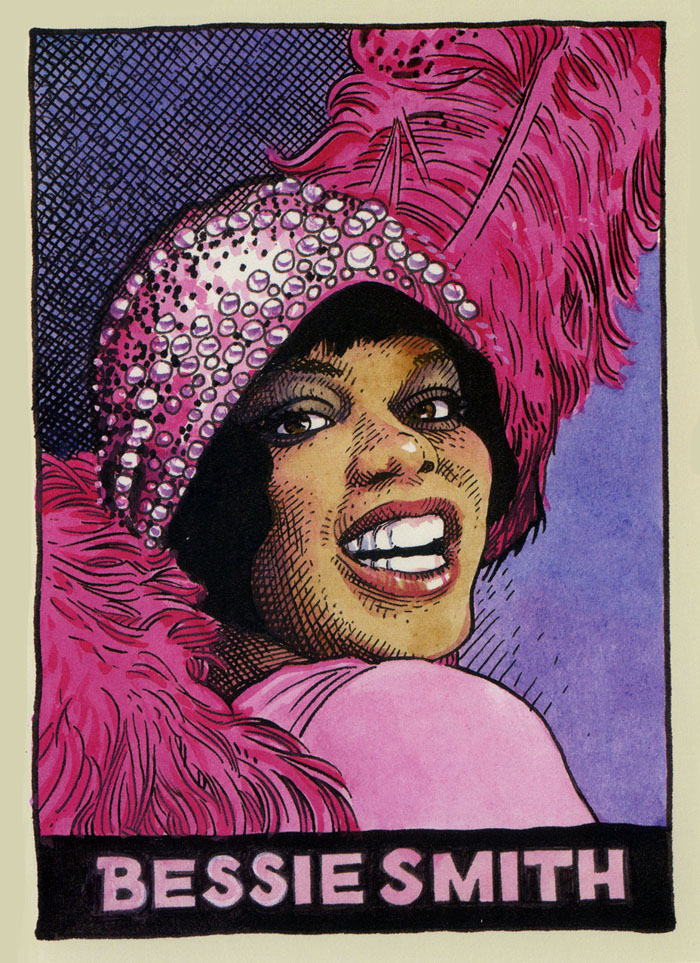
The stories here range from the tragic to the comical. Many are stories of lost childhood, like Billie Holiday; scrambling to carve out a career, like Robert Johnson; and ultimately finding fame fleeting and cruel, like Bessie Smith. And there are no end to interesting facts. One fine example is the story of Robert Petway. His claim to fame was his song, “Catfish Blues.” It was reworked by Muddy Waters and retitled, “Rollin Stone,” the namesake to one of England’s greatest rock bands of all time. As for Petway, the authorship of his hit song has been questioned and it is still unclear as to when he was born and when he died! Such is the life of a blues musician.

“Legends of the Blues” is a 224-page hardcover, with CD, priced at $19.95 U.S., published by Abrams ComicArts. You can find your copy here.

Leave a comment

Filed under Art, Art books, Blues, Comics, Graphic Novel Reviews, graphic novels, Illustration, Music, Rock 'n' Roll

ARLEN SCHUMER: COMIC BOOK ART HISTORY: THE FIRST 25 YEARS!

Comic-Book-Art-History-First-25-Years-Arlen-Schumer-2013

“COMIC BOOK ART HISTORY: THE FIRST 25 YEARS!” is the latest in Arlen Schumer’s impressive VisuaLecture series on the comics medium. It is a not-to-be-missed presentation. If you happen to be in the area, see it in person at Stepping Stones Museum in Connecticut this Sunday, May 5. Or, you can view it as a live-streaming video. Details are below.

Arlen Schumer is one of the leading historians of comic book art. His presentations are lively, highly informative, and, of course, very visual!

Details follow:

Stepping-Stones-Museum-2013

THIS SUNDAY MAY 5th, 2013 @ 3:00pm! In an incredible multimedia gallery space, part of Stepping Stones Museum’s YES2 Youth Program’s 1st Comic Book Mini-Convention! A screen the size of a small IMAX to project on! Comic book images like you’ve never seen ’em before!

I’ll be going though not only “The First 25 Years” of my comic book history works (since my instigating the Fall ’88 PRINT mag special comics issue), but “the first 25 years” of my childhood and young adult years, from being the art director of BATMANIA mag in high school to working for Batman’s greatest artist, Neal Adams, after art school (like getting paid to go to graduate school), and then creating a career illustrating in a comic book style, and parlaying comic book history to audiences around the country!

And hey, adults–it ain’t just for kids! There’ll be plenty of adults/parents, and ALL ages are invited!

And if you CAN’T make it in person…

LIVE-STREAMING VIDEO ON USTREAM! Go here at 4:00pm EST: http://www.ustream.tv/channel/stepping-stones-museum-forchildren

Stepping Stones Museum
Mathews Park, 303 West Avenue
Norwalk, CT 06850
203 899 0606
http://www.steppingstonesmuseum.org

http://www.arlenschumer.com/home/272-comic-book-history-first-25-years

Leave a comment

Filed under Arlen Schumer, Art, Art History, Batman, Comic Book Art, comic books, Comics, Graphic Design, Illustration, Superheroes, Superman