Tag Archives: graphic novels

BLAB! comics anthology (2023) review

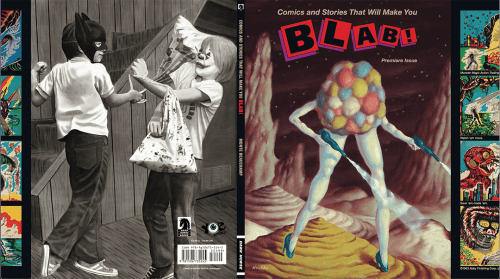
Cover: art by Ryan Heshka

BLAB! Editor: Monte Beauchamp, Dark Horse Books, pp 112, $19.99

Guest Review by Paul Buhle

BLAB!, a creation of the pleasingly twisted mind of Monte Beauchamp and his artists, has been around for quite some time. In fact, the first two issues (1986–87) were published by Beauchamp’s own imprint, Monte Comix. A genius at low-brow art anthologies, Beauchamp began this venture back in the transition or ditch between underground comix and alternative (what might later be called “art”) comics. But art, for Beauchamp, of an almost inexplicable kind.

The title has bounced from his own personal operation, Monte Comix, to Kitchen Sink Press to Fantagraphics and Last Gasp to Dark Horse, where it has become, for reasons known only to Beauchamp, “Blab World!” It was always a planet by itself, and the suspiciously camp rocket-firing goddess on the cover, by Hershka, is clearly interplanetary proof.

Excerpt from “The Death of Comics,” by Noah Van Sciver

Oh, yes, there is some truly understandable stuff here, a lot of it pages by Noah Van Sciver, at 38, the book’s youngest contributor. Louis Wain, a mad artist of cat images in  Victorian Age Britain,  could be a precursive Beauchamp, obsessed with images until he loses his mind. Van Sciver comes back again with a whopper, “The Death of Comics,” aka the story of the best-selling Crime Does Not Pay series. The genius money-making series created by leftwing publisher Ralph Gleason, it encompassed the noir sentiment of the later, disillusioned 1940s as the dreams of antifascist democracy melted into individualism and war-wounded minds that could not be healed.

Excerpt from “The Death of Comics,” by Noah Van Sciver

Van Sciver focuses in on the lives of the Crime Does Not Pay artists, and in particular the genius of graphic sex-and-sadism, Charles Biro. His triumph leads him and the rest of comics into the hands of would-be censors and especially best-selling author Dr. Frederick Wertham. It’s a familiar story to comics devotees, and involves a wider plot of horror comics, MAD’s publisher William M. Gaines, and Congressional hearings that mirrored the hearings held on the purported Communist threat,with near-identical warnings of dangerous Jews poisoning the minds of young Christians. Van Sciver allows himself only a glimpse of the larger picture, because he is following Biro to his own private doom.

Excerpt from “The Death of Comics,” by Noah Van Sciver

A considerable amount of the rest of BLAB! takes us to other strange places in the pulp past, comic book back pages of the 1940s-50s selling miracle hair-replacement liquids, pocket-size miniature monkeys, and other far-fetched hustles aimed at young (or low-capacity) minds. Or to the pulp treatments of great apes, “discovered” only in the mid-19th century, treated as fantastic King Kong types with their hands around near-nude (white) women, or as a link to the link of the “missing link” to the human race, a link that has never been found.  Beauchamp is asking the unasked question, why the obsession, and answering not in prose but by throwing the question back at the reader. Another section offers pages and pages of 19th century attacks on Catholicism, the dangerous threat to everything truly American. Great flying saucer illustrations by Ryan Heshka take us back to the late 1940s and 1950s, the golden era of interplanetary visitations and expectations.
There’s more: Heshka and Beauchamp’s story on Superman’s inventors Siegel and Schuster, taken from Beauchamp’s own anthology Masterful Marks (on great comic artists) is wonderfully weird. He has created no iconic comic figures, neither prompted the empire of capital in comics or been cheated out of it, but he is so much a part of the history, one way or another, that one can hardly tell the larger story without him.

Paul Buhle’s latest comic is an adaptation of W.E.B. Du Bois’s classic Souls of Black Folk, by artist Paul Peart Smith (Rutgers University Press).

2 Comments

Filed under Anthologies, Blab! Magazine, Comics

COVID COP by Dean Haspiel review

COVID COP. Art & script by Dean Haspiel. Dean Haspiel Deep Cuts. 28 pp. $15.

Dean Haspiel is in fine form with this short work in comics that transforms the Covid pandemic into a surreal parody of a sci-fi/horror story. In this scenario, the virus has completely taken over to the point that the government has clamped down hard on anyone disobeying protocol. It’s a take-no-prisoners battle plan and one police officer, Lincoln Bio, is doing his best to follow orders. If you’re a fan of Dean Haspiel, then you can expect that kooky sense of humor, bathed in pathos, made famous in the Billy Dogma comics series.

Our anti-hero Lincoln Bio is aware that he’s living in very strange times making very strange demands on him. How he comes to terms with his marching orders and how he confronts an insurgent group out to kill everyone makes up a good part of this dark comedy. Drawn in the mock heroic style that Haspiel is known for, this comic book will deliver a weird and entertaining jolt right to the jugular and then some. You probably won’t have nightmares from reading this but I can’t guarantee it. And, if there’s a sequel, all bets are off. This comic, by the way, is the first in the developing line of indie comics, Dean Haspiel Deep Cuts.

This comic will defy your expectations, especially if you don’t really know what to expect, and offers up the most recent example of a cartoonist at the top of his game. The winner of a recent Kickstarter campaign, this comic book is making its way to its backers and will make its way to you. Keep up with Dean Haspiel for more details.

4 Comments

Filed under Comics, Comics Reviews, Dean Haspiel

Pop Culture Super Sleuth: Episode 1

This is the first installment of . . .  Pop Culture Super Sleuth . . .

“I’ve been a blogger for almost as long as I’ve been a cartoonist. And then I became a pop culture super sleuth . . . “

*

*

*

*

*

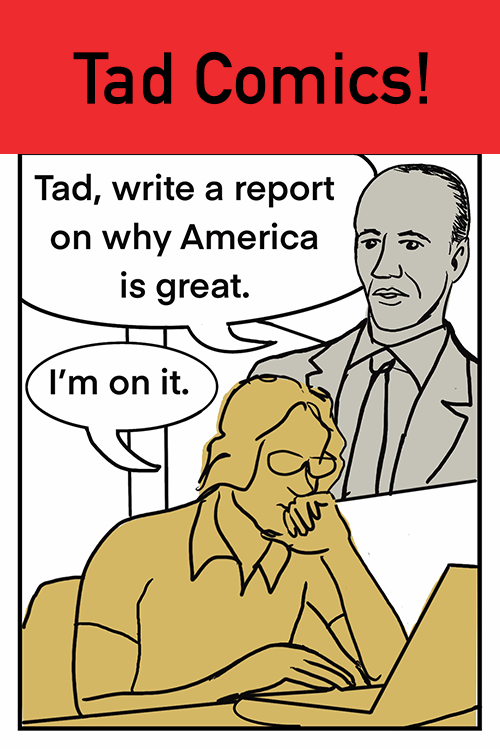
I’m building up steam on this new project. And maybe a little shy. You’ll have to tell me what you think. The character isn’t necessarily me, per se, but a sort of alter ego. It’s fun and it’s all possible in the wonderful world of comics. Am I right? You betcha, I’m right!

Leave a comment

Filed under Barefoot, Comics, Feet, Henry Chamberlain, pop culture, Webcomics

MoCCA Arts Festival 2023: Notes & Observations

Busy and hectic inside and out.

MoCCA Arts Festival returned to the Metropolitan Pavilion in New York City earlier this month and I have some notes and observations to share with you.

Nonstop activity in a place to see and be seen.

MoCCA took place over a weekend, April 1-2, of which I was able to make it for Sunday. I’m not a New Yorker, at least not a resident but a lifelong fond visitor. As luck would have it, I sort of stumbled upon the event this year–although I have plans to participate next year. With that in mind, I was eager to make the most of my visit as well as share whatever insight I’ve collected over the years with a new friend thru comics, Zebadiah Keneally. Between my partner, the cartoonist and writer Jennifer Daydreamer, and myself, we enjoyed the event all the more with his company. We introduced Zeb to friends and colleagues as we came upon them. First off, we were charmed by two wonderful career cartoonists, Dean Haspiel and Gabrielle Bell. Dean chatted with us in an easygoing manner. He’s excited these days about his new comic, COVID COP, which looks fantastic. Gabrielle is doing great and was there to promote her work with Uncivilized Books.

RisoLab at MoCCA.

The last time I’d been to MoCCA was actually twenty years ago, and it was in full swing, riding an intense wave of interest in alt-comics, held at the grand ole Puck Building in SoHo. It was a huge show with a Who’s Who cavalcade of talent, a truly festive circus-like environment and completely free. I was rudely awakened to find that I needed to pay $25 admission for the day. And I literally had to beg for a program since they were nearly out. By comparison, Metropolitan Pavilion is a smaller venue. That said, I quickly got into the groove of things. There was much to see and, no wonder they were almost out of programs. It was nonstop activity.

Ellen Lindner is one of our great cartoonists. She is devoted to whatever project she takes on, like The Strumpet, which is one of the best comics anthologies I’ve had the pleasure to read. And I also know that lately she’s been devoted to a comics project about baseball. Part One and Two to Lost Diamonds are available now. It was fun to chat with her and introduce her to Jennifer and Zeb. Ellen made a wonderfully insightful comment having to do with the creation of comics and the navigating of a comics career: “Do what you want. Pace yourself. Making comics is hard!” Well, perhaps it was a little more nuanced than that but that’s the gist of it–and I must say that I agree. Comics are hard to make, at least the kind that are worth a hoot.

Joe Sikoryak and When We Were Trekkies.

Joe Sikoryak is a filmmaker who decided to follow his brother, R. Sikoryak, into the world of comics. Joe says that is was during the pandemic that he got the idea of a comics series based upon his early years of fandom. When We Were Trekkies follows the adventures of a group of teenagers back in the ’70s who witness, and take part in, the advent of comics fandom as we know it today, going back to the development of interest in reruns of the original Star Trek television series (1966–69) which would evolve into a pop culture phenomenon. The series will be collected into a graphic novel.

Artist Pan Terzis

Panayiotis (Pan) Terzis is an artist, printer and publisher based in New York. Terzis is the founder of the risograph publishing platform Mega Press. In 2015, Terzis co-founded the RisoLAB, a risograph studio based at the School of Visual Arts. The RisoLAB presence at MoCCA was certainly a hit. It was a pleasure to chat with Pan and to purchase one of his prints.

Nikkos Saviolis, a student at Syracuse University College of Visual and Performing Arts.

I got into a conversation with this young student from Syracuse University and lost his card. And then found it later after I had time to decompress. Your comics look great, Nikkos! I briefly got to speak with Frank Cammuso, the professor of Illustration, and was delighted to learn about the university’s comics courses.

Alex Segura

Alex Segura is a writer you may be familiar with, especially if you keep up with comics. Segura is the author of Star Wars Poe Dameron: Free Fall and the acclaimed Pete Fernandez Miami Mystery series, as well as a number of comics. He was at MoCCA in support of his new novel, Secret Identity, published by Flatiron Books.

MoCCA Arts Festival has survived the pandemic and looks to be on steady ground. I could see only happy and content customers in every direction. This festival began in 2002. I was there for its second year and fondly recall the excitement. Indie comics had crossed a significant threshold in the general public’s recognition and anything seemed possible. There was a giddy feeling crossing generations and everyone was there celebrating: Danny Hellman was there. Sophie Crumb was there. Denis Kitchen was there. Kramers Ergot was arguably at its height and flying high. It was fun. People were excited.

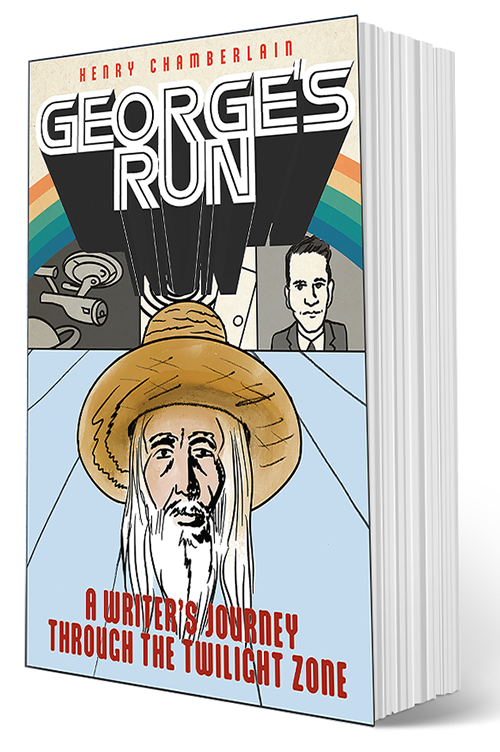
Now, a generation has had time to mature and reflect. Covid has robbed us all of that same innocent euphoria. If it’s there, it’s just not the same. It’s tempered. It’s battle-weary. I’m battle-weary but, as Ellen Lindner pointed out, you’ve got to pace yourself! So, I keep reminding myself that I’m an artist and I’m a cartoonist, even though I don’t really need to remind myself. And, before I made my exit, I stopped by and paid my respects to the Fantagraphics table and kissed the ring of Gary Groth. Well, I say that in jest. It was a pleasure to see him. I handed him a postcard of my new book, George’s Run, and tried my best to give him a fast pitch about it, just for the sake of conversation. You can consider this postcard a preview for my being at MoCCA next year. Anyway, it was a nice thing to do. And I couldn’t help but recalling doing a different pitch for a different book to him at MoCCA all those years ago. I was full of hope then and I’m full of hope now. That spirit is still around. It had better me. It never really left. It’s here. I know it is.

MoCCA Arts Festival returns next year, the weekend of March 16-17, 2024.

2 Comments

Filed under Comic Arts Festivals, Comics, MoCCA Arts Festival

Thaddeus Stevens: The Great Commoner comics review

Thaddeus Stevens: The Great Commoner. writer Ross Hetrick. artist Noah Van Sciver. editor Paul Buhle. Thaddeus Stevens Society of Pennsylvania. 18 pp. $5.

Thaddeus Stevens is an American historical figure who is brought to life in this remarkable mini-comic. You may not recall or recognize the name, and that is part of the reason this little book has come into existence. Stevens is one of the most significant players in the fight for human rights outside of Abraham Lincoln and, some may argue, there is no Lincoln without Stevens. These are the kind of issues dealt with in this pamphlet-sized comic.

Fans of the work of Noah Van Sciver will appreciate the distinctive style and masterful use of the comics medium. If you haven’t gotten a chance, you’ll want to check out Noah’s landmark book from last year, Joseph Smith and the Mormons. You can read our review here. That same intense level of scrutiny, combined with brevity, is on display for this tribute to Thaddeus Stevens. At a brisk and steady clip, each page here packs a punch. We see how pivotal Stevens was in securing freedom and rights for America’s former slaves. Yes, it’s safe to argue that we needed to have Stevens in order to have Lincoln. In other words, we all know and honor Lincoln but credit must be given to the man at the forefront for the fight for freedom and human dignity.

Paper copies are $5 and if you’d like one, send an email requesting one to info@thaddeusstevenssociety.com and one will be sent to you with a self-addressed envelope to send back payment.

Leave a comment

Filed under Comics, Comics Reviews

Van Jensen interview: ARCA, from IDW Originals

It’s the end of the world. Money is meaningless. But the billionaires have got a plan. Sort of like Noah’s Arc, the elite have a space vessel, the Arca, that will take them to a better world, Eden. All they have to do is make sure to keep their slaves, or “settlers,” in line. Effie is one of the teen servants on this vessel. As far as she knows, she should be grateful to have been spared from the billions of people who perished when Earth died. But things aren’t always as they seem. That is the premise of Van Jensen‘s latest graphic novel, ARCA, published by IDW Productions. It is my pleasure to present to you this interview with one of the great writing talents working today in comics.

As I say in my review, this is a story about a reluctant hero who must rise above her quiet demeanor and confront the powers that be. Persephone, or “Effie,” is in the long tradition of reluctant heroes in fiction and particularly in science fiction: the person who emerges as a leader despite their hesitation. As you will come to see for yourself, Effie is a lot like you and me.

In the course of this brief interview, I asked Van if he’d share a little something about the creative process and he provided a gem that I will long cherish and that I’m sure you’ll enjoy too. It involves a tea kettle. Imagine that you’re moving into your new home and you’ve got a thousand things to figure out. Try boiling it down to a tea kettle. If you can pin down your tea kettle, then everything else will fall into place. It’s a wonderful writing exercise: your “tea kettle” can be a brief description of your main character, or a snatch of dialogue or the first couple of sentences in that first chapter. Whatever helps to kick things off. So, I hope you enjoy this interview, stick around for the writer tips, and seek out this remarkable graphic novel.

ARCA comes out July 11, 2023 and is available for pre-order on many platforms including Penguin Random House right here.

Leave a comment

Filed under Comics, Interviews

‘Derborence: When the Mountain Fell’ GN Release in US from Helvetiq

Helvetiq, a publishing house based in Switzerland, announces: Derborence: When the Mountain Fell, based on the classic by C. F. Ramuz of the same name, is being released today in the US and has already been released in Europe in French and German. This graphic novel adaptation highlights the mysteries hidden in the great mountains of Switzerland and is the first in a series of adaptations of C. F. Ramuz’s novels. Derborence is the story of a devastating alpine landslide, of the grief-stricken villagers who are haunted by what they believe is the ghost of a man who should not have survived, and of a woman who refuses to give up hope.
So, that’s the initial brief version of the press release. I love the look and feel of the PDF that I just received so I decided to just jump in and post this. Am I familiar with the work of Fabian Menor? Hmm, I appreciate the loose style.  For loyal readers of this site, you know that I’ll sometimes point you in the right direction with a quick note and circle back later with more. Keep this under consideration and, as I suggest, I will come back to it before you know it.

Leave a comment

Filed under Comics, Comics News

Sparkling Color in Radical Comics: WONDER DRUG and A TRAIN IN THE NIGHT reviews

WONDER DRUG

A TRAIN IN THE NIGHT

Wonder Drug: LSD in the Land of Living Skies, by Hugh D.A. Goldring, Nicole Marie Burton and Dr. Erika Dyck. Toronto: Between the Lines, 2021, 96 pp, $19.99.

A Train in the Night:The Tragedy of Lac-Megantic. By Anne-Marie Saint-Cerny, Christian Quesnel, translated by W. Donald Wilson. Toronto: Between the Lines, 2022. 192 pp, $24.99.

Guest Review by Paul Buhle

Time was, and not long ago, that color printing for radical comics seemed too much to demand, either for the publisher or for the hard-pressed artist. That time may be passing, at least for the innovative, less-than-giant Between the Lines publishers in Toronto.

The story of LSD offered in Wonder Drug is a story almost never heard south of the Canadian-US border, and for good reasons. Aldous Huxley’s major collaboration in the early decades of research happened to be a less-than-famous Candian researcher, Dr. Humphry Osmond.  A veteran of WWII, employed at a psychiatric clinic in a London hospital, Osmond met scientist John Smythies, who would become his long-term collaborator. Osmond coined the term “psychedelic,” but the two seem to have “discovered” the value of LSD and Mescaline.

In distant Saskatchewan, in a research center, the two worked on synthesizing peyote, known and used by Indigenous peoples across the Americas for millennia. Mescaline could be laboratory-produced, as they discovered. But they also hit up on Lysergic Acid Diethylamide, from an ergot fungus. Research became global back in 1943, separately from the Canadian experiments, when a Swiss scientist accidentally ingested LSD and went on a what we could call “A Trip.” Happily, somehow, he did not fall off his bike when returning home.

Here comes the fascinating political part of the book. Saskatchewan, with its social democratic government, The Cooperative Commonwealth Federation (or CCF) set out to attract world scientists for its own version of socialized medicine. Treatments for alcholism among other problems embraced the use of drugs more and more as the decades passed. Dr. Osmund happened to see an ad for a job at the British publication, The Lancet, and snapped it up: the Wayburn Institute was a natural. Osmund also snapped up some LSD.

Enough of the intriguing plot, which carries us foward through better-known territories of the 1960s, official “moral panic” and, everntually, a return to the origins: psychedelics legitimated for the supervised use of psychiatric patients. Onward—says the reviewer—to the way the comic looks and feels. There has never been an all-color comic quite like this one, and we realize it best in the many trippy moments, captured (in my own personal experience) beautifully and successfully, “bad trips” included. The art is therefore a job and a lesson. Better things can be done with comics.

By contrast, A Train in the Night, the saga of a needless train disaster in 2013, offers  the colors of horror. Not so different  in its agonies from East Palestine, the small town in Ohio, USA—if not Trump territory in the Canadian case—the village of Lac-Magnetic is the victim of this story. The former logging town of Lac-Magnetic, if never itself beautiful, stood close enough to the emerging tourist trade in Canada’s majestic northeast to thrive and provide a living for many of its residents.

What is the danger and where did it come from? In an explanatory sidestep, the author/artists take us to fracking and oil in North Dakota, for a few pages. The 2008 economic crisis fell upon all, but hardest upon workers in the fracking operation. A boomtown in an extractive district has grey skies, a lot of heavy drinking by the working people there for temporary well-paying but also dangerous jobs. They risk their lives to extract the oil that goes on trains for destinations far away, with layoffs and health consequences for themselves ahead.

The train that started off in North Dakota, picking up its fracked load, was to deliver the dirty goods to New Brunswick. Lac-Magnetic just happened to be along the way. The train, armored against potential disaster from air breaks, also needed the engine to be engaged for the brakes to work.  Because the company took the short-cut of a one-man crew, the driver himself had not been on hand to apply the hand-brakes. Poor safety regulations and poor maintenance brought 72 tank cars full of crude oil to catastrophe.

As the fire on the train appeared and grew, local firefighters learned to their horror that an earlier problem had been “corrected” with the use of flammable epoxy glue. In the worst possible place, five million litres of toxic explosives went up in a fireball. It was the “the train from hell,” as a  nine-year-old described it. “The fault of one guy who didn’t follow the rules,” as a leading corporate figure responded. This claim was echoed by a raft of similar claims by Canadian authorities.

Less than 200 days later, train service returned with similar toxic loads. Survivors who had abandoned town returned, anxious for their property, enraged that a settlement was so small, for citizens that is. The pharmacies and the supermarket chain got a million Canadian dollars. Investigations were blocked, by leading figures in Canada’s ministry of transport. The railroad corporations across North America basically continue to write their own rules.

The last, beautifully horrible pages of this book are the hellscape/aftermath, with testimony of the victims prominent, and the courage of the survivors our consolation.  At least the corporate and government plan to victimize the engineer himself, part of the project of letting the corporation and government off the hook, is foiled. Some of the strongest drawings of the book capture perfectly the public and corporate officials lying through their teeth, protecting the rich against the public.

It is doubtful that the recent crimes of capitalism have yet been depicted so brilliantly. That the work appeared first in a French edition may help us to understand the levels of Canadian creativity as multi-lingual, multi-cultural. This, at last, may be our consolation.

Paul Buhle

4 Comments

Filed under Comics, Graphic Novel Reviews

Harriet Tubman Demon Slayer Vol. 1 review: America’s Most Wanted

cover by Courtland L. Ellis

Harriet Tubman Demon Slayer. w. David Crownson. a. Courtland L. Ellis and others. Kingwood Comics. 252 pp. $59.99

The subject of slavery has been depicted and processed in many ways, from critical analysis to cathartic expression. This new comics series takes the reader on a mystical journey led by none other than Harriet Tubman (1823-1913), the famed leader of the Underground Railroad (1850-1860) which led enslaved people to freedom in America. Creator and writer David Crownson gives his story just the right bite, which makes sense for this mashup of genres.

Meet Harriet Tubman, Demon Slayer. Crownson goes all out casting Tubman in the role of a superhero ninja freedom fighter who must do battle with whatever monsters slave owners can throw at her: vampires, werewolves, demons, you name it. This trade paperback is a graphic novel collecting the previous six issues to this series. In this story, we follow Tubman as she is helping a family to freedom. Crownson has done a great job with character development. I was quickly engaged in the plight of the Edgefield family: the young girl Vanessa; her parents Caesar and Catherine; and her brother, Nathan. Tubman, like a mysterious angel, suddenly appears in their lives as they are attempting to flee from slavery. The right amount of action, humor, horror and fantasy ensues.

I was immediately intrigued by this book. The cover art got my attention and the artwork throughout, led by Courtland L. Ellis, kept me turning pages. The book begins with a photograph of Tubman and a quote from her: “Never wound a snake; kill it.” That sets the tone very nicely. From what I know, Tubman appears to have been a very driven, reserved and no-nonsense person. That’s the way that Crownson depicts her. She has a job to do and she does it with speed and precision. She knows exactly how to drop a vampire or werewolf in seconds flat. Out comes the magic sword or the wooden stake and that’s that. It’s cathartic to see how swiftly Tubman takes care of all the villains. In comics, we often find some righteous justice and this comic delivers on that promise.

Harriet Tubman and her son, Chip, battle monsters.

To take a historical figure and then put that person into a fictionalized universe is one of the most satisfying things you can do as a writer. No doubt, Crownson is having a great time with his superhero version of Harriet Tubman. On the creative side, it’s great fun. And you can also call it a sacred privilege. Crownson celebrates and honors Tubman with respect and joyful energy, fully aware of the painful and sensitive subject; fully aware of hope and healing. There’s no record of this anywhere but Crownson includes a character, Chip, a young white man, as Tubman’s adopted son. It’s just part of the story, an uplifting use of creative license, and something that Tubman would probably give a wink to and approve of. I’m confident that she’d approve of this whole audacious comic book series and enjoy it.

1 Comment

Filed under Comics, Comics Reviews, Graphic Novel Reviews

Henry Chamberlain, George Clayton Johnson and Pop Culture, interview by Ray Carcases

This is the book for any fan of comics, pop culture, and great stories!

It is my pleasure to present to you my conversation with Ray Carcases on his YouTube channel. Just click the link to the video right below this paragraph. This time around it’s me who is being interviewed. We discuss my new book, George’s Run: A Writer’s Journey Through The Twilight Zone, published by Rutgers University Press. Ray is a kindred spirit and I am so lucky to have gotten this opportunity to chat with him. I look forward to pursuing more of these sorts of conversations with him in the future since he’s a thinker and an excellent conversationalist.

I’ll tell you right now and I’ll bring it up more as we continue to spread the word about George’s Run. I said it in so many words but maybe I didn’t come right out and say it in this interview. I really feel that I’m the ideal spokesperson to guide the reader along as we pursue several pop culture backstories. It’s folks like Ray and myself, from Generation X, that have a certain perspective and so much to share with each other and younger generations. And that doesn’t make me feel “old” at all. It just makes me feel like, as Ray expressed so eloquently, I’m in that group that “know enough to know.” You just don’t get it until you finally reach that point!

An old woman has fought with death a thousand times and has always won. But now she finds herself afraid to let a wounded policeman in her door for fear he is Mr. Death. Is he?

Ray and I got into a groove and built upon one observation after another. We marveled together over the cinematic elements to The Twilight Zone and how you need to appreciate them, “know enough to know,” in order to understand this most celebrated yet misunderstood pop culture phenomenon.  I like one moment when Ray observed the quality of Rod Serling’s epilogue to the George Clayton Johnson masterpiece, “Nothing in the Dark.” Just as the scene comes to a close, that one final thought summing up the tension between fear and reason: “There was nothing in the dark that wasn’t there when the lights were on.”

Gladys Cooper stars as an old and dying woman named Wanda Dunn.

2 Comments

Filed under Comics, George Clayton Johnson, Interviews, Rod Serling, The Twilight Zone