Movie Review: LINCOLN

Tad Lincoln
It was on a bright day in January in 1865 that the United States, despite feverish opposition, passed the 13th Amendment and abolished slavery in the land. The fight to outlaw slavery, once and for all, is the focus of Steven Spielberg’s “Lincoln.” Even if the final outcome is already known to the audience, the full story will likely be new. Remarkably, this film, with its familiar director and familiar subject, feels new too. This is a 21st Century Lincoln led by Daniel Day-Lewis’s brilliant interpretation of a man of his time with a keen sense for the timeless.

Mr. Spielberg uses his Lincoln capital wisely as we begin this film. After some scenes of bloody fighting, we cut to a close-up of two African American infantrymen. They are being interviewed about the Civil War. One man seems content. The other lists the injustices suffered by his people. The interviewer is Pres. Lincoln. We then float up to a dreamworld and there’s the tall and lonely figure in a stovepipe hat standing on the bow of a vast ship. Restraint. Elegant restraint. “Lincoln” proves to have the elegant restraint to make such a movie.

After all the hype, and there’s more to come, “Lincoln,” proves to be a very engaging film. It is not a Frank Capra treatment of our 16th president and that is an understandable concern. As we now know, Daniel Day-Lewis turned down more than one screenplay for this film. The one that finally won him over is based on the book, “Team of Rivals,” by Doris Kearns Goodwin and adapted for the screen by Tony Kushner. It provided a way to maintain that elegant restraint that Mr. Day-Lewis knew was essential.

With the sense of urgency clearly stated, we see a president determined to use all his political capital to steer the country in the right direction. In short order, he means to legitimize his Emancipation Proclamation. The only way to end slavery in the United States is to pass a Constitutional Amendment and the only way to do that is to act immediately. For political junkies, the ensuing dramatization is nirvana. You can almost hear Doris Kearns Goodwin reciting from her popular book in the background. However, this film does offer much more. There is a special urgency you feel in the filmmaking. When Lincoln speaks, everyone listens. We see a jaw drop a bit when the president exercises his distinctive skill to make a point. We feel history being made in a refreshing way as all the players are allowed to live and breathe.

At one point in the film, we see Mr. Day-Lewis in an scene where he ponders over Euclid, the ancient Greek mathematician. It is during a pivotal moment in the war that Lincoln thinks out loud with a couple of young staffers. One of them says he’s an engineer by profession. This sparks Lincoln to quote some Euclidean geometry, “Any two sides that are equal to the whole are equal to each other. Euclid, three thousand years before, stated that this was self-evident.” It is a delightfully low-key moment, one of many, that Mr. Day-Lewis plays masterfully.

In keeping with the restrained vibe in this film, we follow the journey of radical Republican, Thaddeus Stevens, played by Tommy Lee Jones. At first, we don’t seem to know which side he’s on or whether he can be relied upon to check his ego at the door when he needs to. It’s a great performance. One particularly good scene is when he’s confronted by the First Lady, played by Sally Field. She is greeting visitors at a reception and seizes the opportunity to put Stevens in his place. Coming across as a Hillary Clinton complaining over Whitewater investigations, she chides Stevens for his investigating her overseeing renovation of The White House. We see that Stevens can take a good chiding and take it to heart.

The Spielbergian touch is most evident in what we see from a child’s point of view in this film. There was a little boy who lived in the White House, the President’s son, Tad Lincoln. He’s there so often in the film as to be its anchor, conscience, and sense of innocence. When Lincoln and his men gather for a war meeting, the war map is found to have suffered a burn at one corner. Tad Lincoln was there. When Lincoln is patiently awaiting the final vote of the 13th Amendment, he is entertained by Tad Lincoln building a monument from various books and legal briefs. When Lincoln needs to keep up his sense of purpose, all he needs to do is observe the photographs of slaves that Tad Lincoln has been observing. And, when the President is shot, it is Tad Lincoln’s sorrow we focus upon. This is not Doris Kearns Goodwin’s or Daniel Day-Lewis’s doing. This is Steven Spielberg’s.
1 Comment

Filed under American Civil War, Golden Globes, History, Movie Reviews, movies, Oscars, Steven Spielberg

The Six Pack Abs Myth

Six Pack Abs 2013

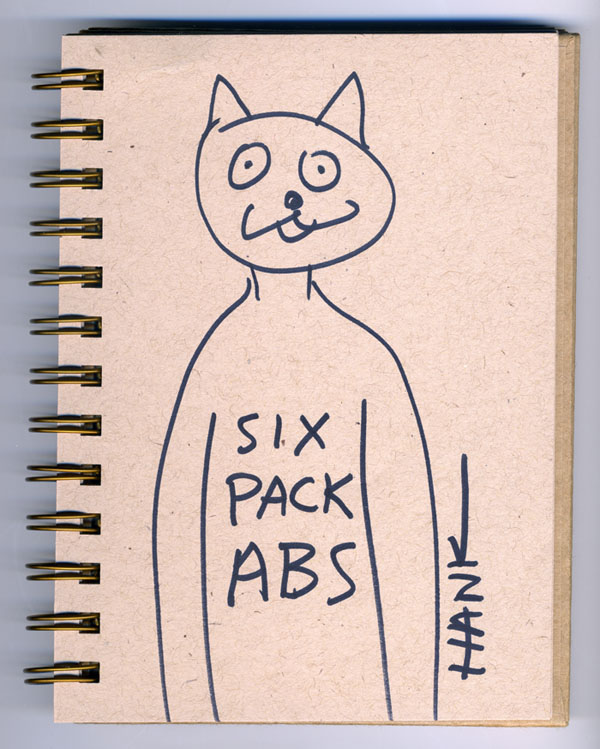
The Comics Grinder meeting this morning at a convenient Starbucks for everyone resulted in our spotting Beautiful Existence in her challenge to only eat at Starbucks for an entire year. We had just posted about her (see post below) and so it was a pleasant surprise to see her in action. Once that excitement died down, we got to business. A consensus grew that there should be more Comics Grinder interviews when possible with much praise given to our interviews with such talents at Mark Z. Danielewski, George Clayton Johnson, and Alex Robinson. There was also an agreement that there is a growing fan base for Comics Grinder reviews. The meeting culminated in a doodle of a strange cartoon cat with the words, “Six Pack Abs” scrawled across its cartoon belly.

Comics Grinder wishes to assure you, all of you, that you don’t need to get caught up in the Six Pack Abs myth. Men’s Fitness is currently featuring a piece about one of its editors going on a regimen that produced the fabled abs. Truth be told, outside of the military, competitive sports or any job that requires intense physical work, there’s no need to worry about this. The guy who documents his abs journey looks just fine in the “before” picture. He’s healthy and there’s nothing wrong with him. If he wants to do some extreme working out, that’s his business but it shouldn’t be touted as his achieving something everyone else should seek out too.

Keep in mind, there’s a book about this regimen being sold. This article is a big sales pitch. Since when has the corporate media been your trusted friend? No, the idea is to keep the myth alive that you need this or that and then you need to buy this or that. You need, you really need, six pack abs and here’s what you need to buy so you’ll think you’re on your way to achieve this unrealistic goal.

Anywhow, if six pack abs were something sensible to aspire to, they would be more common. Sure, the ads say they are easy to achieve–but that’s the pitch. No reason to become a couch potato either but just follow common sense. Given the choice between attempting to get six pack abs and only eating at Starbucks for one year, Comics Grinder concludes that both are too extreme. But, if we had to choose, maybe Starbucks but only for one week.

Leave a comment

Filed under Comics, Comics Grinder

Taking The Starbucks Challenge

Starbucks 2013

There’s someone who is about to try to pull a Morgan Spurlock. Instead of only eating at McDonald’s, like in Spurlock’s “Super-Size Me,” this blogger is planning on only eating at Starbucks. She has set up this challenge for herself which she says is about getting more in touch with being a consumer in Western society.

So what’s left for all the rest of us bloggers? I could pledge to only eat food I buy at a supermarket. That might work since I do that quite a lot. But I also enjoy variety and I like to explore. So, I end up at various restaurants and diners and the like. I’d have to think about it.

Still, I sort of like the challenge. The blogger’s name is Beautiful Existence. Yes, that’s her real name, I just checked on her blog. And this is her blog. It will be fun to follow her exploits.

2 Comments

Filed under pop culture

Kickstarter: A Night At The Sorrento

A night at Sorrento Hotel Henry Chamberlain 2013
Comics Grinder and Henry Chamberlain just want to provide a heads up about an upcoming Kickstarter campaign. The project is a book entitled, “A Night At The Sorrento and Other Stories.” It’s comics and illustrations and the above art is part of that project.

Leave a comment

Filed under Art, Comics, Henry Chamberlain, Illustration

Documentary Review: KEVORKIAN

Jack Kevorkian 2013 documentary

KEVORKIAN is an in-depth look at Dr. Jack Kevorkian, the infamous right-to-die advocate. Filmmaker Matthew Galkin explores the full man as he follows the doctor on his last quest, a 2008 run for a seat in Congress, and goes back over a life that will leave a lasting impression on generations to come. Dr. Kevorkian died in 2011, at the age of 83. This film will be available as a VOD starting on January 15, 2013.

The take away from this documentary is to know when you’ve won. Jack Kevorkian reached a point in his career where he could legally perform assisted suicides. He claimed to have helped end the suffering of upwards to 130 individuals. However, that was not good enough for Dr. Kevorkian. He wanted to officially settle the right-to-die issue once and for all by taking it all the way up to the U.S. Supreme Court. In his view, the only way to do that was to get himself convicted of murder.

We follow Jack Kevorkian on his road to self-destruction with his push to get convicted for murder. From 1990 through 1998, Kevorkian had achieved numerous acquittals thanks to his attorney, Geoffrey Fieger. But, for his trial in 1999, he abandoned his attorney when he needed him most in favor of defending himself. While a brilliant mind, Kevorkian was completely out of his league in a court room. He recited Thomas Jefferson and Cicero and made an eccentric and histrionic plea that earned him 9 years in prison. He was not let out on bail, as he had planned. His case was not heard before the Supreme Court, as he had planned. He went to prison, as he had not planned.

What we ultimately see in Jack Kevorkian is a man that, despite himself, had a worthy cause and was willing to sacrifice himself in the process of supporting his cause. As Jack Lessenberry, a journalist with the Detroit Metro News describes in the documentary, “To see Jack Kevorkian in action is to see an Old Testament prophet, very disagreeable, not someone you’d want over for dinner. But he was willing to discuss death, a subject that we, as a society, are in denial over.”

This documentary, and its subject, so inextricably linked with death, ironically provide some interesting life lessons. Of all the people who could have taken up the right-to-die issue, it had to be Jack Kevorkian, a most persistent but often disagreeable sort. But he was also a very sensitive and complicated man. We get to see how the theme of death haunted him and spurred him into action. He gained his nickname, “Dr Death,” long before he became involved with euthanasia. He was the one to discover how to best tell the time of death of a patient, which is crucial when harvesting organs for transplants. You simply need to examine the eyes. He was a lifelong celibate and, in his case, he cuts a rather lonely figure. What did he do for fun? Well, for one thing, he created paintings about death. Had a better adjusted person taken on the cause of the right to die would that person have made as big of an impact as Dr. Jack Kevorkian? Finally, with his death, his legacy has a chance to live on.

KEVORKIAN is released by Virgil Films.
Available on Digital Download starting January 15, 2013

Leave a comment

Filed under Constitutional Rights, Death and Dying, Documentaries, Dr. Jack Kevorkian, Movie Reviews, Right To Die

Review: X’ED OUT by Charles Burns

Charles Burns XED OUT

If you have not yet read what Charles Burns has been up to lately, don’t panic. You have options. There are two installments of his current wild ride, “X’ed Out” and “The Hive.” Both graphic novels can work as stand alones and you will do fine whether you read one first or the other. Essentially, this is a story that follows the main character mostly through flashbacks and alternates with his doppelganger in a parallel story set in a more cartoony and sinister world. Enjoy it as a multi-layered horror story. We’ll focus here on “X’ed Out,” the first graphic novel in the series which came out in 2010. And you can then proceed to a review of “The Hive” in the next post.

XED OUT Charles Burns

“X’ed Out” is as much about the angst of Generation X as it is a horror story. The two themes actually compliment each other rather nicely here. You will find equal amounts of supernatural horror and the self-inflicted horror of disaffected youth. Consider any art school crowd of a generation ago (or any generation, really) and you will find an inner core of self-loathing malcontented rebels ready to set the world on fire. What will it take? Start up a band? How about a magazine? But what will it ultimately take to make the pain go away? What happens when raw idealism and Prozac aren’t enough?

Charles Burns XED OUT Pantheon

We begin with the cartoony doppelganger. He is sitting up after a restless sleep in an old fold out bed. He has a bandage across the side of his head which can’t be a good sign. He has no idea of where he is. And, once he makes his way out into the outside, we see that this is a very strange place he has found himself in. As we progress through the story, we see that this world is more real in some ways than the hipster world that Doug and his girlfriend, Sarah, are so enthralled by. It’s as if the chickens have come home to roost, as if all those extreme misfits staying up late at night have finally summoned up the Devil. There’s a hint that Sarah may have actually done something like that. And then there’s that strange bandage across the side of Doug’s head.

It really is easy to enjoy both of these installments in either order. Although you can sense the force of the narrative progressing from the first book to the second, the numerous transitions in both books can act as so many elements building up, providing clues. Who is the old man in the creepy cartoon world that Doug’s doppelganger is spying on? Wait, now we have a scene with the old man followed by a scene with Doug and they’re all wearing the same purple bathrobe . Is it a much older Doug in one scene? Maybe. But, in another scene, we know the old man is Doug’s father. “X’ed” will definitely leave you wondering about what will happen next, who is who, and what is what. It’s when the last book in the trilogy, “Sugar Skull,” arrives in 2014 that the sequence will be clear and the resolution unmistakable.

“X’ed Out” and “The Hive” are available in bookstores, comics shops and online. You will find in many shops that both books are neatly displayed side by side. Visit Pantheon Books.

3 Comments

Filed under Charles Burns, Comics, Generation X, Graphic Novel Reviews, graphic novels, Hipsters, Horror, Pantheon

Review: THE HIVE by Charles Burns

1 Charles Burns The Hive 2012

If you are interested in seeing comics taken to their outer limits, the world of Charles Burns is the place for you. “The Hive” is the current installment in Mr. Burn’s work. He’s an artist, at the top of his game, not to be taken for granted. If there was a Mount Rushmore dedicated to comics, there he’d be, alongside Chris Ware, Daniel Clowes and Art Spiegelman, who all happen to be published by Pantheon. Once you put the awe aside, the story and art of “The Hive” sweep you away. This is a story within a story, life imitating art and vice versa, the innocuous mixed in with the surreal. In some respects, it is an even more enigmatic work than the previous, “X’ed Out.”

2 The Hive Charles Burns 2012

There is one key additional layer added since “X’ed Out.” We now see that Doug is looking back at his youth. So, we have yet another version of Doug, this time, in early middle-age. He hasn’t taken care of himself and looks tired and pudgy. He treats the woman he’s now involved with to endless analysis of what went wrong with Sarah, the love of his life. Those days of youthful angst are over and have been replaced with a deeper anxiety only possible once you’ve lived long enough to have your dreams crushed. There’s no more Sarah. She’s not coming back. Try to deal with that, Doug.

3 The Hive Burns Pantheon 2012

As in “X’ed Out,” we have Doug, the cocky provocateur performance artist compared to his doppelganger in a world stranger and more surreal than anything his art could imply. In “The Hive,” we add to that same young Doug, his older despondent self full of regret, full of his own well-earned horrific nightmares. Doug, you once surly youth, searching for pain, you have arrived.

Meanwhile, we follow Doug’s cartoon version as he toils away at a menial job in The Hive, a place run by lizards that appears to be breeding humans. Ultimately, Doug’s own personal misery pales in comparison to whatever is going on in that evil alternate world. The conclusion to this trilogy is entitled, “Sugar Skull,” and will surely be something to look forward to. Given that “X’ed Out” was published in 2010 and “The Hive” was published in 2012, we can expect “Sugar Skull” to come out in 2014.

“The Hive” is published by Pantheon. Visit them to find where to get your copy and learn more about this leading publisher of graphic novels.

5 Comments

Filed under Charles Burns, Comics, Comics Reviews, Graphic Novel Reviews, graphic novels, Horror, Pantheon

Interview: Alex Robinson

Alex Robinson Eating Disorder

Alex Robinson, a very well respected cartoonist, known for his graphic novel, “Box Office Poison,” published by Top Shelf Productions, recently contributed a moving four-page comic to the comics anthology, “Digestate,” edited by J.T. Yost, and published by Birdcage Bottom Books. The theme in that book is food and eating. Mr. Robinson’s piece is about his eating disorder. He describes it and explains how he deals with it. He uses the comics medium to great effect to discuss a complex issue. It’s not often enough that we, as a society, discuss eating disorders but we’re making progress. Add Mr. Robinson’s, “That Peanut Butter Kid!” to a healthy opening up on this subject.

I had the honor to interview Alex Robinson regarding his comic about his eating disorder through e-mail. Here is that interview:

Henry Chamberlain: You recently contributed a piece entitled, “That Peanut Butter Kid!” to the comics anthology, “Digestate,” edited by J.T. Yost, where you are publicly candid about having an eating disorder for the first time. What motivated you to participate and create such a personal work?

Alex Robinson: It’s funny because I told J.T. I was going to contribute but it was only afterwards that I reread the e-mail more closely and realized it was about food. When I look back I remember that a friend of mine did a Facebook post where he talked about being the victim of sexual abuse and the honesty of that really hit me, since I never knew that about him. I think that bravery inspired me to talk about some of my own issues.

It’s also interesting to me because it’s only recently that I started framing my own problem as an “eating disorder” since I think that makes most people think of anorexia or bulimia.

HC: Eating disorders are mentioned more in the media but the actual condition remains something of a mystery for the general public, and even for those dealing with it firsthand.

Do you think the media can play a helpful role in gaining a better understanding of eating disorders?

AR: I would think so. I remember being a kid and there was a made-for-TV movie about a girl with anorexia—which at the time was just coming into the public eye, I think—and the commercial showed a father angrily begging his daughter to just eat something. For a moment I was struck because this was as close as I’d ever seen to someone on TV talking about a problem that, as far as I knew, I was the only one who had. When I watched the movie I was very disappointed that it was about girls worried they were too fat, which didn’t seem at all connected to my own problem, so I still felt alone.

It’s tough because eating disorders are one of those problems where unless you or someone you love is suffering through them it seems dumb—“Just eat something.” George Carlin had that joke about only in America could people develop a mental disorder where they refuse to eat. It’s tough to make sympathetic if you haven’t experienced it first hand. For all of our claims otherwise, we’re generally not sympathetic to mental illness in America.

HC: Of course, eating disorders manifest in different ways. From your viewpoint, what do you see as healthy steps towards recovery?

AR: I can only speak for myself and for me it was years of therapy. I was lucky to find a woman who was and continues to be patient and prod me along.

I think just doing the story was also surprisingly therapeutic. It’s kind of a cliché but exposing your shameful secrets really does lift a burden off of you, if only because it’s one thing you don’t have to worry about anymore. I think it was within a month or two of completing the story that I stopped eating peanut butter altogether. I haven’t had peanut butter in six months, which is amazing considering that I probably never went more than a few days without it before.

HC: In “That Peanut Butter Kid!” you say that you’re concerned that you may come across as glib but the piece is truly nicely balanced. I’m sure you would agree that humor can be very good medicine.

AR: Since it was the first time I’d talked about it publicly I couldn’t trust my own judgment as to the tone. I’m inclined to be funny, especially when I’m nervous, and I also didn’t want to bring people down. I was trying to just explain what life was like for me and not be self-pitying about it.

HC: Would you consider turning “That Peanut Butter Kid!” into a graphic novel? It certainly has all the elements that would make for one.

AR: When I completed the story I found it very therapeutic and the thought crossed my mind to just keep going—a sort of stream-of-conscious rumination about different aspects of my life—but I was also very nervous about the story going public. I figured an alternative comics anthology was enough “under the radar” that it was like going public without going too public.

I also don’t think my life is all that interesting, otherwise.

HC: Any final thoughts or new projects that you are working on?

AR: I’m about halfway done with a new graphic novel that I still don’t have a title for. It’s about a group of guys in their late 30s who are sort of dealing with the issues of midlife—marriage, kids, career, etc. Fun stuff! I’ve been talking with Top Shelf about digitally serializing it so hopefully that might begin later this year.

3 Comments

Filed under Alex Robinson, Birdcage Bottom Books, Comics, Eating Disorders, Interviews, J.T. Yost, Top Shelf Productions

ART: SMITH TOWER MAYHEM By Henry Chamberlain

Smith Tower Henry Chamberlain

Smith Tower is a beautiful landmark in Seattle. Here is a more eccentric view of it with a steampunk vibe.

Leave a comment

Filed under Art, Comics, Hank, Henry Chamberlain, Seattle, Smith Tower

Review: DIGESTATE

Digestate JT Yost 2012

DIGESTATE” is a 288-page food and eating anthology, a veritable cornucopia of cartooning talent. You have fan favorites like Alex Robinson, Kevin Cannon, Noah Van Sciver, Marc Bell, Sam Henderson, and James Kochalka, just to name a few. There are 54 contributors in all and it is edited by J.T. Yost. It is great to see a food theme for a comics anthology and to see it done so well.

Alex Robinson Eating Disorder

Even when food seems to be just food, something to eat when you’re hungry, there is likely a story behind it, something to give it complexity. Cartoonists tend to be complicated too. So, it makes sense to mix the two together. Among a multitude of outlooks on food in this book, the one that stands out is from Alex Robinson who admits to having an eating disorder. Just like a true blue cartoonist, he lets the world at large know about his condition through a comics anthology. Mr. Robinson is one of those cartoonists who has succeeded in making an impression in the world with his best selling works, notably, “Box Office Poison.” Of course, it doesn’t matter what the world thinks when it comes to personal issues. And there’s certainly no shame or stigma to having an eating disorder. Mr. Robinson chose to share that part of his life with readers and that’s what matters. It is a very generous piece that provides insights into eating disorders that you may not know about.

Let’s consider this some more. Buried within this anthology is a significant admission from an important cartoonist, an important member of the pop culture. It is really a big deal as the issue of eating disorders continues to get short shrift in the media. It is like it is something from another planet for your average reader. We are another generation or two away from any real collective understanding on this issue. In Mr. Robinson’s case, the struggle for him is to get beyond eating comfort foods from childhood, such as peanut butter. In his piece, “That Peanut Butter Kid!” Mr. Robinson states that he believes his condition is a result of having suffered sexual abuse as a child. However, he continues to make progress in finding new foods to eat. With the support of his wife, he is eating more healthy foods. If this isn’t a theme for a book, I don’t know what is.

It seems like problems begin to stir when we think too much about food, turn it into something else than food, turn it into something symbolic instead of a means to an end. Ideally, humans want to look out for themselves and provide all the things they need to keep body and soul together. But what do us humans do? We can complicate things. We can be educated about nutrition but, for any number of reasons, we can take another road. Our saving grace is that humans tend to want to improve themselves more that they tend to want to hurt themselves. And we all have our own ideas on how to improve ourselves which range from the sensible to the self-righteous. Such is life. Let’s take a closer look at some samples from this intriguing book.

Jeff Zwirek

In the down to basics category, there is “Caveman Eat,” by Jeff Zwirek, which is an exquisitely rendered silent comic about a caveman hunter. This 8-pager, two panels per page, plays out like a nice piece of animation. Zwirke’s composition and line is very clean and his humor is spot on.

Jonathan Baylis

For something light and fun that might whet your appetite, there’s, “So Brisk,” written by Jonathan Baylis, known for his comic, “So…Buttons,” and drawn by Lisa Rosalie Eisenberg. It’s nicely paced and holds the secret ingredient for making a tasty brisk.

JT Yost

Cartoonists often find themselves taking on the role of the canary in the coal mine. J.T. Yost does an impressive job of providing the facts about the meat industry with illustrations that strike the right balance between restraint and urgency.

Keith Knight

Keith Knight‘s one-pager, “My (Hammy) Vice,” is a very funny ode to bacon.

Noah Van Sciver

Cartoonists are also prone to be subversive. Even your most passive cartoonist can be a powder keg ready to blow. So, there’s some stuff here that pushes the envelope. Your best bet on that front is Noah Van Sciver‘s 3-pager, “3 Bowls of Rasin Bran,” which, as the title implies, is about when things go decidedly south.

Victor Kerlow

And in the simply cute category, Victor Kerlow‘s “Rat Boy” follows a little rat as it forages for dinner.

“Digestate” is a handsome trade paperback, 8.25″ x 10.75″, published by Birdcage Bottom Books. Cover art, with more of her comics inside, is by Cha. This is truly like a cartoonist phone book, a Who’s Who of comics talent. “Digestate” ran a successful Kickstarter campaign and will stand as a shining example of what Kickstarter can help bring about. You can own your very own copy for only $19.95 at Birdcage Bottom Books.

1 Comment

Filed under Anthologies, Comics, Comics Anthologies, Food, Graphic Novel Reviews, graphic novels, J.T. Yost, Kickstarter