
It’s not easy being an artist. We discuss this and much more during our chat.
It’s not easy being an artist. We discuss this and much more during our chat.
Filed under Comics, Comix, Interviews, Museums

‘Good Eggs’ by Hurricane Nancy. Color by Henry Chamberlain.
Filed under Comics, Hurricane Nancy

Art by Hurricane Nancy. Color added by Henry Chamberlain.
Here’s a Halloween Art Cartoon by Hurricane Nancy and an artist statement:
My area just missed a heavy hit from Hurricane Ian: so here is a not too scary cartoon as life was scary in real Time!
Different has become scary to many. Here’s a bit of Halloween which only becomes scary when you ask, “Where are the rest of these Bodies?”
For updates and to purchase art, visit Hurricane Nancy here.

Filed under Art, Comics, Comix, Hurricane Nancy

Outstanding Artist Reimena Yee
Follow the link and you can see all the nominees for this year’s Small Press Expo, along with links to purchase. I believe this is the first time that links have been provided for direct purchase! Scroll below for a list of this year’s winners.
SPX Ignatz Award Winners for 2022:

I See a Knight
– Outstanding Comic: “I See A Knight” by Xulia Vicente (Shortbox). Since childhood, Olivia has been able to see a headless knight invisible to everyone else- is it an omen, a ghost, or something much more real?

Good Boy! magazine
– Outstanding Anthology: “Good Boy Magazine” #1, edited by Michael Sweater and Benji Nate (Silver Sprocket). This 112-page collection features the tagline “Read comics or go to hell.” That says it all!

– Outstanding Artist: Reimena Yee for “Alexander, The Servant, & The Water of Life,” a retelling of the life/legend of Alexander the Great. Yee is also the creator of numerous other comics, including the Eisner & McDuffie-nominated “The Carpet Merchant of Konstantiniyya,” “Séance Tea Party,” and the upcoming “My Aunt is a Monster.”

Mr. Boop
– Outstanding Collection: “Mr. Boop” by Alec Robbins (Silver Sprocket). This is the complete collection of the absurdist and romantic tale of author Alec Robbins being in love with his wife Betty Boop, the 1930s cartoon superstar, presented in a beautiful, deluxe package.

No One Else
– Outstanding Graphic Novel: “No One Else” by R. Kikuo Johnson (Fantagraphics). Johnson’s long-awaited second graphic novel follows Charlene, Brandon, and Robbie as they learn to navigate life day to day with their plans, fears, and desires after a death throws their life into turmoil.

Pee Pee Poo Poo #69
– Outstanding Minicomic: “Pee Pee Poo Poo” #69 by Caroline Cash (self-published). A throwback to ’60s underground comics with a zesty title to boot.

Ride or Die
– Outstanding Online Comic: “Ride or Die” by Mars Heyward features demon cars, street racing, fumbling romance and revenge, and is described as “Christine meets Ghost Rider meets Fast and Furious but gayer!”

The Many Deaths of Laila Starr
– Outstanding Series: “The Many Deaths of Laila Starr” by Ram V & Filipe Andrade with Inês Amaro and AndWorld Design (BOOM! Studios), a five-issue mini-series exploring the fine line between living and dying through the lens of magical realism.

The Lover of Everyone in the World
– Outstanding Story: ‘The Lover of Everyone in the World’ by Beatrix Urkowitz (Parsifal Press). Originally drawn for Popula, ‘The Lover’ joins three other stories about being loved by everyone, and no one, in Urkowitz’s first graphic novella of the same name. The collection was possible thanks to a generous grant from Koyama Provides.

Djeliya by Juni Ba
– Promising New Talent: Juni Ba. A cartoonist from Senegal and France, Ba’s recent work includes the anthology series “Monkey Meat” (Image Comics) and “Djeliya” (TKO Studios), which tells the tale of Prince Mansour and his royal storyteller Awa, as they journey to reach the mysterious Wizard Soumaoro, who guards a fearsome power that he once used to destroy the world.

Krazy Kat’s Ignatz, namesake for the SPX Ignatz Award
Small Press Expo returns next year during the weekend of September 9 and 10, 2023.
Filed under Comics, Small Press Expo, SPX

ANGELS by Hurricane Nancy. Color by Henry Chamberlain.
Hurricane Nancy offers us a meditation on the angels in our lives. I asked Nancy what she meant and she said: “There are wonderful people in life who help and encourage, when one is down. They love to see one creating and expanding their ideas and viewpoints. I call these dear people ANGELS.”

Filed under Art, Comics, Hurricane Nancy

Noah Van Sciver is one of our great cartoonists. He’s been at his drawing table for as long as he can remember–and that has resulted in some very impressive work. It takes a lot to gain any traction in the world of comics and illustration. Van Sciver is one of the brave and persistent souls.
It is my pleasure to share this interview with Noah Van Sciver. We chat about his two new books, Joseph Smith and the Mormons (see Comics Grinder review here) and As a Cartoonist (see Comics Grinder review here). I think some applause and cheers are in order every chance we can get. Along the way, we end up talking about a great deal of Van Sciver’s career as a cartoonist. A lot of dots get connected. So, I hope you’ll tune in and feel free to leave a comment or like over at ye ole YouTubes.

Filed under Comics, Interviews, Noah Van Sciver

As a Cartoonist. Noah Van Sciver. Fantagraphics. 2022. 104 pp. $19.99
One thing you need to get straight is that a bona fide cartoonist, in the truest sense of the word, is someone with a certain way of moving about in the world. I’m a cartoonist, so I should know. Just about every word I write is somehow connected to the fact that I’m one of those people. Word choice is everything. Well, maybe it’s more like every line of thought but it can get right down to the granular level. It’s absolutely a way of life, and that’s not necessarily a good thing or a bad thing. It is what it is–and those among us who are part of this tribe, made up of so many groups and subgroups, understand that this unique ability to write and draw comes at a price. No one is born with this ability, although some people are definitely more predisposed to creating comics than others. Sorry, but it’s a skill that demands a number of factors to fall into place if you intend to reach a certain level of excellence. You don’t see a short person agonizing over the fact that they will never be an all-star basketball player. And, yes, I know about Spud Webb, but he’s the exception to the rule. Anyway, most people don’t give a hoot about whether or not they will ever create comics of any form, let alone win awards and accolades for their effort. This is the story about someone who really cares about all those things having to do with becoming a masterful cartoonist. We’re talking about Noah Van Sciver. And he’d be the first to tell you that being a cartoonist is no walk in the park–and yet, there isn’t anything he’d rather be more.

This book is about all the peculiar things about being a cartoonist. That’s really what it all boils down to. Being a cartoonist is peculiar. That, in and of itself, is a burden and yet it is also alluring. Essentially, it’s something special that envelopes the person seeking to master it. Just like any other creative endeavor, like starting up a band. Noah Van Sciver’s story is one of struggle, persistence, and ultimate accomplishment. This book, a collection of short works in comics, adds up to a portrait of the artist, perhaps his best set of portrait pieces to date. This is, you could say, an anthology all by one creator. In the world of indie comics, cartoonists are always scrambling to jump on board and join the latest collective effort, a way to promote each other and get one’s work out into the world. It’s all about getting people to read your work. A lot of Van Sciver’s auto-bio comics are about this ongoing pursuit of readers: courting them, wanting them, wondering where they are. For all the anti-social behavior that a cartoonist may engage in, at the end of the day, it’s all about the readers. Maybe the cartoonist isn’t exactly looking to spend too much time with any particular reader, but it’s nice to know that they’re still around.

Van Sciver wins over his readers without playing up to them. Far from it. In fact, he’s more than happy to speak the unvarnished truth byway of his social satire. He has a way of evoking authenticity. A real cartoonist, especially someone like Van Sciver who uses his own life for material, is always striving to be real and avoid any false notes. So, Van Sciver’s best work comes across as totally unfiltered. Of course, it’s a balance of artifice and reality. But a reader still ends up getting caught up in the moment as when Van Sciver is juggling an interview with a prominent reporter and his uncouth brother who has just crashed upon the scene. In this specific moment, a big event at an art museum featuring Van Sciver’s work, the hierarchy is easily hijacked. No sooner has Van Sciver begun to talk to the reporter than he’s put off by her obvious remarks. He even sympathizes with his train wreck of a sibling, if only for a moment.

In another more complex scene, Van Sciver is a visiting artist on campus and must find a way to tolerate those less fortunate but still quite annoying. A relatively young man, actually thirty and not so young, who loves to wear a top hat and read teen girl manga, is prime fodder for Van Sciver’s wrath. The guy in the top hat, it turns out, is easily triggered by what he sees as Van Sciver’s micro-agressions. Nevermind that Top Hat has a lot of arrested development to deal with. Now, Top Hat’s focus is to get Van Sciver into trouble by reporting him to a school administrator. There’s no winning for Van Sciver when he’s called in to explain himself. Later, he tries to turn the other cheek and be positive. But, ultimately, Van Sciver is right back to being underwhelmed by life on campus.

A wonderful companion piece to this collection is the 2018 graphic memoir, One Dirty Tree, looking back on a childhood with eight other siblings in a less than ideal situation. This is a closer look at a ramshackle upbringing: living in squalor, an abusive and irresponsible father who is a Mormon zealot, and a young man with a very uncertain future–a young life miraculously held together by dreams of some day becoming a famous cartoonist! By force of will and determination, Noah Van Sciver turned his dreams into a reality beginning with his series of collected comics, Blammo. That would lead to his early masterpiece, his first graphic novel, 2012’s The Hypo. And, most recently, 2022’s Joseph Smith and the Mormons. This new book, As a Cartoonist, comes full circle with a collection of short works that feature comics from Blammo, among other sources.

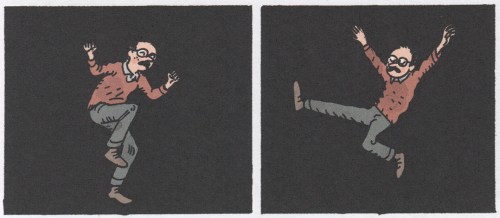
In 1980, Woody Allen made Stardust Memories. He had already made two of his masterworks, Annie Hall and Manhattan, and he seemed to be at a crossroads: keep making funny movies or make more serious films. Perhaps there was a bit of a struggle. Just see Interiors. Anyway, a certain Woody Allen universe had been created and he was pretty much set and would go on to create a wonderful body of work. Van Sciver pays homage to that creative turning point in a moment in the book where he recreates Allen asking space aliens for advice. It’s a perfect opportunity for Van Sciver to insert himself and provide another take on the absurdity of it all.

Van Sciver is now at a point where he can look back and see significant milestones, including Fante Bukowski, which alone would thrill any cartoonist to call their own, and which Van Sciver can say confidently he brought into this world. Having recently become a father, Van Sciver honors his son, Remy, with a dedication and the final comic in the book. I think it’s safe to say that Noah Van Sciver is on the right path.
Filed under Comics, Comics Reviews, Noah Van Sciver

Comics artist Brandon Lehmann
First off, I invite you to read the review I wrote for The Comics Journal to the book in question, G-G-G Ghost Stories. That will add to the enjoyment of the following interview with the creator.
There are details in Brandon Lehmann‘s comics that will come back and reveal themselves upon another reading. Look closely and you’ll see, tucked away amid the backdrop of a mega-bookstore, copies of Brandon Lehmann’s new book, the recently released, G-G-G Ghost Stories, in the panels to his story, “The Werewolf Expert.” Another reading will reveal a copy of Henry Miller’s Tropic of Capicorn, in the hand of a child, a secondary player in this finely-crafted farce. The key idea here is the subject of creating such a thing as a “finely-crafted farce,” and why quality will win out in the end. Lehmann’s sense of humor is an absurdist and existential sensibility. Lehmann has been making comics for about fifteen years featuring observational and satirical work. In this new book, he focuses in on playful use of horror tropes. For this interview, we met at Seattle’s Smith Tower, a favorite haunt of erudite cartoonists and, of course, ghosts. We begin this conversation just as I sit down to join Brandon. I notice pot stickers have already been ordered. (We staged a bit of a humorous intro. You’ll see what I mean if you view the video.)
Hey, Brandon, well, I see you’ve started without me, as usual. Nice to run into you this way.
I just hang out up here in Smith Tower and read my own comics.

G-G-G Ghost Stories by Brandon Lehmann
So, what have we here (picking up a copy of Brandon’s book). Is the proper pronunciation just as it reads, G-G-G Ghost Stories?
When I named it, I was hoping for some awkward interactions at the sales counter. “I’ll take, G-G-G Ghost Stories, please.”
That would be a Scooby-Doo influence, right?
Yeah.
Interesting that we’d find ourselves in Smith Tower since, as everyone knows, this place is haunted.
Yeah, we saw a couple of ghosts on the way in. I was like, “Ahhh, it’s a g-g-g ghost.”

Page excerpt from “The Lfyt”
I think of a lot of your work, like the “The Lfyt,” as being mini-masterpieces. Do you sometimes think in those terms, “I’m going to create something that’s so spot on that everything works perfectly.” Does that make sense to say that?
Yeah, I always feel that when you’re working on a book, especially, you can get into this mode where everything you do just works. And then, when you finish a book, I have this period where I just struggle and I can’t seem to draw anything. But when I’m making a book, I can set a schedule, everything works on the first try for some reason. If that makes sense.

Page excerpt from “The Werewolf Expert” story from G-G-G Ghost Stories
It does make sense. I’m a certified cartoonist myself, as you know. Now, tell us about “The Werewolf Expert,” the longest work in the book.
There’s a trope in horror movies and TV shows where someone needs to seek an expert on the occult and it’s always someone who it doesn’t make sense would be an expert. Like, you’ll have this guy who works at the bowling alley as a mechanic and, for some reason, he’s a vampire expert. In “The Werewolf Expert,” someone consults a Barnes & Noble bookstore employee, and it’s the employee’s first day. And they shouldn’t know anything about werewolf lore but part of the B&N orientation training is that they teach all about werewolf lore. That employee knows a lot but eventually he consults his supervisor and she knows even more about werewolves to a ridiculous degree. So, it just keeps building on that premise.

Desperately seeking werewolf advice.
How would you describe your humor?
It’s absurdist and existentialist. There’s a lot of gags in the book that you can repeat with a similar premise. For the story we’re discussing, there’s a gag that I use a lot. The story is progressing from one point to another and then I’ll throw a wrench into it. And it will spin off in an insane degree. For instance, the bookstore customer seeking advice has a daughter named, Shawnda. He begins yelling at her, she’s off camera. Later, we see her and there’s more of this yelling. That sort of silly exchange is something I like to do in my work.

Panel excerpt from Brandon Lehmann’s Instagram.
There’s a beauty to your work. The humor is consistent. The art is consistent. You must go through a slew of experimentation before you hit upon what works, what’s on point.
The whole concept of the book is classic ghost stories. So, that’s the anchor. We’re dealing here with stories everyone is familiar with in one form or another. The story, “The Lfyt,” we were just talking about, is based upon a popular ghost story about picking up a hitchhiker who turns out to be a ghost. Another good example is “The Viper,” another popular children’s ghost story. The tension builds as he keeps calling and announcing when he’ll arrive. In my story, it turns out that “The Viper” is a guy with a thick German accent, who is just an innocent window wiper.
I didn’t know about that children’s ghost story. The actual one, not your satire!
Yeah, it’s real. There’s also one entitled, “Okiku,” based on a popular Japanese ghost story about a woman who was murdered because she refused to become a samurai’s mistress. She had been thrown down a well and, each night, she appears to seek her revenge. That was actually the basis for the Ringu movies. There’s the books. It was also on stage, as kabuki theater. So, yeah, I gather up all these ghost stories and given them my own spin.
Well, I’m sure this will intrigue readers. Thanks so much for sharing this with us. Where is a good place to find your work?
One good place is my own site for Bad Publisher Books. You can also find me on my Instagram: @brandon.lehmann. And you can find it at various bookstores. In Seattle, there’s Fantagraphics Bookstore, Elliot Bay Bookstore and Push/Pull. Lots of places on the net, like Birdcage Bottom Books.
Thanks, Brandon!
Thank you, Henry!
Filed under Comedy, Comics, Ghosts, Interviews, Seattle