Helping Comics Shops During Covid-19: GIVE COMICS HOPE

GIVE COMICS HOPE

If comics collectors could consider looking over their collections and donating five items or more with a value of $100 to GIVE COMICS HOPE, the proceeds will be distributed to comic book shops around the world struggling during COVID-19. It’s as simple, and powerful, and idea as that. Of course, there are other ways to donate as well. Just visit the GIVE COMICS HOPE website right here. This is one of the best things we can be doing now regarding comics and all the hard-working comics retailers!

GIVE COMICS HOPE is a new charitable initiative founded by Bill Schanes, the teenage founder of Pacific Comics, the comic store that became a chain, a creator-owned publisher and a comic book distributor before it was bought up by Diamond Comic Distributors in the eighties. So, Bill Schanes knows the comics industry like the back of his hand–and he’s the perfect person to lead the way in supporting comic book shops. A press release follows:

Continue reading

Leave a comment

Filed under Comics, Comics News, COVID-19

Interview: Steve Duin and Shannon Wheeler on ‘The Mueller Report Graphic Novel’

The Mueller Report Graphic Novel

For anyone interested in politics, history, the legal system, or a riveting story, there’s something for you in The Mueller Report Graphic Novel. Yes, it would be nice to have every potential voter read this now as we approach one of the most consequential presidential elections in US history. But, beyond that, this is a book that will spark interest in one of the most misunderstood and significant documents to come out of government. Bob Mueller gets the last word, so to speak, and tells a story every American can appreciate, no matter what your politics.

In conversation with Steve Duin and Shannon Wheeler

“Robert Mueller did not go in intending to bring anyone down. What he uncovered was plenty of evidence of very bad behavior.” So, cartoonist Shannon Wheeler sums up The Mueller Report in our interview I had the privilege of getting to talk to both creators of the book: journalist Steve Duin and cartoonist Shannon Wheeler. During our conversation, we got to explore the nuts and bolts behind the daunting task of creating a graphic novel adaptation of such a mammoth book. The truth is, Robert Mueller is an excellent wordsmith so the book itself is not really a slough as it is lengthy and so a graphic novel acts as a wonderful gateway.


You can read my recent review of The Mueller Report Graphic Novel, available as of September 16, 2020. And I hope you enjoy our freewheeling interview. Just click above. For more information, visit IDW Publishing right here. This is a fine example of the sort of books we want to see come out of the multi-layered world of comics. Bio and history are the backbone of graphic novels and this one stands head and shoulders above a lot of titles. You want a book that goes the extra mile and delivers satisfying results? Then this is it.

The Mueller Report Graphic Novel

Leave a comment

Filed under Comics, Donald Trump, Interviews

Review: ‘Paying The Land’ by Joe Sacco 

Paying The Land by Joe Sacco

Guest Review by Paul Buhle

Paying The Land by Joe Sacco. New York: Metropolitan Books, 264pp, $29.99.

A decade ago, in a smallish Swiss comics shop, I could identify only two American artists, or (memory doubtful here) perhaps three. Art Spiegelman’s Maus. Joe Sacco’s Palestine. And on a back shelf, evidently dating from years earlier, Gilbert Shelton’s Fat Freddy’s Cat. Robert Crumb had slipped from a high perch, and Shelton, an entertainer always more popular among Young Europeans, was rapidly receding into the past. During the last decade, several of the dozens of US titles translated into French would probably have found their way into this little shop, it if survives. But we can be sure that the first famed Sacco volumes would have stood alongside others of the same artist. He has the pen that seems almost mightier than the swords, planes, bombs, devastated populations and the rest of the war horrors that have made up his journalistic work.

To call Sacco “American” is a bit of a jump. Maltese by origin, we learn in the erudite Disaster Drawn: Virtual Witness, Comics and Documentary Form (2016) by Hillary L. Shute (co-editor of Mega-Maus) that Sacco grew up with family stories of bombings and death during the Second World War, missing relatives and all the rest. War has never, Shute says, not been part of his life. Did Sacco escape the endless warscape by replanting himself in the US northwest? Not hardly. As a visual journalist of war’s horrors, he has placed himself in harm’s way in the Balkans and Gaza, among other places. This time around he finds another war, but it is the war of centuries and the fighting is what the Pentagon has come to call Low Intensity: the War against Canada’a native populations.

“This is going to end the world.”

Paying the Land is a stunning work, both alike and strikingly different from his earlier journeys into suffering and survival. It is substantially an oral history, and as a trip-weary oral historian, I can appreciate the contrasting points of “orality” (memory expressed by an interviewee) and “history” (a different kind of record). Sacco is trying to do both, no easy thing, and at the same time, to present them visually. With himself as part of the book’s story.

He meets a large handful of tale-tellers who are central, but he determinedly makes the trip himself into Canada’s distant North, in a used pickup-truck, over roads that turn into non-roads, ever further to the land of the Dene, the grouping of related tribes. There, the subsistence economy thousands of years old has been replaced, but only with deep contradictions, by the oil economy.

A couple of generations ago, good jobs appeared for men able to open the land up to drilling, mainly by cutting trees. For a while now, they have demanded controls including their own observation of the drilling process, down to the toxic chemicals pumped into the ground. They can watch the despoliation of the landscape, the lakes and streams, and the inevitable decline across the scope of the animal population. But what choice do they have?

“I remember our lives being led by the environment.”

Sacco takes an invaluable step backward in time, through oral histories, to the forced assimilation ongoing since the nineteenth century but intensified after the Second World War. The many cruelties of Catholic education have only begun to be redressed in Canada: virtual seizure of children from villages into towns, violent punishment for speaking aloud in native languages,  widespread sexual abuse, a violence that turned inward, leading to alcoholism, abuse of children by other children and teens, and a loss of anything like self-identity, including the loss of the older skills and their meanings.

What should the deserted family do? Often, it meant abandoning “life in the bush” to find their children, give them a kind of life, often in a grandparents’ setting, while the parents tried to scratch out a living. Here and there a good priest or nun, with education as something better than cultural extermination.

Neither the families nor Sacco is looking to some recaptured utopia. Life in the backwoods was harsh and in some ways, it was easier to live in even the most modest  house equipped with heat, a modern stove, refrigerator and so on. Besides, and this is one of Sacco’s clearest discoveries, there was no going back in any case.

Toward the end of the book, some of the strongest personalities emerge and flower, and most of them are women. They create new cultural institutions to carry on traditions for the next generations, and they help to make life more possible—free of the accursed alcoholism above all—in the present.

Mineral extraction companies are ruthless and the politicians who make their work possible are just as ruthless, even with the added political rhetoric to make things sound better. Against these pressures, tribal leaders try to balance the shifting economy with ecology. Young folks, raised with no language retention, begin to rebuild cultures as much as possible, networking from sub-group to sub-group.

The book closes with a memorable festival of Dene young people and perhaps that is the most hopeful thing imaginable, Not to await some outside force to heal them or to accept that their inferiority, as a culture, means that they need assimilation for healing.

This is quite a message, delivered in stirring Sacco style, with perhaps less of a Sacco-presence or irony than is usual with him. It’s quite a book.

Paul Buhle is the rare leftwing scholar of comics. He is coeditor of the Paul Robeson comic, to be published in October, and drawn by Sharon Rudahl.

“There were no buildings like they have now.”

5 Comments

Filed under Comics, Graphic Novel Reviews, Guest Column

Review: ‘The Mueller Report Graphic Novel’ by Steve Duin and Shannon Wheeler

The Mueller Report Graphic Novel

The Mueller Report Graphic Novel. written by Steve Duin. illustrated by Shannon Wheeler, IDW Publishing, 2020. 208pp, $15.99.

How easily we seem to forget or let ourselves become distracted. If you are still not sure about Donald Trump, then consider this fresh new look at a book all of us need to better understand. Take a look at The Mueller Report Graphic Novel. I speak as a reasonable person in search of the truth. I have read many passages from the actual 448-page Mueller Report along with a very insightful pamphlet-sized digest e-book from the Lawfare Institute, Reflections on the Mueller Report. My conclusion well over a year ago was that there is plenty to work with to compel Trump’s removal from office–but then the screws were tightened, as in Barr’s own meddling, and nothing ever happened. What if there was a truly compelling movie that people could watch? Well, how about one better: here is a concise and incredibly clear presentation putting to use the power of comics, visual storytelling at its best! Alright, I have an advance copy. Let’s dig in and have a look.

All the President’s Men.

The simplest way to tell a story is to keep it simple. This is a story that explores criminal acts as well as ways of obstructing the investigation of said acts. It’s a story crying out for a narrator! Duin and Wheeler give the floor over to Bob Mueller and, quoting from his report, manage to pump some fresh blood into the telling. Mueller, as narrator of this book, goes right to work. One of Trump’s favorite tactics is to call anything that calls him out a hoax or a witch hunt. The Mueller Report was all just a witch hunt, according to Trump. However, as Mueller clearly states, real indictments were handed down. Leading the pack: Michael Flynn, George Papadopoulos, Michael Cohen, and Paul Manafort. All of them were found to have lied to Mueller’s investigators about their connections to Russia. While compelling evidence has either been destroyed or made unavailable that would most clearly demonstrate collusion, the facts remain that a lot of key players were willing to lie about their own involvement.

William Barr redacted Mueller Report.

I suppose the saddest thing would be if the general casual reader cannot invest two hours to read this graphic novel. Is it just a fantasy to think that enough readers for this book could emerge and it could turn the election in favor of Biden? One can dream! The fact is that Duin and Wheeler do their best to keep partisan politics at bay and stick to the facts in the report. Maybe they know better than most that this is a labor of love that simply had to be completed. Like any JFK conspiracy scholar understands, whether anyone reads their book right away or not, at least the book is out in the world. Readers will emerge, one way or another. History may not change from this book. But the book will have done something to shed some light on our recent history.

Shouldn’t we be concerned more than ever?

Just follow the money.

One thing that really sticks with me about the whole 2016 Russian collusion saga is that infamous June 9, 2016 meeting at Trump Tower. You know, the one where key Trump players meet to discuss obtaining dirt on Hillary Clinton from Russian operatives. Even Duin and Wheeler get caught up in the Russian adoption red herring thrown in whenever this meeting comes up! This is my Trump Tower test and Duin and Wheeler, following the report, chose not to emphasize a key fact. Mueller simply didn’t bother with this little fact or it just never registered. Anyway, the reason that Russian adoptions always come up is because that was the excuse used for holding that meeting. But, not only that, this was code from the Russians. The reason for using the subject of Russian adoptions was to signal that Russia would maintain a ban on Americans adopting Russian babies for as long as Russian human rights violations were sanctioned through the Magnitsky Act. In other words, this cover story was a way to bring home the point that the removal of the Magnitsky Act was high on Putin’s wish list. In my book, if I were to do one, this is a very interesting little fact and a telling clue.

Sow discord and ramp it up! It worked in 2016. And it looks like it’s working in 2020.

All in all, I’d love to follow the progress of this book in real time as it makes its way to readers. The drawing style here is a steady functional look and that’s really all that is required in this case. In fact, the sometimes gritty and cobbled-together look of the art adds to a sense of urgency. It fuels the idea that there is crazed hope to get the book out in time for it to possibly influence this presidential election. It’s a great fast pace that will draw the reader in, now and twenty years from now. In fact, the more I go over it, the more I’m fascinated by it.

The long tortuous process of “covering your ass.”

I can’t help but get that creepy feeling that we are living through this again but we just can’t seem to see it. Yes, believe it or not, the calls are coming from inside the house! Yeah, that sort of feeling. Trump is here and he is well on his way to sticking around. Ideally, a book like this should sway enough voters away from Trump. No doubt, that thought has crossed the minds of everyone involved with this book. Yeah, what if every potential American voter was up to speed on the contents to this report? In a lot of ways, I believe that the American public has already gotten the gist of it. Liars lie and Trump & Co. do lie, and not particularly well. But that was never the point, was it? As Roy Cohn and Putin, and all the other baddies figured out long ago, the only thing that matters is to lie, lie, lie. Keep lying. Hit them hard. Hit them harder. A graphic novel can do many things but it probably won’t remove Trump from office. That said, I’d love to be proven otherwise. Looking forward, Trump and Russia is far from over with and this graphic novel will be ready whenever someone needs it. And, who knows, once all the MAGA hats have been lost and forgotten, maybe we’ll be in the mood for The Mueller Report, The Musical.

So many dots to connect.

On March 24, 2019, the White House released a four-page press release presenting its summary of Special Counsel Robert Mueller III’s investigation into Russian interference during the 2016 Presidential election. On April 18, 2019, the actual redacted report was finally provided to the public.The difference between these conclusions have led to much debate, and while clearly Mueller’s findings are pivotal to our understanding of modern political history, national security, and American democracy, most Americans have still not read the entire 448-page report to be fully informed on the topic. It seems like right about now would be a good time to make up for lost time. Well, it will definitely remain a must-read well past this election. You can read the actual report for free right here. And you can order The Mueller Report Graphic Novel, available as of September 15, 2020, right here.

This will not end well for Donald Trump.

In The Mueller Report Graphic Novel, Eisner Award-winning New Yorker cartoonist Shannon Wheeler and veteran Oregonian journalist Steve Duin reach for truth against a torrent of political spin to lay bare the findings of Mueller’s investigative team. Wheeler and Duin capture history in ink, providing a clear, concise, and entertaining way for readers to truly understand the conclusions that Mueller recorded during his exhaustive investigation.

Encouraging readers to ignore the interpretations of political parties and cable news pundits, this comprehensive graphic novel brings to life a range of key scenes, beginning with Trump’s campaign and continuing over three years of his administration. The staggering laundry list of Trump’s inner circle’s controversial contacts, statements, and perhaps even coordination — enough to overwhelm any student of the U.S. Constitution — provides a roadmap to understanding events of the past four years.

With a bite familiar to fans of his long career in political cartooning, Shannon Wheeler reflects on the subject: “I look forward to the day when I no longer have such rich material to work from.”

For more information on IDW’s library of political cartoons, visit IDWpublishing.com, and be sure to follow IDW on social media for the latest information on The Mueller Report: Graphic Novel.

7 Comments

Filed under Comics, Donald Trump, Graphic Novel Reviews, politics

Review: TITAN by François Vigneault

TITAN by François Vigneault

Titan. by François Vigneault. Oni Press, Portland, OR, 2020. 202pp, $19.99.

François Vigneault is one of the most original and fun cartoonists out there today. If you have not checked out his Titan comics, this is the perfect time since Oni Press presents a new collection of the series coming out November 10, 2020. Consider this an advance review. I will follow up with another Titan-related post closer to the release date. It is often said that the best science fiction has a timeless quality as well as comments with precision on its own time. Titan certainly is relevant to our tumultuous times full of protest. Meet João da Silva and Phoebe Mackintosh: one is a member of the ruling elite; the other is a member of the exploited working class. It is the not-too-distant future, about a hundred years from now. The old mining colony of Homestead, on a moon of Titan, is steadily working its way to obsolescence. In order to try to salvage the situation, MGR First Class da Silva arrives on the scene from HQ, planet Terra. His liaison officer is one of the best workers, Phoebe. What could go wrong? For starters, João and Phoebe immediately sense some hot chemistry between them. Meanwhile, the entire order of things is coming apart at the seams.

Page from TITAN

Vigneault has a very vivid and direct drawing style. Whether he draws with a pen and paper or directly on a digital tablet, he has nailed quite a fluid and expressive line. This is a wonderfully cartoony style with an immediate impact that attracts the reader to the characters and action. Vigneault has a way of evoking emotion that holds its own with any other drawing style with its authenticity. I don’t feel a false note anywhere. Any reader will get hooked into what becomes of João and Phoebe and, by extension, the rest of Homestead, even the whole freaking solar system! In the grand science fiction tradition, the fate of worlds depends upon these two–but also with a touch of irony to boot. This isn’t your father’s sci-fi, after all.

I’ll tell you one thing. Vigneault manages to pull off one of the trickiest of metaphors. In lesser hands, I think this would have felt like a heavy-handed gambit. The ruling class from Terra appear tiny in comparison to the Titan workers, genetically modified for maximum efficiency. When João and Phoebe become lovers, the symbolism is totally brought home, and the stark contrast is pretty powerful, even beautiful. João and Phoebe, as different as they are, fit together. João is small and nimble. Phoebe is large and strong. João can’t help but bring up his concern over whether he is big enough for her to which Phoebe reassures him that “size doesn’t matter.” Over the course of their story, the reader comes to appreciate how right they are for each other.

Panel excerpt: Phoebe reassures João.

Comics and graphic novels share much in common. If a comic strip, for example, is done right, it will entice the reader to go through it more than one quick scan. A reader may not even be fully aware of it but it is likely that the comic strip is digested a number of times, as in a loop. The reader seeks the stimulation and goes for repeated rewards. And then it’s time to move on to something else. But, at that moment, a comics loop experience is enjoyed. And so it can, and does, happen with graphic novels. There are certain passages that must be re-visited. Pages to go back to, pages to compare. Some academics theorize that comics are read in an entirely different way when displayed on a gallery wall and perhaps that even hurts the comics experience. Well, I don’t buy it. I say all this because Vigneault has managed to find that sweet spot in making comics where his creation entices the reader to linger, to re-visit, and to revel in the work. Not all comics do that and perhaps some comics creators don’t even factor that in. But Vigneault does.

I really good novel, or movie, or graphic novel, invites repeated consumption. It is built-in. That is going on here with Titan, a story of two star-crossed lovers caught up in events bigger than themselves. If the characters are compelling, the events in question can recede into the background and come up to the forefront as needed. Not all novels are created equal, of course! The point here is that Vigneault, in the driver’s seat as a auteur cartoonist (both writer and artist), fully understands how to drive a story forward. He is someone who would be fun to chat with over an interview. We would discuss process, storytelling in general, as well as social commentary and science fiction. In the end, what we would talk about would be the art of making comics. It’s not easy and, like the most complex of art forms, it seems to require a bit of magic. You will definitely find something magical about this graphic novel with its pacing, symbols, and daring.

1 Comment

Filed under Comics, Graphic Novel Reviews, science fiction

Review: ‘Jack Kirby: The Epic Life of The King of Comics’ by Tom Scioli

Jack Kirby, via Tom Scioli, tells his own story.

Jack Kirby: The Epic Life of The King of Comics. by Tom Scioli. Ten Speed Press, 2020. 202pp, $28.99.

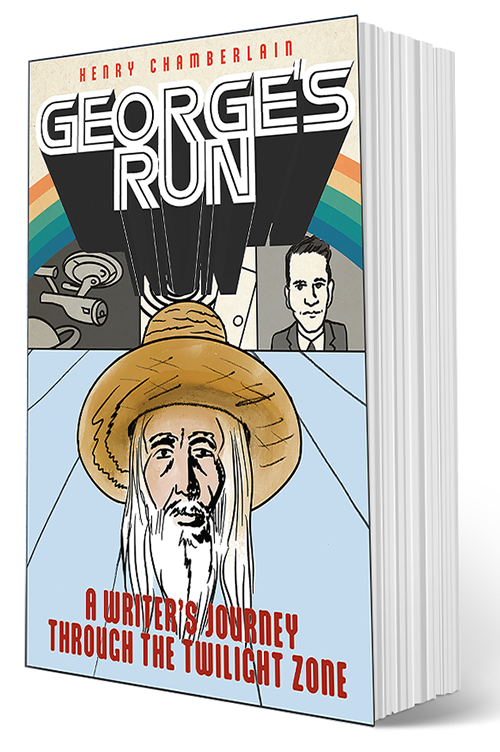
A book that is doing very well these days and just got back on my radar is an in depth look at the life and times of Jack Kirby, the creator or co-creator of such icons as Captain America, the Fantastic Four, and Black Panther. Now, all sorts of things pop in and out on my radar but this one compels me to share. Tom Scioli feels like a doppelganger at the moment: we are both auteur cartoonists determined to get to the bottom of the story. Scioli hitched his wagon to one star and I did to another. In Scioli’s case, it is Jack Kirby. In my case, I have a book that I’m shopping around with George Clayton Johnson as your guide to a wider world. In Scioli’s case, Jack Kirby is the focus and, from there, we see a wider world too. Also, I must stress that Scioli is a one-person operation, a true auteur. That’s the same way that I roll. It’s not easy but it is most rewarding and, in fact, provides the reader with the ultimate comics artistic expression coming from one creator.

Jack Kirby: The Epic Life of the King of Comics

Recently, I’ve been taking a very close look at Jack Kirby and how he figures in the study of comics as a true art form. We are very enlightened about comics, as a general audience, but the dust perhaps has yet to settle on all these questions of what constitutes art. For the record, I will state again that there is no question that comics is as legitimate an art form as any other. Comics is a big deal and will only continue to grow in estimation and appreciation. As for Mr. Kirby, well, of course, he was an artist of the first rank in many ways and he dazzled all of us with what he was able to accomplish. What is so fascinating about Tom Scioli’s book is that here you have a true comics artist providing his own careful and idiosyncratic look at another comics artist. This is an outstanding example of an extended study of comics created in the comics medium. We have precious little of these sort of works, comics about comics. In fact, we have far more comics about painters, novelists, and various other historical figures. Ah, but that will change. We still have plenty of time, right? No rush. We can relax and appreciate Tom Scioli’s very home-grown approach, which all adds up to visual storytelling at a deep and intimate level. Scioli has a very offbeat style as unique to him as his own handwriting or his casual chatting. So, in a sense, Scioli has pared it all down to just a regular guy holding court and riffing on one of his favorite subjects. Yes, that’s perhaps the best way to look at this book. Maybe it’s not an official biography or the last word on Jack Kirby but it is definitely an unusual and personal take on him.

Page excerpt

Take any figure, well-known or not, and there’s a very high probability of creating a compelling story in the right hands. That is precisely what is happening here. Tom Scioli has the passionate interest in his subject and that energy propels the reader. It’s not like anyone, outside of friends and family, knew anything about the actual life lived by Jack Kirby. And some things will always be left to speculation. Here is where the power and magic of comics comes into play. The comics creator is compelled to make you, the reader, care and so the process begins from the very first page, the very first panel. On page one, we see a family history unfold back in the old country of Galicia. Kirby’s parents meet in New York City at an Austrian social and, by the next page, little Jack Kirby is born, August 28, 1917. It is a life of limited resources on the Lower East Side but it is a life full of love. By the very next page, little Jack awaits the birth of his baby brother while poring over the pages of Krazy Kat comics! And, by page four, it is clear that the only color in little Jack’s life comes from the Sunday funnies. Jack is set for a life of adversity with comics already proving to be a gateway to something more.

Yes, Jack Kirby worked alongside Bob Kane for a time.

Fast forward and, indeed, a life emerges filled with challenge and adventure. And, of course, it is Jack’s particular life story that will bring the reader up close to how things worked at Marvel Comics, specifically the working process known as “The Marvel Method,” with the legendary big-name editor, Stan Lee–and all the complications and frustrations that wrought. But before any of that happens, a lot of rain must fall, a lot of struggle and uncertainly coupled with steadfast determination. Before Jack Kirby became part of the Marvel bullpen, he had to pay his dues in a far more modest role as part of Will Eisner and Jerry Iger’s comic strip staff. This is a staff that included, among others, the now much despised Bob Kane, infamous for stealing credit for Batman from co-creator Bob Finger! Just one of the gems of info to be found here.  As the saying goes, a creative person needs to be their one biggest fan. That is what Jack Kirby was for himself, his biggest fan. It was that level-headed persistence that would get him to the promised land of the Fourth World and a legion of his own fans.

Page excerpt

One of the great things about a book like this is how it ends up becoming a treasure trove of information. It just happens naturally as all the dots are connected. This is what resonates the most with readers, especially those invested in art process and pop culture. Even a casual reader will get caught up in the events and get hooked into learning more about the lad who literally picked up a copy of Wonder Stories just before it was swept into a gutter and saw his fate within the pages of the first pulp magazine he’d ever read. As I’m in a position to articulate these matters regarding comics, pop culture and art, I’m thrilled to do so here and on any panel at any comics convention. This very unique look at Jack Kirby is very exciting stuff. No doubt, when you find one book like this, well, it leaves you wanting more. That is what leads me to know that my book will find a home. I’m so happy to see that Tom’s book found a fine home and has been welcomed by scores of readers!

Jack Kirby by Tom Scioli

6 Comments

Filed under Comics, Graphic Novel Reviews

Review: ‘Kent State: Four Dead in Ohio’ by Derf Backderf

Panel excerpt: Allison and Bonnie amid a backdrop of emerging unrest.

Kent State: Four Dead in Ohio. by Derf Backderf. Abrams ComicArts. New York. 2020. 288pp, $24.99.

The connection between journalism and comics runs very deep. You could say the first cut is the deepest of all. Comics and journalism in America goes back to its very roots. So, it is no surprise that many of the comics I am drawn to and that I feature here have that connection. In fact, more have it than don’t; some more than others. That said, it makes a lot of sense why some cartoonists have one foot in art and the other in writing, specifically nonfiction, more the literary journalism type. This brings us to Derf Backderf who is an excellent example of the cartoonist auteur compelled to explain and report. In his latest graphic novel, Backderf takes his formidable visual storytelling skills and presents, Kent State: Four Dead in Ohio.

Kent State: Four Dead in Ohio by Derf Backderf

It’s a little silly to call yourself a graphic novelist unless you’ve really established a track record of creating graphic novels. Usually, it’s just fine to call yourself a cartoonist. That said, Derf Backderf could, if he chose to, claim such a title. Beginning with his comic strip, The City, a favorite in numerous alt-weeklies, Backderf was building the skills required to take on a longform work in comics. Then things started to evolve when Backderf created a 24-page minic-comic about his high school friendship with Jeffrey Dahmer, who later became the infamous serial killer. That project developed into the 2012 award-winning graphic novel, My Friend Dahmer. This led to another graphic novel about sanitation workers, 2015’s Trashed. And now, after more than a quarter century of creating comics, perhaps Backderf could call himself a graphic novelist, if he chose such a title! What is clear is that Kent State is a masterful work: a sprawling narrative with great clarity and sense of purpose.

KENT STATE by Derf Backderf

Backderf, like an auteur movie director, focuses in on one specific character and action after another, then rolls back to provide perspective, and so on. The reader gets to know a set of main characters who can speak to events from various vantage points. Some are in the thick of it. Some have their facts wrong. Some are simply caught in the middle. Backderf gives the narrative a journalist’s objective framework with the goal of setting the record straight: events are presented in chronological order, backed up by dates and documented facts, all leading up to May 4, 1970, when members of the Ohio National Guard fired into a crowd of Kent State University demonstrators, killing four and wounding nine Kent State students. The book spans five days: April 30 to May 4, 1970.

Every great cartoonist has a certain predominant approach and sensibility. What is clear about Derf Backderf is that he’s very empathetic. When you want someone to bring a subject to life and make sense of it, call on a cartoonist like Backderf. We are living in very chaotic and complex times now and so were we at the height of the Vietnam War. Backderf begins his graphic novel with a quick look back at himself at the time of the Kent State shootings: a 10-year-old boy aware of the world in a “kid’s clueless way.” But it’s where you were at such an age that will stick with you for the rest of your life. So, just as once working as a sanitation worker or somehow briefly being friends with a future serial killer can compel a creative mind, Backderf confronts the big story brewing when he was a boy waking up to the world-at-large. In fact, the Backderf family was living only a few miles away from Kent State which adds another layer. It all adds up to a personal quest to understand and get the facts right.

Page excerpt: Protests, 1970.

It’s quite impressive how Backderf intertwines his research within this book. The reader is never taken out of the narrative and all the moments specific to each character. When you wonder about the future of transmedia storytelling, if you even do, I highly recommend a book like this that lets you know all is well with simply processing information one page at a time. For instance, there’s a sequence following the misadventures of Terry, the most inept of student protest infiltrators. At one point, a segue is made to get a deeper look at the historical record. Here, Backderf provides a lot of eye-opening information like the fact that the CIA’s Operation CHAOS is still not fully declassified. This was during the Cold War and the Nixon administration’s full tilt war on student protestors. These factoids then give way back to more intimate circumstances like the relationship between two students, Sandy and Jeff. While Sandy cooks dinner, Jeff confides in her his being scared of even leaving the house for fear of being spied on or stopped by soldiers. Maybe listening to the new Paul McCartney album can relieve the tension for a little while.

Panel excerpt: Sandy and Jeff try to find a little peace.

You see the world a certain way. And a auteur cartoonist writes and draws the world in a certain way. Backderf’s people are imbued with a fierce earnestness that leaves them looking determined but also quite vulnerable. Even the most formidable villain in Backderf’s world is susceptible to the most utterly heartbreaking self-doubt. These are mostly melancholy people who aspire to some possible happiness. And that’s a profoundly good place to start any story. In this case, this is a story of young men who are trapped by the military industrial complex eager to draft them off to war. Protesting the war comes as natural as breathing. Each one of these young men protesting, along with their female compatriots, wishes to breathe. An older and conservative generation mostly doesn’t understand and it can be easy for some to demonize the protestors. In order to steadily keep track of events, Backderf’s empathetic voice makes a big difference. It is this empathy that will guide the reader and provide an accurate and insightful look at what happened at Kent State fifty years ago. Has it been that long? Well, it can feel like it was only yesterday and, in a way, it was.

4 Comments

Filed under Comics, Graphic Novel Reviews, Protest

Interview with Artist Henry Hate

Let’s Riot by Henry Hate

This is a perfect time to post my interview with artist Henry Hate. There have been a number of delays along the way but, perhaps some experiences need to stew and process. It was near October of last year that I visited the Prick! tattoo shop, a home base for Henry Hate in the Shoreditch neighborhood of London. Autumn was creeping in on the streets that Jack the Ripper once lurked; now made up of boutiques and fine eateries co-existing with taverns and other mysterious structures dating back centuries. Prick! tattoo parlor fit right in.

Amy Winehouse by Henry Hate

Just as Henry Hate was rising in prominence as a tattoo artist, Amy Winehouse, early in her career, walked into Henry’s tattoo parlor and became a regular client. Well, that’s the stuff of legend. It was that sort of serendipity that can lift an artist’s life and launch them on a path to a bright future.

Trouble by Henry Hate

Henry Hate, without question, has developed into an excellent artist. That’s not the issue. I love how we both get to the heart of the matter in the video segment of our conversation. For me, I’ve always aspired to great creative heights and that’s usually some mix of journalism and art. When the opportunity arises, I want to go deep with an interview. There is absolutely an art to a good interview. It is sort of like a dance or a courtship. You need to engage the subject. A dynamic emerges. Everything going on behind the scenes culminates. In this case, I was pairing us as both artists and human beings on a journey. The result was Henry Hate speaking to a lifetime commitment to art. It’s as if being an artist is not enough. You can accept yourself but will others follow? That will remain in the background but, first and foremost, you need to give yourself over to your art.

A Work Created Under Extreme Duress by Henry Hate

Into each life, a little death must enter and a lot of self-discovery. As a youth, Henry Hate discovered, despite his family’s resistance, that he was gay and he had no one to apologize to about it.

Prick tattoo parlor.

Henry Martinez evolved into Henry Hate. Sure, the name is part illusion, facade, and brand. It is part of what you do, even if you never really change your name. You need to build up some armor when you go from art to business. “It’s a machine. Success. You’ve achieved a goal. Okay, now what? Sometimes, I wonder if it wouldn’t be easier to just paint pretty clouds.”

Prick! tattoo shop, East London.

“In Los Angeles, when you say you’re a writer, you’re probably a waiter. But, here in London, someone says they’re a painter or a screenwriter, they are actually doing that,” said Hate, at one point, as we chatted about the realities of fame and fortune. Our talk turned to Amy Winehouse and how she dealt with stardom. “Amy was this London girl who suddenly had to deal with fame. It’s a machine. Success is a goal. Now, you have to keep the wheels moving. It’s a lot of pressure to put on someone when art becomes a business. It’s work now, not a love or a passion.”

“Lee McQueen and Amy both had that genuine quality about them, a shyness, unsure about their work. When you stand up and present your work, you need to wear that mask. Both of them had that vulnerability. Great artists, you don’t really know that much about them. Amy would have been happy just singing in a bar and have that pay her bills.”

Mother’s Tongue, mixed media on canvas, by Henry Hate

Informed as much by Tom of Finland as by Andy Warhol, the work of Henry Hate has charted its own path. It is bold, audacious, sly and thoughtful. It is worldly and fanciful. And, without a doubt, it is genuine.

This is work that proudly stands before you, naked or wearing a mask with sexy panache. It’s about art and it’s about life, living large while also maybe on the margins. Maybe there’s still something to prove. Or maybe it’s just time to face the world without flinching. I love the sense of play, like “Let’s Riot,” a punk young Queen Elizabeth echoing Jamie Reid’s art for the Sex Pistols 1977 single, “God Save the Queen.” Or the life-affirming “Mother’s Tongue,” with the subject defiantly showing off her stud.

As Hate says, his work is about sin and redemption. You see each character reveling and unapologetic. Why can’t a little more life fall into one’s life? Why can’t vice and salvation find a way to co-exist? These are questions that can take a lifetime to confront, let alone answer–and Henry Hate is up to the task.

Find Henry Hate at henryhatefineart.com.

Madonna Mouse, excerpt, by Henry Hate

2 Comments

Filed under Art, Artists, Interviews, Tattoos, Travel

Review: SEEDS AND STEMS by Simon Hanselmann

SEEDS AND STEMS

Seeds and Stems. by Simon Hanselmann. Fantagraphics, 2020. 360pp. $29.99.

It is fitting to talk about Simon Hanselmann after having recently reviewed Comic Art in Museums since Hanselmann is the perfect example of a contemporary cartoonist on display within rarefied museum walls. Last year, was the show, Simon Hanselmann: Bad Gateway (April 12-Aug 11), in Seattle at the Bellevue Arts Museum. 2019 also had shows in Spain and France. Well, it’s all very fascinating since the adventures of Megg, Mogg and Owl are not rarefied at all–in fact, they are downright scatological! It’s material that would make the original ’60s underground comix creators proud. What is most compelling about Hanselmann’s work is how fiercely uninhibited it all is. A world where a witch is in a sexual relationship with a cat and a werewolf is perpetually engaged in drunken orgies with vampires is not something that just suddenly pops out of nowhere. It comes from a determined mind. A mind that takes creative risks and likes to work on the razor’s edge.

From Simon Hanselmann: Bad Gateway, BAM, 2019.

Simon Hanselmann is a serious artist making some of the most surreal and irreverent art: original, driven and purposeful. Seeds and Stems is the latest book with Fantagraphics; it collects numerous short works by Hanselmann and it helps explore the creative process. Much of it springs from work that originally appeared as minicomics. Hanselmann became a big name only a few years ago, circa 2013, around the time of a newspaper-format comic with Floating World Comics. Fans quickly grew from Hanselmann’s Girl Mountain  on Tumblr. Megahex, from 2014, certainly cemented his reputation. You can read my review here. It was zines, then webcomics, books, then more zines. Seeds and Stems collects minicomic work going as far back as 2009, with most of the book covering 2016 up to 2019.

From Simon Hanselmann: Bad Gateway, BAM, 2019.

If you enjoy rummaging through B-sides and learning about the creative process, then Seeds and Stem will be most satisfying. The world of minicomics is, at its core, the entry point for emerging new talent but it can also serve as an ongoing platform for established artists. Minicomics, as the name implies, are rather humble home-made projects. That’s not to say that a minicomic is to be dismissed as amateurish, although many an aspiring cartoonist would fit that profile. To some degree, you can think of them as comparable to an open mic night at a comedy club. Minicomics are very flexible, open to being very experimental and even treated more like a sketchbook than finished work. So too with young comics on stage not bothering with appearances and reading material right off their phone. That said, minicomics can also be highly polished works all to themselves. With that in mind, you are in for a treat with this collection.

9 Comments

Filed under Comics, Comics Reviews, Fantagraphics

Animation Review: SUPERMAN: RED SON

Superman: Red Son. Made-for-Video Animation, 84 minutes. Directed by Sam Liu. Written by J.M. DeMatteis. Executive Producers: Bruce Timm and Sam Register. DC Entertainment. Release Date: March 17, 2020

The timing could not be better for one of the great Superman stories. DC Entertainment presents the 2020 animated feature adaptation to Mark Millar’s 2003 Superman: Red Son. This time around, the script is by another DC Comics stalwart creative, J. M. DeMatteis. This is a great time for the alternate-history genre. There’s For All Mankind on Apple TV, a what-if about the Soviets landing on the moon first. And there’s The Plot Against America on HBO, a what-if about a Fascist America. Now, make room for a what-if about a Soviet Superman. This is about what would happen if the future Superman never crash-lands in some corn field in Kansas. But, instead, baby Superman crash-lands in the heart of Cold War-era Russia.

Comrade Superman?!

This is arguably the very best of DC Elseworlds adventures. In this very heated and confused time for U.S.-Russian relations, a story like this provides refreshing perspective. What would Superman do if he found himself part of Mother Russia and developed a loyalty to Communism? Apple pie and baseball don’t mean a thing to the Man of Steel. Superman is more loyal to the latest five-year plan for the people. Capitalism is just a funny concept and the U.S.A. is more suspect than respected. And leading the “greed is good” pack is, of course, Lex Luthor.

What will appeal to a lot of viewers is the clever look at how the world works. No sooner does Superman, innocently enough, prove to be the strongest man at the Kremlin than he’s elevated to the post of supreme leader. To Superman’s way of thinking, he is genuinely compelled to do good. That’s just how he’s built. But he has to do it within the confines of the Soviet Union. Conversely, Lex Luthor, not so innocently, proves to be the strongest capitalist, riding an “America First” campaign, that lands him in the White House. Along the way, we have different versions of the Korean War, the Berlin Wall, and even a taste of Dr. Strangelove thrown in for good measure.

If you’ve never read the original comic book or collected graphic novel, then you’re in for even more of a treat as this story unfolds. I think the animated feature hits all the right marks and could not be better. Voice actors like Jason Isaacs, as Superman, and Vanessa Marshall, as Wonder Woman, lead a lively cast. This is something that I could even see as a major live action movie version. It is certainly a compelling example of what can be done within the formidable world of the DC Universe.

8 Comments

Filed under animation, Comics, DC Comics, Superman