Noah Van Sciver is one of our great cartoonists. He’s been at his drawing table for as long as he can remember–and that has resulted in some very impressive work. It takes a lot to gain any traction in the world of comics and illustration. Van Sciver is one of the brave and persistent souls.
It is my pleasure to share this interview with Noah Van Sciver. We chat about his two new books, Joseph Smith and the Mormons (see Comics Grinder review here) and As a Cartoonist (see Comics Grinder review here). I think some applause and cheers are in order every chance we can get. Along the way, we end up talking about a great deal of Van Sciver’s career as a cartoonist. A lot of dots get connected. So, I hope you’ll tune in and feel free to leave a comment or like over at ye ole YouTubes.
As a Cartoonist. Noah Van Sciver. Fantagraphics. 2022. 104 pp. $19.99
One thing you need to get straight is that a bona fide cartoonist, in the truest sense of the word, is someone with a certain way of moving about in the world. I’m a cartoonist, so I should know. Just about every word I write is somehow connected to the fact that I’m one of those people. Word choice is everything. Well, maybe it’s more like every line of thought but it can get right down to the granular level. It’s absolutely a way of life, and that’s not necessarily a good thing or a bad thing. It is what it is–and those among us who are part of this tribe, made up of so many groups and subgroups, understand that this unique ability to write and draw comes at a price. No one is born with this ability, although some people are definitely more predisposed to creating comics than others. Sorry, but it’s a skill that demands a number of factors to fall into place if you intend to reach a certain level of excellence. You don’t see a short person agonizing over the fact that they will never be an all-star basketball player. And, yes, I know about Spud Webb, but he’s the exception to the rule. Anyway, most people don’t give a hoot about whether or not they will ever create comics of any form, let alone win awards and accolades for their effort. This is the story about someone who really cares about all those things having to do with becoming a masterful cartoonist. We’re talking about Noah Van Sciver. And he’d be the first to tell you that being a cartoonist is no walk in the park–and yet, there isn’t anything he’d rather be more.
This book is about all the peculiar things about being a cartoonist. That’s really what it all boils down to. Being a cartoonist is peculiar. That, in and of itself, is a burden and yet it is also alluring. Essentially, it’s something special that envelopes the person seeking to master it. Just like any other creative endeavor, like starting up a band. Noah Van Sciver’s story is one of struggle, persistence, and ultimate accomplishment. This book, a collection of short works in comics, adds up to a portrait of the artist, perhaps his best set of portrait pieces to date. This is, you could say, an anthology all by one creator. In the world of indie comics, cartoonists are always scrambling to jump on board and join the latest collective effort, a way to promote each other and get one’s work out into the world. It’s all about getting people to read your work. A lot of Van Sciver’s auto-bio comics are about this ongoing pursuit of readers: courting them, wanting them, wondering where they are. For all the anti-social behavior that a cartoonist may engage in, at the end of the day, it’s all about the readers. Maybe the cartoonist isn’t exactly looking to spend too much time with any particular reader, but it’s nice to know that they’re still around.
Van Sciver wins over his readers without playing up to them. Far from it. In fact, he’s more than happy to speak the unvarnished truth byway of his social satire. He has a way of evoking authenticity. A real cartoonist, especially someone like Van Sciver who uses his own life for material, is always striving to be real and avoid any false notes. So, Van Sciver’s best work comes across as totally unfiltered. Of course, it’s a balance of artifice and reality. But a reader still ends up getting caught up in the moment as when Van Sciver is juggling an interview with a prominent reporter and his uncouth brother who has just crashed upon the scene. In this specific moment, a big event at an art museum featuring Van Sciver’s work, the hierarchy is easily hijacked. No sooner has Van Sciver begun to talk to the reporter than he’s put off by her obvious remarks. He even sympathizes with his train wreck of a sibling, if only for a moment.
In another more complex scene, Van Sciver is a visiting artist on campus and must find a way to tolerate those less fortunate but still quite annoying. A relatively young man, actually thirty and not so young, who loves to wear a top hat and read teen girl manga, is prime fodder for Van Sciver’s wrath. The guy in the top hat, it turns out, is easily triggered by what he sees as Van Sciver’s micro-agressions. Nevermind that Top Hat has a lot of arrested development to deal with. Now, Top Hat’s focus is to get Van Sciver into trouble by reporting him to a school administrator. There’s no winning for Van Sciver when he’s called in to explain himself. Later, he tries to turn the other cheek and be positive. But, ultimately, Van Sciver is right back to being underwhelmed by life on campus.
A wonderful companion piece to this collection is the 2018 graphic memoir, One Dirty Tree, looking back on a childhood with eight other siblings in a less than ideal situation. This is a closer look at a ramshackle upbringing: living in squalor, an abusive and irresponsible father who is a Mormon zealot, and a young man with a very uncertain future–a young life miraculously held together by dreams of some day becoming a famous cartoonist! By force of will and determination, Noah Van Sciver turned his dreams into a reality beginning with his series of collected comics, Blammo. That would lead to his early masterpiece, his first graphic novel, 2012’s The Hypo. And, most recently, 2022’s Joseph Smith and the Mormons. This new book, As a Cartoonist, comes full circle with a collection of short works that feature comics from Blammo, among other sources.
In 1980, Woody Allen made Stardust Memories. He had already made two of his masterworks, Annie Hall and Manhattan, and he seemed to be at a crossroads: keep making funny movies or make more serious films. Perhaps there was a bit of a struggle. Just see Interiors. Anyway, a certain Woody Allen universe had been created and he was pretty much set and would go on to create a wonderful body of work. Van Sciver pays homage to that creative turning point in a moment in the book where he recreates Allen asking space aliens for advice. It’s a perfect opportunity for Van Sciver to insert himself and provide another take on the absurdity of it all.
Van Sciver is now at a point where he can look back and see significant milestones, including Fante Bukowski, which alone would thrill any cartoonist to call their own, and which Van Sciver can say confidently he brought into this world. Having recently become a father, Van Sciver honors his son, Remy, with a dedication and the final comic in the book. I think it’s safe to say that Noah Van Sciver is on the right path.
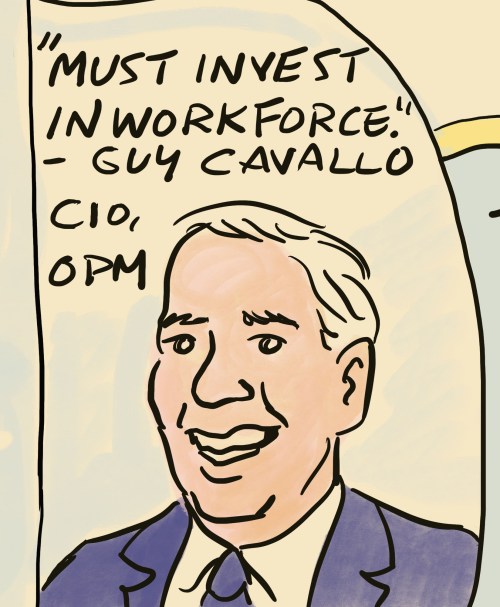
FedTalks, 24 August 2022, Digital Transformation. Infographic by Henry Chamberlain.
FedTalks is a conference series, presented by FedScoop, a gathering of leaders in government and the tech industry. Last week’s FedTalks, on Digital Transformation, sparked a number of lively discussions centered around the focus of the citizen experience. A recent executive order issued by the Biden administration presents a bold vision of streamlining government service to the public. This order is a comprehensive plan to meet the challenges of the 21st century, especially when, left without leadership, government actions are slow and often counterproductive. But that is no longer something that can be ignored or put off for the future, not when our national security hangs in the balance. With that in mind, this conference took on the challenge of presenting twenty-three talks, one after the other, each lasting around ten minutes each, discussing as many facets as possible of the work ahead as the federal government faces a major shift in how it operates: a full-scale digital transformation.
But, you may ask, hasn’t the country already gone through a digital transformation? Well, has it? Business has. Many individuals have. But government, not so much. Government, left to itself, will take the path of least resistance, the path that is most familiar, and definitely not the path that is most visionary. There’s a reason that the very mention of government conjures up thoughts of red tape and bureaucracy. Think about it. Anything that involves government usually, if not always, involves some painfully slow process of unnecessary complexity. And maybe we’ve heard promises of change before. What makes things different this time is that our sluggish ways have left us completely vulnerable to attack from other countries and various other malicious agents.
The Executive Order on Transforming Federal Customer Experience and Service Delivery to Rebuild Trust in Government is the catalyst for change that has arrived not a moment too soon. Here is a link from The White House on that order.
Will an executive order truly make a difference? This one is certainly one of the most articulate, ambitious and credible of such orders. The big takeaway from this FedTalks conference is that people want to rally around a certain set of goals that make sense and can actually lead to a lot of good. So, in that regard, this order is a football in play. The game has begun. And no one appears to want to let the hard-fought momentum slip away. The overall consensus is that experts in tech and government already know that we have a broken system and any push toward fixing it is more than welcome.
FedTalks is a series of discussions and presentations that brings together some of the greatest minds in the tech, government and academic communities. Now in its 13th year, FedTalks is the premier federal IT event, showcasing the most important conversations on topics like modernization, the evolution of zero trust security, the adoption of emerging technologies like AI and 5G, and the importance of culture, talent and innovative thinking in making the government a more digital institution.
Here at Comics Grinder, we remain a steadfast observer and commentator on the cultural landscape, and various related themes. For a look at my specific visual storytelling services, I invite you to refer to WordtoPicture.com.
This monumental work has a considerable backstory. Artist Noah van Sciver, the eighth of nine children, was born and raised in a Mormon home in New Jersey until his parents divorced when he was 12 and his mother brought him along a different path. This disjuncture, followed by others more typical of teens in the last third of the twentieth century, may have stirred his artistic impulse. No doubt he looked to the example of an older brother who went successfully into the Superhero comics big time. Experience, separation and a sort of rejoining the earlier world thorugh art: these are large themes in artists’ and writers’ lives for centuries. That Van Sciver has taken on Mormon founder Joseph Smith is no accident.
Van Sciver has a penchant for US history, especially the history of the nineteenth century, rife with religious and social contradictions, idealists, cranks, Protestant revivalists and utopians. Joseph Smith, unlike nearly all the others, was a successful institution-builder (Mary Baker Eddy with her Christian Science denomination might be another example).
The spectacular, world-wide growth of the LDS or Latter Day Saints, its weighty and deeply conservative political influence in Utah and beyond, is remarkable given the improbable origins of the Church. The extended and heavily institutional story of prophet Joseph Smith, considered by most non-Mormons a dubious self-creation, is offered here in splendid detail in remarkable color.
Van Sciver could have examined the saga from a psychological distance, and even chosen to play the iconoclast. His earlier books on U.S. history, from Lincoln to Johnny Appleseed and Eugene V. Debs, show something else: a penetrating treatment of personality within a vanished era. That he documents his study with careful explanations at the end of the book, and that he donated the original art for the book to Brigham Young University in Provo, Utah, is a measure of his seriousness.
Joseph Smith’s story is bizarre, a story about a discovery (he insisted) of golden tablets buried in the ground in upstate New York in the 1830s; a story about a church with outlandish views including (after a while) polygamy; a story that would not be the same in any other artist’s hands. Smith and his flock moved Westward with the great population shift of the mid-nineteenth century, and—this is crucial—they moved through natural and wondrous landscapes, which are drawn with stunning beauty and a certain strangeness by Van Sciver.
So much of the narrative has always seemed to critical observers as a magnificent case of American charlatanism, these days likely to be seen as pre-Trumpism. And yet Smith and his followers, staggering through bankruptcies, persecutions and the fatal defenestration of Smith himself, seen by Van Sciver, the observer-artist, looks like a revelatory detail of American history that seems in turn. . . a lot like the rest of American history.
It was my pleasure to connect with the Thaddeus Stevens Society and its president, Ross Hetrick. As a freelance writer and illustrator, I end up meeting a number of interesting people and learning a lot about so many subjects. In a visual thinker role, I can facilitate in clearing away the clutter, help organize thoughts, and make sure goals connect with results. That brings us to today’s infographic, a concise look at one of America’s lesser known heroes. Thaddeus Stevens was arguably the most important member of Congress during the American Civil War. His passionate and unrelenting work in support of civil rights helped lead the way to the Emancipation Proclamation, and the 14th, 15th and 16th Amendments to the American Constitution, all working to ensure the rights of Black Americans after the war.
Pulp Power: The Shadow, Doc Savage and the Art of the Street and Smith Universe. Neil McGinness. Abrams. New York. 2022. Fully illustrated, hardcover. 352pp. $58.50
Walter Gibson was the writer behind the masked hero, The Shadow. Writing under the pen name, Maxwell Grant, he developed a character that seemed to emerge on its own, out of the confluence of pop culture media, circa 1930: pulp fiction and radio. The character was a strange mix of mystery and daring, part of something bigger, and a sign of things to come. The strangeness begins with the eerie voice warning that it sees all: “Who knows what evil lurks in the hearts of men? The Shadow knows!” followed by a shrill cackle. Such an otherworldly introduction to adventure was like mana from heaven for the millions of beleaguered radio listeners across the country confronting the dire reality of the Great Depression. Stranger still, at that point, there was only the weird voice to introduce the mystery hour–but the voice had become the star! Overnight, people wanted more. Who is The Shadow? Where do I get The Shadow magazine? This would lead to perhaps the greatest scramble ever to flesh out a popular character that did not yet exist!
“Who knows what evil lurks in the hearts of men? The Shadow knows!”
The Shadow went on to become the leading product of the famous Fiction Factory, founded by Francis Street, a bookkeeper, and Francis Smith, an aspiring writer in the 1850s. Street and Smith bought the New York Dispatch, a newspaper focused on news, and turned it into the New York Weekly (1858–1910), a newspaper focused on fiction, the foundation of what was to become the Street and Smith publishing empire. It was when this publishing house decided to step into creating radio shows that The Shadow emerged out of the ether. Pulp Power covers this phenomenal enterprise providing the reader with an in depth look at the origins of America’s first pop culture icons: The Shadow, Doc Savage, The Avenger, Justice Inc., the trailblazers that would inspire Batman, Superman, The Fantastic Four, even the whole ball of wax at Marvel and DC Comics. Thanks to this generously illustrated book, with engaging writing by Neil McGinness, the original glory days of American pop culture come to life for the reader in this unique collection showcasing dazzling covers from pulp fiction, comics and movies, along with assorted ephemera.
The Shadow magazine
Getting back to The Shadow, if there is just one character to represent the exuberant creative force at play in the early years, it has got to be this strange, yet beloved, fellow. It’s fascinating to consider how much this character is so much of its time, and defies being easily bounced around various media until it finally settles into what works. Ultimately, a lot is working; it’s just a matter of doing justice to the material. You won’t be seeing a major motion picture anytime soon, until maybe you do. What you can count on is The Shadow thriving in prose and in audio. Perhaps that’s simply because The Shadow is so much a creature of the night, a mysterious force not to be observed too closely. He also has his specificity. He’s a New Yorker, and don’t you forget it. Thankfully, Neil McGinness does take a close look for the sake of better understanding the attraction. Essentially, it comes down to quality storytelling, which can’t be faked; it involves so many factors coming into place; and runs best with one determined author.
The Shadow comics
The Shadow’s original author, Walter Gibson, followed a tried and true formula, a five-point plan that never failed: a main crime; a problem arising from the main crime; a secondary crime that serves to complicate matters; an attempted third crime to thwart the investigation which is foiled by the hero; and the climax which reveals the villain, the trick, the true nature of the crime. It is a ticket to endless variations and served Gibson well as he went on to write nearly 300 Shadow novels. Not only that, Gibson was sensitive to literary refinements. In fact, The Shadow is closely based upon Bram Stoker’s Dracula. This is a hero but a dark hero. A crime fighter as grim and merciless as the worst criminal. This is a complicated character shrouded under layer upon layer of ambiguity. . .while, at the same time, just a fun thrill.
Orson Welles portrait by Irving Penn, for Vogue, 1945
The Shadow radio show ran for 17 years, from 1937 to 1954. Orson Welles, then only 22 years-old, served as the first voice of the character in 1937. Welles was quite busy with his own Mercury Theater and would do the show with no rehearsals. He just did it and he proved to be one of the best of the actors to take on the role. This was around the time that Welles was at his hottest: a year later, he would make history with his War of the Worlds broadcast of 1938. It’s a nice touch to see included here in this book a photo of Welles at the height of his success, a portrait by Irving Penn, for Vogue in 1945. It’s a masterwork of a photograph, complete with all of Penn’s still life magic–and a fitting companion piece to the magic and mystery that is The Shadow.
Comics on the beach, right? In theory, at least, you could create comics on the beach. You could also read comics on the beach! As long as you’re not a comics collector, you don’t have much to worry about since that comic book is likely going to get trashed any number of ways: sun, wind, sand, maybe even a crab. . . or a shark. But something is going to happen. It’s the great outdoors! You’re at the beach! So, it’s going to be a challenge. As for creating a comic on the beach, well, that’s possible. Probably best to keep things simple, minimal. Anyway, here is a comic by yours truly.
Here is a new work entitled, Pile of People, referring to the chaos of the human experience: the betrayals, deception and deceit. Color added by Henry Chamberlain. Keep up with Hurricane Nancy.
The comics in the spotlight this time around are by Doogie Horner, a great illustrator who I first took notice of for his book cover design (illustration by Jeremy Enecio) to the madcap fictional adventures of Barack Obama and Joe Biden, Hope Never Dies.
Pride and Prejudice and Zombies
It was shortly after spotting that book that I noticed another one with Horner credited for both illustration and design, a comedy mashup of Jane Austen and zombies! Maybe you’ve seen both of these iconic covers.
This Might Hurt a Bit
But it hardly ends there for Doogie Horner. Along with an impressive creative portfolio of graphic design, illustration and comics, he is also an author and a stand-up comedian. The great thing about whatever Doogie Horner does is that he’s very dedicated. His young adult novel has been well received, This Might Hurt a Bit. And you’ll just have to see for yourself how he tamed a hostile crowd when he was a contestant on America’s Got Talent!
Alright then, I’m very happy to bring to your attention this comic, a sweet story of a boy trying to connect with his dad. Or maybe it has more to do with the kid’s curiosity getting the better of him and his forcing his way into seeing a movie he was told would be too scary for him at his age. Yeah, that’s definitely a big part of the story. Spoiler alert, the movie was scary but not too scary. It depends upon how scary you think The Terminator is for a kid around five years-old. Okay, definitely parental supervision is in order.
The point is that this comic manages to do a lot of things right. It’s funny and engaging for any age. But, most importantly, it flows very well. This is a gentle narrative, told by a child, while maintaining a hip and upbeat sense of humor. The drawing style has a child-like, as well as elegant, simplicity.
So, this is an easygoing look and feel–and that’s actually not easy to do. It takes time to get that natural vibe going. Just ask Doogie Horner. He made it look easy to win over a hostile audience, something easier said and done, but he knows what he needs to know. Part of it is dedication to craft; part of it is learning from past mistakes; and part of it is simply not taking no for an answer. I get a sense of that spirit in this father and son story. Check it out, along with a bunch of other wonderful comics on Doogie Horner’s website.
First off, I invite you to read the review I wrote for The Comics Journal to the book in question, G-G-G Ghost Stories. That will add to the enjoyment of the following interview with the creator.
There are details in Brandon Lehmann‘s comics that will come back and reveal themselves upon another reading. Look closely and you’ll see, tucked away amid the backdrop of a mega-bookstore, copies of Brandon Lehmann’s new book, the recently released,G-G-G Ghost Stories, in the panels to his story, “The Werewolf Expert.” Another reading will reveal a copy of Henry Miller’s Tropic of Capicorn, in the hand of a child, a secondary player in this finely-crafted farce. The key idea here is the subject of creating such a thing as a “finely-crafted farce,” and why quality will win out in the end. Lehmann’s sense of humor is an absurdist and existential sensibility. Lehmann has been making comics for about fifteen years featuring observational and satirical work. In this new book, he focuses in on playful use of horror tropes. For this interview, we met at Seattle’s Smith Tower, a favorite haunt of erudite cartoonists and, of course, ghosts. We begin this conversation just as I sit down to join Brandon. I notice pot stickers have already been ordered. (We staged a bit of a humorous intro. You’ll see what I mean if you view the video.)
Hey, Brandon, well, I see you’ve started without me, as usual. Nice to run into you this way.
I just hang out up here in Smith Tower and read my own comics.
G-G-G Ghost Stories by Brandon Lehmann
So, what have we here (picking up a copy of Brandon’s book). Is the proper pronunciation just as it reads, G-G-G Ghost Stories?
When I named it, I was hoping for some awkward interactions at the sales counter. “I’ll take, G-G-G Ghost Stories, please.”
That would be a Scooby-Doo influence, right?
Yeah.
Interesting that we’d find ourselves in Smith Tower since, as everyone knows, this place is haunted.
Yeah, we saw a couple of ghosts on the way in. I was like, “Ahhh, it’s a g-g-g ghost.”
Page excerpt from “The Lfyt”
I think of a lot of your work, like the “The Lfyt,” as being mini-masterpieces. Do you sometimes think in those terms, “I’m going to create something that’s so spot on that everything works perfectly.” Does that make sense to say that?
Yeah, I always feel that when you’re working on a book, especially, you can get into this mode where everything you do just works. And then, when you finish a book, I have this period where I just struggle and I can’t seem to draw anything. But when I’m making a book, I can set a schedule, everything works on the first try for some reason. If that makes sense.
Page excerpt from “The Werewolf Expert” story from G-G-G Ghost Stories
It does make sense. I’m a certified cartoonist myself, as you know. Now, tell us about “The Werewolf Expert,” the longest work in the book.
There’s a trope in horror movies and TV shows where someone needs to seek an expert on the occult and it’s always someone who it doesn’t make sense would be an expert. Like, you’ll have this guy who works at the bowling alley as a mechanic and, for some reason, he’s a vampire expert. In “The Werewolf Expert,” someone consults a Barnes & Noble bookstore employee, and it’s the employee’s first day. And they shouldn’t know anything about werewolf lore but part of the B&N orientation training is that they teach all about werewolf lore. That employee knows a lot but eventually he consults his supervisor and she knows even more about werewolves to a ridiculous degree. So, it just keeps building on that premise.
Desperately seeking werewolf advice.
How would you describe your humor?
It’s absurdist and existentialist. There’s a lot of gags in the book that you can repeat with a similar premise. For the story we’re discussing, there’s a gag that I use a lot. The story is progressing from one point to another and then I’ll throw a wrench into it. And it will spin off in an insane degree. For instance, the bookstore customer seeking advice has a daughter named, Shawnda. He begins yelling at her, she’s off camera. Later, we see her and there’s more of this yelling. That sort of silly exchange is something I like to do in my work.
Panel excerpt from Brandon Lehmann’s Instagram.
There’s a beauty to your work. The humor is consistent. The art is consistent. You must go through a slew of experimentation before you hit upon what works, what’s on point.
The whole concept of the book is classic ghost stories. So, that’s the anchor. We’re dealing here with stories everyone is familiar with in one form or another. The story, “The Lfyt,” we were just talking about, is based upon a popular ghost story about picking up a hitchhiker who turns out to be a ghost. Another good example is “The Viper,” another popular children’s ghost story. The tension builds as he keeps calling and announcing when he’ll arrive. In my story, it turns out that “The Viper” is a guy with a thick German accent, who is just an innocent window wiper.
I didn’t know about that children’s ghost story. The actual one, not your satire!
Yeah, it’s real. There’s also one entitled, “Okiku,” based on a popular Japanese ghost story about a woman who was murdered because she refused to become a samurai’s mistress. She had been thrown down a well and, each night, she appears to seek her revenge. That was actually the basis for the Ringu movies. There’s the books. It was also on stage, as kabuki theater. So, yeah, I gather up all these ghost stories and given them my own spin.
Well, I’m sure this will intrigue readers. Thanks so much for sharing this with us. Where is a good place to find your work?