Category Archives: Obituaries

Steve Benson (1954 – 2025)

“People are testy and uncomfortable, and they really don’t know where the country’s going. That’s why cartoonists are here.” That quote is by political cartoonist Steve Benson regarding Trump 1.0 back in 2017. Sounds very relevant for today, as does the above editorial cartoon, also circa 2017.

Steve Benson (1954 – 2025) was one of the greats with a career spanning over 40 years. Benson won the Pulitzer Prize for Editorial Cartooning in The Arizona Republic in 1993. Benson grew up in the generation influenced by giants in the industry, Jeff MacNelly and Pat Oliphant, the caliber of cartoonists that even the most casual observer took notice of. As happens with the best, Benson found his own take on things and the rest is history.

Steve Benson is not a name I was particularly acquainted with. Sadly, a good chunk of Benson’s career oversaw the steady decline of newspapers and the overall splintering of media into a thousand pieces. That said, his work was powerful and speaks to the need for more of it, not less. Political cartoons are a perfect vehicle to speak truth to power. We still have any number of cartoonists who aspire to at least try to make as strong a mark as Benson on this or that online platform. We need them to continue their good work since nefarious politicians aren’t slowing down any time soon if ever.

2 Comments

Filed under Comics, Obituaries, Political Cartoons

Roger Corman (1926-2024), An Indie Film Maverick

Roger Corman’s “The Intruder,” featured in the graphic novel, “George’s Run.”

Roger Corman (1926-2024) was a dedicated filmmaker who, by just doing what he loved, managed to carve out a place in cinema history. At the end of the day, he’s one of the great indie film mavericks, whether you happen to be a fan of the B-movie horror genre or not. Heck, the guy practically invented it! Corman addressed what he was doing as a business as much, or more so, than an art pursuit. For the most part, his movies were meant to entertain with chills and thrills for a teen audience at a drive-in.

Charles Beaumont’s controversial novel was a risky choice to adapt into film.

That said, from time to time, his films would demonstrate more than a strict profit motive. In fact, in 1962, you would have been hard pressed to find any movie director who would have considered adapting Charles Beaumont‘s 1959 incendiary novel, The Intruder, an indictment on racism in America. It was not the sort of novel that promised any profit but certainly promised a lot of trouble.

From George’s Run: George and Bill find themselves cast in “The Intruder.”

Despite all the risks (the film was shot in the rural south), Corman went full steam ahead and made a movie that didn’t return anything close to a profit until decades later when it was rediscovered by film enthusiasts.

Before Star Trek, William Shatner starred as the racist villain in “The Intruder.”

Now, here is where some folks might conflate Roger Corman with being attached to science ficiton. No, he was a horror guy but he did cast William Shatner in the lead role in The Intruder as the villain, the outside agitator who stirs up racial unrest in a sleepy little town. Before Star Trek, our very own Captain Kirk was a ruthless and spineless villain!

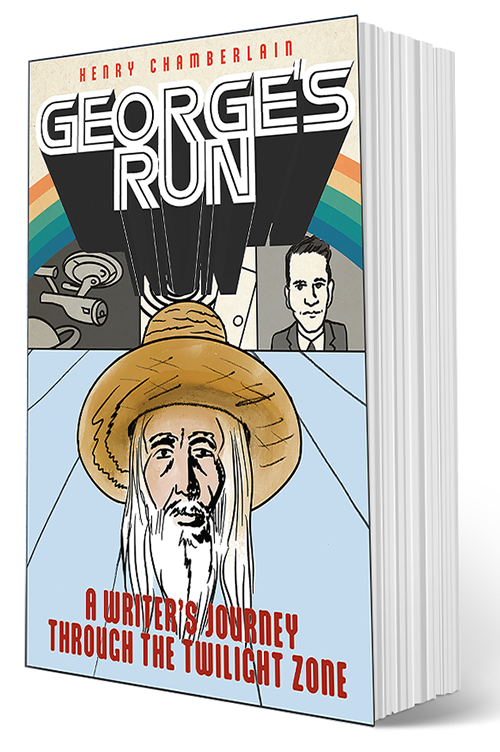
This is the book for any fan of comics, pop culture, and great stories!

It is my honor to include the story of the making of The Intruder in my graphic novel, George’s Run, published by Rutgers University Press. I can appreciate how it’s easy to conflate the various players during the ’60s, a highly creative time in both television and film. In this case, the players, genres and mediums all seem to blend in together as you have two pivotal talents, television writers George Clayton Johnson and William F. Nolan, participating as actors in a film that is based on a novel by another key writer, Charles Beaumont, who was a central cohort of the group of writers who worked separately and together on various projects, including the original Twilight Zone and Star Trek. And then, just to add to the multi-layered and high octane theme, you have William Shatner leading the way. I’m sure all of this creative energy and artistic passion was not lost on Roger Corman. It was quite a fortuitous combination of talents and viewpoints and Corman must have given it all a confident nod. Full steam ahead.

2 Comments

Filed under Comics, Horror, Obituaries, Roger Corman

Trina Robbins, A Remembrance

THE SILVER METAL LOVER by Trina Robbins (Wimmen’s Comix)

Trina Robbins (1938-2024) was a firebrand. Trina Robbins will be fondly remembered as the raucous female alternative voice to the acknowledged underground superstar cartoonists of the 1960s (think R. Crumb), a group that just happened to be predominantly male. There doesn’t appear to be any documented proof that the ’60s comix scene was somehow formed by some conspiracy to create a “no girls allowed” cabal. That said, it was a “man’s world” back then and that attitude and power structure did manage to permeate, ya dig? So, it made perfect sense for Robbins to launch into her own female-focused Wimmen’s Comix comic book series, which became a lightning rod in the culture wars. The men got to create experimental comics. And so did the women.

Continue reading

Leave a comment

Filed under Comics, Obituaries, trina robbins

Ed Piskor, A Rememberance

A love of Hip Hop expressed in Piskor’s beloved comics medium.

I recognized many years back, from it being serialized on Boing Boing, that Hip Hop Family Tree was something very significant. And, the more I loosely followed Ed Piskor’s career, I recognized the deep dive passion he had for certain subjects, most importantly, classic comic book figures. In time, Piskor would team up with Marvel Comics, along with Jim Rugg and Tom Scioli, to each create their own takes on Marvel legends with the Grand Design series. Piskor did his take on X-Men; Rugg did his take on The Hulk; Scioli did his take on The Fantastic Four. Quite honestly, the whole Grand Design series came out during one of my draw downs on superheros. It’s only now, in retrospect, that I can turn to these titles with the best sense of appreciation. And so that brings me back to Hip Hop Family Tree. At a time when the comics community is in tumult over the death of Ed Piskor, it’s with a heavy heart that a reader can go back and experience what is, undoubtedly, Piskor’s highest achievement.

Continue reading

2 Comments

Filed under Comics, Obituaries

Justin Green (1945-2022) by Paul Buhle

Panel excerpt from Binky Brown Meets the Holy Virgin Mary

The death of Justin Green, on April 23rd, leaves poorer the living memory of a revolution in comic book art and narrative. His self-revelation, in the 1972 comic Binky Brown Meets the Holy Virgin Mary, seems to have literally changed a field of perception of what comics could be or do. He drew frequently for the now nearly-forgotten genre of “underground comix” appearing during the 1970s-80s in anthologies with fellow artists: Robert Crumb, Gilbert Shelton, Bill Griffith, Spain Rodriguez, Trina Robbins, and Sharon Rudahl among others. Comics artist and publisher Denis Kitchen recalls that even comics giant Will Eisner was impressed to the point of being influenced by the story line of Binky Brown, and by the uniqueness of the artistic expression.

Page excerpt from Binky Brown Meets the Holy Virgin Mary

Green grew up in Chicago and its suburbs, in a prosperous family, with a Jewish businessman father and a Catholic mother. In sending the boy to Catholic school, she inadvertantly opened the impressionable Justin to a series of intense, confused glimpses of faith, including sexual repression and the accompanying guilt. The lonely teenager and aspiring artist thus acquired the strangest possible inspiration. A few years later, he attended the Rhode Island School of Design, leaving after a Zen Moment of standing on his head in class, according to a story told to his friend and fellow artist Bill Griffith. Relocating to New York, Green joined a handful of other near-future underground greats  through strips in the pages of the East Village Other. The “undergrounds,” avidly rebellious and virtually untrammeled by censorship, had been born.

In 1969, Green became part of the diaspora from New York and other points to the Bay Area, gathering spot of the emerging comic art scene. Griffith recalls, “I like to think we were all a ‘band of brothers’ in those heady San Francisco Underground days, tilting at the windmills of the established comics we both loved and rebelled against.” Which is to say, Justin Green was soon prominent among the community of young and wildly prolific artists, his work appearing in a handful of the anthologies being produced more or less collectively and sold largely via “head shops” through the 1970s. In shunning the commercial comic book industry, they gave up a lot and lived cheaply, but gained complete, uncensored autonomy and the copyright on their own work. The most successful comix sold 100,000 or more….until the mini-industry collapsed along with the Counter-Culture.

Cover for Binky Brown Meets the Holy Virgin Mary

In a 1977 interview conducted by this writer, Green tried to explain the logic of the unique genre of artists. “One must consider,” he suggested, “the peculiarly American phenomenon that financed the creative endeavors of a couple dozen individuals whose visions took (and still take) the material form of pictures with words. That phenomenon is mass readership…the artist is under obligation to make his product coherent [and] visually striking—to opt for specific literal ideas instead of obscure personal motives (though granted. I am one of the worst offenders). Comics is simply not  the format for making great art. Essentially it is entertainment. There are elements of morbidity, aberration and personal indulgence (again, myself included) in the work of many underground cartoonists which will have the longterm effect of sealing the work off from the cultural mainstream.” A fair prediction, as it turned out.

The East Village Other, 1970

He went on to comment about his satires of literary classics in ARCADE, the brilliant but doomed (seven issues before collapse) anthological effort during the second half of the 1970s, edited by Bill Griffith and Art Spiegelman. “All of my ‘classics crucified’ pieces are intended to have a dialectical relationship with history from the shifting focus of the unworthy present. Now that the making of art is within the grasp of thousands of individuals, the false veneer of critical acclaim…must be removed. Unequivocal respect for the ‘classics’ prevents the reader from assimilating material on his own terms. I am trying to do with plot structure what [Harvey] Kurtzman and [Bill] Elder did in the early MADs [Mad Comics 1952-55] for the warbabies bombarded by media—to unmask the subliminal influences of television and especially advertising. In the same way, I try to pick up on those salient details within a great work of literature which will bring matters into a comical perspetive. It is my chosen responsibility to call into question—to see if perhaps there isn’t a little something worth laughing at.”

Disaster Drawn: Visual Witness, Comics and Documentary Form by Hillary Chute

In an aside, he admitted, “Make no mistake about it, you have to be a bit of an egomaniac to showcase your fantasies to tens of thousands of people.” Hillary Chute’s acclaimed study, Disaster Drawn: Visual Witness, Comics and Documentary Form (2016), more than suggested that Green, in Binky Brown, did much to inaugurate the “serious documentary mode for comics globally.”

This is no small matter. Green may be said to have crystalized the semi-autobiographical impulses already expressed famously in Robert Crumb’s stories, Crumb’s persona “Flakey Foont,” like other hapless males seeking meaning (and definitely eros) amidst the sexual revolution, cheap marijuana and cultural upheaval. Crumb’s own work of the 1970s-80s, in turn, connected personally with Harvey Pekar telling more straightforward stories from Pekar’s blue collar, Cleveland daily life. And thus to Joe Sacco, a collaborator of Pekar’s before his own rise to fame drawing the stories of his travels to troubled sections of the world. The syndicated strips of Lynda Barry’s troubled childhood, later Alison Bechdel’s Fun Home helped bring into being a large, still expanding genre of comic lives recounting youthful hopes and follies. Indeed, these may arguably be the chief mode for women’s large role in comics today, a sustained Bildingsroman in a new popular art form. Way back in 1972, Green collaborated with Spiegelman and others in the pages of Funny Aminals [sic], a genre-bending little anthology of animal stories anything but funny, including the very first published slice of Spiegelman’s Maus.

Funny Animals, 1972

In her analysis of comic art, Hillary Chute makes another key point about Justin Green’s hugely productive decade.  All the work of the u.g. comix artists reflected an engagement with the US invasion of Vietnam, directly or indirectly. She quotes Green as explaining that he, like so many (I could have said the rest of us), knew people who knew people—or actually had relatives—fighting and suffering, too often dying amidst the  brutal US invasion of Vietnam.  “I needed to wage my own war. And so I looked within…I didn’t want to present myself as a hero but rather as a specimen. So the comic form gives you a multifaceted way of doing that.”

This weighty point may, by itself, threaten to obscure the multiplicity of Green’s output, the radicalism but also the sheer joy of moments in his humor, amidst the intense personal confusion and angst of his work. The very, very funny stuff, deeply thought and reflexive, is as full of social satire as Bill Griffith’s own caste of characters later realized in his daily strips.

Show and Tell by Justin Green, 1973

To take a Justin Green case or two in point, “Fyodor Dostoevsky’s Crime and Punishment, Featuring Sol Snake-Eyes, Jack Monterey and Gretel Hansel” (in ARCADE #5, 1975) reinvents the novel with a Jewish stand-up comic as the famed investigator of the maddened young egotist and a bimbo who snags Sol while the criminal goes off to the rock-pile. Meanwhile, “The Gates of Purgatory” (in ARCADE #7, 1976), revisits  Dante, with the “Music of the Sack Cloth Five” against a scene of comic horror, with free ginger beer and waterskiing on the Chicago River.

Arcade: The Comics Revue, 1976

The 1977 interview contains another theme crucial to the story of the underground artists’ saga: Green had a new baby in the house and had to find another way to make a living. A small handful of artists, including Griffith, Spiegelman, Crumb, Spain Rodriguez, Gilbert Shelton, Trina Robbins and others, managed to get along while doing their work, sometimes, especially in later years, by teaching comics classes. Most uniquely, Green turned to sign painting, and some of the stories that he later drew about the quirks of the job are hilarious as well as revealing. Raised in prosperity, he found himself reduced to working class standards,  confessing that “I am continually broke, exhausted, under pressure.” He continued to draw the occasional story but his moment had passed. One is tempted to add that the comic artists lacked the way forward successfully found, for instance, by the equally rebellious and radical painter Philip Guston, whose sometimes comics-like retrospective now exhibits in Boston’s Museum of Fine Arts.

Sign Game comic strip by Justin Green, 1994

It is more than a footnote to relate that Green’s widow and fellow artist, Carol Tyler, eventually found a comics niche for herself with a realistic, semi-autobiographical series about her father, the veteran of the Second World War who could not relate, let alone deal psychologically, with the effects of the trauma in his own experiences. Thus, in a way, you could say that the circle, or a circle, has been completed after all, and with as much meaning for the twenty-first century as for the one left behind. The artist sees the world, looks inside himself or herself, and through creative expression, makes the best of an obviously bad and likely worsening situation. This is what an artist in any genre can do, but what no one expected the creators of “funny pages,” “funny animals” and “funny books” to seek, let alone accomplish.

Paul Buhle published Radical America Komiks (1969) and was described in a 1970 issue of Playboy magazine as the “first serious critic of underground comix.”  He has edited more than a dozen nonfiction graphic novels.

Leave a comment

Filed under Comics, Justin Green, Obituaries, Paul Buhle, Underground Comix

William F. Nolan Dead at 93; New ‘Logan’s Run’ Remains a Mystery

From Henry Chamberlain’s graphic novel, George’s Run

William F. Nolan was one of the grand old men from the golden age of science fiction and horror spanning pulp fiction, television and the movies. Starting out as an illustrator in Kansas City, Nolan ultimately made his way to Hollywood and became part of a group of writers within the orbit of Ray Bradbury, and subsequently Charles Beaumont, all trying to break into television. As part of the inner circle of writers, casually known as, “The Group,” little by little, Nolan gained some ground.

Continue reading

Leave a comment

Filed under George Clayton Johnson, Logan's Run, Obituaries, pop culture, William F. Nolan

Comics Artist John Paul Leon (1972-2021)

The Winter Men by Brett Lewis and John Paul Leon

John Paul Leon, an amazing artist in the comics industry with a highly distinctive style, has passed away. I got to know his writing partner, Brett Lewis, and that was such a treat. Brett, if you read this, please contact me. If you want to find out what John Paul Leon was all about, then just seek out THE WINTER MEN, one of the most dazzling and offbeat works of comics you will ever read: so quirky and inventive with its loving tribute to spy thriller tropes in a deliciously subversive way! This is all thanks to the creative team of Leon and Lewis. I love comics and I’m associated with comics on so many levels but it all comes down to the honest hard-working individuals who genuinely have something real and vital to bring to the table. John Paul Leon was such an individual. He is beloved within the industry and by the many fans who got to know his work.

John Paul Leon artwork for Static Shock

John Paul Leon, best known for his artwork for Static Shock and Earth X, gave us a highly energetic and gritty style all his own. Leon died on May 1, 2021, at the age of 49, after a long battle with cancer. The news came via Chris Conroy, a senior editor at DC Comics. He wrote: “It seems the news is out. Last night we lost John Paul Leon, one of the greatest draftsmen in the history of comics, the kind of artist that EVERY artist revered. Those who loved him had some warning, but not enough.” For the ultimate tribute to Leon, read this by Michael Davis, co-founder of Milestone Comics and co-creator of Static Shock.

May 5, 2021 by Tommy Lee Edwards, Organizer
Today was my first attempt at a full work-day since losing JP. Feels like I’ve lost a limb. My sounding board has gone silent. My rudder is broken & my boat’s full of holes. Glasses are fogged & it’s hard to read the map. Reading the lovely comments on this GoFundMe page is helping me stay the course, tho. Thank you.

A GoFundMe has been set up in support of a trust for John Paul Leon’s family. It is organized by Tommy Lee Edwards, John Paul’s studiomate.

Excerpt from Static Shock

Next, let me share with you a post from John Paul Leon’s dear friend and creative partner, Brett Lewis. You can find this and a lot of other goodies by visiting Brett at his Patreon. I only share this one particular post since it is so fitting at this time. This was originally posted back in August of 2020 and is a touching reminiscence of events prior to working on The Winter Men.

The Mail Man by Brett Lewis and John Paul Lewis

Years before Winter Men finally got set up at Vertigo, while we were still shopping it around, i found myself editing and writing a Karl Malone comic book adventure.

(He is a famous now-former basketball player for the Utah Jazz.)

I’ve never looked down on well-executed licensed books the way some do (especially then) and i didn’t want to hire or work with any hacks.

John Paul Leon is always at 100% commitment level and we’d been looking to do something long form for years. I’d also been encouraging him to ink his own work for years (an easier said than done leap in those days) and wanted to see him explore in comics the sort of line qualities& open to color linework he utilized beautifully in his private work & life drawing –where he explored his love of things like Alex Toth fully as well as the kind of gestural 60s-70s editorial illustration style we studied with Jack Potter at SVA. This seemed like a good time and place.

This seemed right.

Best selling comic in the history of Utah. And i did a press conference with the guy, Malone, which was fairly surreal.

The color printed too dark/oversaturated, but the original colors by my other college friend, and John’s hometown friend, Bernard Chang were lovely.

The character designs were by me and the great illustrator and designer Chris Jordon. Maybe i can find some of those.

Above are the only images from it i have at the moment. **

**

Was working on getting a PDF for you guys to enjoy the whole story and original colors, but by a confluence of events the old zip disk it was on has come to be missing in the effects of my friend who had been working on all my old computers and hard drives to rescue into accessibility some files of old projects when he died,

and due to quarantine i can’t go search where i need to go search for it. Yet.

Still hope.

I hope there remain many other small hopes where you are too.

— Brett Lewis

John Paul Leon artwork for BATMAN: CREATURE OF THE NIGHT

There’s an old link buried somewhere within the innards of this site that has by old review of The Winter Men. I will go ahead and post it all here as it is such a wonderful time capsule and just goes to show the excitement that comics can elicit. The Winter Men was part of the Wildstorm imprint (originally, it began as part of Vertigo) at DC Comics and stands as an amazing example of the artful and edgy stuff you can find at DC Comics when all the stars align themselves properly! Ah, this is a double feature as it also includes a review of another oldie but goodie, RED HERRING. This would be a great time to issue a special hardcover edition of The Winter Men. Let DC Comics know how you feel if this strikes a chord with you.

REVIEWS

Well, wet your whistle on this, pardner. This review was originally posted at Newsarama, November 18, 2009:

REVIEW: THE WINTER MEN

“The Winter Men” is a patchwork quilt of observations and red herrings that takes the spy thriller to new heights of eccentric fun. It’s one of those stories that starts out about being one thing and ends up embracing everything. Meet Kris Kalenov, the main character in “The Winter Men,” he is your guide into the underworld and beyond. It’s a new world order since the collapse of the Soviet Union and Kalenov is no longer a star player in a Soviet secret weapons program. He has become a Moscow cop, usually full of vodka and, at the start of this tale, is keeled over drunk on a sidewalk covered in snow.

I did not discover “The Winter Men” when it was a comic book but, considering its production delays, including its switchover from Vertigo to Wildstorm, it’s understandable that it somehow slipped by me. Luckily, I did not have to experience any long waits between issues and got to read this new collected trade in one sitting. This is a good read anytime and anywhere but I also see it as perfect inflight reading. Aren’t spy thrillers very popular in airport bookstores? I believe this to be so. It’s because you’re out of your element and open to adventure.

One big thing about “The Winter Men” is that it gets you way out of your element. It’s like “Goodfellas,” one of the best movies about gang life, all about wiseguys and getting whacked. “The Winter Men,” is all about Russia’s new Mafiya and its biznessmen and getting under the right roof. There’s also something akin to “Watchmen” going on in the background, a uber-man that was once the pride of Mother Russia, but it’s Kalenov and his rough and shady bunch, that will have you delight over this convoluted plot as you would in, say, an Elmore Leonard novel.

“The Winter Men” has a real attitude about it too. It promises the world, heroically keeps up with its ambition and, if it falters, shrugs like a good world-weary Russian. Kalenov, our drunk Moscow cop who once was so much more, would prefer to just live quietly and make do with his less than perfect marriage. But too much has happened in the past and it can’t be ignored. “We once filled the sky with heroes…but now they’ve fallen to earth…” That is an intriguing refrain that is looped throughout the book. Within the span of the first few pages: hints of the Soviet super-hero program, a woman is shot, a child is kidnapped and Kalenov is picked up from the snow and enlisted to solve the crime of the century, although he doesn’t know that yet.

All this reminds me of any number of very good television series that, from the narrative, the characters and the production value, are clearly a cut above. And these shows usually make big promises and it’s okay if they don’t deliver on all of them since it’s the world that the characters inhabit that’s most rewarding. I think of shows like, “Life on Mars,” at least the American version, or “Life” or “Dollhouse.” In fact, it’s interesting to consider if these shows would have done better in finding an audience if they were less about process and more about results but, then again, these shows are primarily about attitude. The promises they make, real or not, can be legitimate fuel for the story’s engine.

Another connection to “Watchmen,” I think, is the group of heroes that Kalenov originally belonged to. Somewhat tongue-in-cheek, the line-up is recalled by Kalenov in a regular loop throughout the book: Drost, the soldier; Nikki, the gangster; Nina, the bodyguard; Kalenov, the poet; for a total of four, or five, if you include The Siberian. There’s even a sepia toned photograph of the gang in much happier times: Nikki has just told a joke and it has The Siberian in stitches. Along with the irony, it’s those details, the atmosphere and texture that this book thrives on.

There are a couple of scenes that come to mind. And, like everything else here, the writer and artist team of Brett Lewis and John Paul Leon tackle it with gusto. One has Kalenov and Nikki creating a disturbance in a McDonald’s so that they can unbolt from the floor a plastic table and chairs console to take home. The employee desperately tries to convince an irate Kalenov that the mayonnaise does adhere to city regulations with “well above the forty percent fat requirement.” Another good one has Nikki in the middle of a full-on turf war with other soft drink vendors. Informing the mayhem and murder are quotes from a self-help best-seller like, “Lose Control to the Maximum.”

Perhaps your reading of “The Winter Men” will find it keeping to all its promises and even holding the answer to the meaning to life. God knows, it is certainly within its reach. If you find fault, some blame, maybe a good bit of it, can go to the fact the series was cut from a promised eight issues down to six. There are parts to the story that do appear truncated. And the ending does seem to come all too quickly. However, the fact remains that this comic is really about the quirk and it’s all there for you to enjoy.

“The Winter Men” collected trade releases on November 25.

Hope you enjoyed this installment of Comics Grinder and I welcome you back for more. You can always check in too at the Comics Grinder site.

And here’s another quirky title, very much up my alley, that I enjoyed from way back. This review was first published at Newsarama on August 12, 2009:

Wildstorm-Red-Herring

Best Shots Extra: WildStorm’s RED HERRING #1
by Henry ChamberlainDate: 12 August 2009 Time: 05:55 PM ET 0 0Reddit0Submit0

Red Herring #1
Writer: David Tischman
Pencils: Philip Bond
Inks: David Hahn
Color: Guy Major
Lettering: Rob Leigh
Published by DC Wildstorm

Reviewed by: Henry Chamberlain

In Stores Today, August 12, 2009

Well, it’s true, as David Tischman says in a recent Newsarama interview, Philip Bond knows how to draw sexy women. So does David Hahn. That’s how we lead into Wildstorm’s latest cool caper comic, Red Herring. A young woman in a lacy bra has just slipped into a pump while chatting on her cell phone. Her languorous pose is surrounded by little bits of intimate narration: “It’s been crazy-busy at the office and talking to your mother calms you down.” We proceed a few pages as Maggie MacGuffin tries to find the right outfit while keeping in mind, as the story title suggests, “Blue Makes Her Look Fat.”

With such a stylish beginning, we smoothly move through what is a top-notch sly and sexy story. One goal of this opener is to connect Maggie MacGuffin with male lead, the titular Red Herring. As characters, they could not be more different. They seem to only share the fact that their names represent literary dead ends, false clues in a mystery, but they prove to be very much alive. They are not meant for each other but that could be fun too.

I haven’t had quite as much fun with a comic since another Wildstorm series, Mysterius the Unfathomable. This is a totally different scene, the world of high rollers and espionage in Washington D. C., but it’s definitely got a similar ultra-cool and clever style. Where Mysterius was very good with details about magicians, Red Herring provides the right balance of insider dealing and conspiracy theorist satisfaction.

We already know that things are never quite as they seem so it makes perfect sense to spice up the ambiguity by having fate bring together a party girl with a conscience, Maggie MacGuffin, and an earnest gumshoe secret agent, Red Herring. Couldn’t make matters any worse, could do it? Well, maybe so. Did I mention there is a possible alien subplot and people are already trying to kill Red before he kills them? Yeah, things could get very messy.

This first issue is probably chock full of MacGuffins and red herrings. As for the details that add texture, they build up quite nicely. The narrator mocks Maggie as she struts her way to Capital Hill. “Compromise is the ESSENCE of politics. That’s what your AP History teacher said.” Maggie works down in the lower levels of Congress “where the offices are small and the salary’s even smaller. Two weeks barely pays for a good pair of shoes.” At first, we see Maggie filing away papers but then we come to find out this meek office worker is actually the lover of a high powered Congressman.

The tempo slows down for some procedural scenes with the no-nonsense Red Herring. So far, Red is proving to be a little too dry for his own good. But he has this thing about his glass eye and so he may prove to have some interesting issues. . Red is supposed to be about ten years older than Maggie and the plan, according to David Tischman, is to keep these two platonic. That could be a pity. Or maybe it’s a red herring.

3 Comments

Filed under Brett Lewis, Comics, DC Comics, John Paul Lewis, Obituaries, Vertigo, Wildstorm

Ruth Bader Ginsburg (1933-2020)

Justice Ruth Bader Ginsburg

May Ruth Bader Ginsburg continue to guide us through these dark times. Here is an illustration I just did to honor RBG and what she stands for. Yes, this is real. Let’s all get political. Contact your US senator. Vote for Joe Biden and Democrats to the US Senate.

“My Most Fervent Wish Is That I Will Not Be Replaced Until a New President Is Installed.”

–Ruth Bader Ginsburg

Let us do whatever we can to honor her wish.

From The Nation magazine:

“That was not her wish alone. Tens of millions shared it. Now, however, the dread prospect is upon us. If Joe Biden is elected president, and if Democrats take control of the Senate, Trump and McConnell will be delegitimized. And it might just be possible to convince a few Republicans to respect Justice Ginsburg’s fervent wish.”


14 Comments

Filed under Illustration, Obituaries

George Floyd Will Never Be Forgotten

George Floyd Will Never Be Forgotten

As Rep. Sheila Jackson Lee (D-TX) said at today’s funeral, “George Floyd was on a mission.” His purpose shines on as his memory moves progress forward. There’s no turning back. Rosa Parks. Emmett Till. Trayvon Martin. George Floyd. Some of us are on such a mission. Their memory sparks change. George Floyd Will Never Be Forgotten.

4 Comments

Filed under George Floyd, Obituaries, Race

Cartoonist Morgan Vogel (1986-2020)

Morgan Vogel

I’ve been carving a little niche of some kind for many years and sometimes wondering where it all will lead—but I do know. I just mean that, push comes to shove, I will occasionally feel obligated to account for my actions. From time to time, all of us indie creative types must ask, “Why are we all doing this?” Indeed. We do it because it’s rewarding in its own right. As we progress through life, I think a lot of us out there begin to think we’d better be a little more respectful of our own work/worth. Why not? It makes sense. That brings me to this post, a look at Morgan Vogel, a remarkable talent now gone all too soon.

Cover to The Necrophilic Landspace by Morgan (then Tracy Auch) published by 2dcloud, 2015

From time to time, I feel compelled to define/explain what I do and this blog is a very good place for that. What I want to share with you right now is a little moment in time, because that is mostly what this blog does, filter through, and grind out some truth. Today, I bring up to the surface a remembrance of a young artist who recently passed away. Morgan Vogel, a name many of you will not know. But she fits the bill for the type of curious creature I hold in high esteem. Morgan was a determined artist. To die at 34 is truly heartbreaking. She was only beginning. I want to direct your attention to a tribute posted by Austin English over at The Comics Journal. Austin English runs Domino Books, a fine online boutique of comics and zines and he’s quite an authority on the indie zine. Austin leads a moving tribute that gives me confidence that Morgan’s legacy is safe and won’t be forgotten. Here’s Austin’s introduction:

Morgan Vogel, a cartoonist known for her distinctively intelligent work, went missing on April 8th. She was found dead Sunday, May 24th, at age 34. While her body of published work was small, its effect on those who read it was immeasurable. Her comics in anthologies (she appeared in Weird Magazine, Smoke Signals, Suspect Device, Tusen Hjärtan Stark, But is it…Comic Aht? and more) were often the stand out piece of the volume in question. The Necrophilic Landscape, a solo masterpiece published by 2dcloud in 2015, is one of the most stunning works of comic art in the last decade. Her recent self published zines, Valle and Nightcore Energy, were beautifully drawn and upsetting to read, a divide that appears in so much of her art and became more pronounced over time. 

Morgan was a favorite cartoonist of mine and many others. Her work was, at once, cruel, funny, forgiving, un-affectionate and, most of all, incredibly perceptive. She often zeroed in on personas that people (in much of her work, artists specifically) constructed for themselves. She would at first offer a satire of these poses, but within a few panels, a more moving–and therefore devastating–portrait of the subject would be revealed. The maturity of her expression, the avoidance of an extreme of anger or acceptance but instead a complicated and upsetting synthesis of the two, was achieved with a precision that I rarely see in comics. Many of my favorite artists make work that, on a superficial level, seems confrontational, but at heart is urgently humane—Morgan’s work, to me, got at this better than most. When I wanted to start a magazine about comics, including Morgan’s work in whatever way possible was one of the highest priorities, because of the nature of her views on art. She wasn’t interested in style or gestures of sophistication, but instead on the true implications embedded within peoples art. In one remembrance below, a quote by Morgan is repeated: “I  cant think of any other way to love except through artwork or some other medium that is public, loving everybody is easy, when you have an actual commitment to a thing or to somebody then it gets more complicated than I can handle.” A belief in the power of art often gets a lot of lip service, but for many artists of consequence, it is a real and specific thing. Morgan, I believe, was one of those artists. 

Morgan’s work was well known to her peers and to many readers, but because she worked under so many pseudonyms (I originally knew her as Caroline Bren, then as Tracy Auch, later as Hennessy, and finally as Morgan or Morgan Vogel), the entirety of her output remains a tangle. I think this is, in part, how she wanted it. But I also know that she was an avid reader of this website and focused much of her thinking on cartoonists and cartooning history. There are no doubt people reading this with feelings about the form that mirror Morgan’s. In spite of her resistance to clarifying her body of work, attention and discussion of it seem important to fulfilling the belief she had in the medium. I think Morgan’s high standards for cartooning were often met most precisely by her own art. It’s hard for me to imagine an artistic achievement equal to that. 

Pages from The Necrophilic Landspace

The Necrophilic Landspace is 32 pages, 7.75 x 9.25 inches, 1 color risograph, $12, available at 2dcloud.


1 Comment

Filed under Comics, Indie, Obituaries, Zines