One thing I love in this life is an awesome comic book shop. Such is the case with Meltdown Comics & Collectibles. On the Sunset Strip, this is the place you want to make time for during a visit to Los Angeles. And, if you’re a native, then you likely know what I’m talking about. Okay, let’s say you’re a tourist and you have your list of places to go to while in LA, well, I am here to tell you that Meltdown is a landmark you’ll want to hit.
MELTDOWN 7522 Sunset Blvd
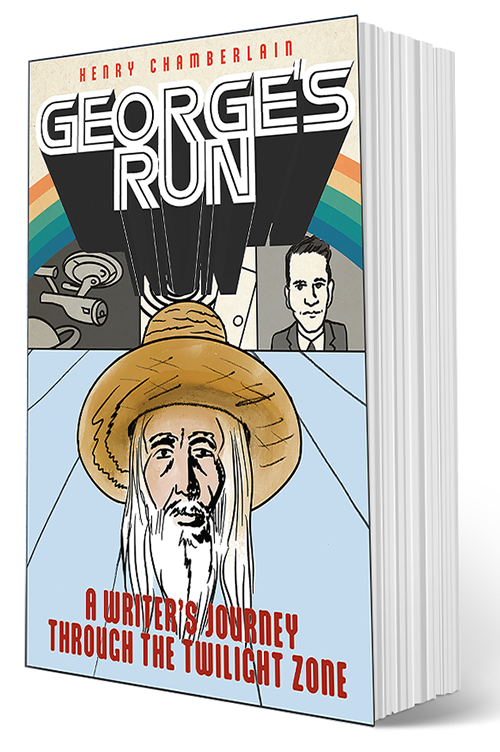
In the spirit of full disclosure, I was at Meltdown to promote my own ongoing comics series, GEORGE’S RUN, about the life and times of screenwriter George Clayton Johnson. However, as my regular readers know, and those of us in the industry fully appreciate, this is a labor of love, very interconnected, so I’m there just as much to embrace the scene and my fellow creators. Stay tuned because I will be posting reviews of some awesome comics that I picked up during my visit. If you are a creator, be sure to contact me about reviewing your work. For this post, I am providing you with a little guided tour that will whet your appetite.
ZINES & MINICOMICS
As you can see from the photos and video, Meltdown is a fully stocked, and fully loved, place for comics and related items. Keep in mind, for those of you still unsure, that comics are not only part of the zeitgeist. Comics are definitely an art form in their own right. That’s been said many times and bears repeating. Comics provide an outlet, a platform, that is a highly specific form of expression. It attracts many stripes of folk including some of the brightest and whipsmart. The word “comics” means many things and, no doubt, is inextricably linked to the world of comedy, even when it’s far from funny. It’s no surprise then that the likes of comedy genius Patton Oswalt cannot help but love comics and write for comics too.
STAFF PICKS
The day I made my visit, a special Bernie Sanders event was being set up. There are all kinds of cool things going on here from music to comedy. And, of course, there are all sorts of special comics events. The next big one is a March 18th signing by Daniel Clowes in support of his latest masterpiece, “Patience,” published by Fantagraphics Books.
MIKE LE’S OPEN IP WALL
Here’s the deal, there is not, or should not be, a great divide between indie/alt comics and superhero comics. That’s a given for a lot of us. But it’s one of those things I feel compelled to repeat as often as necessary. I want readers out there who have not been around comics for a while to come back and see what’s been brewing. That just instantly comes to mind when I’m in such a fine place as Meltdown. The love and the knowledge is clearly here, each member of the staff is carrying the torch. You see it in the careful and thoughtful displays and staff picks. What Amoeba Music is to music, Meltdown is to comics. I rest my case. So, be sure to visit our dear friends at Meltdown right here.
I’d been meaning to read Noah Van Sciver’s latest graphic novel, “Fante Bukowski,” and I guess I was waiting for a good time to do it. I thought I had it figured out: a silly little satire about a ne’er-do-well. It is that, in a nutshell. But, after reading it, I wasn’t totally sure of what to say about it. Well, actually, I had some idea. I couldn’t help but be reminded of Steve Martin in his film debut, 1979’s “The Jerk.” It is both subversively offbeat and totally hilarious.
“Fante Bukowski,” is worthy of your attention in all its irreverent splendor. Part of the humor is that it is quite obvious that Van Sciver has no real axe to grind within the literary community and yet he seems to manage to provide some quite effective biting satire. The bite is not aimed at anyone in particular. It’s more like the Marx Brothers poking fun at the absurdity of life in general. And, it’s safe to say that the pomposity and pretentiousness that Groucho ridiculed a century ago has not changed much for Millennials.
And lest you think this book has anything meaningful to say about Charles Bukowski, think again! Our main character decided to have his name legally changed from Kelly Perkins to Fante Bukowski to honor his childhood idol. It’s, by far, the saddest thing, Audrey, another unpromising writer, has ever heard! Fante meets, or stumbles upon, Audrey during a reading Fante gives of an incredibly brief and ill-conceived bit of his so-called poetry. It is Fante’s dumb luck that Audrey finds him attractive and decides to spend the night with him. To her dismay, she discovers that Fante slaves away on an actual typewriter.
While Van Sciver seems to favor light humor, it also seems that he doesn’t suffer fools lightly either. The following scene can’t help but sound familiar to many an aspiring writer: there is much chit chat over a certain literary magazine at a party and it results in Fante pleading with the editor for the chance to submit some work. After some back and forth, the editor accepts Fante’s half-baked drivel. After more small talk, Fante asks how big the magazine’s circulation is. The editor, without a hint of irony, says it’s a dozen. Brilliant. That, and the fact that Fante is obsessed with using a typewriter does seem to say something about a new generation allowing itself to walk into walls it could have easily avoided.
Van Sciver’s latest subject, and what he does with it, is a prime example of a cartoonist who understands why he keeps going back to his drawing board to toil away. He has made certain choices like keeping the artwork within reasonable limits and cranking the humor just right. This is all in the service of telling the tale of a terribly delusional young man. It’s an absurd story. When it’s all said and done, it is a silly satire about a ne’er-do-well. But it’s an impressive silly little satire too.
“Fante Bukowski” is an 80-page trade paperback published by Fantagraphics Books. For more details, visit our friends at Fantagraphics right here.
Fantagraphics Bookstore & Gallery, in Seattle, celebrates its 9th anniversary in wild style with the Cheech Wizard Show, Mark Bodé, Laura Knetzger, and more! A festive holiday gala takes place Saturday, December 12, from 6:00 to 9:00 PM marking the debut of Cheech Wizard’s Book of Me featuring a fabulous show of tributes to the alluring art of the late Vaughn Bodé and a rare reunion of his extended family.
The very first comic strip of Cheech the Wizard was drawn by Vaughn Bodé on a series of notebook pages in 1957. As the legend goes, the famous underground character came to Bodé as he contemplated a can of chee-chee nuts. Cheech the Wizard would go on to become a big player in underground comix celebrating sex, drugs, and rock ‘n’ roll. He was a Pogo for a mature audience with a similar whimsical quality masking a subversive humor. Which leads us to Cheech Wizard’s Book of Me which collects the best work of Vaughn Bodé along with a cavalcade of extras. The forward is by his son, Mark, who has carried on the tradition with his own take on Cheech and his pals.
And if the holiday gala weren’t enough on Saturday, you are welcome to return on Sunday for a book release party for Laura Knetzger’s Bug Boys Volume I. That takes place from 1:00 to 3:00 PM.
Fantagraphics Bookstore & Gallery is located in Georgetown at 1201 S. Vale St. For more details, visit our friends at Fantagraphics right here.
What if I told you that there was this one graphic novel that seemed to slip by many a reviewer’s radar last year and it turns out to be one of the most beguiling works in years? Here it is, “Arsene Schrauwen” by Olivier Schrauwen, translated from the original Flemish and published by Fantagraphics Books.
We begin with the author, Olivier Schrauwen, introducing himself byway of his connection to his grandfather. And we are soon on a boat in December of 1947 as Arsene Schrauwen leaves behind his homeland of Belgium on his way to a tropical colony. Once there, Arsene is at the mercy of the hospitality of his eccentric cousin, Roger Desmet.
Arsene meets his cousin, Roger!
Arsene is far from a dashing figure. He looks to be in pudgy middle-age although he is actually still in his twenties. Arsene looks like your typical Chris Ware character: remarkable for being unremarkable. Arsene is all banality, a portrait of grotesque pathos. He falls in love with Marieke, Roger’s wife, also a poster child for sad people. And it all works splendidly since, again like Chris Ware, we have here a multi-layered narrative employing an assortment of visual treats.
This graphic novel brings to my mind Werner Herzog’s film, “Fitzcarraldo,” about a crazed man’s dream to build an opera house in the Peruvian jungle. As it turns out, Desmet gets Arsene caught up in his dream of building a shining city in the jungle that will require a caravan of workers navigating through rugged terrain that includes a roaring stream which ultimately leads to a valley situated between mountains.
Lippens and his obscenely thick lips.
Schrauwen appreciates that, if you can legitimately hold the reader’s attention, time and space recede into the background. In this way, Schrauwen can indulge in such involved scenes as, Lippens, a strange old man with thick lips who leaves Arsene feeling uneasy. As he does with other characters, Schrauwen reduces Lippens down to a cylindrical face with only thick lips. Schrauwen deftly focuses on what matters, blurring backgrounds and reducing people to basic shapes as needed.
Perhaps Marieke will save Arsene.
With Schrauwen, you have definitely entered into an ideal example of the often cryptic and fascinating world of alternative comics. The air is thin at times in this rarefied environment. At intervals, you’ll get a notice requesting that you please wait a week before reading further. The very next page thanks you for waiting. But you cannot stop reading.
You read on about the constant threat of “elephant worms” that give Arsene nightmares about tiny elephants entering his body. Ostrich eggs appear regularly as you see Arsene preparing them for breakfast just as often as he’s throwing them against a wall. And then there’s the leopard men with insatiable sexual desires. Indeed. This is a tour de force of weird fiction full of the fantastical and an unabashed celebration of the human psyche and all bodily functions.
For a graphic novel weighing in at 257 pages, it makes sense to bring in some anchoring devices to keep things on track for the long haul. Schrauwen manages to keep to a steady pace by framing much of the story in a grid-like pattern: most pages hold six panels that oddly resemble playing cards. Ornate details are kept to a minimum. And we get a consistent pitter-patter of our many characters, much like you’d find in a classic comic strip or a silent movie. Arsene, after all, is supposed to be an enigmatic creature from a bygone era. It is in this story that, for a relatively brief time, you get to see him in all his glory, among the shadows and the ghosts, in his true element.
“Arsene Schrauwen” is a 257-page trade paperback. For more details, visit our friends at Fantagraphics Books right here.
Tom Van Deusen is a cartoonist based in Seattle who, along with several other cartoonists, started up the quarterly comics newspaper, Intruder. His work includes the comics, “Eat Eat Eat,” and “A Matter of Life and Death.” He was instrumental in bringing back the comics anthology work associated with writer Dennis Eichhorn and “Real Stuff.” Tom’s Poochie Press brought out two issues of “Real Good Stuff.” Subsequently, Last Gasp published, “Extra Good Stuff.” This was an opportunity to revisit previous collaborations as well as new ones between Mr. Eichborn and cartoonists.
Real Good Stuff #2
Dennis P. Eichhorn died October 8, 2015. He was one of the autobio genre’s best-known luminaries. Once nominated for three Eisner Awards for his work in Real Stuff comix, Eichhorn also authored the Real Smut comix series, and self-published The Amazing Adventures of Ace International, Real Schmuck, and Northwest Cartoon Cookery in collaboration with Starhead Comix. A former senior editor of Seattle’s now-defunct Rocket Magazine, Eichhorn distingished himself as the creator of one of America’s most notable art tabloids, the Northwest EXTRA!, by editing and publishing 16 issues in the late 1980s.
Tom Van Deusen’s art on the cover of Seattle Weekly
Tom Van Deusen loves to create art: words, pictures, and words & pictures. He dose it quite well and seemingly effortlessly. That is part of the appeal, for me, as I see him as someone who simply loves what he does.
Tom Van Deusen’s “Space Duck”
The image above is a good example. I was looking through items he’s posted and thought I’d ask him about the duck on the moon. Tom laughed and, almost apologetically but not quite, said that it goes back to his just drawing for the sake of drawing.
Tom has taken the comics bull by the horns and accomplished a lot in these last four years that he’s focused on comics. Although, truth be told, he’s been creating art for longer than that. Most notable for him has been his work with writer Dennis Eichborn. We talk about Eichhorn, the world of comics, and the world of an indie cartoonist. Aspiring cartoonists will often ask cartoonist vets about how to break into comics, if there’s some secret handshake involved, and Tom is a shining example of what’s really involved: a simple love for the work.
Henry Chamberlain: Tell us about your connection with Dennis Eichborn.
Tom Van Deusen: I met Dennis Eichhorn through Pat Moriarity, who is a great cartoonist and worked with Eichhorn on the original run of Real Stuff. I’m a big fan of his work as is my friend and fellow cartoonist, Max Clotfelter, and a whole lot of other cartoonists. Max had been keeping up with a sort of football blog that Dennis was doing. Actually, it was more of a newsletter that he’d email to friends. It was mostly about college football but it also included a fair amount of autobio work. And Max contacted Denny about maybe working together on creating comics. At that point, Eichhorn hadn’t formally published anything in about twenty years.
He had these great new stories and, from that, we asked him he’d be interested in working with a new generation of cartoonists. And Kaz knew him and wanted to work with him again as well. And he agreed. I had these ideas at the time of doing some small scale publishing work. I had self-published for a few years my own comics. So, we decided to do a Kickstarter. We drove over to Bremerton and met with Dennis. I think I only met with him four or five times. We had a very successful Kickstarter, almost doubled our goal.
We got to put out a 64-page double issue and worked with a lot of great cartoonists. Noah Van Sciver wanted to do one. We got cartoonist from the original Real Stuff, like John Hurley and Mary Fleener.
And from there, Dennis had all these other stories he hadn’t published and that led to a second collection that was picked up by Last Gasp. Distribution is really tough. And, for me with a full-time job and trying to create my own comics, getting this book published has been the hardest thing I’ve done so far. It was really lucky to get Last Gasp on board to publish the second volume.
HC: I loved that I got to pick up my copy of that second book at the Seattle ferry terminal, of all places.
TVD: Ha, what was it doing there?
HC: There’s a great story behind that. Dennis Eichhorn’s wife, Jane, let me know that she arranged to have it available at the newsstand there since that was her regular spot to pick up the Sunday New York Times for Dennis on her way back to Bremerton.
TVD: Oh, that’s great!
HC: I wanted to ask your take on underground comix.
TVD: Well, from the ’60s or ’70s, or more recent?
HC: Yes, it is era-based. Take your pick. How would you define it, overall, for people totally unfamiliar with this?
TVD: Anything that’s not mainstream. And mainstream usually means genre work. That’s work that’s never really interested me. Even growing up, I never read superhero comics. I was more into “Ren & Stimpy” and a bunch of other crazy cartoons coming out when I was a kid. When I finally started getting into alternative comics in college, I picked up Crumb and Chris Ware. I think that goes hand in hand. It’s work that isn’t genre…which is sort of a sad description since most things aren’t genre. Most things aren’t “superhero” and “action” outside of comics. But, for some reason, comics are so dominated by things that are more suitable for children. Underground comix are more suited for adults, although they don’t necessarily have to be.
Alternative comics can be anything. And, once I found that work, I was really excited that I’d found my calling. It took a long time. They’re kind of hard to find. Distribution is crumby. Unless you know about it, it’s kind of hard for people to stumble across. It deserves a wider audience. It shouldn’t have to be “underground.” In France, this is major media. It’s not something just for enthusiasts. In Japan, everyone reads comics.
HC: It’s good to hear you use the term “alternative comics,” which I find very useful. It’s “alternative” to market-driven mainstream comics.
TVD: Right.
HC: How would you describe the scene today? I mean, from your vantage point. You’ve got The Intruder.
TVD: Yeah, there’s a lot of stuff coming out. It’s amazing. It seems that I meet a new cartoonist every day. With the internet, cartoonists are coming out of the woodwork quicker than ever. And there’s all these festivals. That’s what brought about The Intruder. We’d been reading Smoke Signal, which came out of Brooklyn’s Desert Island Comics. We want to create something for Seattle. There’s a great comics community in Seattle and always has been. I met Max Clotfelter, Marc Palm, Ian Fitzgerald, and other cartoonists. We hung out a lot. We all drew comics. From there, we did a lot of jam comics. We did a lot of silly, usually scatalogical, comics. We started out with a free newspaper and people seemed to like it.
The only problem is that there’s no money in doing any of this. The problem is distribution. There’s only one distributor, Diamond. They are pretty much closed doors for the sort of comics I enjoy. It’s a bottleneck for small publishers. They exist because of Marvel and DC Comics.
HC: Well, we won’t put too fine point on it. They do have a small press section in their catalog.
TVD: They do have that.
HC: You had mentioned a graphic novel that you really enjoyed in another interview you gave. That was last year’s sleeper hit, “Arsene Schrauwen,” by Olivier Schrauwen, published by Fantagraphics Books. I can see you doing something like that down the road.
TVD: For now, I am focusing on short works. “EAT EAT EAT,” is my longest work at 25 pages and that took four years.
HC: And you enjoy doing comedy.
TVD: That’s how I got into comics, from doing these PowerPoint presentations.
HC: There was a group that did a lot of that some years back called, Slide Rule.
TVD: Oh, really, are they local?
HC: Yes, it was a group of cartoonists in Seattle. I was part of that scene. David Lasky was part of that scene. He could tell you about it.
TVD: I gravitate to that. I enjoy writing up skits. There’s a great comedy scene where I’m from, Buffalo, New York. Great friends of mine there: Matt Thompson, Pat Kewley, and Sarah Jane Barry.
HC: Well, I am impressed with all the things you’re doing. You may end up focusing on writing in the future. Who Knows. I wish you well. Thanks so much for your time.
TVD: Thank you, Henry
You can listen to the podcast below:
Be sure to visit Tom Van Deusen right here. And you can find Poochie Press Publications right here.
If you happen to be reading this on the same day it was posted, Halloween, and you’re in Seattle, go see Tom at Short Run.
There is no Black River to be found in Josh Simmons’s graphic novel, “Black River,” but that’s besides the point. The characters are all post-apocalypse survivors with nary a need to know one river from another. Nihilism prevails. For such a bare bones story, there are plenty of compelling moments, both grim and poetic.
People can be pretty hostile and dangerous even in the best of times, so it is quite something to have a group of youth running wild into the wasteland. No zombies to contend with, if that’s any consolation. It’s more the drip, drip, drip, of too many lost and rough souls wandering. All this Simmons depicts well. It’s something any hip cartoonist can revel in, if he or she chooses, and he does a good job of it.
With all the jailhouse craziness that ensues, Simmons is a careful artist. He has a deft way of creating just the right amount of detail to evoke a landscape or a town that has been left in ruins. And I really enjoy his rendering of the Aurora Borealis. It comes up a number of times in panels, enough to add to the spacey energy that charges this work.
Much like a good old-fashioned horror movie, a comic such as this, to be any good, relies upon setting up an interesting mood and environment. Without a doubt, Simmons succeeds in this. He gives us some compelling characters among his ragtag group of hardened misfits. And we’re left wanting to turn the page as a morbid sense of curiosity sets in. Of course, things will get darker, as well as more disgusting. This is raw stuff, kids. Mature content. Those familiar with it, will not be disappointed.
And if you’re in Seattle, be sure to visit the Fantagraphics Bookstore & Gallery this Saturday, April 25, from 6:00 to 8:00 pm for a reception for the publication of Josh Simmons’s new graphic novel, Black River, and the release of the latest issue of Intruder, #15. Simmons will be joined by his colleagues from the Intruder comix collective. Simmons contributes a story in the latest issue illustrated by Joe Garber. Festivities include a display of Simmons’s original drawings, a black light room, short film screening, a book signing, and complimentary refreshments.
Black River is a 112-page trade paperback, priced at $18.99. For more details, visit our friends at Fantagraphics Books right here.
“Black Light: The World of L.B. Cole,” published by Fantagraphics Books
If you are in Seattle this weekend, get yourself over to Georgetown and the monthly Art Attack. Then go right over to the Fantagraphics Bookstore & Gallery. This Saturday, you have two special treats at Fantagraphics. You can enjoy a slide show lecture on L.B. Cole, the all-time great artist of proto-psychedelic comic book covers. And, there will be a workshop conducted by visiting artists from Le Cagibi, an engraving studio in Lilli, France. This all takes place on January 10, from 6 to 9 pm. Visit our friends at Fantagraphics right here. More details follow:
Miss Lasko-Gross has been creating comics since high school. A collection celebrating 20 years of her work, “Miss Lasko-Gross: Some Short Stories 1994-2014,” is available on comiXology. She has been published by Fantagraphics Books, A MESS OF EVERYTHING and the YALSA nominated ESCAPE FROM “SPECIAL.” Now, Lasko-Gross embarks on another storytelling adventure, HENNI, published by Z2 Comics, a new series of stories about rebellion.
HENNI is a young female in a fanciful world. She is an anthropomorphic character, a cat-like creature. In the same spirit as Maurice Sendak, Dr. Seuss, and Jim Woodring, this is a strange, yet familiar world that Lasko-Gross has created. It’s a place that demands obedience and will not tolerate any questions. Well, Henni has a lot of questions to ask. She tries to maintain a low profile but she also knows that there’s a whole other world beyond her homeland’s gates and she is going to venture out. She does. And so Henni’s adventure begins.
It was a pleasure to get to chat with Lasko-Gross. We begin with thoughts on how her past work flows into her current work. We discuss the process of making comics. We talk about what it’s like to work alongside a spouse who is also an accomplished cartoonist, her husband, Kevin Colden (FISHTOWN; I RULE THE NIGHT). We also talk about her inclusion in the traveling exhibit, “Graphic Details: Confessional Comics by Jewish Women.” And we talk about working with the boutique graphic novel publisher, Z2.
Listen to the podcast interview right here:
“Henni” is a 168-page graphic novel and will be available in comic shops on January 6, 2015 and in bookstores on January 20. For more details, you’ll definitely want to visit Z2 Comics right here. Formerly known as Zip Comics, the newly launched Z2 Comics is run by Josh Frankel and is the place to find some of the most exciting comics available, including the work of Paul Pope and Dean Haspiel.
Megg, Mogg, and Owl. Say it with me, “Megg, Mogg, and Owl.” They will set you free. Set you on a righteous path. What Simon Hanselmann does with his comics is what any artist and/or writer worth his or her salt does: take you somewhere, make you feel something. The most disturbing, and most exhilarating, moment for me in comics this year, or any year, must be Werewolf Jones taking a cheese grater to his testicles. Pure genius. And I say it with only a touch of irony. In fact, it is a great moment in comics.
Imagine the most dazzling art lecture of your dreams complete with live music or, better yet, imagine something like Oscar Wilde touring America in 1882. Art Spiegelman presenting an art lecture accompanied by the Phillip Johnston Sextet is pretty unusual, special, and rare. An audience in Seattle this last Sunday, October 12, enjoyed such a treat and in the most fitting venue, The Moore Theatre, Seattle’s oldest operating theatre, dating back to 1907. A fitting site since Mr. Spiegleman was here to discuss, embrace, and celebrate the comics medium dating back to a bygone era.