Tag Archives: Pop Culture

Interview: Karen Green, the Curator for Comics and Cartoons for the Columbia University Libraries

Karen Green at Butler Library, Columbia University

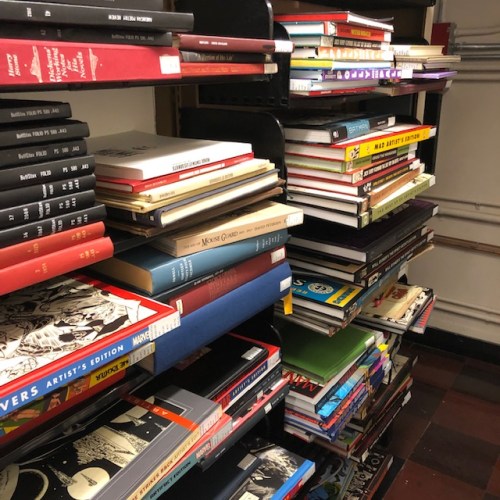
I was recently in New York and had the pleasure of interviewing Karen Green, the Curator for Comics and Cartoons for the Columbia University Libraries which collect both graphic novels for the circulating collection in the Butler Library stacks and also creator archives in the Rare Book & Manuscript Library. The interview was a great treat and I share it with you here. Afterwards, I got a chance to go on my own and explore the stacks at Butler Library. The vast collection that Karen Green has helped to put together really lends itself to this sort of intimate hands-on exploration in real time and students in all disciplines are welcome to come explore for themselves. For more information, on Comics in the Columbia Libraries, go right here. I include here some photos of some of my discoveries exploring the stacks.

Butler Library at Columbia University

The Columbia University Libraries collect both graphic novels for the circulating collection in the Butler Library stacks and also creator archives in the Rare Book & Manuscript Library.  The circulating collection launched in 2005, when the libraries held three titles, and by the end of 2015 the collection featured roughly 10,000 titles in over two dozen languages.  The archival collections, which already contained disparate comics holdings, launched in earnest in 2011, with the acquisition of writer Chris Claremont‘s papers.

Remaking the World, at Columbia University, Kempner Gallery

The circulating holdings contain a diverse collection, with mainstream and alternative titles, archival reprints, independent comics, Kickstarter projects, and other content.  These materials have been used in courses from East Asian Languages and Cultures, to English and Comparative Literature, to Narrative Medicine, and have been featured in the American Studies course “The American Graphic Novel.”  Students have used the collection for term papers, senior theses, and M.A. essays.

Out of the Depths (sinking of RMS Lusitania on May 7, 1915) by Oscar Edward Cesare, pen and ink on board.

We had a brief and informal chat after Karen provided me with a tour of the comics collection in Butler Library. Back at her office, Karen shared with me a syllabus for an upcoming summer class she will be teaching. The proposed reading list and schedule includes Doctor Fate, with guest speaker Paul Levitz; All the Answers, with guest speaker Michael Kupperman; Bad Girls, with guest speaker Alex De Campi; and Prince of Cats, with guest speaker Ronald Wimberly.

The Suffrage Amendment, Another Dark Alley to go Through! by Kenneth Russell Chamberlain (1891-1984), pen and ink on board.

Lastly, just to demonstrate how easy it is to roll into a tangent when you’re surrounded by such treasures, I couldn’t help but spend some time observing the current show in Kempner Gallery at Butler Library. It is entitled, Remaking the World, and it relates to important issues after World War I. I happen to have rested my eyes on a political cartoon on women’s suffrage in the United States. The cartoonist is Kenneth Russell Chamberlain. Any relation to me? Well, I’m not sure. I don’t think so but I’ll have to see to make sure. Even more uncanny to my possible connection is just how relevant the cartoon is today! We’ve made so much progress but we certainly have great challenges still ahead of us to say the least.

HENRY CHAMBERLAIN: Please share with us how the Comics and Cartoon collection came about at Columbia. 

KAREN GREEN: It was 2005. I had just rediscovered graphic novels after a 12-year hiatus and was frantically buying graphic novels to feed my fascination with what was going on. I hit up against the wall of a librarian’s salary and thought about how nice it would be to check out these graphic novels from my library. However, at that time, we only had three graphic novels: Maus, Persepolis, and Palestine. We had Maus because every library has Maus. We had Persepolis and Palestine because Edward Said, the great scholar of Orientalism, taught here and those titles were on his reading lists. So, I thought about ways to frame a proposal for graphic novels. I brought together the stakeholders who I thought would be most interested: our American Studies librarian, our Graphic Arts librarian, and our Fine Arts librarian. And I developed a three-fold argument. The first prong was: this is a field, a medium, that is getting increasing academic and critical acceptance. I was able to show them articles from peer-reviewed academic journals along with The New York Times and The New Yorker. The second prong: Columbia has a film school and a film studies program. Already in 2005, the connection between film and comics was pretty strong and obviously only stronger now. It made sense for those students to have access to this raw material. And the third prong was a little bit more sentimental. Columbia’s full name is Columbia University in the City of New York. New York City is where American comics were born. No academic institution in New York was systematically collecting comics in any form. So, I thought that these two New York City institutions, comics and Columbia, could profitably form a partnership and that we could be the place for these things to be collected in. I presented this argument to a group of my colleagues and they agreed and provided some funds. It was a small budget to start with and it’s a lot more now.

Why do you think it took so long for a comics collection to become part of Columbia?

I think, for the most part, in universities, libraries respond to the curriculum. In this case, I was creating a demand for the curriculum. My feeling was that this is an important area. I was getting to know more and more people who were scholars in this field of comics studies. I felt that if I built a collection and it started getting noticed by faculty and grad students, then coursework and research and learning would follow–and that has turned out to be the case.

Having this vast collection, do you see patterns in the graphic novels that you’re looking at?

What’s interesting in the medium is that the big genre in comics is really the same as the big genre in prose which is memoir. I teach a summer course…it used to be called “Comics as Literature,” which I inherited. I don’t teach it as literature since I see comics as a primarily visual medium. I teach it as “How to Read Comics” or “How to Read This Comics Language.” And, I was trying to teach it by genre as a nod to the English Department and, one year, one of my students pointed out that although I had varied subjects (journalism, war stories, social activism), they all turned out to be memoirs! I try now to very consciously make the reading list more diverse so that we have memoir, reportage, fiction, history, and biography.

I think the natural inclination for the creator is to do memoir. So they end up needing to make a concerted effort to break free from that.

Write what you know and what do you know better than yourself!

Even if you’re not writing about yourself, you end up writing about yourself.

Absolutely.

What do you think is the typical young person’s approach to comics?

The course that I teach in the summer is mostly taken by our students in our School of General Studies, which is a school for returning students. They are not required to take as many of the courses as Columbia’s core curriculum. My course serves as a substitute for the foundational great literature course, Literature Humanities. Many of my students have never read comics or don’t know anything more than newspaper comic strips, if that. There’s another course that is taught here every other year, The American Graphic Novel. It is co-taught by one of our tenured faculty, Jeremy Dauber with Paul Levitz, the former president of D.C. Comics. That course gets huge enrollment from all the undergraduate schools and from some grad students. Jeremy and Paul go around on the first day of class and ask their students about their experience with comics. Maybe ten percent are dedicated comics fans. And, from that group, when asked what got them interested, they usually cite Batman: The Animated Series. I get a lot of students who tell me their gateway drug was Calvin and Hobbes. But I don’t get a lot of students who know the medium well and are reading longer more complex stories.

Let me see if I can get this question right. I’m wondering what you think makes for the ideal comics creator. I believe it is often a lone artist-writer.  However, even when you have a writer and artist collaborating, ideally you would have both of them equally immersed in the literary and visual arts. That leads me to the definition of an alternative comics creator. How would you define that role?

Well, that would be anyone who is not working in mainstream superhero stories. What a broad category that is: from Lynda Barry, to Derf, to Ronald Wimberly. The certain notion of mainstream being the Big Two (Marvel and D.C.) with maybe Dark Horse and Image, although those two have creator owned work, to call that the mainstream (doesn’t take into account) the dozens of  other publishers bringing out material, in addition to the Big Two.  Every year, I buy a lot more non-superhero material than superhero material and not because I’m discriminating against it but because there’s a lot of stuff out there from all sorts of publishers, not just dedicated comics publishers. You have traditional publishers like Random House, Simon & Schuster, and Viking. You have academic presses that are publishing graphic novels, not just scholarship on graphic novels. So, I think “alternative” is becoming less of a useful term. I just call everyone “comics creators.” I try not to put them in pigeon holes. You have people like Dean Haspiel who do superhero material and who do their own stuff. You’ve got Kelly Sue DeConnick, who does superhero stuff and her own stuff. Those categories aren’t as useful since the field has become so broad and diverse. They’re just creators.

I don’t mean to digress but I do think it’s a certain mindset. You get someone like a Dean Haspiel and the Big Two want that certain flavor, a very specific way of seeing that comes from an indie cartoonist, that certain way of creating comics that comes from an alternative comics world. Then you consider that MoCCA, and other comics art festivals, are focusing only on alt-comics. 

I agree.

While something like Comic Con in San Diego is primarily about big money, the Big Two, and Hollywood.

But Comic Con in San Diego has a huge small press presence.

That’s true, they’re able to embrace everything.

You take a look at their Eisner Awards and they’re dominated by so-called “alternative” creators. But, take a look at Paul Levitz, “Mr. D.C. Comics,” who has written two graphic novels for Dark Horse and he’s working with two other smaller publishers…and it’s creator-owned stuff. Sonny Liew, Paul’s collaborator on Doctor Fate, he does work for D.C. and he does his own stuff: The Art of Charlie Chan Hock Chye, which won three Eisners. I just think that the alt-comics distinction has gotten so blurry. I think it’s a good thing to have creators dip their toes in different areas.

Well, I love that there’s a lot of gray area.

Yes! I love gray!

What graphic novels are popping up on your radar right now?

That brings me to my summer course and its reading list. For starters, I have Scott McCloud’s Understanding Comics right along with How To Read Nancy. We begin with wordless comics: Peter Kuper’s Sticks and Stones; and Eric Drooker’s Flood! I really enjoyed reading Black as Fuck. They’ll be reading that along with Ms. Marvel. Junji Ito’s horror comics are just mind-blowing. Ito’s Cat Diary: Yon & Mu brings  takes his horror sensibility over to a story about his cats. Because I love European comics, I’m going to have them read (Dillies & Hautière’s) Abelard. There’s also Michael Kupperman’s All the Answers matched with David Mazzucchelli’s Asterios Polyp. I also have Fun Home and possibly My Favorite Thing is Monsters if we have time. We have Bad Girls by Alex De Campi and Victor Santos. There’s also My Friend Dammer and The Fifth Beatle. And I always end with Ronald Wimberly’s Prince of Cats. I try to get as many titles as I can in as many styles, genres and traditions. It can be disconcerting, if you’ve only read American comics to suddenly be reading manga so we go over how to read it and all the visual cues. Let’s see, what else am I reading. I just read David Small’s Home After Dark which I really loved. Black as Fuck, I think the art is beautiful. It’s a story about what the world would be like if only black people had super powers. In the past, we’ve read Onward Towards Our Noble Deaths by Shigeru Mizuki. Watchmen. Dark Knight. Those two because they’re been so influential. We’ve also read early Action Comics, Detective Comics, Wonder Woman, and Spider-Man. I kept coming back to Dark Knight because we’re so much living in Frank Miller’s world now where superheroes are concerned. But this year I’m going lighter as I focus on Doctor Fate and Ms. Marvel because I’m ready to get out of the dark.

Yeah, we’ve been in the dark for too long. It runs in cycles.

Nothing against it. The dark books are great to teach but it’s good to mix it up.

We’re in a golden age of acknowledgment of comics and graphic novels. Do you think we’ve reached the ideal level or is there still room to grow with more and more people aware of and talking about graphic novels? 

I think there’s still a lot of room to grow.  There was a tweet the other day about an elementary school teacher in Los Angeles who won’t allow graphic novels in his classroom which led one of his students to bring in her own graphic novels to lend out to her classmates. It’s so strange to me that there are still educators who are resistant to graphic novels. Comics have won national book awards. What it is that still needs to happen for comics to be accepted as part of our cultural landscape I honestly don’t know. Four cartoonists have won MacArthur Genius Awards. What needs to still happen, I just don’t know. But there’s definitely room to grow to achieve as broad an acceptance for comics as there is for film, fiction, and any other other art form.

We will leave it there. Thank you so much, Karen.

You’re very welcome, Henry.
That concludes my interview. I want to thank Karen Green for taking the time and sharing her thoughts on graphic novels in general and in an academic setting. Thanks to Karen, she set things in motion and, with the help from like-minded souls, she continues the good work on behalf of comics, cartoons and graphic novels at Columbia University in the City of New York.

7 Comments

Filed under Alt-Comics, Alternative Comics, Columbia University, Comics, Education, graphic novels, Karen Green, Libraries

Guest Review: ‘The Book of Weirdo’

The Book of Weirdo. Edited by Jon B. Cooke. San Francisco: Last Gasp Books, 2019. 288pp, $39.95.

An Ultimate Crumb or was it Editor Crumb?

Guest Review by Paul Buhle

There are many things strange, altogether strange, about this oversized volume. But they are things that Crumb-watchers and devotees of the short but tangled history of the Underground Comix will appreciate and even revere, if “revere”is an accurate and acceptable word.  The Book of Weirdo, published by Last Gasp Books, opens a door wide for rethinking comics and comix history.

The trajectory of the rise—but even more, the fall—of the wildly experimental genre continues to rouse debate, not to mention a lot of quiet grousing among former participants, artists, editors and publishers alike.  By 1973, when Underground Comix, had barely begun, a widespread legal assault on Head Shops threatened to eliminate the customer base. Censorship somehow avoided, comix moved on to the next obstacles that may best be seen as inscribed in the historical moment.

The great social changes hoped for by the young generation did not take place and were not going to take place in the short run, at least. The comic artists, very much part of their time,  joints to long hair, inevitably felt the effects. Working for practically nothing, although owning their own art, many began to wonder whether comix were a career or a dead end. Could the comix movement transform itself into a viable living?

Denis Kitchen had one idea, taking the commercial route with Marvel as publisher of Comix Book, which both paid artists better  but also owned what they drew for that issue of the magazine. A sell out or a practical step toward stability? The question went unanswered because the project folded after 5 issues, unable to achieve stability in the mainstream newsstand market. Bill Griffith and Art Spiegelman had a different and more traditionally aesthetic notion, a quarterly Arcade magazine published by Print Mint. A truly beautiful magazine, perhaps the best that the genre ever produced, it also failed, in a counter-culture market where readers were not accustomed to comix appearing on a punctual quarterly schedule rather than the more customary sporadic, lackadaisical pace.


What dramatic step might be next? That was the burning question for many artists and would-be editors, as the movement began to lose its momentum. But it was not the only thought, especially for many who simply continued under deteriorating circumstances.  The otherwise persuasive argument offered by Patrick Rosenkranz that Underground Comix was doomed as a genre by 1975, may be true, but it also minimizes the reality that much high quality work appeared during the later half of the 1970s and well into the 1980s.

The series of Anarchy Comix, also  Wimmen’s Comix and some dozens new entries of various kinds, lay ahead.  Kitchen actually expanded his line of comics with Kitchen Sink, relocated to Princeton, Wisconsin, and among his titles, Gay Comix is a particular stand-out in anyone’s memory of the field changing and growing in content even as it shrunk in size. It was, indeed, shifting toward the more uncertain market of the ill-defined “Alternative Comics.”  Also consider that the “classic” strips of the 1920s and 1930s, reprinted in Arcade foreshadowed Kitchen’s own reprinting of past masterworks by Will Eisner, Harvey Kurtzman and others. Not to mention The Comics Journal, soon emerging as something like the trade publication of the field.

RAW and Weirdo would serve as markers in any narrative of an evolving comic art in the US, en route to the recognition of comics as art, the museum exhibits, award ceremonies, and even the Superhero-swollen ComiCons to follow.

It would be a mistake to avoid entirely what the historians used to call “geographical determinism.”  Comics, comic books, had always been centered in Greater New York, never mind some printing locations as far as Racine, Wisconsin. Underground Comix emanated from the Bay Area and had the region’s sensibility stamped upon them, never mind some smaller regional operations. Giving up on Arcade, Art Spiegelman moved Back East. RAW  not only emanated from New York but pointed back to New York, in the old literary adage that, culturally speaking, North America is half in the sunshine and half in the shade….that is, everywhere west of the Hudson River.

Much to the credit of co-editor Francois Mouly, RAW encompassed global comic trends, but not only that. Ben Katchor, one of the freshest of the new artists to appear in these pages—himself from a Left Yiddish family background—was to comment later that RAW had shrewdly marketed itself as a lost branch of European art and literature. This would prove decisive in uplifting the genre toward acceptance as an art form, in New York above all.

By vivid contrast. Weirdo was very, very California, published by the Crumbs in Winters, an extended outpost of the Bay Area. The idea of the “outsider,” if already well established in the art world, here unapologetically reached an extreme.

The Book of Weirdo  testifies to the vanishing California sensibility as it pays homage to  that unique publication in a nonacademic and unpretentious manner that often eludes the burgeoning field of comic art studies at large. Jon B. Cooke is at once a comic fan, editor of an ongoing comics “pro” fanzine (Comic Book Creator), and a gifted writer and designer. He follows, in this work, the tradition of a couple dozen authors,  also non-academics in background, who have done admirable work on such subjects as EC Comics and their great artists or writer-artists as Wally Wood,Will Elder and Bernard Krigstein.

That said, The Book of Weirdo is a most unusual work of devotion. Rather than a straightforward narration, it offers extended commentaries by dozens of Weirdo contributors, and several essays—the longest of them unsigned but evidently the work of the editor himself.  This is, by intent, a collective project, with Cooke seeking to impose a light hand even if the creation owes to his extraordinarily careful attention to all aspects of the subject.

How much was Weirdo a response to the publication (and phenomenon) of RAW, moving comic art “uptown” toward new and for many, uncomfortable realms of sophistication? This is a question unsettled, destined to be unsettled, among comics historians, not to mention the editors and artists themselves.

What else was weird about Weirdo?  As Crumb himself wrote in the first issue, the new effort marked “another new magazine, another MAD imitation, another small time commercial feature with high hopes, obviously doomed to fail.” This is a reference to the number of MAD knock-offs that appeared during the 1950s and 1960s, in some cases lasting decades after Mad Comics turned into Mad Magazine in 1955.  Several of them even boasted former Mad artists. They were generally, if not without exceptions, dreadful by any reasonable standard, or perhaps just by the high standard of Mad.

From another angle, Weirdo was arguably closer to Humbug,  Kurtzman’s third effort after Mad and the slick but doomed Trump,  or his last magazine effort, HELP! Humbug and HELP! sought to combine comic pages with fiction, new art by youngsters—including, in HELP!, some of the soon outstanding u.g. comix artists. In the same magazine, “fumetti” or photo-caption combinations appeared, although in Weirdo’s fumettis, Crumb casted himself in the remake of the girlie magazines of the 1930s-40s with humorous shenanigans of dames and the men chasing them. What did this add up to?

Crumb had remarked (to me, in a 1977 interview in Cultural Correspondence) that “artists are always trying to equal the work that impressed them in their childhood and youth. I still feel extremely inadequate when I look at the old Mad comics….”  Adding, “there’s a charm in the ‘looseness’ of the culture of our generation, the lackadaisical approach…besides, our parents threw all the old traditions in the garbage can without a second thought and left us to root around for the remnants in the back alleys of the culture….”

That nicely sums up the aim, several years in advance, of the new venture. Even when the artists in RAW seemed to be slumming, or portrayed subjects in assorted outrageous ways, they were still….sophisticated. RAW could not be as raw as Weirdo was, even if it tried.

And there’s more. Recently, one of the most outstanding and cerebral artists—she now teaches at the University of Michigan—observed that the Weirdo artists and editors “were my tribe.”  Phoebe Gloekner’s comment makes sense in several different ways. Her work was exceptionally dark, with stories rooted in San Francisco’s post hippie cultural underground of drugs and male predation upon young girls, also of the rage felt by those who did not become part of the city’s notorious Good Life. Along with Dori Sedi, who died at an early age from a lung aliment while contributing steadily to Weirdo, Gloeckner may express best, in her comics there, the anxieties that suffused the magazine’s pages.

The stories of the artists, many of them hardly seen before or after Weirdo, are revealing, touching and plain strange, and in a way, the best argument for  the originality of the Book of Weirdo. Most were young or youngish, a large handful making their entry into the world of comics or moving further along the way. The list is an honor roll:  Peter Bagge, Lynda Barry, Charles Burns, Robert Armstong, Terry Boyce, Daniel Clowes, Julie Docet, Drew Friedman, Carol Lay, Steve Lafler, Joe Matt, Gary Panter, Joe Sacco, Carol Tyler, Jim Woodring and Ivan Brunetti, and those are only the artists whose names I recognize!

But it is the occasional anecdote that stands out, for this reviewer. For instance:  at one point, Harvey Pekar and Aline Kominsky-Crumb received  a curious offer to take over a talk-show slot at Fox’s entertainment network!  The whole thing was impossible: Pekar could no more quit his hospital job for a Manhattan gig that could be cancelled at any time than Aline could split her time between New York and Winters. Still, this small non-event points toward an outsiderness that might come inside. (Pekar himself was treated to the award-winning biopic, American Splendor, whose production in Cleveland really did force him to quit his job.) It came inside or rather, comics themselves came inside, with the Pulitzer Prize (and MOMA exhibit) for Art Spiegelman, with glowing if only occasional New York Times reviews for the likes of Alison Bechdel’s Fun Home, and arguably with the success of superhero characters on the big screens. Comics had become a twenty-first century art form.

Readers of The Book of Weirdo will  surely want to discover their own favorite anecdotes, make their own sense of the barrage of details included here. I’m guessing they will be happy to do so.

Paul Buhle has edited more than a dozen nonfiction historical comics. He struggles to understand the 36 year gap between his first effort (Radical America Komiks, 1969, reprinted in 2019) and next (WOBBLIES!, 2005).

Special thanks to Jay Kinney and Ben Katchor for comments on this review.

4 Comments

Filed under Comics, Denis Kitchen, Guest Column, Last Gasp, Last Gasp Books, Paul Buhle, Robert Crumb, Weirdo magazine

Review: PLANET OF THE NERDS #1

PLANET OF THE NERDS #1

We all experience bullies in one form or another–you just can’t escape them. Collectively, many of us are dealing with being bullied by the President of the United States. It is a phenomena many of us (I would really like to say ALL of us) hope will never happen again. Donald Trump has been a bully for decades. He was the model for one of pop culture’s most infamous bullies, Biff Tannen, from the Back to the Future franchise. Well, Paul Constant channels Biff Tannen in his script for a very funny and refreshing new comic book, Planet of the Nerds, published by AHOY Comics.

AHOY Comics? you may ask. I know. It’s new and it’s made a lot of promises that it has attached to its name: A is for Abundance. H is for Humor. O is for Originality. And Y is for YES! AHOY founder Hart Seely is a former newspaper man and he’s serious about wanting to provide something substantial to the comic book market. So far, it does look good for AHOY as they have hit the ground running with a nice mix of titles: The Wrong Earth finds a superhero and supervillain trading places; High Heaven gives a chronic complainer his comeuppance; Captain Ginger is an all-out cats-in-outerspace adventure; and Edgar Allan Poe’s Snifter of Terror is sort of a revisit to Tales of the Crypt. Part of the next wave of titles is Planet of the Nerds. All these titles share a really fun format that includes the feature story, a background story, plus a surprise grab bag that can include prose and even poetry.

Chad pummels Alvin Ad Infinitum

Getting back to Planet of the Nerds, this first issue packs a wallop thanks to the upbeat script by Constant as well as the impressive work by the rest of the creative team which includes artist Alan Robinson and colorist Felipe Sobreiro. The opener finds our bully, Chad, center stage as he pummels Alvin, a hapless fellow high school student. Chad is as stereotypical a bully as you’ll ever care to find. And Alvin is as stereotypical a misfit as you’ll ever see. And perhaps therein lies a wonderful opportunity to play with some well-worn tropes. Will Chad just keep whomping on Alvin? Will Alvin just keep being a doormat? It is a pure dichotomy, a Zen-like premise, a perfect paring of yin and yang. Constant breaks things up by having Chad’s two allies, Steve and Drew, act more human than henchmen. And the initial setting for the story is the late ’80s complete with all its excess and naivete. One of the best lines in this first issue is from Jenny, Steve’s girlfriend, who sweetly mocks his naturally meek demeanor: “If a man in a brown van tries to give you candy, just say, ‘No!'” Ah, nostalgic young love! The art by Robinson and the colors by Sobreiro conspire to provide just the right retro look reminiscent of the work of Ed Piskor.

Cover artist David Nakayama

Suffice it to say, everything is set for a rollicking good adventure. It will be no spoiler to say that this is something of a time travel story. AHOY says as much in their promo copy. And there is definitely a Back to the Future vibe going on here. The future in this case is our own era, a time that would leave any kid from the ’80s doing double takes. Chad, the ultimate nerd hater must come face to face with a world where, as we’ve heard so often, the nerds have won. But have they, really? I don’t know that this comic will fully answer that question but you just never know.
Planet of the Nerds #1 is available as of April 17th, published by AHOY Comics. For more details, and how to purchase, go right here.

Leave a comment

Filed under AHOY Comics, Bullies, Bullying, Comics, Comics Reviews, Geeks, Nerds, Paul Constant

GoFundMe: Brother of Marvel Comics writer Bill Mantlo Needs Help with Homecare

Michael and Bill Mantlo

The brother of Marvel Comics writer Bill Mantlo has turned to GoFundMe for help in continuing to care for his brother at home after a terrible hit-and-run accident. You may recognize the name. Bill Mantlo is the co-creator of Cloak and Dagger and Rocket Raccoon. Bill is also known for his work on two licensed toy properties whose adventures occurred in the Marvel Universe: Micronauts and Rom. It is a shame that with such an impressive lineup, the Mantlo family finds themselves in urgent need but that is unfortunately the case.

Rocket Raccoon #1

Bill Mantlo was an attorney who worked as a public defender. In 1992, he was the victim of a hit-and-run accident and he’s been under care ever since. His brother, embarrassed to seek help is compelled to ask since his own funds have been completely depleted. He owes over $100,000 after having taken on the responsibility of caring for his brother. Please visit the Mantlo family’s GoFundMe page right here.

Cloak and Dagger #1

You can learn more here: https://www.gofundme.com/embarassed-to-admit-this-but-i-need-help


2 Comments

Filed under Bill Mantlo, Comics, GoFundMe, Marvel Comics

Trumpworld: Trump and Bill Barr: Nothing to See Here, Folks!

Meet Trump’s New Fixer: The Attorney General of the United States. Illustration by Henry Chamberlain.

Working for Trump is not the first time that Attorney General William Barr has been called upon to clean up a mess. Barr had the very same job of Attorney General under George H.W. Bush where he presided over making the Iran-Contra scandal fade away. Papa Bush, with Barr’s whole-hearted support, pardoned six key people from the Reagan administration who were involved, including former Defense Secretary Caspar Weinberger.

If Barr saw no problem in absolving players in Iran-Contra, one of the biggest scandals since Watergate, then he certainly has no problem in helping to somehow make the Mueller report go away; clear Trump & Co. of any and all charges; and just perform his role as a smug little henchman doing his master’s bidding.

4 Comments

Filed under Comics, Donald Trump, Editorial Cartoons, Humor, Mueller Report, Political Cartoons, politics, Trump

Advance Review: THIS LOVE SO BRIEF by Fred Chao 

THIS LOVE SO BRIEF by Fred Chao

The other night, I was part of a marketing workshop. It was a little disheartening since I got pegged as a dreamer who didn’t care about business plans but just followed his muse–in other words, the antithesis of a marketing person, as far as a marketing person is concerned. But I remain hopeful. I think reading this review might help these marketing people out quite a bit. I am speaking about writing authentically about authentic things, the very thing the marketing people claimed to value. The point is that this one-shot comic book, This Love So Brief, published by Action Lab Entertainment is just the sort of subversive and authentic stuff that really baffles marketing people but is welcomed by all of us discerning readers! Okay, now let’s take a look at this advance spoiler-free review.

It is very serendipitous that my own eyeballs should fall upon this particular comic book as it is a prime example of the alternative comics aesthetic that I gravitate to. This is a collection of personal stories by cartoonist Fred Chao. There are no superheroes flying around in capes. There’s no big cuddly cast of animal characters either. Those are marketing bonanzas, right? Bread and butter stuff. Money. Money. Money. Well, the creator of this comic book appreciates that. Frank Chao, after all, is known for his children’s book, Alison and her Rainy Day Robot and the comic strip, Alison and her Rock Awesome Robot. That sounds market-friendly–and nothing wrong with that. But he’s also known for Johnny Hiro (Half Asian, All Hero) and Johnny Hiro (The Skills to Pay the Bills) which attracts the art-loving crowd. Which brings us over to this new comic book which is an opportunity fulfilled to break free and say a few things from the heart.

The first thing you notice right away about Chao’s artwork is a lightness about it. The first thing you notice right away about Chao’s prose is a similar lightness, an openness, an honesty. These are a bunch of little stories, little observations, mostly about mad youthful falling in, and out of, love. Tied in with life’s loves, and their euphoria and drama, is an ever-evolving appreciation for the delicate balance that is life. A person can be nearly tone deaf to what it takes to create art but just about everyone can relate to how precious and vulnerable life itself really is. Bit by bit, moving past elementary school crushes, and sliding into the sweet melancholy of true wisdom, Chao shares a few tales that will both engage and delight readers. Every generation has its profound moments meeting the dawn after a rooftop party. Chao got his chance to write and draw his take on it in this charming comic book.

This Love So Brief is a one-shot comic book published by Action Lab Entertainment.

Leave a comment

Filed under Comics

Review: FAMILY MAN by Jerome Charyn & Joe Staton

The Empire State Building looms large over Alonzo.

“To finally have this collaboration between two giants available in a single volume is a gift for which we can only hope to be worthy.” — Howard Chaykin

Sometimes, a book is placed under my nose and I just can’t stop reading. So it is with Family Man, the crime noir graphic novel written by Jerome Charyn and drawn by Joe Staton. This is a deluxe edition to the 1995 series by Paradox Press, an imprint of DC Comics. This new 2019 edition is by It’s Alive and IDW Publishing. For a brief moment, both publishers were working together. What matters most is that this book packs a wallop, full of the grim and gritty underbelly of New York City that novelist Jerome Charyn knows so well. As is the case here at Comics Grinder, while we enjoy sharing images from books with you, we also don’t rely on it so much to the exclusion of thoughtful reviews. That said, let’s take a closer look at a book that well deserves it.

Alonzo pays his respects and kisses Don Furioso’s hand.

As a reviewer who also happens to be a cartoonist, I can tell you on an intimate level that this is a very special book. It’s a perfect pairing of writer and artist. Both Staton and Charyn are not holding back anything while also working as a team. Charyn is busy condensing his prose to the perfect concise distillation. Staton is busy letting loose with his highly expressive line ever mindful of disciplined efficiency and consistency. Both are being the artists they were born to be, both working on the same page. Take a look at the panel above. A whole story, a whole way of life, is held together in that one rectangle. Staton is depicting a connection between two brute men. Alonzo is the Mafia hitman showing respect. Don Furioso is the kingpin in decline who has been reduced to fretting over his colon.

Family Man page excerpt

We can see that Alonzo and the don are both past their prime and yet remain quite deadly creatures with no immediate plans to depart this earth. To that end, Alonzo the mob’s hitman, fixer, and “family man,” has been assigned the job of killing a band of rogue assassins who are bent on killing off all the Mafia dons in the city. It won’t be an easy task for Alonzo by any means. Add to the mix Charles, his own brother, the local Monsignor who works for the NYPD. If the killers don’t get him, Alonzo’s own brother just might.

Family Man page excerpt

Let’s take a moment to skip back to Joe Staton’s artwork. If you examine the above examples, you’ll start to focus in on the distinctive shades running throughout. Before everything went digital, artists had to be rather crafty about finding ways to create tones to spice up black & white line art. One way was with the use of a special bristol board that was embedded with shading inside the board. Applying a brush that had been dipped into a special solution would reveal the shading hidden within the board. What tones ended up making it to the surface were dependent upon the artist’s choice of brushstrokes. It’s my guess that Staton had a hefty stockpile of Duotone board at his disposal. By the early ’90s, around the time of the creation of this graphic novel, this old-fashioned board was pretty much already extinct. Staton probably had hoarded more than enough of this board going back decades. The results are stunning, of course, and it would take some doing to even try to come close to emulating it in Photoshop. Staton has a clean sharp style to begin with so this special shading technique was really just an option, an option that he makes the most of in this book.

Greetings from the Bronx Boys

With Family Man, Jerome Charyn and Joe Staton create  their very own crime noir mythos. Alonzo, the mob hitman, and Charles, his monsignor brother, have numerous tales to tell and to act out. The setting, the mood, and the attitude all add up to an edgy good time. Joe Staton (Batman, Green Lantern) seems to channel the best of the work he’s done during his impressive career. He also seems to offer a tip of the hat to Will Eisner’s The Spirit. Jerome Charyn plays with various crime fiction tropes and brings in his unique sensibility as evidenced by his critically-acclaimed Isaac Seidel crime novel series. Alonzo is a “family man” in more ways than one. He used to be a true family man with a wife and kids. Later on, he became a family man to the mob alone. And, to further frustrate and complicate matters, he finds himself in mortal conflict with his only remaining member of flesh and blood family, his brother, Charles, the man of god who is not what he seems. As Charyn and Staton drop each layer of the narrative into place, the reader becomes all the more invested in the outcome.

Family Man page excerpt

A satisfying narrative, whatever the medium, is made up of a finely spun web of action, deliberation, long and short pauses, and a resolution that resonates, perhaps even transcends. It’s a matter of a myriad of creative choices and observations, big and small. Bit by bit, it all comes into focus: Alonzo, our big hefty protagonist, seems up to any challenge given enough time to digest a hoagie. Something about a certain metropolis is forever swirling in the background, and creeping into the foreground. New York City welcomes everyone but it coddles no one. Better to be tough, tough it out. A flamboyant so-called “man of god ‘ should wear a cloak or cape. And Alonzo better have a secret weapon. All the hoods eat hoagies too. Lastly, in the end, all the corruption, filth, mayhem, and blood lust tallies up. Maybe nobody gets the girl, like they used to in the movies. It’s all set “one hour into the future” with a crime-ridden New York City on her knees! But Alonzo will prevail, one way or another, and live or die as a “family man.”

Family Man, published by It’s Alive and IDW

I welcome everyone, especially my longtime readers, to check out the video review below. I invite you all to like, subscribe, do whatever you like to engage with, the Comics Grinder YouTube channel. Comics Grinder welcomes your support, as always, to help expand our reach and scope with your feedback and general goodwill! Take a look:

Family Man, by Jerome Charyn & Joe Staton, is a 300-page hardcover. For more details, and how to purchase, visit IDW Publishing right here.

Leave a comment

Filed under Comics, DC Comics, Graphic Novel Reviews, graphic novels, IDW Publishing, IT’S ALIVE! Press, Jerome Charyn, Joe Staton, New York City, Paradox Press, The Spirit, Will Eisner

Review: ‘Herbert Marcuse, Philosopher of Utopia: A Graphic Biography’

All too often, we are susceptible to allowing ourselves to be cogs in a machine. The ever-expanding technological age has no mercy. It is up to the individual to avoid becoming one dimensional. These are ideas that we don’t necessarily think about enough while, at the same time, we find ourselves confronting them on a daily basis. If you’ve fancied becoming more in tune with philosophical discourse, and would really appreciate a way in that is highly relevant and accessible, then turn your attention to the new graphic novel, Herbert Marcuse, Philosopher of Utopia: A Graphic Biography, by author/illustrator, Nick Thorkelson, published by City Lights.

The Swine of 117th Street

There have been a number of comics adaptations of subjects that would seem not to lend themselves to being broken down into the comics medium. However, the truth is that comics is uniquely equipped to take the complex and make it concise. In this case, Nick Thorkelson has crafted quite an engaging book based on the life and work of one of the great philosophers of the modern era, Herbert Marcuse. It is Marcuse who serves as a vehicle to hang a number of challenging and eternal questions dating back to Aristotle: What is our role in life? What are our expectations in life? What makes up a good and purposeful life? And once the questions are asked, who has the answers? Descartes? Marx? Heidegger? Marcuse?

The Reluctant Guru

We follow the young Marcuse as he goes from fighting in the First World War to finding his way among German intellectuals to developing his own philosophy with the help of mentors like Martin Heidegger. But, after Heidegger swears his allegiance to the Nazi Party, Marcuse moves on and, in 1933, finds his way to Columbia University in New York City. The Social Democratic Party, once the hope of a new Germany, had been forced aside by the Nazis Party which had made numerous false promises and had pushed its way into power. Fast forward to the present, we may ask ourselves: Are we headed into a similar abyss? Have we already entered a dark period with some parallels to Nazi Germany? In a very even-tempered way, Mr. Thorkelson is clearly suggesting that, yes, a cycle is repeating itself. But hope is not lost. A way out can be found in the soul-searching work of Herbert Marcuse. Basically, it is up to the individual to demand a better life. And, by and by, Herbert Marcuse found himself in the thick of the fight right alongside the student protests of the sixties.

History has a way of repeating itself.

Over time, Herbert Marcuse established himself as a leading voice within philosophical and activist circles. That voice can still be heard today and must be heard today. With a sense of great timing, Nick Thorkelson brings to the reader an essential and inspiring guide to one of our great thinkers. On each page, from one panel to the next, Mr. Thorkelson has condensed various bits of information into a seamless presentation that is easy on the eyes, both engaging and highly informative. The whole book is a delight as it is clearly organized and designed with a keen sense of style. Thorkelson’s cartoons are highly sophisticated and such a pleasure to behold in their own right. You can say that the artwork expresses the Marcuse joie de vivre quite fittingly.

Step by Step

Herbert Marcuse, Philosopher of Utopia is a 128-page trade paperback in duotone, available now, published by City Lights.

1 Comment

Filed under City Lights Publishers, Columbia University, Comics, Graphic Novel Reviews, graphic novels, Herbert Marcuse, Nick Thorkelson, philosophy, politics

GoFundMe: Comic Book Artist Joyce Chin Recovering From a Stroke

Joyce Chin

Joyce Chin is a highly respected comic book artist who has suffered a setback. She was on her way to a comics convention in Chicago when she experienced a sub arachnoid hemmorage in the O’Hare airport terminal. A stroke. At the same time, she also fractured her ankle. You can imagine the pain and agony–and the hospital bills. Ms. Chin needless to say, did not attend C2E2. Instead, she spent nearly two weeks in the ICU ward of Presence Resurrection hospital in Chicago undergoing multiple procedures and diagnostic tests. Lucky for her, she is on her way to recovery but she has mounting medical bills to attend to. Visit the Joyce Chin GoFundMe and help in any way that you can.

Joyce Chin cover

Joyce Chin is a comic book penciler, inker, colorist, and cover artist. She has created content under the Marvel Comics, DC Comics, Dynamite Comics, Image Comics, Dark Horse Comics, and IDW Publishing labels. A large portion of Chin’s work has been in creating comic book covers. Visit the Cartoonist Joyce Chin Recovering From a Stroke GoFundMe right here.

Leave a comment

Filed under Comics, GoFundMe

Movie Review: BREAKING HABITS

A nun at work providing support through cannabis.

Nuns are a group that we’ve come to perceive, especially in pop culture, as capable of anything. You just don’t mess with a nun. Expect the unexpected. And this idea proves true in the new documentary, Breaking Habits, written and directed by Rob Ryan. Not only do we have an inspiring story about nuns doing heroic things, we also have a fascinating look at where cannabis currently stands in the real world. Whether you support cannabis, are against cannabis, or fall somewhere in the middle, here is a documentary that tells it like it is and offers up various valid viewpoints.

Cannabis is a subject with plenty of gray area. What you’ll find in this documentary is that folks on all sides of the debate can potentially be pretty reasonable. Part of the problem is a legal one. As long as cannabis is caught within certain legal restraints, you have a messy situation. For example, the big problem our nuns face is trying to help those who can benefit from the medicinal benefits of cannabis while skirting the law. Currently, as is the case in Merced, California, a person can only own two cannabis plants and it is strictly for personal use only. However, as people see a golden opportunity to sell bumper crops, you regularly have violations of the two-plant limit. That is where our nuns find themselves: in direct violation of the law in favor of a higher calling. It’s a great business opportunity too but the risk of getting caught by law enforcement is just as great.

We follow the story of Christine Meeusen, from high-flying corporate executive to her new calling as Sister Kate, founder of the medical-marijuan empire Sisters of the Valley. We see Meeusen shed her former life, triggered by the outrageous actions of her former husband who left her and her family penniless. Sister. Healer. Grower. Meet Sister Kate, reborn rebel and founder of medical marijuana enterprise, Sisters of the Valley. Matter-of-factly, Sister Kate found a way out of her own despair and a came out the other side as a badass nun. Truth can indeed be stranger than fiction. Sister Kate’s troubles with the law are real. The embodiment to this, her nemesis per se, is the local sheriff who never met a cannabis plant or user he ever liked. But the law is the law and the case is made in a fair manner.

Most important is the crusade that Sister Kate and her nuns are on. She’s breaking new ground and, in time, others will follow. That is inevitable but we are dealing with current law. What needs to be understood better by everyone involved is the medical benefits of cannabis. Sister Kate and her disciples produce cannabidiol (CBD) products that treat cancer and other conditions, but despite their healing enterprise, continue to have a legal fight on their hands, along with dodging bullets from local drug kingpins.

Breaking Habits is a balanced look at where cannabis stands today in the real world and an inspiring story about a group of brave nuns. A worthy and entertaining documentary you won’t want to miss.

Breaking Habits will release in theaters and On Demand on April 19, 2019.

Leave a comment

Filed under Cannabis, Documentaries, Movie Reviews, movies