One of the strangest and most wonderful movies I’ve ever seen is 1969’s “Pippi Longstocking.” I barely remember a thing about it except that it involved the misadventures of an odd Swedish girl who liked to dance on rooftops. I recall, as a kid, that the movie was subtitled and looked like it had originally been released many years prior. Just like “Monty Python’s Flying Circus” was released on PBS many years after its original run, so too with this oddball family movie.
What if some of that Pippi magic could occur today? Hey, how about if Pippi rescued the President of the United States? Well, that amazing scenario is indeed played out in 2014’s “Big Game.” Yes, the same Scandinavian eccentricity that gave us the little ragamuffin in pigtails, now gives us a totally weird and awesome kid adventure movie. And the best thing of all is that Samuel L. Jackson is the President!
“Big Game” is now my favorite strange and wonderful movie. Oskari, the 13-year-old Finnish boy who saves a president, (played by Onni Tommila) is a new generation’s Pippi Longstocking! I don’t say that lightly. The fanciful quality to this movie is so uninhibited that it immediately took me back to the closest thing to it, Pippi. It is such an outrageously whimsical plot and yet it runs on a sound logic all its own. Sure, why not, a boy’s rite of passage, of shooting down a moose or bear, is abruptly interrupted when Air Force One comes crashing down into the tundra. Assassins are on the loose since POTUS survived the crash. It will be up to little Oskari to foil their plans.
There is some real nail-biting tension as POTUS and boy get to know each other while, unbeknownst to them, killers are in hot pursuit. The story reads like a fable but there are a number of nuanced moments and a worldliness running throughout. These are not just assassins but terrorists with a twisted cause. So, even in this faraway land that may seem so innocent, the war on terror is not far behind. Another nod to realism is Jackson’s understated demeanor. He has to hold back on the macho stuff. He is, after all, the leader of the free world. Maybe he doesn’t know how to use a machine gun the first time he uses one. But, push come to shove, Mr. President can handle himself.
The ugly realities of the world have now intruded upon a world that Pippi only knew as silly and fun. I never bothered to question whether a little boy should be fighting terrorists in the Finnish tundra. It was just meant to be.
And so it begins, a Disney Star Wars movie. Disney had its share of false starts when it started venturing away from such titles as “Superdad” and “The Apple Dumpling Gang” to its first PG-rated movie, a sci-fi action flick no less, the box office flop that was 1979’s “The Black Hole.” At the time, it was deemed too expensive for Disney to use some Star Wars magic and rent equipment from George Lucas and his Industrial Light and Magic. Of course, all that was a long time ago. After the Disney buyout of Lucas to the tune of $4.05 billion, would Disney gain some real Star Wars cred? The goal seems to be met.
This Star Wars movie had to be better than the last three installments and it had to harken back to that something special from the original, without kowtowing to it. Were the Egyptian pyramids this intimidating to build? Yes, I think so. When I read Lev Grossman wax on about Star Wars in Time magazine, it felt like he was describing something too big to fail. When I saw the Star Wars special edition of Jimmy Kimmel Live, I saw in J.J. Abrams one relieved dude. The major players from the cast were there with Mr. Abrams. And they too looked relieved, after having carried a mighty weight upon their shoulders. They had all survived an enterprise involving enough money to bankroll a number of countries’ annual budgets.
Lor San Tekka (Max von Sydow) in Star Wars: The Force Awakens
This movie was designed to not disappoint anyone. And, if you believe the speculation from diehard fans, the opening line says it all, “This will begin to make things right.” The opening line is recited by Lor San Tekka (Max von Sydow) at the prospect of finding a gone missing Luke Skywalker. But, as core fans will tell you, it sure sounds like a coded message related to fans’ distaste for the Star Wars prequels. This is something that Abrams certainly took to heart.
Finn (John Boyega) and Rey (Daisy Ridley) in Star Wars: The Force Awakens
There is no doubt that the shadow of the Star Wars legend looms larger than life here. An answer to R2-D2. Check. An answer to Han Solo. Check. An answer to Yoda. Check. And so on down the line to the Mos Eisley Cantina and Luke Skywalker’s X-34 Landspeeder. The sense of urgency to get it right is ferociously palpable. It is directed into every single scene by J.J. Abrams. Abrams wrote the final script with original trilogy writer Lawrence Kasdan. The two best new additions to the franchise: John Boyega as Finn, a runaway deserter; and Daisy Ridley as Rey, a reluctant new hero in touch with The Force.
In simpler times: Mark Hamill, Carrie Fisher, and Harrison Ford
Star Wars was never true science fiction. It was fantasy and, more to the point, a comment on fantasy. At its core, Star Wars was a quirky tribute by George Lucas, a nostalgic look back to Buck Rogers and action-packed pulp fiction. It was a nostalgia for childhood entertainment that was then reconfigured into something even more enchanting. By the time that the original trilogy was completed, George Lucas was done. So, it’s hard to really blame him for the direction he took with the prequels which was as far removed from the original source as possible. It was simply too early to get all nostalgic over something that was nostalgic to begin with. And, anyway, Harrison Ford would never have reprised his role at that point. More time would need to pass which brings us to what amounts to this fun revisit.
But how often can you successfully tap into nostalgia with a franchise like Star Wars? As the James Bond franchise has learned, it all needs to be measured out in proper doses. For now, it looks like a new trilogy has been mapped out that holds on to what made Star Wars worthwhile to begin with. In the end, at its best, Star Wars was an eccentric notion by an eccentric guy named George Lucas. It’s now a franchise designed to not disappoint anyone.
Writer George Clayton Johnson past away this Christmas day at 12:46 PST. His son, Paul, posted an announcement. He said of his father, “He was more than a reknowned writer, fan & hemp legalization advocate, he was a truly loving father & husband. Dad understood some truths deeply….understanding, tolerance & love, and above all, we’re all the same and should be cared for as human beings…no homeless…no hunger, but charity for all.”
For those of you new to George Clayton Johnson, he was, and will always remain, a spirited beacon. He was able to take his love for science fiction and fantasy and realize some excellent writing. A prime example is his work on The Twilight Zone. He wrote some of the most memorable episodes, including “The Four of Us Are Dying” (1960), “A Game of Pool” (1961), “Nothing in the Dark” (1961), and “Kick the Can” (1962).
Of this work for The Twilight Zone, it was “Nothing in the Dark” that was his favorite and, perhaps, his all-around favorite of everything he wrote. The story has a favorite theme for him, the game of trying to cheat death. In the episode, Gladys Cooper (played by Wanda Dunn) is doing her best to avoid death by remaining in hiding. Attempting to reassure her is a handsome young man, Harold Beldon (played by Robert Redford). If only Gladys will give herself over to Harold’s logical and gentle words, she may find peace. Of course, this is the off-center world of The Twilight Zone with nothing as it may seem.
In the end, this is a story with an unpredictable and satisfying resolution. In a similar fashion, George Clayton Johnson bid farewell. He was in hospice care and it was assumed he was near the end a number of times. Ultimately, it seems, he got his wish, hung on until Christmas, and left on his own terms.
One of George’s favorite themes as a writer was that of cheating death. News outlets have already reported on his death but he is still among us, the living. This is an irony that I must think is appreciated by George. His legion of fans have entered a process of mourning. His spirit, I must think, is pleased, restful, and joyful. Some fans believe he will hang on with us until Christmas.
George Clayton Johnson is in hospice and nearing the end. Of course, he will always live on. His impressive writing career began when he thought up the ultimate heist story. That was to be the Rat Pack classic, Ocean’s Eleven.
George Clayton Johnson has led a full life as a writer, activist, and all-around humanitarian. He will always be an important part of some key pop culture: Ocean’s Eleven, The Twilight Zone, Star Trek, and Logan’s Run. It’s pretty phenomenal when you stop and think about it. And such a decent man. Such a very decent man.
George came from humble origins, poverty-stricken Cheyenne, Wyoming during the Great Depression. He followed his heart, became great friends with legends and, in the process of living, loving, and creating, became a legend himself. This man did not seek out notoriety in some contrived manner. George had the great fortune of possessing just the right combination of talent, determination, and luck. As for luck, he gravitated toward other great talent. As for talent, he’d always had that. He loved to read since he could remember and writing came naturally to him. And, as for determination, that’s just second-nature to a man like George.
This is the man who co-wrote the novel that led to Ocean’s Eleven. He then went on to write iconic episodes of The Twilight Zone. He wrote the first aired episode of Star Trek. And, in a great capping off to a career, co-wrote the novel that led to the cult-classic Logan’s Run. But there’s much more to it than that. On a deeper level, it was always about maintaining one’s integrity and fighting to create something original in a world that demands the tried and true.
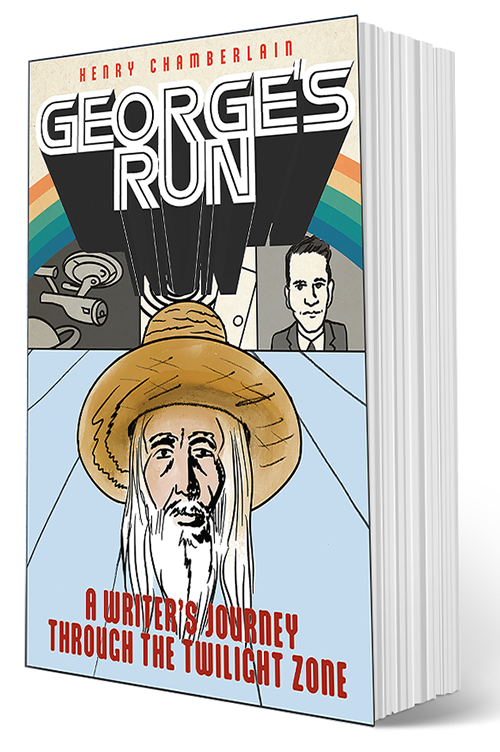
I had the opportunity to interview George for a couple of podcast interviews and got to chat a bit over the phone with him. During the course of one of our conversations, I suggested to him that his life and times would add up to an interesting book. I began work on it. We got to meet in person at his home in Los Angeles in December of 2014. For the next year, I began work on a book in a graphic novel format. It was through knowing George that I opened myself up more to my own love of writing. It was George who helped me rediscover Theodore Sturgeon. And it was George, because of his spirited way, that I opened myself up more to the world in general.
We had planned to meet again this year like before, in December of 2015, but, by then, it was too late. George was already in hospice care and, in the time that followed, it became clear that his time left was short. I had hoped to show him what I’d created thus far. But, I immediately understood, a significant page had turned. The time for asking questions or seeking advice had passed. I understood that I was alone to proceed. George had passed on the baton, just like he did for so many others like me.
“I Am Legend” by Richard Matheson. Illustration by Henry Chamberlain.
The work of Richard Matheson (1926-2013) is certainly suitable for in-depth analysis. It is through an academic lens that you can plumb such insights as the one about the recurring nemesis in Matheson’s groundbreaking novel, “I Am Legend.” As Charles Hoge describes, in this first survey of its kind, the neighbor-turned-vampire who repeatedly taunts the protagonist is part of a literary tradition dating back hundreds of years. Instead of being hidden away in Bavarian castles, vampires were known to call out their victims from their own village. It is a simple distinction like that which Matheson runs with to create one of the most influential books in pop culture.
It was this seismic shift from monsters in castles to monsters in the suburbs that would change everything and influence everyone from George Romero to Stephen King. Yes, you can thank Richard Matheson for the zombie apocalypse. He essentially invented it with his 1954 horror novel, “I Am Legend.” Well, there’s more to it. And you can dig deeper in this first ever substantial study, “Reading Richard Matheson: A Critical Survey,” edited by Cheyenne Mathews and Janet V. Haedicke, published by Rowman & Littlefield.
The original “I Am Legend” novel is an elegant and tightly written work. Our protagonist, Robert Neville, must figure out, with Sherlockian exactitude, what has brought about a world-wide pandemic of vampires. It is a prime example of work from the first phase of Matheson’s career. The theme here is man as victim of his own environment. By the time of Matheson’s work on the landmark television series, The Twilight Zone, his theme has broadened to man as victim of his own making. Within these two themes, a multitude of work can be examined. It is with this survey that we receive an essential collection of serious thought on a writer who Stephen King has ranked with Poe and Lovecraft.
In a piece that focuses on the noir character of The Twilight Zone, Cheyenne Mathews demonstrates both Matheson’s artistry and how well The Twilight Zone holds up to critical scrutiny. Cheyenne writes: “Through science fiction tropes of time travel, alternate realities, and new technologies, Matheson emphasizes the physical and social displacement that afflicted both men and women during the attempted postwar return to normality.” And, in describing what is considered the most noir Twilight Zone episode, “Night Call,” Mathews writes: “The second act of the episode conflates Elva’s personal anxieties with her social alienation, as she becomes increasingly disconnected from the other characters, who attempt to downplay her distress.” Of course, there is Matheson’s most celebrated TZ episode, “Nightmare at 20,000 Feet,” but, as Mathews makes clear, it is part of a bigger picture. Outside of Rod Serling, who wrote the majority of scripts, Matheson wrote the most episodes and they were all gems.
A man of his time, and ahead of his time, Richard Matheson has secured a place for himself within not only great science fiction, horror, and fantasy, but great fiction in general. Ultimately, Matheson’s work strikes a universal chord. We can explore the specific era he worked in and how he spoke to concerns of postwar paranoia and shifting gender roles; and, like Kafka, we can place him within some of the most eloquent writers on the human condition. Matheson was weary of being labeled a genre writer. Perhaps one of his fellow writers and friends, George Clayton Johnson, summed it up best when he said of Matheson that he was one of the “serious storytellers whose works were artful gems of wisdom fiction.”
“Reading Richard Matheson: A Critical Survey” is essential reading for anyone interested in understanding the origins of today’s pop culture at a deeper level and gaining a greater appreciation of the work of Richard Matheson.
“Reading Richard Matheson: A Critical Survey” is a 262-page hardcover published by Rowman & Littlefield.
Olivia Olson has much to celebrate and share with fans. She is in the unique position of getting to do a lot of cool and creative stuff with her dad, comedy writer Martin Olson. For starters, both are voice talent on the animated series “Adventure Time” on Cartoon Network. This is one of the most creative, quirky, and strangest shows on television. If you know the show, all I need to say is: Marceline the Vampire Queen and, her dad, the Lord of Evil, Hunson Abadeer! It was Adventure Time’s very own creator, Pendleton Ward, who recruited Olivia Olson, and later on Martin Olson, to become part of the show and the rest is history.
Marceline Vampire Queen and, her dad, Hunson Abadeer stealing her french fries
As Olivia describes in this interview, it was just a natural progression that led her to follow in her father’s footsteps into show business. Sure, it can be a harsh business but, with the right guidance, special things can result.
In the case of this father and daughter, it has led to not only performing together but also writing together. The first Adventure Time book was “The Adventure Time Encyclopedia,” written by Martin Olson. And that sparked an interest in Olivia to join in.
Olivia Olson and Marceline the Vampire Queen
Now comes a new book that goes even further, “Adventure Time: The Enchiridion & Marcy’s Super Secret Scrapbook!!!” You can read my review here. This one is a collaboration between the two. Martin Olson focuses on the Enchiridion. And Olivia Olson focuses on Marcy’s Super Secret Scrapbook. But there’s more to it than that and we cover it in the interview.
One thing that Olivia wanted to point out is that this book is not only two books in one. When you think about it, it’s actually four books in one! You see, the Enchiridion covers two separate books: one for Heroes; and one for Wizards. And Marcy’s Scrapbook is actually two books: a journal by Simon Petrikov, aka The Ice King, the man who raised Marceline; and a journal by Marceline.
The full interview with Olivia Olson follows and includes the podcast at the end.
Henry Chamberlain: I read that the idea for this book began on a subway ride in New York City with you, your dad, and editor Eric Klopfer. Would you tell us about that, what you were anticipating doing on the book?
Olivia Olson: It’s a funny story since originally I wasn’t going to be part of the writing process. I helped a little bit for our first book, the encyclopedia for Adventure Time. That was mostly my dad writing it and I had so many notes to give him because, at the time, he didn’t know too much about the show. He said, “How about if I keep the wrong information and you keep correcting me throughout the book.” That was my first little snippet of writing. We were at New York Comic Con, with the first book being so well received, and we just thought we needed to do another book. The first book had been successful. And we knew how much my dad wanted to tackle writing the Enchiridion.
At the time, we didn’t know how we were going to fuse the Enchiridion with Marcy’s Scrapbook. That came about way later. We sort of tricked our publisher, Abrams, into having me be a co-author on the book. I wrote my segments and submitted them and then, after they provided feedback, we revealed that the writing was mine.
HC: There’s such a literary quality to Adventure Time stemming from the original creators, your dad. And now you, part of the next generation. Would you describe to us growing up in that world, being exposed to all that creativity, getting to write with your dad.
OO: It’s so funny because, when I was a little girl, I always wanted to act and sing, all that kind of stuff. My dad, being in the business, did not want me to have anything to do with it since, you know, it’s hard on children being part of that. So, he frowned upon it. But here I was growing up among all these comedians and writers and actors so it was kind of impossible for him not to expose me to the world.
Not in a million years would I have thought that I’d be performing and writing right alongside him. It is such a funny coincidence as I grew up in animation. I grew up with all these people who worked in cartoons. But I never really thought that was to be my path. I always thought it would be more like Beyonce or Mariah Carey. It’s just so weird. People like Tom Kenny and his wife used to babysit me and my brother. Now I get to play a character with Tom Kenny. And I get to write with my dad.
HC: From what I observe, it looks like it’s all coming together naturally. For instance, your dad never considered himself an actor, even though he has that performing background.
OO: We joke about it. We’ve been doing this all our lives and now we have a job where we’re getting paid for it. Adventure Time has provided all these amazing outlets. I started off as an actor. My dad started off as a writer. Now, five years later, he’s an actor on the show and I’m a writer. It’s really amazing that Pen Ward, the creator of Adventure Time, gave us these opportunities to not only work as father and daughter but explore the range of our talents.
HC: You have a very distinctive voice and style for Marceline the Vampire Queen. And you bring her to life so well in this book. This is quite a unique two-books-in-one. Could you describe your take on your writing process–and how your songwriting background comes into play. I can think of some lyrics that you include in the book.
OO: There’s definitely a lot of poetry and lyrics spread throughout the Scrapbook part. It’s funny that we pitch it as a two part book because, if you really delve into it, you see that it’s a four part book. The Enchiridion side has two parts, one for Heroes and one for Wizards. And the Scrapbook has a journal by Simon Petrikov followed by a journal by Marceline.
The Scrapbook was originally going to be something completely different. I wrote summaries for every episode I’d ever done. I was following along with each episode and wrote a diary entry for what Marceline might write on that particular day. That’s what we originally submitted and then we end up scrapping all of that. We wanted to dive deeper into the backstory since Marceline is such a mysterious character. We really wanted to cover the Mushroom War and how tragic her story really is.
It was when I added the poetry that it kicked in. I had never written a work like this before. It was something new. I definitely started off by writing a lot of poetry for it. And that made me feel more connected to my character.
Marceline in “Stakes” from Adventure Time on Cartoon Network
HC: What do you hope readers will get out of the Scrapbook? I am thinking that, for young readers, they will get a fuller appreciation of how a character is depicted in a different medium. You see Marceline one way in an animated format and you see her in a different way in a literary format. Can you speak to how the character can do different things in different media?
OO: I think all the work outside of the actual series, and that includes the video games, comics, anything like that, is technically not canon to the show. We worked extremely hard with everyone involved to have our contributions match as closely to what is happening on the show. And that was a huge help in having us align with “Stakes,” the new mini-series that’s just come out. It gave us a platform to jumpstart where Marceline was going next and learn more about her.
I was so excited about this since Adventure Time fans really get down and dirty with everything. That’s what is so great about the show. It sparks the imagination. Fans have all these theories about what’s going on in the show. We went through so many drafts to stay true and do justice to the show. I was really impressed with what we ended up with, being able to go deeper into the characters, taking a different approach from the random humor the show is known for. When the show began to dig deeper into the characters, we wanted to do the same.
The Girl with All the Gifts by M.R. Carey
HC: What are you reading now or what sort of books do you like?
OO: Right now, I’m reading a zombie apocalypse book. It’s called, “The Girl with All the Gifts.” It’s 20 years after a zombie outbreak. You start with all these children at a playground. You don’t know why they’re being treated so poorly. They’re half-human and half-zombie. They’re hybrids. I was drawn to it since Marceline is a demon hybrid.
I like all kinds of books. I’m definitely not someone who judges a book by its cover. I’ll be at the airport and give anything a try.
HC: What sort of music are you currently listening to?
OO: Well, I like how Apple iTunes organizes your music and makes suggestions. It has me now listening to Justin Bieber. My boyfriend wasn’t a fan but now he is. I’m also enjoying the oldies, like The Doors.
HC: Any new writing projects brewing?
OO: I don’t want to jinx it but we’re in talks with my publisher, Abrams, about a new book. And I’m working on new music. I’d say, right now, I’m not reaching a quarter-life crisis but more of a quarter-life reprocessing of what path I want to take. I’ve been so fortunate to be so successful at such a young age. So, if there are any young listeners out there, don’t worry about having to know what you’re doing since I don’t always feel that I do.
HC: I think you’re on a great path. I foresee more of the same with new discoveries along the way.
OO: Yeah, I’ve been extremely fortunate. I’m a lucky girl but I always want to top myself and find what’s new.
HC: Well, great. Thanks so much, Olivia.
OO: Thank you, Henry. This has been a great chat. Really great questions.
The podcast is below:
“Adventure Time: The Enchiridion & Marcy’s Super Secret Scrapbook!!!” is published by Abrams. Visit them right here. And be sure to catch Marceline the Vampire Queen on Cartoon Network right here.
I’m a lot like you, someone who loves to be creative and follow their wanderlust. My latest adventure took me to Los Angeles and I want to share with you the wonderful place I stayed at, BLVD Hotel & Suites. What follows is a review of this boutique hotel complete with my own illustrations. Hope you like this and will see yourself at BLVD on your next visit to L.A.
BLVD Hotel & Suites has three locations in California. I stayed at the one in the heart of Hollywood near the iconic intersection of Hollywood and Highland Blvd. Thus its name, BLVD. It’s easy to remember and easy to find. You are within walking distance of the Hollywood Walk of Fame and beyond.
BLVD in Hollywood is located at 2010 N Highland Avenue and that proves to be a really convenient hub to return to as you go about your day and night. I need to emphasize this fact because a lot of people will take a hotel’s location for granted. Where you start your day plays a pivotal role. This made it easy to wander over to a number of great places for meals. At the top of my list is Musso & Frank Grill at 6667 Hollywood Blvd. A new find since my last visit to L.A. is Loteria Grill on 6627 Hollywood Blvd. Another old favorite is Miceli’s on 1646 N Las Palmas Avenue off of Hollywood Blvd. All are walking distance from BLVD Hotel & Suites.
BLVD is a very pleasant luxury boutique hotel at a reasonable price. All the staff are courteous and friendly. The room, as they say, exceeded expectations. I think when you get a welcome home feel to your room, that says it all: great bed, plenty of room to spread out, ample television screen, plenty of care with amenities.
Everything has been looked after: from well-stocked toiletries and ample towels in your room to an inviting lobby and lounge. They even have a snack bar for a quick bite on the go. Other features include a pool and a gym. Here is where you get refreshed and relaxed in a comfortable setting before your next L.A. adventure.
This is what I had hoped for and this is what I ended up getting. Yes, indeed, location is everything. Specifically, you are very close to the Hollywood Bowl. And, for fans of film history, let me tell you here that you are in for an added treat: you are near the Hollywood Heritage Museum at 2100 Highland Avenue. This is just an interesting fact that I want to throw in since, as I say, you are close to everything.
Visit our friends at BLVD Hotel & Suites right here.
I love good stuff that is for all ages because you can easily share it with family and friends and it’s hitting universal chords. That brings me to a book you will want to get for yourself and anyone you know looking for something odd and compelling: “Adventure Time: The Enchiridion & Marcy’s Super Secret Scrapbook!!!” Yes, that’s a mouthful but for very good reason. I am guessing that you’re familiar with the celebrated animated series, Adventure Time, on Cartoon Network. Am I right? If not, think of it as offbeat humor of a rare kind like such classics as Rocky and Bullwinkle and Bugs Bunny.
The world of Adventure Time invovles some very funny misadventures along with a very colorful cast of characters. Lots of magic. Lots of weird humor. And a heck of a lot of style and whipsmart goings-on. Set in a post-apolalyptic world, there is nary a zombie to be found here but loads of other curious creatures. The authors of this two-books-in-one are, among other things, voice talent on the show. Olivia Olson is Marceline the Vampire Queen and Martin Olson is her father, Hunson Abadeer.
Okay, this is what happened. The creator of Adventure Time, Pendleton Ward, was so impressed with the work of Martin Olson that he brought him on board to write about Adventure Time. Now, fast forward to this year, Martin Olson is taking things further and has enlisted his daughter, Olivia Olson, to help make this latest Adventure Time book a reality. And, yes, you read correctly, this is literally two books in one! You get the fabled Enchiridion, the infamous book found in the animated series. Plus, you get an in depth look into the inner world of Marceline The Vampire Queen, one of the most intriguing characters on the show.
From Marcy’s Super Secret Scrapbook!!! by Olivia Olson
Allow me one digression: there actually is another Enchiridion! It is a book filled with advice for gentleman originally published in 125 AD. It was written by Arrian, a 2nd-century disciple of the Greek philosopher Epictetus. And it offers bits of wisdom that you can boil down to one main theme: recognize what you’re in control of and you’ll lead a happy life. Ah, there is beauty in the spinning of universal truth. It sounds like something that Jake, the philosopher/party animal magical dog on the show would say. Some things never change.
The universal truth of the matter is that both Martin Olson and Olivia Olson offer you quite a special treat with this book. It is remarkable how well it all lives up to its ambition. It is the equivalent of handing to a fan of the show something snatched right off the screen that actually lives and breathes. Martin Olson turns in a virtuoso work of humor. And Olivia Olson proves to be an insightful and heartfelt author as well.
“Adventure Time: The Enchiridion & Marcy’s Super Secret Scrapbook!!!” is a 224-page hardcover in full color, published by Abrams, with illustrations by some of the leading cartoonists working today.
Fantagraphics Bookstore & Gallery, in Seattle, celebrates its 9th anniversary in wild style with the Cheech Wizard Show, Mark Bodé, Laura Knetzger, and more! A festive holiday gala takes place Saturday, December 12, from 6:00 to 9:00 PM marking the debut of Cheech Wizard’s Book of Me featuring a fabulous show of tributes to the alluring art of the late Vaughn Bodé and a rare reunion of his extended family.
The very first comic strip of Cheech the Wizard was drawn by Vaughn Bodé on a series of notebook pages in 1957. As the legend goes, the famous underground character came to Bodé as he contemplated a can of chee-chee nuts. Cheech the Wizard would go on to become a big player in underground comix celebrating sex, drugs, and rock ‘n’ roll. He was a Pogo for a mature audience with a similar whimsical quality masking a subversive humor. Which leads us to Cheech Wizard’s Book of Me which collects the best work of Vaughn Bodé along with a cavalcade of extras. The forward is by his son, Mark, who has carried on the tradition with his own take on Cheech and his pals.
And if the holiday gala weren’t enough on Saturday, you are welcome to return on Sunday for a book release party for Laura Knetzger’s Bug Boys Volume I. That takes place from 1:00 to 3:00 PM.
Fantagraphics Bookstore & Gallery is located in Georgetown at 1201 S. Vale St. For more details, visit our friends at Fantagraphics right here.
Wonder Woman. How well do you know her? What I love about this new book from Insight Editions is how accessible this great American icon has been made. Writer Matthew K. Manning and illustrator Paul Bulman have explored everything you’ve ever wanted to know and some things you may have thought you knew.
Each and every aspect of Wonder Woman triggers a new story. This book is all about sticking to canon. Manning does this by having Wonder Woman speak for herself in journal entries. For instance, we get a firsthand recollection of her growing up in Themyscira. Just to set the record straight, Wonder Woman explains, that whole thing about her being formed from clay was just a ruse. Her mom was having an affair with another god. Being born from clay sounded like a good idea at the time.
Think of this as a guidebook in a picture book format. There is a level of sophistication here that will appeal to fans of any age. Manning maintains an engaging conversational tone while peppering his narrative with bona fide comics facts, as in describing how Wonder Woman joined the Justice League; as well as integrating Greek mythology as in comparing superhero secret identities with Zeus incognito walking amongst mortals.
The beauty of this book lies within its crisp and concise structure. Add to that Bulman’s dynamic artwork, and you have a truly informative, entertaining, and compelling book. I leave you with one last example. Any fan will appreciate the four-page spread featuring all the gods in Wonder Woman’s orbit from the New 52 DC Comics universe. Very impressive for fans and casual readers alike.
“The World According to Wonder Woman” is published by Insight Editions. This is a hardcover 64-page book in full color priced at $16.95. For more details, visit Insight Editions right here.