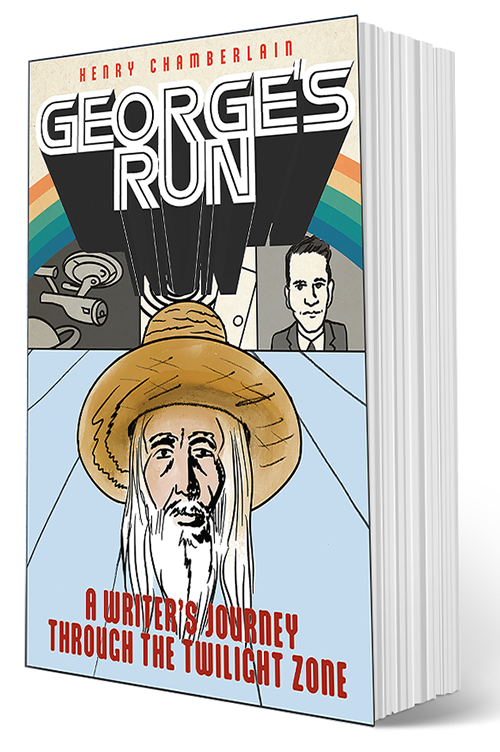
As many of you out there know, I am currently working on a graphic novel about the life and times of science fiction writer George Clayton Johnson. I am also working on some other projects that are just as important. They all share something in common as they use the graphic novel format. I invite you to take a moment to complete a quick survey that will prove quite useful. For the first ten respondents, if you choose, I will send you a free copy of the first issue of George’s Run. Just reach me by email, which you can find in CONTACT right on the navigation bar, and let me know that you completed the survey. Thank you to all my loyal followers. You can go to the survey right here.
I found myself in Los Angeles these last few days of February for a number of reasons. Let me put it to you this way, I was there as much to enjoy a day long visit to the Los Angeles County Museum of Art as I was for anything else. And, of course, I devoted a chunk of time to the Oscars. Here is the key to a lot in life: keep an open mind. Now, when it comes to entertainment, the more flexible you are, the better. I keep things to a broad spectrum, from the intellectual to the spectacle. That said, I’ll share with you some observations from this last visit. In the end, we can explore the idea of what it is to be entertained.
The Gumbo Pot in the Farmers Market, Los Angeles
Seattle is my home base. It is in this relatively small, yet bustling, city that various forms of entertainment are created by some very talented individuals in music, film, fiction, comics, and so on. And then there are just as many, perhaps even more, individuals involved in commenting on all this creative work. That’s something I am very sensitive to as I am both a creator and a commentator. Let’s just say I appreciate when the air has gotten too thick. Sometimes, you just want some frog legs at The Gumbo Pot in the Farmers Market, which I definitely enjoyed. And, to be sure, the level of discourse at tables was quick, smart, and unpretentious. If I say I am going to talk to you about the true meaning of fiction or entertainment, it’s in the spirit of an open discussion without the pretense. Please, we have too much of that.
Chris Burden’s “Urban Light,” at LACMA
It’s all about going from the specific to the general. Take the time to give one particular subject its due, focus on that, consider its merits, and then reap the rewards of entertainment and insight. I will compare for you two events in Hollywood that are closely related: a tribute to screenwriter George Clayton Johnson at the American Cinematheque this last Friday; and then some observations on the Oscars this last Sunday. I really wasn’t planning on doing this. I want to keep it light but offer you a few ideas. The best thing I can do is jump right in with some observations beginning with the tribute. Here, I want to make clear that much depends upon your understanding and knowledge.
George Clayton Johnson tribute at the American Cinematheque in Hollywood
If such things as the literary background of The Twilight Zone are new to you, then perhaps this will spark interest. I know a great deal about this subject, particularly the writers known as, The Group, from which much of this springs from. George Clayton Johnson was a key member of The Group. He had within his power the ability to write some of the most compelling magical realism. That’s important because, despite the many disadvantages he had in life, he was a writer with not only a vision but a determination. George went on to create some of the most iconic and beloved episodes of The Twilight Zone which is the gold standard for what can be done when melding the art forms of fiction and television. Don’t let yourself think that Masterpiece Theater holds the key. That is too obvious a venue. Actually, it is within The Twilight Zone, at its best, that you will find much that is stimulating and intriguing with great literary merit.
George Clayton Johnson tribute at the American Cinematheque in Hollywood
So, here you have this very special individual, George Clayton Johnson, who understood better than most, the fundamental inner workings of fiction. He took his insight, skill, and hard work and did what he did with it. He primarily wrote for television. All of his work on The Twilight Zone is remarkable. This led to him writing the first episode of Star Trek to be broadcast. Among other TV work, he wrote an exceptional episode of Kung Fu where the main character experiences a flashforward, as opposed to a flashback, to help him save his life. And, to cap it all off, George and William F. Nolan wrote the classic dystopian novel, Logan’s Run. Beyond those achievements, it is George’s life story that is inspiring. He was close friends with such greats as Ray Bradbury and Theodore Sturgeon. George was simply a man who loved to keep it simple: write what you believe in, give back to the community, love thy neighbor. The outpouring of love and admiration for George at this tribute was very moving. I had the opportunity to get to know George. I can fully understand how bright his light shines.
Chris Rock tells it like it is at the Oscars.
A couple of nights later, lo and behold, it’s the Oscars. Now, mind you, I did not have any set plans. How I wish my Comics Grinder credentials would have gotten me a press pass. Perhaps they would had I pursued it. I’ll tell you something, I am a keen observer and a friendly interviewer. I can easily adapt to any situation. This segues to what I did for Oscars night. Due to a few things going on that night, I found myself outside the Hollywood Roosevelt Hotel. Let me back track a bit, a buddy of mine suggested that as a great spot to maybe see something going on. In fact, the plan was to meet up with him. I show up and, yes, it is a great spot, right on the corner of Orange and Hollywood overlooking that whole block of Madame Tussauds, Grauman’s Chinese Theatre, and the Dolby Theatre.
25 Degrees at the Hollywood Roosevelt Hotel
Well, on that corner are a bunch of onlookers, of course. Shades of “The Day of the Locust.” I mingled for a bit. No one knows exactly what to expect, if anything. I then made my way into the Hollywood Roosevelt and 25 Degrees, one of the hotel’s seven bars. 25 Degrees is known for its gourmet burgers and onion rings, which I fell in love with. I patiently waited for a cozy table overlooking the bar and two big screen TVs broadcasting the Oscars. Chris Rock was doing his monologue. I saw any number of what appeared to be otherwise jaded industry folk carefully listening and giving way to outbursts of laughter. Just as I was assured by my hostess that I could have the table, this one lady sat down at that very same table. The hostess explained to her that I had already been given that table but I said it was alright. Sure, it’s the Oscars, I’ll share the table. Well, it was definitely for the best. The lady turned out to be an executive with a Mexican network. We ended up chatting about the decline of culture in general and the disturbing rise of Donald Trump.
Behind the scenes at the Oscars
It always comes down to the coveted issues of time and space. That table had a fixed value of one hour. You could not stay at that table beyond an hour. I sweet talked my hostess into letting me begin a new hour given that I had to share it. In the meantime, my new friend, the Mexican TV executive, had hoped that I could hold on to the table as she had wanted to return after a while. Well, there must have been a lot of discussion in the back. At first, yes, I could keep the table if I ordered more food. After having the delicious Patty Melt, and a half jug of Pinot Noir, I opted to start with a Dark and Stormy. Later, the supervisor negotiates with me. It turns out that the table really needs to be relinquished. If I am alright with moving to the bar, he will treat me to another drink. Well, that’s fine with me. And, well appreciated too!
Behind the scenes at the Oscars
We always hear the long-running jokes about the Oscars being too long. The crowd that night enjoyed every minute of it and would have been happy to see more. The high points were the Chris Rock monologue, the announcement for Best Actor to Leonardo DiCaprio, and the announcement for Best Picture to “Spotlight.” In between, and throughout, careful attention was given to each category. I ended up chatting a bit with other patrons at the bar. The consensus seemed to be that this was one of the best Oscars. I certainly found myself in a perfect setting. The bar, with its old-school charm, was impeccable.
Here I am in front of the American Cinematheque in Hollywood.
One Oscar tradition never fails to move me. That’s when a tribute is given to notable members of the Academy who had passed away in the previous year. I was certain that George Clayton Johnson would receive a mention. While he wrote primarily for television, he also co-wrote the story that was the basis for “Ocean’s Eleven” and he also co-wrote an Academy Award nominated animated feature with Ray Bradbury, “Icarus Montgolfier Wright.” But he did not get his mention. That left a sad note hanging in the air. But it was still grand to be at the Hollywood Roosevelt on Oscar night. I can tell you, I can share with you, the fact that both nights, the tribute to George and Oscar night, were both magical. George is still remembered and people will enjoy his work whether they realize he wrote it or not. George will always be part of that magic that people seek out whether they know it or not.
Great fiction comes from all over: horror, dark fantasy, mystery, and so on. William F. Nolan writes in various genres. You may know him from his work with Dan Curtis, such as the classic horror film, “Burnt Offerings.” Or perhaps you know him from co-writing, with George Clayton Johnson, the classic dystopian novel, “Logan’s Run.” Mr. Nolan has gained great recognition and won numerous awards and honors. Just last year he was named the Grand Master at the World Horror Convention in Atlanta. In this interview, we spend a good time chatting about horror as well as fiction in general. And we definitely visit the subject of the Southern California Sorcerers, otherwise known simply as The Group.
“Burnt Offerings” from 1976
During our conversation, Bill shared a very special moment regarding his friend and fellow writer, George Clayton Johnson, who passed away this last Christmas. He offers up for us a picture of a fresh-faced, and beaming, young George bursting upon the scene, circa 1957. He has shown up at a meeting of The Group and asks if he may join in with the illustrious and ambitious writers. Someone asks George what he has to show for himself. And, George, just having received his box of author copies, proudly shows the men what he’s been up to. “Hey guys,” George says, “I co-wrote this really cool thing called, ‘Ocean’s Eleven!'” And the rest is history!
This interview was conducted Monday, February 22nd. William F. Nolan is going strong, just shy of his 88th birthday on March 6th. If you love a good story, or if you are an aspiring writer yourself, or if you’d like to know something about the Sixties zeitgeist, then this interview is for you. In the span of about twenty minutes we cover a lifetime of observations and insight.
Henry Chamberlain: Thank you for getting together with me, Bill. I wanted to cover the writer’s life with you in this interview. First off, a good horror story has been compared to placing a frog in gradually boiling water. What can you tell us about the boiled frog method of storytelling?
William F. Nolan: Allow me to veer off a bit from the boiled frog to tell you how I approach telling a story. Really, how I tell a story is like the other night when I was in bed, half asleep and half awake, a state where I get all of my ideas. I was thinking of these deadly flowers. They had the power to stop the human heart. They were alive and, if you didn’t treat them right, they could turn against you and stop your heart. There’s this couple who decide to rent this place on the beach. It looks like a great place. The owner lets them know that they have to take care of these special flowers but the couple ignore him, they don’t do it. And they end up being killed by the flowers. Their dead bodies are found on the beach. That’s how I form an idea for a story. I get an opening in my head for the concept and then I get the ending. Finally, I fill in the middle. That’s how I write a horror story, or any other kind of story.
Discoveries Best of Horror and Dark Fantasy edited by James R. Beach and Jason V Brock
HC: There’s a story of yours, “Stabbed by Rob,” in the recently published collection of dark fantasy from Dark Discoveries, edited by James R Beach and Jason V Brock. That story is a perfect example of that boiled frog method. There are a number of touches of humor, including your mentioning a glow-in-the-dark statue of Jesus. And the story keeps turning up the heat to the very last sentence.
WFN: Well, I believe you really can’t get away without some humor in a horror story. Horror is too stark, raw, and unflinching. You need to be able to live in it. You’ve got to lighten it with some humor. All my horror stories have elements of humor. You need to let the reader breathe. You can’t go from the first page to the last and do straight horror. That’s the problem with H. P. Lovecraft for me. Lovecraft has no sense of humor. He was a brilliant writer. He was a brilliant innovator. But no sense of humor. By the time you finish “The Shadow over Innsmouth,” you’re exhausted. I want my readers to relax a little, to breathe, and have a good chuckle while they’re being frightened. That’s my method of writing horror.
HC: I’m glad that you mention Lovecraft because I’ve had difficulty with him too. Your adaptation with Dan Curtis of Robert Marasco’s 1973 novel, “Burnt Offerings,” has just the right touches of humor at the start, and they give way to a more sinister mood. There’s a balance.
WFN: Yes, that was adapted from the Marasco novel which had no humor whatsoever. I told Dan Curtis, who directed, and produced the film with me, that we were going to need to lighten up the material because it was too stark. I’m glad that you appreciate the humorous elements in the film. As I say, I just don’t think you can do horror without lightening it up a little bit.
HC: Then there’s Ray Russell’s work. Perhaps more of a touch of elegance than humor. I love the way Ray Russell masterfully brings up a lot of pretty grim stuff in his work. He knows what to leave in and what to mostly imply. I’m thinking of “Sardonicus,” “Sagittarius,” and “Sanguinarius.”
WFN: Ray Russell was one of my closest friends for years. We would talk about how to write in terms of horror. And we both agreed on the same thing that you’ve got to put some humor into it in order to lighten the whole thing. I love Ray’s work. He passed on some years back. He would be happy to hear that you enjoy his work.
Just Part of The Group: Charles Fritch, Chad Oliver, Charles Beaumont, Richard Matheson, and William F. Nolan, circa 1954.
HC: There were all of these amazing writers that you got to be close with in social settings and in work sessions. All of you together were the Southern California Writer’s Group.
WFN: There were eleven of us. We didn’t think of ourselves as anything special. We were all trying to make a living, pay the rent, pay the mortgage, stay afloat. We wrote science fiction and fantasy in a modern vein. We took it away from the Lovecraftian type of fiction and wrote a modern type. It was sort of pioneered by Richard Matheson and Ray Bradbury who were part of our group. We all worked from the same principle: you can do modern horror but it has got to be something that people can believe in. It has to be realistic. It should happen today, in somebody’s kitchen. It could happen in a kitchen. You don’t have to go to a haunted castle, back in Transylvania, to have horror. Horror can happen on your doorstep. Horror can be a terrorist with a submachine gun that sprays lead over you while you’re eating in a restaurant. That’s horror. Horror takes many forms. We all tried to work within that scope.
Yeah, eleven of us. Matheson, Bradbury, myself…Charles Beaumont was sort of the hub of the thing. We had Jerry Sohl. We had Robert Bloch, known for “Psycho.” We’d all gather together at each other’s houses, at all-night coffeeshops and talk shop, editors, and markets. We were quite a group. All these years later, people look back on us as pioneers in the field. And that’s nice but, at the time, we were just trying to make a buck, just trying to make a living.
HC: Well, sure, you guys were so close to it all. You would need to stand back to see it clearly. What you guys did was take gothic literature and give it a modern cool. That’s essentially it.
I AM LEGEND by Richard Matheson
WFN: Yeah. I still think that you can credit Richard Matheson for a lot of that. Stephen King said that he was influenced more by Richard Matheson, than any other author, because he took horror out of the castle and brought it into the kitchen. And I agree with him. We all tried to do that. We all felt that was the way to go. We weren’t interested in something ancient. We wanted something real, something of today.
HC: You list eleven members of The Group. Was there any time that all eleven of you met under one roof?
WFN: Three or four of us were into auto racing. Richard Matheson, Jerry Sohl, and Robert Bloch didn’t care at all about that. But Charles Beaumont, John Tomerlin, and myself were heavily into Grand Prix sports car racing both here and in Europe. We actually flew to Monte Carlo one year for the Grand Prix. And we went to Sebring Raceway in Florida for the races there. The Beaumont kitchen in North Hollywood, his upstairs kitchen, is where most of us would meet. George Clayton Johnson was part of that group too. We would meet there. But there was never a meeting of all eleven of us at one time. It was three or four of us at at time at different places. We’d go to movies together. We’d meet in coffeeshops.
Musso and Frank Grill
HC: I imagine that you guys enjoyed Musso and Frank Grill.
WFN: We loved Musso and Frank Grill. It has all that history: Hemingway, Fitzgerald, and William Faulkner. The murals never changed. The seats are the same. When you’re sitting there, it’s like you’ve gone back in a time machine. We loved it. I still love it. I love to go whenever I’m in L.A.
HC: You touched upon George. I have to say that I can imagine that he loved the fact that he got to pass away on Christmas Day. Such a magical thing. Such an act of will.
WFN: That was no accident. He was ill. He was in hospice care for about a week before that happened.
HC: Oh, yeah.
WFN: The doctors were saying that he could go at any minute but George, subconsciously, since he couldn’t verbalize it at that stage, was saying that the doctors couldn’t tell him when he was going to die. He was always an independent guy. He was saying: “I want to die on Christmas Day since that was the birthday of Rod Serling, who made me famous for my writing for The Twilight Zone.” He was able to die three days past when he was expected to die. He was able to fool all the doctors. That was no accident.
George Clayton Johnson and William F. Nolan, circa 1957, illustration by Henry Chamberlain
HC: Yes, that’s what I meant. I was honored to interview George a number of times and got to meet him in person. Would you share with us a little more of the flavor of the era and a picture of George at one of these bull sessions at The Group that may come to mind?
WFN: Four or five of us were sitting in the living room of the upstairs apartment of Charles Beaumont one night. There was a knock at the door. This is around 1957. The Group was around from the ’50s to ’60s. So, there’s a knock at the door. We open the door and there’s George Clayton Johnson with a package under his arm. He said, “I’m George Clayton Johnson. I want to join you guys. I want to be with you. I’ve heard about you and I want to join you.” Someone asked, “Are you a writer?” He said, “Yes, I am,” and he held up the package, “It’s called, ‘Ocean’s Eleven’ and I just sold it to Frank Sinatra!” That’s what got him started with The Group.
HC: That’s beautiful. I wanted to ask you about the literary tradition that The Group worked from. I’m sure that Nathaniel Hawthorne, Mary Shelly, all the gothic writers, were subjects of conversations for all of you.
WFN: You can’t write out of a vacuum. We’re all influenced by other people. Ray Bradbury was influenced by Herman Melville, William Shakespeare, and George Bernard Shaw. We were influenced more by such horror writers as Arthur Machen and Algernon Blackwood. I started out reading H.G. Wells’s “The Time Machine” and “War of the Worlds” when I was a boy growing up in Kansas City, Missouri. And then I discovered Bradbury and Weird Tales. Ray Bradbury and I became close friends and that lasted 50 years. We’re all standing on the shoulders of other people. We all read Hawthorne and Robert Louis Stevenson. We were influenced by them but we wanted to take our fiction into a modern setting and move it forward and I believe we succeeded.
Photo by Ralph Morris, Hollywood Blvd. 1960
HC: I wanted to close out by asking if you could give us a little more of a flavor of Los Angeles in the ’50s and ’60s. I can just imagine: you had the ghost of Raymond Chandler; old Hollywood giving way to new Hollywood; Forey Ackerman and the rise of geek culture. L.A. in the Sixties, it doesn’t get much better than that.
WFN: I read Raymond Chandler, Dashiell Hammett, the hard-boiled school, James M. Cain. I’ve read books on Chandler and Hammett. I’m a big hard-boiled fan. Los Angeles was a hard-boiled city in those days. Dashiell Hammett glorified San Francisco. But Los Angeles was also part of that era where corruption ruled in high places. It was a violent and colorful era captured beautifully by Raymond Chandler. If you read the work of Raymond Chandler, you’re learning a lot about Los Angeles as he experienced it.
I can tell you that there was a lot of smog. I used to live in Burbank, right against the mountains. The smog was terrible. I did move around different parts of Los Angeles. It changed quite a lot during the many years I was there. It’s not the same city that it used to be.
HC: I love Los Angeles and love looking for signs of yesteryear. They’re around if you know where to look for them.
WFN: If you go to Pasadena, there’s the old bridge that Raymond Chandler wrote about in one of his novels. The bridge that Philip Marlowe drove over at night. It’s still standing there. I wrote a piece entitled, “Marlowe in Los Angeles.” I toured all the places he used to go to, including Musso and Frank Grill. Chandler was an insatiable researcher, always moving around, and usually within the greater Los Angeles area. He grew to know it beautifully. Hammett made San Francisco famous with “The Maltese Falcon.” Chandler did the same for Los Angeles with “The Big Sleep.”
HC: I wish you a great year ahead, Bill. Any projects we can look forward to soon?
WFN: I had a collection of my poetry come out last year. This year we’ll have a new collection of my essays. I’m working on a new collection of short stories. I just wrote three new stories this month. So, even though I’ll be turning 88, I feel like I’m still 28.
HC: I can feel the energy. Thanks again, Bill.
WFN: I really enjoyed this. Thank you.
You can listen to the podcast interview by just clicking the link below:
Keep up with William F. Nolan at his website right here.
Charles Beaumont on the set of “The Howling Man.” Illustration by Henry Chamberlain.
How do you describe the distinctive character of the landmark television series, The Twilight Zone (1959-1964)? Well, it has everything to do with its unique literary quality. And how to best speak to that? Charles Beaumont (1929-1967), one of its celebrated writers, is a perfect example. Let’s look at a new collection of his work, published by Penguin Classics, “Perchance to Dream: Selected Stories by Charles Beaumont.”
“Perchance to Dream” by Charles Beaumont
What a treat this book is for any Twilight Zone fan since here you have some of the original stories by Beaumont that went on to become classic episodes. And you also get them in the context of his work for various magazines of the era, a total of 23 stories in this collection. Consider the title piece, “Perchance to Dream,” first published in Playboy, October 1958, and then turned into a TZ script and broadcast November 27, 1959. A distraught man enters a psychiatrist’s office in fear that he will die if he falls asleep. He is certain this will happen since he sees things that tell him so. For instance, if he stares long enough at a painting, the figures will move around and talk to him. Here, perhaps Beaumont borrows a little from “The Golgotha Dancers,” by Manly Wade Wellman, first published in Weird Tales, October 1937. It’s just enough to fuel another strain in the tradition of weird fiction dating back to Gothic literature. In this case, we have a man in a contemporary setting who has been reduced to a quivering heap as his only solace, to dream, has been denied him.
Rod Serling was a writer on the rise, already with a reputation for first-rate work like “Requiem for a Heavyweight,” when he decided to try something new. It was to be an anthology series of science fiction and fantasy, the best possible route for him to continue to pursue his social commentary. When Serling approached Ray Bradbury for advice, Bradbury presented him with four books by authors he should know: Ray Bradbury, John Collier, Richard Matheson, and Charles Beaumont. Dark fantasy is what Serling was seeking. Beaumont seemed to be dark fantasy incarnate. He was a brash young aspiring writer when Bradbury took him under his wing. In a year’s time, Beaumont was well on his way. In 1950, at 21, he sold his first story to Amazing Stories. And, in 1954, Playboy magazine selected his story “Black Country” to be the first work of short fiction to appear in its pages. His astonishing trajectory would end by a mysterious condition that would cut his life short, at 38, in 1967. A fascinating documentary by Jason V Brock provides great insight into this unique life and career.
Browsing through the titles, you’ll find a wealth of creativity spanning many genres, all of them embracing a sense of the macabre. The opening lines to “The New People” (1958) lure you in with the misgivings of Hank Prentice over buying his first home, that embodiment of the American Dream. Instinctively, he fears for his wife and son: “Too late for what? It’s a good house, well built, well kept up, roomy. Except for that blood stain, cheerful.” And so commences a fine piece of horror with a fine bite of social commentary. Conformity has brought each member of the neighborhood together. However, in order to cope with and stave off boredom, we discover this group gives new, and bloody, meaning to the quaint notion of “community.” In the same spirt as Richard Matheson, Beaumont conjures up a fable that questions our so-called dreams and aspirations.
Charles Beaumont’s work has a distinctive style and it is far from formulaic. What he did was follow a certain way of revealing a greater truth. Beaumont confronted that clean wall of 1950s conformity. He looked closer to see the stress cracks forming. He responded with fiction that helped to tear that wall down.
“Perchance to Dream: Selected Stories by Charles Beaumont” is published by Penguin Classics. For more details, visit our friends at Penguin Random House right here.
Writer George Clayton Johnson past away this Christmas day at 12:46 PST. His son, Paul, posted an announcement. He said of his father, “He was more than a reknowned writer, fan & hemp legalization advocate, he was a truly loving father & husband. Dad understood some truths deeply….understanding, tolerance & love, and above all, we’re all the same and should be cared for as human beings…no homeless…no hunger, but charity for all.”
For those of you new to George Clayton Johnson, he was, and will always remain, a spirited beacon. He was able to take his love for science fiction and fantasy and realize some excellent writing. A prime example is his work on The Twilight Zone. He wrote some of the most memorable episodes, including “The Four of Us Are Dying” (1960), “A Game of Pool” (1961), “Nothing in the Dark” (1961), and “Kick the Can” (1962).
Of this work for The Twilight Zone, it was “Nothing in the Dark” that was his favorite and, perhaps, his all-around favorite of everything he wrote. The story has a favorite theme for him, the game of trying to cheat death. In the episode, Gladys Cooper (played by Wanda Dunn) is doing her best to avoid death by remaining in hiding. Attempting to reassure her is a handsome young man, Harold Beldon (played by Robert Redford). If only Gladys will give herself over to Harold’s logical and gentle words, she may find peace. Of course, this is the off-center world of The Twilight Zone with nothing as it may seem.
In the end, this is a story with an unpredictable and satisfying resolution. In a similar fashion, George Clayton Johnson bid farewell. He was in hospice care and it was assumed he was near the end a number of times. Ultimately, it seems, he got his wish, hung on until Christmas, and left on his own terms.
One of George’s favorite themes as a writer was that of cheating death. News outlets have already reported on his death but he is still among us, the living. This is an irony that I must think is appreciated by George. His legion of fans have entered a process of mourning. His spirit, I must think, is pleased, restful, and joyful. Some fans believe he will hang on with us until Christmas.
George Clayton Johnson is in hospice and nearing the end. Of course, he will always live on. His impressive writing career began when he thought up the ultimate heist story. That was to be the Rat Pack classic, Ocean’s Eleven.
George Clayton Johnson has led a full life as a writer, activist, and all-around humanitarian. He will always be an important part of some key pop culture: Ocean’s Eleven, The Twilight Zone, Star Trek, and Logan’s Run. It’s pretty phenomenal when you stop and think about it. And such a decent man. Such a very decent man.
George came from humble origins, poverty-stricken Cheyenne, Wyoming during the Great Depression. He followed his heart, became great friends with legends and, in the process of living, loving, and creating, became a legend himself. This man did not seek out notoriety in some contrived manner. George had the great fortune of possessing just the right combination of talent, determination, and luck. As for luck, he gravitated toward other great talent. As for talent, he’d always had that. He loved to read since he could remember and writing came naturally to him. And, as for determination, that’s just second-nature to a man like George.
This is the man who co-wrote the novel that led to Ocean’s Eleven. He then went on to write iconic episodes of The Twilight Zone. He wrote the first aired episode of Star Trek. And, in a great capping off to a career, co-wrote the novel that led to the cult-classic Logan’s Run. But there’s much more to it than that. On a deeper level, it was always about maintaining one’s integrity and fighting to create something original in a world that demands the tried and true.
I had the opportunity to interview George for a couple of podcast interviews and got to chat a bit over the phone with him. During the course of one of our conversations, I suggested to him that his life and times would add up to an interesting book. I began work on it. We got to meet in person at his home in Los Angeles in December of 2014. For the next year, I began work on a book in a graphic novel format. It was through knowing George that I opened myself up more to my own love of writing. It was George who helped me rediscover Theodore Sturgeon. And it was George, because of his spirited way, that I opened myself up more to the world in general.
We had planned to meet again this year like before, in December of 2015, but, by then, it was too late. George was already in hospice care and, in the time that followed, it became clear that his time left was short. I had hoped to show him what I’d created thus far. But, I immediately understood, a significant page had turned. The time for asking questions or seeking advice had passed. I understood that I was alone to proceed. George had passed on the baton, just like he did for so many others like me.
For all of us in the comics community, whether creators or fans, it is time once again for the Short Run Comix & Arts Festival. There’s a nice write-up about it in the local alt-weekly, The Stranger, that you can check out here. Among a splendid array of comics that you will have a chance to choose from, I humbly add something I am working on. This is the first installment to a full-length work. It’s called, “George’s Run,” and it’s about the life and times of science fiction writer George Clayton Johnson. I am still in the process of weaving the narrative but this is a perfect time to share some of what I’ve put together thus far. If you happen to go to Short Run, you’ll have a chance to buy a copy of this 24-page comic. You can find me at the Short Run tables under the name, Comics Grinder Press.
Short Run Comix & Arts Festival takes place this Halloween: Saturday, October 31, in Fisher Pavilion at Seattle Center from 11 am to 6 pm.
For more details, be sure to visit our friends at Short Run right here.
The new print and ebook edition of the original novel, “Logan’s Run,” by George Clayton Johnson and William F. Nolan, is now out, published by Vintage Books, a division of Penguin Random House. Check out the new line of Vintage Movie Classics right here. This is the bestselling dystopian novel that inspired the 1970s science-fiction classic starring Michael York, Jenny Agutter, and Richard Jordan. For many of you out there, enough said. It will instantly bring to mind crystal palm flowers flickering red. If that means nothing to you, then you’re in for a treat. Perhaps knowing that such works as “The Hunger Games” and the Divergent trilogy owe much to this novel with pique your interest.
It is a beautiful new edition for longtime fans and newcomers alike. For the longest time, this title was essentially out of print, as far as a mass market printing was concerned. The original novel was a huge hit in its day, only to be magnified by its tie-in with the major motion picture. The novel was never forgotten and, in fact, its legend grew. Special edition print runs came out over the years and you could always find an old copy of the many editions that exist. For collectors, there are many iconic paperback editions to choose from. But the fact remained that the time had come for a new readily available edition and now we have it. I’ve been a big supporter of bringing out a new edition. You can read my review of the original novel and my call for a new edition right here.
The forward is by Daniel H. Wilson, author of several books on possible dystopian futures, including Where’s My Jetpack?, Robogenesis, and the forthcoming, Quarantine Zone. Wilson provides just the right balance of looking back to his own childhood experience with Logan’s Run and observations on the novel’s enduring relevance. Wilson’s enthusiasm for his subject is infectious and adds a contemporary boost to a timeless classic.
The novel, first published in 1967, paints a very compelling, and alarming, picture of a society overly dependent upon technology for all aspects of life. Youth has been conditioned to seek out distraction and pleasure over all else, including quality of life. That said, for anyone familiar with the movie, this is also one very entertaining story. The movie echoes the novel as it veers off into its own high level of kitsch. But no harm done. The movie remains a cult classic and an excellent gateway to the original novel.
I have always held a fascination with how movies adapt novels so I am thrilled to discover Logan’s Run is part of a new line of books from Vintage Books. Vintage Movie Classics includes a wide variety titles like “Night of the Hunter,” the bestselling National Book Award-finalist that inspired Charles Laughton’s expressionist horror classic starring Robert Mitchum and Shelly Winters. Other available titles: The Bad Seed, The Bitter Tea of General Yen, Back Street, Alice Adams, Show Boat, and The Ghost and Mrs. Muir. This is truly astounding for the broad range and the opportunity to rediscover lost gems.
You can find Logan’s Run over at Vintage Books right here and over at Amazon right here.
Jason V Brock is an author, artist, and filmmaker who finds himself in a very interesting place in pop culture. For starters, he has created two well-regarded documentaries that focus on two very different men, both great contributors to science fiction, horror, movies, television, and the arts in general. One is Charles Beaumont. The other is Forrest J Ackerman. We chat about them and the creative process. How do you create art? One rule of thumb: Do it yourself! We begin with a look back at Brock’s childhood and how he, a child of the ’80s, grew up with the DIY ethos. In Charlotte, North Carolina. That’s where Brock cut his teeth on comics, retro cinema, vintage LPs, pulp fiction, and Playboy. Brock began working at his local comic book shop at the age of 13. His dad was a writer and graphic designer. It sounds like an idyllic way to grow up, right out of a Ray Bradbury story.
Charles Beaumont and Robin Hughes on the set of “The Howling Man”
Speaking of stories,there are so many stories to cover just in Brock’s documentary on Beaumont. Take the case of the short story, “The Crooked Man,” by Charles Beaumont. It is a classic today that was highly controversial for the time, circa 1955. It imagined a society where homosexuality was predominant while hetrosexuality was outlawed. The story was bought by Esquire but subsequently was not published. It turned out to also be too hot for the pages of The Magazine of Fantasy & Science Fiction. But when Playboy published it in 1955, then that same story became okay, more than okay. Charles Beaumont sold his first science fiction story, “The Devil You Say,” to Amazing Stories in 1950. By 1954, he had written the first work of fiction, the landmark work, “Dark Country,” to appear in Playboy in 1954. This kicked off over a decade of Beaumont stories in Playboy. Writing for movies and televison soon followed including some of the best episodes of “The Twilight Zone.” All this, and so much more, before his life was cut short at 38 by a mysterious illness.
And, that gives you some sense of what to expect in Brock’s “Charles Beaumont: Short Life of Twilight Zone’s Magic Man.” You can find that documentary as well as Brock’s documentary on Famous Monsters of Filmland’s former editor, Forrest J Ackerman (Uncle Forry), “The AckerMonster Chronicles!” right here.
We also chat about Brock’s work in editing and writing his own stories. This led us to discussing a unique pairing of talents. In the course of working on the Beaumont documentary, Brock got to know one of the members of the Southern California Writer’s Group, William F. Nolan. They struck up a solid friendship. When Nolan was at a turning point on where he wanted to live next, it was a reasonable choice for him to move a bit further north from Bend, Oregon to Brock’s neighborhood in Vancouver, Washington. It turned out to be a natural fit and Brock and his wife, Sunni, could not be happier to share meals but not only that. Bill Nolan became family and you look out for family.
Among Brock’s impressive editorial work, there’s the recent anthology, from 2014, “A Darke Phantastique.” This is a 730-page lushly illustrated collection of some of the best dark horror fiction around with more than fifty stories, poems, and one teleplay. This includes Joe R. Lansdale’s “The Case of the Four-Acre Haunt”; Paul Kane’s “Michael the Monster”; William F. Nolan’s “The Last Witch”; Nathaniel Lee’s “The Wisest Stone and the Zoo”; Derek Künsken’s “The Buddha Circus”; E.E. King’s “Three Fables”; Jason Maurer’s “In Your Dark: Differing Strategies in Subhuman Integration Through Monster Academies” and S.T. Joshi’s “You’ll Reach There in Time.” “A Darke Phantastique” is published by Cicatrix Press and you can find it here.
And another recent anthology, out this year, is “Disorders of Magnitude.” This is a 336-page overview of the genres of horror, science fiction, and the supernatural. It will prove useful to anyone who wants a better understanding of the roots of one of today’s dominant forms of entertainment and art. Included in this collection are essays, reviews, and interviews. Brock studies such dynamic figures as H. P. Lovecraft, Forrest J Ackerman, Harlan Ellison, Ray Bradbury, Charles Beaumont, Richard Matheson, Rod Serling, and William F. Nolan. This collection also includes filmmakers Roger Corman, George Romero, and Dan O’Bannon, and such fantasy artists as H. R. Giger. “Disorders of Magnitude” is published by Rowman & Littlefield Publishers. You can find it as Amazon right here.
You can listen to our conversation by clicking the link below. For anyone interested in writing, filmmaking, and creativity in general, there’s something here for you. Enjoy.
And be sure to visit Jason and Sunni Brock at JaSunni Productions to find out more about their products and services right here.
William F. Nolan and George Clayton Johnson. Art: Henry Chamberlain
William F. Nolan is a writer with a brilliant career. Stephen King has acknowledged Mr. Nolan as “an expert in the art and science of scaring the hell out of people,” and Ray Bradbury has spoken of Mr. Nolan’s ability “to create an atmosphere of ultimate terror.” Crafting an interview with him can take a variety of directions. You could focus on race car driving, movies, television, horror, or science fiction. I chose to talk about genre fiction, specifically the pulp era, as Mr. Nolan is an authority on that subject. And, of course, we made our way to the biggest title that Mr. Nolan is attached to, Logan’s Run. He co-wrote, with George Clayton Johnson, the original novel and has gone on to write further Logan’s Run novels as well as the pilot episode to the television series.
Imagine yourself a young person with big plans to embark on a career in writing. It’s the 1950s. You’ve made it out to Los Angeles. You grew up reading pulp fiction. You adore it. Max Brand Westerns are the best! But you also love hard-boiled detective stories. Who better than Dashiell Hammett to deliver on that score, right? And then there’s science fiction. If only you might meet up with your hero, Ray Bradbury. Wouldn’t that be the tops? Sure enough, you meet Ray Bradbury. Not only that, Mr. Bradbury takes you under his wing and helps set your writing career on a high-flying course. That would be your first published story, “The Joy of Living”, in If magazine in 1954. Welcome to the life of William F. Nolan.
We focus on three major writers and, in turn, see how Nolan learned from them, adopted their techniques and tenacity, to become a professional writer in his own right. We talk about Ray Bradbury and his penchant to pay it forward with other writers. “We all support each other,” Nolan says. We talk about Frederick Faust, known as “Max Brand,” among other pseudonyms, and his uneasy relationship with fame. As for Faust’s all-time famous title, “Destry Rides Again,” it paled in comparison to his devotion to writing poetry, which never sold. It’s a similar case with Dashiell Hammett. Despite his wildly popular “Thin Man” stories, he wasn’t satisfied and had hoped to develop writing beyond his genre, but never did. Oddly enough, despite any reservations from Faust or Hammett, all three of these writers are held in high regard. But only Bradbury was to live to see and appreciate his place in fiction as well as his notoriety.
It’s a perplexing predicament to be, or aspire to be, a writer. “The problem is that most students of writing are lazy,” Nolan points out. “They want to become Stephen King over the weekend. Well, you can’t become Stephen King over the weekend. Stephen King couldn’t do that. People have some idea that he’s always had it easy and been rich. But, no, he spent ten years writing and struggling before ‘Carrie’ came along and made him a tidy sum of money.” And far be it for a writer to always be the best judge of his own work. As the story goes, King threw away the manuscript to “Carrie” in a fit of frustration. He tossed it into a waste basket only to have his wife fish it out and persuade him to send it to his agent. Good thing he did just that.
“Writing is like a roller coaster,” Nolan says. But he is also inspired to share the fact that hard work will pay off. What best illustrates this is just talking shop with him. For example, you get great insight exploring the work that Nolan has done with George Clayton Johnson. Among the dozen or so writers that Nolan has worked with, it is with Johnson that he wrote his first teleplay and, years later, his first novel. It was to be firsts for both of them. In 1959, Nolan and Johnson wrote their first teleplay, “Dreamflight,” for “The Twilight Zone.” It was never produced. Thanks to the jet age, the show found itself with one too many airplane-related stories. It’s since been printed in the anthology, “Forgotten Gems.” And it is a gem, a modern day take on Sleeping Beauty.
In the intervening years, Nolan and Johnson would continue to grow as writers, in no small measure due to the collaborative process they developed as part of what became known as The Southern California Writers Group. And so they did work together again, including two unproduced “Star Trek” teleplays, finally leading up to one of the best collaborations ever, the original “Logan’s Run” novel.
As we closed out our interview, I asked about upcoming projects and William F. Nolan is, at 87 this March, as busy as ever. On his list of top priority items, he included his longtime friend and collaborator, writer/artist/filmmaker Jason V. Brock, who is set to work with Nolan on a new Logan’s Run novel that will deconstruct what has come before and is entitled, “Logan’s Fall.” Also on the list: “Images in Black,” an edited collection of Ray Bradbury stories with an African-American theme; “A Man Called Dash,” a definitive biography of Dashiell Hammett; “Soul Trips,” a collection of Nolan poetry; and a Nolan horror collection for the series, “Masters of the Weird Tale,” to be published by Centipede Press.
Just click below to listen to the podcast interview. Enjoy: