Category Archives: Alternative Comics

Interview: Karen Green, the Curator for Comics and Cartoons for the Columbia University Libraries

Karen Green at Butler Library, Columbia University

I was recently in New York and had the pleasure of interviewing Karen Green, the Curator for Comics and Cartoons for the Columbia University Libraries which collect both graphic novels for the circulating collection in the Butler Library stacks and also creator archives in the Rare Book & Manuscript Library. The interview was a great treat and I share it with you here. Afterwards, I got a chance to go on my own and explore the stacks at Butler Library. The vast collection that Karen Green has helped to put together really lends itself to this sort of intimate hands-on exploration in real time and students in all disciplines are welcome to come explore for themselves. For more information, on Comics in the Columbia Libraries, go right here. I include here some photos of some of my discoveries exploring the stacks.

Butler Library at Columbia University

The Columbia University Libraries collect both graphic novels for the circulating collection in the Butler Library stacks and also creator archives in the Rare Book & Manuscript Library.  The circulating collection launched in 2005, when the libraries held three titles, and by the end of 2015 the collection featured roughly 10,000 titles in over two dozen languages.  The archival collections, which already contained disparate comics holdings, launched in earnest in 2011, with the acquisition of writer Chris Claremont‘s papers.

Remaking the World, at Columbia University, Kempner Gallery

The circulating holdings contain a diverse collection, with mainstream and alternative titles, archival reprints, independent comics, Kickstarter projects, and other content.  These materials have been used in courses from East Asian Languages and Cultures, to English and Comparative Literature, to Narrative Medicine, and have been featured in the American Studies course “The American Graphic Novel.”  Students have used the collection for term papers, senior theses, and M.A. essays.

Out of the Depths (sinking of RMS Lusitania on May 7, 1915) by Oscar Edward Cesare, pen and ink on board.

We had a brief and informal chat after Karen provided me with a tour of the comics collection in Butler Library. Back at her office, Karen shared with me a syllabus for an upcoming summer class she will be teaching. The proposed reading list and schedule includes Doctor Fate, with guest speaker Paul Levitz; All the Answers, with guest speaker Michael Kupperman; Bad Girls, with guest speaker Alex De Campi; and Prince of Cats, with guest speaker Ronald Wimberly.

The Suffrage Amendment, Another Dark Alley to go Through! by Kenneth Russell Chamberlain (1891-1984), pen and ink on board.

Lastly, just to demonstrate how easy it is to roll into a tangent when you’re surrounded by such treasures, I couldn’t help but spend some time observing the current show in Kempner Gallery at Butler Library. It is entitled, Remaking the World, and it relates to important issues after World War I. I happen to have rested my eyes on a political cartoon on women’s suffrage in the United States. The cartoonist is Kenneth Russell Chamberlain. Any relation to me? Well, I’m not sure. I don’t think so but I’ll have to see to make sure. Even more uncanny to my possible connection is just how relevant the cartoon is today! We’ve made so much progress but we certainly have great challenges still ahead of us to say the least.

HENRY CHAMBERLAIN: Please share with us how the Comics and Cartoon collection came about at Columbia. 

KAREN GREEN: It was 2005. I had just rediscovered graphic novels after a 12-year hiatus and was frantically buying graphic novels to feed my fascination with what was going on. I hit up against the wall of a librarian’s salary and thought about how nice it would be to check out these graphic novels from my library. However, at that time, we only had three graphic novels: Maus, Persepolis, and Palestine. We had Maus because every library has Maus. We had Persepolis and Palestine because Edward Said, the great scholar of Orientalism, taught here and those titles were on his reading lists. So, I thought about ways to frame a proposal for graphic novels. I brought together the stakeholders who I thought would be most interested: our American Studies librarian, our Graphic Arts librarian, and our Fine Arts librarian. And I developed a three-fold argument. The first prong was: this is a field, a medium, that is getting increasing academic and critical acceptance. I was able to show them articles from peer-reviewed academic journals along with The New York Times and The New Yorker. The second prong: Columbia has a film school and a film studies program. Already in 2005, the connection between film and comics was pretty strong and obviously only stronger now. It made sense for those students to have access to this raw material. And the third prong was a little bit more sentimental. Columbia’s full name is Columbia University in the City of New York. New York City is where American comics were born. No academic institution in New York was systematically collecting comics in any form. So, I thought that these two New York City institutions, comics and Columbia, could profitably form a partnership and that we could be the place for these things to be collected in. I presented this argument to a group of my colleagues and they agreed and provided some funds. It was a small budget to start with and it’s a lot more now.

Why do you think it took so long for a comics collection to become part of Columbia?

I think, for the most part, in universities, libraries respond to the curriculum. In this case, I was creating a demand for the curriculum. My feeling was that this is an important area. I was getting to know more and more people who were scholars in this field of comics studies. I felt that if I built a collection and it started getting noticed by faculty and grad students, then coursework and research and learning would follow–and that has turned out to be the case.

Having this vast collection, do you see patterns in the graphic novels that you’re looking at?

What’s interesting in the medium is that the big genre in comics is really the same as the big genre in prose which is memoir. I teach a summer course…it used to be called “Comics as Literature,” which I inherited. I don’t teach it as literature since I see comics as a primarily visual medium. I teach it as “How to Read Comics” or “How to Read This Comics Language.” And, I was trying to teach it by genre as a nod to the English Department and, one year, one of my students pointed out that although I had varied subjects (journalism, war stories, social activism), they all turned out to be memoirs! I try now to very consciously make the reading list more diverse so that we have memoir, reportage, fiction, history, and biography.

I think the natural inclination for the creator is to do memoir. So they end up needing to make a concerted effort to break free from that.

Write what you know and what do you know better than yourself!

Even if you’re not writing about yourself, you end up writing about yourself.

Absolutely.

What do you think is the typical young person’s approach to comics?

The course that I teach in the summer is mostly taken by our students in our School of General Studies, which is a school for returning students. They are not required to take as many of the courses as Columbia’s core curriculum. My course serves as a substitute for the foundational great literature course, Literature Humanities. Many of my students have never read comics or don’t know anything more than newspaper comic strips, if that. There’s another course that is taught here every other year, The American Graphic Novel. It is co-taught by one of our tenured faculty, Jeremy Dauber with Paul Levitz, the former president of D.C. Comics. That course gets huge enrollment from all the undergraduate schools and from some grad students. Jeremy and Paul go around on the first day of class and ask their students about their experience with comics. Maybe ten percent are dedicated comics fans. And, from that group, when asked what got them interested, they usually cite Batman: The Animated Series. I get a lot of students who tell me their gateway drug was Calvin and Hobbes. But I don’t get a lot of students who know the medium well and are reading longer more complex stories.

Let me see if I can get this question right. I’m wondering what you think makes for the ideal comics creator. I believe it is often a lone artist-writer.  However, even when you have a writer and artist collaborating, ideally you would have both of them equally immersed in the literary and visual arts. That leads me to the definition of an alternative comics creator. How would you define that role?

Well, that would be anyone who is not working in mainstream superhero stories. What a broad category that is: from Lynda Barry, to Derf, to Ronald Wimberly. The certain notion of mainstream being the Big Two (Marvel and D.C.) with maybe Dark Horse and Image, although those two have creator owned work, to call that the mainstream (doesn’t take into account) the dozens of  other publishers bringing out material, in addition to the Big Two.  Every year, I buy a lot more non-superhero material than superhero material and not because I’m discriminating against it but because there’s a lot of stuff out there from all sorts of publishers, not just dedicated comics publishers. You have traditional publishers like Random House, Simon & Schuster, and Viking. You have academic presses that are publishing graphic novels, not just scholarship on graphic novels. So, I think “alternative” is becoming less of a useful term. I just call everyone “comics creators.” I try not to put them in pigeon holes. You have people like Dean Haspiel who do superhero material and who do their own stuff. You’ve got Kelly Sue DeConnick, who does superhero stuff and her own stuff. Those categories aren’t as useful since the field has become so broad and diverse. They’re just creators.

I don’t mean to digress but I do think it’s a certain mindset. You get someone like a Dean Haspiel and the Big Two want that certain flavor, a very specific way of seeing that comes from an indie cartoonist, that certain way of creating comics that comes from an alternative comics world. Then you consider that MoCCA, and other comics art festivals, are focusing only on alt-comics. 

I agree.

While something like Comic Con in San Diego is primarily about big money, the Big Two, and Hollywood.

But Comic Con in San Diego has a huge small press presence.

That’s true, they’re able to embrace everything.

You take a look at their Eisner Awards and they’re dominated by so-called “alternative” creators. But, take a look at Paul Levitz, “Mr. D.C. Comics,” who has written two graphic novels for Dark Horse and he’s working with two other smaller publishers…and it’s creator-owned stuff. Sonny Liew, Paul’s collaborator on Doctor Fate, he does work for D.C. and he does his own stuff: The Art of Charlie Chan Hock Chye, which won three Eisners. I just think that the alt-comics distinction has gotten so blurry. I think it’s a good thing to have creators dip their toes in different areas.

Well, I love that there’s a lot of gray area.

Yes! I love gray!

What graphic novels are popping up on your radar right now?

That brings me to my summer course and its reading list. For starters, I have Scott McCloud’s Understanding Comics right along with How To Read Nancy. We begin with wordless comics: Peter Kuper’s Sticks and Stones; and Eric Drooker’s Flood! I really enjoyed reading Black as Fuck. They’ll be reading that along with Ms. Marvel. Junji Ito’s horror comics are just mind-blowing. Ito’s Cat Diary: Yon & Mu brings  takes his horror sensibility over to a story about his cats. Because I love European comics, I’m going to have them read (Dillies & Hautière’s) Abelard. There’s also Michael Kupperman’s All the Answers matched with David Mazzucchelli’s Asterios Polyp. I also have Fun Home and possibly My Favorite Thing is Monsters if we have time. We have Bad Girls by Alex De Campi and Victor Santos. There’s also My Friend Dammer and The Fifth Beatle. And I always end with Ronald Wimberly’s Prince of Cats. I try to get as many titles as I can in as many styles, genres and traditions. It can be disconcerting, if you’ve only read American comics to suddenly be reading manga so we go over how to read it and all the visual cues. Let’s see, what else am I reading. I just read David Small’s Home After Dark which I really loved. Black as Fuck, I think the art is beautiful. It’s a story about what the world would be like if only black people had super powers. In the past, we’ve read Onward Towards Our Noble Deaths by Shigeru Mizuki. Watchmen. Dark Knight. Those two because they’re been so influential. We’ve also read early Action Comics, Detective Comics, Wonder Woman, and Spider-Man. I kept coming back to Dark Knight because we’re so much living in Frank Miller’s world now where superheroes are concerned. But this year I’m going lighter as I focus on Doctor Fate and Ms. Marvel because I’m ready to get out of the dark.

Yeah, we’ve been in the dark for too long. It runs in cycles.

Nothing against it. The dark books are great to teach but it’s good to mix it up.

We’re in a golden age of acknowledgment of comics and graphic novels. Do you think we’ve reached the ideal level or is there still room to grow with more and more people aware of and talking about graphic novels? 

I think there’s still a lot of room to grow.  There was a tweet the other day about an elementary school teacher in Los Angeles who won’t allow graphic novels in his classroom which led one of his students to bring in her own graphic novels to lend out to her classmates. It’s so strange to me that there are still educators who are resistant to graphic novels. Comics have won national book awards. What it is that still needs to happen for comics to be accepted as part of our cultural landscape I honestly don’t know. Four cartoonists have won MacArthur Genius Awards. What needs to still happen, I just don’t know. But there’s definitely room to grow to achieve as broad an acceptance for comics as there is for film, fiction, and any other other art form.

We will leave it there. Thank you so much, Karen.

You’re very welcome, Henry.
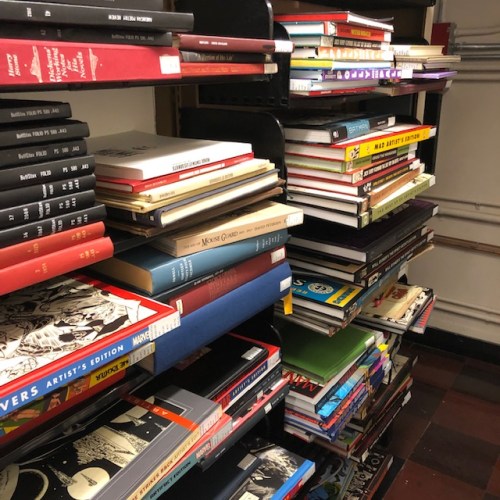
That concludes my interview. I want to thank Karen Green for taking the time and sharing her thoughts on graphic novels in general and in an academic setting. Thanks to Karen, she set things in motion and, with the help from like-minded souls, she continues the good work on behalf of comics, cartoons and graphic novels at Columbia University in the City of New York.

7 Comments

Filed under Alt-Comics, Alternative Comics, Columbia University, Comics, Education, graphic novels, Karen Green, Libraries

Review: The Comics Journal #303

The Comics Journal #303

This is a very meta thing to be doing but here’s a review of a magazine that features reviews. Dating back to 1977, in its heyday, The Comics Journal was a monthly source of comics news and reviews, a trailblazer for the burgeoning field of comics journalism and criticism. It has always maintained a certain quirky attitude, consisting of a mix of features and topped off by a expansive soul-searching interview a la Playboy magazine. It mainly attracts those who consider themselves comics aficionados. In 2013, it ceased its print version, staying online, but now it makes its return to print with Issue 303. TCJ returns this month with new editors RJ Casey and Kristy Valenti.

Now, I go pretty far back. I have fond memories of picking up this magazine at Tower Records back in the day (circa 1995), usually with a recent release from Sub Pop Records. I also fondly recall a special dynamic, or synergy, at play between the magazine and its online counterpart that led many of us to the forums section that let you interact with subgroups within subgroups of people in the comics community. This was long before Facebook or social media as we know it today. I think the monthly magazine, as we knew it back then, is still sorely missed. Towards the end of its print run, it came out less often and each issue covered a big theme and came out in different sizes. The consistency of a monthly had been lost. I think, in a perfect world, this latest return to print would do well to go back to that monthly format. Alas, with this latest #303, we’re seeing the start of a twice-a-year format. You might argue that TCJ is simply working with today’s print reality and is offering up a taste to a new generation of what is possible.

The showcase item in this issue is, of course, TCJ founder Gary Groth’s interview with a legendary firebrand, the satirist and children’s book author, Tomi Ungerer. For those of you unaware of Mr. Ungerer’s impressive career, I highly recommend that you read this interview and, before or afterward, check out the 2013 documentary, “Far Out Isn’t Far Enough,” directed by Brad Bernstein. The title is one of Ungerer’s sayings, along with “Don’t Hope, Cope” and “Expect The Unexpected.” I interviewed the documentary’s director and its writer and the fact that Ungerer is a true force of nature was the overriding theme. So, it makes perfect sense for someone as outspoken as Groth to sit down and talk it out with someone as outspoken as Ungerer! It’s a match made in heaven.

From Ben Passmore’s story in Now: The New Comics Anthology #3, published by Fantagraphics

Among the various features to be found here, you’ll find them under such titles as “From the Trenches” and “Fair Warning.” For example, under the former is a think piece by cartoonist Ben Passmore, who shares his insights on the alt-comics scene from an African American perspective. And, under the latter, you will find an interview by RJ Casey with emerging comics talent, Fifi Martinez. The thing to always remember about TCJ is that its focus is a serious look at comics as an art form. That leaves little room, if any, for superhero comics, per se. What you’ll mostly find here is a focus on the independent artist-cartoonist. It does a heart good to see cartoonists like Passmore and Martinez provided with a platform.

Ultimately, TCJ remains what it’s always been, a valuable resource that is most appreciated by those who take the comics medium seriously. It’s a niche audience but a fiercely loyal one. In the new more fragmented world we live in, it’s all about niches. That is actually a very positive thing. And niches are supposed to attract outside readers too, right? You can only calculate so much as to how strong a presence you can make on today’s newsstands. For some special readership out there, it will be a great treat to see TCJ on a shelf. Newsstands aren’t going away anytime soon from such places as Barnes & Noble, specialty shops, comic book shops, and even airports. TCJ might just want to make a real push into these venues and see how it goes. I asked about TCJ at my local B&N as well as the Pike Place Market newsstand, one of the granddaddies of newsstands. Neither place had ever heard of TCJ or had any plans to carry it. I asked around a couple of nearby comics shops. They heard of it but were not carrying it. This is TCJ’s return to print, right? Let’s see it out there in the real world.

The reality is that creating any kind of magazine, digital or print, is a big challenge. Everyone in the comics community is rooting for TCJ to make as big of an impact as it can. Those of us already in the choir, can keep singing its praises and wish it well. You can find your copy of TCJ #303 by visiting the Fantagraphics store right here.

Leave a comment

Filed under Alt-Comics, Alternative Comics, Comics, Comics History, Comics Journalism, Fantagraphics, Fantagraphics Books, Gary Groth, Independent Comics, The Comics Journal, Tomi Ungerer

THE ALTERNATIVE UNDERGROUND art show at Scott Eder Gallery, Feb 1 thru Mar 9, 2019

THE ALTERNATIVE UNDERGROUND

If you live in or plan to be around the New York metro area, then consider visiting the Scott Eder Gallery for an in depth look at a variety of notable underground cartoonists from the sixties. This includes a number of names that are common to the comics community along with a number that will be newly discovered gems for gallery visitors. The show is entitled, THE ALTERNATIVE UNDERGROUND: Foot Soldiers in the Revolution that Forever Changed Comics and runs from Feb 1 thru March 9, 2019. The opening reception is Friday, Feb. 1, 2019, 5-9 PM. Scott Eder Gallery is located at 888 Newark Avenue, #525, Jersey City, New Jersey in the Mana Contemporary Arts Complex. From New York City, you can easily reach it from the PATH train.

Mickey Rat Comix by Robert Armstrong


What If? by Joel Beck


Casserine


Women at Work!!! by Daniel Clyne


Pro Junior by Dave Dozier


Smile by Jim Mitchell


Rev. Jeremiah Moses by Grass Green


Jesus Learns a Thing or Two by Frank Stack


Trina Robbins self-portrait

More details from Scott Eder Gallery:

When the Underground Comix movement is discussed, R. Crumb, Art Spiegelman, and Gilbert Shelton come quickly to mind. But the revolutionary break from mainstream comic books in the late ‘60s, leading to graphic novels and today’s vital independent scene, was comprised of numerous other artists. Many seldom get their due. Scott Eder Gallery is proud to present some of the largely unsung pioneers like Joel Beck and Frank Stack, both of whose comix significantly predated ZAP. Other featured artists are Bob Armstrong (Mickey Rat), Sharon Rudahl, (Wimmens Comix), Dan Clyne (Hungry Chuck Biscuits), Wendel Pugh (Googiewaumer), Mike Roberts (Bizarre Sex), and other foot soldiers active in the broad and groundbreaking underground comix scene. Discover or rediscover the idiosyncratic styles of more than twenty outspoken and bold cartoonists whose work remains surprising fresh a half century after the psychedelic fervor and anti-war chants swirling around their era have faded away.
Interview with gallery owner Scott Eder:

If you’re interested in comics or would like to take the opportunity to see firsthand some of the exciting trailblazing art that has influenced today’s boom in indie comics, then be sure to visit Scott Eder Gallery.


4 Comments

Filed under Alternative Comics, Comics, Comix, Denis Kitchen, Phil Yeh, Robert Crumb, Scott Eder, Scott Eder Gallery, The Sixties, Underground Comics

Review WINDOWPANE by Joe Kessler

Windowpane by Joe Kessler

One of the first pages from Joe Kessler’s Windowpane, published by Breakdown Press, shows a wandering dog searching for food and finally finding a baked pie sitting out on a windowsill. There are splotches of color overlay on some of the blue line art. Welcome to a most experimental work in comics. Kessler covers various themes: childhood trauma, alienation, sexual dysfunction, and religion. Everything is a bit off kilter and on edge. What could be better for this kind of work, right? Well, this kind of work can often fall short and not measure up. But, in this case, there’s a lot to like even if it seems that things don’t always add up as the general reader might expect from the comics medium.

Like any artist, Kessler wants to challenge the reader. For instance, he enjoys the harsh use of basic colors. He also likes tossing his characters from one situation into another. He has them suddenly running away from things. He has them hurting each other. Then, in a fit of petulant bravado, he will take a gob of primary colors and fling them like a bolt of lightning. A blast of these harsh basic colors will blow up some characters to bits. Others will be saved for a proper decapitation. All in a day’s work.

There goes that iguana.

Quieter moments will serve for such scenes as an iguana forcing its way into a sleeping woman’s mouth.

It’s pretty wild stuff. Not for kids. Mature content abounds. All in all, this collection of sordid tales is quite fun, original, and worthwhile.

Windowpane is a 272-page full color soft cover. It collects new and previous work by artist Joe Kessler. You will find here reprints of Windowpane issues 3 and 4. This collection is published by Breakdown Press, based out of London.  Visit Breakdown Press right here. And be sure to visit Mr. Kessler right here.

3 Comments

Filed under Alt-Comics, Alternative Comics, Art, Breakdown Press, Comics, Europe, European Comics, Independent Comics, Indie, Joe Kessler

Seattle Focus: Jason Lutes and BERLIN

Megan Kelso with Jason Lutes

Cartoonist Jason Lutes was in Seattle to talk about the new book that collects his comics series, Berlin. It took place at The Elliott Bay Book Company, November 8, 2018. This event included a conversation with cartoonist Megan Kelso. It was co-presented by Short Run.

Berlin is a monumental work in comics. Few cartoonists will come close to such an achievement–and it couldn’t have been created by a  nicer guy. What came across, over and over, during this talk is the fact that Lutes is very accessible and down to earth. That open approach plays into part of what makes his landmark work so special. It all began when teenager Jason Lutes wanted to make sense of a documentary about the holocaust he was suddenly exposed to in a high school history class. The teacher for that class was an alcoholic who made no effort to hide his struggles. He literally set up the movie for his class and left to get a drink. That abrupt and careless action ultimately triggered an in depth exploration of Weimar Germany through a creation of an expansive work in comics that would take 22 years to complete.

#ProtectMueller march in Seattle on 8 Nov. 2018

It was not lost on anyone during Lutes’s talk related to the dismantling of the German government of the 1920s that concerned citizens, just outside on the streets of Seattle, were protesting Trump’s own inroads into dismantling the U.S. government. Timing is everything. That Thursday night book talk directly coincided with protests across the country in support of protecting the Robert Mueller investigation after Trump installed a loyalist as acting Attorney General of the United States. Details are everything. If you follow the characters and the rich narrative of Berlin, you can’t help but get an eerie sense of having a mirror held up to the past and to the present.

Cartoonists holding each other’s works: Jason Lutes with David Lasky

Authenticity is everything. What is so appealing about comics by Jason Lutes is the solid storytelling. That involves a dynamic use of the comics medium: a crisp consistency in step with strategically placed visual elements that are pleasing to the eye and move the story forward. A quick example: I was standing in line to get my copy of Berlin signed and I made a point of poring over each page as I flipped my way through. Right around the midpoint, there is a page made up of wordless panels showing a mysterious figure in a row boat. He reaches the shore to find what looks like a vicious snake. He picks it up by its jaws and overpowers it. That same character reappears in the book as does the snake, both providing just the right doses of symbolism as well as pure entertainment. It’s important to note that, while Lutes referred to vast amounts of research and reading, he also fondly recalled the influence of key works in pop culture. Berlin Alexanderplatz, a novel about Weimar Germany, by Alfred Döblin, holds as much importance to Lutes as his viewing of the original Star Wars movie as a kid. Altogether, what you have in Berlin is an honest look from an individual processing and distilling at a meticulous level.

Cartoonists Revisit: Jason Lutes with Jennifer Daydreamer

For many in the audience that night, it was an opportunity to revisit a respected work and commiserate with a friend and colleague. Seattle is a lightning rod for countless creative people and that includes a high number of independent cartoonists. There’s a certain sensibility to the alt-comics artist with Jason Lutes being a prime example. As he discussed in his lecture, it was Seattle that he gravitated to in the 1990s. After attending the Rhode Island School of Design, Lutes moved to Seattle and worked for the comics publisher, Fantagraphics. He subsequently worked for the alt-weekly, The Stranger, just as it began publication in 1991. During this era, Lutes became part of a group of cartoonists that went on to form an integral part of the Seattle comix scene. That group included some members that were in attendance that night: Megan Kelso, David Lasky and Jennifer Daydreamer. It was a treat to have part of the gang together again on such a special occasion.

BERLIN by Jason Lutes

Berlin, the complete collection, is out now. It is a 580-page hardcover published by Drawn & Quarterly. Jason Lutes teaches comics at the Center for Cartoon Studies in Vermont.

1 Comment

Filed under Alt-Comics, Alternative Comics, Berlin, Comics, Comix, David Lasky, Donald Trump, Drawn and Quarterly, Elliot Bay Book Company, Germany, graphic novels, Independent Comics, Indie, Jennifer Daydreamer, Nazi Germany, Nazis, Seattle, Trump, Weimar Germany

Comics Review: ANDROMEDA by Zé Burnay

ANDROMEDA by Zé Burnay

Editor’s Note: There is a crowdfunding campaign going on for this book thru Dec 14, 2018. For more details, go right here.

Cartoonists are instructed and encouraged by their mentors to construct comics that not only fill the page but interact with one page to the next. Few artists heed that sage advice so well as Zé Burnay. You can clearly see that he is playing off what’s going on one page onto another page. The forms, the compositions, the very structure, is interconnected from one panel to the next, from one page to the next. Every bit building  into a beautiful fever dream byway of the dazzling tattoo parlor with a detour through an enchanted forest and a side trip into a magical castle. Zé Burnay knows comics and how to turn them into psychedelic entertainment. So, I’m telling you right now, the book to get is Andromeda by this groovy dude, Zé Burnay, an up and coming and most excellent illustrator and cartoonist from Sintra, Portugal.

Visual delights throughout.

I swear to God, my next major tattoo is going to be a three-headed snake by Zé Burnay! This is an artist who spends the required amount of time immersed in the stuff that dreams are made of. That’s good for him–and good for us. Andromeda collects three works that all share the same main character, a Christ-like figure who is wandering and searching. In the process, he comes across numerous symbolic creatures and numerous classic tropes. He battles an eagle, a lion, a bull, and so on. I begin to lose count but that’s okay. He enters an old Victorian mansion and becomes acquainted with its strange inhabitants. Every scene quickly becomes ethereal and hallucinatory. It’s a virtual Cornucopia of visual delights. Burnay keeps the fireworks going from one page to the next.

The energy from one page resonates onto the next.

A comic from a true visionary is something very special and Zé Burnay delivers a marvelous book with Andromeda. It is a wondrous visual feast inextricably linked to a haunting narrative. Burnay was born in 1991 in Portugal and grew up fascinated by the woods and castles of Sintra and its unique and mysterious aura. Clearly, that inspiration can be found on every page of his work. Burnay states on his website that his love of drawing was kindled from “inheriting my father’s extensive collection of Franco/ Belgian comics and by spending time on my Grandfather’s antique shop.” All of this has added up quite nicely. He goes on to say, “In between working on my own comics, I draw comics for other people, design logos, posters and cover art for numerous bands.” Burnay is definitely on the right course!

A very cohesive and richly structured work.

Be sure to visit Zé Burnay at his website right here.

And visit the Indiegogo campaign for this book right here.

2 Comments

Filed under Alt-Comics, Alternative Comics, Comics, Comix, mini comics, mini-comics, Self-Published, Zines

Seattle Focus: Short Run Comix & Arts Festival, Nov. 3, 2018

SHORT RUN 2018

Short Run Comix & Arts Festival is this Saturday, November 3, 2018 in Seattle, WA.

Short Run is a free all-ages event showcasing the best in new and local comics, zines, and more!

If you’re in Seattle, be sure to take in this wonderful event from 11am-6pm at Fisher Pavilion and The Vera Project at Seattle Center.

For more details, visit Short Run right here.

Leave a comment

Filed under Alternative Comics, Comics, Comix, mini-comics, Minicomics, Seattle, Short Run, Short Run Comix & Arts Festival

24-Hour Comics Day 2018: Character and Narrative Development

Emily is haapy, right?

The unique character of Emily emerged in the mist of the night. Who is she? Well, if I could talk with Emily, I would tell her that she’s intriguing and deserves everything wonderful in life. It looks like I’ve found my main character. It is a very natural discovery.

When you’re building up a story, you do a lot of things on the fly and juggle as best you can until it’s time to settle down. What I started with was a whole bunch of background stuff.

Not so happy.

And then, as I wandered along, a character fell into place that could carry along and support the background. We see her smiling. Next panel, we already see her not smiling. Okay, what’s up?

Radio silence.

By the third panel, everything has gone quiet.

The plot thickens.

And on the last panel, we’ve got some conflict. The plot thickens. So, suffice it to say, I am intrigued with Emily and I wish her well on her journey.

2 Comments

Filed under 24 Hour Comics, Alt-Comics, Alternative Comics, Comics, Comix, Henry Chamberlain, Independent Comics, Indie

Small Press Expo: 2018 Ignatz Award Nominees

Ignatz image by 2017 Promising New Talent winner Bianca Xunise

The Small Press Expo (SPX), the preeminent showcase for the exhibition of independent comics, graphic novels and alternative political cartoons, is pleased to announce the 2018 nominees for the annual presentation of the Ignatz Awards, a celebration of outstanding achievement in comics and cartooning.

The Ignatz, named after George Herriman’s brick-wielding mouse from his long running comic strip Krazy Kat, recognizes exceptional work that challenges popular notions of what comics can achieve, both as an art form and as a means of personal expression. The Ignatz Awards are a festival prize, the first of such in the United States comic book industry.

The nominees for the ballot were determined by a panel of five of the best of today’s comic artists: Mita Mahato, Carolyn Nowak, Kevin Czap, Leila Abdelrazaq, and Taneka Stotts.

Congratulations to all our nominees!, with the votes cast for the awards by the attendees during SPX. The Ignatz Awards will be presented at the gala Ignatz Awards ceremony held on Saturday, September 15, 2018 at 9:30 P.M.

Outstanding Artist

Yvan Alagbé – Yellow Negroes and Other Imaginary Creatures
Ivy Atoms – Pinky & Pepper Forever
Tommi Parrish – The Lie and How We Told It
Richie Pope – The Box We Sit On
Sophie Standing – Anxiety is Really Strange

Outstanding Collection

Beirut Won’t Cry – Mazen Kerbaj
Blackbird Days – Manuele Fior
Language Barrier – Hannah K. Lee
Sex Fantasy – Sophia Foster-Dimino
Super Late Bloomer: My Early Days in Transition – Julia Kaye

Outstanding Anthology

La Raza Anthology: Unidos y Fuertes – ed. by Kat Fajardo & Pablo Castro
Comics for Choice – ed. by Hazel Newlevant, Whit Taylor and Ø.K. Fox
Ink Brick #8 – ed. by Alexander Rothmans, Paul K. Tunis, and Alexey Sokolin
Bottoms Up, Tales of Hitting Rock Bottom – ed. by J.T. Yost
Lovers Only – ed. by Mickey Zacchilli

Outstanding Graphic Novel

Why Art? – Eleanor Davis
Run for It: Stories of Slaves Who Fought for Their Freedom – Marcelo D’Salete
Uncomfortably Happily – Yeon-sik Hong
The Lie and How We Told It – Tommi Parrish
Anti-Gone – Connor Willumsen

Outstanding Series

Ley Lines – Czap Books
Nori – Rumi Hara
Bug Boys – Laura Knetzger
Gumballs – Erin Nations
Frontier – Youth in Decline

Outstanding Minicomic

Dog Nurse – Margot Ferrick
Greenhouse – Debbie Fong
Common Blessings & Common Curses – Maritsa Patrinos
Mothball 88 – Kevin Reilly
Say It With Noodles: On Learning to Speak the Language of Food – Shing Yin Khor

Outstanding Comic

Recollection – Alyssa Berg
Hot to Be Alive – Tara Booth
Hot Summer Nights – Freddy Carrasco
Whatsa Paintoonist – Jerry Moriarty
Baopu – Yao Xiao

Outstanding Online Comic

Woman World – Aminder Dhaliwal
The Wolves Outside – Jesse England
A Fire Story – Brian Files
Lara Croft Was My Family – Carta Monir
A Part of Me is Still Unknown – Meg O’Shea

Promising New Talent

Yasmin Omar Ata – Mis(h)adra
Tara Booth – How to Be Alive
Xia Gordon – The Fashion of 2004, Harvest
Rumi Hara – Nori and The Rabbits of the Moon
Tommi Parrish – The Lie and How We Told It

Outstanding Story

Yellow Negroes and Other Imaginary Creatures – Yvan Alabge
Why Art? – Eleanor Davis
Rhode Island Me – Michael DeForge
How the Best Hunter in the Village Met Her Death – Molly Ostertag
The Lie and How We Told It – Tommi Parrish

Small Press Expo is this weekend in Bethesda, Maryland, September 15-16!

Leave a comment

Filed under Alt-Comics, Alternative Comics, Comics, Comix, Ignatz Awards, Independent Comics, Micropublishing, Minicomics, Small Press Expo

SPX 2018: Time for Small Press Expo, September 15-16!

SPX illustration by Molly Ostertag

Time for Small Press Expo, September 15-16! SPX, created in 1994, is the cornerstone to the comics community. It is at the forefront in promoting and providing support. Each year, more than 4,000 cartoonists and comics enthusiasts gather in Bethesda Maryland for North America’s premiere independent cartooning and comic arts festival. Let the latest news speak for itself. This is from a press release that just came out:

“Small Press Expo announced that it will immediately make available $20,000 and also launch a legal aid fundraising vehicle to support members of the SPX community who are currently facing a defamation lawsuit. The fundraising vehicle, administered by SPX, and created in consultation with the Comic Book Legal Defense Fund, will be established for the purposes of defraying the cost of legal representation for the eleven members of the independent comics community named as defendants in the ongoing lawsuit.”

So, yeah, it’s September and that can only mean one thing for die-hard indie comics fans: Small Press Expo! Yes, indeed, each year Bethesda Maryland suddenly becomes, for one weekend, the lightning rod for some of the most cutting-edge comics. If you’re in the area the weekend of September 15-16, then come out to this event and check out some awesome alt-comics.

Now, I must admit that, although I’ve gone and I’ve participated in numerous comics festivals and events as a journalist and as a comics creator, I have never gone to Small Press Expo. Some folks there will have heard of me and some know me from years back. But that doesn’t change the fact that I’m new to SPX. So, I hope to do my best to provide some stellar coverage to this most venerable and respected gathering. Small Press Expo is where much of the indie comics scene gained traction and it remains the jewel in the crown.

So, say hello if you see me and we make eye contact or somehow slip into conversation. We’ll figure it out. Or say hello here at Comics Grinder. If you’re a creator, let me know what you’re up to and maybe we can set up an interview or I can plan to review your work. I don’t exactly expect an avalanche of responses– but I always end up making a decent number of connections at these events. I understand that things will get hectic and maybe you’re shy to begin with. I understand– and I can only focus on so much myself. The main thing is to have fun and to always strive for authenticity. The rest works itself out.

The full press release on the Legal Aid Fund for Cartoonists follows:

Continue reading

Leave a comment

Filed under Alt-Comics, Alternative Comics, Comics, Comix, Independent Comics, Indie, Millennials, mini comics, mini-comics, Minicomics, Self-Published, Small Press, Small Press Expo, SPX