Paul Buhle is busy these days with various comics projects. He is truly a friend to cartoonists. And, as we find out in this interview, there’s a good story behind that. In fact, there’s plenty to talk about when you engage in a conversation with Paul Buhle. Today, his latest book, co-edited with David Berger, is out and avaiable, “Bohemians: A Graphic History,” a 304-page comics anthology that explores the world of bohemians in America from about 1850 to 1950 (my review here). It is published by Verso Books and you can find it here.
Paul Buhle retired a few years ago from Brown University where he lectured on History and American Civilization. He has written and edited numerous books on labor, culture, and radicalism. Now, Mr. Buhle finds a good portion of his time devoted to editing books that tell their stories through comics.
“Where Bohemia Began,” art by Summer McClinton, script by Paul Buhle
“Good morning, Bohemians!” So, the jubilant cry would have been heard in Paris, circa 1853. It can still be heard today from down the street where I live in Seattle and all across the globe. I am a bohemian. I’ve always identified as such as a writer, artist, and cartoonist. But what does it really mean and how did this concept come to be? In the new comics anthology, “Bohemians: A Graphic History,” edited by Paul Buhle and David Berger, we get a full history. These short works are created by some of today’s most accomplished cartoonists, who also happen to be some of the best examples you will find of contemporary bohemians.
UNCLE JAM is a magazine showcasing the visual and literary arts. It’s been around since 1973 and can always be relied upon to entertain and inform. Phil Yeh started up this magazine when he was still just a kid with a dream. He’s seen his magazine evolve into a sophisticated publication both in print and on the web. You can view it by visiting the Winged Tiger website here.
I am honored to do whatever I can to lend a hand in broadening UNCLE JAM’s reach in my area and beyond. As its Seattle Bureau Chief, I’ll oversee distribution and content related to the Pacific Northwest. UNCLE JAM, as always, remains a beautiful work-in-progress and I look forward to lending a hand in the years to come. I will see what I can do to give UNCLE JAM, a California-based magazine, a bit of that Seattle, and Portland, cool. It is, after all, already very cool! UNCLE JAM is a jewel among the many good works that Phil Yeh does to support the arts and literacy around the world. Learn more about Phil Yeh, and Cartoonists Across America and The World, here.
Editor’s Note: Any serious conversation on urban planning will include the thoughts of activist Jane Jacobs. She was a champion of urban spaces at a human scale and of the preservation of older buildings in a community. Just in terms of practicality, it was the older buildings that had intrinsic value. It was their presumably lower rents, that allowed for risk-taking ventures with limited funds.
When is gentrification too much of a good thing? Something to consider as Ballard continues to grow. Will there always be room for those things with the original sense of Ballard?
Keith Knight is one very funny, and profound, cartoonist. What is the secret to his success? Consider this life lesson: It is all in the doing. It applies in art school, law school, med school, any kind of school. “I’ve been doing this for years,” said Keith to a question I put to him about his success. That comment says it all. It is a part of this interview that stays with me. Knight has created a wonderful life for himself that includes making a living as a cartoonist. He has done it with style and become a significant voice. And he is easy to find and to keep up with, especially with his special subscription service you can check out here.
In this interview, we talk about activism in comics as well as the nature of humor. We go over a long and rewarding career. And we look at some exciting things that lie ahead, like Keith’s first full-length graphic novel, “I Was A Teenage Michael Jackson Impersonator.” Keith has also branched out into live action videos which bring his comics to life. And there is a comedy show, based on Keith’s life as a struggling cartoonist, that is being pitched so we’ll see how things go.
Keith Knight has three comic strips he regularly creates, there are two weekly strips, “The K Chronicles” and “(Th)ink.” And there’s the daily, “The Knight Life.” He also has strips in Mad Magazine: “Father O’Flannity’s Hot Tub Confessions” and “Bully Baby.”
Also in this interview, Keith jokes about his focus being, “the fight for a more decent cartoonist’s wage.” Certainly, his concern is over the same stuff most folks worry about: healthcare, education, and “not being condemned if you’re poor or low-income.” When asked about his thoughts over his legacy, Keith’s mind turns to the 500-page collection of “The K Chronicles,” published by Dark Horse Comics and that you can take a look at here.
Just click below to listen to the interview:
If you’re in the San Francisco area, you can stop by and visit with Keith at the Alternative Press Expo on October 12 and 13.
KEEF KNIGHT‘s hilarious and insightful comic strip, “The K Chronicles,” is a prime example of how to speak truth to power and get people thinking and taking action. Now, Keef has a hilarious video for your consideration, with more to come, no doubt. But, first, this one is definitely going to make you think…and laugh.
Stephanie McMillan is an important voice. She is doing her part to make this a better world through her activism and her comics. And, fortunately for us, those two passions turn into some very compelling work. Her latest collection of comics, “The Minimum Security Chronicles: Resistance to Ecocide,” is published by Seven Stories Press. This book is a 160-page trade paperback priced at $12.71 and is set for release on October 8, 2013. Be sure to visit our friends at Seven Stories Press here and visit Stephanie McMillan here.
The following is an extensive email interview that I hope you’ll enjoy and be inspired by. What really motivates our actions? What sort of world do we accept and what sort of world could we aspire to? These are some of the ideas up for discussion in this interview.
Tomi Ungerer was a household name. He was the most popular children’s book illustrator in America. He is also a masterful artist of subversive and erotic art. That’s what got him into trouble within the children’s book community. His career was derailed. But he wasn’t. “Far Out Isn’t Far Enough” is a powerful documentary about a most remarkable man and artist. Tomi Ungerer’s life and career spans World War II, at the hands of the Nazis, into the high flying life of New York City in the “Mad Men” era of the ’50s and ’60s, and into the heart of the counterculture movement. It’s a life, not unlike Robert Crumb’s, full of explosive expression and heroic turns.
Director Brad Bernstein has brought into focus the life of Tomi Ungerer in a variety of ways. First and foremost, is Tomi Ungerer, who eloquently speaks his mind and is the guiding force throughout this film. It is his expressions, like “Don’t Hope, Cope” and “Expect The Unexpected,” that are used as chapter headings and repeated in various ways to draw out their meaning. Tomi’s life story is so compelling by itself too but, with the help of an impressive group of individuals, we hear his story told from many vantage points. This is a wonderfully structured documentary that alternates with grace between interview subjects and vivid use of animation (thanks to Brandon Dumlao, Alain Lores, and Rick Cikowski) that makes Tomi’s already powerful images jump out at you all the more.
We quickly take in Tomi Ungerer in the opening scenes. We see an older gentleman, with sad eyes and a mischievous smile, who has seen more of the world than has been good for him. He is also full of life and happy to joke around. But his comments can be cryptic: “I always have nightmares. I’m always being arrested in my dreams!” There is sadness and gaiety as he says this. He was once the most celebrated artist of children’s books in America. He was a rock star among illustrators. And then he disappeared.
Born in 1931 in Strasbourg, France, Ungerer and his family would come to know their Nazi neighbors all too well. Alsace, Strasbourg had only been French for about 300 years so its identity was split evenly Franco-German. This fractured identity would inform Ungerer’s life and his work. While under German occupation, it was forbidden to speak French and German culture prevailed. However, after the Allied victory, Ungerer’s German upbringing was a severe liability. The French, he found, treated him just as poorly as the Germans. And there was no regret by the French to burn German literature. It was very absurd, Ungerer concluded. Life was absurd.
At age 25, with only sixty dollars, Ungerer moved to America. He had always managed to cope and to prosper as an artist and so he would try to make a living from it in New York City. As luck would have it, Ungerer’s arrival in 1956 was a perfect time to break into the wildly lucrative world of illustration. Not only did he manage a foothold, he brought with him a whole new style that peeled away at conformity. The problem for Ungerer would be that, as he reacted to the times, he would just keep peeling away to the point that he crossed a line.
The musical score, by Nick Dei Rossi, dips into an ominous tone once Ungerer has come into his own and matured as an artist. He always loved the children’s book illustration he was known for but now he was reacting to the Civil Rights movement, the Vietnam War, and the Sexual Revolution. His peers, artists like Maurice Sendak and Jules Fieffer, admired what he was doing. Both are interviewed extensively in this film and provide great insight. They both loved Ungerer. But there was nothing they could do when Ungerer met his Waterloo.
Ungerer’s life, post-America, is not a sad story. He did give up children’s book illustration for 25 years but he discovered a whole new life, a life with new challenges and old fears that needed to be overcome. We come to realize that there will always be a touch of fear in this man’s life but it’s a good kind of fear, the sort he can use as a challenge. He seems to already have come to terms with the fear of death. Even if it should turn out to be vast nothingness, he is encouraged that this will be an opportunity to fill the nothingness with something from his mind. In the end, he remains encouraged and eager to continue crossing a line, pushing the envelope. The Tomi Ungerer expression used for the film’s title, “Far Out Isn’t Far Enough,” proves to be his way of life.
“Far Out Isn’t Far Enough: The Tomi Ungerer Story” is currently in theaters. Be sure to visit the site here for details. If you’re in Seattle or Minneapolis, you can catch it this weekend at one of your Landmark Theatres. Check it out here.
And you can listen to my podcast interview with the director/writer and lead editor/animator of this dazzling documentary here.
Based on various studies, it is estimated that over a third of Americans cannot read this sentence. Yes, at least 60 million Americans are illiterate. Consider these reports here and here. Not being able to read and comprehend the written word robs people of the ability to control their lives in very significant ways. This burden is preventable. Ask Phil Yeh. He knows. As a cartoonist and an activist, he has worked hard throughout his life to inspire and help others to learn the joy of reading. Phil Yeh has painted more than 1800 murals in 49 states and 15 countries promoting literacy and the arts with his Cartoonists Across America & the World Tours.
Phil Yeh. You know the name. He’s the guy in the comics history books as a pioneer in the creation of the graphic novel. He’s the guy who promotes literacy with all those murals around the world. Yeah, that Phil Yeh. Are there others? Well, we sure could use more Phil Yehs in the world.
Phil Yeh is always busy. He can be working on his latest book. He can be working on his most recent mural for Cartoonists Across America and the World. At this particular time, for this interview, we find Phil continuing to work on a very special mural that highlights the achievements, the personalities, and the great history of the City of San Bernardino, California.
Sandy Fischer Cvar created the portraits on the San Bernardino mural
About a year and a half ago, Phil suffered a stroke. It slowed him down but, as Phil observes, it has led to the best work of his life. In April of 2012, after having started to pick up a paint brush again, he embarked upon one of his greatest murals. It is on the historic site of the world’s first McDonald’s restaurant in San Bernardino, California, on Route 66. This mural is just the sort of spark that sure helps in the process of San Bernardino’s revival.
Ribbon Cutting Ceremony with Mayor Pat Morris, May 1, 2012
The main topic of discussion for this interview is the City of San Bernardino. It has fallen on hard times and every effort to set things back on track is essential. The Great Recession has taken its toll but hope prevails. Phil’s mural is a bright light on the way to recovery. In this interview, he goes into detail about the inspiring people from San Bernardino who have made history and major contributions to the betterment of everyone. And, if there was only one person to focus on, it would be Chester Carlson. He came from poverty, even having lived in an abandoned chicken coop as a teen, and rose to create Xerox.
A book on Chester Carlson that Phil highly recommends is “Copies in Seconds,” published in 2004, by David Owens. You can find it here. He would like to see it in every library and school. But there is always another inspiring story. Phil speaks with great feeling and ready with another story such as that of San Bernardino favorite son, Garner Holt. Starting at age 16, Holt began his work on animatronics. He’d been inspired by the animatronics he’d seen on a trip to Disneyland. He went on to create a major animatronics firm that developed, among other projects, the animatronics for the Chuck E.Cheese restaurant chain. And, like Carlson, Holt never forgot San Bernardino and gave back significantly.
Phil’s enthusiasm is truly boundless. Get him to talk about today’s youth and he’s adamant about valuing one’s time. “If you spend four hours a day on social media, hey, that’s four hours wasted. That’s four hours you could have been doing something creative.”
Phil loves to share his first experience at San Diego Comic-Con in 1970. He talks about how he went there as a timid teenager and was set on his life’s path with two conversations. He talked to Ray Bradbury about his passion for writing but his fear that he couldn’t pursue it because he couldn’t type. Ray Bradbury reassured him and revealed to him that he didn’t know how to type. He told him to just write. Phil then sought advice from Jack Kirby. He talked to Jack Kirby about his passion for drawing but his concern that he should go to art school. Kirby had the best advice: Just draw! Phil took both men’s advice to heart, started his own publishing company and never looked back.
Phil looks forward to a number of book projects including one with a steampunk theme. And he’s looking forward to press coverage on the San Bernardino mural that will reach full completion this by this summer. “We’re getting China’s CCTV to cover us. That’s the biggest televison network in the world with a 1 billion 400 million viewership. We’re thinking that with German TV, French TV, and Brazilian TV coverage on board, that this will ultimately lead to local Los Angeles TV coverage. They’re tough to reach!”
Sometimes good news is a hard sell. But Phil Yeh knows how to reach people. He’s been doing that all his life.
Right below is the full podcast interview with Phil Yeh:
And one more a bit of news on the San Bernardino mural: Here is an update as of today from Phil Yeh:
Phil Yeh and the San Bernardino mural
We are painting the entire Route 66 in California ending up in Santa Monica! Brendan Moore is capturing some of Hollywood’s landmarks & the Queen Mary in Long Beach while Beth Winokur brings her own creativity to the boxcars. Every one of these boxcars will feature a town in San Bernardino County as a fruit label! I am working on my favorite manmade landmark in the world, Simon Rodia’s Watts Towers in Los Angeles not far from my boyhood home where I grew up in the 1960s. We should be finished in the summer of 2013.





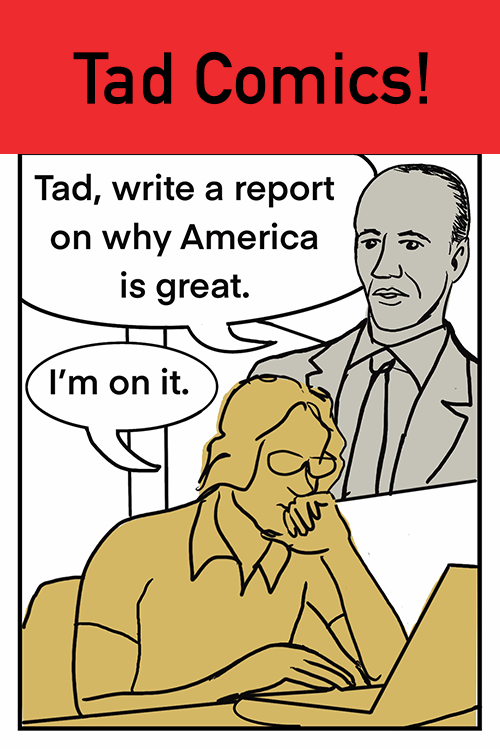
BALLARD COMICS #7
Editor’s Note: Any serious conversation on urban planning will include the thoughts of activist Jane Jacobs. She was a champion of urban spaces at a human scale and of the preservation of older buildings in a community. Just in terms of practicality, it was the older buildings that had intrinsic value. It was their presumably lower rents, that allowed for risk-taking ventures with limited funds.
When is gentrification too much of a good thing? Something to consider as Ballard continues to grow. Will there always be room for those things with the original sense of Ballard?
Share this:
Like this:
Leave a comment
Filed under Ballard, Ballard Comics, Comics
Tagged as Activism, architecture, Art, arts, Ballard, Cities, City Living, comics, Commentary, Entertainment, Gentrification, Jane Jacobs, Politcs, Political Cartoons, Pop Culture, Seattle, social issues, Urban, Urban Living, Urban Planning